Market Snapshot
Middle bar: base-year value × (1 + CAGR), rounded to two decimals. This is a calculated illustration, not a separately researched annual estimate.
Market Definition and Scope — Electric Bicycles, Not Electric Motorcycles
The India electric bicycle market — referred to across the Indian industry as the 'e-cycle' or 'electric cycle' market — covers low-speed pedal- and throttle-assisted electric bicycles within the ≤250W/≤25km/h envelope, together with speed pedelecs with motor assistance up to 45 km/h under separate classification. This market is legally and commercially distinct from India's electric two-wheeler market (electric scooters, electric motorcycles, and mopeds), which operate under the Central Motor Vehicles Rules (CMVR) as classified motor vehicles requiring registration, driver's licence, compulsory insurance, and road tax. An electric bicycle meeting the ≤250W/≤25km/h standard under CMVR 1989 is classified as a non-motorised vehicle — exempting buyers entirely from motor vehicle compliance. This regulatory distinction applies to the low-speed segment; the speed pedelecs included in this report have separate motor-vehicle compliance requirements.
This report covers three propulsion sub-categories: (1) Pedal-Assisted (PA) — motor assistance active only while pedalling, cut-off at 25 km/h; (2) Throttle-Assisted (TA) — motor activated independently of pedalling via twist throttle, within the ≤250W/≤25km/h legal envelope; and (3) Speed Pedelec — motor assistance up to 45 km/h, with separate motor-vehicle compliance requirements. This report does not cover electric scooters, electric motorcycles, mopeds, or electric bicycles with an assisted top speed above 45 km/h — regardless of whether they are colloquially described as 'e-bikes' in Indian media or retail contexts, where the term frequently conflates electric bicycles with electric motorcycles.
The India electric bicycle market was valued at USD 79.20 million in 2025 and is projected to reach USD 210.50 million by 2030, expanding at a CAGR of 21.56% during the 2026–2030 forecast period. In volume terms, the market is estimated at approximately 165,000 units in 2025 and is projected to reach approximately 412,000 units by 2030 — volume growth of approximately 2.5x over the forecast horizon. The market's historical CAGR between 2021 and 2025 was approximately 26.4%, reflecting the rapid expansion from a very low base during the early adoption phase. The e-cycle penetration rate — electric bicycles as a share of total bicycle sales — is estimated at approximately 1.0% in 2025 and is projected to reach approximately 3.8% by 2030. While penetration remains far below China (30%+ of bicycle sales are electric) or Europe (15–20% of premium bicycle sales), the upward trajectory is consistent and reflects favourable structural conditions: over 85% of India's daily commuters travel within 15 km per day, directly within the operational range of a fully charged electric bicycle.
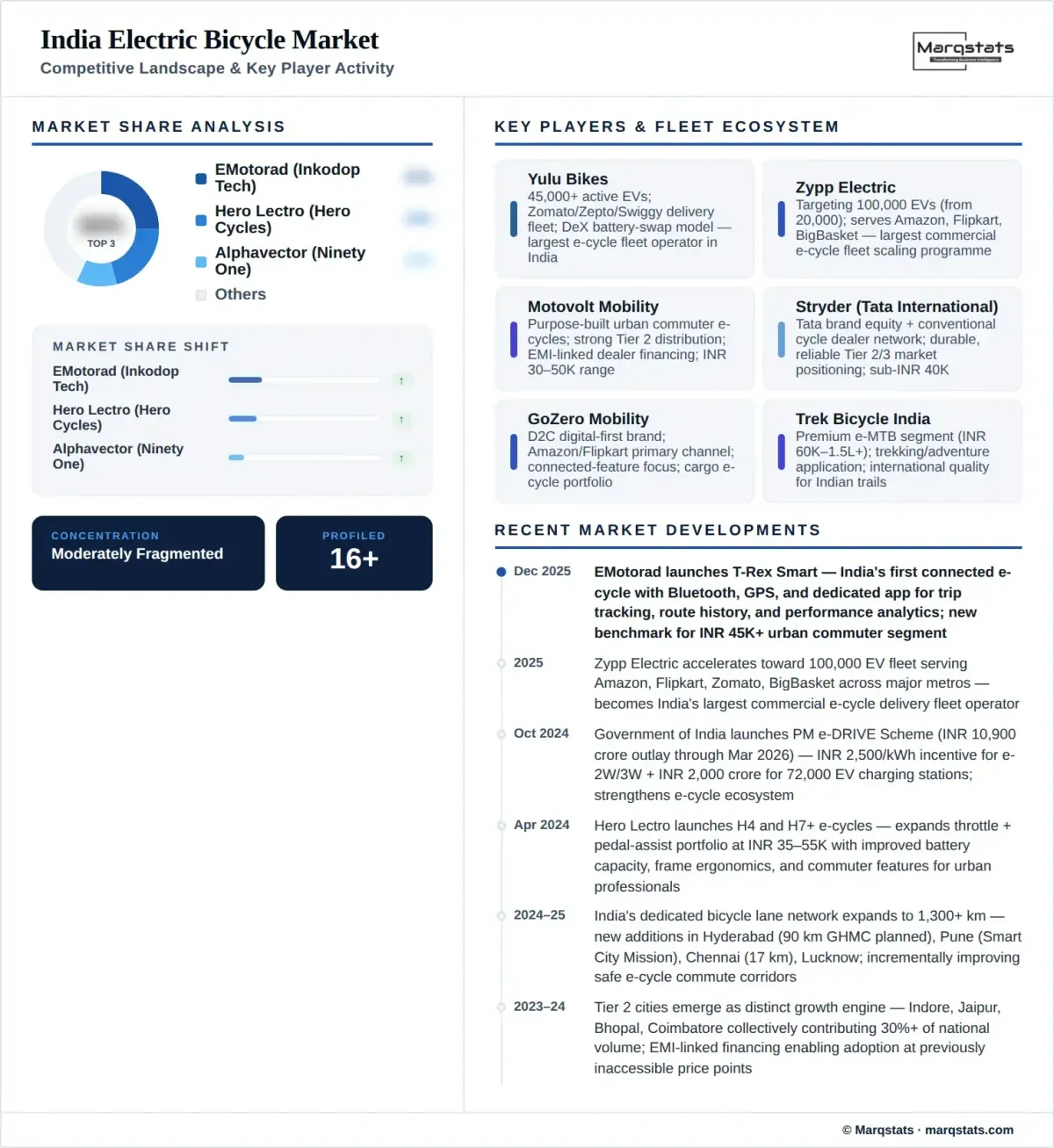
EMotorad (Inkodop Technologies Private Limited) is estimated to lead the India electric bicycle market with approximately 22% revenue share in 2025, having built its position through direct-to-consumer digital sales, a 175+ dealer network across 90+ cities and towns, and a product portfolio spanning INR 25,000 to INR 75,000 across throttle-assisted and pedal-assisted formats. Hero Cycles Limited's Lectro brand — India's largest traditional bicycle manufacturer now competing in the electric segment — commands significant offline dealer presence and brand recognition, with a portfolio spanning cargo e-bikes (WINN), city commuters, and fitness-oriented formats. Other active OEMs include Alphavector India (Ninety One brand), Cultsport, Stryder (Tata International subsidiary), Motovolt Mobility, Nibe E-motor Limited, Tru E Bikes, Being Human, and GoZero. Li-ion battery adoption has reached approximately 94% of total market value by 2025, with prices estimated at USD 108/kWh in 2025 and projected to decline to approximately USD 62/kWh by 2030 — the primary input cost driver enabling further retail price reduction across the forecast period.
Key Takeaways
Market Overview & Analysis
Report Summary
The India electric bicycle market — covering low-speed pedal- and throttle-assisted electric bicycles (≤250W, ≤25km/h) and speed pedelecs with motor assistance up to 45 km/h, across city/urban, trekking/mountain, and cargo/utility applications — is at an inflection point between early adoption and early mass-market penetration. The study period covers 2021–2030 with 2025 as base year. The market's defining structural advantage over most global e-cycle markets is the unique Indian legal framework: electric bicycles meeting the CMVR ≤250W/≤25km/h standard are not classified as motor vehicles — eliminating registration, licence, and insurance costs that have slowed electric scooter adoption in the INR 20,000–50,000 consumer segment. The historical CAGR of approximately 26.4% from 2021–2025 reflects the market's transition from nascent to early-growth stage, underpinned by falling battery costs, expanding D2C distribution, and growing last-mile delivery fleet demand. The forecast CAGR of 21.56% for 2026–2030 reflects continued strong growth against a progressively larger base.
India's total bicycle market is structurally stable at approximately 11–12 million units annually, creating a large and growing demand anchor for e-cycle substitution. With e-cycle penetration estimated at approximately 1.0% in 2025 and projected to reach approximately 3.8% by 2030, the market is in early substitution phase — far from saturation — with long-run upside dependent on infrastructure improvement, pricing reduction, and institutional adoption acceleration. The city/urban application segment accounts for the majority of volume at approximately 78.5% in 2025, reflecting India's primary e-cycle use case: congested urban short-distance commuting, where average travel times exceed 28–34 minutes per 10 km in India's most congested cities, and where over 44% of commuters travel between 5–15 km daily — directly within the optimal operating range for a charged e-cycle on a typical daily round trip.
The India electric bicycle market's competitive architecture is shaped by three concurrent forces: (1) D2C digital brands (EMotorad, GoZero) using Amazon, Flipkart, and proprietary websites as primary channels to acquire tech-savvy urban buyers without legacy dealer investment; (2) established bicycle manufacturers converting to the e-segment (Hero Lectro/Hero Cycles, Stryder/Tata International, Trek Bicycle India) using existing dealer relationships and brand equity; and (3) mobility platform operators (Yulu, Zypp Electric, BLive, EVeez) deploying e-cycles in shared mobility, delivery, and leasing formats that generate fleet-scale demand outside the retail channel. This three-tier competitive structure differentiates India's e-cycle market from European or North American e-bike markets and creates distinct go-to-market strategies for each competitive tier.
Market Dynamics
Key Drivers
- CMVR legal exemption supporting low-speed e-cycle adoption: The most commercially significant regulatory feature of India's electric bicycle market is the legal exemption under Central Motor Vehicles Rules 1989 — electric bicycles with ≤0.25 kW motor, pedals, and motor cut-off at or before 25 km/h are classified as non-motorised vehicles. This means no RTO registration, no driver's licence, no mandatory motor insurance, no helmet mandate under the Motor Vehicles Act, and no road tax. For a household considering switching from a conventional bicycle to an electric bicycle in the INR 25,000–40,000 price range, there is zero compliance overhead — the purchase and use experience is identical to buying a conventional bicycle. This regulatory exemption has been a foundational enabler of throttle-assisted adoption specifically, where the motor-scooter-like ride experience is delivered at non-motor-vehicle compliance cost.
- Urban traffic congestion driving commuter demand across city tiers: India's urban mobility challenge is the electric bicycle's most durable structural tailwind. Average travel times per 10 km across major Indian cities ranged from 23 to over 34 minutes in 2024, with multiple metros among the world's most congested. For the approximately 44% of Indian commuters travelling 5–15 km daily, an electric bicycle offers competitive travel times versus cars and auto-rickshaws in congested inner-city corridors, with zero fuel cost and minimal parking requirements. The combination of physical congestion, rising fuel costs, and the e-cycle's CMVR non-registration status creates a genuinely competitive alternative to conventional two-wheelers for the large majority of India's daily urban commuter base.
- Hyper-local delivery boom institutionalising fleet-scale e-cycle demand: India's grocery and food delivery platforms collectively represent a multi-billion-dollar commercial ecosystem that is actively electrifying its last-mile logistics fleets. The operational logic for e-cycle deployment in this sector is straightforward: deliveries within the 2–6 km radius optimally suit the e-cycle's range and maneuverability; operating costs are lower than petrol two-wheelers; CMVR non-motor-vehicle status reduces fleet compliance cost; and platform-level sustainability commitments are accelerating the shift from ICE to electric. Yulu operates 45,000+ active EVs nationally serving Zomato, Zepto, and Swiggy, while Zypp Electric is scaling from 20,000 to 100,000 EVs, collectively demonstrating that institutional fleet demand is already structurally significant for the e-cycle category.
- Li-ion battery price decline enabling progressive retail price reduction: Li-ion battery prices for e-cycles in India have declined substantially from approximately USD 245/kWh in 2017 to an estimated USD 108/kWh in 2025 — a reduction of over 55% in eight years. Since battery packs constitute 30–40% of an e-cycle's total bill of materials, this decline directly enables retail price reduction in a market where approximately 70% of volumes are sold in the sub-INR 40,000 price band. Independent assessments project further declines to approximately USD 62/kWh by 2030, driven by global lithium-ion cell manufacturing scale-up, India's domestic battery assembly programmes, and progressive raw material cost normalisation. At USD 62/kWh, a capable throttle-assisted e-cycle with 8–10 Ah battery capacity becomes commercially viable at INR 22,000–26,000 retail — accessing significantly larger consumer cohorts across Tier 2 and Tier 3 cities.
- GST differential and state subsidy stack making e-cycles cost-competitive with premium conventional bicycles: The GST Council places electric bicycles at 5% tax — versus 12% for conventional bicycles — creating a 7-percentage-point tax advantage that directly lowers e-cycle effective retail pricing. Stacked on top of this are state-level subsidies: Punjab offers INR 4,000 per e-cycle, Chandigarh INR 3,000, Tamil Nadu 20% of cost (capped at INR 5,000), and Maharashtra 25% of cost (capped at INR 3,000). For an aspirational buyer in Tamil Nadu acquiring a INR 32,000 throttle-assisted e-cycle, the combined GST benefit plus state subsidy reduces the effective purchase price to approximately INR 23,500–24,000 — making the e-cycle cost-competitive with a quality premium conventional geared bicycle while delivering the zero-operating-cost and reduced-effort benefits of electric assistance.
Key Restraints
- Price sensitivity confining adoption predominantly to sub-INR 40,000 segment: India's e-cycle volume remains heavily concentrated at the entry price point — approximately 70% of volume is estimated in the sub-INR 40,000 segment in 2025, reflecting the deep affordability constraint of the core Indian e-cycle buyer. Models priced above INR 70,000, particularly speed pedelecs, account for less than 12% of total volume. OEMs must sustain or reduce average selling prices to expand adoption beyond early adopters in Bengaluru, Mumbai, and Delhi NCR into the deeper Tier 2 and Tier 3 consumer base, where monthly household incomes are INR 20,000–40,000 and the e-cycle must compete against INR 8,000–15,000 conventional bicycles for discretionary mobility spend.
- Absence of dedicated cycling infrastructure constraining rider confidence: India's dedicated bicycle lane network has expanded to approximately 1,300+ km across all cities — a meaningful improvement from earlier years but still a very small fraction of total urban road length. For most Indian city commuters, daily e-cycle use involves mixed-traffic riding conditions that impose real safety risk and reduce rider confidence, particularly among women commuters, older riders, and first-time e-cycle users. Independent assessments consistently identify cycling infrastructure as the primary barrier to expanding the e-cycle addressable base beyond the fit young male urban professional segment into the broader demographic spectrum.
- After-sales service ecosystem underdeveloped outside Tier 1 cities: E-cycles require periodic battery maintenance, motor servicing, and software updates beyond the capability of India's conventional bicycle repair network. In Tier 2 and Tier 3 cities, limited authorised e-cycle service centre availability creates post-purchase risk that influences purchasing decisions, particularly in the INR 40,000–70,000 mid-range segment where service economics must justify the premium over a conventional bicycle. EMotorad's 175+ dealers across 90+ cities still leaves large gaps in Tier 3 India, as do other OEMs' networks, creating consumer confidence barriers that slow conversion of aspirational demand into completed purchases outside major metros.
- Speed pedelec regulatory ambiguity constraining premium segment development: Speed pedelecs — capable of 35–45 km/h — are classified as motor vehicles under CMVR, requiring registration, insurance, and a driving licence, imposing the same compliance overhead as an electric scooter on a product that is physically far closer to a bicycle. Without a distinct regulatory category for light electric vehicles operating between 25 km/h and 45 km/h, India's speed pedelec market is structurally limited to niche recreational and premium lifestyle applications rather than scaling as a high-performance urban commuter product — a potential that European and Chinese markets have realised with similar product categories under differentiated regulatory frameworks.
Key Trends
- Connected e-cycle era beginning — IoT integration redefining premium segment expectations: EMotorad's launch of the T-Rex Smart in December 2025 — India's first connected e-cycle with built-in Bluetooth, GPS, and dedicated app for real-time trip tracking, route history, and performance analytics — marks the transition from feature-based to connectivity-based product differentiation in India's e-cycle market. For institutional buyers (delivery platforms, corporate campuses, shared mobility operators), connected e-cycles enable fleet tracking, predictive maintenance, and utilisation analytics that fundamentally improve commercial economics. Connected features are moving from premium exception to standard specification in the INR 45,000+ segment and will migrate downmarket as embedded electronics costs decline through 2030.
- Cargo e-cycle segment transitioning from pilot to structured fleet deployment: The cargo and utility e-cycle application is growing fastest in percentage terms — from approximately 2,000 units in 2025 toward an estimated 9,000–10,000 units by 2030. Hero Lectro's WINN cargo e-cycle (food delivery pilots with major platforms), Yulu's DeX delivery-optimised model, and municipality pilots in cities like Indore are establishing cargo e-cycles as a recognised logistics asset class. As quick-commerce platforms (Zepto, Blinkit, Swiggy Instamart) scale their 10-minute delivery operations, cargo e-cycles become operationally essential at hyper-local delivery station level in dense urban corridors where the fixed operating cost advantage over ICE two-wheelers is most pronounced.
- Tier 2 cities driving 30–35% of volume market and growing disproportionately: Tier 2 cities — Indore, Jaipur, Coimbatore, Lucknow, Bhopal, Surat, Chandigarh — collectively represent approximately 30–35% of national e-cycle volume and are growing faster than Tier 1 metros in absolute unit terms. The Tier 2 buyer profile — price-sensitive (INR 25,000–40,000 preference), utility-driven, increasingly comfortable with e-commerce purchase, and facing growing commute congestion — is closely aligned with the throttle-assisted e-cycle's core value proposition. OEMs investing in localised dealer presence, EMI-linked financing, and after-sales service networks in Tier 2 markets are best positioned to capture the market's next volume growth phase during 2026–2030.
- Online channel growing toward 30%+ of total volume as D2C model matures: Online and D2C sales of e-cycles are estimated at approximately 29% of total market volume in 2025, having grown from a negligible base in 2017. E-commerce platforms (Amazon, Flipkart) and brand websites are the primary channels for the digital-first segment of the Indian e-cycle buyer. The D2C model — pioneered by EMotorad — has demonstrated that significant market share is achievable without legacy dealer networks, reducing OEM distribution cost while enabling direct customer relationship management. By 2030, independent assessments suggest online sales could represent 35–40% of total volume, approaching parity with traditional offline dealer networks — a structural shift that rewards OEMs with strong digital marketing and fulfilment capability.
Market Segmentation
Throttle-assisted electric bicycles — where the rider activates the motor using a twist throttle independently of pedalling, within the ≤250W/≤25km/h CMVR envelope — dominate India's electric bicycle market with an estimated 83% of volume in 2025, moderating toward approximately 80% by 2030 as speed pedelecs grow disproportionately. Throttle-assisted models appeal to India's core e-cycle buyer: cost-sensitive urban commuters seeking low-effort mobility for daily short distances, gig economy delivery workers requiring operational simplicity, and semi-urban users in Tier 2 and Tier 3 cities where the bicycle is primarily a utility vehicle. The throttle-assisted segment is projected to expand from approximately 137,000 units in 2025 to approximately 330,000 units by 2030. Brands including Hero Lectro (H3+, H7Σ), EMotorad (X1), Stryder, and Motovolt offer best-selling throttle models in the INR 25,000–45,000 range that account for the majority of segment volume.
Pedal-assisted electric bicycles — motor active only while rider pedals, cut-off at 25 km/h — represent India's second-largest propulsion segment and are the dominant format in the premium lifestyle and fitness commuter category. Pedal-assist models are particularly well-positioned for the INR 40,000–70,000 price band, where brand differentiation is based on frame quality, component specification, and connectivity features. Hero Lectro, EMotorad, Cultsport, and Alphavector (Ninety One) are the primary players offering pedal-assist models. The segment is projected to grow from approximately 16,500 units in 2025 to approximately 41,000 units by 2030 — approximately 2.5x volume growth — driven by institutional adoption (corporate wellness, campus commuting) and rising health consciousness, particularly in Tier 1 metros where fitness riding commands a meaningful consumer segment.
Speed pedelecs — motor assistance up to 45 km/h, with separate motor-vehicle compliance requirements — represent the smallest but fastest-growing propulsion sub-segment, projected at approximately 11,500 units in 2025 and growing to approximately 40,000 units by 2030 at an estimated CAGR of approximately 34.5%. Growth reflects premium urban commuter demand for cycling performance comparable to an electric scooter, proliferation of models in the INR 70,000–1,50,000 range from international brands and domestic OEMs, and the development of dedicated e-cycle infrastructure enabling higher-speed riding. The segment is structurally constrained by the absence of a differentiated regulatory framework for light electric vehicles — a policy gap that, if addressed, could accelerate speed pedelec adoption as India's premium urban commuter vehicle of choice through 2030.
City and urban commuting dominates the India electric bicycle market at an estimated 78.5% of total volume in 2025, projected at approximately 130,000 units and growing to over 320,000 units by 2030. The city/urban application thesis is directly supported by India's commuter geography: approximately 44% of commuters travel 5–15 km daily and approximately 38% travel under 5 km — together representing over 80% of daily commuters within e-cycle range. The sub-25 km/h legal speed cap is not a material operational constraint in Indian urban traffic, where congestion-driven average travel speeds in inner-city corridors are often below 20 km/h regardless of vehicle type. The core product for this segment — INR 25,000–45,000 throttle and pedal-assist models with commuter accessories — represents the clearest product-market fit in India's electric bicycle ecosystem.
Trekking and mountain electric bicycles represent a premium, high-average-selling-price segment accounting for an estimated 19% of market value in 2025 despite a smaller volume share of approximately 17.5%. The segment benefits from India's growing recreational cycling community and expanding adventure tourism in hill states, with the number of active trekkers estimated at over 180,000 in 2025 — a sustained multi-year upward trend. EMotorad and Trek Bicycle India are the primary OEMs offering e-MTB formats with pedal-assist for incline-heavy terrain, with models priced INR 60,000–1,50,000+. The segment commands the highest average selling price and margin in the India e-cycle market, making it disproportionately important for OEM profitability despite its lower volume share.
The cargo/utility e-cycle segment — electric bicycles designed for loads of 50–150 kg, used in hyper-local delivery, municipal services, and institutional logistics — is estimated at approximately 2,000 units in 2025 and projected to exceed 9,500 units by 2030 at the fastest compound growth rate of any application segment. Growth is directly tied to India's hyper-local delivery expansion: grocery and quick-commerce platforms collectively represent a rapidly growing commercial ecosystem requiring last-mile electric delivery solutions at the 2–6 km optimal range for cargo e-cycles. Hero Lectro WINN, Yulu DeX, and purpose-built cargo e-cycles from GoZero and Pedl represent the early commercial models. As platform operators formalise fleet electrification programmes, cargo e-cycle procurement will shift to institutional and volume-based channels, reducing OEM per-unit distribution cost and accelerating segment scaling.
By Geography
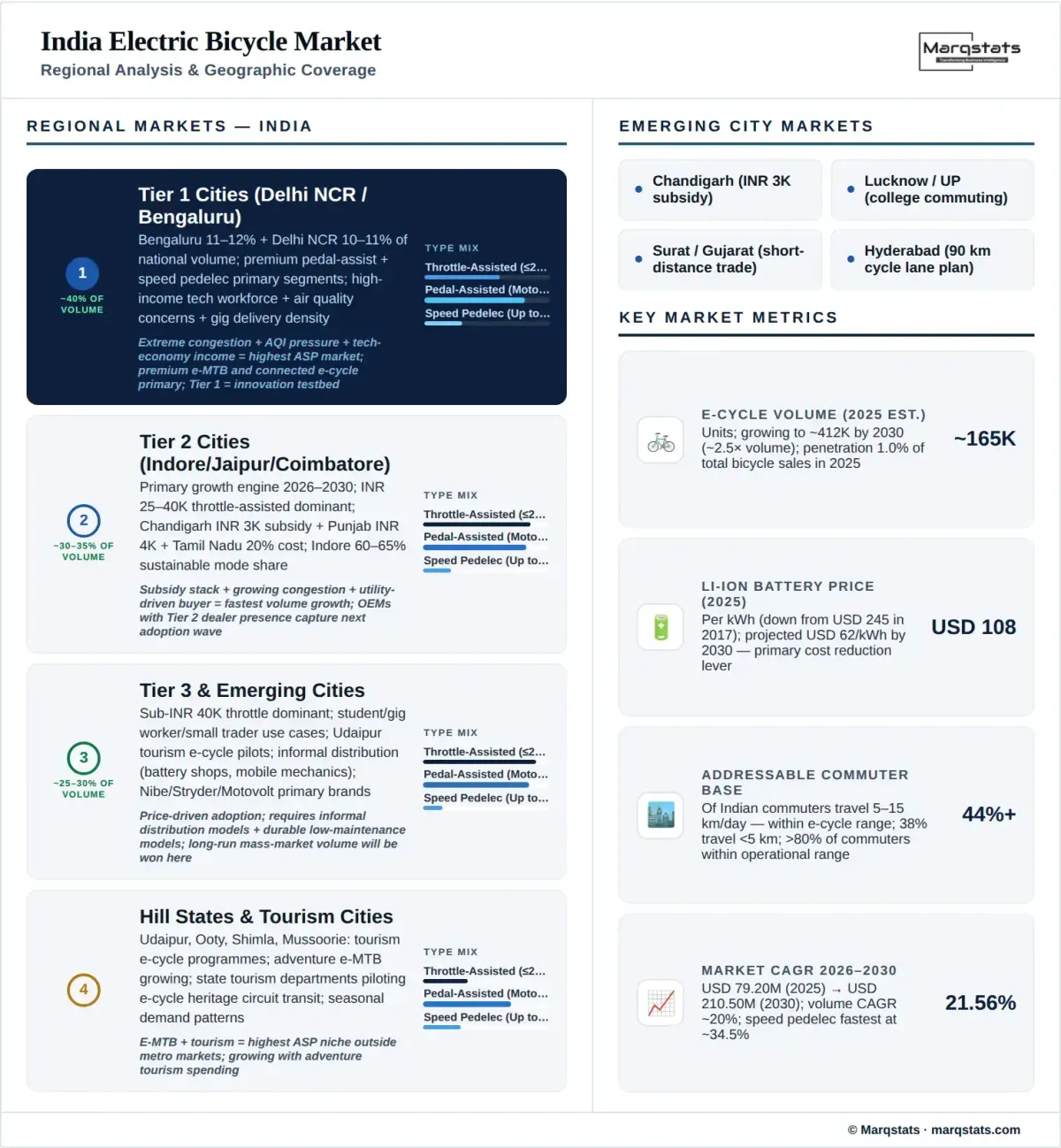
Tier 1 Cities — Approximately 40% of Total Market Volume
India's major Tier 1 cities — Delhi NCR, Bengaluru, Mumbai, Pune, Hyderabad, and Chennai — collectively account for approximately 40% of national e-cycle adoption. Bengaluru contributes the largest individual share at an estimated 11–12% of Tier 1 volume, reflecting its combination of extreme traffic congestion, high-income tech-economy workforce, and expanding gig delivery ecosystem. Delhi NCR follows with an estimated 10–11% of Tier 1 adoption, driven by last-mile metro connectivity demand, air quality concerns (consistently among India's highest AQI cities), and gig economy delivery use cases. The Tier 1 buyer profile — young professionals aged 25–35, fitness-conscious, and hybrid commute-plus-leisure users in Mumbai and Bengaluru — commands the highest average selling prices and is the primary driver of the premium pedal-assist and speed pedelec segments. City-level suitability analysis rates Bengaluru, Pune, Delhi NCR, and Ahmedabad as offering 'excellent' to 'high' e-cycle adoption potential based on commute profile, congestion, infrastructure, and income.
Tier 2 Cities — Approximately 30–35% of Total Market, Primary Growth Engine
Tier 2 cities — Indore, Jaipur, Coimbatore, Lucknow, Bhopal, Surat, and Chandigarh — are estimated at approximately 30–35% of national e-cycle volume and represent the primary growth engine for 2026–2030. The Tier 2 adoption driver profile differs from Tier 1: buyers are more price-sensitive (INR 25,000–40,000 dominant preference), more utility-driven, and often involve EMI-linked purchases or student acquisition. College commuting, office travel, and short-range delivery are the primary use cases. Chandigarh's INR 3,000 per unit subsidy, Indore's strong non-motorised transport culture (estimated 60–65% sustainable mode share), and Jaipur's short-distance cargo and school drop-off dynamics make these cities structurally favourable for e-cycle growth. Brands like Motovolt, Ninety One, and Hero Lectro dominate Tier 2 distribution through EMI-linked dealer programmes.
Tier 3 and Emerging Cities — Approximately 25–30% of Total Adoption
Tier 3 cities and emerging towns contribute an estimated 25–30% of national e-cycle volume and represent the most price-sensitive market segment, predominantly in the sub-INR 40,000 throttle-assisted category. Adoption is utility and affordability-driven — e-cycles function as replacements for ageing conventional two-wheelers or premium bicycles for students, small traders, and gig workers. Brands gaining Tier 3 traction include Nibe, Stryder, and Motovolt with simple, durable models below INR 40,000. Tourism-linked adoption is emerging in heritage and hill cities including Udaipur, where tourism departments are piloting e-cycle programmes for heritage circuit transit. The Tier 3 market requires informal distribution models — battery shops serving as EV resellers, mobile service mechanics, local cooperative-assisted sales — that differ from the experience-centre and D2C digital models deployed in Tier 1 metros.
How Competition Is Evolving
The India electric bicycle market's competitive landscape is moderately fragmented, with EMotorad holding a leading revenue share estimated at approximately 22% in 2025. The competitive architecture divides into three tiers: D2C-first digital brands (EMotorad, GoZero) that built scale through e-commerce platforms without legacy dealer infrastructure; converted conventional bicycle OEMs (Hero Lectro/Hero Cycles, Stryder/Tata International, Trek Bicycle India) applying existing dealer networks and brand equity to the e-cycle segment; and new-format electric mobility companies (Motovolt, Nibe, Ninety One/Alphavector, Cultsport) offering purpose-built e-cycles with modern frame geometry, connectivity features, and urban-focused specifications. A distinct fourth tier of platform fleet operators (Yulu, Zypp Electric, BLive, EVeez) generates institutional fleet demand outside the retail channel.
Two structural forces are reshaping competitive dynamics. First, connectivity as a differentiator — EMotorad's T-Rex Smart (December 2025) establishes IoT integration as a product standard in the INR 45,000+ segment, creating technology investment pressure on incumbent OEMs. Second, B2B fleet market emergence — as Zomato, Swiggy, Amazon India, and quick-commerce platforms scale EV fleet programmes, OEMs with cargo-optimised products (Hero Lectro WINN) and fleet management software integration gain structural advantage over purely retail-focused competitors. Independent assessments suggest the India electric bicycle market will consolidate around 3–5 leading OEMs controlling 60–70% of revenue by 2030, as battery cost decline enables volume-led share gains over product-level differentiation and weaker players exit or consolidate.
Companies Covered
Companies covered in the report include:
Recent Market Activity
Table of Contents
Coverage & Segmentation
This report provides a comprehensive analysis of the India electric bicycle market covering low-speed pedal- and throttle-assisted electric bicycles (≤250W, ≤25km/h) and speed pedelecs with motor assistance up to 45 km/h across the 2021–2030 study period with 2025 as base year. Market scope covers new electric bicycle sales across offline dealer networks and online/D2C channels; shared mobility and fleet deployment (Yulu, Zypp Electric, BLive, EVeez, Pedl); corporate and institutional procurement; and cargo/utility e-cycle deployments in commercial delivery, municipal services, and campus mobility. This report does NOT cover electric scooters, electric motorcycles, mopeds, or electric bicycles with an assisted top speed above 45 km/h — regardless of how such vehicles are described in Indian media or retail contexts. Geographic coverage spans all major Indian cities and states, with detailed city-level analysis for 15+ Tier 1, Tier 2, and Tier 3 markets and state-level policy analysis for Chandigarh, Punjab, Tamil Nadu, Maharashtra, Delhi, Karnataka, and national GST policy. Primary research includes 40+ interviews with e-cycle OEM commercial teams, fleet operators, delivery platform procurement managers, state government transport officials, retail channel partners, and end consumers across Tier 1, 2, and 3 cities.