Market Snapshot
Key Takeaways
Market Overview & Analysis
Report Summary
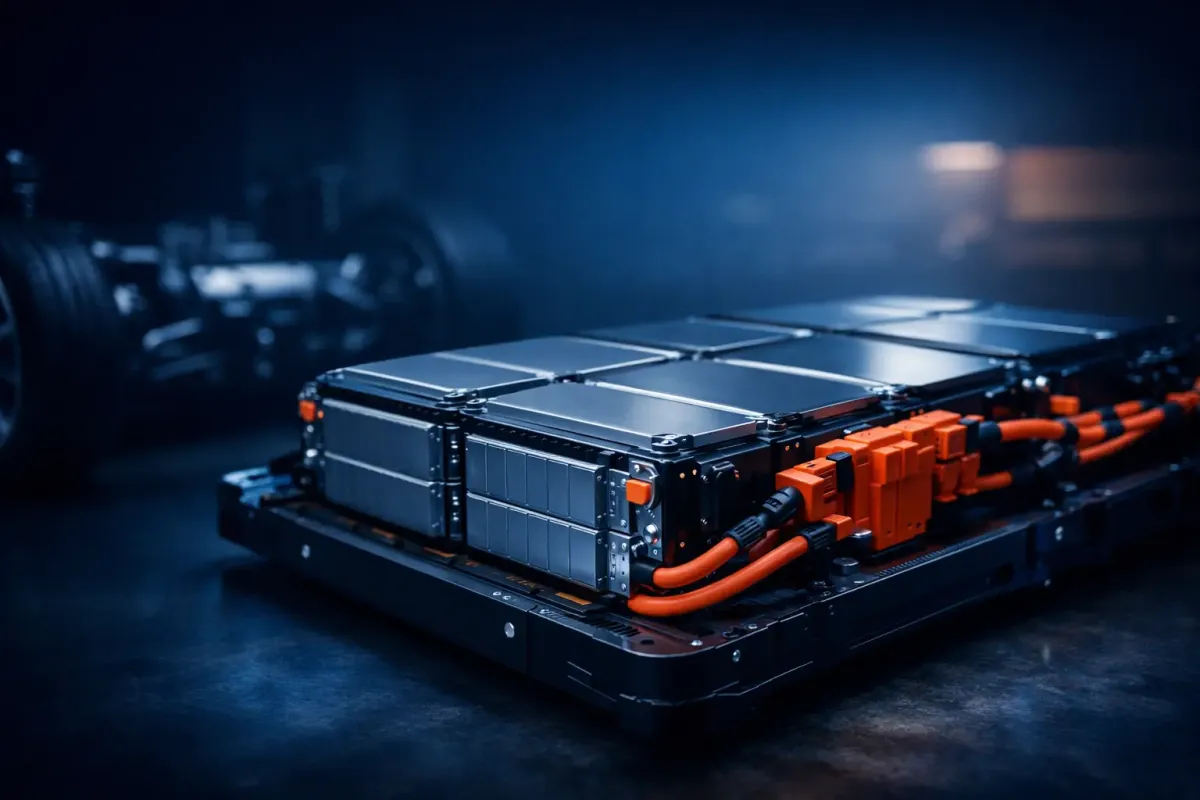
The India electric commercial vehicle battery pack market covers complete energy storage and power delivery systems—comprising lithium-ion battery cells, modules/packs, battery management systems (BMS), and thermal management systems—designed for battery electric commercial vehicles including light commercial vehicles (LCVs), medium-and-heavy commercial vehicles (M&HCVs), and buses/coaches. The market scope focuses exclusively on battery electric drivetrains; plug-in hybrid, CNG-electric hybrid, and fuel cell commercial vehicles are excluded. Battery pack components such as standalone BMS and casing sold separately are excluded from market size calculations.
India’s electric commercial vehicle industry set a new annual record in CY2025 with 15,798 units sold—a significant milestone though representing under 1% of India’s total commercial vehicle market. Zero-emission light goods carriers dominated with 10,759 units (68% share, up 79% YoY), driven by Tata Ace EV, Mahindra Zeo, Euler HiLoad, Switch Mobility’s e-LCV platform, and Altigreen neEV serving e-commerce last-mile delivery, FMCG distribution, and waste management applications. Electric bus sales reached 4,395 units (up 15% YoY), primarily procured by state transport undertakings under government programmes, with Delhi recording the highest e-bus penetration at 51.9%. Heavy goods carriers remained nascent at 565 units but surged 152% YoY as new platforms entered the market.
The battery pack dimension is particularly significant for commercial vehicles because per-unit pack capacity is 5–50 times larger than passenger EVs and two-wheelers. An electric LCV typically requires 11–21 kWh (LFP), a medium-duty truck needs 100–200 kWh, and an electric bus operates with 200–400+ kWh packs. This translates to disproportionately high battery value per unit sold—making the commercial vehicle segment the highest-value battery pack application on a per-vehicle basis. Pack design must also accommodate demanding commercial duty cycles: 200–300 km daily range requirements, high-utilization depot charging rotations, and thermal management for Indian ambient temperatures exceeding 40°C.
Market Dynamics
Key Drivers
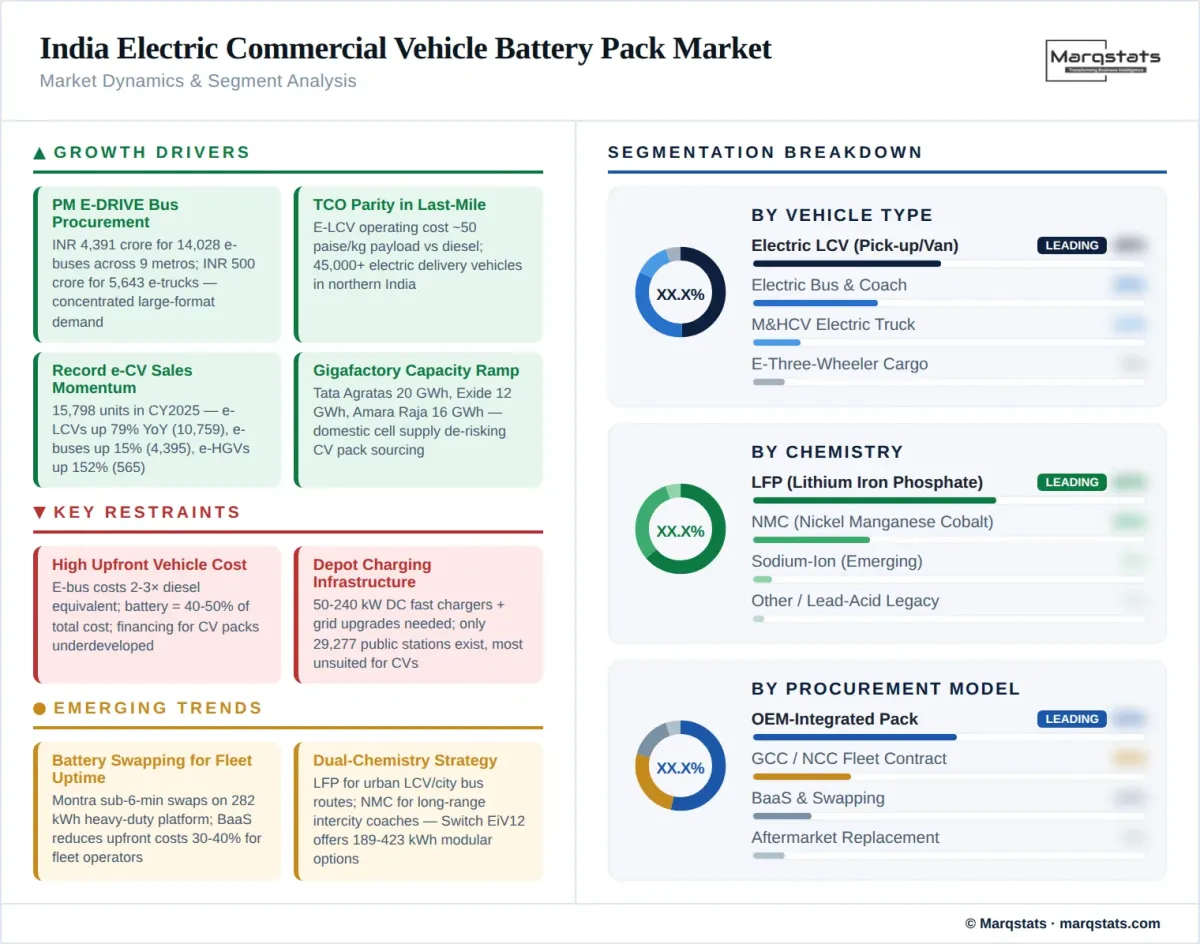
- PM E-DRIVE’s concentrated procurement driving large-format battery pack demand: The scheme allocates INR 4,391 crore (~USD 492 million) for 14,028 electric buses across nine metropolitan cities with populations exceeding 4 million—Delhi, Mumbai, Kolkata, Chennai, Ahmedabad, Surat, Bengaluru, Pune, and Hyderabad. Each bus requires 200–400+ kWh battery packs, creating concentrated demand for domestic pack assemblers and cell suppliers. Additionally, INR 500 crore (~USD 56 million) is specifically designated for 5,643 e-trucks, signalling government intent to electrify freight alongside passenger transport. The procurement emphasizes scrapping older buses under the Vehicle Scrapping Scheme, ensuring multi-year replacement demand.
- TCO parity in last-mile e-LCV delivery applications: Electric LCVs have achieved total cost of ownership parity with ICE counterparts in urban last-mile delivery routes, where daily distances of 80–120 km align with current battery range capabilities. E-LCV operating costs are approximately 50 paise per kg of payload (depending on electricity tariffs)—significantly below diesel equivalents. E-commerce logistics operators including Amazon, Flipkart, BigBasket, and Zomato are deploying electric delivery fleets at scale, with over 45,000 electric delivery vehicles operational across northern India. This B2B-driven demand creates predictable, recurring battery pack procurement cycles. Industry analysts estimate EV penetration in the LCV market will reach 15% by 2030.
- Modular battery pack architecture enabling fleet flexibility: Modular prismatic pack design enables flexible sizing across different commercial vehicle applications—from 11 kWh LCV packs to 400+ kWh bus configurations using standardized cell modules. This modularity supports battery swapping (sub-6-minute swap demonstrated on Montra’s Rhino 5538EV with 282 kWh pack), rapid field replacement for maximizing fleet uptime, and commonality across vehicle platforms that reduces manufacturing costs. OEMs including Tata Motors, Olectra, Switch Mobility, and JBM Auto are standardizing modular pack interfaces across their commercial vehicle ranges.
- State transport corporation electrification mandates: State transport agencies across Delhi, Maharashtra, Tamil Nadu, Kerala, West Bengal, Madhya Pradesh, Odisha, and Assam are actively procuring electric buses for city and intercity routes. Delhi’s DEVi initiative flagged off 400 electric buses in a single deployment. Maharashtra’s MSRTC, Gujarat’s GSRTC, and Telangana’s TSRTC operate growing fleets using Olectra’s Blade Battery-powered buses (261–324 kWh). Plans call for expansion from over 500 operational e-buses to 2,000+ by 2027 across these states. Each procurement cycle creates bulk battery pack orders that enable domestic manufacturers to achieve economies of scale.
- Declining battery pack prices improving e-CV economics: Global lithium-ion battery pack prices are trending toward USD 80/kWh by 2026, with Indian packs for commercial applications targeting sub-INR 50,000 for LCV configurations by late 2026. LFP chemistry’s 30% cost advantage over NMC is particularly impactful in price-sensitive commercial segments. Cell-to-pack (CTP) architecture—eliminating module-level packaging—delivers additional 15–20% cost and energy density improvements for large-format bus and truck packs. Combined with declining costs, PLI-ACC localization incentives further reduce landed pack costs for domestic assembly.
Key Restraints
- High upfront vehicle cost despite TCO advantages: Electric commercial vehicles command significant price premiums over ICE equivalents—an electric bus costs 2–3x more than a comparable diesel bus, primarily due to the battery pack representing 40–50% of total vehicle cost. While TCO favours electrification over 8–10 year operational life, the upfront capital barrier limits adoption among smaller fleet operators and state transport corporations with constrained budgets. Gross Cost Contract (GCC) and Net Cost Contract (NCC) models partially address this by spreading costs, but financing mechanisms for e-CV battery packs remain underdeveloped compared to passenger vehicle segments.
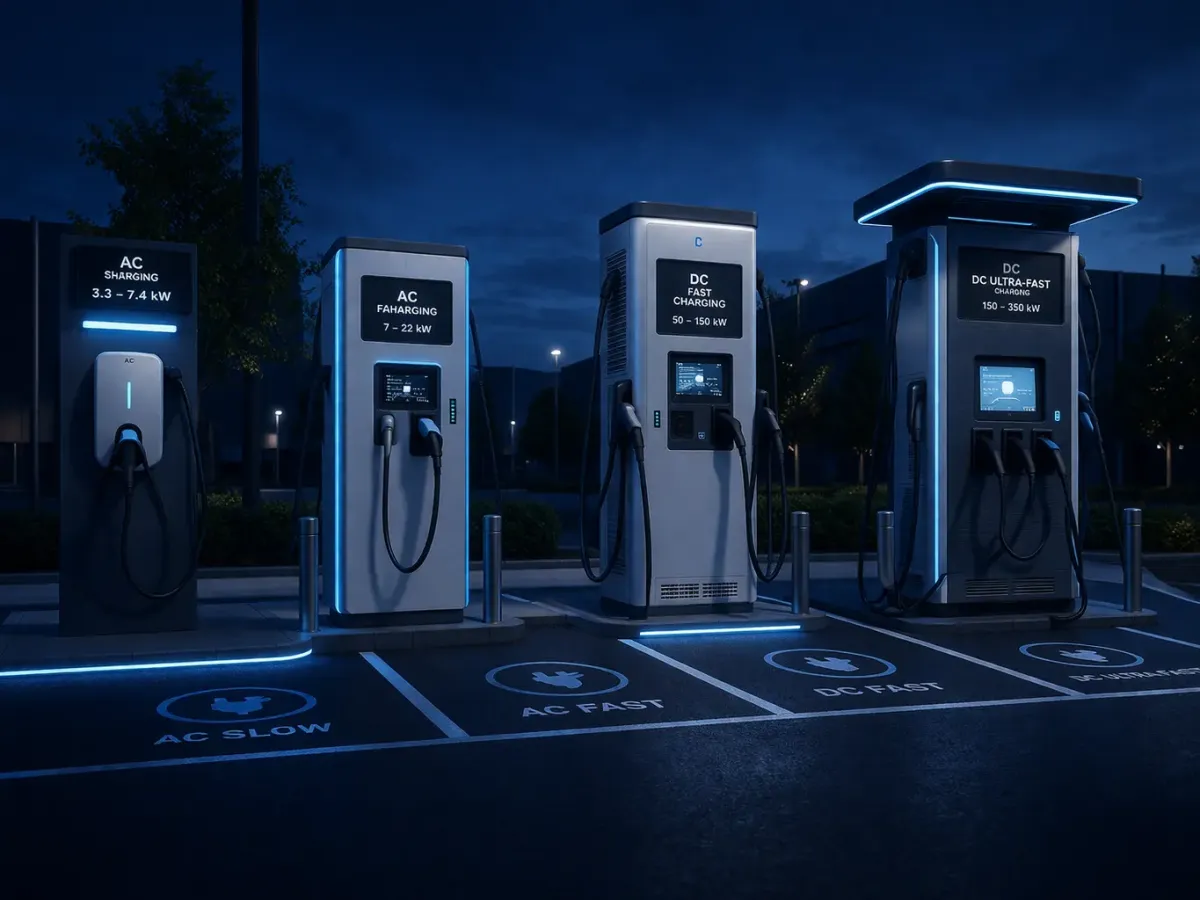
- Charging and depot infrastructure gaps for commercial operations: Commercial fleet electrification requires dedicated depot charging infrastructure with 50–240 kW DC fast chargers, load management systems, and grid capacity upgrades—representing significant capital investments. Intercity bus and long-haul truck routes require en-route opportunity charging stations that remain sparse outside major highways. Only 29,277 public charging stations existed as of November 2025, with the majority unsuited for commercial vehicle charging requirements. Grid capacity constraints in industrial zones and bus depots further complicate deployment timelines.
- Limited heavy-duty electric truck maturity: The M&HCV electric truck segment remains at an early stage with only 565 units sold in CY2025. Battery pack requirements of 150–400+ kWh for heavy-duty applications create weight penalties that reduce payload capacity—a critical metric for trucking economics. Duty cycle requirements for long-haul trucking (400–800 km daily) exceed current battery range capabilities. Most electric truck deployments are confined to port operations, mining, and short-haul urban freight. Blue Energy Motors, Ashok Leyland (through Tivoli Electric Vehicles), and Tata Motors (Prima E.55S, Ultra E.12) are launching platforms, but fleet-scale adoption requires further battery energy density improvements and charging infrastructure build-out.
- Policy sensitivity and subsidy dependency: Electric CV sales have demonstrated significant sensitivity to policy changes and subsidy cycles. When the FAME II subsidy ended in March 2024, monthly e-CV sales dropped sharply before recovering under PM E-DRIVE. In March 2025, electric CV penetration fell to 1% (down from 2.3% in March 2024), with Tata’s monthly sales declining 80% YoY. This volatility reflects the market’s continued dependence on government procurement programmes and demand-side subsidies, creating uncertainty for battery pack manufacturers planning capacity investments.
Key Trends
- Battery swapping and BaaS for commercial fleet uptime optimization: Battery swapping is gaining traction in commercial applications where maximizing fleet uptime is critical. Montra Electric demonstrated sub-6-minute battery swaps on its Rhino 5538EV (282 kWh) heavy-duty platform with 240 kW CCS2 chargers and 10-year/900,000 km AMC. Mahindra is piloting battery swapping for e-3W cargo and LCV fleets. Battery-as-a-Service (BaaS) models decouple battery ownership from vehicle purchase, reducing upfront costs by 30–40% and enabling fleet operators to pay per-kWh consumed. This drives demand for standardized, high-cycle-life LFP packs designed for rapid swap operations.
- Dual-chemistry pack strategies for range and cost optimization: OEMs are deploying LFP chemistry for cost-sensitive urban delivery LCVs and city bus routes, while reserving NMC for premium, long-range intercity bus and coach applications requiring higher energy density. Switch Mobility’s EiV12 platform exemplifies this approach with modular NMC/LFP pack options ranging from 189–423 kWh, enabling operators to select chemistry based on route profile. JBM Auto’s Ecolife platform similarly offers modular NMC packs optimized for different city/intercity duty cycles.
- Advanced telematics and smart BMS integration: Commercial fleet operators demand sophisticated battery management beyond basic charge/discharge control. JBM Auto, Olectra, Tata Motors, and Montra are integrating SaaS-based telematics platforms with real-time battery health monitoring, predictive maintenance scheduling, thermal management optimization for Indian climate conditions, and TCO analytics. Smart BMS systems optimized for high-utilization commercial duty cycles—including depot charging optimization, state-of-health prediction, and warranty management—are emerging as key competitive differentiators among battery pack suppliers.
- E-truck market entering inflection phase with new platform launches: CY2025 marked a turning point for India’s electric truck segment. Tata Motors unveiled the Prima E.55S heavy-duty electric truck and Ultra E.12 at Bharat Mandapam. Blue Energy Motors, previously focused on LNG trucks, launched its first electric truck (BEM5548e). Energy in Motion introduced a swappable electric truck in August 2025. Ashok Leyland’s Tivoli Electric Vehicles sold 314 units. Propel Industries launched electric tippers at EXCON 2025 for mining and construction. These launches signal that battery pack demand from the M&HCV segment will accelerate significantly during 2026–2030.
Market Segmentation
Electric LCVs represent the dominant volume segment in India’s electric commercial vehicle battery pack market, with 10,759 units sold in CY2025 (68% of total e-CV sales, up 79% YoY). Typical battery pack capacities range from 11–21 kWh using LFP chemistry in prismatic format. Tata Motors leads with the Ace EV family (Ace EV, Ace EV 1000, Ace Pro EV, Intra EV) selling 4,785 units across LCV and truck categories. Mahindra’s Zeo electric mini-truck surged 188% YoY to 1,245 units, offering 160 km real-world range with a 7-year/150,000 km warranty. Switch Mobility posted 266% YoY growth with 870 units. Euler Motors sold 1,053 units in its first full retail year with the HiLoad modular platform. Altigreen neEV serves e-commerce and rural logistics. Maharashtra, Tamil Nadu, and Karnataka are the top three states for e-LCV registrations. Approximately 15 e-LCV models were available in 2025 versus 5–6 in 2024, dramatically expanding fleet operator choices. EV penetration in the LCV segment is projected to reach 15% by 2030.
Electric buses represent the highest-value battery pack application on a per-unit basis, with pack capacities ranging from 200–400+ kWh. Sales reached 4,395 units in CY2025 (up 15% YoY), primarily driven by state transport corporation procurement. Delhi recorded the highest e-bus penetration at 51.9% with 1,039 units, led by PMI Electro Mobility (613 units) and JBM Auto (320 units). Maharashtra followed at 10.4% penetration (1,036 units), dominated by Olectra Greentech (636 units) and Pinnacle Mobility/EKA (269 units). Tamil Nadu recorded 7.8% penetration, led by Switch Mobility (314 units). Olectra deploys BYD’s Blade Battery technology with scalable 261–324 kWh LFP packs across MSRTC, GSRTC, and TSRTC fleets. Switch Mobility’s EiV12 offers modular NMC/LFP options from 189–423 kWh with dual-gun CCS2 fast charging. JBM Auto’s Ecolife platform targets 20,000 annual bus capacity with TCO-optimized contracts. Private operators like Zingbus plan 50 electric buses in 2026 and 1,000 by 2030 for intercity travel. PM E-DRIVE’s allocation for 14,028 buses ensures sustained multi-year demand.
The M&HCV electric segment is the fastest-growing battery pack sub-segment by CAGR (~80%), albeit from a low base of 565 units in CY2025 (up 152% YoY). Battery pack requirements are substantial—150–400+ kWh per vehicle, representing the highest per-unit battery value across all commercial segments. Current deployments are concentrated in port operations, mining, construction, and short-haul urban freight, where fixed routes and depot charging make electrification viable. Tata Motors’ Prima E.55S and Ultra E.12 electric trucks, Blue Energy Motors’ BEM5548e, and Energy in Motion’s swappable electric truck represent new platform entries. Ashok Leyland’s IPL Tech sold 69 units in Maharashtra alone. Propel Industries launched electric tippers at EXCON 2025. PM E-DRIVE’s INR 500 crore allocation for 5,643 e-trucks signals government commitment to freight electrification. Battery pack design for M&HCVs must balance energy density with weight constraints—excessive battery weight reduces payload capacity, directly impacting trucking economics. This drives demand for advanced CTP architectures and higher-energy-density chemistries including LMFP.
LFP dominates battery packs across electric LCVs, city buses, and cargo three-wheelers, commanding the overwhelming majority of commercial vehicle battery installations. Its 30% cost advantage over NMC, thermal runaway onset of 250–270°C, and 5,000–6,000 cycle life are critical for commercial duty cycles requiring daily deep discharges and high-utilization depot charging. The 2022 LFP patent expiration has enabled domestic cathode production. Prismatic LFP cells in cell-to-pack configurations are the standard for Olectra’s Blade Battery platform, Tata’s Starbus/LCV platforms, and JBM’s Ecolife buses.
NMC chemistry serves premium, long-range intercity bus and coach applications where higher energy density (~250 Wh/kg vs. LFP’s ~170 Wh/kg) is essential for routes exceeding 300 km between charging opportunities. Switch Mobility’s EiV12 deploys NMC packs up to 423 kWh for intercity operations. Some premium LCV platforms targeting 200+ km range also use NMC. However, NMC’s higher cost, shorter cycle life, and cobalt/nickel import dependency constrain its expansion in cost-sensitive commercial segments.
Battery packs below 25 kWh serve the electric LCV segment—the highest-volume commercial application. Tata Ace EV operates with approximately 21 kWh, Mahindra Zeo with 16–21 kWh variants, and Euler HiLoad with modular configurations. This capacity band balances range requirements (80–160 km) with vehicle weight constraints and affordability targets, with pack prices trending toward sub-INR 50,000 by late 2026.
Medium-duty trucks and larger LCV variants require 100–200 kWh packs for intra-city freight and port operations. This capacity band is emerging rapidly as Tata’s Ultra E.7 and E.12 platforms, Switch Mobility’s commercial truck offerings, and Euler’s heavy-duty variants enter production. Modular pack architectures allow scaling within this range to match specific route and payload requirements.
Large-format packs of 200–400+ kWh serve electric buses and heavy-duty trucks. Olectra’s C9 buses use 261–324 kWh packs, JBM’s Ecolife deploys 200–288 kWh, Tata Starbus operates at 250 kWh, and Switch’s EiV12 ranges up to 423 kWh. Montra’s Rhino 5538EV uses a 282 kWh swappable pack. This capacity band drives the highest per-unit battery value and demands the most sophisticated thermal management, BMS, and structural engineering.
By Geography
Delhi-NCR
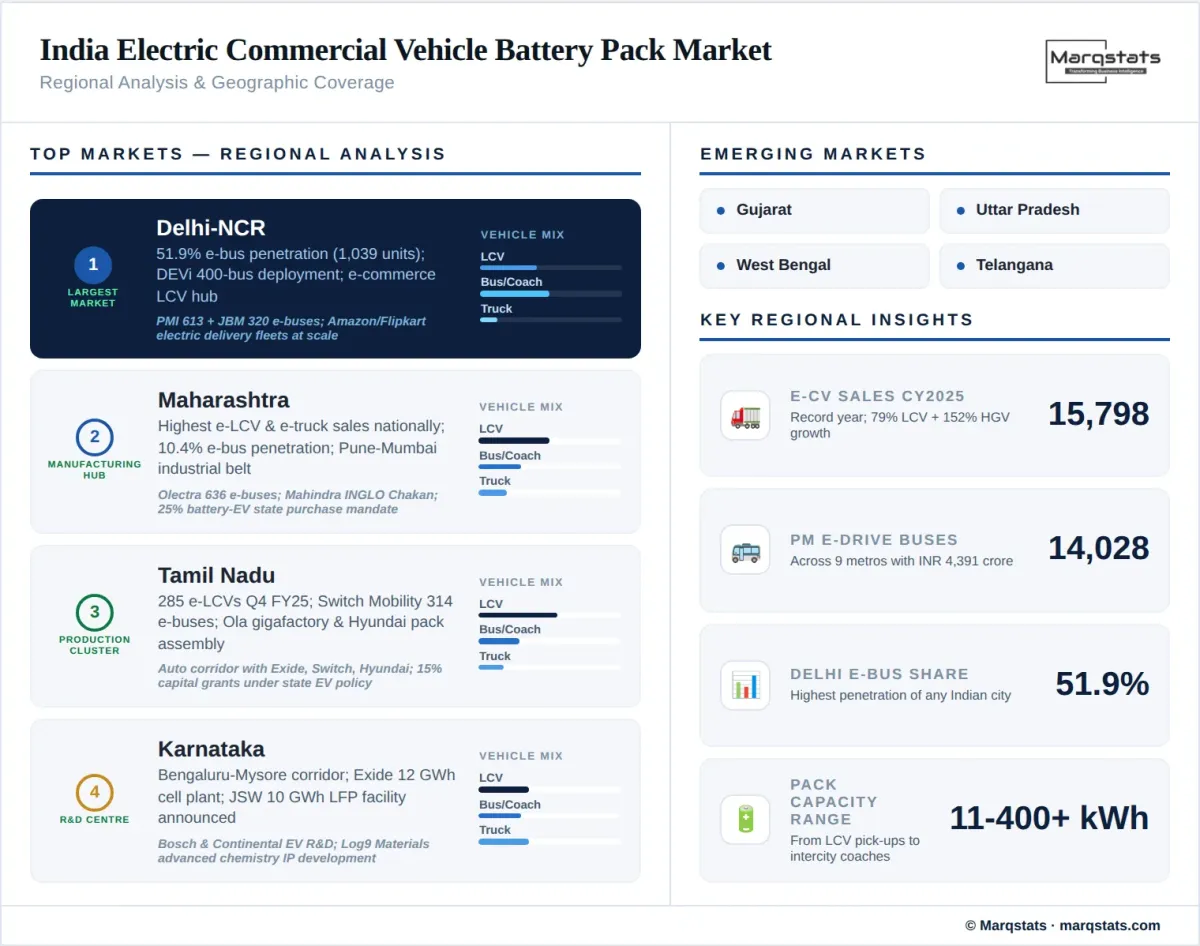
Delhi leads India in electric bus deployment with 51.9% e-bus penetration (1,039 units in Apr–Nov 2025). The DEVi initiative flagged off 400 electric buses in a single procurement round. PMI Electro Mobility (613 units) and JBM Auto (320 units) dominate Delhi’s e-bus market. Delhi-NCR also serves as a primary hub for e-commerce last-mile delivery fleets, with Amazon, Flipkart, and other operators deploying thousands of electric LCVs. JBM Auto’s manufacturing facility in the Delhi-NCR region produces its Ecolife modular e-bus platform.
Maharashtra
Maharashtra registered the highest e-LCV and e-truck sales nationally, with 357 e-goods carrier units in Q4 FY2025 alone (Tata: 244, Mahindra: 75). For e-buses, Maharashtra recorded 10.4% EV penetration (1,036 units), led by Olectra (636 units) and Pinnacle Mobility/EKA (269 units). MSRTC operates one of India’s largest e-bus fleets. The Pune-Mumbai industrial belt hosts multiple pack assembly facilities, and Mahindra’s Chakan plant produces INGLO battery packs. Maharashtra’s EV policy mandating 25% battery-electric share in state purchases anchors demand. For heavy goods carriers, Maharashtra leads with 153 units and 0.6% EV penetration.
Tamil Nadu
Tamil Nadu is a critical manufacturing and deployment hub, recording 285 e-LCV sales in Q4 FY2025 (Tata: 301, Mahindra LMM: 280, Switch: 162). Switch Mobility leads e-bus sales (314 units, 7.8% penetration). The state’s automotive corridor hosts Ola Electric’s gigafactory, Switch Mobility’s bus manufacturing, and Hyundai’s Chennai battery pack assembly. Tamil Nadu’s electricity-duty exemptions and 15% capital grants attract continued investment in commercial vehicle battery production.
Karnataka
Karnataka recorded 156 e-LCV units in Q4 FY2025 and hosts India’s premier R&D hub for EV battery technology. Exide Energy Solutions’ 12 GWh Bengaluru gigafactory and JSW Energy’s 10 GWh LFP facility serve as upstream supply anchors for commercial vehicle battery packs. Bengaluru’s concentration of technology companies and e-commerce operations drives substantial LCV battery pack demand.
Rest of India
E-bus deployments span Kerala, West Bengal, Madhya Pradesh, Odisha, and Assam with over 500 operational buses and plans to expand to 2,000+ by 2027. Pilot e-bus cities include Kochi, Kolkata, Bhopal, and Guwahati. Gujarat hosts major battery manufacturing with Tata Agratas’ 20 GWh Sanand facility and Reliance’s 30 GWh Jamnagar complex. Haryana recorded 63 e-truck units, led by Energy in Motion. For electric LCVs, the top five states account for 91.4% of total market share, reflecting concentrated adoption in commercial-industrial hubs. Tier-2 and Tier-3 cities represent the growth frontier as e-commerce logistics and municipal transport electrification expand beyond metropolitan areas.
How Competition Is Evolving
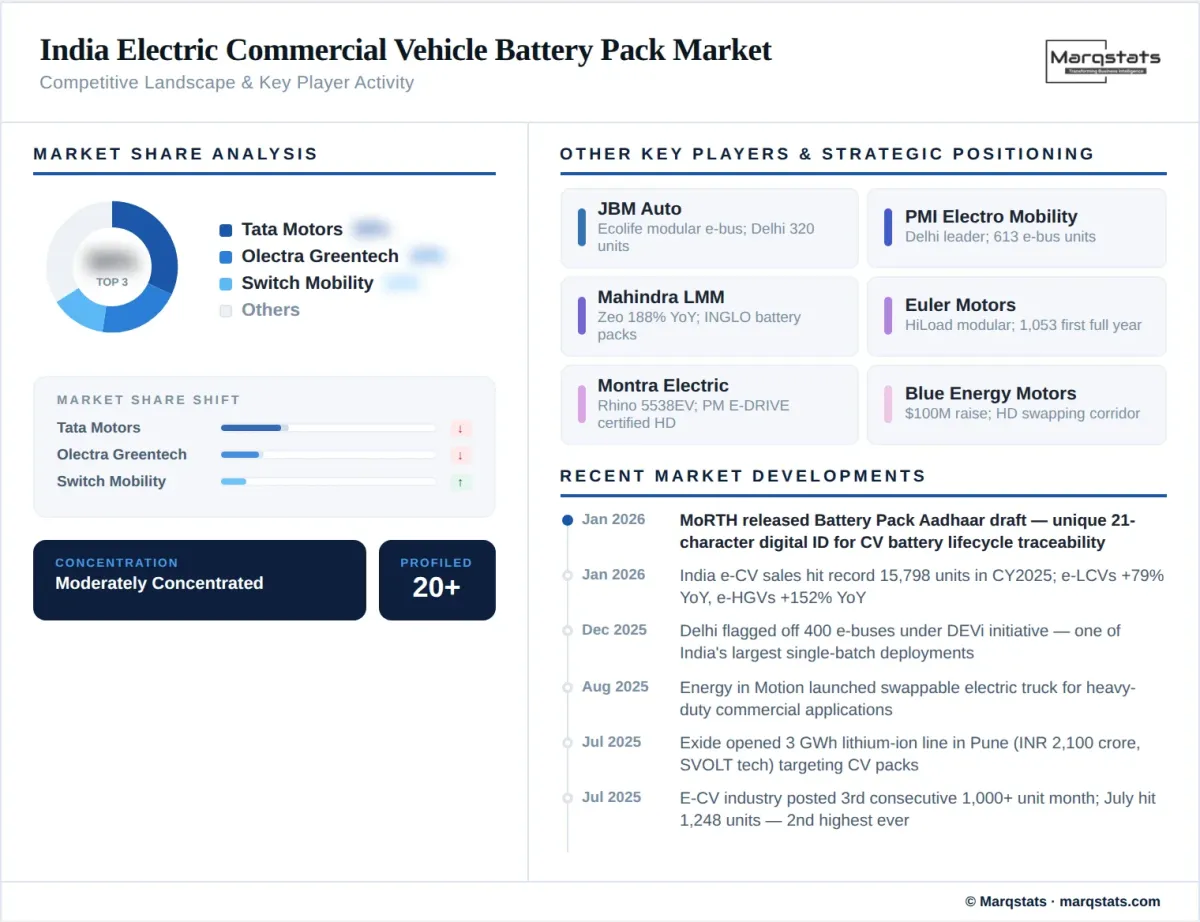
The India electric commercial vehicle battery pack market is moderately fragmented and undergoing rapid competitive restructuring. Tata Motors retained the overall e-CV market leadership in CY2025 with 4,785 units (30% share), but its dominance eroded significantly from 66% in CY2024 as competitors scaled aggressively. Mahindra Last Mile Mobility surged to second position with 2,548 units (16% share, +279% YoY), driven by the Zeo electric mini-truck. Switch Mobility, Ashok Leyland’s electric CV arm, posted 1,897 units (12% share, +245% YoY) across buses and LCVs. Euler Motors entered the top tier with 1,053 units (7% share) in its first full retail year. PMI Electro Mobility (1,041 units) and Olectra Greentech (1,027 units) recorded strong growth in the e-bus segment.
From a battery pack supply perspective, the competitive landscape features integrated OEMs assembling packs in-house (Tata through Agratas, Ola Electric for its 4680 cells, Mahindra), dedicated battery pack specialists (Exide Energy Solutions, Amara Raja Energy & Mobility, Octillion Power Systems, Cygni Energy, Geon), and international cell suppliers (CATL, LG Energy Solution, BYD) providing cells to domestic assemblers. Olectra’s strategic use of BYD’s Blade Battery technology for its bus fleet represents the most prominent cell-supplier-to-OEM relationship in the commercial segment.
Key competitive strategies in the commercial battery pack space include: (1) modular pack design for cross-platform commonality (Tata, Switch, JBM); (2) vertical integration from cell to pack to vehicle (Tata-Agratas, Exide’s gigafactory strategy); (3) technology licensing from Chinese partners (Exide-SVOLT, Amara Raja-Gotion) for accelerated manufacturing capability; (4) battery swapping ecosystems with AMC contracts (Montra’s 10-year/900,000 km offering); (5) SaaS-based fleet management and battery health telematics (JBM, Olectra); and (6) GCC/NCC contract models that bundle vehicle, battery, and maintenance to reduce fleet operator capital burden. The competitive intensity is expected to increase further as PLI-ACC gigafactories become operational during 2026–2028, expanding domestic cell supply and enabling new pack pricing strategies.
Companies Covered
The report profiles 20++ companies with full strategy and financials analysis, including:
Recent Market Activity
Table of Contents
Coverage & Segmentation
This report provides a comprehensive analysis of the India electric commercial vehicle battery pack market covering the historical period (2021–2025) and forecast period (2026–2030), with 2025 as the base year. The study examines market size in USD, unit volume forecasts, growth trends, competitive dynamics, and segment-level analysis across vehicle types (electric LCVs, M&HCVs, buses/coaches), battery chemistry (LFP, NMC, others), battery pack capacity bands (sub-25 kWh, 100–200 kWh, 200–400+ kWh), and state-level geographic analysis. Company profiling covers 20+ players spanning commercial vehicle OEMs, dedicated battery pack assemblers, cell manufacturers, and international cell suppliers.
Research methodology combines bottom-up market sizing by vehicle sub-segment and battery chemistry, validated against top-down estimates using VAHAN registration data, FADA retail sales figures, SIAM industry statistics, and company annual reports. Primary research encompasses interactions with fleet operators, state transport corporations, e-commerce logistics providers, bus/truck OEMs, and battery pack suppliers. Secondary research draws from Ministry of Heavy Industries notifications, PM E-DRIVE procurement data, state-level EV policy documents, and CESL tender data. Companion Marqstats reports on the India EV battery pack market, India electric bus market, India EV charging infrastructure market, and India EV battery swapping market provide integrated ecosystem intelligence.