What Happens When One Contract Can Flip a National Carrier Ranking?
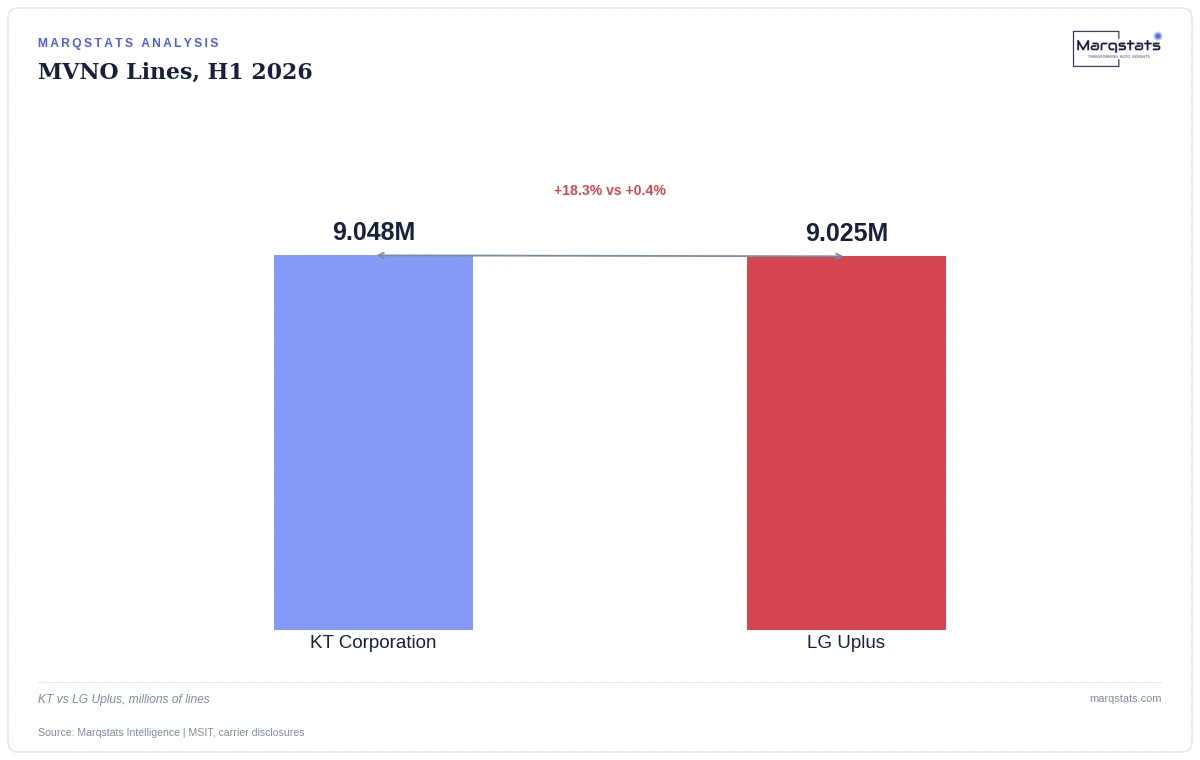
In brief: a single wholesale telematics contract with Hyundai Motor Group was large enough to flip South Korea's national MVNO carrier ranking within eighteen months, a striking illustration of how concentrated this particular telecommunications market really is. KT Corporation's September 2024 win of Hyundai's exclusive supply agreement, effective for vehicles built from January 2025, has driven KT's MVNO lines to 9.048 million by the first half of 2026 — 18.3% growth against LG Uplus's 0.4% — enough to reclaim a lead LG Uplus had held since 2024.
How Concentrated Is This, Really?
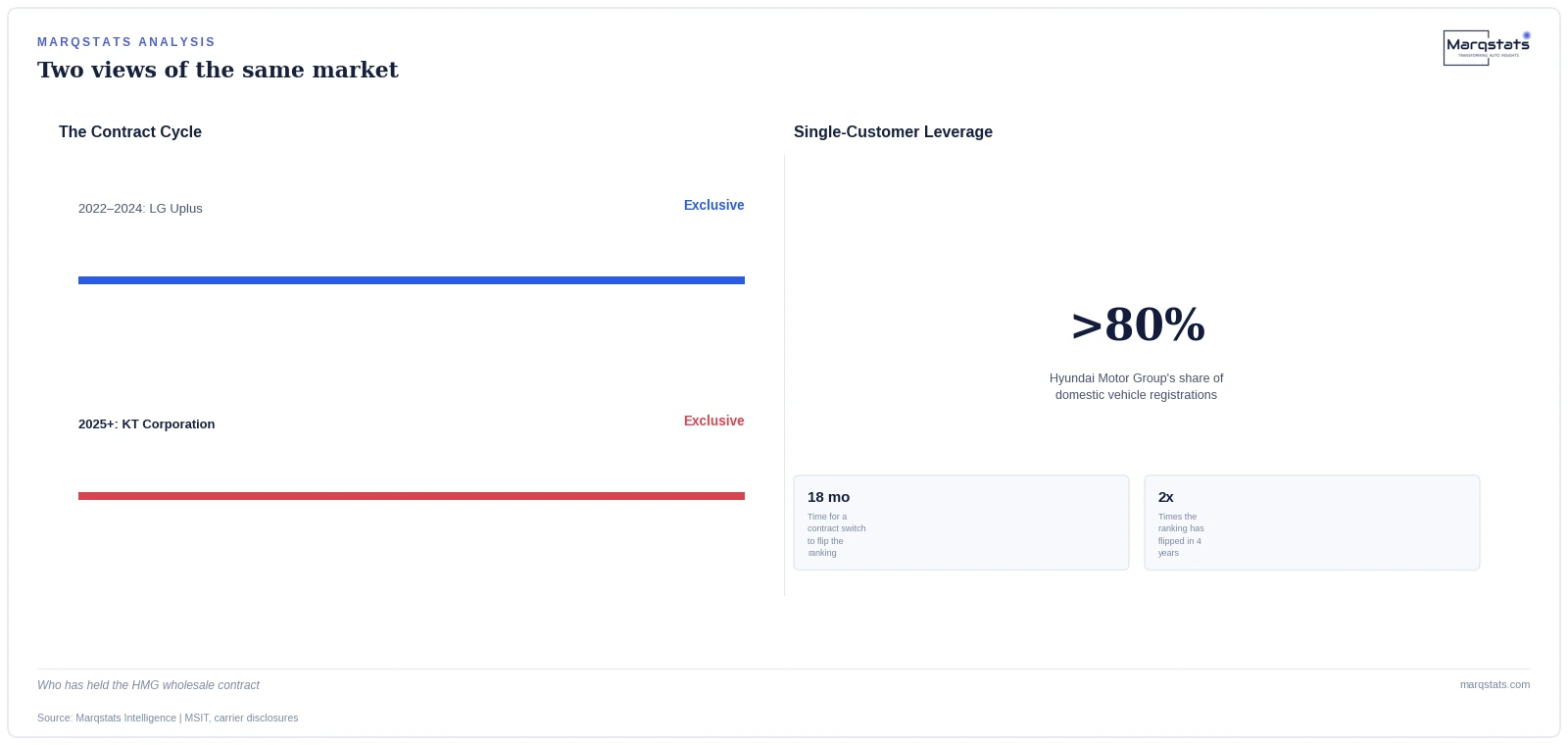
To be precise about the scale involved: Hyundai Motor Group — Hyundai, Kia and Genesis combined — captures more than 80% of annual domestic vehicle registrations. Every one of those vehicles ships with factory-installed telematics as standard equipment, and every one of those telematics lines is provisioned through whichever carrier holds the group's exclusive wholesale contract at the time the vehicle is built. That means a single procurement decision, made once every few years, directly determines a meaningful share of two carriers' reported total wireless connections — a level of customer concentration almost no other national telecommunications market carries.
The 2022 Precedent
This is not the first time the contract has moved the needle this visibly. When LG Uplus won the Hyundai Motor Group wholesale agreement in 2022, the automaker's active connected fleet stood at 2.8 million vehicles — 2.1 million Hyundai and 720,000 Kia. The agreement generated an estimated 50 billion KRW in annual connectivity revenue for LG Uplus and directly fed the IoT subscription growth that let LG Uplus surpass KT in total reported wireless connections for the first time, in September 2023. The pattern repeated in reverse once KT won the contract back for 2025-built vehicles.
One automotive procurement decision, repeated on a multi-year cycle, has now flipped South Korea's carrier rankings twice in four years.
— Marqstats Analyst Team
What the Wholesale Rate Itself Suggests
The estimated 50 billion KRW in annual connectivity revenue LG Uplus generated from its 2022 Hyundai Motor Group contract, against a connected fleet of 2.8 million vehicles at the time, implies a per-line wholesale rate in the range this coverage set cites elsewhere — roughly 1,500 to 2,500 KRW per line monthly. That is a thin per-line margin by any telecom standard, which makes the contract's real value to a carrier less about the wholesale revenue itself and more about the downstream effect on aggregate connection counts, carrier rankings, and the negotiating leverage that scale provides across other business lines entirely.
Why Legacy Fleet Doesn't Just Transfer
A carrier that loses the Hyundai Motor Group contract does not lose its existing subscriber base overnight. LG Uplus retains the legacy installed base of vehicles built during its 2022-to-2024 contract window — those vehicles keep their existing SIM provisioning until they are retired or the owner actively switches — while only newly produced vehicles are provisioned on KT's network going forward. That is precisely why the ranking flip took eighteen months rather than happening immediately at the September 2024 contract announcement: new production volume had to accumulate before it outweighed LG Uplus's existing base.
That transition dynamic also means LG Uplus's revenue exposure did not vanish the moment KT won the contract — it decays gradually, at the pace of South Korea's vehicle replacement cycle, as the 2022-to-2024 cohort ages and is eventually retired. A carrier planning around a lost automotive contract has a multi-year runway to build replacement revenue, not a cliff, which is worth remembering before assuming a contract loss translates into an immediate financial shock.
What the Carriers Themselves Dispute
KT has publicly challenged how much these rankings should matter in the first place, arguing that aggregating low-ARPU vehicle-control lines with high-ARPU consumer mobile phone subscribers distorts each carrier's actual competitive position. KT has previously noted its own substantially larger base of premium handset subscribers as the more meaningful competitive metric — an argument that becomes harder for either carrier to make consistently once the same automotive contract dynamic starts working in their own favour.
A Named Comparison: Does SK Telecom Even Compete for This Contract?
Notably absent from this entire cycle is SK Telecom, South Korea's largest mobile carrier by consumer subscriber count. SK Telecom holds the largest direct-MNO fleet share of the three carriers, built on partnerships with KG Mobility, Renault Korea and commercial fleet operators, but has never held the Hyundai Motor Group consumer wholesale contract in the period this analysis covers. That absence is worth noting precisely because it shows the ranking flip is not simply 'whichever carrier is biggest wins the contract' — Hyundai's own procurement choice, not overall carrier scale, is what determines who benefits.
One plausible explanation is that SK Telecom's consumer mobile business is large and profitable enough that a comparatively low-margin, high-volume automotive wholesale contract is less much less of a strategic priority to pursue than it is for KT or LG Uplus, both of which have used automotive IoT volume specifically to contest the number-two overall carrier position. For SK Telecom, sitting out this particular contract cycle may simply reflect a different set of priorities, not a failed bid.
How This Compares to Other Carrier Markets
Single-customer concentration of this magnitude is unusual even among markets with dominant national automakers. Japan's NTT Docomo, KDDI and SoftBank each serve multiple large domestic automakers without any single manufacturer commanding an 80%-plus share of new registrations the way Hyundai Motor Group does in Korea, which spreads automotive wholesale risk across several customer relationships rather than concentrating it in one. Korea's automotive market structure — two effectively co-owned national brands capturing the overwhelming majority of domestic sales — is what makes a single contract decision powerful enough to move national telecom statistics in the first place; the carrier dynamic described here is a downstream consequence of that automotive concentration, not an independent telecom-market phenomenon.
The comparison also suggests a plausible future path: as Korea's own auto market diversifies with more competitive imports and new domestic entrants, the single-contract leverage described here could gradually weaken, moving Korea's carrier dynamics closer to the more distributed pattern seen in Japan for its own domestic carrier and automaker relationships.
Outlook: One Trigger, Not Three
This market does not support a three-scenario outlook on carrier rankings specifically. The single evidenced trigger is the next Hyundai Motor Group wholesale contract cycle: whichever carrier wins it next will, on the same eighteen-month lag pattern already observed twice, eventually see its MVNO ranking move accordingly. No public timeline for the next contract renewal has been disclosed.
What a Foreign OEM Entrant Should Take From This
A foreign automaker weighing a Korean market entry should read this carrier dynamic as a warning about dependency, not merely a data point about Hyundai. Mercedes-Benz Korea's decision to build its "Mercedes me connect" platform on KT specifically, rather than negotiating separately with each carrier by region or model line, mirrors the same single-partner concentration that makes Hyundai's own carrier switches so consequential — the difference is scale, not structure. Any OEM entering Korea should expect that whichever carrier it selects will become a structural dependency, not simply a vendor relationship, and should negotiate contract-transition provisions accordingly rather than assuming a smooth handover if that relationship ever changes.
The Question This Analysis Cannot Yet Answer
What remains genuinely unknown, and worth watching closely, is how long KT's current lead will last. LG Uplus held its own lead for roughly two years before losing it, and nothing in the public record suggests the current contract with KT has a shorter or longer term than the 2022-to-2024 LG Uplus agreement did. Until Hyundai Motor Group discloses its next procurement timeline, or a contract announcement leaks through the same trade press that reported the 2022 and 2024 switches, any projection of how long KT holds its current MVNO lead is necessarily speculative — which is exactly why this analysis frames the next contract cycle as the market's single evidenced trigger rather than assigning it a specific date.
For a market analyst, the practical takeaway is to treat South Korea's carrier rankings as a lagging indicator of automotive procurement decisions rather than a leading indicator of underlying telecom demand — the ranking tells you who won a contract eighteen months ago, not who is winning the broader connectivity market today.