Hyundai Bluelink After the Free 5 Years: Is 11,000 Won a Month Worth It?
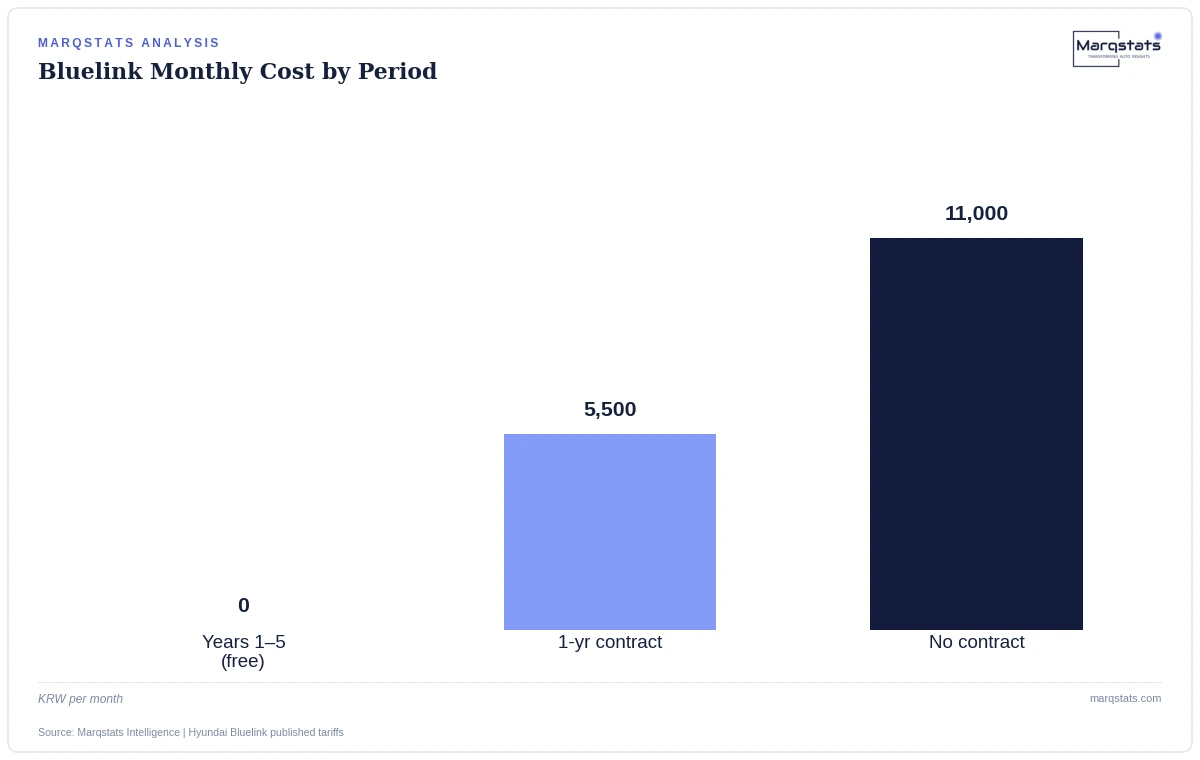
It depends entirely on which features you actually use. Hyundai bundles five years of complimentary Bluelink access with every new vehicle; after that, a one-year contract renewal costs 5,500 KRW a month, or 11,000 KRW a month with no contract commitment. Whether that is worth paying comes down to a simple test: do you use any Bluelink feature a free smartphone app cannot replicate?
What Bluelink Does That Your Phone Already Does
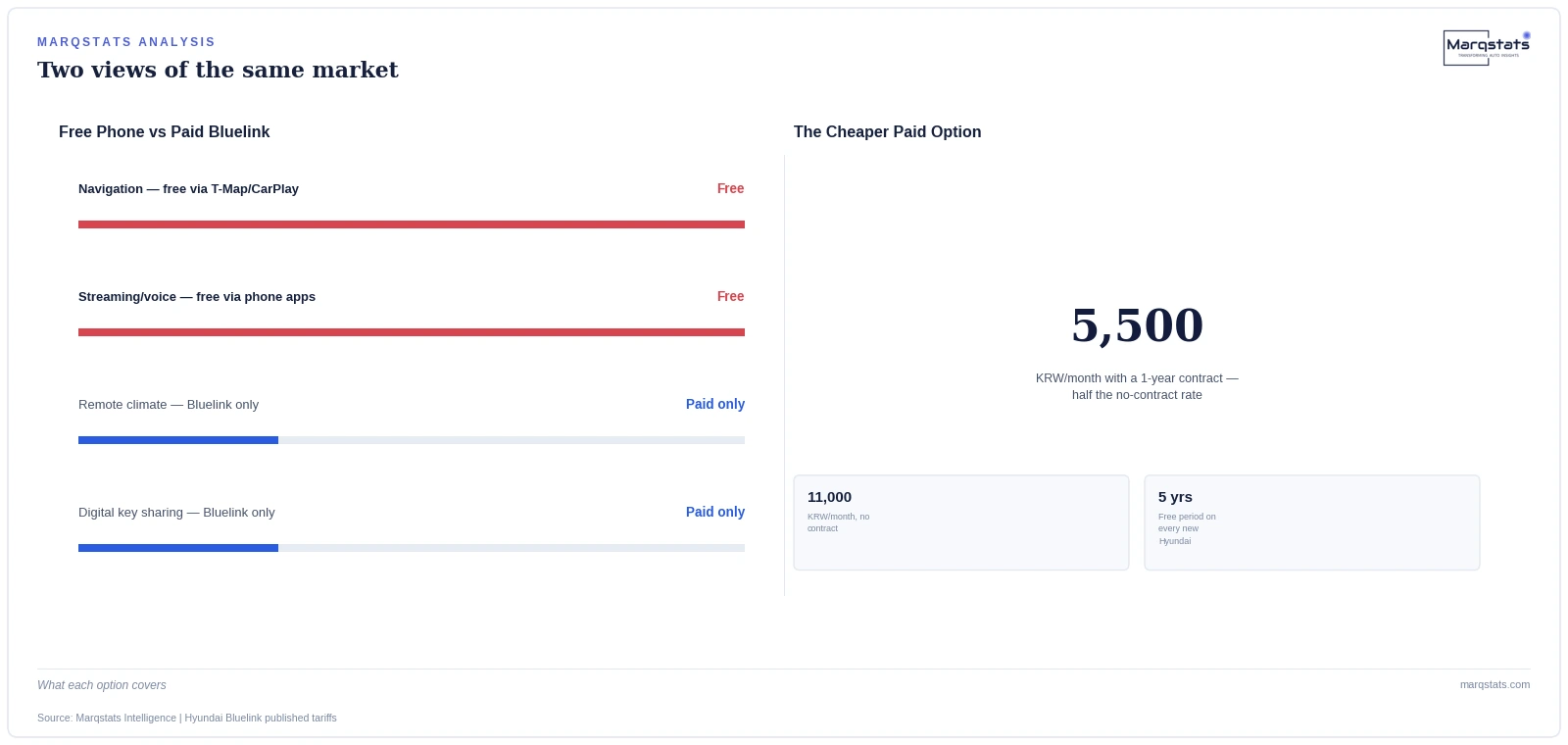
Dynamic navigation, live traffic rerouting, audio streaming and voice queries — the features most drivers interact with daily — are all available free through Apple CarPlay, Android Auto or T-Map, none of which require a Bluelink subscription at all. If these are the features that matter to you, letting Bluelink lapse costs nothing in practical capability.
What Bluelink Does That Your Phone Cannot
Remote climate pre-conditioning, digital key sharing, and vehicle security and theft monitoring require a persistent connection to the vehicle's own systems — capabilities a smartphone mirroring app cannot provide, because the phone has no independent link to the car once it is not physically connected. These are the features Hyundai's own retention strategy leans on, and they are the ones worth paying for if you use them regularly.
The Actual Decision
If your daily use of Bluelink is navigation, streaming or hands-free calling, cancel it — your phone already does the job for free. If you regularly use remote start on a cold morning, share digital keys with family members, or specifically value the security monitoring, the 5,500 KRW one-year contract rate is the better of the two paid options, since committing to a year cuts the monthly cost in half compared to the no-contract rate.
What About Kia Connect and Genesis Connected Services?
Kia Connect and Genesis Connected Services follow the same complimentary-then-paid structure as Bluelink, since all three brands sit under Hyundai Motor Group and share the underlying MVNO telematics infrastructure. The feature set is broadly comparable across the three brands — remote climate control, digital key, security monitoring — which means the same decision framework applies regardless of which HMG nameplate you drive: pay for what your phone cannot do, skip the rest.
Why the Carrier Behind Your Subscription Might Matter
Vehicles built during 2022 to 2024 run on LG Uplus's network; vehicles built from January 2025 onward run on KT's. For most owners this distinction is invisible day to day — the Bluelink app and pricing look identical regardless of which carrier provisions the underlying connection. It becomes relevant only in the rare case of a service outage or coverage gap specific to one carrier's network, in which case knowing which carrier your vehicle's build date puts you on can help you troubleshoot faster than assuming the issue is with Hyundai's app itself.
What If You Drive an Older Hyundai?
Owners of vehicles built before the 2018-to-2019 wave of five-year complimentary bundles face a slightly different calculation, since their free period may already have expired years ago on different terms than the current published tariff. If your Bluelink subscription lapsed some time back and you have not checked pricing since, it is worth confirming the current 5,500-to-11,000 KRW rate directly with Hyundai rather than assuming an older quote still applies — tariffs on connected-car subscriptions have moved during a period of broader telecom repricing across the Korean market.
A practical middle path also exists: pause rather than fully cancel. Hyundai's subscription structure allows owners to let the complimentary period lapse without immediately committing to a paid tier, keeping the option open to subscribe later — for a road trip requiring remote monitoring, or a period of lending the car to a family member who would benefit from digital key sharing — without paying for months where none of Bluelink's paid features would actually be used.