Market Snapshot
Key Takeaways
Market Overview & Analysis
Report Summary
The Saudi Arabia wireless EV charging market comprises stationary and dynamic wireless charging installations deployed in the Kingdom for commercial fleets, autonomous vehicles and other road vehicles, together with the ground-side hardware, power electronics, vehicle-side receivers and installation that bring a site into service. Market value is annual investment in sites entering service, calculated as installations commissioned in each year multiplied by a blended per-site investment. The installed site count is reported alongside value at every point. On this basis the market opens at USD 0.42 million and one commercial site in 2026, against zero verified operating sites in 2025.
Wireless Charging Site Count and Installation Forecast
Commercial wireless charging sites in Saudi Arabia rise from zero in 2025 to one in 2026 and 19 by 2030, a 108.78% compound annual growth rate measured from the 2026 base, reaching 40 sites by 2031. Growth is measured across four years rather than five because 2025 carried no commercial volume, and the installed base is a stock that accumulates while market value reflects only the sites commissioned in each year.
Site count and market value diverge by 64 percentage points, 108.78% against 44.28%, the widest gap in any Saudi fleet infrastructure market and a direct consequence of how early this technology sits on its cost curve. Blended investment per site falls from USD 420,000 to USD 260,000 as ground-side hardware moves from pilot pricing toward volume pricing and installation practice standardises. The indicative range around the base is wide by construction — one to two sites in 2026 and 25 to 60 in 2031 — and confidence is low, because a single deployment decision by a single operator moves the count by a material percentage.
Three boundaries define the market. Laboratory and demonstration installations outside Saudi Arabia are excluded from volume, however relevant the technology, because a reference architecture proven elsewhere is not a Saudi site. Dynamic roadway charging is analysed as technology optionality but carries no site in the base case, since it would require road authority, utility and civil infrastructure approvals that no Saudi project has sought. Conventional plug-in charging is excluded entirely and belongs to the fleet depot charging market; where a depot carries both, only the wireless installation is counted here.
The relationship to adjacent Saudi infrastructure markets is one of specialised subset rather than overlap. Fleet depot charging covers the conventional plug-in energy layer at commercial depots and is substantially larger. Autonomous vehicle depot infrastructure covers the wider automation layer — staging, remote supervision, calibration — of which automated energy transfer is one function, and wireless charging is one way of delivering that function. A wireless installation at an autonomous depot is counted in both this market and the depot infrastructure market, because one measures the technology supplied and the other measures the depot capability created.
Market Dynamics
Key Drivers
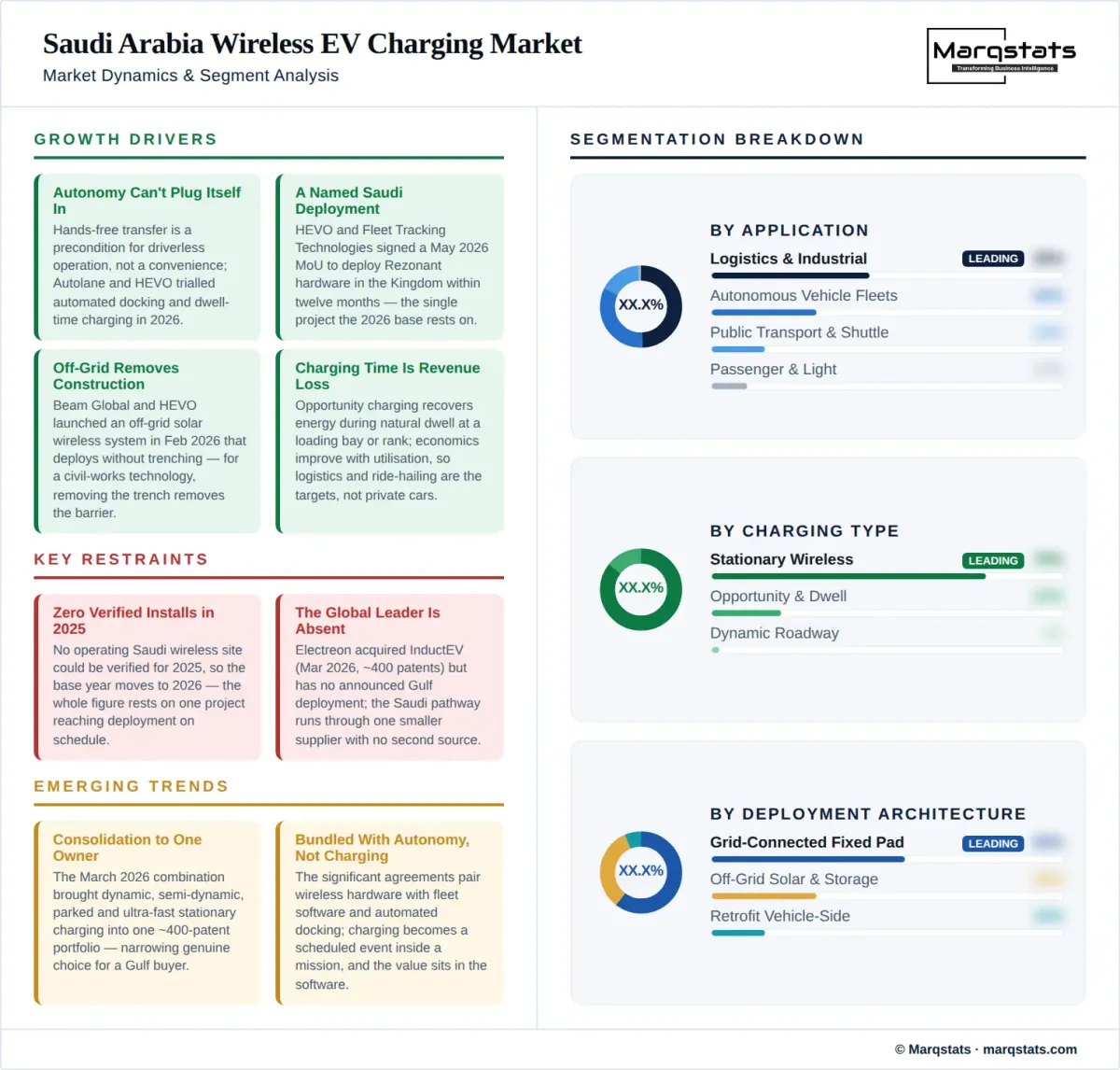
- Autonomous fleets that cannot plug themselves in. Hands-free energy transfer is a precondition for driverless operation rather than a convenience, and it is the only charging method that removes the last manual task from an autonomous duty cycle. Autolane and HEVO announced a partnership in March 2026 combining autonomous curbside orchestration with hands-free wireless charging, with 2026 commercial trials testing automated docking, dwell-time charging and integration of charge events into mission planning.
- A named Saudi deployment with a stated timeline. HEVO and Saudi-based Fleet Tracking Technologies announced a memorandum of understanding in May 2026 to deploy Rezonant wireless charging hardware and the Journey software platform in the Kingdom, targeting a first commercial deployment within twelve months and explicitly aiming at logistics fleets, industrial operators and autonomous vehicle programmes. This is the single project the 2026 base rests on.
- Off-grid architectures that remove construction from wireless deployment. Beam Global and HEVO launched an integrated system in February 2026 combining wireless hardware with an off-grid solar platform that deploys without trenching or permanent utility connection. For a technology whose ground-side installation is otherwise a civil works project, removing the trench removes the largest single barrier to siting a pilot quickly.
- High-utilisation duty cycles where charging time is revenue loss. Opportunity charging during natural dwell — at a loading bay, a taxi rank, a depot stand — recovers energy in windows that a plug-in session cannot use, because nobody is present to connect and disconnect. The economics improve with utilisation rather than with distance, which is why logistics, ride-hailing and industrial fleets are the target applications rather than private vehicles.
- Robotaxi commitments that create the first at-scale hands-free requirement. WeRide and Uber agreed in February 2026 to deploy at least 1,200 robotaxis across Abu Dhabi, Dubai and Riyadh as soon as 2027, on a model where fleet operations sit with Uber or local partners. A driverless fleet at that scale cannot be plugged in manually, which converts wireless charging from a technology demonstration into an operating requirement.
Key Restraints
- Zero verified commercial installations in the Kingdom to date. No operating Saudi wireless charging site could be verified for 2025, which is why the base year moves to 2026 and why confidence is low. The entire 2026 figure rests on one announced project reaching commercial deployment on schedule, and a single slipped timeline moves the base year rather than merely the growth rate.
- The global technology leader has no Saudi presence. Electreon completed its acquisition of InductEV in March 2026, combining dynamic and semi-dynamic roadway charging with ultra-fast stationary charging for heavy-duty transit and freight under roughly 400 granted and pending patents. Neither the acquirer nor the target has an announced Gulf deployment, so the Kingdom's stated pathway runs through a supplier outside the consolidated leader — a supply concentration risk with no second source.
- Vehicle-side receiver compatibility, not ground-side hardware, gates adoption. A wireless pad charges only vehicles fitted with a compatible receiver, and receivers are neither standard equipment nor easily retrofitted across a mixed fleet. Standardisation will determine whether suppliers move from single-fleet pilots to broader deployment, and until it settles an operator specifying wireless today is committing its vehicle procurement to one supplier's ecosystem.
- Technology proof is not commercial approval. Any Saudi deployment remains subject to electrical, site and vehicle-compatibility approvals, and wireless systems must coexist with the CCS fast-charging infrastructure and fleet management already in place. Dynamic roadway charging would additionally require road authority, utility and civil infrastructure consent that no project has sought, which is why it carries no site in the base case.
Key Trends
- Consolidation into a single global technology owner. The March 2026 combination brought dynamic highway charging, semi-dynamic burst charging at stop-and-go locations, hands-free parked charging and ultra-fast heavy-duty stationary charging into one portfolio backed by roughly 400 patents. For a Gulf buyer this narrows genuine technology choice sharply, and it raises the strategic value of any supplier positioned outside that portfolio.
- Wireless charging bundling with autonomy rather than with charging. The commercially significant agreements pair wireless hardware with fleet software, mission planning and automated docking rather than with energy retail. Charging becomes a scheduled event inside a vehicle's mission rather than a stop the driver makes, and the software integration is increasingly where the value sits.
- Dynamic roadway charging advancing on patents while stationary advances on projects. A dynamic roadway charging patent issued in August 2026 covers wireless power transfer from pads embedded along a roadway to moving vehicles, and the consolidated global portfolio includes a deployed dynamic product. Commercial activity in the Kingdom, however, remains entirely stationary, and the gap between patent activity and Saudi project activity is the clearest signal of where the technology actually stands.
- Off-grid and solar-backed siting becoming the default for early installations. Because ground-side wireless installation is civil works, pairing it with an off-grid solar and storage platform that needs neither trenching nor utility connection removes the two longest lead items at once. For pilot deployments where speed of proof matters more than throughput, this is becoming the standard configuration.
Market Segmentation
Stationary wireless charging, in which a vehicle parks over a fixed ground pad and charges without connection, accounts for effectively the entire market across the forecast. It is the only type with an announced Saudi deployment pathway, and it is the configuration that suits depot, loading bay and rank applications where vehicles dwell in known positions. Investment per site is dominated by ground-side hardware, power electronics and installation.
Opportunity charging places pads at points where vehicles stop as part of normal operation — taxi ranks, loading bays, terminal stands — recovering energy in short windows rather than during a dedicated session. The application is technically stationary but commercially distinct, because it is sized around route dwell patterns rather than depot capacity and it favours higher power at lower utilisation per pad. It grows fastest across the forecast as fleet operators map charging onto existing stops.
Dynamic roadway charging transfers power from pads embedded along a road surface to vehicles in motion, and a patent covering that architecture was issued in August 2026 while a deployed dynamic product exists in the consolidated global portfolio. No Saudi project has been announced, and deployment would require road authority, utility and civil infrastructure approvals beyond anything a depot installation needs. The segment carries no site in the base case and is treated as long-term optionality.
Logistics and industrial fleets are the largest application by investment across the forecast and the primary target of the announced Saudi deployment. Return-to-base operation gives known parking positions, high daily utilisation makes charging time expensive, and industrial sites often have the space to install ground-side hardware without disrupting existing operations. The segment carries the clearest payback case in the near term.
Autonomous vehicle fleets are the fastest-growing application and the one where wireless charging is a requirement rather than an option, because a vehicle with nobody aboard cannot connect a cable. Regional robotaxi commitments of at least 1,200 vehicles across three Gulf cities as soon as 2027 create the first at-scale hands-free charging requirement, and automated docking integrated into mission planning is being trialled commercially during 2026.
Public transport and shuttle applications suit opportunity charging at terminal stands and layover points, where vehicles stop repeatedly at fixed positions on a published timetable. Ultra-fast stationary charging for heavy-duty transit is an established product line in the consolidated global portfolio, though no Saudi transit deployment has been announced. The segment is modelled as later-period and contingent on public procurement rather than fleet economics.
Passenger and light commercial vehicle charging is the smallest application throughout and is deliberately modelled that way. Private charging is a convenience case rather than an operating case, and the cost of a wireless installation against a domestic or workplace plug-in charger is not recovered by removing a task a driver performs in seconds. The segment contributes to site count only where it shares infrastructure with a fleet application.
Charging up to 11 kW serves light vehicles and long-dwell applications where replenishment can spread across hours of idle time. Hardware cost per installation is the lowest of the three bands and siting requirements are the least demanding, which makes it the entry configuration for a first pilot. Its share of investment value declines across the forecast as fleet duty cycles push power requirements up.
The 11 to 50 kW band matches most commercial fleet duty cycles, delivering a usable top-up inside a loading window or a between-shift stop without the grid demand of high-power charging. It is the working middle of the market and takes the largest share of installations across the forecast, and it is the band where off-grid solar and storage platforms can realistically supply the load.
Above 50 kW serves heavy-duty transit and freight applications where dwell is short and vehicle energy demand is large, and ultra-fast stationary hands-free charging for exactly this duty is an established product line internationally. Cost per installation is the highest of the three bands and grid demand is material. The segment appears late in the Saudi forecast and is contingent on heavy commercial electrification rather than on wireless technology readiness.
Grid-connected fixed pads are the conventional architecture, drawing from utility supply through a permanent connection with ground-side hardware installed into the surface. The configuration supports the widest power range and the highest throughput per pad, and it carries the longest lead time because installation is civil works and utility connection proceeds in sequence rather than in parallel.
Off-grid solar and storage architectures pair wireless hardware with a self-contained solar and battery platform requiring neither trenching nor permanent utility connection, an integrated version of which reached market in February 2026. Removing the two longest lead items makes this the fastest route to a proven pilot, and Saudi solar resource is exceptional. Throughput per site limits the architecture to lighter duty cycles for now.
Retrofit vehicle-side integration covers fitting receivers to vehicles that did not leave the factory with them, and it is the part of the value chain most likely to constrain adoption. A ground pad without a compatible fleet is inert, so early deployments carry vehicle-side cost that a plug-in installation does not. The segment grows with fleet standardisation and is the clearest indicator of whether wireless moves beyond single-operator pilots.
By Geography
Riyadh Region
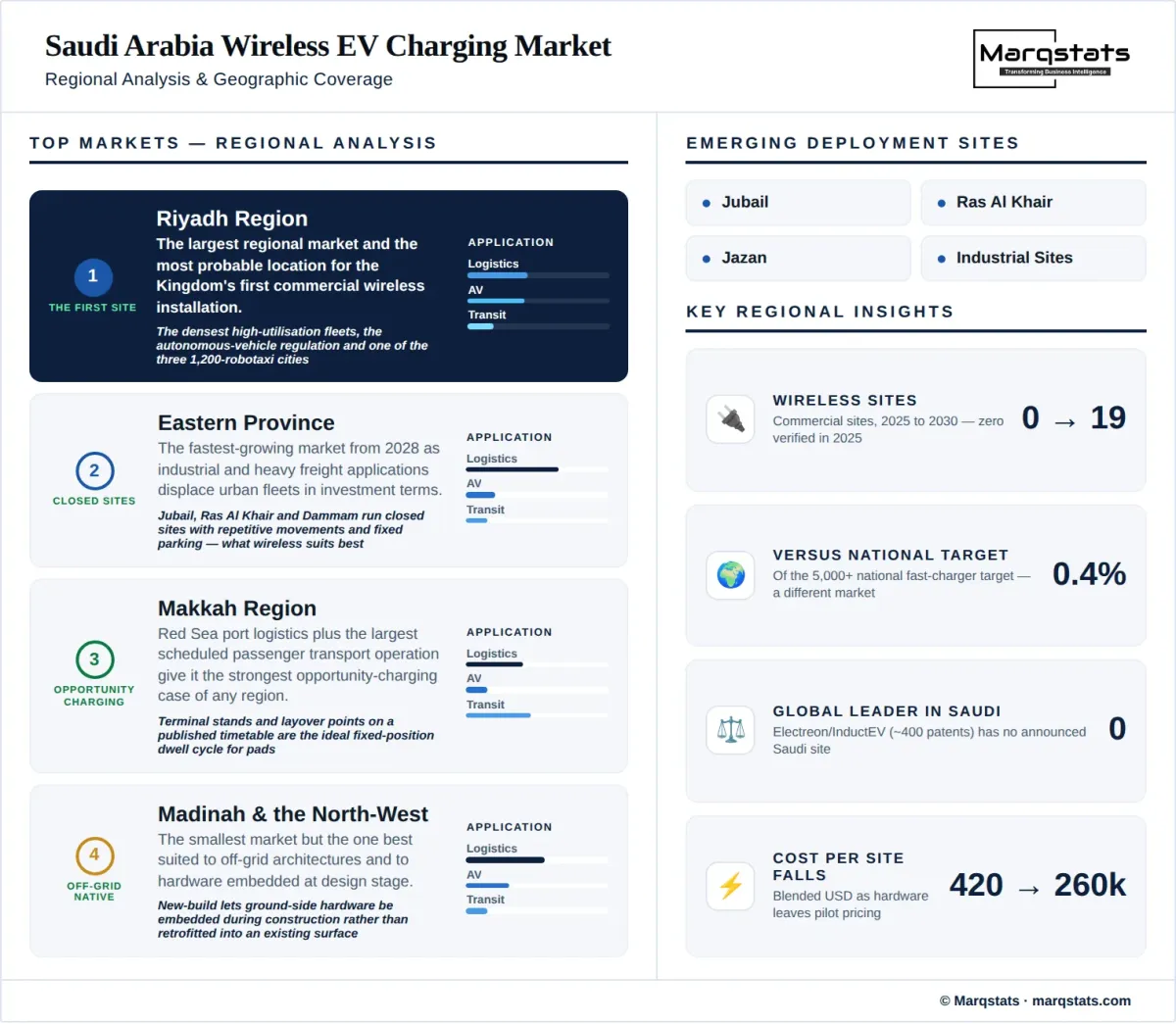
Riyadh is the largest regional market throughout the forecast and the most probable location for the Kingdom's first commercial installation. It holds the densest concentration of high-utilisation fleets, the regulatory activity around autonomous vehicle operation, and one of the three cities named in the regional robotaxi commitment. Logistics, ride-hailing and corporate fleets in the capital give the widest choice of anchor operator for a first site.
Eastern Province
The Eastern Province is the fastest-growing regional market from 2028 as industrial and heavy freight applications displace urban fleets in investment terms. Jubail, Ras Al Khair and the Dammam port complex operate closed and semi-closed sites where vehicle movements are repetitive and parking positions fixed — the conditions wireless charging suits best — and where site control makes ground-side installation straightforward.
Makkah Region
The Makkah Region combines Red Sea port logistics with the largest scheduled passenger transport operation in the country, giving it the strongest opportunity-charging case of any region. Terminal stands and layover points serving high-frequency shuttle operations are the natural application, and vehicles returning repeatedly to fixed positions on a timetable are the ideal duty cycle. Deployment follows the two leading regions in the modelled path.
Madinah Region and the North-West
The Madinah Region and the wider north-west, including Yanbu, Tabuk and the NEOM development area, form the smallest regional market but the one best suited to off-grid architectures and to installations specified at design stage. New-build development allows ground-side hardware to be embedded during construction rather than retrofitted into an existing surface, which removes the largest cost element of a wireless installation.
Rest of Saudi Arabia
The remaining regions hold a negligible share of installations throughout the forecast. Fleet density is too low to justify dedicated wireless infrastructure, and the technology's economics depend on high utilisation of a fixed installation rather than on coverage. Any later-period deployment is most likely at industrial sites with captive vehicle movements rather than in general commercial use.
How Competition Is Evolving
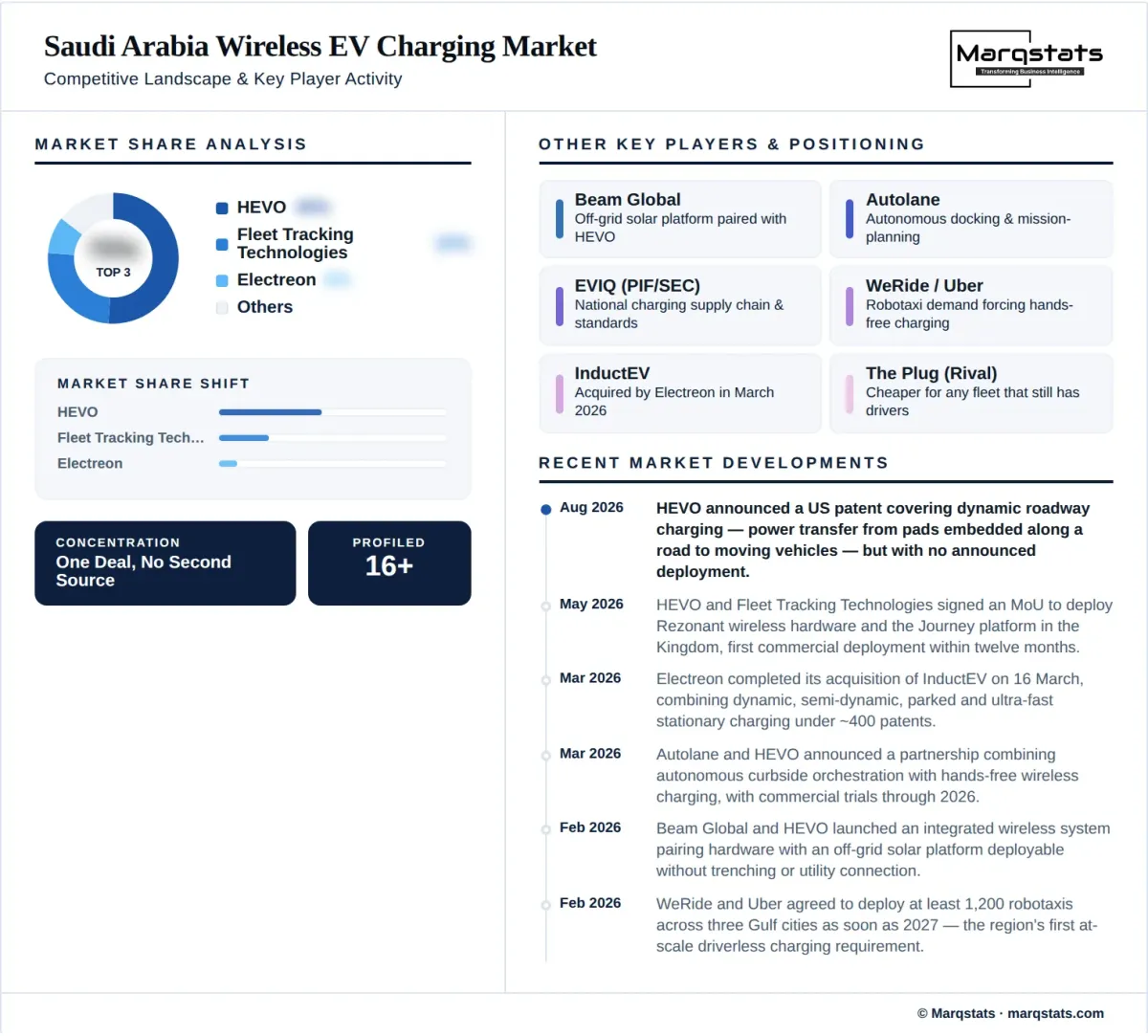
The Saudi Arabia wireless EV charging market is highly concentrated, and it is concentrated on a single announced supplier relationship rather than on a competitive field. One agreement — between a United States wireless charging specialist and a Saudi fleet technology company — accounts for the entire near-term deployment pathway, and no competing supplier has announced a Kingdom project. There is no installed base to compete for, no tender history, and no second source. Market share before 2028 describes one project rather than a competitive outcome.
The global picture changed materially in March 2026, and it changed in a direction that matters for Gulf buyers. Electreon completed its acquisition of InductEV, bringing dynamic highway charging, semi-dynamic burst charging at stop-and-go locations, hands-free charging for parked vehicles and ultra-fast heavy-duty stationary charging into a single portfolio backed by roughly 400 granted and pending patents across passenger vehicles, light delivery vans and Class 8 trucks. Genuine technology alternatives narrowed at exactly the point the Kingdom began procuring.
Neither the acquirer nor the acquired company has an announced Saudi or wider Gulf deployment, which produces an unusual structure: the technology leader is absent from the market and the market's only announced supplier sits outside the leading portfolio. That cuts both ways commercially. It gives the incumbent supplier a clear run at the first installations and a defensible position if it converts them into an installed base; it also leaves a Saudi operator specifying wireless today dependent on a single supplier with no alternative source, at a moment when the patent position around the technology is consolidating elsewhere.
Competition in the near term is therefore not between wireless suppliers but between wireless charging and the plug. Every fleet evaluating hands-free energy transfer is also evaluating whether a conventional connector, a robotic arm or simply a driver solves the same problem more cheaply, and for any fleet that still has drivers the plug usually wins. The technology's competitive position strengthens precisely as vehicles lose their drivers, which is why the announced Saudi pathway targets autonomous programmes and high-utilisation logistics rather than general fleet charging.
Companies Covered
The report profiles 16+ companies with full strategy and financials analysis, including:
Recent Market Activity
Table of Contents
Coverage & Segmentation
This report covers stationary and dynamic wireless electric vehicle charging installations in Saudi Arabia serving commercial fleets, autonomous vehicles and other road vehicles, with 2026 as the base year and 2027 – 2030 as the forecast period. Market size is annual investment in sites entering service, reported in US dollars and corroborated at every point by the installed commercial site count. Segmentation covers charging type, application, power level and deployment architecture, with regional analysis for the Riyadh Region, the Eastern Province, the Makkah Region, the Madinah Region and the north-west, and the rest of Saudi Arabia.
The base year is 2026 rather than the house standard of 2025, and the departure is arithmetic. Commercial wireless charging volume in the Kingdom was zero in 2025 with no verifiable operating site, and a compound growth rate cannot be computed from a zero base. The 2025 zero is carried as a historical observation rather than discarded, and all growth rates are measured across four years from 2026. Any figure presented as a 2025-based compound rate for this market is undefined rather than merely uncertain.
Four boundaries define the market perimeter. First, laboratory and demonstration installations outside Saudi Arabia are excluded from volume however relevant the technology, since a reference architecture proven elsewhere is not a Saudi site. Second, dynamic roadway charging is analysed as long-term optionality and carries no site in the base case, because it requires road authority, utility and civil infrastructure approvals no Saudi project has sought. Third, installed sites are a stock and annual investment is a flow: the 2030 value reflects the seven sites commissioned that year, not the 19 then installed. Fourth, conventional plug-in charging is excluded and belongs to the fleet depot charging market; at a depot carrying both, only the wireless installation is counted here.
Sizing this market as a share of national charging infrastructure would be the defining error, and it would overstate it by an order of magnitude. Wireless charging is a specialised technology subset serving fleet automation, not a percentage of the chargers a country installs: 19 sites by 2030 sits against a national target above 5,000 fast chargers, and the two are driven by different demand entirely — one by vehicle electrification, the other by the removal of drivers. Confidence is low by construction, with an indicative range of one to two sites in 2026 and 25 to 60 in 2031, because a single deployment decision by a single operator moves the count materially. The 2030 installed base of 19 sites sits on the same geometric path as the 2031 endpoint of 40.