Market Snapshot
Middle bar: base-year value × (1 + CAGR), rounded to two decimals. This is a calculated illustration, not a separately researched annual estimate.
The Middle East electric bus market is estimated at USD 148.8 million in 2025 and is projected to reach USD 333.5 million by 2030, at a CAGR of 17.52%. Deliveries rise from 480 zero-emission buses a year to 1,150, a 19.09% CAGR, with Israel taking 60% of 2025 volume on the region's only zero-emission purchase mandate and Qatar operating a public transport fleet that is already roughly 70% electric.
Market size and forecast figures are generated using Marqstats' proprietary estimation framework, updated as of September 2026.
This report counts new zero-emission buses — battery-electric, with a small hydrogen fuel-cell volume — delivered across the Middle East, spanning the Gulf Cooperation Council states, Israel, Jordan and the wider Levant. Intercity coaches are excluded where separable, as is charging infrastructure, which the Marqstats Middle East EV Charging Station report covers. The Marqstats Electric Bus report is the global parent; this is the regional cut carrying the mandate-versus-showcase divide that defines Middle Eastern demand.
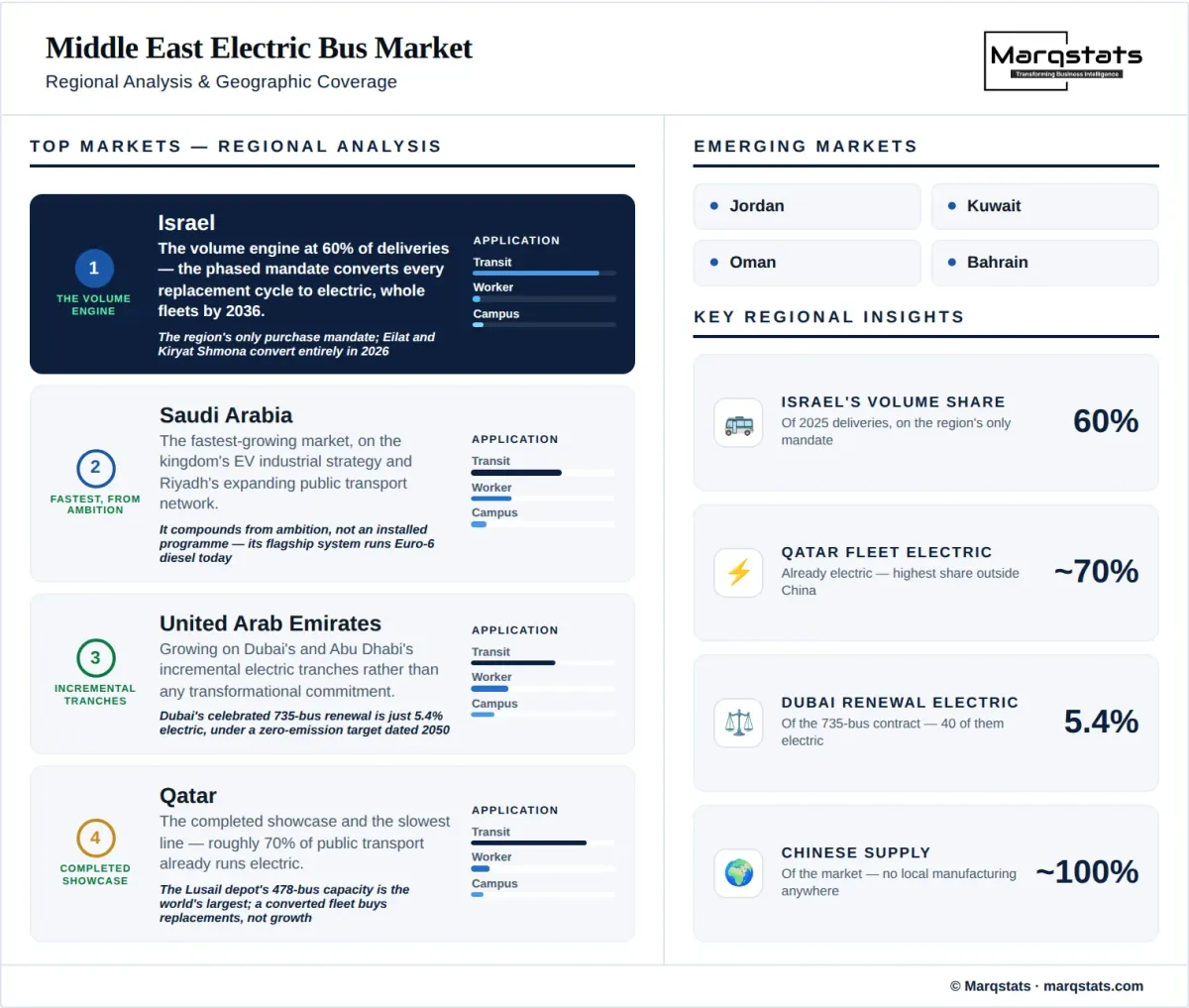
The region contains three different markets wearing one name. Qatar is a completed showcase: its World Cup fleet made public transport roughly 70% electric and built the world's largest electric bus depot, but a converted fleet buys few new buses. Israel is the volume engine: a phased purchase mandate reached 100% zero-emission for new public transport buses in 2026, converting every replacement cycle into electric demand. And the Gulf's headline programmes are smaller than they read — Dubai's celebrated 735-bus renewal contains just 40 electric vehicles, with a zero-emission target set for 2050, two decades behind Qatar's.
Key Takeaways
Market Overview & Analysis
Report Summary
This report sizes the Middle East electric bus market — new zero-emission buses delivered to public transport authorities, franchise operators and corporate fleets across the Gulf, Israel and the Levant. It is a region where bus electrification decisions are made by a handful of state buyers rather than by markets: a ministry order converted Qatar's fleet in two years for a World Cup, a ministerial mandate converts Israel's at replacement rate, and the Gulf monarchies' programmes advance at the pace their national visions assign them.
The market's history explains its shape. Deliveries spiked near 450 buses in 2022 as Qatar took the bulk of a roughly 741-bus Yutong fleet for the World Cup — with the Lusail depot, at a capacity of 478 buses, recognised as the largest electric bus depot in the world — then collapsed to about 180 in 2023 once the showcase was complete. Growth since is Israeli: the phased purchase mandate lifted deliveries to about 320 in 2024 and 480 in 2025, and from 2026 every new public transport bus Israel buys must be zero-emission, with Eilat and Kiryat Shmona converting their entire city fleets in the first mandate year.
The forecast turns on whether the Gulf's stated ambitions become orders. Saudi Arabia is modelled as the fastest-growing market at 34.44% from a 58-bus 2025 base, on Riyadh's expanding network and the kingdom's electric vehicle industrial push — but its flagship bus system runs Euro-6 diesel today, and the report treats Saudi volume as compounding from ambition rather than from an installed programme. The United Arab Emirates grows at 28.18% on Dubai's and Abu Dhabi's incremental electric tranches, and Qatar's replacement-only demand grows slowest, at 10.89%.
Money and mandates diverge across the region in a way no other market in this series shows. The Gulf states have sovereign capital but soft targets — 2050 in Dubai's case — while Israel has hard targets and ordinary municipal budgets. The result is that the region's poorest large buyer produces most of its demand, and the wealthiest produce showcases: a pattern that holds through the forecast and that any reader projecting Gulf wealth into bus volume will get wrong.
Market Dynamics
Key Drivers
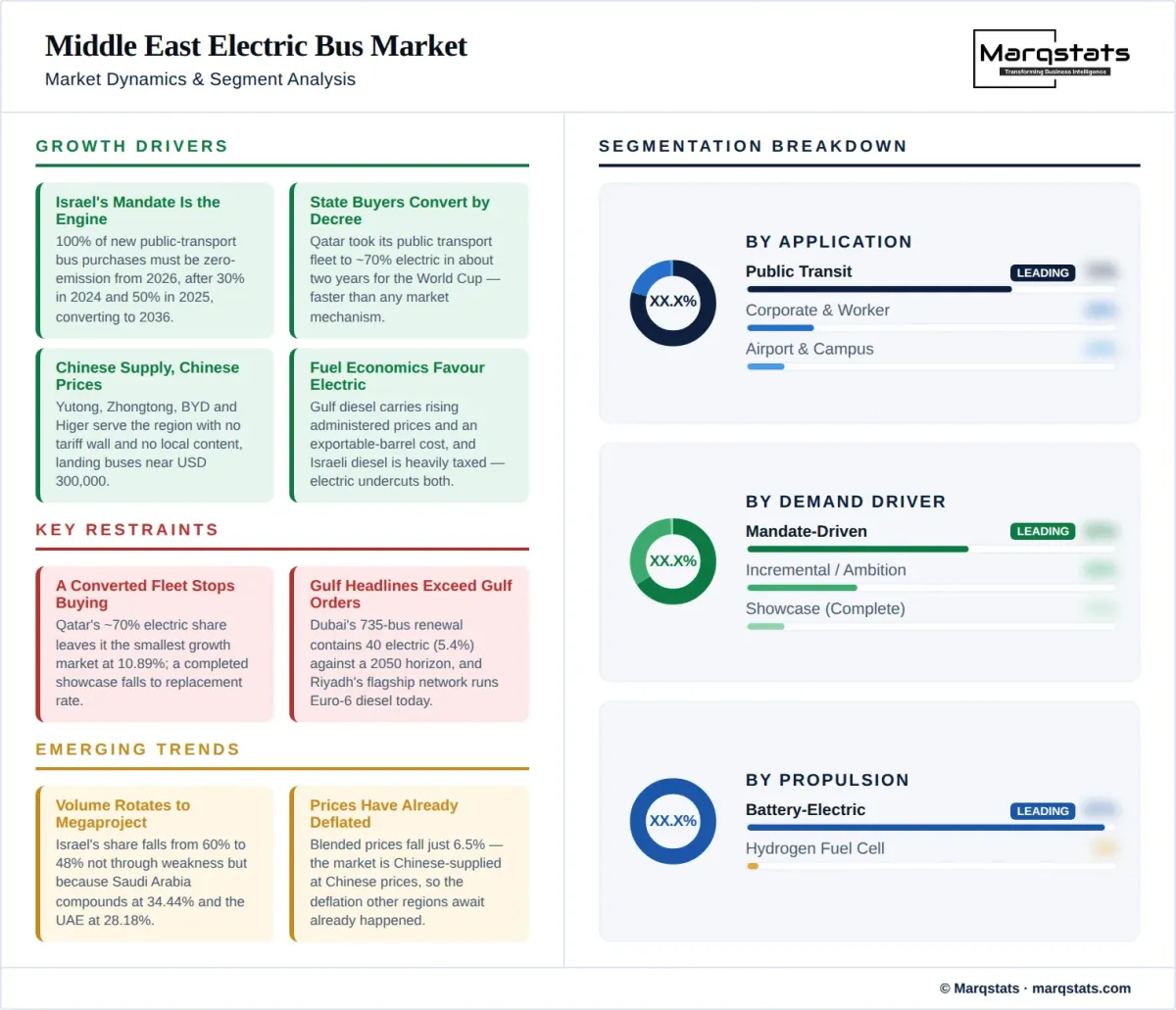
Israel's purchase mandate is the region's demand engine: 100% of new public transport bus purchases must be zero-emission from 2026, after floors of 30% in 2024 and 50% in 2025, with the full municipal fleet converting by 2036 — turning roughly a decade of replacement cycles into guaranteed electric volume.
State buyers can convert fleets by decree. Qatar took its public transport fleet to roughly 70% electric in about two years for the World Cup, proving that a Gulf state that decides to electrify can do so faster than any market mechanism anywhere.
Chinese supply arrives at Chinese prices. Yutong, Zhongtong, BYD and Higer serve the region with no tariff wall and no local content requirement, landing buses near USD 300,000 — the price level other regions reach only after years of competition arrived here with the first order.
Fuel economics favour electric even in oil states. Domestic diesel in the Gulf carries rising administered prices and an opportunity cost in exportable barrels, while Israeli diesel is heavily taxed — on both sides of the divide, per-kilometre electric operating costs undercut diesel.
Air quality and heat drive city-level adoption. Extreme summer heat makes curbside emissions a public-health issue in Gulf cities, and depot-based overnight charging suits the region's centralised, state-owned depot networks better than almost any other geography.
Key Restraints
The showcase problem: a converted fleet stops buying. Qatar's roughly 70% electric share leaves it the region's smallest growth market at 10.89%, and its completed World Cup programme shows how quickly Middle Eastern demand can fall to replacement rate once a national target is met.
Gulf headlines exceed Gulf orders. Dubai's 735-bus renewal contains 40 electric vehicles — 5.4% — against a 2050 zero-emission horizon, and Saudi Arabia's flagship Riyadh network runs Euro-6 diesel; projecting announced ambition into delivered volume is the region's characteristic forecasting error.
Heat degrades batteries and ranges. Sustained 45-degree summers force oversized batteries, active thermal management and conservative range ratings — the UAE's newest electric buses carry 434 kilowatt-hours for a rated 280 kilometres — raising unit cost per delivered kilometre above temperate-market equivalents.
No local industry anchors political commitment. With every bus imported and no manufacturing jobs at stake, bus electrification has no domestic constituency in most of the region — leaving programmes exposed to the kind of quiet deferral that hard-industry markets resist.
Key Trends
Volume is rotating from mandate to megaproject. Israel's share of deliveries falls from 60% to 48% by 2030 not through weakness but because Saudi Arabia compounds at 34.44% and the UAE at 28.18% as Gulf programmes move from pilots to tranches.
Hydrogen holds a foothold no other region gives it, rising from 3% of deliveries toward 4.5% on UAE and Saudi hydrogen-economy programmes — still trial-scale, but backed by national hydrogen strategies rather than by transit economics.
Worker and campus transport is an under-counted second market: corporate and worker transport takes 18% of 2025 deliveries across Gulf industrial and construction fleets, a segment with no Western analogue and almost no published data.
Prices decline only 6.5% across the forecast because the market is already Chinese-supplied at Chinese prices — the region skipped the western-incumbent price era entirely, so the deflation other markets await has already happened here.
Market Segmentation
Battery-electric buses hold 97% of 2025 deliveries and effectively all volume through 2030, growing at 18.72%. Depot-based overnight charging fits the region's centralised state depot networks, and every operating fleet of scale — Doha, Tel Aviv, Dubai's electric tranche — is battery-electric. Heat management, not range, is the specification battleground.
Fuel-cell buses grow from 3% of deliveries to 4.5% at 29.15% — the strongest hydrogen share in any regional report in this series, sustained by UAE and Saudi national hydrogen strategies rather than transit economics. The segment is a policy option being kept open, and the report characterises rather than champions it.
The core at 72% of 2025 deliveries rising to 74%, growing at 19.75%. Israel's mandated municipal replacements, Qatar's Karwa network and Dubai's electric tranches all sit here. State ownership of nearly every transit operator in the region makes this segment a direct read on government policy.
The region's distinctive second market at 18% of 2025 deliveries, growing at 16.32%. Gulf industrial operators, contractors and staff-transport fleets run tens of thousands of buses with no Western analogue, and electrification here is driven by corporate decarbonisation commitments and fuel costs rather than mandates. Data is thin and the segment is the report's widest uncertainty band.
Steady at 10% of deliveries, growing at 19.09% with the market. Airside buses at the region's mega-hubs, university and hospital campuses, and giga-project sites buy electric for air quality and image as much as economics, in small fleets with premium specifications.
By Geography
Israel
The volume engine: 60% of 2025 deliveries easing to 48% by 2030, growing at 13.90%. The phased purchase mandate — 30% zero-emission in 2024, 50% in 2025, 100% from 2026 — converts every replacement cycle to electric, with the full municipal fleet to convert by 2036. Eilat and Kiryat Shmona convert their entire city fleets in 2026, and BYD holds the largest tenders to date.
Saudi Arabia
The fastest-growing market at 34.44%, from 12% of deliveries to 22% by 2030. The kingdom's electric vehicle industrial strategy and Riyadh's expanding public transport network point one way; its flagship bus system running Euro-6 diesel today points the other. The forecast compounds Saudi volume from ambition, and states so.
United Arab Emirates
Growing at 28.18% from 9% of deliveries to 13%. Dubai's 735-bus renewal delivers through 2026 with a 40-bus electric tranche — the largest UAE electric bus procurement to date, specified at 280 kilometres and 434 kilowatt-hours — under a 2050 zero-emission strategy, while Abu Dhabi runs parallel trials. The Emirates buy electric incrementally, not transformationally.
Qatar
The completed showcase: 10% of 2025 deliveries falling to 7%, growing at 10.89% — the slowest line in the report. Roughly 70% of public transport is already electric on the World Cup fleet, the Lusail depot's 478-bus capacity is the world's largest, and the 2030 target of 100% requires only the residual. A converted fleet buys replacements, not growth.
Rest of Middle East
Jordan, Kuwait, Bahrain, Oman and the Levant hold 9% of deliveries rising to 10%, growing at 21.63%. Amman's bus rapid transit system anchors Jordanian demand, Kuwait and Oman run early tenders, and the segment's growth assumes political continuity that the region does not always supply.
How Competition Is Evolving
Charging sits outside this report's scope but inside its constraint set. The region's public charging build-out — roughly 10,400 points in 2025, heavily concentrated in Saudi Arabia and the United Arab Emirates and majority-owned by state utilities and national fuel retailers — serves cars, not buses; bus fleets charge in dedicated depots built per programme. That coupling of depot to order is why Middle Eastern deliveries arrive in state-sized steps, and why the Lusail depot's 478-bus capacity was built before most of its buses had arrived.
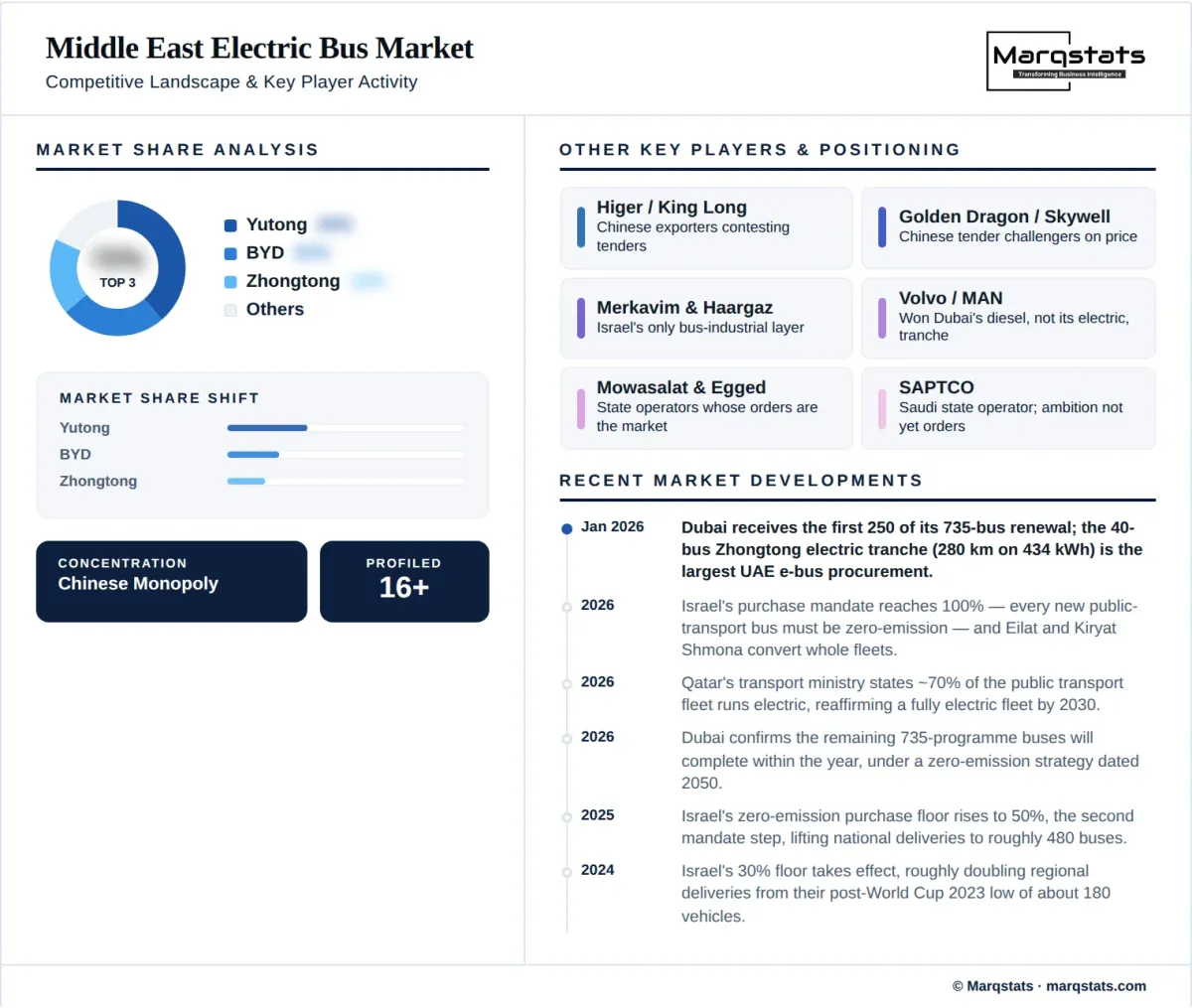
The supply side is Chinese to a degree no other regional report in this series matches. Yutong built Qatar's World Cup fleet — the order that created the regional market. Zhongtong won Dubai's electric tranche and supplies Israeli operators; BYD holds Israel's largest electric bus tenders; Higer, King Long, Golden Dragon and Skywell contest the remaining tenders. No Middle Eastern country imposes bus local-content requirements and none hosts electric bus manufacturing at scale, so competition is a delivered-price and service-network contest among Chinese exporters.
The non-Chinese presence is narrow and specific. Israel's body-builders Merkavim and Haargaz assemble and adapt imported platforms for local specifications, giving Israel the region's only bus-industrial layer of consequence. Volvo and MAN supply Dubai's renewal — but its combustion tranches, not its electric one, which is itself the finding: the European majors hold the region's diesel business while ceding its electric future to China without a contest.
The demand side is a short list of state buyers whose decisions are the market. Mowasalat in Qatar, Egged and Dan in Israel, Dubai's transport authority and Saudi Arabia's national operator between them account for most regional volume, and each operates under direct government direction. Competitive analysis in this market is therefore policy analysis: the supplier who wins is the one standing nearest when a ministry decides to move, which is why Yutong's Qatar coup and BYD's Israeli tenders matter more than any product comparison.
Companies Covered
Companies covered in the report include:
Recent Market Activity
Table of Contents
Coverage & Segmentation
This study covers new zero-emission buses — battery-electric and hydrogen fuel-cell — delivered in the Middle East across 2021 to 2030, measured at vehicle level in US dollars. The geography spans the Gulf Cooperation Council states, Israel, Jordan and the Levant; North Africa is excluded and covered within Marqstats' Africa-scope reports. Segmentation runs across two propulsion types, three applications and five geographic markets. Intercity coaches are excluded where separable, and charging infrastructure is excluded and covered by the Marqstats Middle East EV Charging Station report.
The delivery series carries an unusual shape that must not be smoothed away: the 2022 spike near 450 buses is Qatar's World Cup fleet arriving, and the 2023 collapse to roughly 180 is its completion. Growth rates computed from 2022 or 2023 bases are therefore artefacts of a single procurement event; this report anchors on 2025, by which time Israel's mandate had become the dominant flow, and states the caliber of every national figure — Qatar's 70% is a share of fleet stock, Israel's mandate percentages govern purchases, and Dubai's 735 buses are an order delivering across 2026.
Prices are stated at delivered-vehicle level in US dollars. The blended average of USD 310,000 in 2025 reflects a wholly import-supplied market buying Chinese standard buses with heat-hardened specifications, and it declines just 6.5% to USD 290,000 by 2030 — the shallowest deflation of any regional bus report in this series after Australia, for the opposite reason: Australia's prices are held up by local-content rules, the Middle East's are already at the floor Chinese competition sets. Currency risk is minimal, as Gulf currencies are dollar-pegged and Israeli purchases hedge dollar exposure through national tender frameworks.