Market Snapshot
Key Takeaways
Market Overview & Analysis
Report Summary
Construction site charging is the market for delivering electrical energy to a temporary worksite at a power level and reliability sufficient to operate battery-electric construction machinery. In practice it consists of three overlapping product families: containerised and trailered mobile battery energy storage systems typically rated between 90 kWh and 1,200 kWh; mobile DC charging stations rated between 30 kW and 180 kW; and portable battery power units in the one-to-ten kilowatt-hour class used for tools and light equipment. These are sold outright to large contractors, bundled by machine OEMs, and — most commonly in Europe — supplied through the equipment rental channel.
The market's foundation is regulatory. Oslo required all municipal construction sites to be zero-emission from 1 January 2025, having built toward it since a 2017 fossil-free requirement and the world's first fully emission-free site at Olav Vs gate in 2019. Norway followed on 3 April 2025 with national enabling legislation permitting every municipality to impose zero-emission requirements on public and private sites alike. Copenhagen will require all work machines under eight tonnes on its own construction projects to be emission-free from 1 July 2027. Helsinki, Espoo, Vantaa and Turku operate a voluntary green deal targeting fossil-free sites with a minimum 20% electric, biogas or hydrogen share by the end of 2025, rising to 50% by 2030.
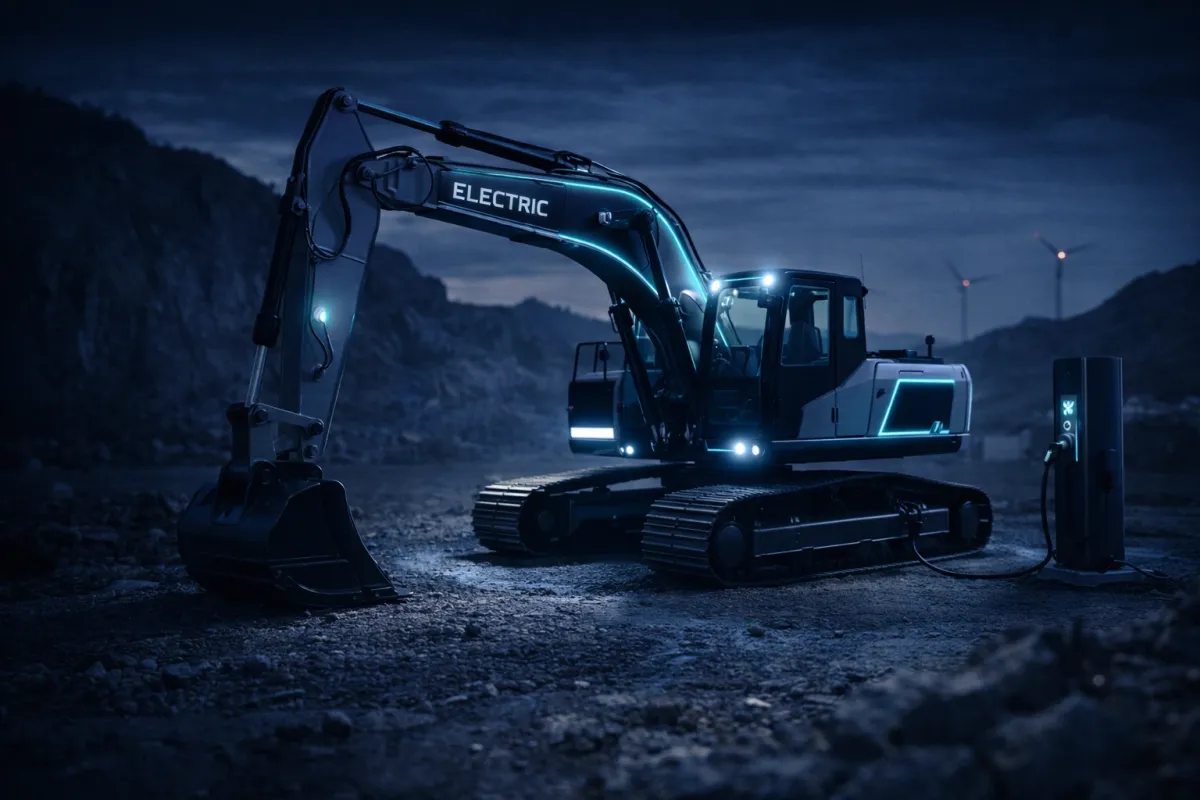
The demand-side mechanics are simpler than the policy suggests. A Volvo EC230 Electric excavator carries a 264 kWh battery and delivers four to five hours of typical stop-start work per charge, which means a full eight-hour shift requires a fast charge over the lunch break. Marqstats estimates energy consumption for that machine class at 53 to 66 kWh per operating hour, or roughly 420 to 530 kWh across a shift. Supplying that from the grid means a connection capable of 150 kW per machine. In the Netherlands a 160-to-630 kVA connection costs EUR 35,644 as a one-off charge, which is cheap — but Liander quotes two to five years to deliver one, temporary and construction connections are priced only on application, and 54% of Enexis stations already carry a demand restriction. The battery is not chosen because it is cheaper. It is chosen because it is available.
Growth to 2030 rests on three forces compounding against two constraints. The forces are widening municipal and national mandates, the arrival of credible OEM-backed jobsite power products from Volvo, Liebherr, Atlas Copco and Caterpillar, and a grid queue that is worsening rather than clearing. The constraints are the capital position of the European rental channel, which fell or flatlined through 2025, and the demonstrated political fragility of the mandates themselves — Oslo softened its own proposal in August 2026, and Norwegian zero-emission machine sales flatlined in absolute terms in the first half of that year even as the total market recovered.
Market Dynamics
Key Drivers
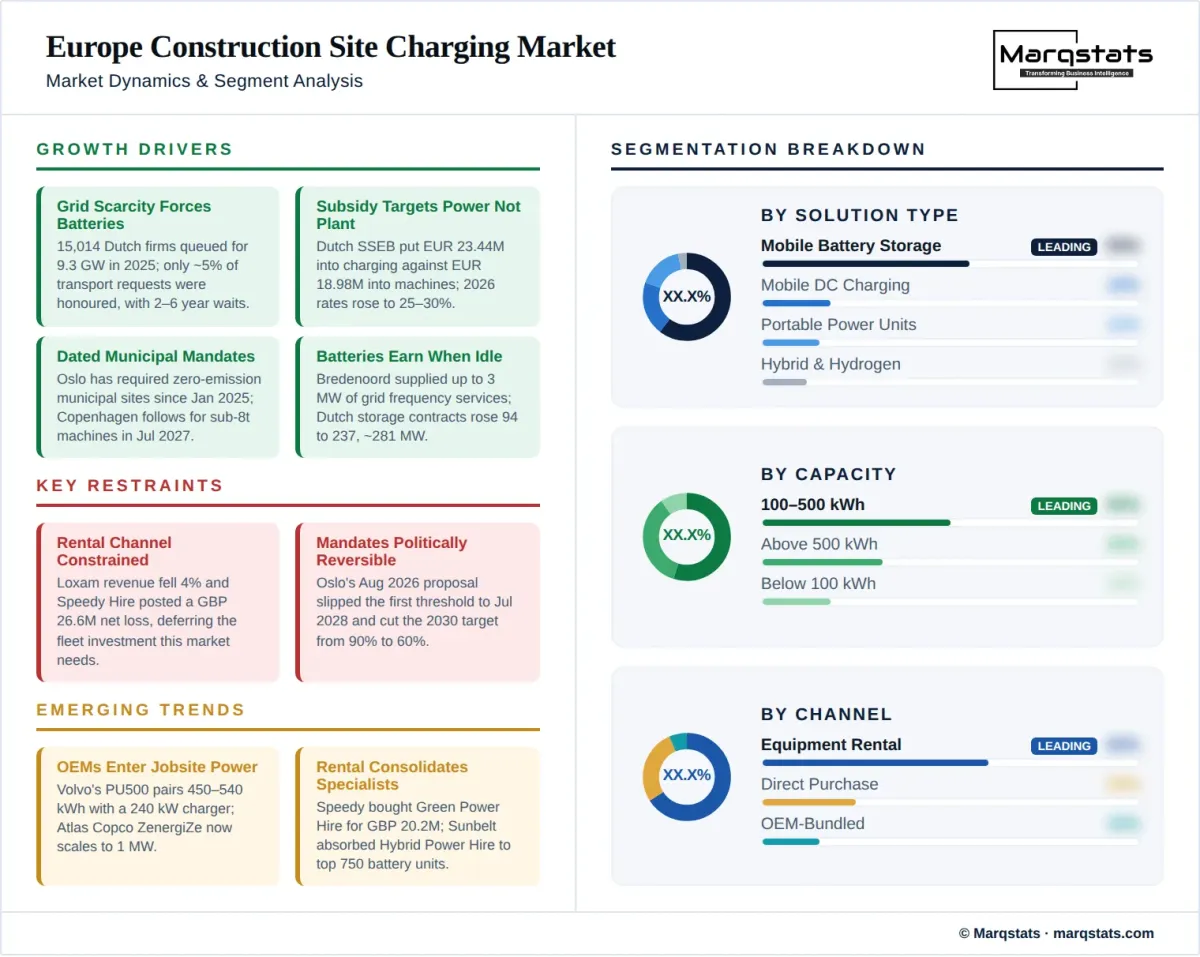
Grid connection scarcity is the single strongest driver and it is worsening. The Dutch queue for new or enlarged connections reached 15,014 businesses and 9.3 GW in 2025, up 26% year on year, and only around 5% of transport requests were honoured. Waits run two to five years at Liander, three to six at Stedin and two to four at Enexis, while 54% of Enexis stations carry a demand restriction. From 1 July 2026 small consumers entered the same queuing regime.
Subsidy is flowing directly into charging infrastructure rather than machines. The Dutch SSEB scheme committed EUR 23.44 million to jobsite charging in 2025 across 507 approvals, an average of EUR 46,239 each, and the 2026 round raised subsidy rates from 14% to 25% for large enterprises and from 19% to 30% for SMEs after decoupling from the MIA tax scheme. The 2026 machines module was oversubscribed by mid-August at EUR 54.2 million requested against EUR 25 million available.
Municipal mandates create bounded, dated demand. Oslo has required zero-emission municipal sites since 1 January 2025 and reached roughly 85% of site work by that standard in 2024. Copenhagen requires emission-free machines under eight tonnes on its own projects from 1 July 2027. Norway's April 2025 national regulation lets any municipality extend the requirement to private sites, and signals a general prohibition on combustion engines in construction machinery for 2035.
Electric machine energy demand is rising faster than machine counts. Each mid-size electric excavator added to a fleet creates 420 to 530 kWh of daily charging demand and requires up to 150 kW of instantaneous supply. Oslo's own modelling puts the peak power demand increase from full construction electrification at 120 MW in an optimised scenario — for one city.
Mobile batteries earn revenue when idle. Operators such as Bredenoord have run mobile battery fleets supplying up to 3 MW of frequency-control services to the Dutch grid between construction deployments, and Dutch storage grid contracts rose from 94 in 2024 to 237 in 2025 with contracted power doubling to roughly 281 MW. Dual-use economics materially improve fleet returns and are not available to a diesel generator.
Key Restraints
The rental channel that carries this equipment to site is capital-constrained. Loxam revenue fell 4% to EUR 2.47 billion in 2025, Speedy Hire Plc reported a GBP 26.6 million net loss on GBP 416.1 million of revenue for the year to March 2026 with EBITDA down 12%, and Boels Rental's 7.5% growth to EUR 1,862.4 million was acquisition-driven with like-for-like roughly flat and EBITDA slightly down. Fleet investment decisions are being deferred.
Mandates are proving politically reversible. Oslo's city government proposal published on 6 August 2026 moved the first threshold from 2027 to 1 July 2028 at 30% of site energy, set 60% from July 2030 and 75% from July 2032 — materially weaker than the earlier draft, which had proposed 30% from 2027 rising to 90% by 2030. Any forecast anchored on the superseded figures overstates near-term demand.
Adoption is not a straight line. Norway's zero-emission share of new machine sales rose from 4.5% in 2024 to 8.0% in the first half of 2025, but fell back to 7.4% in the first half of 2026 as zero-emission volumes flatlined at 128 units against 127 a year earlier while the total market recovered 9.5%. Electrified machines remain 1.7% of the installed Norwegian fleet.
Cost and operational friction persist at the site level. Oslo puts the additional cost of the zero-emission transition at 0.5% to 4% of overall project cost, electric machine leases run roughly 10% above diesel equivalents, and contractors report needing 10% to 15% more machines on site to cover charging downtime. Battery installation lead times of eight to sixteen weeks from quote to commissioning add further planning burden.
Key Trends
Machine OEMs are entering jobsite power directly rather than leaving it to specialists. Volvo Energy launched the PU500 in April 2025 with a 450-to-540 kWh battery and an integrated 240 kW DC fast charger capable of power-boosting off a weak grid connection. Liebherr's Liduro Power Port range pairs a 94 kWh, 55 kVA LPO 100 available now with a 564 kWh, 540 kVA LPO 600 carrying twin 150 kW CCS2 chargers, due in 2027. Atlas Copco extended its ZenergiZe range to eight models topping out at the 1 MW, 1,200 kWh ZBC 1000-1200.
System integration is displacing product competition. Volvo Construction Equipment and Hitachi Energy announced a collaboration on 27 May 2026 covering on-site power supply and energy management for charging battery-powered equipment, beginning with plug-and-play deployment before moving to connected machines and digital integration. Liebherr ships Energy Planner software for phase-by-phase site power planning alongside its hardware.
The rental channel is consolidating specialist battery suppliers rather than building capability. Speedy Hire Plc acquired Green Power Hire Limited for GBP 20.2 million after that company grew revenue from GBP 0.4 million to GBP 5.9 million in under two years; Sunbelt Rentals absorbed Hybrid Power Hire to reach a combined fleet of more than 750 battery storage units; and Generac Holdings Inc. took Off Grid Energy Ltd into the Pramac group. Sunbelt Rentals made the largest single United Kingdom investment in instagrid portable power in October 2025.
European cell supply is contracting while demand rises. Northvolt AB filed for bankruptcy in March 2025, Morrow Batteries ASA followed in May 2026 after roughly NOK 3.3 billion of shareholder capital, and VARTA AG filed for insolvency under self-administration in July 2026. Jobsite battery integrators are increasingly dependent on non-European cell supply at exactly the point when European mandates are expanding.
Market Segmentation
Solution type is the primary segmentation because each family answers a different site problem — bridging a missing connection, delivering fast charge to a machine, or powering hand tools away from any supply at all.
Containerised and trailered battery systems are the largest solution type and the reason this market exists, accounting for the majority of both revenue and installed energy. Dutch SSEB approved 302 mobile battery packs of 50 kWh and above in 2025, more than any other single item in the scheme. Practical jobsite units cluster between 250 kWh and 700 kWh at 150 kW to 600 kW output, with rental rates in the range of EUR 1,000 to EUR 4,000 per week depending on size.
Mobile DC charging stations deliver the 150 kW that a mid-size electric excavator needs for a lunch-break top-up, and are commonly deployed downstream of a battery rather than instead of one. Dutch SSEB recorded 99 mobile DC charging station approvals in 2025, its fifth-largest category. The Dutch rental market offers jobsite charging poles at 30, 60, 120 and 180 kW tiers.
Portable units in the one-to-ten kilowatt-hour class serve hand tools, lighting and light equipment where no supply exists. instagrid GmbH has shipped roughly 30,000 units across 29 countries and its LINK MAX unit delivers 400 volt three-phase power at 11 kW rated and 54 kW peak from a 65 kilogram package. This segment reaches site almost entirely through rental and is the highest-volume, lowest-value part of the market.
Hybrid units pair a battery with a downsized generator to cut fuel burn without sacrificing autonomy, and remain the pragmatic choice on sites with no realistic charging window. Dutch SSEB approved 106 hydrogen and fuel-cell aggregates in 2025, its fourth-largest category, indicating a durable niche rather than a marginal one.
The sub-100 kWh tier covers portable power units and the smallest trailered batteries such as Liebherr's 94 kWh LPO 100 and JCB's 10-to-45 kVA E-TECH Powerpack. It carries the highest unit volumes and the lowest revenue per unit, and is the entry point for contractors testing electrification before committing to fleet-scale investment.
This is the working core of the construction market, matching the energy content of one to two full charges for a mid-size electric excavator. Volvo's PU500 at 450 to 540 kWh and Liebherr's LPO 600 at 564 kWh bracket the upper end. The average Dutch SSEB charging-infrastructure award of EUR 46,239 in 2025 is consistent with packs in the 460 to 660 kWh range at prevailing subsidy rates.
Above 500 kWh the product becomes a site-wide power solution rather than a machine charger, capable of running tower cranes, site accommodation and multiple charging points simultaneously. Atlas Copco's ZBC 1000-1200 delivers 1 MW and 1,200 kWh from a 20-foot container and parallels up to eight units for 8 MW. Greener Power Solutions offers a 1.2 MWh power trailer at 900 kVA.
Rental is the dominant route to site in Europe, because construction projects are temporary and battery assets are expensive enough that ownership rarely pays across a single project. Loxam, Boels Rental, Kiloutou, Speedy Hire Plc, Sunbelt Rentals and Zeppelin all carry battery power in their fleets, though none discloses a battery or eco-fleet share — a genuine transparency gap across the entire European rental sector.
Large contractors with sustained pipelines of zero-emission work buy outright, particularly in the Netherlands where SSEB subsidy makes the economics work. Dutch SSEB recorded 356 unique applicant firms in 2025, with SMEs taking 1,001 of 1,331 approvals and 79% of the charging-infrastructure budget — evidence that direct purchase is not confined to the largest players.
Machine manufacturers increasingly sell power alongside plant, bundling chargers and batteries into machine packages to remove the customer's integration risk. Volvo, Liebherr, Caterpillar, Wacker Neuson and Yanmar's HIMOINSA all now offer jobsite energy products, and the Volvo Construction Equipment collaboration with Hitachi Energy announced in May 2026 signals that the bundle is extending to energy management software.
By Geography
Netherlands
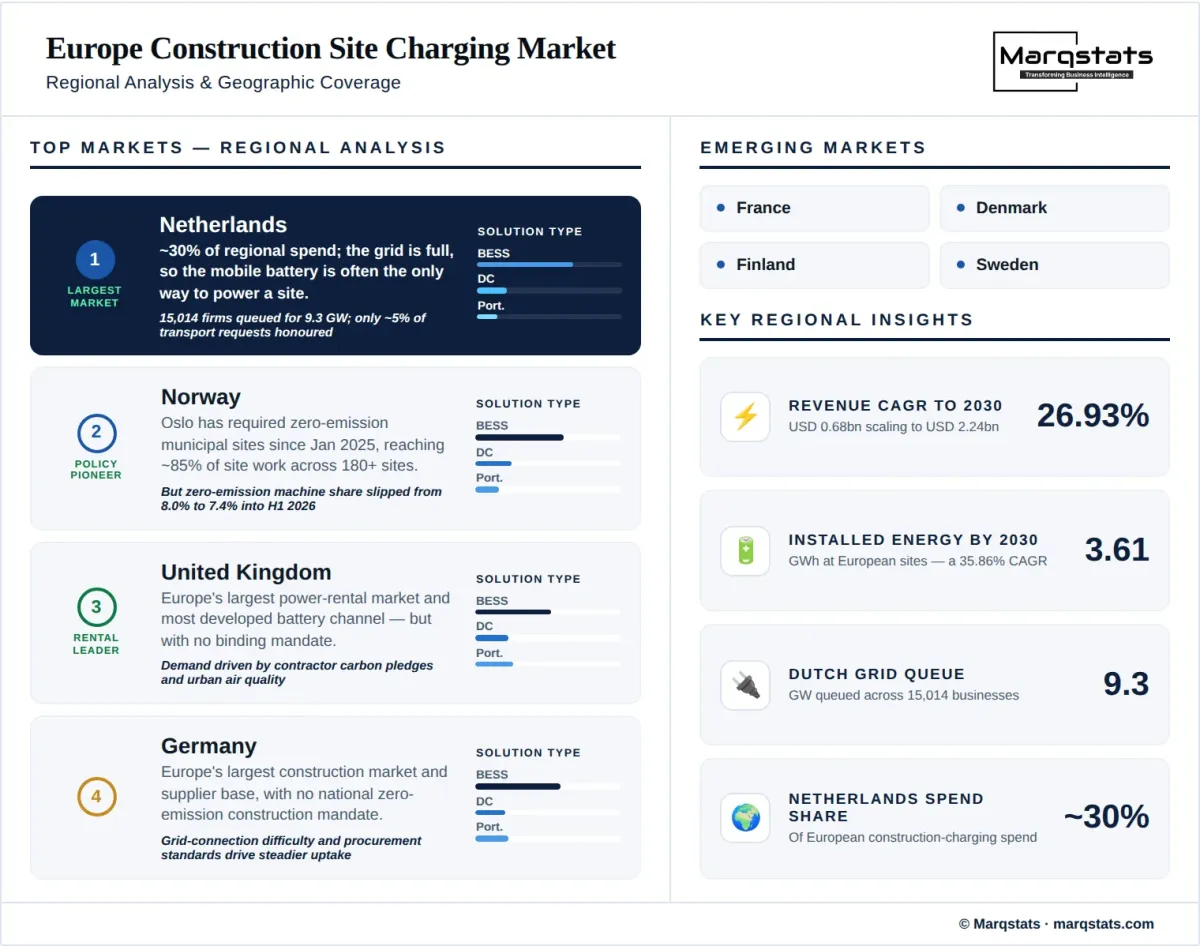
The Netherlands is the largest and most advanced market in Europe, accounting for approximately 30% of regional spend, and it leads for a reason that is uncomfortable rather than aspirational: its grid is full. With 15,014 businesses queued for 9.3 GW and only around 5% of transport requests honoured, the mobile battery is often the only way to power a site at all. The SSEB scheme reinforces this, committing EUR 23.44 million to charging infrastructure across 507 approvals in 2025 and raising subsidy rates again for 2026. Randstad, Noord-Brabant and Limburg are the most constrained regions.
Norway
Norway is the regulatory pioneer and the cautionary tale in equal measure. Oslo has required zero-emission municipal construction sites since 1 January 2025 and reached roughly 85% of site work by that standard, having run more than 180 zero-emission sites to date. The national regulation of 3 April 2025 lets any municipality extend the requirement to private projects. But zero-emission machine share fell from 8.0% to 7.4% between the first halves of 2025 and 2026, and Oslo's own August 2026 proposal pushed its first city-wide threshold to July 2028 at only 30%.
United Kingdom
The United Kingdom is the largest power rental market in Europe and the most commercially developed battery rental channel, though it lacks a binding zero-emission construction mandate. Sunbelt Rentals holds a combined fleet of more than 750 battery storage units following the Hybrid Power Hire acquisition and made the largest single United Kingdom investment in instagrid portable power in October 2025; Speedy Hire Plc acquired Green Power Hire Limited for GBP 20.2 million. Demand here is driven by contractor carbon commitments and urban air quality rather than statute.
Germany
Germany combines the largest construction market in Europe with a strong domestic supplier base — instagrid GmbH, Betteries AMPS GmbH, Wacker Neuson SE, Liebherr and Zeppelin Rental all operate from or into the German market — but has no national or major municipal zero-emission construction mandate. Adoption is driven by grid connection difficulty in urban redevelopment and by corporate procurement standards, which makes German demand steadier but slower-building than Dutch or Norwegian demand.
France
France is served principally through its rental majors, Loxam and Kiloutou, both of which reported soft domestic performance in 2025 with French revenue down 6.5% and 0.9% respectively. Adoption is concentrated in Paris and other dense urban projects where noise and air quality restrictions bind, and Eiffage Construction acts as a channel partner for imported mobile battery systems. The absence of a Dutch-style purchase subsidy leaves French uptake reliant on project-level economics.
Nordic Countries and Rest of Europe
Denmark's binding requirement arrives on 1 July 2027 for machines under eight tonnes on Copenhagen municipal projects. Finland's Helsinki-led green deal targets fossil-free sites with a minimum 20% electric, biogas or hydrogen share from the end of 2025 and 50% by 2030, but is voluntary rather than statutory. Sweden has no equivalent construction-site mandate, working instead through national procurement requirements at Trafikverket. Belgium, Ireland, Switzerland and Spain form an emerging tier served largely through Dutch and United Kingdom rental fleets.
How Competition Is Evolving
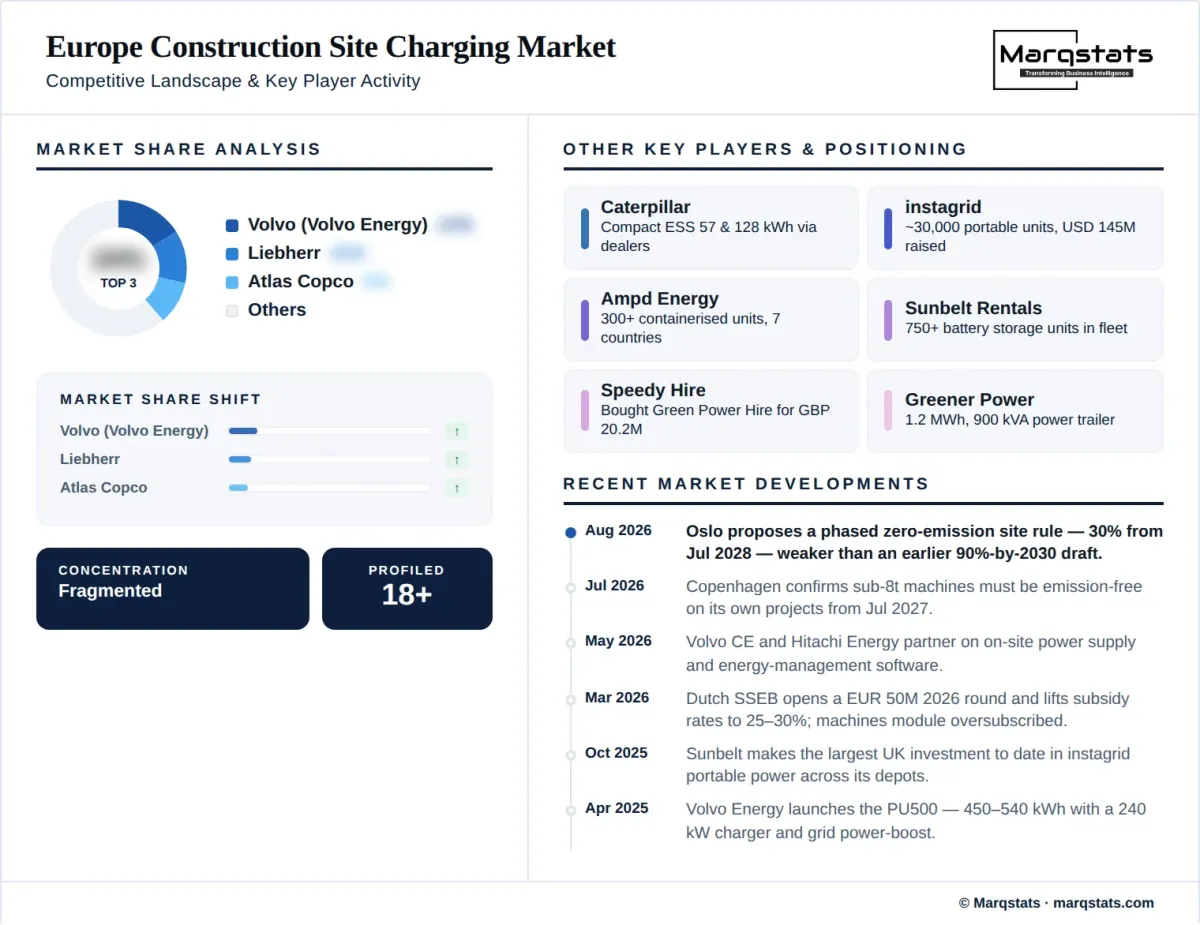
The European construction site charging market is fragmented, and unusually so for a market with this much industrial gravity behind it. No supplier holds a dominant position, and the competitive set spans four distinct origins: machine OEMs extending into power, compressor and generator manufacturers extending into storage, venture-funded pure-play battery specialists, and the equipment rental groups that increasingly own the customer relationship. Fragmentation persists because the product is not yet standardised — capacity, output, connector type and control software all vary — and because the buying decision sits with a site manager solving an availability problem rather than with a central procurement function.
The strongest positions belong to companies that pair hardware with the machine fleet it serves. Volvo has the broadest European offer through Volvo Energy's PU500, a 450-to-540 kWh unit with an integrated 240 kW DC charger, backed by the Hitachi Energy collaboration announced in May 2026. Liebherr's Liduro Power Port range and Energy Planner software address whole-site planning for mixed crane and excavator fleets. Atlas Copco AB has scaled its ZenergiZe range to eight models reaching 1 MW and 1,200 kWh, and Caterpillar Inc. distributes its Compact ESS line at 57 kWh and 128 kWh through dealers in Europe. Among the pure-plays, instagrid GmbH has raised more than USD 145 million including a USD 95 million Series C and shipped roughly 30,000 portable units across 29 countries, while Ampd Energy Limited has deployed more than 300 containerised construction batteries across seven countries.
The rental channel is consolidating rather than competing on its own hardware. Speedy Hire Plc bought Green Power Hire Limited for GBP 20.2 million, Sunbelt Rentals absorbed Hybrid Power Hire to reach more than 750 battery storage units, Generac Holdings Inc. took Off Grid Energy Ltd into the Pramac group, and Boels Rental entered a strategic partnership with Volvo Penta on next-generation battery energy storage in September 2025. Yet not one major European rental group discloses the battery or electrified share of its fleet, which leaves the true installed base unmeasurable from public sources. Meanwhile the upstream is deteriorating: Northvolt AB, Morrow Batteries ASA and VARTA AG all failed between March 2025 and July 2026, concentrating European jobsite battery supply on non-European cells.
Companies Covered
The report profiles 15+ companies with full strategy and financials analysis, including:
Recent Market Activity
Table of Contents
Coverage & Segmentation
This report sizes and forecasts the European construction site charging market over a 2022 to 2025 historical period and a 2026 to 2030 forecast period, using 2025 as the base year. Market value is expressed in USD billion and covers equipment sales and rental revenue for mobile and containerised battery energy storage systems, mobile DC charging stations, portable battery power units, hybrid and hydrogen jobsite power units, and the temporary distribution equipment supplied alongside them. Installed energy capacity is expressed in MWh. Permanent grid infrastructure, utility-scale stationary storage, on-machine traction batteries and electric construction machinery itself are excluded.
Segmentation covers solution type — mobile battery energy storage, mobile DC charging stations, portable battery power units, and hybrid and hydrogen units; capacity band — below 100 kWh, 100 to 500 kWh, and above 500 kWh; and route to market — equipment rental, direct purchase by contractors, and OEM-bundled supply. Geographic coverage spans the Netherlands, Norway, the United Kingdom, Germany, France, the Nordic countries and the rest of Europe. The competitive section profiles eighteen suppliers across machine OEMs, power equipment manufacturers, pure-play battery specialists and rental groups, with product specification, deployment evidence and strategic activity.