Market Snapshot
Key Takeaways
Market Overview & Analysis
Report Summary
The North America Second-Life EV Battery Energy Storage Market sits at the intersection of EV battery retirement, the largest stationary storage scale-up globally, and a private-sector-led commercialization architecture distinct from Europe’s regulation-led path. Rather than relying on EU-style traceability infrastructure, the North American market is shaped by tax credits (Inflation Reduction Act standalone storage Investment Tax Credit), safety standards (UL 1974, UL 9540, UL 9540A, NFPA 855), state-level permitting, recycling rules, and project finance requirements. The market has stronger private-sector momentum than other regions, especially from companies including Redwood Materials, B2U Storage Solutions, Moment Energy, Element Energy, Rivian, GM, Nissan, and Smartville.
Safety, certification, and bankability requirements anchor the cost structure and define the gatekeeper for commercial second-life deployment. Repurposed packs must satisfy UL 1974 Standard for Evaluation for Repurposing Batteries, covering sorting, grading, continued viability, and rating mechanisms for continued battery use. Moment Energy became the first North American company UL 1974-certified. Adjacent UL 1973 for stationary applications, UL 9540 and UL 9540A for energy storage system safety and thermal runaway fire propagation testing, and IEC 62619 for industrial lithium battery safety together complete the international certification architecture.
North America-specific installation safety is governed under NFPA 855 Standard for the Installation of Stationary Energy Storage Systems, updated to its third edition (2026) on a three-year cycle, providing minimum installation requirements for residential, commercial, industrial, and utility-scale ESS deployments. The 2026 edition introduces mandatory large-scale fire testing, improved explosion control guidance, and alignment with NFPA 1 and the International Fire Code. The standard is referenced by local authorities having jurisdiction (AHJs), state fire codes, utility interconnection requirements, project insurers, and BESS financiers across North America. State and local fire codes complete the project-approval and siting architecture.
Battery feedstock supply through 2030 spans warranty returns, manufacturing rejects, test fleets, commercial fleet retirements, accident salvage, and early EV retirements rather than mass end-of-life passenger EV waves which materialize after 2030–2035. Redwood Materials processes approximately 20 GWh of batteries annually equivalent to 250,000 EVs across nearly all major automakers, representing approximately 90% of all lithium-ion batteries recycled in North America. The North American architecture sits within a broader Global Second-Life EV Battery Energy Storage Market where dedicated specialists across all regions, OEM circular-economy programs, battery recyclers extending into stationary storage, and BESS integrators together compete for share of the addressable repurposed-battery storage pool.
Market Dynamics
Key Drivers
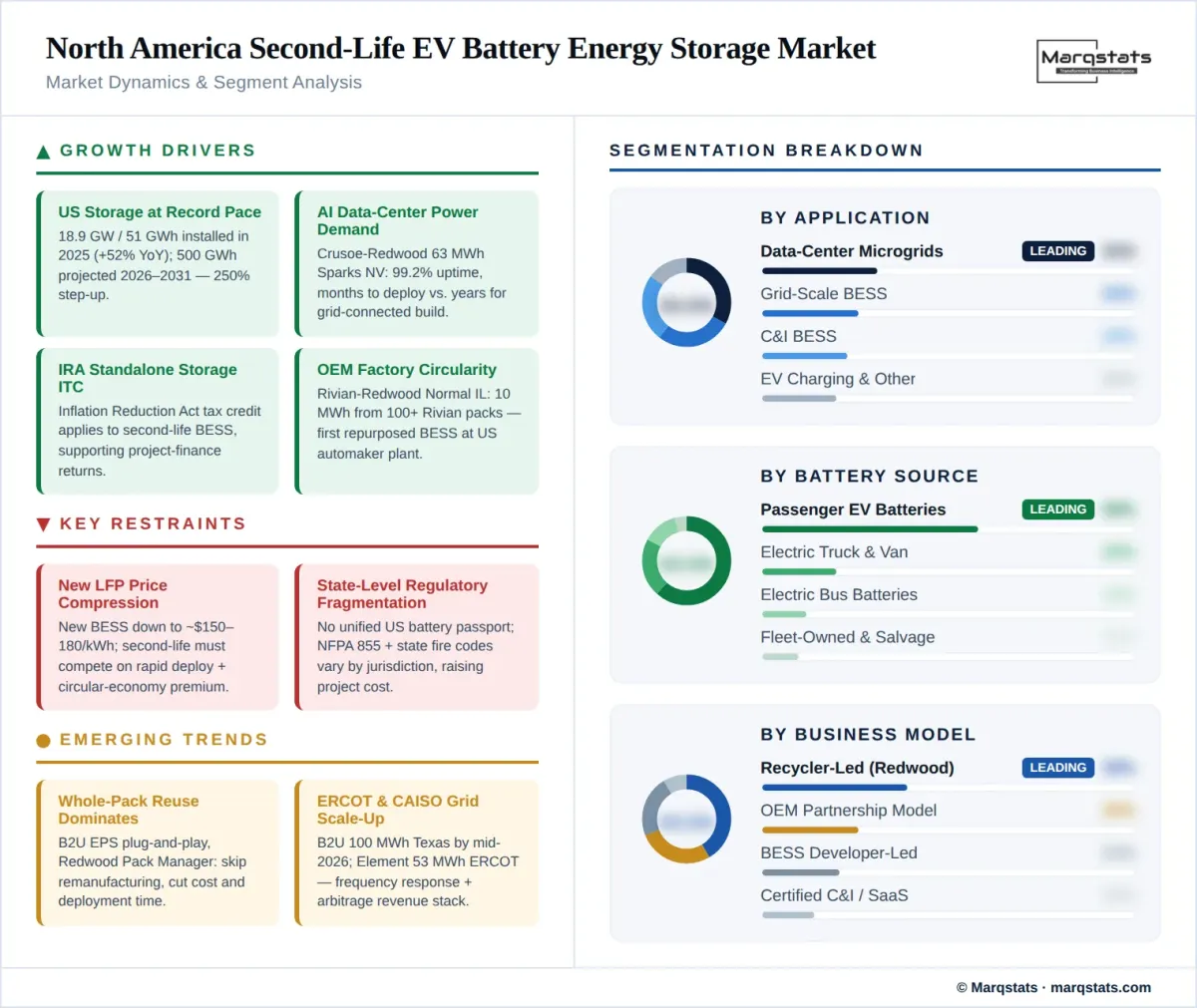
- US battery storage demand is scaling at unprecedented pace. The United States installed a record 18.9 GW (51 GWh) of battery storage in 2025, up 52% year-on-year. Q4 2025 set a quarterly record with 5.8 GW installed across 13 states, demonstrating market diversification beyond California and Texas. Cumulative US installations since 2019 exceed 50 GW / 144 GWh, with 500 GWh of new storage projected through 2031. The demand pool creates substantial uptake pathway for second-life systems where used-battery cost economics offset integration complexity.
- AI and data-center power demand emerges as the strongest North American-specific growth driver. Crusoe Spark modular AI data centers paired with second-life battery microgrids enable rapid deployment in months rather than year-long grid build-outs. The Redwood-Crusoe Sparks Nevada deployment expanded from 4 to 24 Crusoe Spark modular data centers in March 2026 at 99.2% operational availability over seven months. Redwood reports over 1 GWh of reusable batteries in deployment pipeline expanding by an additional 5 GWh in the coming year, with 100+ MW projects already in design.
- Battery supply infrastructure benefits from vertically integrated recycling and OEM partnerships. Redwood Materials processes approximately 20 GWh of batteries annually equivalent to 250,000 EVs, representing approximately 90% of all lithium-ion batteries recycled in North America. The GM-Redwood partnership combines GM second-life battery supply with Redwood stationary storage deployment. The Rivian-Redwood Normal Illinois deployment in April 2026 extends the model to OEM factory self-consumption.
- Inflation Reduction Act standalone storage Investment Tax Credit supports US BESS economics. The IRA expanded tax-credit eligibility for standalone energy storage, supporting second-life battery projects within the same project-finance environment as new BESS. The credit creates favorable returns for grid-scale, C&I, and microgrid deployments where second-life economics compete with new battery systems.
- Cost economics support specific application targeting. B2U deploys at well under USD 200 per kWh versus the US average of USD 219 per kWh for new BESS turnkey sites, achieving approximately 30-40% project-level cost reduction versus new lithium-ion. Redwood Materials states repurposed packs can be deployed at roughly half the cost of new systems while offering comparable performance in stationary settings. The cost advantage is most attractive in C&I storage, EV charging support, fleet depots, and data-center microgrids.
- OEM factory circularity creates closed-loop deployment model. The Rivian-Redwood partnership at Normal, Illinois deploys 10 MWh of stationary storage using 100+ second-life Rivian packs, the first repurposed BESS at a US automaker manufacturing facility. The architecture supports rapid deployment, predictable feedstock, and circular-economy positioning for OEM customers including GM, Ford, Tesla, Hyundai, Toyota, Nissan, and battery factory operators.
Key Restraints
- Cheap new LFP battery competition compresses second-life pricing power. Falling new lithium-ion BESS prices have come down to approximately USD 150 to USD 180 per kWh for new enclosures, with strong warranty and bankability backing. The competitive pressure means second-life batteries must compete on cost, rapid deployment, and circular-economy positioning rather than just price arbitrage.
- Battery variability raises testing and integration cost. Used packs differ by chemistry, age, thermal history, degradation, cell imbalance, abuse history, and design. Pack-level state-of-health testing, grading, and certification can erode the cost advantage. Redwood’s Pack Manager technology and B2U’s EV Pack Storage architecture address this constraint with universal controllers and AI-driven monitoring, however the engineering investment remains a meaningful per-supplier hurdle.
- Limited near-term battery feedstock constrains scale. Most batteries available for second life through 2030 will come from early EVs, warranty returns, manufacturing rejects, test fleets, commercial fleets, buses, and accident salvage rather than the much larger end-of-life passenger EV wave that materializes after 2030–2035 when first-generation BEV batteries reach typical retirement age.
- Insurance, permitting, and warranty constraints favor new battery systems. Used batteries can face additional scrutiny from insurers and permitting authorities, particularly given fire safety considerations. Project financiers prefer standardized new BESS systems with known performance and OEM warranty backing. Second-life projects require differentiated financing, insurance, and uptime contract architecture, slowing deployment in capital-intensive utility-scale applications.
- State-level regulatory fragmentation raises compliance complexity. Unlike the EU which operates under unified Battery Regulation, North America lacks a single harmonized battery passport system. State and local fire codes, permitting requirements, and safety standards differ across jurisdictions, raising project-development cost. The fragmentation pushes the market toward specialists with multi-state deployment capability.
- Recycling competition under high battery metal prices. Damaged packs, low-state-of-health packs, packs with valuable nickel-cobalt content, and feedstock covered by OEM contracts requiring direct recycling bypass second-life entirely. Manufacturing scrap is expected to account for a large share of recycling feedstock through 2030, with end-of-life EV and storage batteries becoming the main recycling feedstock after 2035.
Key Trends
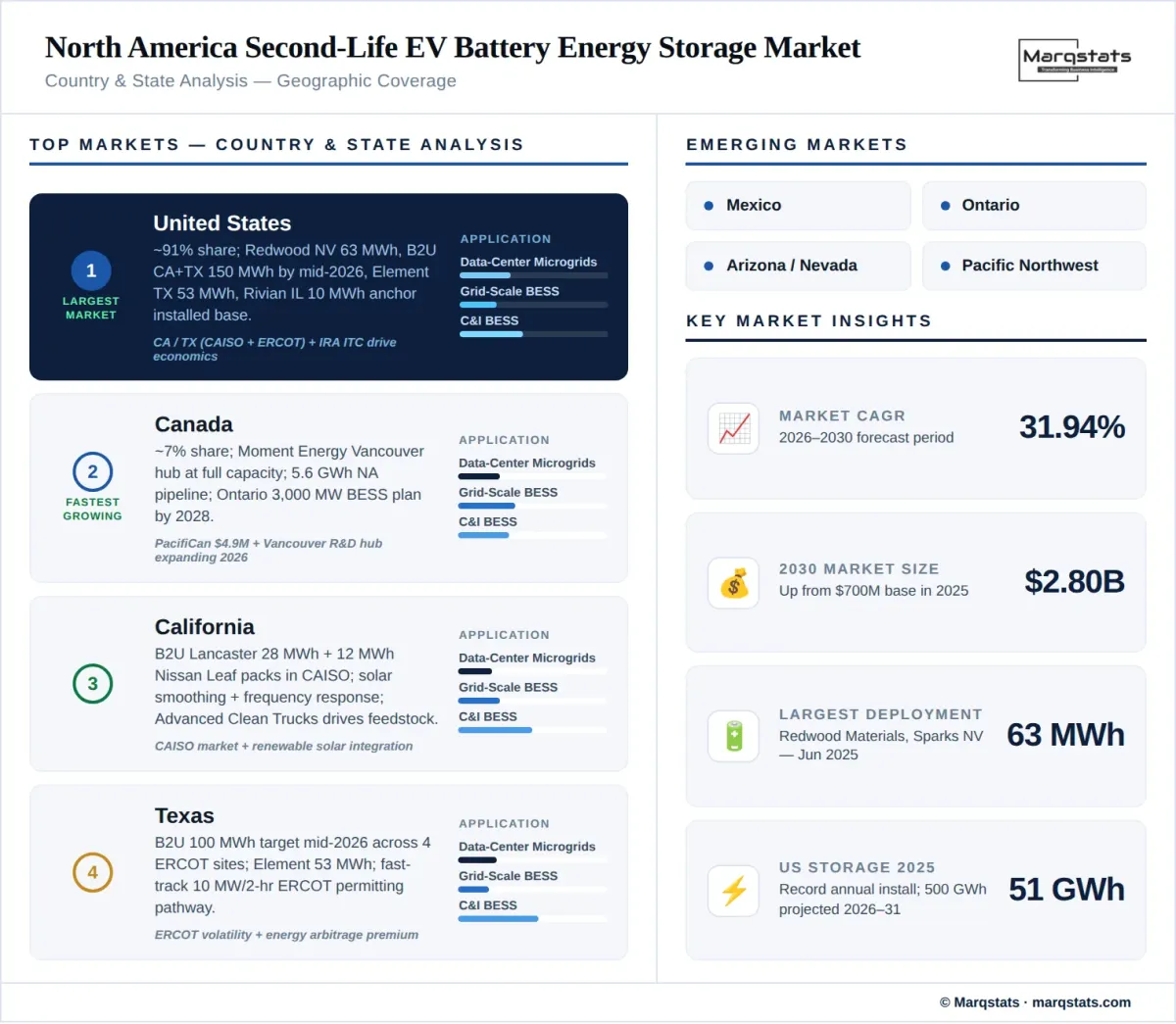
- Shift from small pilots to large second-life microgrids defines the market. The Redwood-Crusoe Sparks Nevada deployment at 12 MW / 63 MWh represents the world’s largest second-life battery deployment and largest North American microgrid. The architecture targets AI/data-center power rather than only sustainability demonstration, with the system delivering 99.2% operational availability since June 2025 commissioning at energy cost lower than grid prices. Element Energy West Texas at 53 MWh and B2U California aggregate at 40 MWh complete the commercial-scale tier.
- Whole-pack reuse architecture becomes the dominant deployment model. B2U EV Pack Storage technology uses entire EV battery packs with plug-and-play deployment, avoiding remanufacturing costs. Redwood Pack Manager technology integrates packs across different chemistries, capacities, and voltage classes by communicating with each pack’s onboard battery management system. The architecture reduces labor cost, accelerates deployment, improves safety, and supports faster project timelines than cell-level dismantling approaches.
- Grid-connected second-life BESS scales in California and Texas. B2U California operations at 40 MWh combined demonstrate CAISO market participation and renewable smoothing. The Bexar Corrilla 24 MWh / 10 MW project operational since late 2025 in San Antonio area uses approximately 720 second-life packs across 21 cabinets connecting to CPS Energy distribution. B2U targets 100 MWh in Texas by mid-2026 across four sites in ERCOT, where ERCOT volatility and energy arbitrage opportunities support strong second-life economics.
- OEM factory energy storage emerges as a distinct deployment category. The Rivian-Redwood Normal Illinois project in April 2026 deploys 10 MWh of dispatchable storage using 100+ second-life Rivian packs, the first repurposed BESS at a US automaker manufacturing facility. The model creates a closed-loop circular-economy architecture where OEMs reuse warranty-returned and retired packs in their own plants, reducing sourcing risk and improving circular-economy positioning.
- UL 1974 certification becomes a market gatekeeper separating credible specialists from informal battery reuse operators. Moment Energy became the first North American company UL 1974-certified by UL Solutions. The certification validates sorting, grading, continued viability, and rating mechanisms for reused batteries, supporting customer trust, project bankability, and insurance acceptance for commercial deployments.
Market Segmentation
Data-center microgrids hold the largest application share at approximately 31% of the 2025 North America Second-Life EV Battery Energy Storage Market, anchored by Redwood-Crusoe Sparks Nevada deployment and emerging AI infrastructure power demand. EV charging support represents the fastest-growing application segment, expanding at approximately 51% CAGR during 2026–2030, supported by grid-upgrade-cost-avoidance economics at fleet depots, highway DC fast charging, bus depots, and logistics hub charging hubs. Grid-scale BESS, C&I storage, factory energy storage, fleet depot storage, solar-plus-storage, telecom backup, and residential storage together represent the remaining application pool.
Data-center microgrid applications represent the largest current application share with the strongest premium per-deployment value. The Redwood-Crusoe Sparks Nevada 12 MW / 63 MWh microgrid scaled from 4 to 24 Crusoe Spark modular AI data centers in March 2026 with 99.2% operational availability over seven months, validating second-life systems for high-reliability AI infrastructure. The architecture supports deployment in months rather than year-long grid interconnection timelines. Redwood Energy reports over 1 GWh of reusable batteries in deployment pipeline expanding by an additional 5 GWh in the coming year with 100+ MW projects in design.
EV charging support represents the fastest-growing application segment owing to grid-upgrade-cost-avoidance economics at high-power charging hubs. Second-life BESS at fleet depots, highway DC fast chargers, bus depots, logistics hubs, airports, and parking operator sites enables charging from grid or solar with rapid discharge to vehicles, eliminating costly transformer and grid-connection upgrades. The architecture supports premium per-kWh pricing and is especially relevant at megawatt-class deployments where multi-megawatt grid connection delays are a primary deployment constraint.
Grid-scale second-life BESS scales materially in California and Texas. B2U California operations at 28 MWh + 12 MWh combined participate in CAISO markets using over 1,300 Nissan Leaf packs to smooth solar output. B2U Bexar Corrilla 24 MWh / 10 MW project operational since late 2025 connects to CPS Energy in ERCOT, with three additional Texas sites scheduled to bring B2U Texas total to 100 MWh and combined US footprint to 150 MWh by mid-2026. Element Energy operates 53 MWh in West Texas with approximately 900 second-life packs in ERCOT. The segment benefits from frequency response, energy arbitrage, and fast-track ERCOT permitting for 10-MW configurations with two-hour discharge.
C&I deployment anchors the second-largest application supported by demand charge reduction, peak shaving, solar self-consumption, backup power, resilience, and sustainability reporting. Moment Energy positions Luna BESS modular systems scalable to 10 MWh for industries including data centers, public institutions, transportation, food and beverage, forestry, and manufacturing. The segment supports moderate cycling profiles aligned well with used-battery characteristics and benefits from UL 1974-certified product offerings that meet customer bankability requirements.
Factory energy storage represents an emerging high-attractiveness OEM circularity category. The Rivian-Redwood Normal Illinois deployment in April 2026 anchors the model with 10 MWh of dispatchable storage using 100+ second-life Rivian packs, described as the first repurposed BESS at a US automaker manufacturing facility. The architecture creates closed-loop circular-economy deployment where OEMs reuse warranty-returned and retired packs in their own plants. The model can scale to GM, Ford, Tesla, Hyundai, Toyota, Nissan, and battery gigafactory deployments.
Fleet depot second-life storage represents a high-potential closed-loop business model where the same operator controls both battery source and stationary storage application. Electric bus operators, delivery fleet operators, and logistics fleet operators repurpose retired packs into depot BESS for charging optimization, peak shaving, and backup power. The architecture combines predictable feedstock supply, vertically integrated economics, and direct operational benefit at logistics hubs, bus depots, port operations, and last-mile delivery facilities.
Solar-plus-storage applications support renewable energy integration where capital cost matters more than absolute energy density. B2U Lancaster California operations integrate over 1,300 Nissan Leaf packs to smooth solar output. The segment combines well with second-life cost economics in California, Arizona, Nevada, and other high-solar-penetration markets, supporting circular-economy positioning for renewable project developers.
Telecom backup represents a mature use case in selected geographies with lower cycling intensity supporting longer effective battery life. Residential storage faces stricter safety, certification, warranty, installer trust, and insurance requirements than commercial applications, with new LFP residential batteries generally easier to finance and certify. Mobile and temporary power applications including construction sites, events, and off-grid deployments anchor a niche segment with growth potential post-Battery-Passport infrastructure maturation.
Passenger EV batteries hold the largest source share at approximately 58% of the 2025 North America Second-Life Market, anchored by Tesla, Nissan Leaf, GM Bolt, Ford Mustang Mach-E, Rivian, Hyundai-Kia, and Volkswagen US fleet warranty returns and retirements processed by Redwood Materials. Electric truck and van batteries represent the fastest-growing source segment, expanding at approximately 39% CAGR during 2026–2030, supported by Class 8 truck electrification, last-mile delivery fleet retirements, and predictable commercial vehicle pack supply. Electric bus batteries, warranty returns, manufacturing rejects, fleet-owned batteries, and accident salvage batteries together represent the remaining feedstock pool.
Passenger EV battery feedstock anchors the largest source share supported by Tesla, Nissan Leaf legacy, GM Chevy Bolt, Ford Mustang Mach-E and F-150 Lightning, Rivian R1S/R1T, Hyundai-Kia E-GMP, and Volkswagen Group ID family platforms. Redwood Materials receives approximately 20 GWh of batteries annually equivalent to 250,000 EVs across nearly all major automakers including Volkswagen/Audi, Toyota, BMW, Ford, Nissan, GM/Ultium, Isuzu trucks, plus partnerships with micromobility and fleet operators including Lime, Rad Power Bikes, Lyft, and Amazon. B2U Lancaster California operations integrate over 1,300 Nissan Leaf packs.
Electric truck and van battery feedstock represents the fastest-growing source segment as Class 8 truck electrification scales under California Advanced Clean Trucks, EPA emissions standards, and corporate fleet electrification commitments. Daimler eCascadia, Freightliner electric platforms, Volvo VNR Electric, Peterbilt 579EV, and Mack LR Electric anchor the heavy-duty supply base. Last-mile delivery fleets including Amazon Rivian, Ford E-Transit, Mercedes eSprinter, and Stellantis ProMaster EV provide medium-duty feedstock. Heavy-duty trucks operate at high utilization with very large battery packs, accelerating retirement timelines relative to passenger BEV.
Electric bus battery feedstock provides predictable retirement cycles, larger pack sizes, fleet operator-controlled supply, and concentrated geographic deployment. New Flyer, BYD US, Proterra legacy, GreenPower Motor, and Lion Electric platforms anchor the North American supply base. The segment supports closed-loop fleet operator deployment and integration with EV charging infrastructure at bus depots.
Warranty-returned packs and manufacturing rejects represent important near-term feedstock with often-higher state of health than retired packs. Manufacturing scrap is expected to account for a large share of recycling feedstock through 2030 with overlap into second-life selection where pack health permits. The segment supports closed-loop OEM-Tier-1 partnerships including the GM-Redwood architecture and Mercedes-Benz Energy supply contracts to Moment Energy.
Fleet-owned batteries from delivery fleets, transit operators, and corporate vehicle fleets provide concentrated supply with single-owner pack provenance documentation. Amazon Rivian fleet, FedEx Ground BrightDrop, UPS Ford E-Transit, and corporate vehicle fleet deployments anchor the segment. The architecture supports closed-loop battery deployment within the same operator’s charging or facility infrastructure.
Accident-damaged or salvage vehicle batteries with intact battery packs provide an important feedstock stream after screening and safety validation. Insurance carriers including Geico, Progressive, and State Farm; salvage operators including Copart and IAA; and OEM warranty channels supply the segment. State-of-health verification, safety certification, and provenance documentation are particularly critical given pack history uncertainty.
Full pack reuse holds the largest form share at approximately 53% of the 2025 North America Second-Life Market, anchored by B2U EV Pack Storage technology, Redwood Pack Manager technology, and lower labor cost economics relative to disassembly approaches. Module-level reuse represents the fastest-growing form segment, expanding at approximately 34% CAGR during 2026–2030, supported by Moment Energy module-disassembly and rebuild architecture and increasing OEM design-for-repair compliance. Cell-level reuse and mixed-architecture configurations together represent the remaining form pool.
Full pack reuse uses entire EV battery packs as deployed BESS modules with intelligent pack-level controls. B2U EV Pack Storage (EPS) technology enables plug-and-play deployment of used EV batteries without costly remanufacturing, with 21 specialized cabinets at the Bexar Corrilla site housing 720+ packs. Redwood Pack Manager technology integrates packs across different chemistries, capacities, and voltage classes by communicating with each pack’s onboard battery management system. The form supports faster project timelines and lower per-kWh integration cost.
Module-level reuse disassembles packs to module level, enabling more granular state-of-health grading, mixed-vintage integration, and pack reconfiguration for specific application power and energy profiles. Moment Energy uses module-level disassembly and rebuild architecture supplying Luna BESS to Vancouver airport, Tofino General Hospital, and emerging US C&I customers. The form supports diverse OEM source pack integration but raises labor and certification cost relative to full pack reuse.
Cell-level reuse fully dismantles batteries to individual cells for sorting, regrading, and rebuild into new BESS module configurations. The form provides maximum flexibility but highest labor cost and slowest deployment timeline. The segment is small but technically significant for selected applications where heterogeneous source packs must be unified into uniform deployment configurations.
Mixed architecture deployments combine full packs, modules, and selectively rebuilt assemblies depending on source feedstock state of health and target application profile. The architecture supports flexible scaling and adaptive integration of multi-vintage source feedstock from heterogeneous OEM platforms.
NMC chemistry holds the largest share at approximately 64% of the 2025 North America Second-Life Market by chemistry, anchored by Tesla, GM Ultium, Ford Mustang Mach-E, Rivian, Hyundai-Kia E-GMP, and BMW i3 platforms historically deployed in North American passenger BEV and PHEV fleets. LFP chemistry represents the fastest-growing chemistry segment, expanding at approximately 44% CAGR during 2026–2030, supported by Tesla Model 3/Y LFP transition, Ford Energy LFP BESS production from the retooled Kentucky plant, and Chinese OEM LFP platforms entering North America. NCA, LMO blends, and emerging chemistries together represent the remaining chemistry pool.
Nickel-manganese-cobalt (NMC) batteries dominate current North American second-life feedstock owing to historical passenger BEV and PHEV deployment dominance. Tesla Model S/X/3 Long Range, GM Ultium platform (Chevy Bolt EUV legacy, Cadillac Lyriq, GMC Hummer EV), Ford Mustang Mach-E and F-150 Lightning, Rivian R1S/R1T, Hyundai-Kia E-GMP, and BMW i3 platforms deploy NMC. The chemistry supports higher energy density and is well-suited to second-life applications requiring meaningful capacity in compact deployment footprint.
Lithium iron phosphate (LFP) chemistry feedstock is the fastest-growing chemistry source as Tesla Model 3/Y standard range and Chinese OEM platforms transition to LFP. The chemistry offers superior cycle life and thermal stability, particularly well-suited to high-cycling stationary applications including grid storage, EV charging support, and renewable integration. Ford Energy is retooling the BlueOval SK Battery Park plant in Kentucky for LFP BESS production, signaling broader LFP chemistry adoption in North American stationary storage applications.
Nickel-cobalt-aluminum (NCA) batteries appear primarily in Tesla legacy platforms (Model S/X early generations) and selected high-energy-density applications. The chemistry retains useful capacity for second-life deployment but represents a smaller and declining share of overall feedstock as OEM platforms transition to NMC and LFP for new vehicle deployment.
Lithium manganese oxide (LMO) blends and other lithium-ion chemistries appear in selected legacy passenger BEV and early commercial EV platforms. The category supports niche second-life applications and provides chemistry-mix diversity in heterogeneous feedstock streams.
The recycler-led model holds the largest share at approximately 39% of the 2025 North America Second-Life Market by business model architecture, anchored by Redwood Materials vertical integration combining battery collection, diagnostics, second-life storage, and material recovery. The OEM partnership model represents the fastest-growing business model segment, expanding at approximately 41% CAGR during 2026–2030, supported by Rivian-Redwood factory storage, GM-Redwood partnership, Mercedes-Benz Energy supply to Moment Energy, and emerging Ford/Tesla/Toyota circular-economy programs. BESS developer ownership, certified C&I product, storage-as-a-service, and grid-service merchant revenue models complete the business architecture.
Recycler-led architecture anchors the largest current business model share. Redwood Materials operates the most complete vertical integration combining battery collection, diagnostics, second-life storage deployment via Redwood Energy, and material recovery via traditional recycling. The architecture extracts maximum value at each lifecycle stage and is supported by Redwood’s 20 GWh annual battery processing volume.
OEM partnership architecture represents the fastest-growing business model. The Rivian-Redwood Normal Illinois deployment in April 2026 anchors the factory-storage variant of the model. The GM-Redwood partnership combines GM second-life and new battery supply with Redwood stationary storage deployment. Mercedes-Benz Energy supplies packs to Moment Energy under multi-year contracts. The architecture supports OEM circular-economy positioning, residual-value optimization, and lifecycle emissions reduction.
BESS developer-led architecture positions specialists as grid-scale asset owners and operators. B2U Storage Solutions develops and operates grid-connected second-life BESS in California and Texas, monetizing CAISO and ERCOT power-market revenue including frequency response, energy arbitrage, and capacity payments. The model supports long-term recurring revenue capture and direct grid-market participation.
Certified C&I product architecture provides modular UL 1974-certified BESS to commercial and industrial customers. Moment Energy is the first North American company UL 1974-certified, supplying Luna BESS scalable to 10 MWh to data centers, public institutions, transportation, food and beverage, forestry, and manufacturing customers. The architecture supports customers requiring lower-cost BESS but unable to accept informal or uncertified repurposed systems.
Storage-as-a-service business models charge customers for storage capacity, power, or energy throughput rather than upfront battery system purchase. The architecture supports lower customer adoption barriers and recurring-revenue economics. The segment is concentrated in C&I and EV charging support customer segments where moderate cycling profiles align well with second-life economics.
Grid-service merchant revenue arrangements monetize frequency response, energy arbitrage, capacity mechanisms, and ancillary services in CAISO, ERCOT, NYISO, MISO, and PJM markets. The segment supports specialist BESS operators with revenue-stacking software and trading capability. B2U operates AI-driven autonomous wholesale market bidding for its operating second-life portfolio.
By Geography
By Application
Data-center microgrids hold the largest application share at approximately 31% of the 2025 North America Second-Life EV Battery Energy Storage Market, anchored by Redwood-Crusoe Sparks Nevada deployment and emerging AI infrastructure power demand. EV charging support represents the fastest-growing application segment, expanding at approximately 51% CAGR during 2026–2030, supported by grid-upgrade-cost-avoidance economics at fleet depots, highway DC fast charging, bus depots, and logistics hub charging hubs. Grid-scale BESS, C&I storage, factory energy storage, fleet depot storage, solar-plus-storage, telecom backup, and residential storage together represent the remaining application pool.
Data-Center Microgrids
Data-center microgrid applications represent the largest current application share with the strongest premium per-deployment value. The Redwood-Crusoe Sparks Nevada 12 MW / 63 MWh microgrid scaled from 4 to 24 Crusoe Spark modular AI data centers in March 2026 with 99.2% operational availability over seven months, validating second-life systems for high-reliability AI infrastructure. The architecture supports deployment in months rather than year-long grid interconnection timelines. Redwood Energy reports over 1 GWh of reusable batteries in deployment pipeline expanding by an additional 5 GWh in the coming year with 100+ MW projects in design.
EV Charging Support
EV charging support represents the fastest-growing application segment owing to grid-upgrade-cost-avoidance economics at high-power charging hubs. Second-life BESS at fleet depots, highway DC fast chargers, bus depots, logistics hubs, airports, and parking operator sites enables charging from grid or solar with rapid discharge to vehicles, eliminating costly transformer and grid-connection upgrades. The architecture supports premium per-kWh pricing and is especially relevant at megawatt-class deployments where multi-megawatt grid connection delays are a primary deployment constraint.
Grid-Scale BESS
Grid-scale second-life BESS scales materially in California and Texas. B2U California operations at 28 MWh + 12 MWh combined participate in CAISO markets using over 1,300 Nissan Leaf packs to smooth solar output. B2U Bexar Corrilla 24 MWh / 10 MW project operational since late 2025 connects to CPS Energy in ERCOT, with three additional Texas sites scheduled to bring B2U Texas total to 100 MWh and combined US footprint to 150 MWh by mid-2026. Element Energy operates 53 MWh in West Texas with approximately 900 second-life packs in ERCOT. The segment benefits from frequency response, energy arbitrage, and fast-track ERCOT permitting for 10-MW configurations with two-hour discharge.
Commercial and Industrial (C&I) BESS
C&I deployment anchors the second-largest application supported by demand charge reduction, peak shaving, solar self-consumption, backup power, resilience, and sustainability reporting. Moment Energy positions Luna BESS modular systems scalable to 10 MWh for industries including data centers, public institutions, transportation, food and beverage, forestry, and manufacturing. The segment supports moderate cycling profiles aligned well with used-battery characteristics and benefits from UL 1974-certified product offerings that meet customer bankability requirements.
Factory Energy Storage
Factory energy storage represents an emerging high-attractiveness OEM circularity category. The Rivian-Redwood Normal Illinois deployment in April 2026 anchors the model with 10 MWh of dispatchable storage using 100+ second-life Rivian packs, described as the first repurposed BESS at a US automaker manufacturing facility. The architecture creates closed-loop circular-economy deployment where OEMs reuse warranty-returned and retired packs in their own plants. The model can scale to GM, Ford, Tesla, Hyundai, Toyota, Nissan, and battery gigafactory deployments.
Fleet Depot Storage
Fleet depot second-life storage represents a high-potential closed-loop business model where the same operator controls both battery source and stationary storage application. Electric bus operators, delivery fleet operators, and logistics fleet operators repurpose retired packs into depot BESS for charging optimization, peak shaving, and backup power. The architecture combines predictable feedstock supply, vertically integrated economics, and direct operational benefit at logistics hubs, bus depots, port operations, and last-mile delivery facilities.
Solar-Plus-Storage and Renewable Integration
Solar-plus-storage applications support renewable energy integration where capital cost matters more than absolute energy density. B2U Lancaster California operations integrate over 1,300 Nissan Leaf packs to smooth solar output. The segment combines well with second-life cost economics in California, Arizona, Nevada, and other high-solar-penetration markets, supporting circular-economy positioning for renewable project developers.
Telecom Backup, Residential, and Mobile Applications
Telecom backup represents a mature use case in selected geographies with lower cycling intensity supporting longer effective battery life. Residential storage faces stricter safety, certification, warranty, installer trust, and insurance requirements than commercial applications, with new LFP residential batteries generally easier to finance and certify. Mobile and temporary power applications including construction sites, events, and off-grid deployments anchor a niche segment with growth potential post-Battery-Passport infrastructure maturation.
By Battery Source
Passenger EV batteries hold the largest source share at approximately 58% of the 2025 North America Second-Life Market, anchored by Tesla, Nissan Leaf, GM Bolt, Ford Mustang Mach-E, Rivian, Hyundai-Kia, and Volkswagen US fleet warranty returns and retirements processed by Redwood Materials. Electric truck and van batteries represent the fastest-growing source segment, expanding at approximately 39% CAGR during 2026–2030, supported by Class 8 truck electrification, last-mile delivery fleet retirements, and predictable commercial vehicle pack supply. Electric bus batteries, warranty returns, manufacturing rejects, fleet-owned batteries, and accident salvage batteries together represent the remaining feedstock pool.
Passenger EV Batteries
Passenger EV battery feedstock anchors the largest source share supported by Tesla, Nissan Leaf legacy, GM Chevy Bolt, Ford Mustang Mach-E and F-150 Lightning, Rivian R1S/R1T, Hyundai-Kia E-GMP, and Volkswagen Group ID family platforms. Redwood Materials receives approximately 20 GWh of batteries annually equivalent to 250,000 EVs across nearly all major automakers including Volkswagen/Audi, Toyota, BMW, Ford, Nissan, GM/Ultium, Isuzu trucks, plus partnerships with micromobility and fleet operators including Lime, Rad Power Bikes, Lyft, and Amazon. B2U Lancaster California operations integrate over 1,300 Nissan Leaf packs.
Electric Truck and Van Batteries
Electric truck and van battery feedstock represents the fastest-growing source segment as Class 8 truck electrification scales under California Advanced Clean Trucks, EPA emissions standards, and corporate fleet electrification commitments. Daimler eCascadia, Freightliner electric platforms, Volvo VNR Electric, Peterbilt 579EV, and Mack LR Electric anchor the heavy-duty supply base. Last-mile delivery fleets including Amazon Rivian, Ford E-Transit, Mercedes eSprinter, and Stellantis ProMaster EV provide medium-duty feedstock. Heavy-duty trucks operate at high utilization with very large battery packs, accelerating retirement timelines relative to passenger BEV.
Electric Bus Batteries
Electric bus battery feedstock provides predictable retirement cycles, larger pack sizes, fleet operator-controlled supply, and concentrated geographic deployment. New Flyer, BYD US, Proterra legacy, GreenPower Motor, and Lion Electric platforms anchor the North American supply base. The segment supports closed-loop fleet operator deployment and integration with EV charging infrastructure at bus depots.
Warranty Returns and Manufacturing Rejects
Warranty-returned packs and manufacturing rejects represent important near-term feedstock with often-higher state of health than retired packs. Manufacturing scrap is expected to account for a large share of recycling feedstock through 2030 with overlap into second-life selection where pack health permits. The segment supports closed-loop OEM-Tier-1 partnerships including the GM-Redwood architecture and Mercedes-Benz Energy supply contracts to Moment Energy.
Fleet-Owned Batteries
Fleet-owned batteries from delivery fleets, transit operators, and corporate vehicle fleets provide concentrated supply with single-owner pack provenance documentation. Amazon Rivian fleet, FedEx Ground BrightDrop, UPS Ford E-Transit, and corporate vehicle fleet deployments anchor the segment. The architecture supports closed-loop battery deployment within the same operator’s charging or facility infrastructure.
Accident Salvage Batteries
Accident-damaged or salvage vehicle batteries with intact battery packs provide an important feedstock stream after screening and safety validation. Insurance carriers including Geico, Progressive, and State Farm; salvage operators including Copart and IAA; and OEM warranty channels supply the segment. State-of-health verification, safety certification, and provenance documentation are particularly critical given pack history uncertainty.
By Battery Form
Full pack reuse holds the largest form share at approximately 53% of the 2025 North America Second-Life Market, anchored by B2U EV Pack Storage technology, Redwood Pack Manager technology, and lower labor cost economics relative to disassembly approaches. Module-level reuse represents the fastest-growing form segment, expanding at approximately 34% CAGR during 2026–2030, supported by Moment Energy module-disassembly and rebuild architecture and increasing OEM design-for-repair compliance. Cell-level reuse and mixed-architecture configurations together represent the remaining form pool.
Full Pack Reuse
Full pack reuse uses entire EV battery packs as deployed BESS modules with intelligent pack-level controls. B2U EV Pack Storage (EPS) technology enables plug-and-play deployment of used EV batteries without costly remanufacturing, with 21 specialized cabinets at the Bexar Corrilla site housing 720+ packs. Redwood Pack Manager technology integrates packs across different chemistries, capacities, and voltage classes by communicating with each pack’s onboard battery management system. The form supports faster project timelines and lower per-kWh integration cost.
Module-Level Reuse
Module-level reuse disassembles packs to module level, enabling more granular state-of-health grading, mixed-vintage integration, and pack reconfiguration for specific application power and energy profiles. Moment Energy uses module-level disassembly and rebuild architecture supplying Luna BESS to Vancouver airport, Tofino General Hospital, and emerging US C&I customers. The form supports diverse OEM source pack integration but raises labor and certification cost relative to full pack reuse.
Cell-Level Reuse
Cell-level reuse fully dismantles batteries to individual cells for sorting, regrading, and rebuild into new BESS module configurations. The form provides maximum flexibility but highest labor cost and slowest deployment timeline. The segment is small but technically significant for selected applications where heterogeneous source packs must be unified into uniform deployment configurations.
Mixed Pack and Module Architecture
Mixed architecture deployments combine full packs, modules, and selectively rebuilt assemblies depending on source feedstock state of health and target application profile. The architecture supports flexible scaling and adaptive integration of multi-vintage source feedstock from heterogeneous OEM platforms.
By Chemistry
NMC chemistry holds the largest share at approximately 64% of the 2025 North America Second-Life Market by chemistry, anchored by Tesla, GM Ultium, Ford Mustang Mach-E, Rivian, Hyundai-Kia E-GMP, and BMW i3 platforms historically deployed in North American passenger BEV and PHEV fleets. LFP chemistry represents the fastest-growing chemistry segment, expanding at approximately 44% CAGR during 2026–2030, supported by Tesla Model 3/Y LFP transition, Ford Energy LFP BESS production from the retooled Kentucky plant, and Chinese OEM LFP platforms entering North America. NCA, LMO blends, and emerging chemistries together represent the remaining chemistry pool.
NMC Chemistry
Nickel-manganese-cobalt (NMC) batteries dominate current North American second-life feedstock owing to historical passenger BEV and PHEV deployment dominance. Tesla Model S/X/3 Long Range, GM Ultium platform (Chevy Bolt EUV legacy, Cadillac Lyriq, GMC Hummer EV), Ford Mustang Mach-E and F-150 Lightning, Rivian R1S/R1T, Hyundai-Kia E-GMP, and BMW i3 platforms deploy NMC. The chemistry supports higher energy density and is well-suited to second-life applications requiring meaningful capacity in compact deployment footprint.
LFP Chemistry
Lithium iron phosphate (LFP) chemistry feedstock is the fastest-growing chemistry source as Tesla Model 3/Y standard range and Chinese OEM platforms transition to LFP. The chemistry offers superior cycle life and thermal stability, particularly well-suited to high-cycling stationary applications including grid storage, EV charging support, and renewable integration. Ford Energy is retooling the BlueOval SK Battery Park plant in Kentucky for LFP BESS production, signaling broader LFP chemistry adoption in North American stationary storage applications.
NCA Chemistry
Nickel-cobalt-aluminum (NCA) batteries appear primarily in Tesla legacy platforms (Model S/X early generations) and selected high-energy-density applications. The chemistry retains useful capacity for second-life deployment but represents a smaller and declining share of overall feedstock as OEM platforms transition to NMC and LFP for new vehicle deployment.
LMO Blends and Other Chemistries
Lithium manganese oxide (LMO) blends and other lithium-ion chemistries appear in selected legacy passenger BEV and early commercial EV platforms. The category supports niche second-life applications and provides chemistry-mix diversity in heterogeneous feedstock streams.
By Business Model
The recycler-led model holds the largest share at approximately 39% of the 2025 North America Second-Life Market by business model architecture, anchored by Redwood Materials vertical integration combining battery collection, diagnostics, second-life storage, and material recovery. The OEM partnership model represents the fastest-growing business model segment, expanding at approximately 41% CAGR during 2026–2030, supported by Rivian-Redwood factory storage, GM-Redwood partnership, Mercedes-Benz Energy supply to Moment Energy, and emerging Ford/Tesla/Toyota circular-economy programs. BESS developer ownership, certified C&I product, storage-as-a-service, and grid-service merchant revenue models complete the business architecture.
Recycler-Led Model
Recycler-led architecture anchors the largest current business model share. Redwood Materials operates the most complete vertical integration combining battery collection, diagnostics, second-life storage deployment via Redwood Energy, and material recovery via traditional recycling. The architecture extracts maximum value at each lifecycle stage and is supported by Redwood’s 20 GWh annual battery processing volume.
OEM Partnership Model
OEM partnership architecture represents the fastest-growing business model. The Rivian-Redwood Normal Illinois deployment in April 2026 anchors the factory-storage variant of the model. The GM-Redwood partnership combines GM second-life and new battery supply with Redwood stationary storage deployment. Mercedes-Benz Energy supplies packs to Moment Energy under multi-year contracts. The architecture supports OEM circular-economy positioning, residual-value optimization, and lifecycle emissions reduction.
BESS Developer-Led Model
BESS developer-led architecture positions specialists as grid-scale asset owners and operators. B2U Storage Solutions develops and operates grid-connected second-life BESS in California and Texas, monetizing CAISO and ERCOT power-market revenue including frequency response, energy arbitrage, and capacity payments. The model supports long-term recurring revenue capture and direct grid-market participation.
Certified C&I Product Model
Certified C&I product architecture provides modular UL 1974-certified BESS to commercial and industrial customers. Moment Energy is the first North American company UL 1974-certified, supplying Luna BESS scalable to 10 MWh to data centers, public institutions, transportation, food and beverage, forestry, and manufacturing customers. The architecture supports customers requiring lower-cost BESS but unable to accept informal or uncertified repurposed systems.
Storage-as-a-Service
Storage-as-a-service business models charge customers for storage capacity, power, or energy throughput rather than upfront battery system purchase. The architecture supports lower customer adoption barriers and recurring-revenue economics. The segment is concentrated in C&I and EV charging support customer segments where moderate cycling profiles align well with second-life economics.
Grid-Service Merchant Revenue
Grid-service merchant revenue arrangements monetize frequency response, energy arbitrage, capacity mechanisms, and ancillary services in CAISO, ERCOT, NYISO, MISO, and PJM markets. The segment supports specialist BESS operators with revenue-stacking software and trading capability. B2U operates AI-driven autonomous wholesale market bidding for its operating second-life portfolio.
How Competition Is Evolving
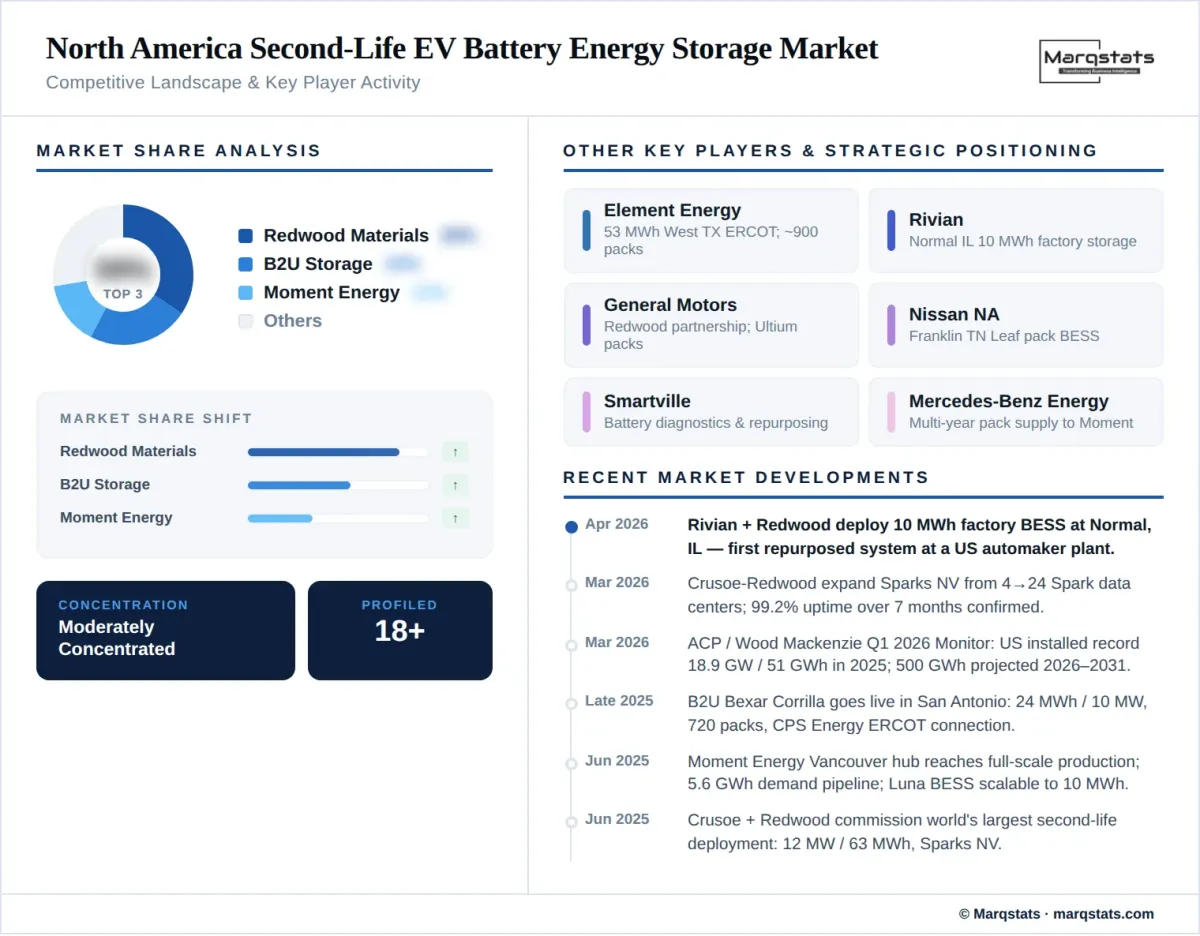
The North America Second-Life EV Battery Energy Storage Market is moderately concentrated at the dedicated specialist level, with three distinct business model archetypes coexisting. Redwood Materials (Redwood Energy division) anchors the recycler-led vertically integrated model, processing approximately 20 GWh of batteries annually and operating the largest installed second-life deployment at Sparks Nevada. B2U Storage Solutions anchors the BESS developer-led grid-connected model with operations in California and Texas. Moment Energy anchors the certified C&I product model as the first North American UL 1974-certified company, with the Vancouver Luna BESS production hub at full-scale capacity. Element Energy operates 53 MWh in West Texas with approximately 900 packs in ERCOT.
Automaker programs include Rivian (Redwood factory storage partnership at Normal Illinois), GM (Redwood second-life and new battery supply partnership), Nissan (Franklin Tennessee Leaf battery BESS at US headquarters), Mercedes-Benz Energy (supply to Moment Energy), Tesla, Ford, Toyota, Hyundai, and Honda circular-economy programs. Smartville provides EV battery repurposing and battery diagnostics. Battery recyclers including Redwood Materials, Li-Cycle, Ascend Elements, Cirba Solutions, and Ecobat operate at the boundary between second-life and direct recycling, with selection logic depending on battery state of health, application demand, and metal pricing.
New BESS integrators including Tesla Energy, Fluence, Wartsila, and Powin primarily compete with new battery systems but represent the broader stationary storage competitive landscape that second-life systems must address. Ford Energy is retooling the BlueOval SK Battery Park plant in Kentucky for LFP BESS production, signaling competitive intensification. Testing and certification firms including UL Solutions, Intertek, TUV Rheinland North America, and DNV anchor the bankability and safety infrastructure essential for commercial second-life deployment. Battery analytics firms including Smartville and emerging digital passport providers anchor the data infrastructure that determines second-life value capture. The competitive landscape will be defined by control over battery sourcing, state-of-health diagnostics, safe integration into certified BESS architectures aligned with UL 1974 and NFPA 855, bankable warranties, grid-market software, and recycling exit pathways.
Companies Covered
The report profiles 18 company profiles+ companies with full strategy and financials analysis, including:
Recent Market Activity
Table of Contents
Coverage & Segmentation
The North America Second-Life EV Battery Energy Storage Market report analyzes the repurposed battery stationary storage opportunity across data-center microgrids, grid-scale BESS, commercial and industrial storage, EV charging support, factory energy storage, fleet depot storage, solar-plus-storage, telecom backup, residential storage, and mobile applications for the period 2021 to 2030. The report covers historical data for 2021–2025, with 2025 as the base year, and forecasts spanning 2026–2030. Market sizing is conducted in USD millions with parallel GWh capacity tracking. The study examines retired EV battery packs, modules, and cells repurposed into stationary BESS configurations across passenger EV, electric truck and van, electric bus, warranty return, manufacturing reject, fleet-owned, and accident salvage feedstock streams.
The scope evaluates competing chemistry economics across NMC, LFP, NCA, LMO blends, and emerging lithium-ion chemistries. Battery form factors include full pack reuse, module-level reuse, cell-level reuse, and mixed-architecture configurations. Business models covered include recycler-led, OEM partnership, BESS developer-led, certified C&I product, storage-as-a-service, and grid-service merchant revenue architectures. Country coverage includes United States (California, Texas, Nevada, Illinois, Tennessee, Arizona, Michigan, Ohio, Georgia, Kentucky), Canada (British Columbia, Ontario), and Mexico. Regulatory frameworks evaluated include UL 1974 Standard for Evaluation for Repurposing Batteries, UL 1973 stationary battery applications, UL 9540 / UL 9540A energy storage system safety, NFPA 855 stationary BESS installation standard, IEC 62619 industrial lithium battery safety, UN 38.3 battery transport, EPA lithium-ion battery guidance, IRA standalone storage Investment Tax Credit, and state-level fire codes and permitting.