Market Snapshot
Key Takeaways
Market Overview & Analysis
Report Summary
The second-life EV battery energy storage market sits at the intersection of EV battery retirement, stationary storage demand, and circular economy regulation. An EV battery may be removed from a vehicle when its capacity falls below automotive performance requirements, but typically retains 70% to 80% of usable capacity, creating value for grid-scale, commercial, microgrid, and backup power applications before final material recycling. The circular pathway flows EV traction battery → stationary energy storage → recycling for lithium, nickel, cobalt, copper, and graphite recovery. Second-life economics work where tested, certified, and integrated used-battery systems can be operated safely at lower cost than new BESS in selected applications.
Safety, certification, and bankability requirements anchor the cost structure for second-life deployments. Repurposed packs must satisfy UL 1974 Standard for Evaluation for Repurposing Batteries, covering sorting, grading, continued viability, and rating mechanisms for continued battery use. Adjacent standards include UL 1973 for stationary battery applications, UL 9540 for energy storage system safety, UL 9540A for thermal runaway fire propagation testing, IEC 62619 for industrial lithium battery safety, and UN 38.3 for battery transport. State-of-health testing, battery management system data access, and pack-level integration architecture together determine the cost-to-deploy economics for each second-life project.
Battery feedstock supply through 2030 is dominated by warranty returns, manufacturing rejects, test fleets, commercial fleet retirements, accident salvage, and early EV retirements rather than mass end-of-life passenger EV waves, which become material only after 2030–2035 when first-generation BEV batteries reach typical retirement age. Heavy-duty commercial vehicle battery retirement provides earlier feedstock owing to high-utilization duty cycles, with electric truck deployment within the India E-Truck Market positioning the heavy-duty pool for follow-on second-life feedstock supply alongside parallel European and Chinese commercial EV fleet retirement streams.
Market Dynamics
Key Drivers
- Stationary battery storage demand pull is rising sharply. Battery storage was the fastest-growing power technology in 2025 with 108 GW of new battery storage capacity deployed globally, up approximately 40% year-on-year. The demand pull creates uptake pathway for any safe, lower-cost storage source including repurposed EV batteries, particularly in price-sensitive C&I, EV charging, and microgrid applications.
- EV battery retirement pipeline expands materially through 2030. The global EV fleet (excluding two- and three-wheelers) is expected to reach 250 million vehicles by 2030, four times end-2024 level. Redwood Materials processes approximately 20 GWh of batteries annually equivalent to 250,000 EVs, representing approximately 90% of all lithium-ion batteries recycled in North America, with many packs retaining 50% to 80% useable capacity that supports second-life selection ahead of recycling.
- EU Battery Regulation creates regulatory tailwind for traceability and lifecycle optimization. The EU Battery Regulation 2023/1542 entered into force on 17 August 2023, covering sustainability, collection, recycling, and repurposing across the entire battery lifecycle. The Battery Passport requirement effective 18 February 2027 mandates electronic registration for EV and industrial batteries above 2 kWh placed on the EU market, providing verified state-of-health, chemistry, age, and usage history data essential for second-life buyers.
- Data-center microgrids emerge as a high-value premium application. AI infrastructure power demand is expanding rapidly, and second-life battery systems can be deployed in months rather than year-long grid-interconnection timelines. The Crusoe-Redwood Sparks Nevada deployment proves the model at 12 MW / 63 MWh, with the partnership scaling from 4 to 24 Crusoe Spark modular data centers in March 2026 at 99.2% operational availability over seven months.
- Cost economics support specific application targeting. Redwood Materials chief commercial officer states that repurposed packs can be deployed at roughly half the cost of new systems while offering comparable performance in stationary settings. The cost advantage is most attractive in applications where the buyer does not require absolute highest energy density or longest warranty, including behind-the-meter C&I storage, EV charging buffering, renewable smoothing, telecom backup, rural microgrids, temporary power, construction-site power, and data-center microgrids.
Key Restraints
- Cheap new LFP batteries compress second-life pricing power. LFP batteries accounted for approximately 90% of battery storage deployments in 2025 because they are cheaper, safer, and better suited for frequent cycling than many higher-energy chemistries used in EVs. The competitive pressure means second-life batteries must compete not only with recycling but with very cheap new LFP storage batteries, narrowing the addressable application set.
- Battery variability raises testing and integration cost. Used packs differ by chemistry, age, thermal history, degradation, cell imbalance, abuse history, and design. Pack-level state-of-health testing, grading, and certification can erode the cost advantage. The variability constraint pushes the market toward closed-loop OEM-fleet pathways where battery provenance is known and pack design is uniform.
- Limited near-term battery feedstock constrains scale. Most batteries available for second life through 2030 will come from early EVs, warranty returns, manufacturing rejects, test fleets, commercial fleets, buses, and accident salvage rather than the much larger end-of-life passenger EV wave that materializes after 2030–2035 when first-generation BEV batteries reach typical retirement age.
- Pack design diversity raises integration complexity. Each OEM pack architecture may require different integration hardware, software, BMS interfaces, and cooling. Redwood’s engineers built a universal controller box that connects to each EV pack type and operates it according to its unique needs, however the engineering investment remains a meaningful per-supplier hurdle.
- Warranty and bankability constraints favor new battery systems. Lenders prefer standardized new battery systems with known performance and OEM-backed warranty structure. Second-life projects require differentiated financing, insurance, and uptime contract architecture, slowing deployment in capital-intensive utility-scale applications.
- Recycling competition intensifies under high metal prices. Damaged packs, low-state-of-health packs, unsafe packs, and packs covered by OEM contracts requiring direct recycling bypass second-life entirely. Manufacturing scrap is expected to account for a large share of recycling feedstock through 2030, with end-of-life EV and storage batteries becoming the main recycling feedstock after 2035.
Key Trends
- Shift from small pilots to commercial-scale deployments. Earlier second-life projects were small pilots involving Nissan Leaf packs for buildings, BMW i3 modules for backup, and bus battery trials. The market has moved toward commercial-scale BESS, with Redwood Sparks Nevada at 63 MWh, Element Energy West Texas at 53 MWh, and B2U California at 28 MWh plus 12 MWh together demonstrating scale beyond demonstration.
- OEMs are formalizing battery take-back and circular economy programs. Nissan and 4R Energy reuse Leaf battery modules across portable and stationary power applications. Jaguar Land Rover with Allye Energy developed the Allye MAX 270 kWh mobile BESS using second-life Range Rover PHEV batteries from seven vehicles per unit. General Motors signed a letter of intent with Redwood for stationary energy storage using GM batteries and end-of-life EV packs. Mercedes-Benz Energy and Nissan supply packs to Moment Energy under multi-year contracts.
- Pack-level reuse is becoming the preferred architecture over cell-level dismantling. Pack-level reuse reduces labor cost, accelerates deployment, and improves safety compared with full disassembly into cells. The architecture supports faster project timelines and lower per-kWh integration cost, anchoring the commercial competitiveness of second-life relative to new battery systems.
- Battery health data and digital infrastructure are becoming competitive advantages. The EU battery passport requirement effective February 2027 will provide verified data on handling instructions and state-of-health for recycling operators and second-life repurposers. Battery analytics, BMS data access, and digital passport providers anchor the data infrastructure that determines second-life value capture.
- Data-center and AI infrastructure represent the highest-value emerging niche. Crusoe Spark modular data centers paired with second-life battery microgrids enable rapid deployment in months rather than year-long grid build-outs, supporting AI infrastructure power demand. The Sparks Nevada deployment is operating below grid prices and has demonstrated 99.2% operational availability since June 2025 commissioning, validating the architecture for further deployment.
Market Segmentation
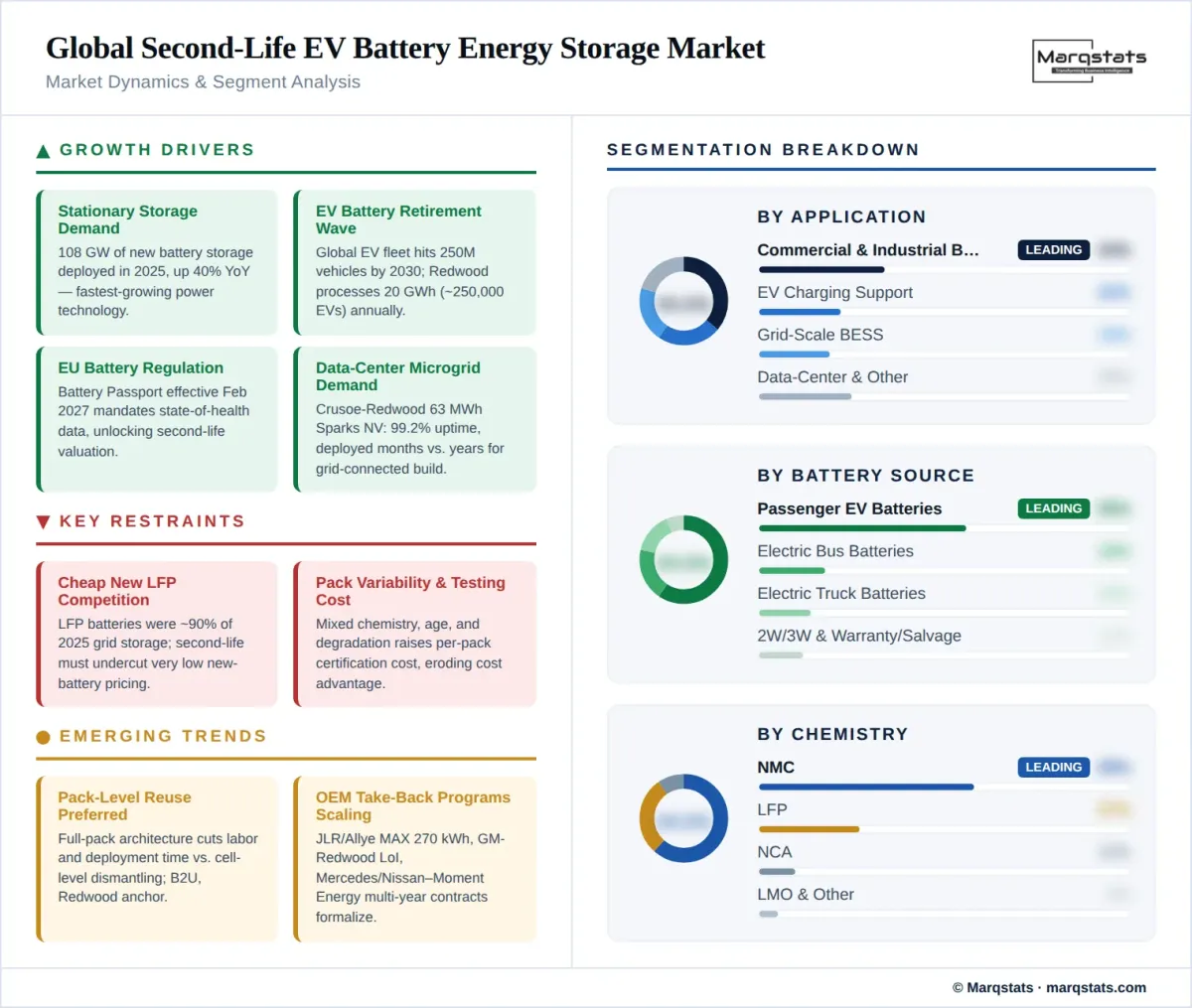
Commercial and industrial (C&I) BESS holds the largest application share at approximately 34% of the 2025 second-life EV battery energy storage market, anchored by peak shaving, demand charge reduction, solar self-consumption, backup power, and EV charging support deployments where moderate cycling profiles align well with used battery characteristics. Data-center microgrids represent the fastest-growing application segment, expanding at approximately 58% CAGR during 2026–2030, supported by AI infrastructure power demand and the Crusoe-Redwood deployment milestone. EV charging support, grid-scale storage, telecom backup, solar-plus-storage, residential, mobile/temporary, and emerging-market microgrid applications represent the remaining application pool.
C&I deployments anchor the largest share owing to favorable economics, predictable usage patterns, and price-sensitive buyer profiles. Applications include peak shaving for high-demand-charge customers, demand charge reduction, solar self-consumption optimization, backup power, power quality, and EV charging support. B2U Storage Solutions operates 28 MWh and 12 MWh sites in California using over 1,300 Nissan Leaf packs to smooth solar output. The segment supports moderate cycling that aligns well with used battery characteristics.
Data-center microgrid applications represent the fastest-growing application segment with premium per-deployment value. The Crusoe-Redwood Sparks Nevada deployment scaled from 4 to 24 Crusoe Spark modular data centers in March 2026 with 99.2% operational availability over seven months. The architecture supports AI infrastructure deployment in months rather than year-long grid interconnection timelines. Redwood reports over 1 GWh of reusable batteries in deployment pipeline expanding by an additional 5 GWh in the coming year, with 100+ MW projects already in design.
EV charging support storage buffers grid demand at fast-charging sites, enabling charging from grid or solar with rapid discharge to vehicles. The architecture avoids high grid-upgrade costs at fleet depots, highway DC fast chargers, bus depots, logistics hubs, airports, and parking operator sites. Bengaluru solar-integrated EV charging near Kempegowda International Airport demonstrates the second-life-with-renewables model in emerging markets. The segment supports premium per-kWh pricing relative to passive storage applications.
Grid-scale second-life BESS supports renewable energy integration, frequency regulation, and capacity firming. Element Energy operates 53 MWh in West Texas. The segment faces direct competition from new LFP utility-scale BESS but maintains relevance for applications where rapid deployment timeline, circular-economy positioning, or specific contract structure favors second-life pathways. Bankability constraints and warranty structure differences slow utility-scale deployment relative to C&I and microgrid applications.
Telecom backup represents a mature use case in selected geographies owing to lower cycling intensity and predictable operational profiles that extend battery service life. Power requirements are typically lower than grid-scale storage, supporting smaller installation footprint and integration complexity. The segment is concentrated in emerging markets and weak-grid regions where backup reliability commands material premium relative to capital cost.
Solar-plus-storage and wind smoothing applications support renewable energy integration where capital cost matters more than absolute energy density. The segment is strongest in emerging markets, islands, rural areas, and weak-grid regions. The architecture aligns well with second-life cost economics and supports circular-economy positioning for renewable project developers.
Residential second-life storage faces stricter safety, certification, warranty, installer trust, and insurance requirements than commercial applications, limiting near-term scale relative to new LFP residential battery offerings. Mobile and temporary power applications including construction sites, events, festivals, and off-grid deployments anchor a high-niche segment. Allye Energy MAX BESS units use second-life Range Rover PHEV batteries from seven vehicles each in 270 kWh configurations.
Passenger EV batteries hold the largest share at approximately 56% of the 2025 second-life market by source, anchored by the global passenger BEV and PHEV fleet warranty return and early retirement pipeline. Electric bus batteries represent the fastest-growing source segment, expanding at approximately 41% CAGR during 2026–2030, owing to higher utilization duty cycles that bring battery retirement forward and predictable fleet operator-controlled supply. Electric truck batteries, two-and-three-wheeler batteries, warranty returns, manufacturing rejects, and accident salvage batteries together represent the remaining feedstock pool.
Passenger EV battery feedstock anchors the largest source share supported by global BEV and PHEV fleet warranty returns, early retirements, manufacturing scrap, and accident salvage. Tesla, BYD, Volkswagen Group, Hyundai-Kia, Toyota, Honda, Nissan, Ford, GM, and Stellantis platforms drive feedstock diversity. Redwood receives 20 GWh of batteries annually equivalent to 250,000 EVs across nearly all major automakers including Volkswagen/Audi, Toyota, BMW, Ford, Nissan, GM/Ultium, and partnerships with micromobility and fleet operators.
Electric bus battery feedstock represents the fastest-growing source segment owing to higher utilization duty cycles in transit operations that bring battery retirement forward, predictable fleet operator-controlled supply, and concentrated geographic deployment that simplifies logistics. Connected Energy partnered with Volvo Group on its Norfolk testing facility for multi-manufacturer bus and truck battery integration. The segment supports scalable closed-loop supply contracts.
Electric truck battery feedstock scales as commercial truck electrification expands. Heavy-duty trucks operate at high utilization with very large battery packs, accelerating retirement timelines relative to passenger BEV. Swedish Rosersberg Smartcharger Station deploys second-life heavy-duty truck batteries at depot charging applications. The segment supports closed-loop fleet operator deployment and integration with EV charging infrastructure.
Two-wheeler and three-wheeler battery feedstock provides smaller individual pack sizes but substantial absolute volume in India, Southeast Asia, and emerging markets. Smaller pack architecture supports lower-power telecom backup, residential, and small-business backup applications. The segment is anchored by Indian e-rickshaw and electric scooter fleet operations with predictable retirement profiles.
Warranty-returned packs and manufacturing rejects represent important near-term feedstock with often-higher state of health than retired packs. Manufacturing scrap is expected to account for a large share of recycling feedstock through 2030, with overlap into second-life selection where pack health permits. The segment supports closed-loop OEM-Tier-1 partnerships and rapid-deployment commercial pilots.
Accident-damaged or salvage vehicle batteries with intact battery packs provide an important feedstock stream in selected projects. Porsche Leipzig pre-series vehicle dismantling demonstrates the model. Insurance carriers, salvage operators, and OEM warranty channels supply the segment. State-of-health verification and safety certification are particularly critical given pack history uncertainty.
Full pack reuse holds the largest share at approximately 47% of the 2025 second-life market by form factor, anchored by lower labor cost, accelerated deployment timeline, and improved safety relative to disassembly approaches. Module-level reuse represents the fastest-growing form segment, expanding at approximately 36% CAGR during 2026–2030, owing to more granular pack configuration flexibility, mixed-vintage integration capability, and selective health-grade matching across heterogeneous source packs.
Full pack reuse uses entire EV battery packs as deployed BESS modules with intelligent pack-level controls. The architecture reduces labor cost, accelerates deployment, improves safety, and supports faster project timelines. B2U EV Pack Storage technology and Redwood Pack Manager technology anchor the architecture across commercial deployments. The form supports closed-loop OEM-controlled supply where pack provenance and design uniformity simplify integration.
Module-level reuse disassembles packs to module level, enabling more granular state-of-health grading, mixed-vintage integration, and pack reconfiguration for specific application power and energy profiles. Moment Energy uses module-level disassembly and rebuild architecture supplying packs to Vancouver airport, Tofino General Hospital, and emerging US C&I customers. The form supports diverse OEM source pack integration but raises labor and certification cost relative to full pack reuse.
Cell-level reuse fully dismantles batteries to individual cells for sorting, regrading, and rebuild into new BESS module configurations. The form provides maximum flexibility but highest labor cost and slowest deployment timeline. The segment is small but technically significant for selected applications where heterogeneous source packs must be unified into uniform deployment configurations.
Mixed architecture deployments combine full packs, modules, and selectively rebuilt assemblies depending on source feedstock state of health and target application power and energy profile. The form supports flexible scaling and adaptive integration of multi-vintage source feedstock. Connected Energy 5 MWh Norfolk facility integrates batteries from multiple bus and truck manufacturers including Forsee Power as initial supplier with additional partners scheduled.
NMC chemistry holds the largest share at approximately 58% of the 2025 second-life market by chemistry, anchored by the global passenger BEV and PHEV fleet that has historically deployed nickel-manganese-cobalt cells. LFP chemistry represents the fastest-growing chemistry segment, expanding at approximately 42% CAGR during 2026–2030, supported by accelerating LFP adoption in Chinese passenger BEV and global commercial vehicle platforms that will shift second-life feedstock chemistry composition through the forecast horizon. NCA, LMO blends, and emerging chemistries together represent the remaining feedstock pool.
Nickel-manganese-cobalt (NMC) batteries dominate current second-life feedstock owing to historical passenger BEV and PHEV deployment dominance. Tesla Model S, Model X, Model 3 Long Range, BMW i3, Mercedes EQ platforms, Hyundai-Kia E-GMP, Volkswagen Group ID family, and most premium European BEV platforms deploy NMC. The chemistry supports higher energy density and is well-suited to second-life applications requiring meaningful capacity in compact deployment footprint.
Lithium iron phosphate (LFP) chemistry feedstock is the fastest-growing chemistry source as Chinese OEM passenger BEV and global commercial vehicle platforms increasingly deploy LFP. The chemistry offers superior cycle life and thermal stability, particularly well-suited to high-cycling stationary applications including grid storage, EV charging support, and renewable integration. The chemistry shift in second-life feedstock through 2030 mirrors the upstream EV battery chemistry transition.
Nickel-cobalt-aluminum (NCA) batteries appear primarily in Tesla legacy platforms and selected high-energy-density applications. The chemistry retains useful capacity for second-life deployment but represents a smaller and declining share of overall feedstock as OEM platforms transition to NMC and LFP for new vehicle deployment.
Lithium manganese oxide (LMO) blends and other lithium-ion chemistries appear in selected legacy passenger BEV and early commercial EV platforms. The category supports niche second-life applications and provides chemistry-mix diversity in heterogeneous feedstock streams. The segment is small but technically significant for selected deployment configurations.
The 100 kWh to 1 MWh capacity range holds the largest share at approximately 38% of the 2025 second-life market, anchored by C&I BESS, mid-size depot charging support, and small microgrid applications. The 1 MWh to 10 MWh range represents the fastest-growing capacity segment, expanding at approximately 49% CAGR during 2026–2030, supported by data-center microgrid scaling, EV charging hub deployment, and large C&I site installations.
Sub-100 kWh deployments anchor residential, small-business backup, telecom, and mobile applications. Allye MAX 270 kWh units sit in the upper portion of this band but most deployments fall below 100 kWh. The segment supports rapid pack-level integration and minimal site-engineering complexity.
The 100 kWh to 1 MWh range anchors the volume centroid of current second-life deployments. Moment Energy targets 400 kWh to 10 MWh BESS deployments. C&I peak shaving, demand charge reduction, depot charging support, and small microgrid applications drive segment volume. The segment combines proven economics with manageable site engineering and integration complexity.
The 1 MWh to 10 MWh range represents the fastest-growing capacity segment as data-center microgrids, EV charging hub buffering, and large C&I deployments scale. Connected Energy Norfolk facility anchors at 5 MWh. The segment supports premium per-kWh pricing relative to smaller deployments and benefits from concentrated site-engineering economies of scale.
The 10 MWh to 50 MWh range covers commercial-scale microgrid and grid-scale BESS deployments. Element Energy West Texas at 53 MWh and B2U California aggregate operations sit at this scale. The segment requires meaningful site-engineering investment and anchors large utility, AI data center, and corporate sustainability deployments.
Above-50 MWh deployments anchor the largest installed projects with premium per-deployment value. Redwood Sparks Nevada at 63 MWh leads the segment. The category remains specialty deployment through 2030 with material long-term growth potential as AI data center microgrids, large C&I corporate sustainability projects, and utility-scale second-life deployments scale beyond demonstration.
By Geography
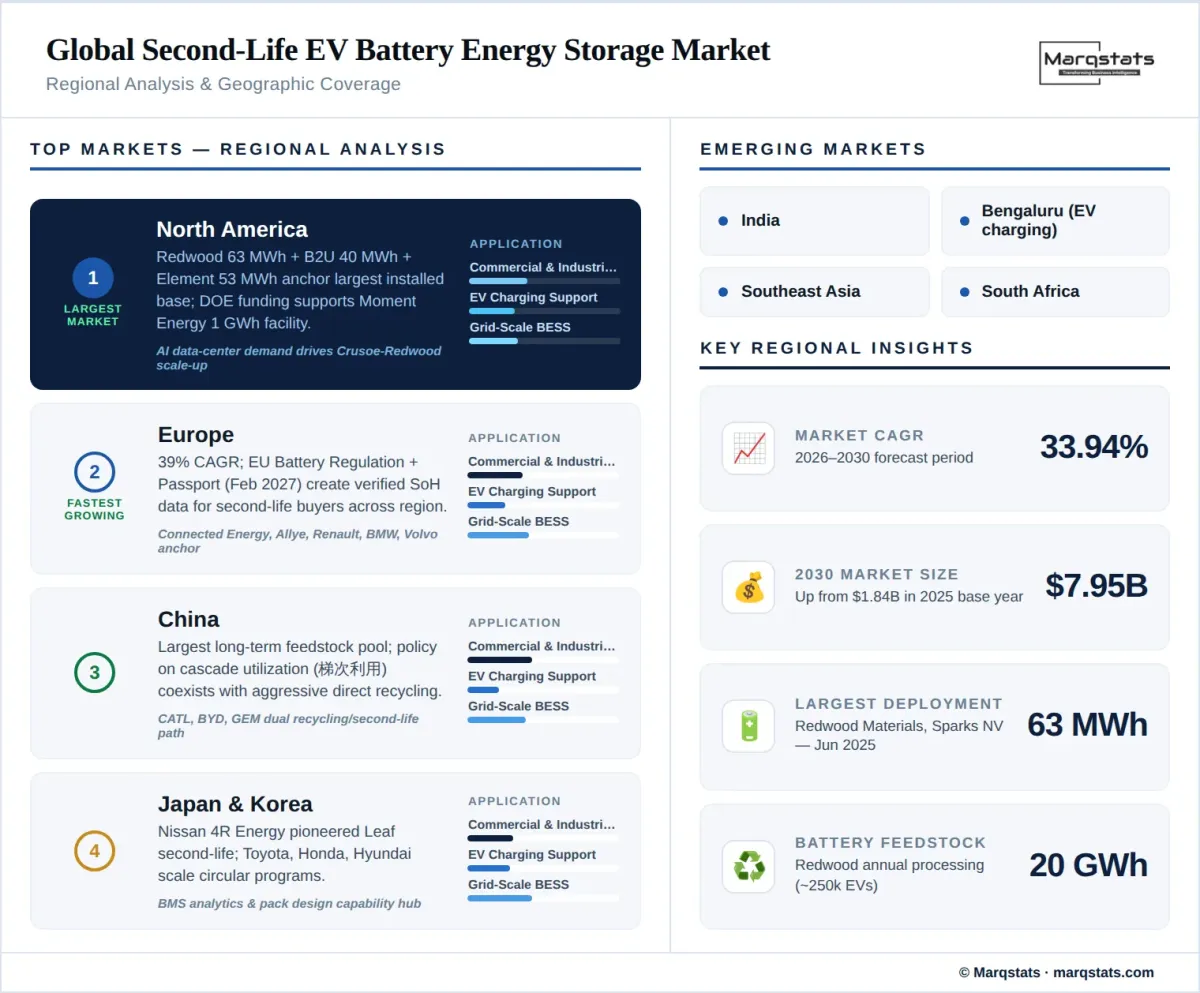
North America holds the largest regional share of the 2025 second-life EV battery energy storage market, anchored by Redwood Materials installed deployments, B2U California operations, Element Energy West Texas, and Moment Energy facility under construction in Taylor, Texas. Europe represents the fastest-growing regional cluster expanding at approximately 39% CAGR during 2026–2030, supported by EU Battery Regulation, battery passport infrastructure, and dedicated specialists including Connected Energy, Allye Energy, and Renault circular-economy programs. China, Japan-Korea, and Rest of World together represent the remaining regional demand pool.
North America
North America anchors the largest installed base of commercial second-life deployments. Redwood Materials Sparks Nevada at 12 MW / 63 MWh expanded to 24 Crusoe Spark modular data centers in March 2026. B2U Storage Solutions operates 28 MWh and 12 MWh sites in California using over 1,300 Nissan Leaf packs. Element Energy operates 53 MWh in West Texas. Moment Energy is building a 1 GWh certified repurposing facility in Taylor, Texas with USD 20.3 million US Department of Energy funding and contracts with Mercedes-Benz Energy and Nissan. The regional ecosystem benefits from strong OEM circular-economy partnerships, growing data-center demand, and federal funding support including Justice40 Initiative coal-community manufacturing programs.
Europe
Europe represents the fastest-growing regional cluster supported by binding regulatory infrastructure under the EU Battery Regulation 2023/1542, which entered into force on 17 August 2023 covering sustainability, collection, recycling, and repurposing across the entire battery lifecycle. The Battery Passport requirement effective 18 February 2027 mandates electronic registration for EV and industrial batteries above 2 kWh placed on the EU market. Connected Energy is developing a £2 million testing facility at Scottow Enterprise Park in Norfolk with 5 MWh BESS scheduled for mid-2026 commissioning, supported by Advanced Propulsion Centre UK funding and partnered with Forsee Power for initial battery supply. Renault, BMW, JLR/Allye Energy, Nissan, Volvo Group, and Mercedes-Benz Energy anchor the OEM circular-economy partnerships.
China
China represents the largest long-term second-life market opportunity given the largest EV parc, dominant EV battery manufacturing base, and policy focus on cascade utilization (梯次利用). The country also has substantial demand for stationary storage, telecom backup, renewable integration, and distributed energy systems. However, Chinese battery manufacturers and recyclers also pursue aggressive direct recycling for lithium, nickel, cobalt, and graphite feedstock recovery, partially competing with second-life pathways. CATL, BYD, Brunp, and GEM anchor the recycling-second-life dual-pathway architecture.
Japan and South Korea
Japan and South Korea provide important automaker and battery company involvement. Nissan / 4R Energy operates one of the earliest second-life ecosystems with Leaf battery reuse for portable and stationary power applications, with batteries often outlasting the original vehicles. Toyota, Honda, and Hyundai-Kia circular-economy programs scale across the regional ecosystem. Japanese and Korean battery analytics, BMS, and pack design capability support the regional supply-side capability.
Rest of World
Rest of World, including India, Southeast Asia, Latin America, the Middle East, and Africa, captures emerging second-life deployment in EV charging support, telecom backup, commercial storage, and solar-plus-storage applications. Bengaluru solar-integrated EV charging near Kempegowda International Airport demonstrates the second-life-with-renewables model. Indian commercial fleet, two-wheeler, and three-wheeler battery retirement provides growing regional feedstock supply. Southeast Asian port and commercial fleet electrification scales the addressable feedstock base. South African off-grid and weak-grid microgrid applications anchor selective deployment.
How Competition Is Evolving
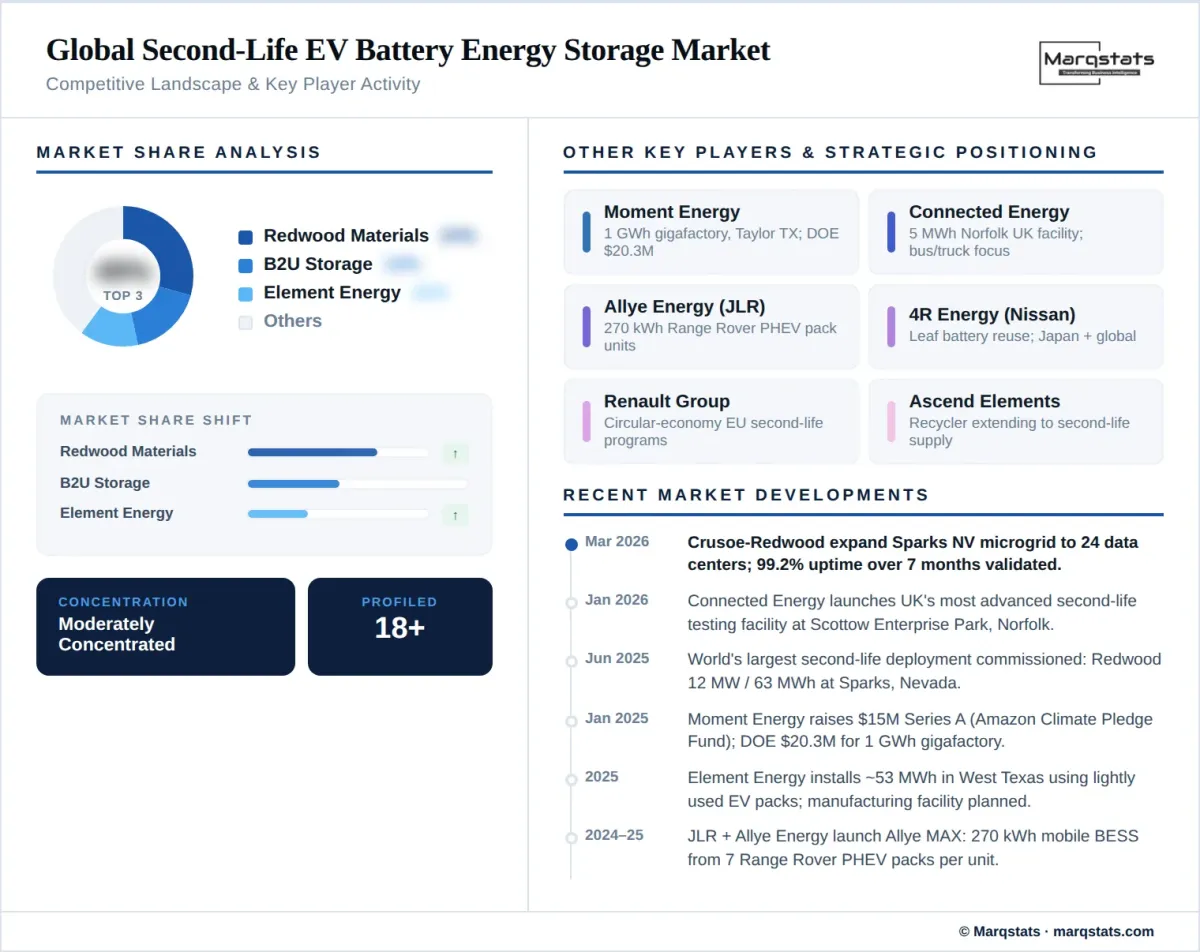
The second-life EV battery energy storage market is moderately concentrated at the dedicated specialist level and broadly distributed across automaker circular-economy programs, battery recyclers extending into stationary storage, and battery analytics and certification firms. Redwood Materials (Redwood Energy division), B2U Storage Solutions, Element Energy, Moment Energy, Connected Energy, and Allye Energy anchor the specialist tier. Automaker programs from Nissan/4R Energy, Renault, BMW, JLR, Mercedes-Benz Energy, GM (Redwood partnership), and Volkswagen circular-economy initiatives provide the supply-side feedstock infrastructure.
Battery recyclers including Redwood Materials, Li-Cycle, Ascend Elements, Ecobat, Umicore, GEM, and the Brunp-CATL ecosystem operate at the boundary between second-life and direct recycling, with selection logic depending on battery state of health, application demand, and metal pricing. New BESS integrators including Fluence, Tesla Energy, Wärtsilä, Sungrow, CATL, BYD, and HyperStrong primarily compete with new battery systems but represent the broader stationary storage competitive landscape that second-life systems must address.
Testing and certification firms including UL Solutions, TÜV SÜD, Intertek, and DNV anchor the bankability and safety infrastructure essential for commercial second-life deployment. Battery analytics, BMS, and digital passport providers anchor the data infrastructure that determines second-life value capture. The competitive landscape will be defined less by used-battery cost arbitrage and more by control over battery sourcing from OEMs, fleets, and salvage networks; state-of-health diagnostics using BMS data and analytics; safe integration into certified stationary BESS architectures; and bankable warranties and performance guarantees.
Companies Covered
The report profiles 18 company profiles+ companies with full strategy and financials analysis, including:
Recent Market Activity
Table of Contents
Coverage & Segmentation
The Global Second-Life EV Battery Energy Storage Market report analyzes the repurposed battery stationary storage opportunity across commercial and industrial BESS, EV charging support, microgrids, telecom backup, data-center microgrids, grid-scale storage, solar-plus-storage, residential, and mobile and temporary power applications for the period 2021 to 2030. The report covers historical data for 2021–2025, with 2025 as the base year, and forecasts spanning 2026–2030. Market sizing is conducted in USD millions with parallel GWh capacity tracking. The study examines retired EV battery packs, modules, and cells repurposed into stationary BESS configurations across passenger EV, electric bus, electric truck, two-wheeler and three-wheeler, warranty return, manufacturing reject, and accident salvage feedstock streams.
The scope evaluates competing chemistry economics across NMC, LFP, NCA, LMO blends, and emerging lithium-ion chemistries. Capacity ranges covered include below-100 kWh, 100 kWh to 1 MWh, 1 MWh to 10 MWh, 10 MWh to 50 MWh, and above-50 MWh deployments. Battery form factors include full pack reuse, module-level reuse, cell-level reuse, and mixed-architecture configurations. Regulatory frameworks evaluated include the EU Battery Regulation 2023/1542, EU Battery Passport effective February 2027, UL 1974 Standard for Evaluation for Repurposing Batteries, UL 1973 stationary battery applications standard, UL 9540 energy storage system safety, UL 9540A thermal runaway fire propagation testing, IEC 62619 industrial lithium battery safety, and UN 38.3 battery transport.