Market Snapshot
Key Takeaways
Market Overview & Analysis
Report Summary
The India EV charging payment and interoperability platform market comprises digital software platforms across the charging value chain. The defined scope includes electric-vehicle charging apps, charger discovery platforms, payment gateways, UPI and BHIM integration, wallet and RFID payments, slot booking, roaming platforms, OCPI-based network interoperability, OCPP-based charger management integration, charger management system middleware, charge-point-operator dashboards, fleet charging payment platforms, and settlement and billing systems. Physical charger hardware, electrical installation, unconnected home chargers and battery-swap hardware fall outside the scope.
India installed 29,151 public charging stations by February 2026, reported through Bharat Heavy Electricals Limited to the Ministry of Heavy Industries. Charging-station setup was notified as an unlicensed activity under Ministry of Power guidelines, which lowered entry barriers and multiplied charge point operators. The resulting fragmentation, spanning more than 40 operators with separate apps and payment systems, created friction for users managing multiple logins, wallets and billing processes. This friction defines the demand for discovery, payment and interoperability platforms.
The 2025 market is estimated at USD 48 million, weighted toward charger management software and charge-point-operator platforms, with payment integration, roaming and discovery apps forming growing shares. Demand is increasing owing to charger-base expansion, operator fragmentation and the government push for a unified interface. Forecast value reaches USD 280 million by 2030 as the public charging base approaches 72,300 stations, roaming adoption scales through the OCPI protocol, and payment integration deepens across the UPI and BHIM ecosystem.
Platform monetization rests on session volume and recurring software fees. Charger management software enables remote monitoring, dynamic tariff management and uptime reporting, while payment platforms reduce transaction friction across UPI, wallets and RFID. Backend providers report substantial scale; Kazam EV Tech Private Limited has managed more than 8.83 million charging sessions, enabled over 124 GWh of energy and onboarded more than 485,000 users across its platform. Growing session volume converts directly into transaction-commission and payment-gateway revenue as charging frequency rises with the on-road electric-vehicle base.
Revenue accrues through software-as-a-service subscriptions, per-charger fees, transaction commissions, payment-gateway and settlement fees, and white-label platform fees. The value chain spans charger hardware, charger management software, eMobility service providers, roaming hubs and payment rails operated by the National Payments Corporation of India. Backend software providers such as Kazam EV Tech Private Limited and Numocity Technologies Private Limited sit closest to the charge-point-operator layer, while user-facing apps such as Statiq and Tata Power Company Limited’s EZ Charge serve discovery and payment.
Unified Charging and Interoperability Framework
The Unified Bharat e-Charge initiative defines a national, open interoperability framework for electric-vehicle charging, with Bharat Heavy Electricals Limited designated as the nodal agency for demand aggregation and the unified digital app, per the Ministry of Heavy Industries. The platform targets single-interface charger discovery, real-time availability, slot booking and digital payment across operators, with the government comparing its intent to the Unified Payments Interface. The app is built on the open, India-originated Beckn-based protocol, which avoids dependence on foreign charging-network standards.
Interoperability rests on two protocols. The Open Charge Point Protocol connects charger hardware to backend charger management software, while the Open Charge Point Interface connects networks for authentication, data exchange and payment, enabling EV roaming across operators. Plug & Charge authentication under the ISO 15118 standard enables automated vehicle authentication without apps or RFID cards. The IS 17017 connector series and the Ministry of Power charging guidelines frame the hardware and tariff environment within which these platforms operate.
The PM E-DRIVE allocation funds approximately 72,300 public charging stations, including about 22,100 fast chargers for passenger cars, by the end of FY2026. The government positions the unified interface as the charging equivalent of the Unified Payments Interface, where a single application abstracts the underlying operator. Industry participants expect the framework to shift competition from proprietary network apps toward integration with the national platform, payment-rail access and protocol coverage.
Market Dynamics
Key Drivers
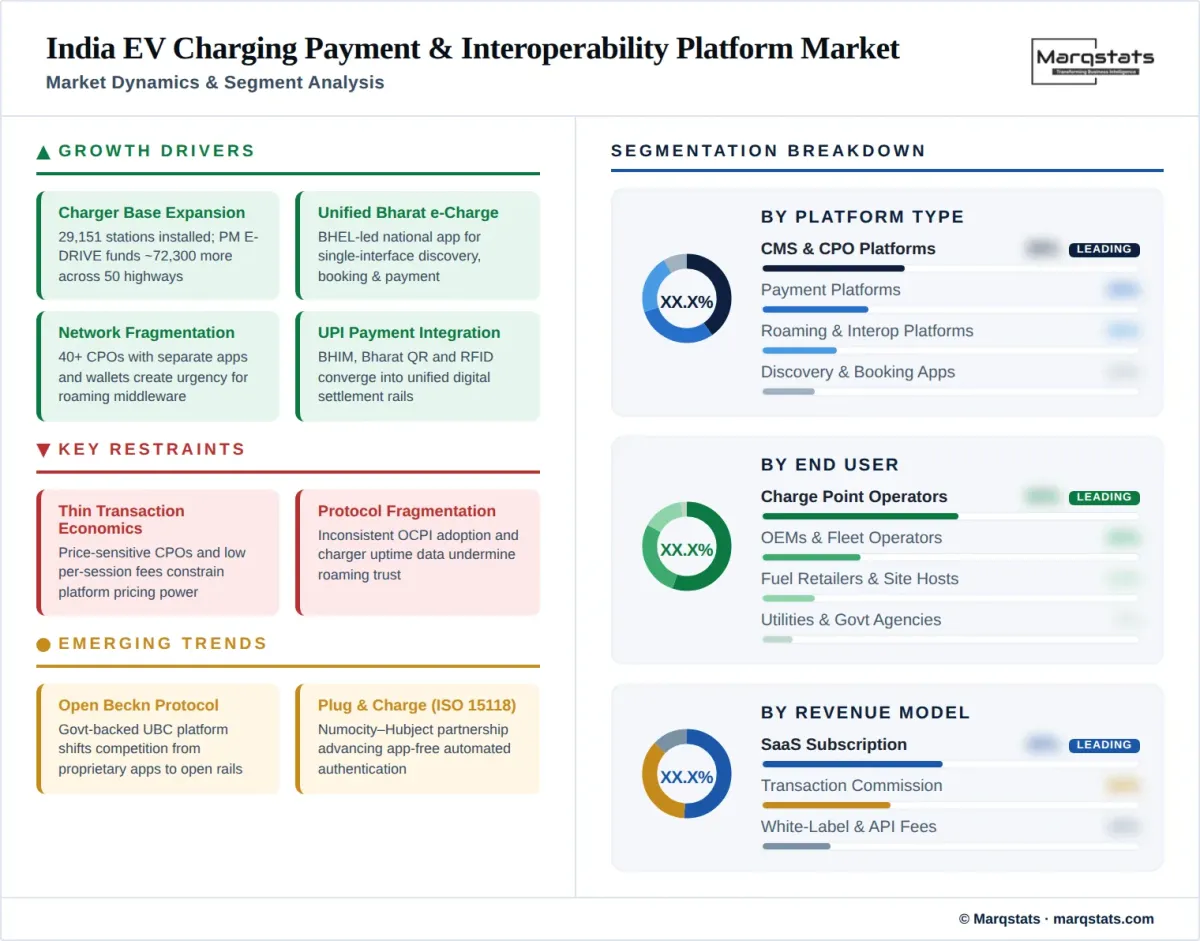
- India installed 29,151 public charging stations by February 2026, with PM E-DRIVE funding approximately 72,300 stations, expanding the base of chargers that require discovery, payment and management software.
- The Unified Bharat e-Charge initiative, with Bharat Heavy Electricals Limited as nodal agency per the Ministry of Heavy Industries, creates a national platform for single-interface discovery, booking and payment across operators.
- More than 40 charge point operators run separate apps, logins and payment systems, generating demand for roaming and interoperability platforms that unify the user experience.
- Payment integration through the UPI and BHIM ecosystem and Bharat QR lowers transaction friction and broadens digital settlement across charging networks.
- Charging-station setup, notified as an unlicensed activity, multiplied operators and site hosts, expanding the charge-point-operator software and dashboard market.
- Plug & Charge authentication under the ISO 15118 standard, advanced through the Numocity and Hubject partnership, enables app-free charging and deepens platform value.
- Tata Motors plans to more than double charging points to 400,000 by 2027 with partners including Tata Power and Statiq, expanding the verified-discovery and interoperability addressable base.
Key Restraints
- Fragmentation across operators, protocols, settlement models and data-sharing rules complicates integration and slows roaming adoption.
- Inconsistent charger-status accuracy and uptime reporting undermine real-time availability data, which reduces user trust in discovery platforms.
- Thin per-transaction economics and price-sensitive charge point operators constrain software pricing and platform monetization.
- Unresolved ownership of customer support, billing disputes and settlement across networks raises operational complexity for roaming platforms.
Key Trends
- Government-backed unified platforms are converging the market toward open, Beckn-based interoperability rather than proprietary network apps.
- Roaming middleware and multi-CMS connectors are emerging to bridge operators without requiring full OCPI adoption across every stakeholder.
- Plug & Charge under ISO 15118 is advancing automated authentication and payment, reducing reliance on apps and RFID cards.
- Payment platforms are integrating UPI, wallets and RFID into single checkout flows, aligning EV charging with India’s broader digital-payment stack.
Market Segmentation
Payment platforms process charging transactions through UPI, BHIM, wallets, QR and RFID, and manage billing and settlement across operators. A government-appointed protocol committee endorsed digital payments for charging, including the BHIM app and Bharat QR, which aligns charging payment with national rails. The segment grows fastest as digital payment integration deepens and the Unified Bharat e-Charge interface standardizes cross-network settlement and reconciliation.
Roaming platforms connect operator networks through the OCPI protocol, enabling users to access chargers across providers from one interface. Independent assessments define interoperability as standardized infrastructure that lets market participants work together and lets users access chargers from different providers through a single platform. The segment expands with the Unified Bharat e-Charge framework and multi-CMS connectors that bridge operators without requiring full protocol adoption across every stakeholder.
User-facing apps provide charger discovery, real-time availability and slot booking. Statiq lists more than 7,000 charging points for discovery and booking across India, while operator apps such as Jio-bp pulse and Tata Power EZ Charge and the planned national app anchor this segment. Accuracy of real-time charger status and uptime remains the principal differentiator for discovery platforms.
Charger management systems hold the largest value share, providing remote monitoring, tariff management, uptime tracking and revenue sharing for operators. Kazam EV Tech Private Limited reports more than 148,000 chargers onboarded and 8.83 million sessions managed, while Numocity Technologies Private Limited provides white-label management and roaming software across more than 20 countries. Pulse Energy and ElectreeFi provide charger management, payment and uptime software to operators, while charger manufacturers such as Exicom Tele-Systems Limited and Servotech Renewable Power Systems Limited bundle management software with hardware.
Fleet platforms manage charging payment, scheduling and billing for commercial and last-mile fleets. The segment grows with fleet electrification across delivery and ride-hailing operators.
The Open Charge Point Protocol connects charger hardware to backend software and forms the foundation for monitoring, tariff and uptime management. It anchors the charger management software layer and the largest share of platform integrations.
The Open Charge Point Interface connects operator networks for authentication, data exchange and payment, enabling roaming across providers. Adoption accelerates with the national unified framework and dedicated roaming hubs.
Application-programming-interface integration and ISO 15118 Plug & Charge enable automated authentication and payment. The Numocity Technologies Private Limited and Hubject GmbH partnership advances Plug & Charge across Indian operators.
Charge point operators form the largest end-user group, adopting management, payment and roaming software to operate networks. Fragmentation across more than 40 operators sustains demand for backend platforms, and the unlicensed-activity framework continues to add new operators, site hosts and aggregators that require software to monitor uptime, set tariffs and reconcile payments.
Vehicle manufacturers and fleet operators integrate charging payment and discovery into apps and fleet systems. Tata Motors and partner networks expand integrated charging access for car and commercial users.
Fuel retailers and commercial site hosts deploy chargers with management and payment software, supported by oil-marketing networks and the unlicensed-activity framework that lowered entry barriers.
Utilities and government agencies adopt platforms for demand aggregation, deployment tracking and the unified national interface, with Bharat Heavy Electricals Limited coordinating rollout across states and ministries.
Software-as-a-service subscriptions and per-charger fees form the core recurring revenue for charger management platforms, scaling with the installed charger base. Pricing is typically charged per charger per month, which links platform revenue directly to the 29,151-station base and the planned expansion toward 72,300 stations.
Transaction commissions and payment-gateway fees accrue on charging sessions, growing with session volume and deeper payment integration across networks.
White-label platform fees and integration or application-programming-interface fees support backend providers serving operators, OEMs and roaming hubs.
By Geography
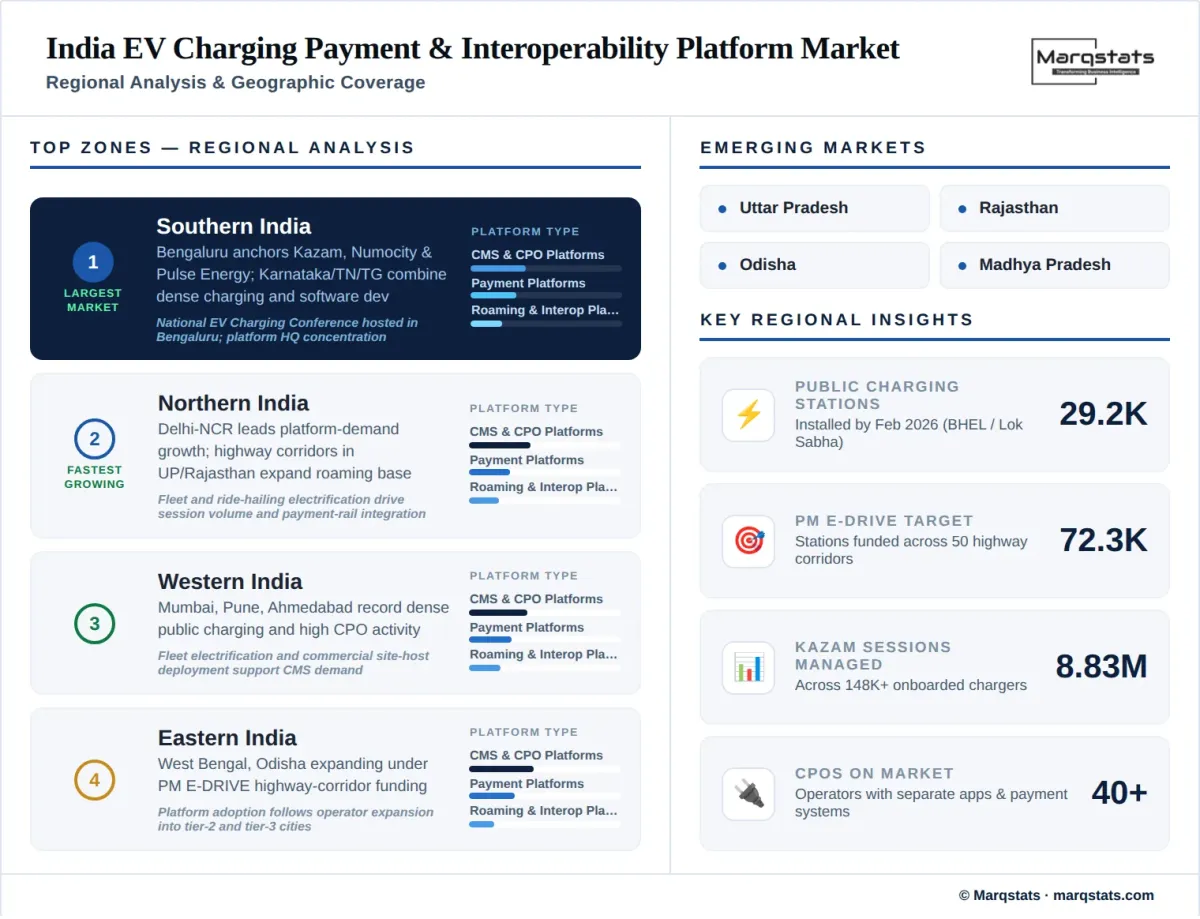
Southern India
Southern India holds the largest platform-market value, anchored by Bengaluru as the development hub for charger management and roaming software, including Kazam EV Tech Private Limited, Numocity Technologies Private Limited and Pulse Energy. Karnataka, Tamil Nadu and Telangana combine dense charging deployment with software development capacity. The National EV Charging Conference convened in Bengaluru reinforces the regional concentration.
Western India
Maharashtra and Gujarat anchor western demand, with Mumbai, Pune and Ahmedabad recording dense public charging and high charge-point-operator activity. The region combines fleet electrification and commercial site-host deployment, which supports payment and management platform demand.
Northern India
Delhi-NCR records the fastest platform-demand growth, supported by high public charging density, fleet and ride-hailing electrification, and state electric-vehicle incentives. Uttar Pradesh and Rajasthan add charger deployment along highway corridors, expanding roaming and discovery demand.
Eastern and Rest of India
West Bengal, Odisha and northeastern states form the remaining demand, with charger deployment increasing under PM E-DRIVE highway-corridor funding. Platform adoption develops as operators expand beyond metropolitan markets into tier-2 and tier-3 cities.
How Competition Is Evolving
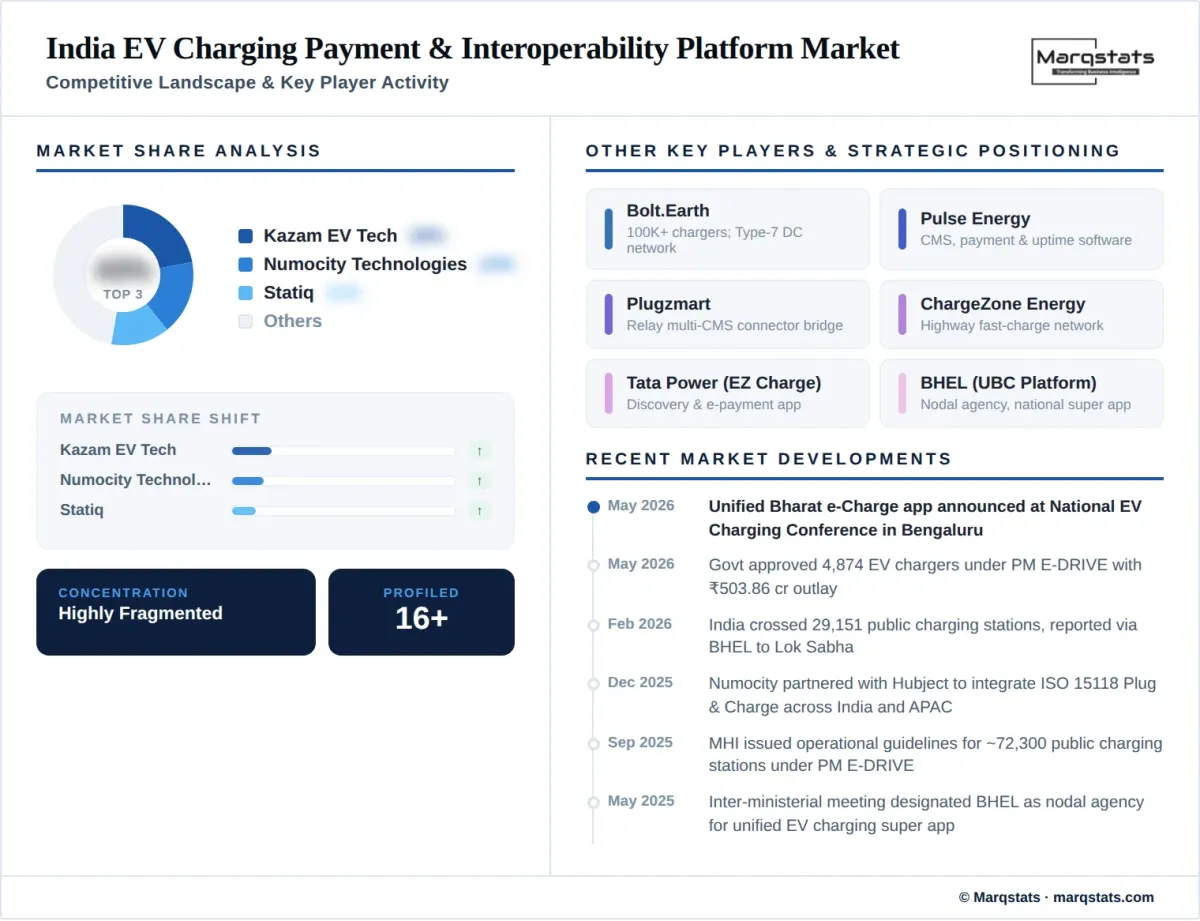
The market is fragmented and stratifies into four layers: user-facing discovery and payment apps, charger management software for operators, roaming and interoperability middleware, and government-backed unified platforms. More than 40 charge point operators run independent networks, which fragments the user-facing layer, while a smaller group of backend software providers concentrates the management and roaming layer.
User-facing apps include Statiq, which lists more than 7,000 charging points, alongside Tata Power Company Limited’s EZ Charge and Reliance BP Mobility Limited’s Jio-bp pulse networks. Backend software providers such as Kazam EV Tech Private Limited, with more than 148,000 chargers onboarded and 8.83 million sessions managed, and Numocity Technologies Private Limited, operating across more than 20 countries, sit closest to the charge-point-operator layer. Pulse Energy, Ionage and ElectreeFi compete in charger management and payment software.
Interoperability and roaming middleware competition centers on bridging fragmented networks. Plugzmart introduced Relay, a multi-CMS connector designed to improve interoperability without requiring full OCPI adoption across every stakeholder. Numocity Technologies Private Limited integrated ISO 15118 Plug & Charge through a partnership with Hubject GmbH, advancing automated authentication across Indian operators. These platforms compete on protocol coverage, settlement capability and operator reach.
Government-backed platforms reshape competition. The Unified Bharat e-Charge initiative, coordinated by Bharat Heavy Electricals Limited, positions a national interface for discovery, booking and payment across operators, with Tata Motors, Statiq, Bolt.Earth, ChargeZone and oil-marketing networks integrating their networks. Competition increasingly turns on integration with the national framework, payment-rail access through the UPI and BHIM ecosystem, and protocol interoperability rather than standalone app reach.
Companies Covered
The report profiles 16++ companies with full strategy and financials analysis, including:
Recent Market Activity
Table of Contents
Coverage & Segmentation
This report analyzes the India EV charging payment and interoperability platform market across the 2021–2025 historical period, a 2025 base year, and the 2026–2030 forecast period. The study quantifies market size in value, segments demand by platform type, protocol and integration layer, end user and revenue model, and profiles the user-facing app, charger management, roaming middleware and government-backed platform layers. Market sizing follows a bottom-up approach calibrated to the public charging base, session volume and software pricing, validated against top-down estimates. Forecasts present base, conservative and accelerated scenarios reflecting charger deployment, unified-framework adoption and payment-integration depth.
The scope covers EV charging apps, charger discovery and booking, payment gateways, UPI and BHIM integration, roaming and OCPI interoperability, OCPP charger management, CMS middleware, charge-point-operator dashboards, fleet charging payment platforms, and settlement and billing systems. Coverage includes the Unified Bharat e-Charge initiative, PM E-DRIVE charging-infrastructure policy and the Ministry of Power charging guidelines. The report excludes physical charger hardware, electrical installation, unconnected home chargers and battery-swap hardware, along with pure fleet-telematics platforms without charging payment or interoperability functions.