Market Snapshot
Key Takeaways
Market Overview & Analysis
Report Summary
The Saudi Arabia fleet depot charging market comprises dedicated electric vehicle charging connectors installed at commercial, logistics, corporate, industrial, taxi and limousine fleet depots in the Kingdom, together with the installation, grid provision and energy management that bring them into service. Market value is annual investment in connectors entering service, calculated as connectors commissioned in each year multiplied by a blended installed cost covering hardware, civil works, grid connection or on-site storage, and depot energy management. The installed connector base is reported alongside value at every point. On this basis the market stood at USD 2.73 million and 35 installed dedicated fleet connectors in 2025.
Fleet Depot Connector Count and Installation Forecast
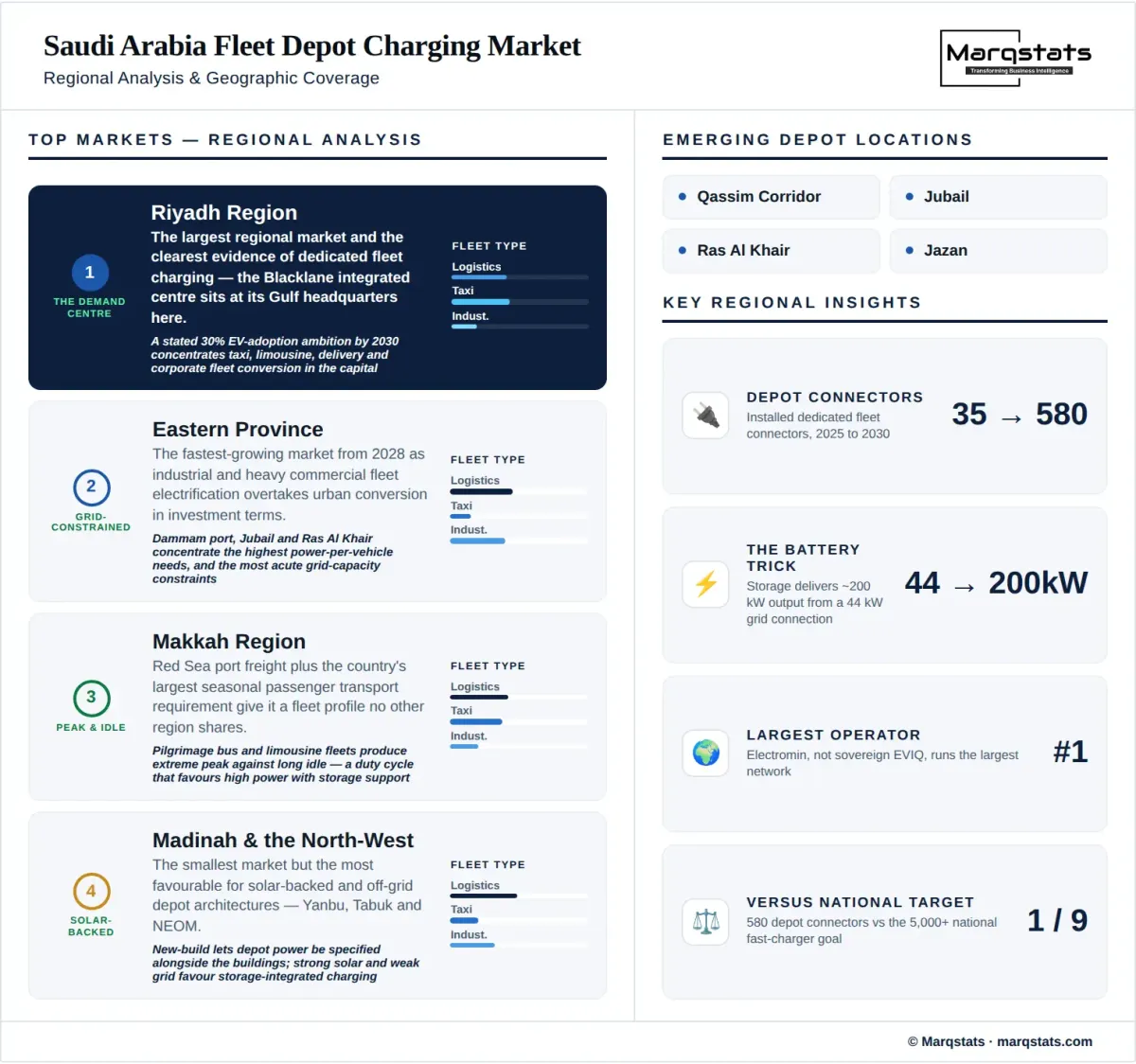
Installed dedicated fleet depot connectors rise from 35 in 2025 to 580 by 2030, a 75.34% compound annual growth rate, reaching 950 connectors by 2031. The installed base is a stock that accumulates while market value reflects only the connectors commissioned in each year, and the two therefore move on different curves. Annual installations rise from 35 to 180 across the period, a 38.75% compound rate, and it is that flow rather than the installed base that market value is built from.
Connector count and market value diverge by 46 percentage points, 75.34% against 29.39%, because blended installed cost per connector falls from USD 78,000 to USD 55,000 as hardware prices decline, installation practice standardises and battery-integrated systems replace expensive grid upgrades at constrained sites. A supplier sizing addressable revenue from the connector curve alone overstates it by roughly half. The indicative range around the base is wide by construction — 25 to 45 connectors in 2025, 60 to 100 in 2026 and 700 to 1,200 in 2031 — and confidence is low, because no register of dedicated fleet connectors exists separately from public charging counts.
Two exclusions define the boundary. Public and retail charging is excluded, because a charger open to any driver is retail infrastructure earning from ambient demand rather than depot infrastructure earning from a contracted fleet; the exception is a public connector operating inside an integrated fleet model, as in the arrangement where a national network is folded into one operator's fleet operations. Charging service revenue — the energy sold through these connectors over their life — is excluded from market value and analysed as an adjacent pool, and it is substantially larger than the hardware spend measured here. Published tariffs of SAR 0.65 and SAR 0.99 per kWh give the scale of that adjacent pool.
The relationship to the Saudi Arabia autonomous vehicle depot infrastructure market is adjacent and additive rather than nested, and the two are separated by function inside the same site. Conventional plug-in charging, grid connection and transformer capacity serving driven vehicles are counted here. Automated hands-free energy transfer, autonomous staging and yard movement, remote supervision and sensor calibration are counted in the autonomous vehicle depot infrastructure market. A single depot can therefore carry investment in both markets without either double-counting the other, because they measure different line items — which is the opposite of the subset relationship that governs the autonomous truck reports.
Market Dynamics
Key Drivers
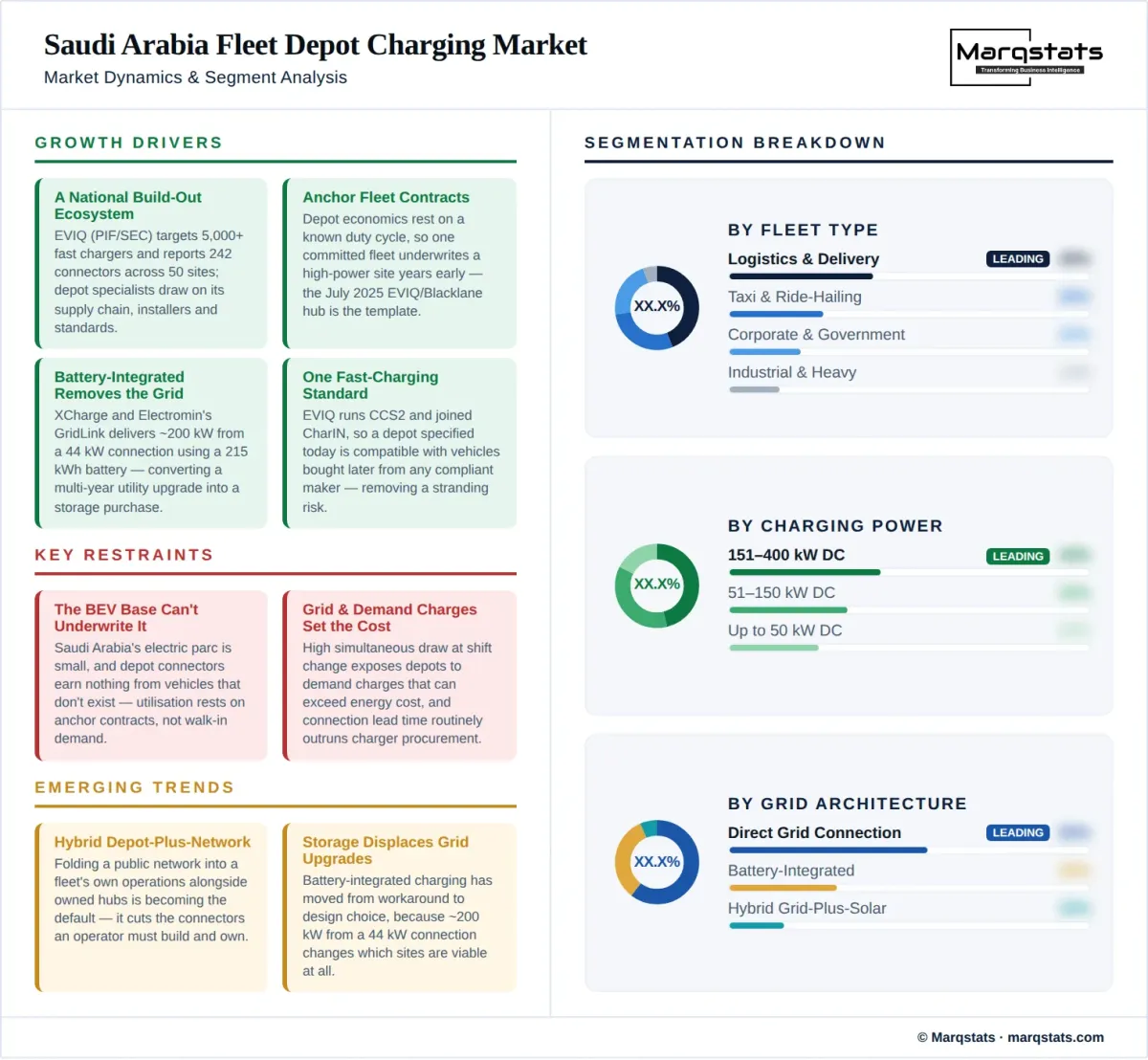
- A national charging build-out that supplies the installer and service ecosystem. EVIQ, a joint venture owned 75% by the Public Investment Fund and 25% by the Saudi Electricity Company and established in 2023, targets more than 5,000 fast chargers across the Kingdom. It currently reports 7 cities, 50 locations, 125 chargers and 242 connectors. Fleet depot specialists draw on the supply chain, installer base, standards environment and maintenance capability that this build-out creates, even though dedicated depot connectors are a specialised subset rather than a proportional share of it.
- Anchor fleet contracts that justify high-power sites before passenger density does. Depot charging economics rest on a known duty cycle rather than on ambient traffic, which lets a single committed fleet underwrite a high-power site years before public charging economics would work in the same location. The July 2025 agreement between EVIQ and Blacklane demonstrates the model, establishing dedicated hubs including an integrated charging centre at the operator's Gulf regional headquarters in Riyadh while folding the public network into the same fleet operations.
- Battery-integrated systems that remove the grid from the critical path. XCharge and Electromin began deploying GridLink systems across the Kingdom in November 2025, delivering close to 200 kW of DC fast-charging output from only 44 kW of grid input using a 215 kWh battery scalable to 430 kWh, and capable of operating through grid outages. The configuration targets exactly the sites where conventional connections are cost-prohibitive or unavailable, which describes a large share of industrial and logistics depots.
- Interoperability settled early around a single fast-charging standard. EVIQ operates CCS2 fast charging and has joined CharIN, aligning the Kingdom's charging ecosystem on a common connector and communication standard. For fleet procurement this removes a material stranding risk: a depot specified today is compatible with vehicles bought later from any compliant manufacturer, which is not true in markets where competing standards persisted.
- Urban electrification targets that create long-run depot demand. A stated ambition of 30% electric vehicle adoption in Riyadh by 2030 implies fleet conversion across taxi, limousine, delivery and corporate operations well beyond private passenger uptake, and those vehicles return to depots rather than to public forecourts. Commercial vehicle sales of 100,556 units in 2025 give the scale of the fleet base that conversion would draw on.
Key Restraints
- A battery-electric base too small to underwrite utilisation. Saudi Arabia's electric vehicle parc remains modest, and depot connectors earn nothing from vehicles that do not exist. Utilisation therefore depends almost entirely on anchor fleet contracts rather than on walk-in demand, and a depot built ahead of its fleet is a stranded asset rather than an early mover. This is the single largest reason the base is 35 connectors rather than several hundred.
- Grid capacity and demand charges shaping total cost more than hardware price. Fleet hubs require utility connection, electrical and fire safety approval, parking and site permits, and operator-specific energy management. High simultaneous draw at shift change exposes depots to demand charges that can exceed energy cost, and connection lead time routinely outruns charger procurement. Battery-integrated systems relieve this at moderate power but do not yet solve it for heavy commercial duty cycles.
- No register of dedicated fleet connectors separate from public counts. Published charging statistics report national or network totals without separating depot-dedicated infrastructure from retail sites, so the installed base in this market is constructed from known fleet hubs, commercial vehicle adoption and fleet requirement rather than counted. Confidence is low by construction and the 2031 range spans 700 to 1,200 connectors.
- Depot charging competing against a public network that is expanding faster. With a national target above 5,000 fast chargers, a fleet operator can defer depot capital by routing vehicles through public infrastructure and paying the published tariff. That is a rational choice at low fleet density and it delays depot investment, which is why the hybrid model — some depot capacity, some network access — is spreading faster than fully self-supplied depots.
Key Trends
- Hybrid depot-plus-network models displacing fully self-supplied depots. The arrangement in which a public network is integrated into a fleet operator's own operations alongside dedicated hubs is becoming the default rather than the exception. It reduces the connector count an operator must build and own, converts part of the energy requirement from capital expenditure into operating cost, and gives coverage on routes where the operator has no depot.
- Storage displacing grid upgrades as the standard answer to constrained sites. Battery-integrated charging has moved from a workaround to a design choice, because a 200 kW output from a 44 kW connection changes which sites are viable at all. Off-grid solar and storage systems launched for autonomous and commercial fleets in February 2026 extend the same logic further, removing construction and utility interconnection entirely at lighter duty cycles.
- Charging moving up the value chain from hardware into managed service. The commercially significant offers pair connectors with installation, commissioning, preventive and corrective maintenance, and energy management under one contract. Fleet operators buy uptime rather than equipment, and the network operator with a national service footprint is better placed to sell that than a hardware vendor — which is why the largest charging operator in the Kingdom is an automotive services group rather than an energy company.
- Intercity corridors opening depot demand beyond the major cities. The first highway charging station on the Riyadh–Qassim corridor, opened in March 2025, extended fast charging to intercity routes and with it the feasibility of electric commercial operation between cities. Corridor coverage converts long-haul fleet duty cycles from impossible to marginal, and depot investment follows at both ends of the route rather than only in the origin city.
Market Segmentation
Charging up to 50 kW serves light commercial vehicles, corporate cars and depots with long overnight dwell, where slow replenishment costs nothing operationally because the vehicle is idle anyway. Hardware and installation costs per connector are the lowest of the three bands, and the published public tariff at this power level sits materially below faster charging. The segment holds the largest share of connector count in the early years and a declining share of investment value as duty cycles intensify.
The 51 to 150 kW band is the working middle of the fleet depot market, matching delivery, taxi and limousine duty cycles that require a usable top-up inside a driver break or a between-shift window. Battery-integrated systems delivering close to 200 kW from a small grid connection sit at the top of this band, which is why the segment is the primary beneficiary of storage-backed architectures at grid-constrained sites.
High-power charging from 151 to 400 kW is the dominant segment by investment value across the forecast and serves heavy commercial vehicles and high-utilisation fleets that cannot afford extended dwell. It carries the highest cost per connector, the largest grid demand and the steepest exposure to demand charges. Published tariffs at this band run above lower-power charging, giving depot operators the clearest internal benchmark to beat.
Logistics and delivery fleets are the largest served segment by connector count, combining predictable return-to-base patterns with high daily distance and dense urban routing. Depot dwell is concentrated overnight and between shifts, which suits mid-power charging and makes utilisation forecastable. The segment is also the most exposed to the pace of commercial vehicle electrification, which lags passenger adoption in the Kingdom.
Taxi, limousine and ride-hailing fleets run the highest daily utilisation of any segment, which makes charging time a direct revenue loss and pushes procurement toward higher power than distance alone would justify. These operators were the earliest movers on dedicated hubs in the Kingdom, and the hybrid depot-plus-public-network model originated here because vehicles range far from base during a shift.
Corporate and government fleets convert on policy and procurement mandate rather than on operating economics, which makes their timing more predictable and their utilisation lower. Depots are typically office or ministry car parks with modest power requirements and long dwell, favouring lower-power connectors. The segment contributes more to connector count than to investment value.
Industrial and heavy commercial fleets serving ports, industrial cities and construction generate the highest power demand per vehicle and the most difficult grid conditions, often at sites where connection capacity was sized decades ago for a different purpose. The segment is the smallest by connector count and among the largest by investment per connector, and it is where battery-integrated and storage-backed architectures matter most.
Direct grid connection remains the majority architecture by investment across the forecast and is the only configuration able to serve heavy commercial duty cycles at full utilisation. It carries the longest lead times, since utility connection, electrical and fire safety approval and site permitting proceed in sequence, and it exposes the operator to demand charges that can exceed energy cost at depots with concentrated shift-change draw.
Battery-integrated charging places on-site storage between the grid and the connector, delivering close to 200 kW of output from a 44 kW connection using a 215 kWh battery scalable to 430 kWh, and continuing to operate through grid outages. The architecture converts a grid upgrade into a storage purchase and makes depots viable where a conventional connection would be cost-prohibitive. It is the fastest-growing segment across the period.
Hybrid grid-plus-solar configurations add photovoltaic generation to a constrained connection, using Saudi Arabia's exceptional solar resource to offset daytime charging load and reduce peak grid draw. The architecture suits depots with large roof or canopy area and daytime dwell, which describes many corporate and government sites. Off-grid solar and storage systems brought to market for commercial and autonomous fleets in February 2026 represent the fully independent end of this segment.
Operator-owned depots, where the fleet company buys and owns the charging infrastructure outright, account for the largest share of market value across the forecast and are the configuration assumed in the base valuation. The model suits operators with stable duty cycles, owned premises and balance sheets able to carry infrastructure with a long payback. It gives full control of availability and energy cost and full exposure to utilisation risk.
Under charge-point-operator managed arrangements a specialist installs, owns and maintains the depot infrastructure and charges the fleet per kilowatt-hour or per month. It removes capital and technical risk from the fleet operator and gives the operator recurring revenue, and it is the natural extension for a network operator that already provides installation, commissioning and maintenance across the Kingdom. The segment grows fastest across the period.
Hybrid arrangements combine a smaller owned depot with contracted access to a public fast-charging network, sizing depot capacity for typical rather than peak requirement and using the network for overflow and off-route charging. It lowers the connector count an operator must build, which suppresses measured market value while raising effective charging capacity. This is the model the largest published Saudi fleet charging agreement uses.
By Geography
Riyadh Region
Riyadh is the largest regional market throughout the forecast and holds the Kingdom's clearest evidence of dedicated fleet charging activity, including the integrated charging centre agreed for a ride-hailing operator's Gulf regional headquarters. The stated ambition of 30% electric vehicle adoption in the city by 2030 concentrates taxi, limousine, delivery and corporate fleet conversion here, and the region carries the highest density of return-to-base operations in the country.
Eastern Province
The Eastern Province is the fastest-growing regional market from 2028 as industrial and heavy commercial fleet electrification overtakes urban conversion in investment terms. King Abdulaziz Port at Dammam, the Jubail and Ras Al Khair complexes and 17 of the 59 planned national logistics centres concentrate the highest power-per-vehicle depot requirements, and the province has the most acute exposure to grid capacity constraints at existing industrial sites.
Makkah Region
The Makkah Region combines Red Sea port freight through Jeddah Islamic Port and King Abdullah Port with the country's largest seasonal passenger transport requirement, giving it a fleet profile no other region shares. Depot demand splits between logistics operations at the ports and large bus and limousine fleets serving pilgrimage traffic, the latter producing extreme peak utilisation against long idle periods — a duty cycle that favours high-power charging with storage support.
Madinah Region and the North-West
The Madinah Region and the wider north-west, including Yanbu, Tabuk and the NEOM development area, form the smallest regional market but the most favourable for solar-backed and off-grid depot architectures. New-build development allows depot power to be specified alongside the buildings it serves rather than retrofitted into an existing connection, and remote sites with strong solar resource and weak grid access are the clearest case for storage-integrated charging.
Rest of Saudi Arabia
The remaining regions, principally Qassim, Asir, Jazan, Najran, Hail and the Northern Borders, hold a small share of connector investment throughout. Fleet density is too low to support dedicated depots in most locations, and intercity corridor charging serves the commercial traffic that passes through. The Riyadh–Qassim corridor, where the first highway fast-charging station opened in March 2025, is the exception and the likeliest source of later-period depot demand at corridor termini.
How Competition Is Evolving
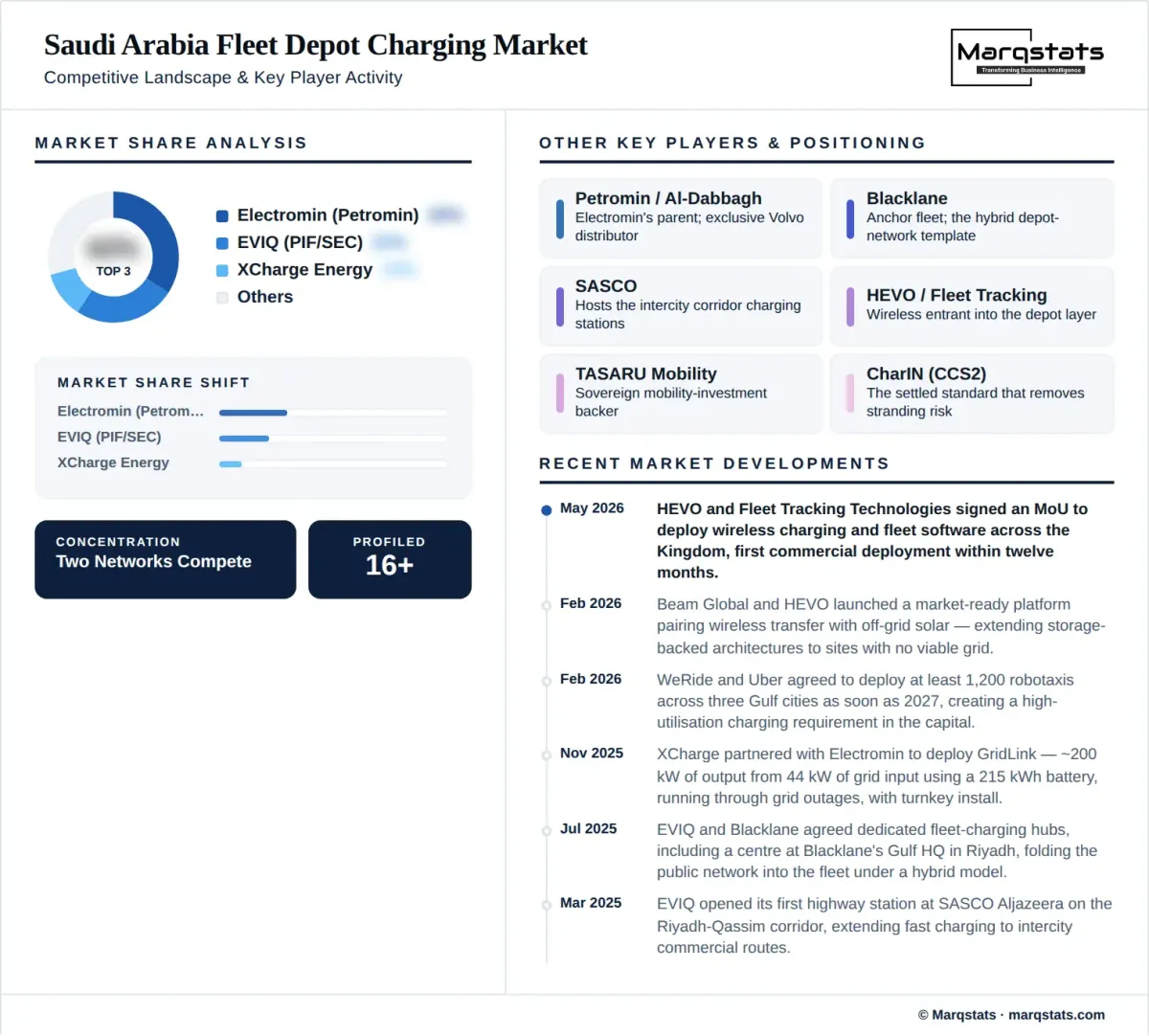
The Saudi Arabia fleet depot charging market is moderately fragmented, and it is the only market in the Kingdom's autonomous and electric fleet infrastructure cluster with genuine commercial competition rather than sovereign coordination. Two networks of materially different character compete directly: an automotive services group operating the largest charging network in the country, and a sovereign-backed national infrastructure joint venture with a 5,000-charger mandate. Around them sit hardware specialists, wireless charging entrants and turnkey installers. Concentration falls further across the forecast as depot contracts multiply and specialist entrants take defined roles.
The largest charging network operator in Saudi Arabia is Electromin, a subsidiary of Petromin and part of the Al-Dabbagh Group, which is also the exclusive distributor of Volvo Cars in the Kingdom. That combination matters commercially: the operator reaches fleet customers through vehicle sales, installs and maintains through an existing national automotive service footprint, and can bundle vehicles, chargers and maintenance into a single fleet contract. A pure infrastructure competitor cannot match that route to market, which is why the national network's response has been to partner with fleet operators directly rather than to compete on service coverage.
Competition runs on service capability rather than on hardware, because the equipment is largely interchangeable under a common standard. With CCS2 and CharIN alignment settled, a fleet buying today can procure vehicles and chargers independently, so differentiation moves to installation speed, maintenance response, energy management and the ability to solve a grid constraint. The November 2025 partnership pairing a battery-integrated charger manufacturer with a national installer is the clearest expression of this: the hardware is imported, the value is the turnkey installation, commissioning and maintenance layer wrapped around it.
Merger and acquisition activity has been absent, and the more probable consolidation is contractual rather than corporate. Anchor fleet agreements lock a depot to an operator for the life of the infrastructure, so winning a large logistics or ride-hailing fleet forecloses that demand to competitors more effectively than acquiring a rival would. Sovereign structure still shapes the field — the Public Investment Fund holds the national charging joint venture alongside the utility, backs the mobility investment vehicle supporting fleet electrification, and is the principal shareholder in the Kingdom's electric vehicle manufacturer — but unlike the autonomy markets it does not determine outcomes on its own.
Companies Covered
The report profiles 16+ companies with full strategy and financials analysis, including:
Recent Market Activity
Table of Contents
Coverage & Segmentation
This report covers dedicated electric vehicle charging connectors installed at commercial, logistics, corporate, industrial, taxi and limousine fleet depots in Saudi Arabia, with 2025 as the base year and 2026 – 2030 as the forecast period. Market size is annual investment in connectors entering service, reported in US dollars and corroborated at every point by the installed dedicated fleet connector count. Segmentation covers charging power, fleet type, grid architecture and operating model, with regional analysis for the Riyadh Region, the Eastern Province, the Makkah Region, the Madinah Region and the north-west, and the rest of Saudi Arabia.
Four boundaries define the market perimeter. First, public and retail charging falls outside it, with the exception of public connectors operating inside an integrated fleet model. Second, charging service revenue — the energy sold through these connectors — is excluded from market value and analysed as an adjacent pool substantially larger than the hardware spend measured here. Third, installed connectors are a stock and annual investment is a flow: the 2030 value reflects the 180 connectors commissioned that year, not the 580 then installed. Fourth, automated hands-free energy transfer, autonomous staging, remote supervision and sensor calibration belong to the autonomous vehicle depot infrastructure market; the two markets are adjacent and additive rather than nested, and a single depot can carry investment counted in both without double-counting, because they measure different line items.
No register of dedicated fleet depot connectors exists separately from public charging counts, in Saudi Arabia or in comparable markets. Published statistics report national or network totals that mix retail and depot infrastructure, so the installed base is constructed from evidenced fleet hubs, commercial vehicle adoption and fleet requirement rather than counted from a register. Confidence is low by construction, with an indicative range of 25 to 45 connectors in 2025, 60 to 100 in 2026 and 700 to 1,200 in 2031. Blended installed cost per connector spans a band wider than a factor of two between a low-power corporate car park and a high-power industrial depot, and is presented as an order of magnitude rather than a transaction price.
Sizing this market as a share of the national charging build-out would be the common error. A national target above 5,000 fast chargers describes retail and network infrastructure serving ambient demand; dedicated fleet depot connectors reach 580 by 2030, roughly a ninth of that count, and the two are driven by different economics — one by traffic, the other by contracted fleet duty cycles. The 2030 installed base of 580 connectors sits on the same geometric path as the 2031 endpoint of 950, so the two horizons describe a single curve rather than two forecasts.