Market Snapshot
Key Takeaways
Market Overview & Analysis
Report Summary
This report scopes the Megawatt Charging System market as public and semi-public direct-current hardware conforming to the CharIN/IEC TS 63379 connector specification, deployed for heavy-duty vehicles above 16 tonnes along TEN-T corridors, urban nodes and safe/secure parking areas regulated under Regulation (EU) 2023/1804 (AFIR). The figure in general circulation — the European Alternative Fuels Observatory's 1,512 public HDV-capable recharging stations — is not the MCS market: only 143 of those sites are exclusively dedicated to heavy trucks, and fewer than 40 connection points across the entire continent are rated strictly above 1 MW. Depot and private overnight charging, which handles 80–90% of fleet energy replenishment on unconstrained 50–100 kW CCS equipment, sits outside this report's scope, as does light-duty vehicle infrastructure governed under AFIR's separate kilowatt-per-vehicle formula.
Public deployment remains genuinely early-stage: the European Alternative Fuels Observatory recorded just 42 operational public MCS dispensers across Europe in 2025, and Milence — the joint venture formed by Daimler Truck, TRATON GROUP and Volvo Group in July 2022 — did not commission its first public MCS point until February 2025, at the Port of Antwerp-Bruges. Germany's Autobahn GmbH des Bundes closed the largest single national tender to date in June 2026, contracting 836 total charging points including 447 MCS-class connectors across 124 previously unserved motorway rest areas. Against this, Fraunhofer ISI's techno-economic modelling anchors the entire public hardware market at approximately EUR 15.20 million in 2025, rising to an estimated EUR 827.80 million by 2030 under a base-case deployment of 3,850 operational points. Annual hardware deliveries are estimated to reach USD 39.22 million in 2026, the first full year following the market's 2025 commissioning phase, before scaling to the USD 960.25 million 2030 forecast — an absolute growth of USD 942.62 million over the five-year forecast period.
The forecast holds only if three separate conditions are met simultaneously: AFIR's corridor milestones are met on the statutory schedule through 2030; Germany's Autobahn GmbH completes its contracted 1,800-plug delivery; and OEM series-production platforms — the Mercedes-Benz eActros 600, Volvo FH Electric and MAN eTGX — reach roughly 10% of new heavy-truck sales. None of these is assured. Grid queues are the risk that matters most. Grid interconnection queues running five to ten years in parts of Western Europe represent the single largest identified risk to the base case, ahead of vehicle-side technology readiness, which this report finds is not the binding constraint.
Market Dynamics
Key Drivers
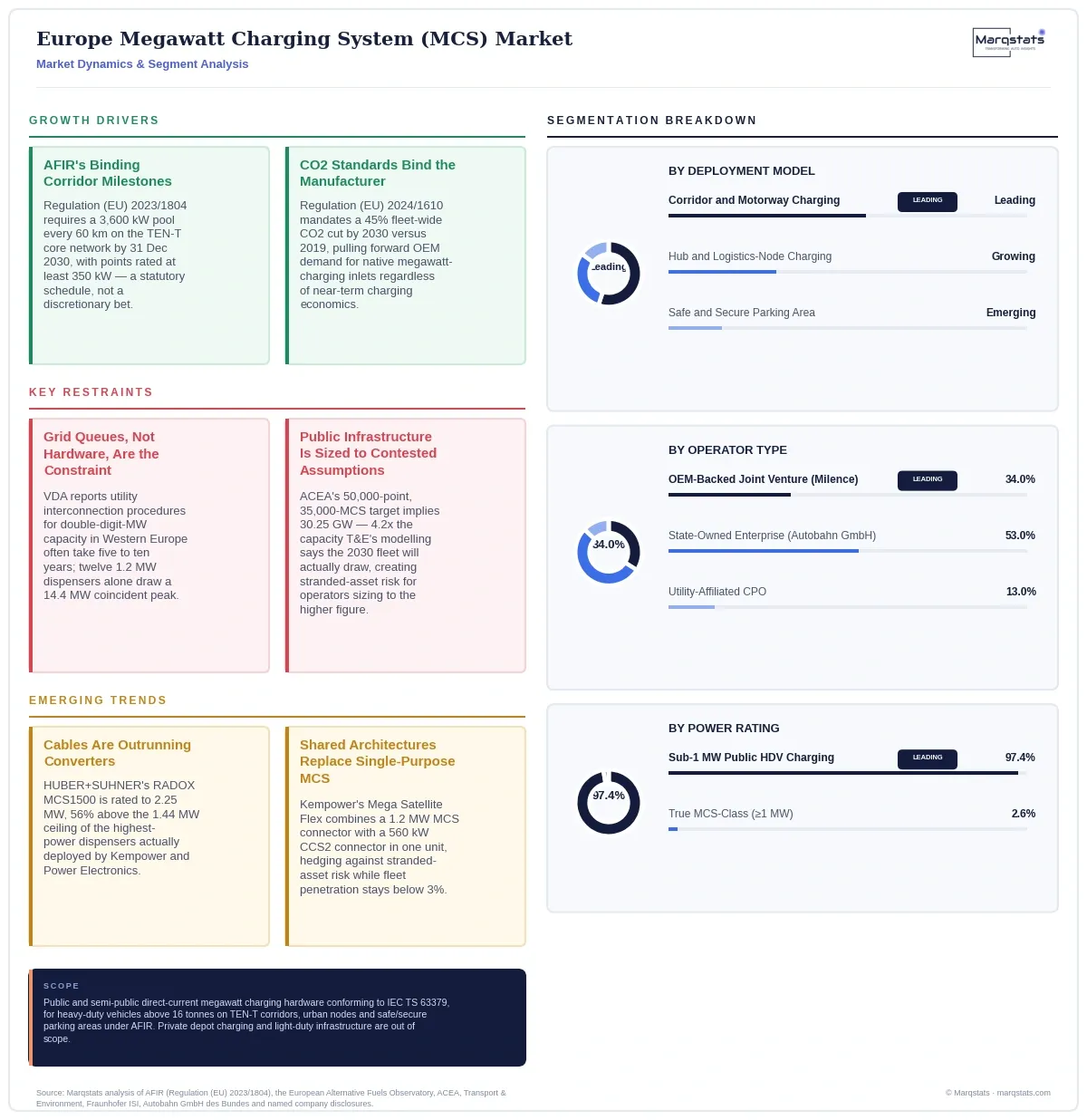
Regulation (EU) 2023/1804 (AFIR) converts megawatt charging from a discretionary infrastructure bet into a statutory obligation with enforceable milestones. AFIR Article 4 requires Member States to deploy a minimum 3,600 kW pool every 60 km along the TEN-T core network by 31 December 2030, with individual points rated at least 350 kW — a binding schedule that removes the deployment-timing risk private capital alone would otherwise price in.
The revised CO2 standards under Regulation (EU) 2024/1610 bind the vehicle manufacturer rather than the buyer, mandating fleet-wide reductions of 45% by 2030 against a 2019 baseline. To avoid financial penalties, OEMs must scale battery-electric truck deliveries regardless of near-term charging economics, which pulls forward demand for native megawatt-charging inlet integration on new HDV platforms above 16 tonnes.
Toll and subsidy policy is closing the total cost of ownership gap faster than charging infrastructure itself. The Netherlands' vrachtwagenheffing, effective 1 July 2026, charges zero-emission Class 5 trucks EUR 0.038/km against EUR 0.204/km for Euro VI diesel — a EUR 19,920 annual saving per vehicle at 120,000 km — while the AanZET purchase subsidy offers up to EUR 115,200 per vehicle in capital offset.
Named commercial pilots are converting technical feasibility into operating proof points. Germany's HoLa demonstrator, coordinated by Fraunhofer ISI and funded by the Federal Ministry for Digital and Transport, validated real-world MAN eTGX charging sessions above 700 kW average power and up to 1.2 MW peak at the Lipperland Süd site on the A2 motorway from 29 September 2025 — evidence the physical technology already performs at the duty cycle long-haul freight requires.
Hardware cost is falling ahead of volume. That is unusual. Fraunhofer ISI's midpoint CAPEX per megawatt of MCS capacity declines from EUR 398,300 in 2025 to EUR 342,500 in 2030, a 13.9% reduction attributed to silicon carbide semiconductor economies of scale that are running independently of the deployment ramp itself, improving the unit economics available to any operator entering before the market matures.
Key Restraints
Grid interconnection timelines, not equipment availability, are the primary constraint on deployment pace. Hardware is ready. Grids are not. The Verband der Automobilindustrie reports that utility interconnection procedures for double-digit-megawatt capacity in Western Europe frequently take five to ten years, and a single plaza with twelve 1.2 MW dispensers creates a 14.4 MW coincident peak load that exceeds the electrical demand of many medium-scale industrial facilities.
Public infrastructure is being sized against contested fleet assumptions. ACEA's own industry recommendation of 50,000 public points, including 35,000 MCS-class, implies 30.25 GW of installed capacity — 4.2 times the capacity Transport & Environment's independent modelling suggests the projected 2030 battery-electric truck fleet will actually draw down, creating real stranded-asset risk for operators who size to the higher figure.
Fleet charging economics still favour the depot over the corridor. The depot wins on cost. Fleet telematics data cited in this report show 80% to 90% of commercial truck energy replenishment occurs at private logistics depots during mandatory overnight rest periods on unconstrained 50–100 kW CCS equipment, meaning public MCS infrastructure competes for a demand base that is structurally smaller than headline fleet-size figures suggest.
National build-out plans are running behind domestic industry estimates even in the most advanced market. Germany's Nationale Leitstelle Ladeinfrastruktur has tendered 1,800 MCS points through 2030, while the Verband der Automobilindustrie states the country needs 4,000 points and 14 GW of grid capacity — a gap of 2,200 points, or 55.0% of the stated requirement, in the single national market furthest along in procurement.
Key Trends
Hardware suppliers are engineering well ahead of currently deployed power levels. HUBER+SUHNER's RADOX MCS1500 cable is rated to a 2.25 MW theoretical envelope — 56% above the 1.44 MW ceiling of the highest-power dispensers Kempower and Power Electronics have actually deployed — evidence the industry expects converter and grid capacity, not cable technology, to be the next constraint to resolve. We examine this cable-versus-deployed-power gap in full, including what it implies about where the real bottleneck sits, in a dedicated analysis.
Operators are shifting toward shared power-electronics architectures rather than single-purpose MCS dispensers. Kempower's Mega Satellite Flex integrates a 1.2 MW MCS connector and a 560 kW high-power CCS2 connector within one unit, dynamically routing converter capacity between bays — a direct response to the stranded-asset risk of committing capital exclusively to megawatt-only hardware while fleet penetration remains below 3% of new heavy-vehicle registrations.
Civil-works investment is running ahead of hardware installation at some sites. ENGIE Vianeo's Paris–Lyon corridor, opened October 2024 with five 480 kW CCS stations, was deliberately engineered with transformer bay allocations for future MCS retrofit — the operator committed grid-ready civil infrastructure roughly two years before its planned early-2027 MCS commissioning on the German A7 corridor.
National tenders are consolidating around operators with existing corridor experience rather than splitting evenly. Germany's June 2026 Autobahn GmbH award allocated MCS points unevenly across its five lots — from 76 points (E.ON/mblty) to 105 points (ENGIE Vianeo) — despite near-identical total site counts per lot, indicating incumbency and delivery track record are becoming selection criteria in public procurement.
The European Automobile Manufacturers' Association is itself operating from two different figures depending on the publication. Its 2030 position paper calls for 50,000 public points including 35,000 MCS-class, while its more recent interactive zero-emission tracker reports that only about 1,100 truck-suitable public chargers of 350 kW or above currently exist — the same body now emphasising the shortfall from today's baseline more than the scale of its original target.
Strategic Implications
For charging network entrants and CPOs, committing capital exclusively to single-purpose MCS dispensers carries meaningful stranded-asset risk while the battery-electric truck fleet remains below 3% of new heavy-vehicle registrations. Dynamic power-sharing architectures that serve both CCS and MCS demand from a shared converter bank — the approach Kempower and Alpitronic have already commercialised — reduce exposure to slow fleet ramp-up without sacrificing megawatt-readiness for when demand arrives.
For truck original equipment manufacturers, factory-standard integration of IEC TS 63379-compliant inlet hardware and ISO 15118-20 communications on every HDV platform above 16 tonnes is becoming a competitive requirement rather than a premium option. OEMs that continue to treat megawatt capability as a retrofit risk losing fleet customers to competitors offering native megawatt charging as standard, given that public infrastructure — however contested its ultimate scale — is now committed under binding statutory milestones through 2030.
For electric utilities and grid system operators, the gap between cable and connector capability already rated to 2.25 MW and deployed converter capability topping out near 1.44 MW suggests near-term investment value concentrates in grid-interconnection and power-conversion hardware, not cable technology, where headroom already exceeds near-term demand. Utilities that fast-track interconnection for named heavy-transit hubs stand to capture disproportionate early-mover value as corridor operators route capital toward jurisdictions with shorter connection queues.
Outlook
The base case reaches 3,850 operational public MCS dispensers by 2030, generating EUR 827.8 million in annual hardware value. This holds if AFIR corridor milestones are met on schedule, the Autobahn GmbH 351-site rollout completes its contracted 1,800 MCS-plug delivery, and OEM series-production models — the Mercedes-Benz eActros 600, Volvo FH Electric and MAN eTGX — reach approximately 10% of new heavy-truck sales penetration.
The upside case reaches 7,200 operational dispensers and EUR 1,479.6 million in annual hardware value. This requires the European Commission to tighten the 2030 HDV CO2 target beyond -45%, Member States to introduce mandatory corporate fleet procurement quotas, and distribution system operators to implement fast-track utility interconnection specifically for heavy-transit hubs — none of which is currently in force.
The downside case falls to 2,100 operational dispensers and EUR 431.5 million in annual hardware value. This follows if grid connection lead times remain at five to ten years across core markets, vehicle manufacturers slow native MCS integration in response to weak freight-sector macroeconomics, and public funding programmes face fiscal cutbacks — conditions already partially visible in the utility interconnection queue data cited in this report.
Market Segmentation
Corridor and motorway sites are the leading deployment model and the direct target of AFIR's statutory milestones. Germany's Autobahn GmbH June 2026 tender alone contracted 447 MCS points across 124 rest areas, and France's ENGIE Vianeo/APRR Paris–Lyon corridor, opened October 2024, was purpose-built with transformer bay allocations for future MCS retrofit — the deployment model AFIR's Article 4 requirements are designed to produce.
Hub-based charging at freight terminals and logistics nodes is the model Milence has prioritised, commissioning its first public MCS dispenser at the Port of Antwerp-Bruges in February 2025 and its Hessenpoort business-park hub in Zwolle in May 2025. This model concentrates demand at high-utilisation freight-generating sites rather than distributing it evenly along a corridor.
Urban and depot-adjacent charging sits outside this report's MCS scope, since it is dominated by 50–100 kW CCS equipment serving overnight fleet replenishment rather than megawatt-class opportunity charging. Fleet telematics cited in this report show 80% to 90% of commercial truck energy replenishment occurs at this tier, making it the largest energy segment by volume even though it is excluded from the MCS hardware market this report sizes.
AFIR mandates dedicated charging points rated at least 100 kW at safe and secure truck parking areas by 31 December 2030, a smaller-power segment distinct from corridor MCS dispensers. This segment serves mandatory overnight driver rest periods and is sized by parking-area capacity rather than by fleet-wide charging demand, making it structurally separate from the corridor hardware market this report's sizing chain covers.
Milence, the joint venture between Daimler Truck, TRATON GROUP and Volvo Group, is the leading operator by disclosed capital commitment at EUR 500 million and by named site count, having secured EUR 111.5 million in EU co-funding through the MILES project toward its 284-point, 71-hub target by 2027. A site-by-site tracking of Milence's named commissioning progress against its 284-point target is available in our related analysis.
Autobahn GmbH des Bundes is the leading state-owned operator following its June 2026 tender award of 836 total charging points, including 447 MCS-class connectors, across five contracted lots covering 124 previously unserved motorway rest areas in Germany.
ENGIE Vianeo, E.ON and Iberdrola represent the utility-affiliated operator model, combining grid-connection expertise with charging operations. ENGIE Vianeo secured the largest single MCS allocation (105 points) in Germany's 2026 tender, while Iberdrola is separately engineering 1 MW MCS corridor hubs in Spain's Murcia region.
Sub-1 MW charging, predominantly 400–700 kW CCS equipment, accounts for the vast majority of the European Alternative Fuels Observatory's 1,512 tracked HDV-capable stations. This band is the current de facto standard for public heavy-vehicle charging even though it falls short of true megawatt-class throughput.
True megawatt-class charging, at or above 1 MW, remains genuinely scarce: fewer than 40 points across all of Europe meet this threshold as of the 2025 baseline. This is the segment this report's sizing chain directly measures, and its small current base is precisely why the 2025-to-2030 hardware-value CAGR of 122.44% is arithmetically real but should be read as scaling from a pilot volume rather than as a steady-state growth rate.
IEC TS 63379 defines a theoretical ceiling of 4.5 MW at 1,500 V and 3,000 A — more than 3.7 times the highest power rating actually deployed in any named European installation to date. This headroom was written into the standard for future vehicle classes, including marine, rail and off-highway applications, that the current heavy-truck market does not use.
By Geography
Germany
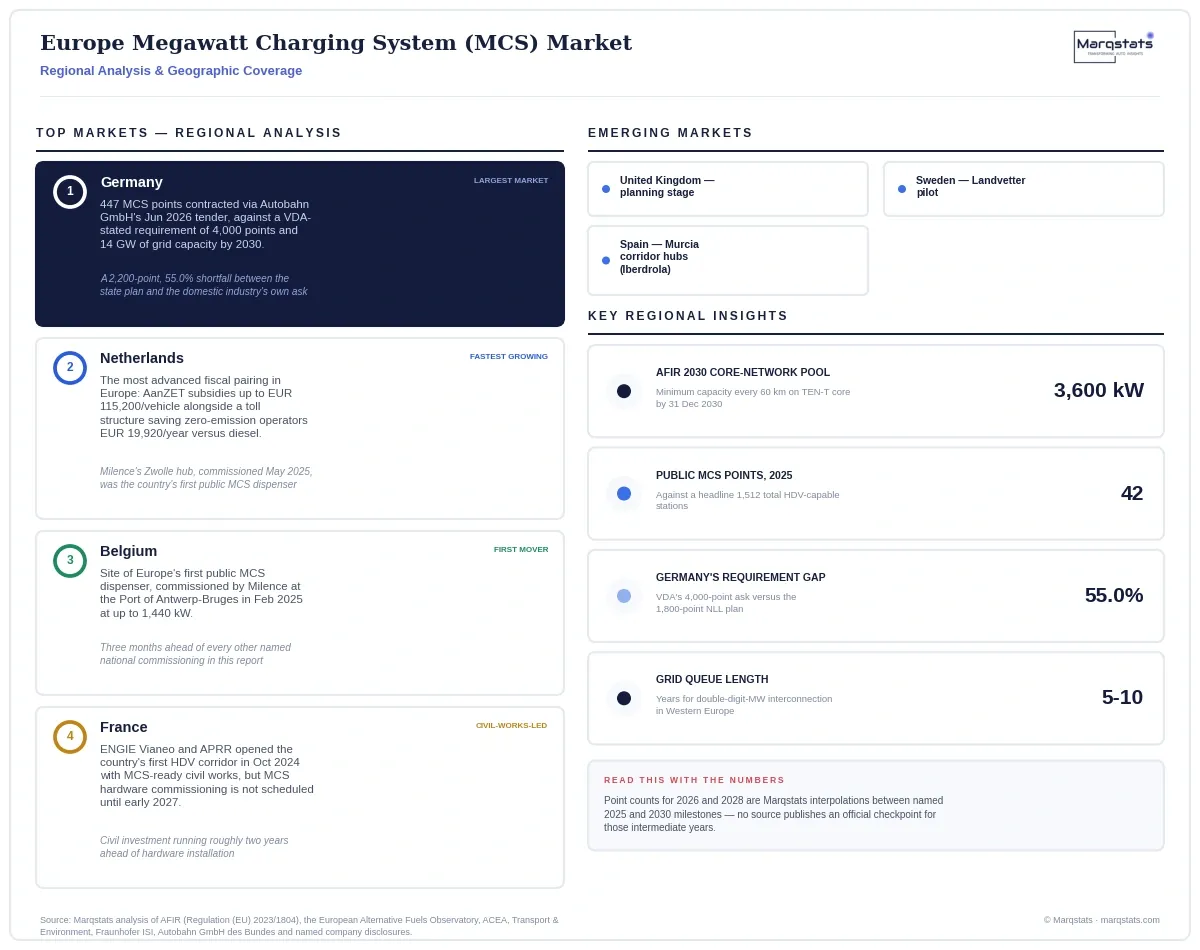
Germany carries the largest named national programme and the clearest evidence of a gap between state ambition and industry requirement. Autobahn GmbH's June 2026 tender contracted 447 MCS points against a Verband der Automobilindustrie estimate that the country needs 4,000 points and 14 GW of grid capacity by 2030 — a shortfall the Nationale Leitstelle Ladeinfrastruktur's own 1,800-point masterplan does not close.
Netherlands
The Netherlands hosts the most advanced fiscal-policy pairing in Europe: the AanZET purchase subsidy of up to EUR 115,200 per vehicle alongside the vrachtwagenheffing distance-based toll, effective 1 July 2026, which charges zero-emission trucks 81.4% less per kilometre than Euro VI diesel equivalents. Milence commissioned the country's first public MCS dispenser at Zwolle in May 2025, priced at a EUR 0.399/kWh default tariff.
Belgium
Belgium is the site of Europe's first public MCS dispenser, commissioned by Milence at the Port of Antwerp-Bruges in February 2025 at up to 1,440 kW output. The Belgian deployment predates every other named national commissioning in this report by three months, making it the market's de facto starting point rather than a proportionally sized share of continental demand.
France
France demonstrates civil-works investment running ahead of hardware installation. ENGIE Vianeo and APRR opened the country's first heavy-duty charging corridor between Paris and Lyon in October 2024 with 480 kW CCS stations engineered for future MCS retrofit, but MCS hardware commissioning is not scheduled until early 2027, on the German A7 corridor rather than domestically.
United Kingdom
The United Kingdom is the earliest-stage of the profiled markets. BP Pulse's acquisition of the Ashford International Truckstop freehold and its stated plan for up to 20 MCS dispensers remain a disclosed intention rather than a commissioned installation, reflecting the market's position outside the EU's AFIR statutory framework.
How Competition Is Evolving
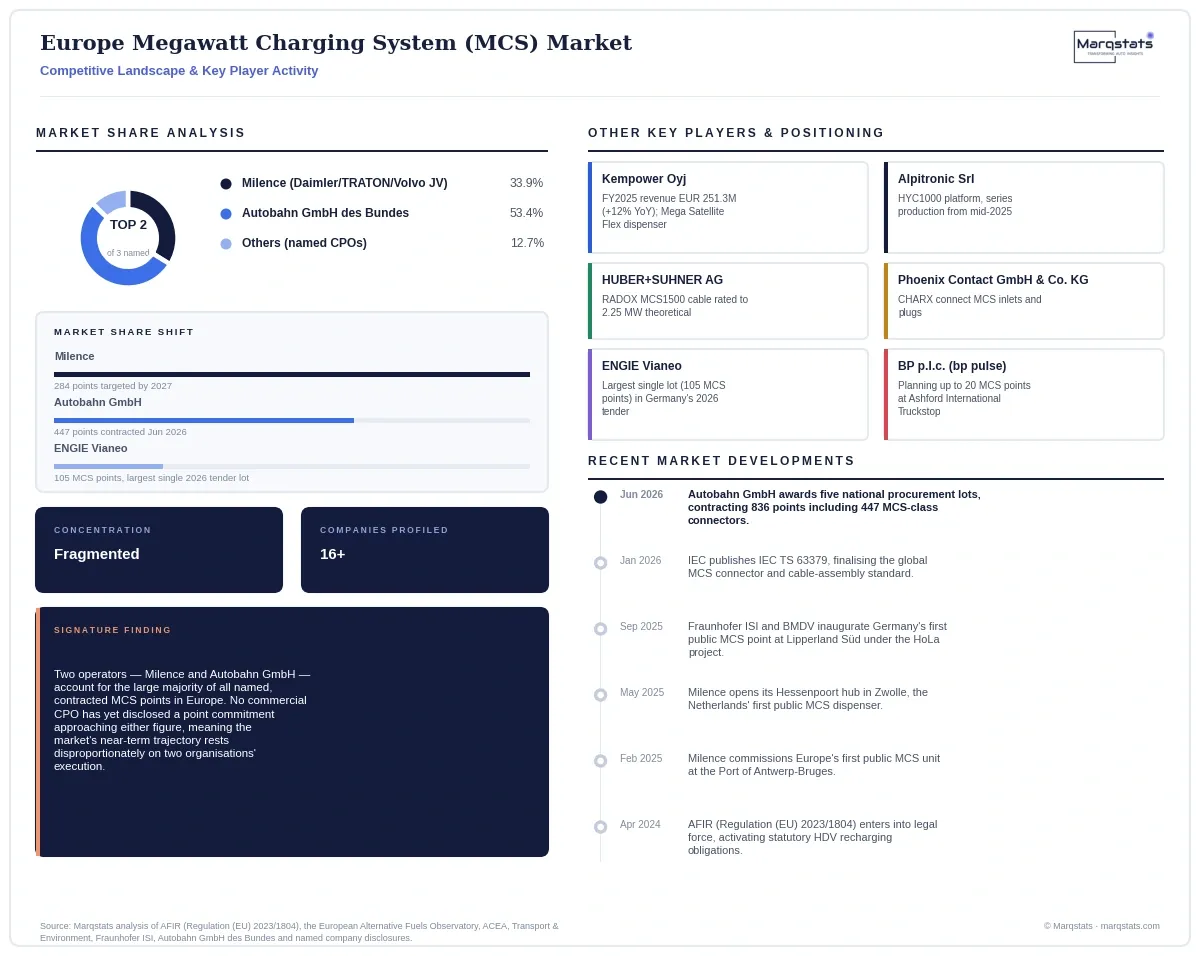
The European MCS hardware and operator landscape is fragmented, with no single entity controlling more than a low double-digit share of disclosed or contracted points. Milence's 284-point MILES target and Autobahn GmbH's 447-point June 2026 award are the two largest named commitments, together accounting for a minority of the 3,850-point 2030 base-case total — meaning the majority of the eventual market remains uncontracted and open to new entrants, unlike more mature charging-infrastructure categories.
Operators compete primarily on national tender wins rather than on retail brand recognition at this early stage. Germany's June 2026 award split 836 total points across five distinct consortiums — eliso Voltix, autostrom.plus, ENGIE Vianeo's Electric Mobility Infrastructure Deutschland subsidiary, a STRA-loaded consortium and an E.ON/mblty partnership — with allocations ranging unevenly from 76 to 105 MCS points per lot, suggesting incumbency and delivery track record now factor into public procurement decisions.
Hardware suppliers are consolidating around a small number of named specialists rather than diversified conglomerates. Kempower Oyj reported FY2025 group revenue of EUR 251.3 million (+12% year-on-year) and order intake of EUR 304 million, citing commercial vehicle electrification as a primary driver, while Alpitronic Srl entered series production of its HYC1000 platform in mid-2025 following a May 2025 Brenner-corridor demonstration — both companies scaling directly against the corridor-deployment demand this report sizes.
Companies Covered
The report profiles 16+ companies with full strategy and financials analysis, including:
Recent Market Activity
Table of Contents
Coverage & Segmentation
This study covers public and semi-public direct-current megawatt charging hardware conforming to the CharIN/IEC TS 63379 connector specification, sized on a EUR hardware-CAPEX basis at the point of installation. The base year is 2025, the historical period is 2025 only given the category's recent commissioning, and the forecast period runs 2026–2030. Point counts and hardware values are drawn from the European Alternative Fuels Observatory, named national tender documentation, and Fraunhofer ISI's techno-economic cost model; where an annual figure is interpolated between named milestones rather than independently published, this report states so explicitly.
Outside this report's scope: private depot and overnight charging on 50–100 kW CCS equipment, which handles the majority of fleet energy replenishment but falls outside AFIR's public-infrastructure statutory framework; light-duty and van charging, governed under AFIR's separate kilowatt-per-vehicle formula; and hydrogen refuelling infrastructure, tracked separately by the European Alternative Fuels Observatory under AFIR Article 6. Readers seeking depot-charging economics or light-duty infrastructure sizing should consult Marqstats' adjacent reports on those categories.