Market Snapshot
Key Takeaways
Market Overview & Analysis
Report Summary
The EV battery recycling market is at the most commercially significant inflection point in its history: transitioning from a small-scale, specialist waste management activity into a strategic supply-chain industry that major automotive OEMs, battery manufacturers, mining companies, and chemical groups are investing in at industrial scale. The study period is 2021–2030 with 2025 as base year. The market's defining dynamic is the convergence of three structural forces acting simultaneously: a rapidly growing end-of-life battery supply that provides the recycling feedstock; hardening regulation that mandates collection, recovery rates, and recycled-content targets that force industry to build recycling capacity ahead of the waste curve; and raw-material security imperatives that make recycled battery metals a strategically important domestic supply alternative to imported mined materials.
The IEA estimates that with improving collection rates, recycled material from batteries could meet 20–30% of global lithium, nickel, and cobalt demand by 2050, reducing mining investment needs by approximately 30% through 2040 and cutting supply-chain emissions substantially versus mined equivalents. The JRC estimates that by 2040, battery recycling could contribute up to 51% of EU cobalt demand and 42% of EU nickel demand — numbers that transform battery recycling from waste management into a primary supply route for the battery industry. These are not minor sustainability adjustments; they represent a fundamental restructuring of the critical mineral supply chain in which recycling and mining operate as parallel and complementary sources of battery metals.
The market's commercial architecture in 2025 is characterised by geographic concentration of capacity — China dominates current global recycling volume with CATL/Brunp and GEM as the largest disclosed processors; North America has Redwood Materials as a clear early-scale leader; and Europe is building industrial capacity at pace following the EU Batteries Regulation's enforcement trajectory. The coming five years will see rapid European capacity build-out as the regulatory deadlines approach and as the EU's black mass hazardous waste classification (March 2025) creates demand for in-region refining rather than material export. The Japan and South Korea ecosystems are also advancing, with Korea's Battery Circulation Cluster beginning full-scale operation in November 2025.
Market Dynamics
Key Drivers
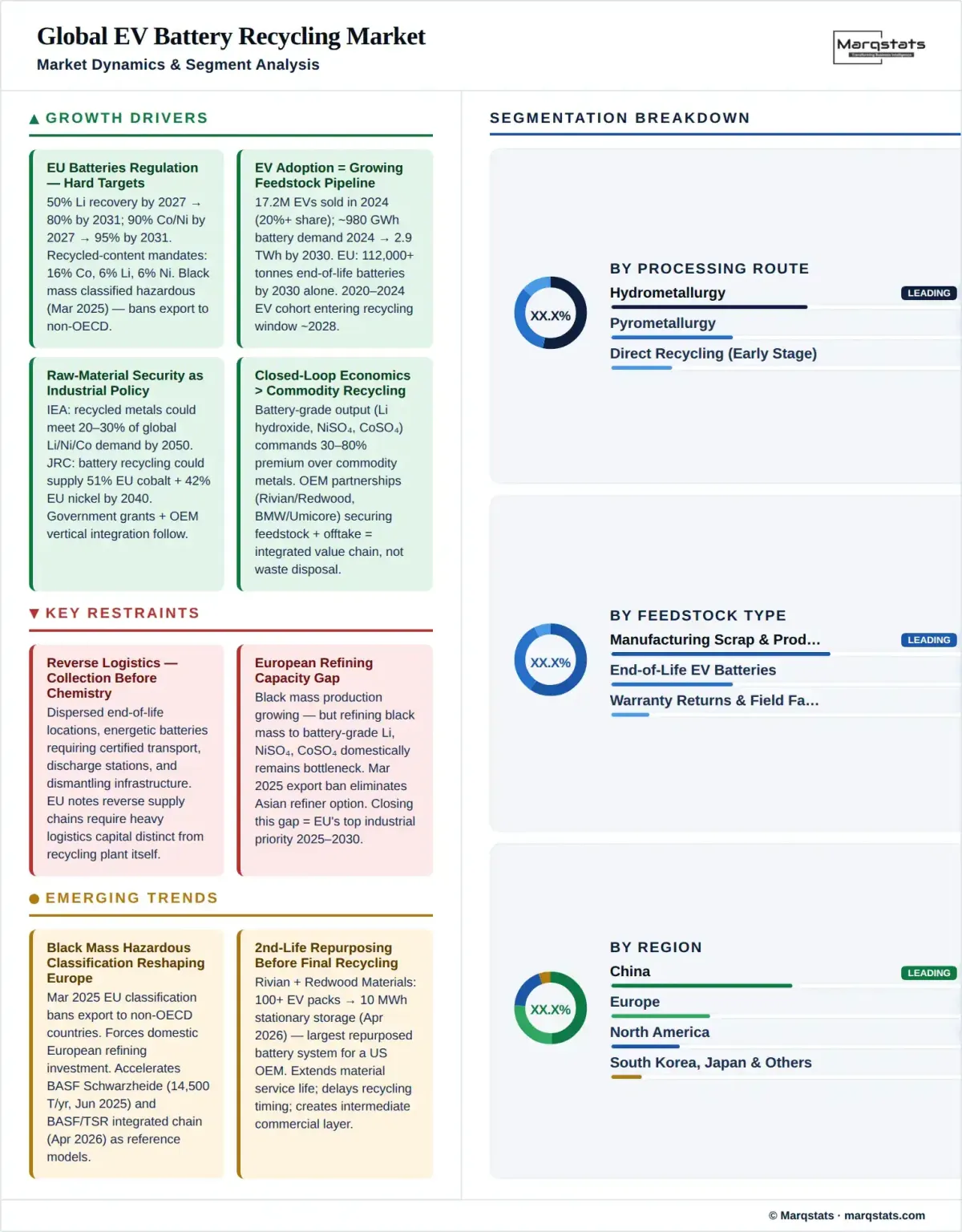
- EU Batteries Regulation creating mandatory recovery and recycled-content requirements that force capacity investment ahead of end-of-life wave: The EU Batteries Regulation — the most comprehensive battery life-cycle regulatory framework globally — requires minimum material recovery rates of 50% lithium by 2027 and 80% by 2031, and 90% for cobalt, copper, lead, and nickel by 2027 rising to 95% by 2031. It also introduces recycled-content requirements for new batteries, with the first tier mandating 16% cobalt, 85% lead, 6% lithium, and 6% nickel from recycled sources. In July 2025, the Commission published new verification rules for recycling efficiency and material recovery calculation. In March 2025, battery black mass was classified as hazardous waste, with a ban on export to non-OECD countries — a regulatory development that forces European recyclers and manufacturers to build domestic refining capacity rather than exporting intermediate materials to Asia for further processing. Together, these measures create a mandatory demand for European recycling capacity that does not depend on economic incentive alone — it is enforced by law.
- Explosive EV adoption creating the feedstock engine that determines recycling market scale: The recycling market's long-term size is fundamentally a function of EV adoption volumes at a 10–15 year lag — the time it takes a battery sold today to reach its first end-of-life event. With global electric car sales at approximately 17.2 million in 2024 (20%+ of all car sales), growing toward 20+ million in 2025, and EV battery demand at approximately 980 GWh in 2024 growing to over 2.9 TWh by 2030, the feedstock pipeline for the recycling market is already large and growing rapidly. The EU alone projects more than 112,000 tonnes of batteries reaching end-of-life in 2030 — a figure that will multiply significantly by 2035 as the 2022–2026 high-volume EV sales cohort begins retirement. This creates a visible, growing, and relatively predictable feedstock curve that justifies large industrial recycling capacity investments today even before the full wave materialises.
- Raw-material security making recycled battery metals a strategic domestic supply alternative: The IEA's 2025 critical-minerals outlook explicitly identifies battery recycling as a mechanism to reduce dependence on primary mined materials and to cut mining investment requirements by approximately 30% through 2040. This framing — recycling as a critical minerals supply route, not just a waste management activity — has elevated battery recycling to industrial policy priority in the EU (through the Critical Raw Materials Act), the US (through the DOE battery recycling programme and Inflation Reduction Act content requirements), and China (through its national traceability and recycling standards). When recycling is framed as a supply-chain security activity, investment follows from sources — government grants, OEM vertical integration, chemical company diversification — that would not be available for a pure waste management business.
- China tightening recycling standards to 90% lithium recovery and launching national battery digital identity (2025–2026): China's January 2025 tightening of recycling process standards — requiring at least 90% lithium recovery during smelting and at least 98% recycling of powdered electrodes — raises the quality floor for Chinese recycling operations and aligns China's standards more closely with EU recovery requirements. The April 2026 interim measures requiring each NEV power battery to carry a digital identity backed by a national traceability platform (effective 1 April 2026) create the data infrastructure needed for closed-loop battery tracking, supporting both collection rate improvement and quality certification of recycled materials. Together, these measures reinforce China's position as the most advanced national battery recycling regulatory-industrial system and create competitive pressure on global recyclers to match Chinese process efficiency standards.
- Closed-loop integration economics making battery recycling a value-added chemical business rather than a cost centre: The economics of battery recycling are improving as processing technology matures and as recovered metal values support positive business cases independent of regulatory mandate. Recovered cobalt, nickel, lithium, manganese, and copper from EV batteries represent real commodity value — particularly at a time when primary supply chains for these metals are geographically concentrated and subject to price volatility. Companies that can achieve battery-grade purity in recovered materials — enabling direct reintegration into pCAM and CAM production — capture the full value chain premium rather than simply selling black mass to third-party refiners. Redwood Materials, BASF, Umicore, and CATL/Brunp are all pursuing integrated chain models that capture value at multiple stages rather than a single commodity sale.
Key Restraints
- Reverse logistics complexity — safe collection, discharge, transportation, and dismantling before recycling can begin: Battery recycling's operational challenge is not primarily the chemistry of recovery but the logistics of getting batteries from dispersed end-of-life locations (scrapped vehicles, failed packs, warranty returns) to processing facilities safely and cost-effectively. Lithium-ion batteries are energetic, temperature-sensitive, and potentially hazardous if damaged, discharged improperly, or subjected to thermal runaway during transport. Building the reverse supply chain — including collection networks, certified transportation, discharge stations, and dismantling facilities — requires significant capital investment that is structurally distinct from the recycling plant itself. The EU's own analysis notes that large-scale end-of-life flows require safe reverse supply chains and heavy logistics, not just recycling capacity.
- Refining capacity gaps in Europe limiting the value chain from black mass to battery-grade recovered metals: Even as European battery black mass production capacity grows — driven by regulation and capacity build-outs from BASF, Stena, Ecobat, Hydrovolt, and others — the downstream refining capacity to convert black mass into battery-grade lithium, nickel sulphate, cobalt sulphate, and manganese products suitable for cathode active material production remains a bottleneck. The March 2025 hazardous waste classification of black mass (banning export to non-OECD countries) intensifies this bottleneck by removing the option of exporting to Asian refiners and makes domestic European refining investment an urgent industrial policy priority. Closing the gap between black mass production and battery-grade refining capacity is the single most important operational challenge for the European battery recycling value chain in the 2025–2030 forecast period.
- Battery chemistry evolution complicating recycling economics and process standardisation: The rapid evolution of battery chemistry — from NMC 111 to NMC 622, NMC 811, NCMA, and LFP — means that recycling processes must continually adapt to extract maximum value from changing material compositions. LFP batteries (lithium iron phosphate), increasingly used by Chinese OEMs and growing in penetration globally, contain no cobalt or nickel and therefore yield lower recovered-metal value than NMC batteries, potentially making LFP recycling economics marginal without process cost reduction. Solid-state batteries, if and when they reach commercial scale in the 2030s, will require entirely different recycling approaches. This chemistry diversity and evolution creates process design and economic modelling complexity that adds risk to long-payback capital investments in recycling infrastructure.
- Collection rate uncertainty limiting feedstock volume predictability: Despite regulatory mandates for collection, the actual collection rates achieved for EV batteries depend on consumer behaviour, dealer participation in take-back schemes, export of end-of-life vehicles to markets outside the regulatory perimeter, and the availability of convenient collection infrastructure. If collection rates remain below regulatory targets — as has been the case historically for smaller battery categories despite collection mandates — recycling capacity utilisation will fall short of design and economics will deteriorate. The EU has acknowledged this uncertainty and the difficulty of building complete reverse supply chains, particularly for the initial years before the end-of-life wave reaches full scale.
Key Trends
- EU black mass hazardous waste classification (March 2025) reshaping European recycling supply chain geography: The March 2025 classification of battery black mass as hazardous waste — with tighter shipment controls and a ban on export to non-OECD countries — is the single most commercially significant recent regulatory development in the European battery recycling market. It closes the option of producing black mass in Europe and exporting it to Chinese or other Asian refiners for further processing, forcing European companies to either invest in domestic refining capacity or remain limited to primary dismantling activities. This classification has already accelerated domestic European investment decisions for refining infrastructure and has raised the strategic value of integrated European players (BASF, Umicore) that can process black mass to battery-grade recovered materials within the EU regulatory perimeter.
- Hydrometallurgy displacing pyrometallurgy as the dominant processing route for battery-grade output: Hydrometallurgy — which uses aqueous chemistry to selectively dissolve and separate battery metals from processed black mass — is progressively displacing pyrometallurgy (smelting at high temperature) as the preferred processing route for EV battery recycling, particularly where battery-grade output is the commercial objective. Hydromet delivers higher purity outputs (lithium carbonate/hydroxide, nickel sulphate, cobalt sulphate, manganese sulphate) that can be directly reintegrated into pCAM and CAM production without further processing, capturing the full battery-grade value premium. Pyromet remains competitive for simpler material recovery and for certain alloy recovery applications, and many commercial plants use a combination of the two routes. Direct recycling — which attempts to restore cathode active material properties without full dissolution — remains at earlier commercialisation stage but offers the highest potential energy efficiency and lowest material loss if processes can be scaled to commercial throughput and consistent quality.
- Second-life repurposing expanding the addressable market around end-of-life batteries before recycling: Battery second life — the use of EV battery packs that no longer meet vehicle performance standards (typically below 70–80% original capacity) in stationary energy storage applications — is expanding the commercial ecosystem around end-of-life batteries in ways that affect recycling market timing and economics. Rivian and Redwood Materials' April 2026 announcement of the largest repurposed battery energy storage system for a US automotive manufacturer — over 100 EV battery packs providing an initial 10 MWh system — illustrates the commercial reality of second-life repurposing at automotive scale. Second life does not compete with recycling in the long run — repurposed batteries eventually reach recycling entry — but it does extend the service life of battery material, delay recycling feedstock timing, and create an intermediate commercial layer between first-life automotive use and final recycling.
- Production scrap and manufacturing waste as the near-term dominant recycling feedstock: In the immediate 2025–2027 period, manufacturing scrap — off-spec cells, electrode trimmings, formation losses, and quality rejects from gigafactory production lines — remains a larger and more readily accessible recycling feedstock than genuine end-of-life EV batteries, which require vehicle retirement, dismantling, and reverse logistics before reaching recycling facilities. Redwood Materials and other North American recyclers explicitly reference manufacturing scrap as a significant current input. This scrap-dominant near-term feedstock mix shifts progressively toward end-of-life battery dominance as the EV parc ages — with the transition point accelerating from approximately 2028 onward as the large 2020–2023 EV cohort begins entering the end-of-life window.
Market Segmentation
Black mass is the intermediate material produced by shredding and processing lithium-ion battery cells or modules after initial discharge and dismantling — a dense, dark powder containing lithium, cobalt, nickel, manganese, copper, graphite, and residual electrolyte compounds. Black mass production is the critical bridge between battery collection and dismantling on one side, and battery metals recovery (hydrometallurgy or pyrometallurgy) on the other. The value of black mass and the economics of its processing are directly driven by the battery chemistry of the input (NMC, LFP, NCA, NMCA), the purity of the shredding and separation process, and the downstream refining capability available to extract individual battery-grade metals from the mixed material.
Battery materials recovery from black mass proceeds through selective dissolution, solvent extraction, precipitation, and purification steps — each targeted at recovering a specific metal stream at battery-grade purity. Lithium recovery from black mass — historically the most challenging step due to its dilute concentration and the selectivity requirements — is the central technical and economic challenge in battery recycling. The EU's mandate of 50% lithium recovery by 2027 and 80% by 2031 directly targets this challenge. China's January 2025 tightening to require 90% lithium recovery during smelting demonstrates that industry-leading processes can achieve high lithium recovery rates — but that reaching these rates at industrial scale and competitive cost requires process investment and optimisation that remains a differentiating capability rather than a commodity standard.
Black mass recycling economics are improving as scale increases and as battery-grade output commands premium pricing over commodity metal streams. A recycler that produces battery-grade lithium carbonate or hydroxide from black mass captures a materially higher revenue per tonne than one that sells mixed metal streams. BASF's Schwarzheide black-mass plant — designed for approximately 14,500 tonnes of end-of-life lithium-ion batteries and production scrap per year, beginning commercial operation in June 2025 — and the BASF/TSR expanded collaboration (April 2026) covering dismantling, discharging, and black-mass processing represent the European integrated chain benchmark for this segment.
Hydrometallurgy, pyrometallurgy, and direct recycling represent the three primary processing routes for recovering battery materials from end-of-life lithium-ion batteries, each with distinct economics, output quality, energy intensity, and capital requirements.
Hydrometallurgy uses aqueous chemistry — typically involving leaching (dissolving metals from black mass in acidic or alkaline solution), solvent extraction, ion exchange, and precipitation — to selectively separate and recover individual battery metals at high purity. The primary advantage of hydromet is output quality: properly executed hydromet processes produce lithium carbonate or hydroxide, nickel sulphate, cobalt sulphate, and manganese sulphate at battery-grade specification, enabling direct reintegration into pCAM and CAM production without further processing. This closed-loop integration is the highest-value commercial model in the battery recycling chain. The primary disadvantages are capital intensity, process complexity, chemical consumption, and wastewater treatment requirements. Hydromet is the processing route of choice for NMC and NCA battery chemistries where cobalt and nickel value justifies the investment — and it is the direction of travel for European and North American recyclers seeking EU-compliant, battery-grade output.
Pyrometallurgy processes batteries at high temperature (smelting), converting them into alloys and slags that can be further refined to recover metals. Pyrometallurgy has the advantage of being chemistry-agnostic — it can process mixed battery chemistries without sorting, and handles manufacturing scrap and damaged batteries more flexibly than hydromet. However, pyrometallurgy typically cannot recover lithium from slag economically, and the high energy consumption and process emissions create cost and sustainability disadvantages versus hydromet for high-purity output. Most modern commercial battery recycling operations use a combination of pyrometallurgy (for initial volume processing and damage tolerance) and hydrometallurgy (for high-purity metal separation), rather than either route in isolation. Umicore's established European recycling process is an example of a combined pyro/hydro approach applied at commercial scale.
Direct recycling — which attempts to recover and restore cathode active material (CAM) properties without full dissolution — is the technically most ambitious processing route. If successful at scale, direct recycling would preserve the complex crystal structure of cathode materials (NMC, NCA, LFP), reducing the energy and chemical inputs required to produce recycled CAM versus the full hydromet refining route. Direct recycling is currently at pilot and early commercial scale at research institutions and specialist startups, with commercialisation timelines in the 2027–2032 window for most credible programmes. The challenge is achieving consistent CAM quality across variable input battery conditions — a quality control problem that is technically tractable but not yet commercially solved at scale. If direct recycling reaches industrial scale with battery-grade output quality, it has the potential to displace significant hydromet capacity by the mid-2030s.
The EV battery recycling market's feedstock in 2025 is still dominated by manufacturing production scrap — off-specification cells, electrode trimmings, formation losses, quality rejects, and warranty returns from gigafactory production lines — rather than genuine end-of-life EV batteries from retired vehicles. This distinction matters commercially because production scrap is more controlled, more consistently specified, and more readily accessible through manufacturer relationships than vehicle retirement flows, which require reverse logistics from dispersed geographic locations. Redwood Materials and other North American recyclers explicitly reference manufacturing scrap as a significant current input fraction.
The transition from production-scrap-dominant to end-of-life-battery-dominant feedstock is already underway and will accelerate significantly from approximately 2028 onward as the large EV sales cohorts of 2020–2024 begin reaching their first end-of-life event. The EU Urban Mobility Observatory projects more than 112,000 tonnes of batteries reaching end-of-life in Europe in 2030 alone. This is an explicit, data-backed feedstock pipeline that justifies recycling capacity investment today, even if the full wave has not yet materialised. The challenge is building the reverse supply chain — collection networks, certified transportation, discharge facilities, and dismantling infrastructure — ahead of the wave rather than in response to it.
The economic value of EV battery recycling is dominated by the metals recovered from processed black mass, with the relative importance of each metal depending on the battery chemistry processed and current commodity prices. Cobalt has historically been the highest-value recovered metal per unit weight, and cobalt recovery rates — 90% by 2027, 95% by 2031 under the EU Batteries Regulation — reflect its commercial importance. Nickel is the highest-value recovered metal by total revenue for high-nickel NMC and NCA chemistries, given the large nickel mass fraction and rising battery-grade nickel demand for next-generation high-performance cells. Lithium recovery is technically the most challenging — and regulatory attention to lithium recovery rates (EU mandating 50% by 2027 rising to 80% by 2031) reflects both the commercial importance of recovered lithium and the historical difficulty of achieving economically competitive lithium recovery from mixed black mass.
The JRC estimates that by 2040, battery recycling could contribute up to 51% of EU cobalt demand and 42% of EU nickel demand — making recovered battery metals a primary supply route for the European battery industry rather than a supplementary source. At the global level, the IEA projects that with improved collection, recycled metals could meet 20–30% of global lithium, nickel, and cobalt demand by 2050. These projections create a clear commercial case for investment in battery-grade recovery processes over commodity metal recovery — the premium for battery-grade output (lithium hydroxide versus carbonate versus mixed metals; nickel sulphate versus mixed alloy; cobalt sulphate versus mixed slate) can be 30–80% above commodity equivalents, and the buyer universe (pCAM producers, CAM manufacturers, battery cell manufacturers) is highly motivated by supply security to pay for certified quality.
The highest-value commercial model in the EV battery recycling market is the closed-loop circular supply chain — in which recovered battery metals are processed to battery-grade specification and sold directly to cathode active material or precursor producers, who reintegrate them into new battery cell production. This model closes the circle between battery retirement and new battery production, reducing the battery industry's dependence on primary mined materials and delivering the most defensible commercial economics in the recycling chain. Redwood Materials' business model explicitly targets this closed-loop positioning — receiving end-of-life batteries and manufacturing scrap, producing anode copper foil and cathode active materials, and selling battery-grade recovered materials back to cell manufacturers. CATL/Brunp's integrated model achieves the same closed loop at much larger scale within China's domestic battery supply chain.
Closed-loop economics depend on three converging factors: sufficient recycling volume to justify CAM-grade processing investment; processing technology capable of battery-grade output across varied input chemistries; and contractual supply relationships with battery manufacturers or OEMs that guarantee both feedstock supply (from their warranty returns and manufacturing scrap) and recycled material offtake (into their cell production). The OEM partnerships being formed — Rivian/Redwood, BMW/Umicore, Stellantis/Renault with European recyclers — reflect the industry's move toward integrated, contract-secured closed-loop relationships rather than open-market spot trading of black mass or mixed metal streams. This partnering dynamic is the clearest signal that the EV battery recycling market is evolving from a commodity waste processing business into a strategic materials supply industry.
By Geography
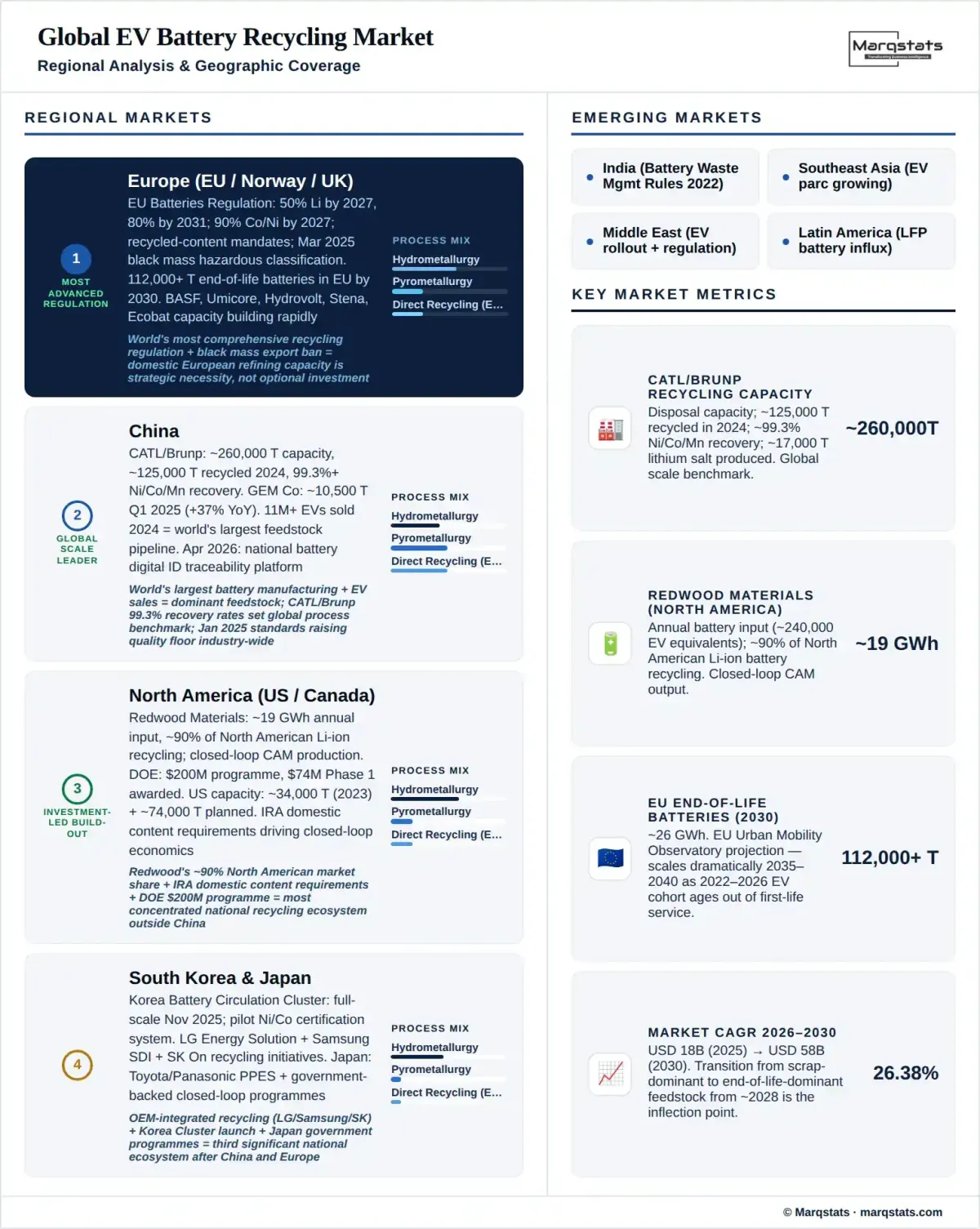
Europe — Most Advanced Regulatory Framework, Accelerating Industrial Capacity
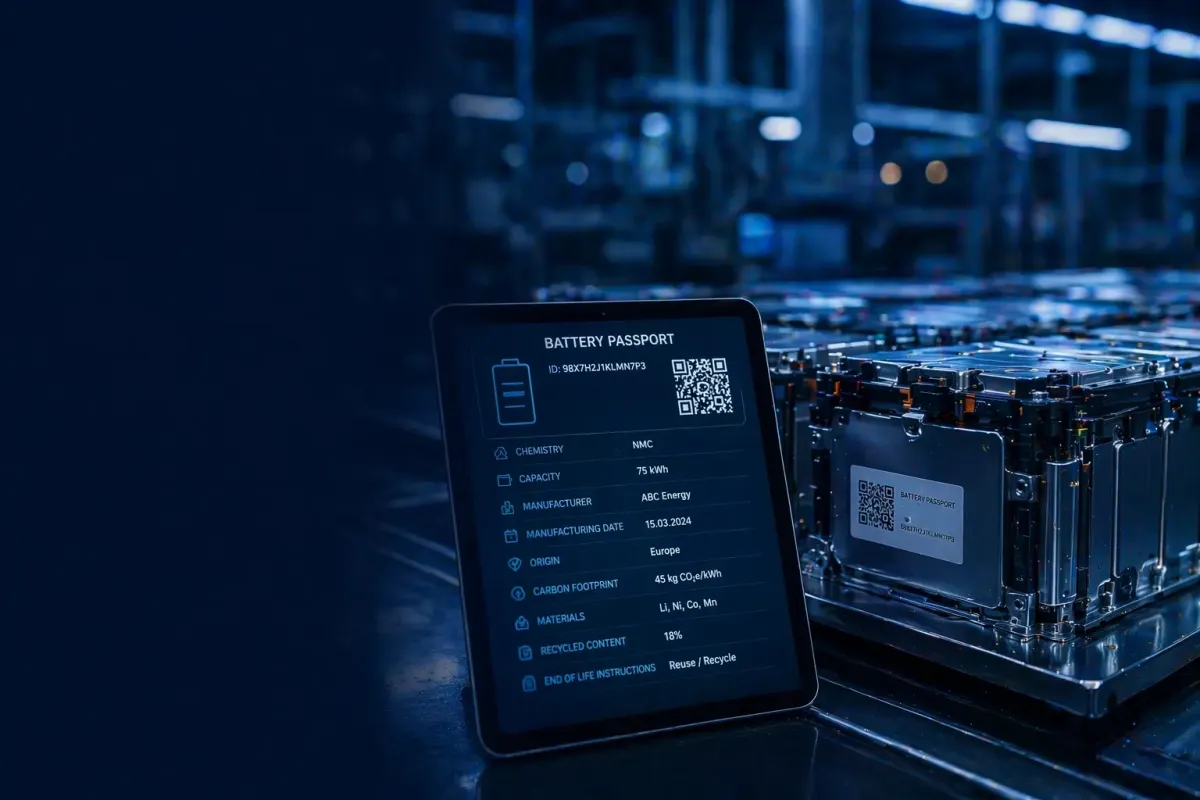
Europe is the world's most advanced regional EV battery recycling market from a regulatory standpoint and is rapidly building the industrial capacity to match. The EU Batteries Regulation — with its mandatory collection rates, recovery targets (50% lithium by 2027, 80% by 2031, 90%+ for cobalt/nickel by 2027), recycled-content mandates, battery passport requirements, and the March 2025 black mass hazardous waste classification — creates the most complete and enforceable regulatory framework for battery recycling globally. The JRC projects total EU battery consumption reaching approximately 395 GWh in 2025 with approximately 60% tied to e-mobility, and the EU Urban Mobility Observatory projects more than 112,000 tonnes of end-of-life batteries in Europe by 2030. The EU's July 2025 publication of verification rules for recycling efficiency and material recovery calculation provides the compliance methodology that underpins commercial contracts and regulatory reporting.
European industrial capacity is building rapidly. BASF's Schwarzheide black-mass plant (approximately 14,500 tonnes/year, commercial operation June 2025) and the April 2026 BASF/TSR collaboration on dismantling and discharging represent the clearest integrated European chain deployment. Hydrovolt's Fredrikstad (Norway) plant processes approximately 11,500 tonnes of battery packs per year with automotive OEM supply agreements. Stena Recycling's Halmstad facility processes approximately 9,500–18,500 tonnes of battery material annually (scalable), having invested over SEK 500 million in battery-handling initiatives, with battery operations targeted to generate SEK 500 million in annual revenue within five to seven years. Ecobat's three European lithium recycling plants handle approximately 9,800 tonnes annually, with plans to scale to approximately 24,000 tonnes. Umicore's established process handles approximately 6,800 tonnes per year with battery-grade cobalt and nickel output.
North America — Investment-Led Build-Out Anchored by Redwood Materials
North America's EV battery recycling market is characterised by investment-driven rather than mandatory-target-driven growth, with federal DOE programme support providing financial acceleration for capacity build-out. US domestic battery recycling capacity was approximately 34,000 tonnes in 2023, with approximately 74,000 tonnes of additional capacity planned in the following two to four years. The DOE's battery recycling and second-life programme under the Infrastructure Investment and Jobs Act totals USD 200 million, with approximately USD 74 million already awarded in the first phase to ten projects. The IRA's domestic content requirements for battery components used in vehicles eligible for EV tax credits create a commercial incentive for closed-loop recycling that produces North American-sourced battery materials.
Redwood Materials is the standout North American player — receiving approximately 19 GWh of batteries annually (representing approximately 240,000 EV equivalents), which the company characterises as approximately 90% of lithium-ion batteries and battery materials recycled in North America. Redwood's model — collecting manufacturing scrap and end-of-life batteries, producing anode copper foil and cathode active materials domestically — is the North American reference implementation for the closed-loop recycling model. The April 2026 Rivian/Redwood repurposed battery energy storage announcement (100+ EV battery packs, 10 MWh initial capacity) demonstrates that Redwood is also building second-life capability as an adjacent commercial layer.
China — Global Scale Leader, Most Advanced Process Standards
China is the global EV battery recycling market's scale leader by a substantial margin, reflecting China's dominant position in EV sales (approximately 11+ million EVs in 2024 representing 60%+ of global sales), battery manufacturing, and the resulting manufacturing scrap and end-of-life battery flows. CATL/Brunp — CATL's recycling subsidiary — has disclosed waste-battery disposal capacity of approximately 260,000 tonnes with approximately 99.3% recovery rates for nickel, cobalt, and manganese, and recycled approximately 125,000 tonnes of used batteries in 2024 to produce approximately 17,000 tonnes of lithium salt. GEM Co. reported power-battery recycling reaching approximately 10,500 tonnes in Q1 2025, up approximately 37% year on year. The total Chinese battery recycling ecosystem — including Brunp/CATL, GEM, Ganfeng Lithium, BYD, and hundreds of smaller operators — processes at a scale that dwarfs any other national ecosystem.
China's regulatory framework is hardening rapidly. January 2025 tightened recycling standards require 90% lithium recovery during smelting and 98% recycling of powdered electrodes — process standards that align Chinese requirements more closely with EU targets and raise the quality floor for the industry. The April 2026 digital identity mandate for NEV power batteries (national traceability platform, effective 1 April 2026) creates the data infrastructure for closed-loop tracking that supports both collection rate improvement and quality certification of recycled materials, directly paralleling the EU Battery Regulation's battery passport requirements.
South Korea and Japan — Advanced Ecosystem Players
South Korea and Japan are material contributors to the global EV battery recycling ecosystem, reflecting their positions as home markets for major battery and automotive OEMs with significant battery manufacturing and EV sales volumes. South Korea's Battery Circulation Cluster began full-scale operation in November 2025 to support the full cycle from recycling technology development to commercialisation, with a pilot recycled-material production certification system planned for key minerals including nickel and cobalt. LG Energy Solution, Samsung SDI, and SK Innovation — the three Korean battery manufacturers collectively responsible for a substantial fraction of global battery supply — all have recycling initiatives tied to their battery manufacturing operations. Japan's battery recycling ecosystem is anchored by Toyota, Panasonic (PPES), and specialist recyclers, with the Japanese government supporting closed-loop battery material recovery through research and industry partnerships.
India — Formal Regulatory Base, Structural Growth Opportunity
India has established a formal regulatory framework for battery recycling through the Battery Waste Management Rules 2022, which require producers to meet collection and recycling targets and mandates registration through the CPCB's centralised EPR battery portal. India is at early stage in actual recycling capacity deployment — it is a structural growth opportunity market rather than a mature capacity market in the current period — but the regulatory foundation and India's rapidly growing EV and two-wheeler electric vehicle market are creating the demand conditions for organised battery recycling infrastructure investment through the forecast period. The combination of India's large vehicle parc, growing EV adoption, and formal EPR framework makes it one of the most commercially significant emerging markets for EV battery recycling investment in the 2027–2032 timeframe.
How Competition Is Evolving
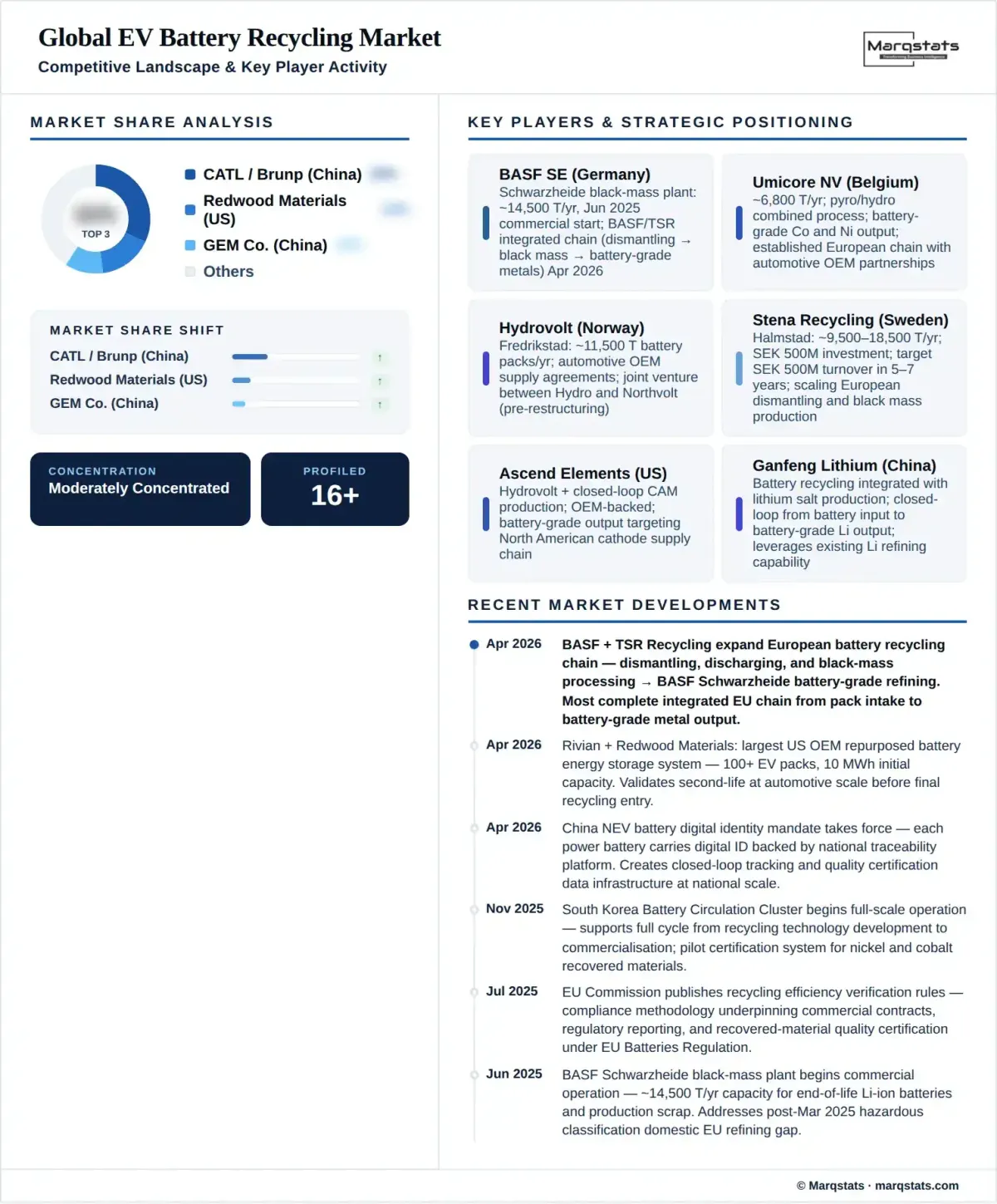
The EV battery recycling competitive landscape is geographically segmented — China is dominated by large integrated players with established relationships with battery manufacturers; North America has a single clear early-scale leader (Redwood Materials); and Europe has a developing ecosystem of specialist recyclers, chemical groups, and OEM-backed ventures building capacity ahead of the regulatory deadline. There is no global market-share leader across all regions, and direct capacity comparisons are difficult because different players report capacity in different units (battery pack weight, black mass tonnes, battery input TWh, or recovered metal output).
In Europe, the competitive landscape is shaped by three types of player: specialist battery recyclers (Hydrovolt, Ecobat, Stena Recycling) building dismantling and black mass production capacity; chemical groups with established precious-metals and battery-materials processing (Umicore, BASF) extending into battery black mass refining to battery-grade output; and OEM-affiliated ventures backed by automotive manufacturers seeking to secure closed-loop recycled material supply. BASF/TSR's April 2026 collaboration — combining TSR's dismantling and discharging with BASF's Schwarzheide black-mass refining — is the clearest example of the integrated European chain model.
In North America, Redwood Materials has an unusually dominant early position — its disclosed 19 GWh annual input volume and approximately 90% North American market share of lithium-ion battery recycling give it a network-effect advantage as both OEM and cell manufacturer partnerships increasingly route material through its facilities. Li-Cycle was an early significant player but has faced financial and operational challenges. Battery Resources (acquired by Ascend Elements) and Ascend Elements are building capacity with investment from OEM and energy company backers. In China, the CATL/Brunp and GEM combination is followed by Ganfeng Lithium, BYD Recycling, and a large fragmented tail of smaller operators — with tightening process standards progressively consolidating the market toward higher-capability players.
Companies Covered
The report profiles 16++ companies with full strategy and financials analysis, including:
Recent Market Activity
Table of Contents
Coverage & Segmentation
This report provides a comprehensive analysis of the global EV battery recycling market covering the collection, dismantling, processing, and material recovery of end-of-life and production-scrap lithium-ion batteries from electric vehicles — including BEVs, PHEVs, and HEVs — across pyrometallurgical, hydrometallurgical, and direct recycling processing routes, spanning the 2021–2030 study period with 2025 as base year. Value chain coverage spans reverse logistics and battery collection, discharge and dismantling, black mass production and refining, recovered metal outputs (lithium, cobalt, nickel, manganese, copper), cathode active material and precursor production using recycled inputs, and second-life repurposing as an adjacent commercial layer. Regulatory analysis covers EU Batteries Regulation (recovery targets, recycled-content mandates, black mass hazardous waste classification, verification rules), China's recycling standards and NEV battery digital identity mandate, US DOE battery recycling programme, India Battery Waste Management Rules 2022, and Korea's Battery Circulation Cluster. Geographic coverage spans Europe (EU-27, Norway, UK), China, North America (US, Canada), South Korea, Japan, and India. Company analysis covers Redwood Materials, CATL/Brunp, GEM, BASF, Umicore, Hydrovolt, Stena, Ecobat, Ganfeng, Ascend Elements, Li-Cycle, and related ecosystem players. Primary research includes 40+ interviews with battery recycling plant operators, automotive OEM battery strategy teams, chemical group battery materials executives, regulatory authorities, pCAM and CAM producers, and battery manufacturer supply-chain teams.