Market Snapshot
Middle bar: base-year value × (1 + CAGR), rounded to two decimals. This is a calculated illustration, not a separately researched annual estimate.
Depot charging is the backbone of US fleet electrification, not a side segment. Approximately 87% of US medium- and heavy-duty vehicles travel less than 200 miles daily, and an estimated 75–90% of chargers for MD/HD vehicles will be depot chargers because depot charging is generally more convenient and cost-effective than en-route charging. As of June 2025, more than 59,000 zero-emission trucks were operating nationwide, and more than 5,100 electric school buses were on the road with 13,931 committed across 1,542 school districts. Separately, CALSTART's March 2026 report covers more than 8,100 full-size and nearly 1,400 small zero-emission transit buses as of July 2025, including funded, ordered, delivered or deployed vehicles. These transit-bus totals combine procurement and deployment stages; they are not a count of buses all operating on the road. The United States fleet depot charging infrastructure market size was valued at approximately USD 2.87 billion in 2025 and is projected to reach USD 9.42 billion by 2030, expanding at a CAGR of 26.84% during the forecast period (2026–2030).
The economics are compelling: depot electricity costs run approximately USD 0.03–0.05 per mile versus USD 0.17 per mile for diesel, creating a structural cost advantage for return-to-base fleets that can charge overnight or during scheduled dwell windows. But the biggest bottleneck is not charger hardware—it is power, interconnection, and site energisation. A federal five-state transportation electrification study found incremental charging infrastructure investment of USD 9.7 billion by 2032, with incremental distribution-grid investment of USD 2.3 billion unmanaged (USD 1.6 billion with managed charging)—and managed charging could cut grid upgrade needs by approximately 30%. Total depot project costs range from approximately USD 7.9 million (small depot) to USD 15.4 million (medium depot), with behind-the-meter investments the main source of cost variation while front-of-the-meter costs are relatively predictable at USD 2.5–2.9 million.
The market is splitting into three winning models: fleet-owned depot charging (Amazon, FedEx, UPS building proprietary infrastructure), third-party shared depots/hubs (Forum Mobility’s FM Harbor at Port of Long Beach: 44 high-speed chargers, 9 MW, 200+ trucks/day; Prologis/Maersk’s Torrance depot: up to 96 simultaneous truck charges, up to 9 MW charging capacity; Voltera’s 20 US properties, 115+ MW total capacity), and Charging-as-a-Service (CaaS) subscription models where fleet operators pay per kWh or per vehicle rather than owning infrastructure. A critical structural point: 44% of all on-road vehicles operate in fleets of 10 vehicles or less—meaning the US market needs shared hubs, utility make-ready, and flexible charging models alongside mega-depots. The Marqstats electric vehicle battery components market report and off-highway electric vehicle market report provide complementary coverage of the upstream battery cost stack and off-highway depot charging applications.
Key Takeaways
Market Overview & Analysis
Report Summary
The United States fleet depot charging infrastructure market covers all charging infrastructure, power systems, software, and services deployed at fixed fleet facilities where commercial electric vehicles charge during scheduled downtime: overnight depot charging for trucks, buses, and vans; mid-day opportunity charging for school buses and transit; and shift-change fast charging at high-utilisation freight and drayage depots. The scope includes charger hardware (Level 2 AC, DC fast chargers, megawatt charging systems), behind-the-meter infrastructure (transformers, switchgear, panels, cable runs, site civil work), power management systems (demand charge optimisation, managed/smart charging software, load balancing), energy assets (depot solar, battery energy storage, microgrids), utility make-ready and front-of-the-meter interconnection, and Charging-as-a-Service (CaaS) business models. En-route public corridor charging is excluded from the core scope but referenced for comparative context.
The market is being built by fleet segments with strong depot-charging logic: drayage fleets returning to port-adjacent depots, delivery/distribution fleets with overnight dwell, school buses with 18-hour daily park windows and summer idle periods, transit buses with depot-based overnight and mid-day charging, municipal fleets with predictable duty cycles, and local freight with return-to-base operations. Over 90% of the US school bus fleet could be electrified with 19.2 kW depot charging using current technology. The critical economic insight is that site power and behind-the-meter design matter as much as charger count—utility engagement, site selection, meter-side scope, and load management are deciding project timelines more than charger procurement alone.
Market Dynamics
Key Drivers
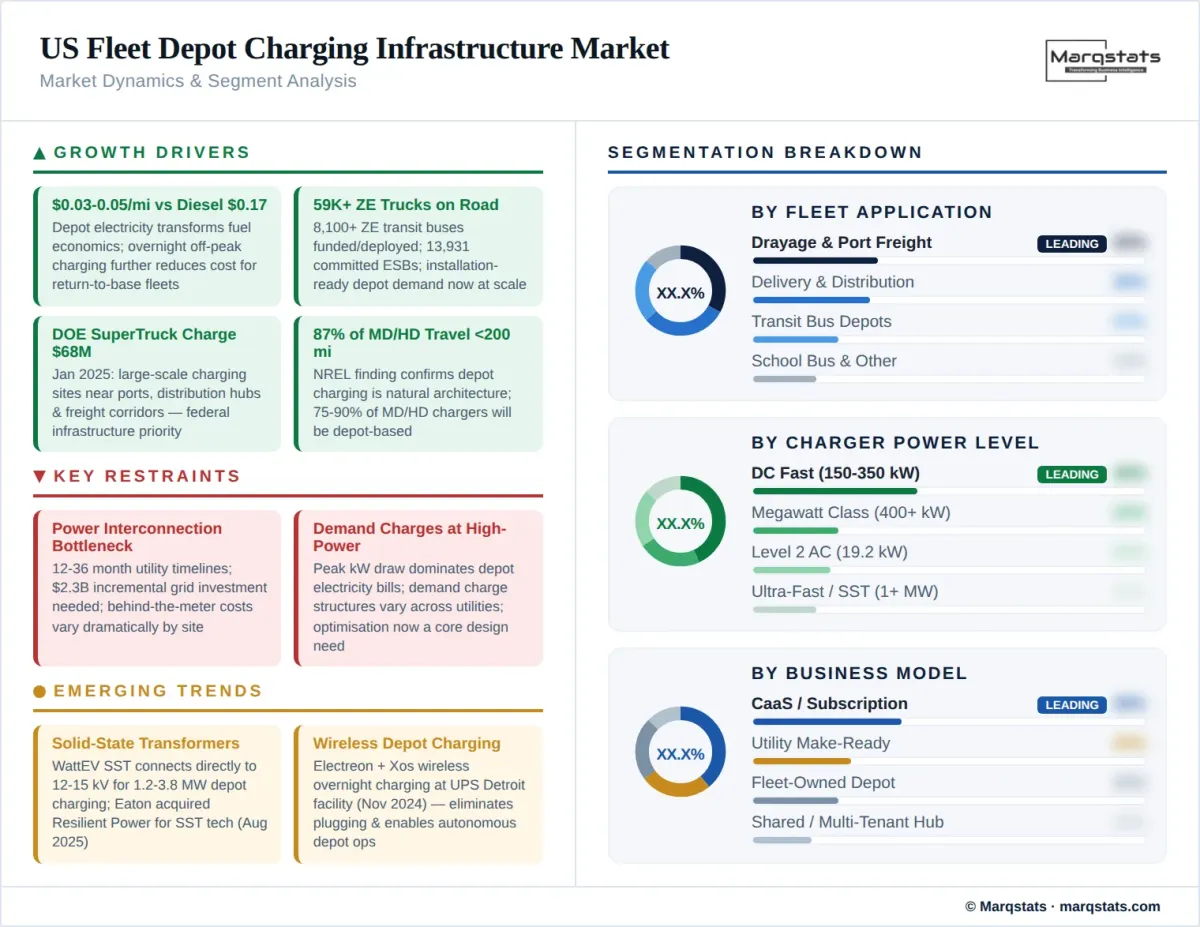
- Depot electricity cost advantage: USD 0.03–0.05/mile vs diesel USD 0.17/mile: For return-to-base fleets, depot charging transforms fuel economics from a variable diesel expense to a lower, more predictable electricity cost. Overnight charging at off-peak rates further reduces per-mile cost. This structural advantage is the primary economic driver for depot charging adoption across Class 6–8 electric trucks, transit buses, delivery vans, and school buses.
- 59,000+ ZE trucks and an 8,100+ mixed-status ZE transit bus procurement and deployment pipeline supporting depot planning: The fleet base is now large enough to drive depot infrastructure investment at scale. Amazon, FedEx, and UPS are electrifying delivery fleets with proprietary depot charging. Transit agencies across all 50 states are deploying electric buses with depot infrastructure. Climate United announced plans to spend up to USD 250 million to buy up to 500 electric semis for port trucking, partnering with Forum Mobility for charging depots at California ports.
- DOE SuperTruck Charge USD 68 million for large-scale depot sites near ports and corridors: DOE announced USD 68 million in January 2025 for large-scale charging sites near ports, distribution hubs, and major freight corridors—the clearest federal signal that heavy-duty depot charging is a national infrastructure priority. This complements Section 30C tax credits (6% or 30% up to USD 100,000 per item) and EPA’s Clean Heavy-Duty Vehicles programme funding for zero-emission vehicle refuelling infrastructure.
- Utility make-ready programmes absorbing front-of-the-meter cost: PG&E’s EV Fleet programme targets 375+ sites and 6,500+ EVs, covering utility-side work up to the customer meter. SCE’s Charge Ready Transport provides medium/heavy-duty fleet infrastructure at low or no cost (open through June 2026). New York’s Joint Utilities’ EV Make-Ready has USD 1.243 billion total budget with USD 885+ million for make-ready, and NYSERDA adds USD 500 million for zero-emission school buses and charging. These programmes directly change project viability by absorbing the utility-side infrastructure investment.
- Fleet depot solar, microgrid, and energy storage integration reducing grid dependence: According to the May 2024 project announcement, the Prologis/Maersk Denker depot uses 2.75 MW of fuel-flexible, hydrogen-ready linear generation and 18 MWh of battery storage to support up to 9 MW of charging capacity for up to 96 trucks simultaneously. Source: Maersk project announcement, 23 May 2024. DOE emphasises that managed charging, VGI, co-located storage, and microgrids reduce infrastructure costs, lower energy costs by shifting load, and improve site energisation timelines. Fleet depot solar and storage create on-site generation that reduces demand charges and grid interconnection requirements.
Key Restraints
- Power interconnection and site energisation timelines: The biggest bottleneck is not charger hardware—it is getting power to the site. Behind-the-meter investments are the main source of cost variation, and utility interconnection processes can take 12–36 months depending on grid capacity and upgrade requirements. DOE’s five-state study found incremental distribution-grid investment of USD 2.3 billion unmanaged. Pioneer Power’s e-Boost Mobile solves this by deploying immediately at Portland’s fleet yard while waiting for permanent grid upgrades.
- Demand charges creating unpredictable electricity costs at high-power depots: Commercial electricity rates include demand charges based on peak kW draw, which can dominate depot electricity bills when multiple trucks charge simultaneously. Fleet depot smart charging and demand charge management software optimise charging schedules to flatten peak demand, but demand charge structures vary dramatically across utility territories. Demand charge optimisation is now a core depot design requirement, not an optional add-on.
- Small fleets (44% of vehicles in fleets of ≤10) lacking capital and utility expertise: Nearly half of US on-road commercial vehicles operate in small fleets that cannot justify building proprietary high-power depots. These fleets often lack capital, utility expertise, permanent depot facilities, and in-house electrical engineering. Shared depot hubs and CaaS models are essential to serving this segment, but shared infrastructure is still early-stage outside California and major port corridors.
Key Trends
- Charging-as-a-Service (CaaS) emerging as dominant model for mid-size fleets: CaaS subscription models allow fleet operators to pay per kWh or per vehicle per month rather than owning and managing charging infrastructure. CaaS providers handle hardware, installation, maintenance, software, demand charge management, and utility coordination. This mirrors the broader fleet-electrification-as-a-service trend, where operators want to electrify without becoming electricity infrastructure experts.
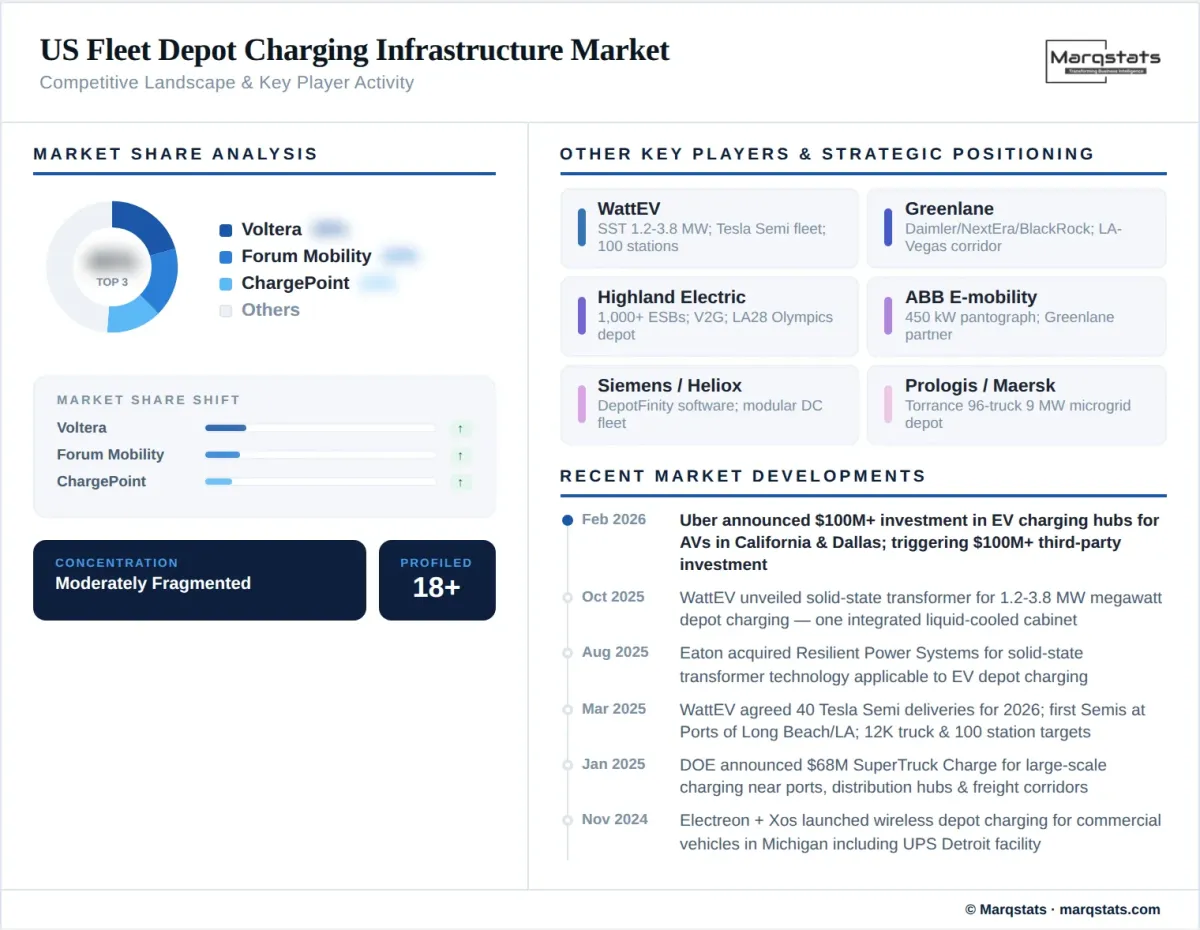
- Solid-state transformers accelerating megawatt charging deployment at depots: WattEV unveiled a solid-state transformer (SST) connecting directly to 12–15 kV utility lines for 1.2–3.8 MW depot charging (October 2025), replacing traditional step-down transformers, switchgear, and rectifiers with one integrated liquid-cooled cabinet. Eaton acquired Resilient Power (August 2025) for SST technology applicable to EV charging depots. SSTs dramatically simplify site construction, lower installation costs, and support true megawatt-level charging for Class 8 heavy-duty trucks.
- Wireless depot charging entering commercial trials: Electreon and Xos are operating wireless charging solutions for commercial delivery vehicles in Michigan (November 2024), including wireless overnight charging at a UPS facility in Detroit. Wireless depot charging eliminates driver plugging, reduces cable damage, and enables autonomous depot operations. The technology is still early-stage for heavy-duty but commercially viable for medium-duty delivery and school bus depots.
- Uber investing USD 100+ million in autonomous vehicle charging depots: Uber announced USD 100+ million investment in EV charging hubs for autonomous vehicles (February 2026) in California and Dallas, with an additional USD 100+ million triggered in third-party charging networks and 1,000+ new chargers globally. While primarily targeting robotaxis, this investment creates depot-style charging infrastructure that overlaps with fleet depot market architecture.
Market Segmentation
The highest-power depot segment. Forum Mobility’s FM Harbor at Port of Long Beach has 44 high-speed chargers, 9 MW of power, and serves 200+ electric drayage trucks per day. Prologis/Maersk’s Torrance depot provides up to 9 MW charging capacity for up to 96 simultaneous heavy-duty truck charges near the Ports of LA and Long Beach. WattEV is placing Tesla Semis at the ports and plans 12,000 heavy-duty electric trucks on California roads by 2030 with 100 charging stations by 2035. Climate United’s USD 250 million for 500 electric semis with Forum Mobility depot partnerships defines the port-freight depot model. California’s 2035 diesel drayage truck end-of-sale target drives near-term infrastructure urgency.
The highest-volume depot segment by fleet count. Amazon, FedEx, and UPS are electrifying delivery fleets with proprietary depot charging at distribution centres. NREL found that 87% of MD/HD vehicles travel less than 200 miles daily—making overnight depot charging at distribution facilities the natural charging architecture. Michigan’s Electreon/Xos wireless charging pilot at a UPS Detroit depot demonstrates cable-free overnight charging innovation. Medium-duty delivery depots typically use 50–180 kW DC chargers and 19.2 kW Level 2 AC, with managed charging software to optimise overnight schedules.
The most infrastructure-intensive per-vehicle segment. As of July 2025, CALSTART records more than 8,100 full-size and nearly 1,400 small zero-emission transit buses across funded, ordered, delivered or deployed stages nationally. FTA’s Low-No programme selected approximately USD 2 billion across 165 projects in 45 states (November 2025). VERDEK installed ABB 450 kW pantograph-up chargers for electric buses at NYC MTA’s Grand Avenue Depot in Queens, with Phase Two in Staten Island. Transit depots require high-power overnight charging (150–450 kW per bus), pantograph or plug-in infrastructure, and significant site power capacity for 50–200 bus deployments.
The most V2G-ready depot segment. 5,100+ electric school buses on the road, 13,931 committed across 49 states, DC, and 4 territories. Over 90% of the US school bus fleet can be electrified with 19.2 kW depot charging. Managed charging reduces depot peak loads by up to 77%. EPA’s Clean School Bus Program has awarded nearly USD 3 billion (95% electric). NYSERDA’s programme adds USD 500 million. School bus depots uniquely support V2G because buses are parked 18 hours/day during school year and 3 months over summer. The Marqstats US electric school bus V2G market report provides detailed coverage.
Local government fleets including refuse trucks, utility vehicles, street sweepers, and public works. Pioneer Power’s e-Boost Mobile provides deployable depot charging for Portland’s fleet yard while waiting for permanent grid upgrades—demonstrating how municipal fleets can begin electrifying immediately with mobile infrastructure. EPA’s CHDV funding supports associated infrastructure for vocational vehicle electrification. Municipal depots typically start with lower-power Level 2 and grow to DC fast charging as fleets expand.
Level 2 AC (19.2 kW for overnight school bus/light-duty), DC fast charging (50–480 kW for trucks, buses, delivery), and megawatt charging systems (MCS, 1+ MW for Class 8 heavy-duty). Zerova’s DZ480 uses Adaptive Scalable Architecture to scale from 480 kW to 3.84 MW with multiple dispenser options. ChargePoint’s 2025 platform manages any EV charging operation including fleet depots. Siemens positions end-to-end depot solutions with DepotFinity software. Kempower’s ChargEye manages depot charging for trucks, buses, and ports. Heliox provides modular DC charging for e-bus and e-truck fleets.
Transformers, switchgear, panels, cable runs, site civil work, and fleet depot power management systems for demand charge optimisation. This is the main source of depot cost variation. WattEV’s solid-state transformer connects directly to 12–15 kV utility lines, replacing multiple traditional components with one cabinet. Eaton’s Resilient Power SST acquisition targets power distribution for depot charging. Fleet depot smart charging software optimises schedules to flatten peak demand and reduce demand charges.
Prologis/Maersk’s depot combines 2.75 MW of linear generation with 18 MWh of battery storage, supporting up to 9 MW of charging capacity. On-site solar, battery storage, and microgrids reduce grid dependence, demand charges, and interconnection requirements. DOE positions co-located storage and microgrids as critical to depot economics. Mainspring Energy’s fuel-flexible, hydrogen-ready linear generators power the Prologis depot—showing that depot microgrids can use diverse generation sources.
By Geography
California
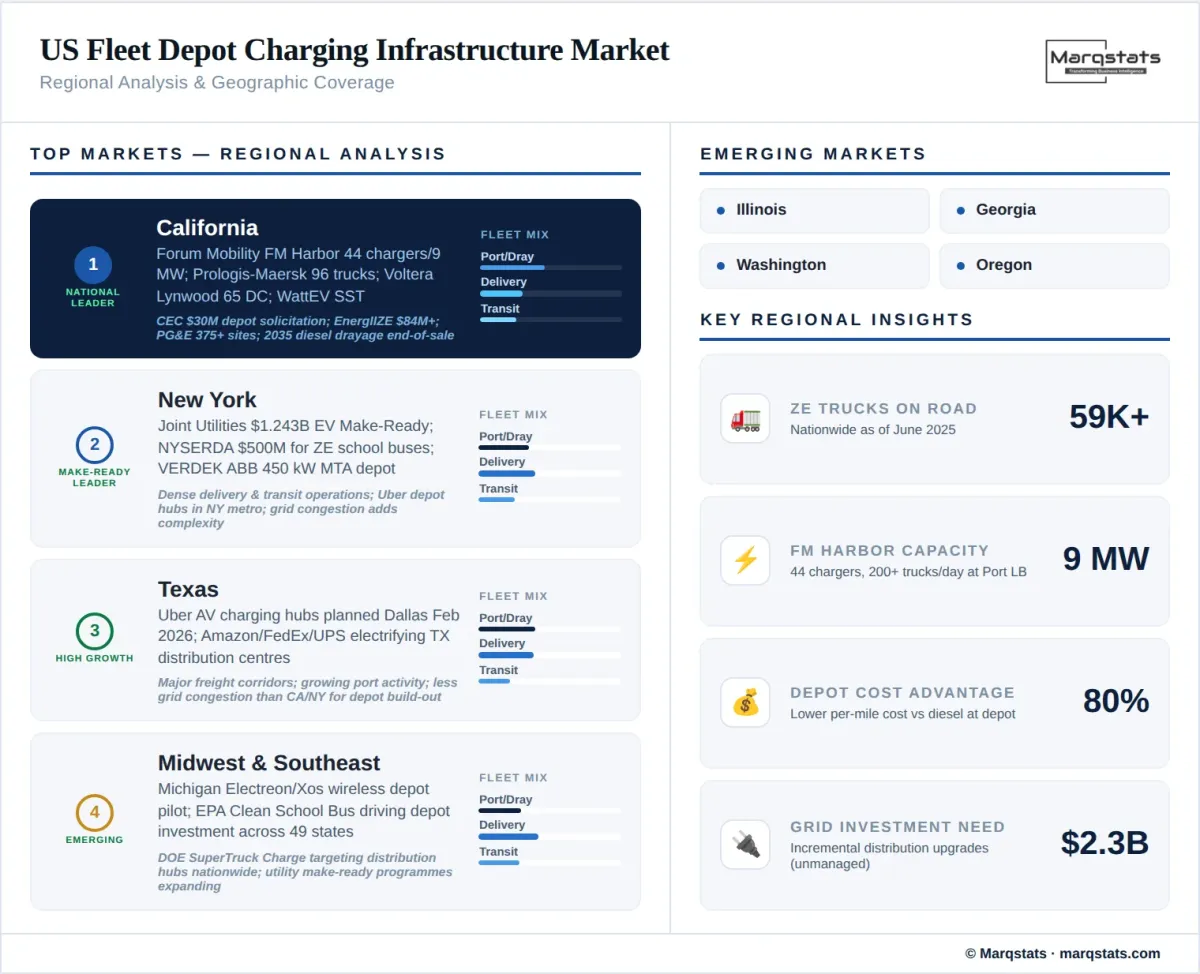
The undisputed US leader in fleet depot charging deployment. Forum Mobility FM Harbor (Port of Long Beach: 44 chargers, 9 MW, 200+ trucks/day). Prologis/Maersk Torrance (up to 96 trucks charging simultaneously, up to 9 MW charging capacity). Voltera Lynwood truck hub (65 DC fast chargers, 200 trucks/day). WattEV deploying Tesla Semis at LA/Long Beach ports with 100-station plan by 2035. Greenlane’s Southern California flagship for medium/heavy-duty corridor. CEC USD 30 million depot/hydrogen solicitation (2025). EnergIIZE USD 84+ million to 250+ projects. PG&E EV Fleet (375+ sites). SCE Charge Ready Transport (open through June 2026). DOE SuperTruck Charge near CA ports and corridors.
New York
The second-largest depot charging market. Joint Utilities’ EV Make-Ready has USD 1.243 billion total budget with USD 885+ million for make-ready programmes. NYSERDA USD 500 million for zero-emission school buses and infrastructure. VERDEK installed ABB 450 kW pantograph chargers at NYC MTA Grand Avenue Depot for transit bus electrification. Uber announced depot charging hubs in the NY metro area. New York’s dense delivery and transit operations create strong depot demand, but site constraints and grid congestion add complexity.
Texas
An emerging high-growth depot market. Uber plans autonomous vehicle charging hubs in Dallas (February 2026). WattEV’s solid-state transformer technology was developed with California Energy Commission support but applies to Texas freight corridors. Amazon, FedEx, and UPS distribution centres in DFW and Houston drive delivery-fleet depot demand. Texas’s deregulated electricity market creates different demand-charge and time-of-use dynamics than regulated California utilities.
Pacific Northwest (Oregon, Washington)
Portland is deploying fleet depot charging with Pioneer Power’s e-Boost Mobile units—providing immediate depot capacity while grid upgrades proceed. Washington state’s Clean Fuel Standard and fleet electrification mandates create regulatory pull. Amazon’s Pacific Northwest distribution operations drive delivery-fleet depot demand.
Midwest and Southeast
Michigan’s wireless depot charging trials (Electreon/Xos at UPS Detroit, November 2024) position the state as an innovation hub for next-generation depot technology. Illinois, Ohio, and Georgia host major delivery and distribution hubs where depot charging investment is growing. Transit agencies in Chicago, Atlanta, and Detroit are deploying electric bus depots under FTA Low-No programme funding.
How Competition Is Evolving
The competitive landscape has three layers. The first is site owner / depot developer / CaaS players who build, own, and operate depot infrastructure: Voltera (20 US properties, 115+ MW total capacity, 294 charging stalls added, Lynwood truck hub with 65 DC chargers), Forum Mobility (FM Harbor Port of Long Beach: 44 chargers, 9 MW, 200+ trucks/day—freight-corridor and port-focused), Prologis Mobility (warehouse-adjacent depots, Torrance depot with up to 96 simultaneous truck charges and up to 9 MW charging capacity alongside Maersk), Greenlane (backed by Daimler Truck, NextEra Energy, BlackRock—Southern California flagship, LA–Las Vegas corridor with 100+ charger ports), and Highland Electric Fleets (1,000+ electric school buses under contract, first commercial V2G programme, LA28 Olympics 500-bus depot management).
The second layer is hardware and software enablers who provide depot-grade charging technology: ChargePoint (fleet depot management platform for any EV operation), ABB (heavy-duty energy management, Greenlane corridor, VERDEK NYC transit pantographs), Siemens (end-to-end depot solutions with DepotFinity software, Heliox subsidiary for modular DC fleet charging), Kempower (ChargEye depot charge management for trucks, buses, ports), Zerova Technologies (DZ480 scalable to 3.84 MW, BABA-compliant Phoenix manufacturing), WattEV (solid-state transformers for 1.2–3.8 MW megawatt depot charging), Eaton (Resilient Power SST acquisition, Express Grid V2X architecture), and Pioneer Power (e-Boost Mobile deployable depot charging).
The third layer is utility programmes and federal/state incentives: PG&E EV Fleet (375+ sites, 6,500+ EVs), SCE Charge Ready Transport (open through June 2026), New York Joint Utilities’ EV Make-Ready (USD 1.243 billion), NYSERDA (USD 500 million school bus), FTA Low-No (USD 2 billion, 165 projects), DOE SuperTruck Charge (USD 68 million), EPA Clean School Bus (USD 5 billion), Section 30C tax credit (6%/30% up to USD 100,000), and California CEC/EnergIIZE programmes. Utility make-ready is a market shaper—not a footnote—because it directly changes project economics by absorbing front-of-the-meter costs.
Companies Covered
Companies covered in the report include:
Recent Market Activity
Table of Contents
Coverage & Segmentation
This report provides a comprehensive analysis of the United States fleet depot charging infrastructure market covering the historical period (2021–2025) and forecast period (2026–2030), with 2025 as the base year. The study examines market size in USD across fleet application (drayage/port, delivery/distribution, transit bus, school bus, municipal/vocational), infrastructure layer (charger hardware, behind-the-meter, power management, solar/microgrid/storage), business model (fleet-owned, third-party shared, CaaS), and geography covering 12 state/metro clusters. Company profiling covers 20+ players across depot developers, charger providers, and utility programmes. Policy analysis covers Section 30C, DOE SuperTruck Charge, EPA CHDV, EPA Clean School Bus, FTA Low-No, NEVI, California CEC/EnergIIZE, and utility make-ready programmes.
The authored methodology describes bottom-up modelling from fleet vehicle counts (59,000+ ZE trucks, 8,100+ transit buses, 5,100+ school buses). The 8,100+ transit-bus figure includes funded and ordered vehicles as well as delivered or deployed buses, and should not be treated entirely as an operating-fleet input. Other stated model inputs include depot project cost data (USD 7.9M small, USD 15.4M medium), charger deployment counts by type (Level 2, DCFC, MCS), utility make-ready programme budgets, and CaaS pricing models. Primary research encompasses 40+ interactions with fleet depot operators, utility programme managers, charging hardware providers, depot developers, transit agencies, and school district transportation directors across California, New York, Texas, Pacific Northwest, and Midwest regions.