Market Snapshot
Middle bar: base-year value × (1 + CAGR), rounded to two decimals. This is a calculated illustration, not a separately researched annual estimate.
The global purpose-built robotaxi vehicle market size is estimated at USD 184.50 million in 2025 and is projected to reach USD 4,902.50 million by 2030, growing at a CAGR of 92.70% over 2026 – 2030. Annual deliveries rise from about 4,510 vehicles to 185,000, a 110.18% annual rate, while the average ex-factory price falls from about USD 40,909 to USD 26,500 per vehicle.
Marqstats defines the market as the ex-factory wholesale value of Level 4 robotaxis designed from the start for driverless fleet operation and delivered to fleet operators. It covers vehicles with no manual controls and vehicles with detachable steering wheels and pedals that are removed once driverless permits are granted. Conventional cars converted into robotaxis with aftermarket kits, privately owned cars with Level 3 systems, autonomous shuttles carrying more than eight passengers, driving software subscriptions, teleoperation services and fare revenue are excluded.
Vehicles with detachable controls account for an estimated 90.14% of 2025 value and four-seat vehicles for 62.01%. China accounts for 67.10% of 2025 value and North America for 26.67%. The study segments the market by control architecture, seating capacity, supply model and region.
Key Takeaways
Market Overview & Analysis
Report Summary
Marqstats sizes the purpose-built robotaxi vehicle market as the ex-factory value of Level 4 passenger vehicles engineered from the start for driverless commercial service and delivered to fleet operators. In 2025 about 4,510 vehicles were delivered worldwide, worth an estimated USD 184.50 million at an average ex-factory price of about USD 40,909.
The first generation of robotaxis were converted consumer cars. Waymo used the Chrysler Pacifica Hybrid and Jaguar I-PACE, and Cruise used the Chevrolet Bolt, adding roof sensor pods, extra cooling, extra wiring and backup actuators. Converted vehicles proved that driverless software could work on public roads, but they cost USD 135,000 to 200,000 each once fitted, wasted cabin space on a steering wheel and pedals nobody used, and exposed sensors to vibration and weather that caused calibration drift and depot maintenance.
Purpose-built robotaxis are designed around fleet use. Steering, braking, power supply and computing networks have two independent channels so the vehicle can stop safely if one fails. Sensors are built into body panels and roof modules with cleaning and heating systems. Cabins have flat floors, sliding doors and lounge seating, and the vehicle is designed to run 500,000 to 800,000 miles rather than the 150,000 to 250,000 miles typical of a private car. Batteries use durable lithium iron phosphate chemistry with fast charging or battery swapping.
Two design approaches are used. Most Chinese programmes, including the Baidu Apollo RT6, Pony.ai Gen-7 bZ4X and WeRide Robotaxi GXR, have steering wheels and pedals that can be removed, so they can be approved under existing passenger car rules and then run without controls once operators receive driverless permits. Zoox, Tesla Cybercab and the planned Verne two-seater have no manual controls at all and need special exemptions or new rules.
The market grew from about 45 prototype vehicles in 2021, worth USD 5.40 million, to 110 in 2022, 380 in 2023 and 1,820 in 2024, worth USD 96.80 million, as Jiangling Motors began line production of the Baidu Apollo RT6 and Geely group companies started building vehicles for WeRide and Waymo. Marqstats expects about 11,850 deliveries worth USD 475.20 million in 2026.
Regulation shapes vehicle design in each market. In the United States, federal safety standards assume a human driver, so a vehicle without a steering wheel or brake pedal needs a Part 555 exemption limited to 2,500 vehicles a year per manufacturer. China approves vehicles through a national pilot for intelligent connected vehicles and leaves driverless service to city permits. The EU allows type approval of automated driving systems for small series of up to 1,500 vehicles per type a year, Germany allows Level 4 vehicles in approved areas under remote technical supervision, and the UK Automated Vehicles Act 2024 sets out a framework for authorised self-driving entities.
Global Purpose-Built Robotaxi Vehicle Market Size and Forecast
The global purpose-built robotaxi vehicle market grows from USD 184.50 million in 2025 to USD 4,902.50 million in 2030, a CAGR of 92.70%. Marqstats expects deliveries of about 28,500 vehicles worth USD 997.50 million in 2027, 62,000 worth USD 1,922.00 million in 2028 and 118,000 worth USD 3,363.00 million in 2029, before reaching 185,000 vehicles in 2030.
Prices fall as production scales. The average ex-factory price falls from about USD 120,000 per prototype in 2021 to USD 53,187 in 2024, USD 40,909 in 2025, USD 35,000 in 2027 and USD 26,500 in 2030. Delivery volume therefore grows at 110.18% a year while value grows at 92.70%.
Automated driving hardware drives the price fall. Marqstats estimates the cost of the compute platform falls from about USD 8,500 per vehicle in 2025 to USD 3,200 in 2030, the LiDAR array from USD 7,200 to USD 2,100, radar from USD 2,100 to USD 900, cameras and sensor cleaning from USD 1,800 to USD 750, wiring and integration from USD 2,400 to USD 850, and redundant steering, braking and power from USD 3,200 to USD 1,400. In total the driving hardware falls from about USD 25,200 to USD 9,200 per vehicle, and the base electric vehicle from about USD 22,000 to USD 17,300.
Fleet economics decide adoption. Marqstats estimates a human-driven ride-hail vehicle in a US city costs about USD 2.02 per revenue mile to run, of which USD 1.15 is the driver. A converted robotaxi saves the driver but costs about USD 2.05 per mile because of USD 0.65 of depreciation, USD 0.45 of remote supervision, higher insurance and maintenance. A purpose-built robotaxi in 2028 to 2030 costs about USD 0.61 per mile, with depreciation of USD 0.14 and remote supervision of USD 0.08 as one operator supervises 20 to 50 vehicles.
Deliveries depend on permits as much as factories. Waymo, Pony.ai, WeRide and Baidu each plan thousands of vehicles a year, but each city and country must approve driverless service before vehicles can earn revenue. Marqstats tracks four indicators to monitor the forecast: driverless permit approvals by city, changes to the US exemption cap and EU small-series limits, factory output at partner plants, and the average cost of the driving hardware kit.
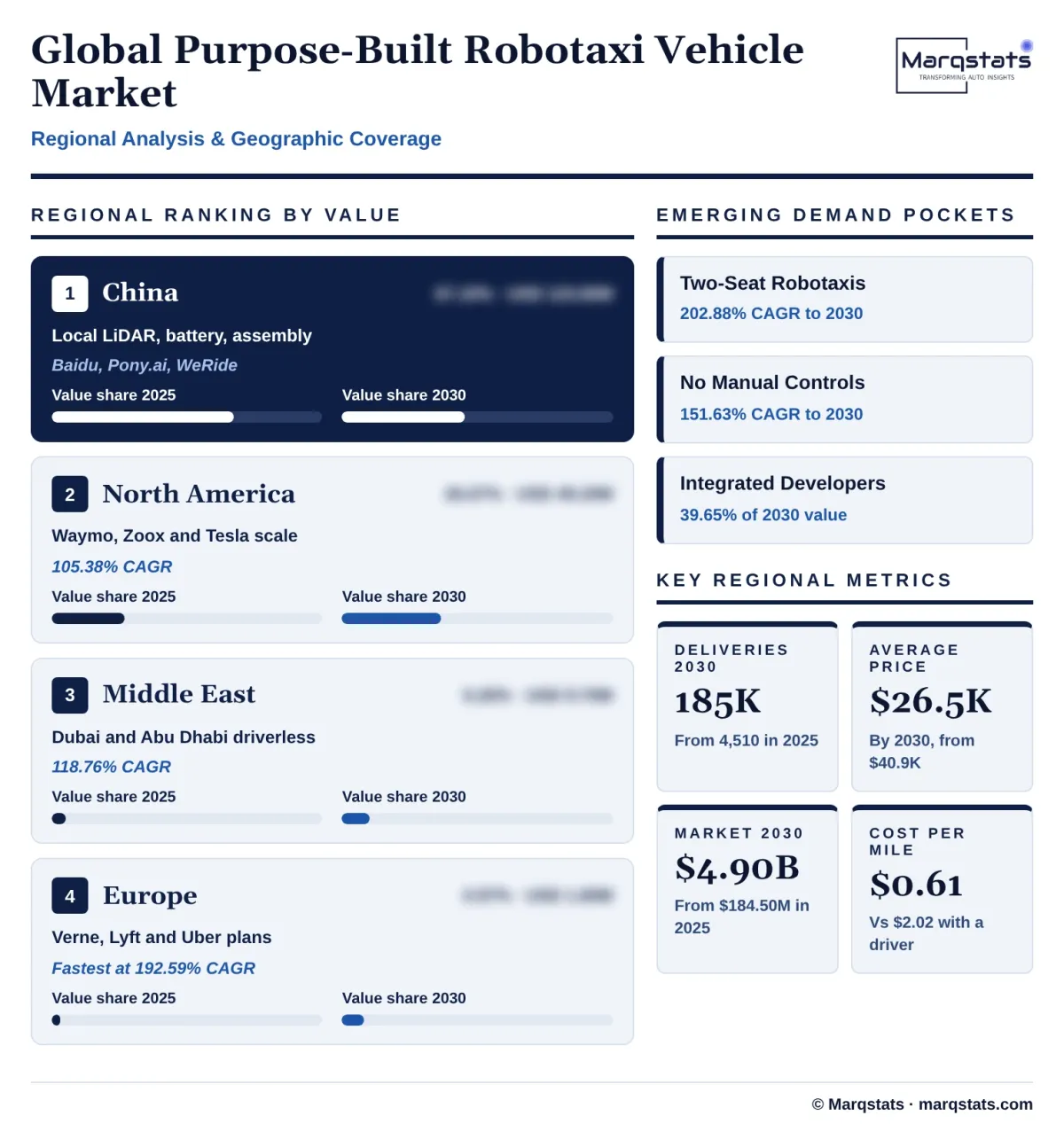
The mix of vehicles changes over the forecast. Vehicles with no manual controls rise from 9.86% to 37.45% of value, two-seat vehicles from 2.76% to 26.52%, and vertically integrated developers from 9.86% to 39.65%. China remains the largest region but its share falls from 67.10% to 45.54% as North America, the Middle East and Europe scale up. The Middle East rises to 9.91% of value as Dubai and Abu Dhabi expand driverless service, and Europe to 7.87% as Verne, Baidu with Lyft, and Pony.ai with Uber add fleets.
Market Dynamics
Key Drivers
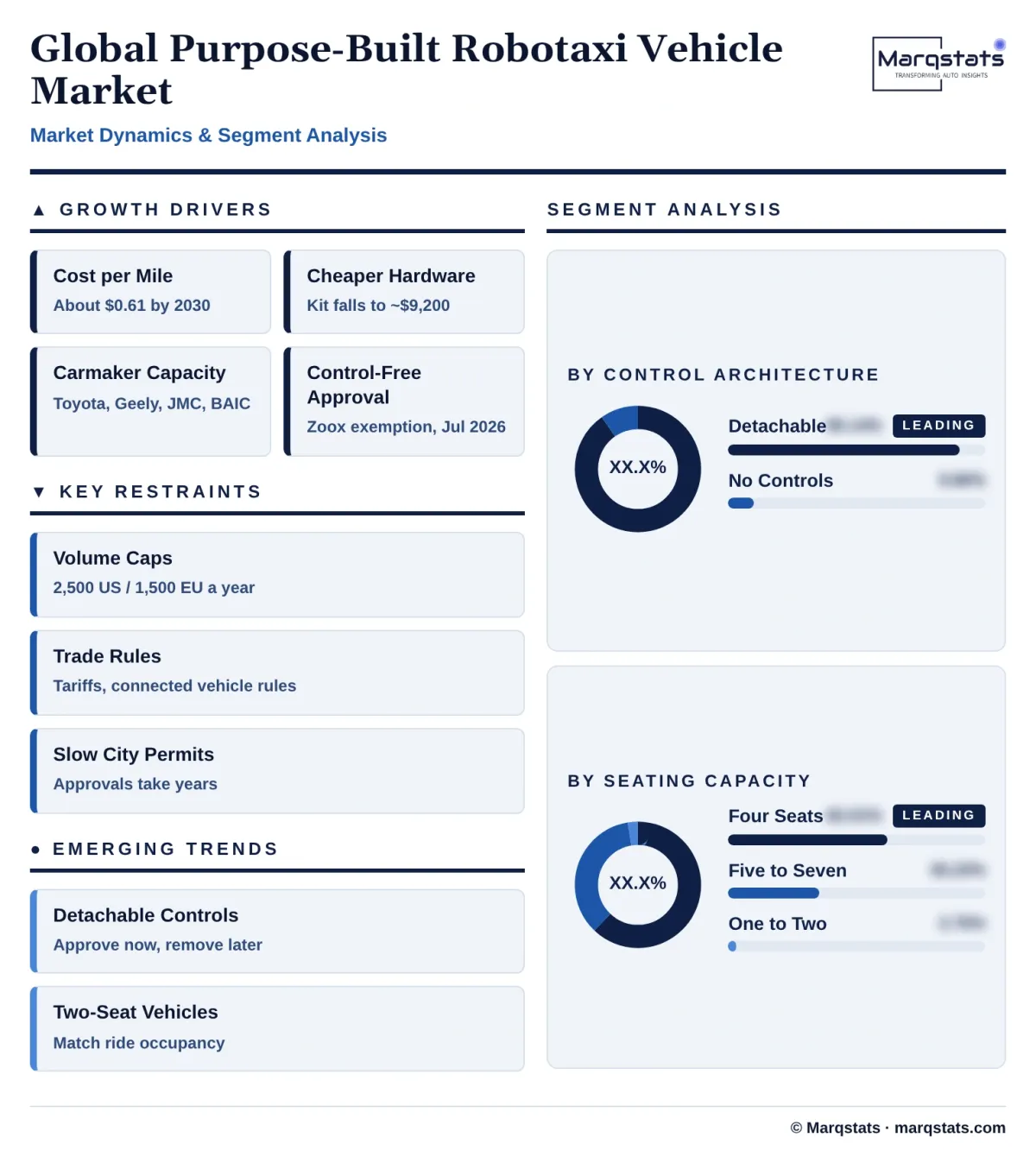
Five forces are moving robotaxi fleets from converted cars to purpose-built vehicles.
- Lower cost per mile. Purpose-built vehicles cut depreciation and maintenance costs per mile by spreading a lower purchase price over a much longer life, making driverless fleets cheaper to run than human-driven ride-hail.
- Cheaper sensors and computers. Solid-state LiDAR from suppliers such as RoboSense and Hesai, and automotive processors such as NVIDIA DRIVE Thor, cut the cost of the driving hardware and allow it to be installed on the production line.
- Car companies offer production capacity. Toyota and GAC Toyota, Geely and its Zeekr and Farizon brands, Jiangling Motors and BAIC build robotaxis for software developers, giving developers factory scale without building their own plants. Pony.ai and Toyota began mass production of the Gen-7 bZ4X robotaxi in February 2026, and WeRide ordered 2,000 upgraded Robotaxi GXR vehicles from Farizon in March 2026.
- Regulators approve vehicles without controls. NHTSA granted Zoox the first commercial Part 555 exemption for a robotaxi without manual controls in July 2026, and amended its rules so vehicles built before an exemption can be covered.
- Ride-hailing platforms want driverless supply. Uber and Lyft are signing deals with Waymo, Baidu, Pony.ai, WeRide and others, creating demand for large numbers of vehicles without the platforms owning them.
Key Restraints
Four constraints limit how fast purpose-built robotaxis can be built and deployed.
- Volume caps. A US Part 555 exemption is limited to 2,500 vehicles a year per manufacturer, and the EU small-series approval route for automated vehicles is limited to 1,500 vehicles per type a year, restricting large fleets outside China.
- Trade and connected vehicle rules. US tariffs on Chinese-built electric vehicles and rules restricting Chinese connected vehicle hardware and software force developers to ship vehicles without sensors and computers and install them locally, adding cost and complexity.
- Safety scrutiny. NHTSA opened an audit in September 2026 into how Tesla certified the Cybercab as meeting federal safety standards, showing that regulators will test compliance claims closely.
- City permits are slow. Each city must approve driverless commercial service, and approvals can take years, delaying the point at which delivered vehicles start earning revenue.
Key Trends
Four shifts are changing how purpose-built robotaxis are designed, built and sold.
- Detachable controls as a bridge. Chinese programmes use steering wheels and pedals that can be removed, letting vehicles pass existing approval rules and then operate without controls once permits are granted.
- Smaller vehicles. Two-seat designs such as Tesla Cybercab and the planned Verne vehicle match typical ride-hail occupancy and use smaller, cheaper batteries.
- Assembly split across borders. Waymo receives Zeekr-built vans in the United States without connected vehicle technology and installs its sixth-generation driving system in Arizona, a model other developers may copy to meet trade rules.
- Fast charging and battery swapping. Purpose-built robotaxis use battery swapping, as on the Baidu Apollo RT6, or wireless charging, as planned on Tesla Cybercab, to keep vehicles in service for most of the day.
Strategic Implications
- For carmakers, robotaxi programmes are a contract manufacturing opportunity. Platforms built for 600,000-mile lives, easy replacement of body and sensor parts and high-uptime charging can win volume from several software developers at once.
- For autonomous driving developers, vehicle cost is the key to profitability. Sharing production with established carmakers, using standard automotive processors and designing hardware that works across several vehicle platforms keep capital needs under control.
- For sensor and chip suppliers, line-fit integration is the growth path. Suppliers whose products can be installed and calibrated on the production line, rather than fitted afterwards, will win the largest volumes.
- For ride-hailing platforms, mixed fleets reduce risk. Working with several vehicle makers and driving software developers lets platforms grow driverless supply without owning vehicles.
- For regulators, volume limits now shape the market. Raising the US exemption cap or replacing the EU small-series limit with full type approval for automated vehicles would allow much larger fleets outside China.
- For investors and fleet owners, vehicle life is the key assumption. A purpose-built robotaxi that reaches 600,000 miles spreads its purchase price over more than twice the mileage of a converted car, so durability of batteries, drive units, doors and sensors decides fleet returns as much as purchase price does.
Market Segmentation
Vehicles with removable steering wheels and pedals account for 90.14% of 2025 value, USD 166.30 million and about 4,270 vehicles, rising to USD 3,066.50 million by 2030, a 79.12% CAGR, while their share falls to 62.55%. The Baidu Apollo RT6, Pony.ai Gen-7 bZ4X and WeRide Robotaxi GXR use this approach to gain approval under existing passenger car rules.
Vehicles built without any manual controls account for 9.86% of 2025 value, USD 18.20 million and about 240 vehicles, and grow at 151.63% a year to USD 1,836.00 million and 37.45% of the market by 2030. Zoox, Tesla Cybercab and the planned Verne two-seater lead this segment, helped by the July 2026 Zoox exemption.
Four-seat vehicles account for 62.01% of 2025 value, USD 114.40 million and about 3,000 vehicles, through the Baidu Apollo RT6 and Pony.ai Gen-7 bZ4X, and grow at 86.02% a year to USD 2,548.00 million, 51.97% of 2030 value.
Multi-purpose vans for five to seven passengers account for 35.23% of 2025 value, USD 65.00 million and about 1,450 vehicles, through the Zeekr-built Waymo Ojai and WeRide Robotaxi GXR, serving airport routes and shared rides, and grow at 74.59% a year to USD 1,054.50 million.
Compact one- and two-seat vehicles account for 2.76% of 2025 value, USD 5.10 million, and grow fastest, at 202.88% a year, to USD 1,300.00 million and 26.52% of 2030 value as Tesla Cybercab production scales.
Vehicles built by carmakers for driving software developers and sold or leased to fleets and ride-hailing platforms account for 90.14% of 2025 value, USD 166.30 million, rising to USD 2,958.50 million by 2030, a 77.84% CAGR, and 60.35% of the market.
Developers that design, build and operate their own vehicles, led by Zoox and Tesla, account for 9.86% of 2025 value, USD 18.20 million, and grow at 154.52% a year to USD 1,944.00 million and 39.65% of the market by 2030.
By Geography
China
China is the largest market, with 67.10% of 2025 value, USD 123.80 million and about 3,420 vehicles, rising to USD 2,232.50 million by 2030, a 78.33% CAGR, while its share falls to 45.54%. Local supply of batteries from CATL and BYD, LiDAR from RoboSense and Hesai and vehicle assembly from Jiangling Motors, Geely, GAC and BAIC keeps vehicle costs well below those of Western programmes. Baidu Apollo Go runs more than 1,000 vehicles in Wuhan, Pony.ai operated 1,975 robotaxis at the end of June 2026 and targets more than 3,500 by year-end, and city rules in Wuhan, Beijing, Guangzhou and Shenzhen allow fully driverless paid service.
North America
North America accounts for 26.67% of 2025 value, USD 49.20 million and about 780 vehicles, and grows at 105.38% a year to USD 1,798.00 million and 36.68% of the market by 2030. Waymo put about 300 Zeekr-built Ojai robotaxis into regular paid service in San Francisco, Los Angeles and Phoenix in August 2026, Zoox received its federal exemption in July 2026, and Tesla began series production of Cybercab at Giga Texas in April 2026. Tariffs on Chinese-built vehicles and connected vehicle rules lead Waymo to install its driving system in Arizona.
Middle East
The Middle East accounts for 5.26% of 2025 value, USD 9.70 million and about 250 vehicles, and grows at 118.76% a year to USD 486.00 million and 9.91% of the market by 2030. Dubai aims for 25% of trips to be autonomous by 2030, WeRide and Uber launched fully driverless paid service in Dubai in 2026, and WeRide runs fully driverless operations in Abu Dhabi.
Europe
Europe accounts for 0.97% of 2025 value, USD 1.80 million, and grows fastest, at 192.59% a year, to USD 386.00 million and 7.87% of the market by 2030. Verne launched a commercial robotaxi service in Zagreb in April 2026 using Pony.ai Gen-7 technology and is preparing its own two-seat vehicle and factory, Baidu and Lyft plan to deploy Apollo Go vehicles in Europe, and Uber and Pony.ai plan more than 2,000 robotaxis across five European cities. The EU small-series limit of 1,500 vehicles per type a year constrains scale.
How Competition Is Evolving
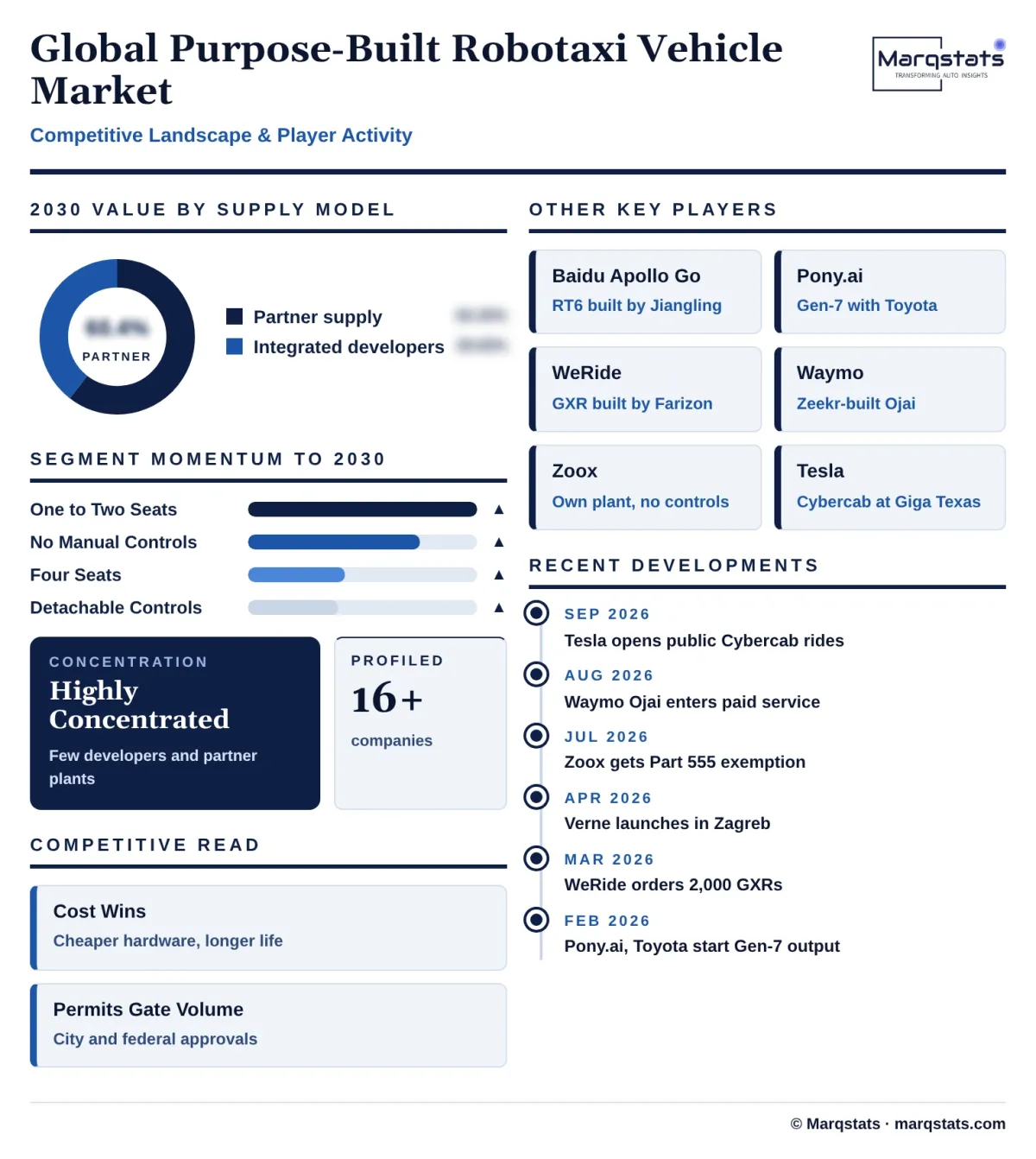
The purpose-built robotaxi vehicle market is highly concentrated. A small number of driving software developers and their manufacturing partners deliver almost all vehicles: Baidu with Jiangling Motors, Pony.ai with Toyota, GAC Toyota and BAIC, WeRide with Geely Farizon, Waymo with Zeekr, and Zoox and Tesla in their own plants.
Two business models compete. Platform partnerships let developers use established factories and supply chains and sell or lease vehicles to fleets and ride-hailing platforms. Vertically integrated developers control vehicle design, production and operations, accepting higher upfront investment in return for lower long-run costs and full control of the vehicle.
Suppliers matter. LiDAR makers RoboSense and Hesai, chip makers NVIDIA and Mobileye, and battery makers CATL and BYD supply most of the hardware, and their cost reductions drive vehicle price falls.
Competition will be decided by cost per vehicle, permits and access to ride-hailing demand. Developers that combine low-cost factory production, approvals in several cities and partnerships with Uber, Lyft and other platforms will capture the largest share of deliveries.
Production capacity is being built quickly. Pony.ai planned to build more than 1,000 Gen-7 bZ4X robotaxis with Toyota in 2026, WeRide ordered 2,000 upgraded GXR vehicles from Farizon with production of the new model starting in the third quarter of 2026, Zoox builds its vehicle at its own plant in Hayward, California, and Tesla began series production of Cybercab at Giga Texas in April 2026. Verne is preparing a robotaxi factory near Zagreb, and Waymo expects thousands more Ojai vehicles to arrive in the United States by the end of 2026.
Companies Covered
Companies covered in the report include:
Recent Market Activity
Table of Contents
Coverage & Segmentation
The study covers the global purpose-built robotaxi vehicle market, with 2025 as the base year, 2021 – 2025 as the historical period and 2026 – 2030 as the forecast period. Values are in US dollars at ex-factory wholesale prices, and volumes are annual deliveries to fleet operators. The market is segmented by control architecture, seating capacity, supply model and region.
Conventional cars converted into robotaxis with aftermarket kits, privately owned vehicles with Level 3 systems and permanent manual controls, autonomous shuttles for more than eight passengers, driving software fees, teleoperation services and fare revenue are excluded. Segment and regional splits are Marqstats estimates built on developer disclosures, manufacturing partner announcements, delivery and fleet data, and vehicle price benchmarks.