Market Snapshot
Middle bar: base-year value × (1 + CAGR), rounded to two decimals. This is a calculated illustration, not a separately researched annual estimate.
The global robotaxi depot automation market size is estimated at USD 184.20 million in 2025 and is projected to reach USD 2,415.50 million by 2030, growing at a CAGR of 67.32% over 2026 – 2030. Growth follows the expansion of commercial robotaxi fleets operated by Waymo, Baidu Apollo Go, Pony.ai, WeRide and Zoox, which need to charge, clean and inspect thousands of driverless vehicles every day.
Marqstats defines robotaxi depot automation as the equipment and software that service autonomous passenger vehicles in fleet depots without manual work. It covers hands-free robotic and underbody charging systems and battery swapping, touchless sensor-safe washing and automated cabin cleaning, drive-through inspection and sensor calibration gantries, and depot management software. Values cover equipment supply, installation, commissioning and software licences. Depot real estate, grid connections, standard chargers, conventional car washes and vehicle sensors are excluded.
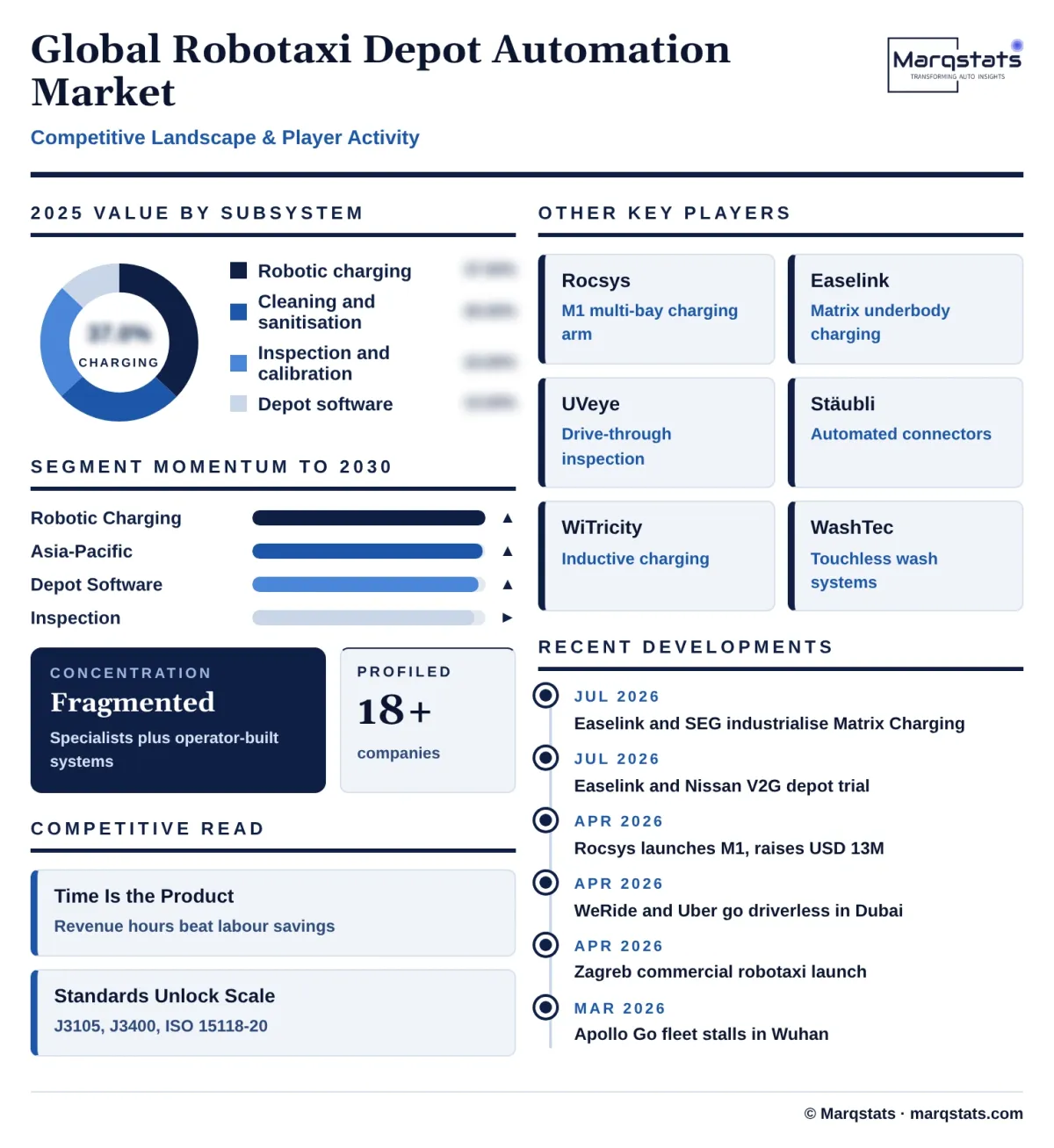
Robotic hands-free charging systems account for an estimated 37.00% of 2025 value, cleaning and sanitisation for 26.00%, inspection and calibration for 24.00% and depot software for 13.00%. North America accounts for 44.00% of 2025 value and Asia-Pacific for 41.00%. The study segments the market by subsystem and region.
Key Takeaways
Market Overview & Analysis
Report Summary
Marqstats sizes the robotaxi depot automation market as spending on equipment and software that service SAE Level 4 robotaxis in fleet depots without manual work. It includes robotic arms and underbody systems that plug in or connect vehicles for charging, automated battery swapping stations, touchless wash arches and air dryers safe for sensors, automated cabin vacuuming and sanitisation, drive-through inspection gantries for bodywork, tyres and underbody, sensor calibration rigs, and depot management software that queues vehicles, assigns bays and clears them for service. In 2025 the market was worth an estimated USD 184.20 million.
Depot models differ between operators. Waymo runs its own depots in most cities but relies on Uber to manage depots in Austin and Atlanta, Pony.ai combines its own depots with partner facilities, WeRide works with local transport operators, and Baidu operates central hubs with battery swapping. Each model affects who buys automation equipment and how standard it needs to be.
The market is a small but critical part of the robotaxi industry. Global robotaxi bookings were about USD 3.5 billion to 4.2 billion in 2025, the value of robotaxi vehicles in service about USD 0.85 billion to 1.1 billion, and total depot infrastructure spending, including grid connections, land and building, about USD 420 million to 510 million. Automation equipment and software are the part of depot spending that directly determines how quickly vehicles return to service.
Manual servicing does not scale. A technician must receive each vehicle, plug in a heavy fast-charging cable, walk around it to check for damage, measure tyres, wipe lidar and camera covers and vacuum the cabin. This takes 45 to 60 minutes per vehicle and requires one technician for every five to eight vehicles. As fleets grow from hundreds to thousands of vehicles per city, depots become congested and labour costs rise sharply.
Automated depots run these tasks in parallel. Robotic charging starts within about 20 seconds of the vehicle stopping, touchless washing takes about two minutes, laser and camera scans check tyres, underbody and body in about 15 seconds, and sensors are recalibrated in about three minutes while cabins are cleaned. Depot software coordinates the sequence and issues a digital clearance before the vehicle leaves.
Depots also serve as energy hubs. Large depots use on-site battery storage to smooth charging peaks, and bidirectional charging allows parked robotaxis to supply power back to the grid. Depot management software increasingly schedules charging around electricity prices and grid limits, adding energy management to the value of automation.
Marqstats estimates the market reaches USD 352.80 million in 2026 and USD 2,415.50 million in 2030. Growth depends on fleet expansion, the share of depot bays automated, falling equipment costs as suppliers industrialise their products, and the speed of grid connections and safety certification for unattended robotic equipment.
Global Robotaxi Depot Automation Market Size and Forecast
The global robotaxi depot automation market grows from USD 184.20 million in 2025 to USD 2,415.50 million in 2030, a CAGR of 67.32%. Marqstats estimates USD 352.80 million in 2026, almost double the 2025 value, as multi-bay robotic charging systems and automated inspection lanes are installed in North American depots and driverless permits expand in Asian and Middle Eastern cities.
Growth is spread evenly across subsystems. Robotic charging grows fastest, at 69.09% a year, depot software at 67.31%, cleaning and sanitisation at 66.01% and inspection and calibration at 65.90%. Charging gains share because energy replenishment is the longest step in the turnaround and the one where automation saves the most time.
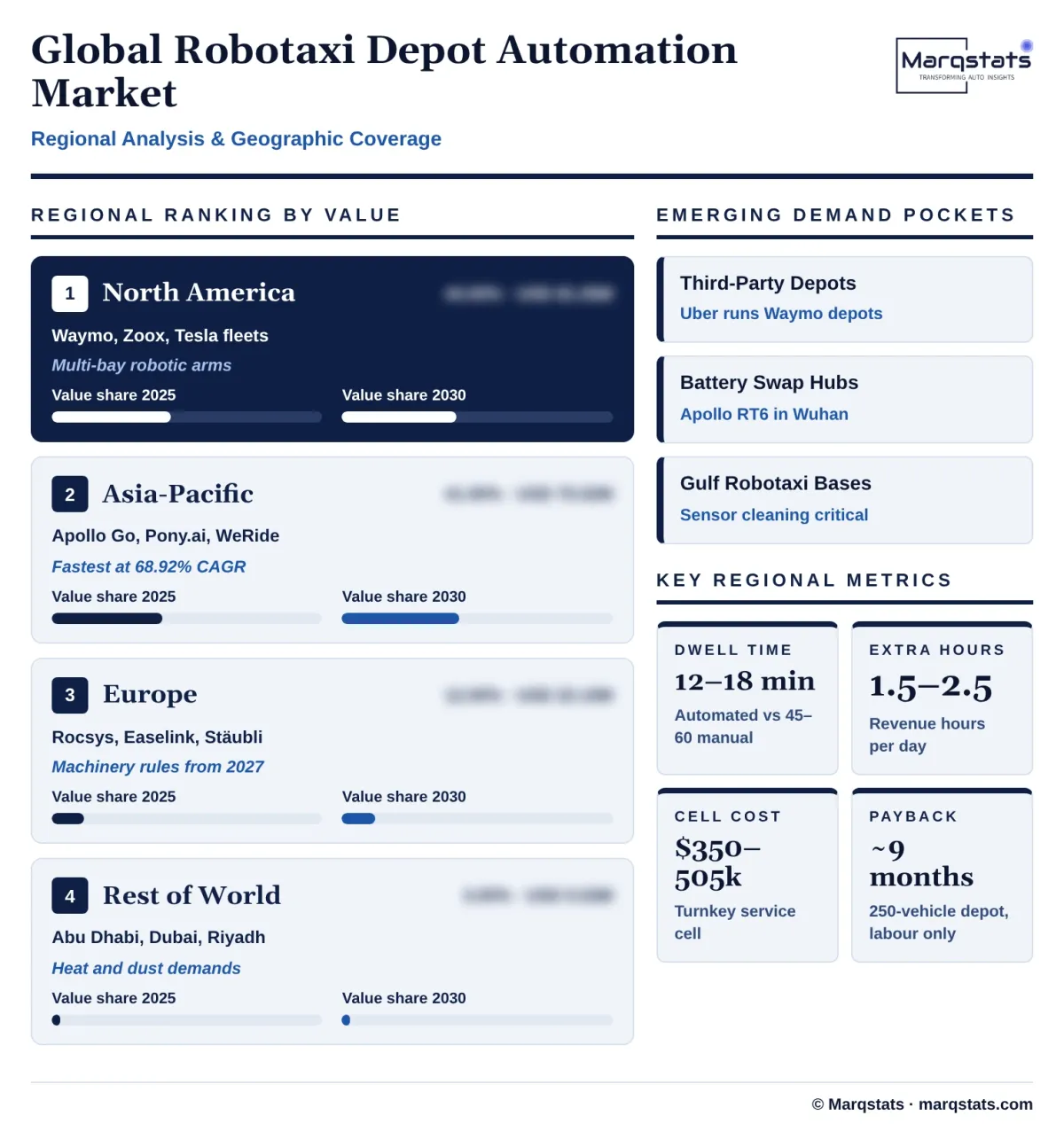
A turnkey automated service cell costs about USD 350,000 to 505,000. This covers a multi-bay robotic charging gantry at about USD 140,000 to 180,000, a touchless wash and dry arch at USD 75,000 to 110,000, a drive-through inspection gantry at USD 80,000 to 125,000, cabin sanitisation equipment at USD 35,000 to 55,000 and depot software and controllers at USD 20,000 to 35,000. Annual maintenance and licences add about USD 32,500 to 49,000 per cell. Each cell can handle 60 to 80 turnarounds a day.
The return on investment is fast. Marqstats estimates a 250-vehicle depot with manual servicing needs about 42 technicians across three shifts, costing about USD 3.15 million a year at USD 75,000 per technician. An automated depot with five cells needs about five exception technicians, costing about USD 375,000. The saving of about USD 2.78 million a year repays the roughly USD 2.13 million equipment cost in about nine months, before counting the extra revenue hours from shorter turnarounds.
Depot automation rates rise over the forecast. Marqstats estimates that a minority of robotaxi depot bays were automated in 2025, mostly at the largest operators, and that more than 75% of bays in major urban depots will be automated by 2030. New depots are increasingly designed for automation from the start, while older depots are retrofitted bay by bay as fleets grow.
Equipment costs are expected to fall. Marqstats expects the cost per automated cell to decline by about 35% by 2030 as suppliers such as Easelink and SEG Automotive industrialise standard charging components and multi-bay designs spread the cost of each robot across more parking stalls.
Market Dynamics
Key Drivers
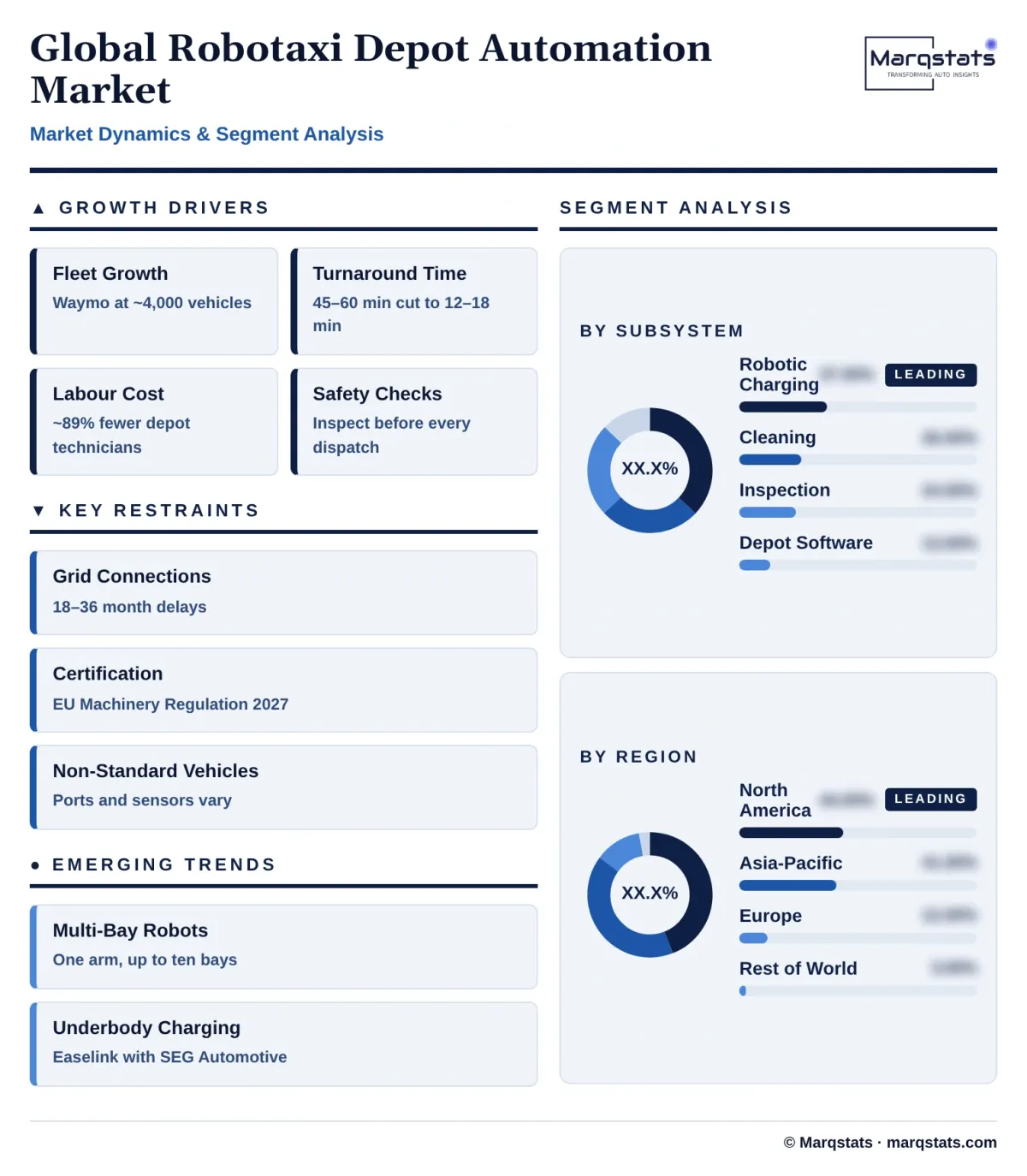
Five forces are pushing robotaxi operators to automate their depots.
- Robotaxi fleets are scaling quickly. Waymo grew from about 2,000 vehicles in late 2025 to about 4,000 by September 2026 across 15 US cities, Pony.ai grew from 270 vehicles at the end of 2024 to more than 2,000 in mid-2026, and WeRide, Baidu Apollo Go and Zoox are expanding. Each new vehicle needs to be charged, cleaned and inspected every day.
- Turnaround time limits revenue. Every hour a robotaxi spends in the depot is an hour it cannot earn fares. Cutting turnaround from 45 to 60 minutes to 12 to 18 minutes adds 1.5 to 2.5 revenue hours per vehicle per day, improving returns on expensive vehicles.
- Depot labour is costly. In cities such as San Francisco, Los Angeles and New York, depot labour is one of the largest operating costs after electricity, and technicians face safety risks handling high-voltage cables. Automation can cut on-site headcount by about 89%.
- Safety and reliability expectations are rising. Sensor misalignment, damaged lidar covers or worn tyres can cause dangerous perception errors, and the Wuhan outage in March 2026 showed the need for robust checks. Automated inspection gives consistent, documented checks on every vehicle before it returns to service.
- Standard interfaces reduce risk. SAE J3105 for automated charging connections, SAE J3400 for NACS connectors and ISO 15118-20 for charging communication allow equipment from different suppliers to work with different vehicles, making operators more willing to invest.
Key Restraints
Four constraints slow the roll-out of automated robotaxi depots.
- Grid connections take years. Depots that charge hundreds of vehicles need large power connections, and grid connection delays in major cities average 18 to 36 months. Battery storage buffers help but must meet NFPA 855 fire and separation rules.
- Certification adds time and cost. The EU Machinery Regulation requires notified-body certification for AI-based safety components and treats anyone who substantially modifies robotic equipment as its manufacturer, raising compliance costs for integrators and operators.
- Designs are not yet standard. Vehicles differ in charging port location, sensor layout and body shape, so equipment often needs custom adjustment. Single-arm, single-stall robotic chargers remain too expensive for large depots.
- Security and cyber risk need managing. Depot robots, software and vehicle links are connected systems, and a compromised controller could disrupt charging or clear unsafe vehicles for service. Rules such as the EU Cyber Resilience Act and operator security requirements add design and testing costs for suppliers.
- Operators fear lock-in. Large operators such as Waymo, Baidu and Tesla design their own depot systems, and others worry about depending on one supplier's robots or software. This can slow purchasing decisions until standards mature.
Key Trends
Four shifts are reshaping how robotaxi depots charge, clean and inspect vehicles.
- Multi-bay robots are lowering cost per stall. Rocsys's M1 uses one rail-mounted arm to charge up to ten bays, and similar designs spread the cost of each robot across many vehicles, making robotic charging affordable for large depots.
- Underbody conductive charging is moving towards production. Easelink's Matrix Charging uses a floor pad and an underbody connector, delivers up to 99% efficiency at about one-third of the cost of inductive charging, and completed bidirectional vehicle-to-grid trials with Nissan in 2026.
- Battery swapping is used in China. Baidu's Apollo RT6 robotaxis use swappable batteries that automated stations replace in about three minutes, keeping vehicles in service while batteries charge in controlled conditions.
- Inspection data is feeding maintenance planning. Drive-through scanners record tyre wear, body damage and underbody condition on every visit, building a history for each vehicle. Operators use this data to schedule maintenance before faults occur and to provide evidence of vehicle condition to regulators and insurers.
- Third parties are running depots. In Austin and Atlanta, Uber manages depot operations for Waymo vehicles, including charging, cleaning and maintenance, and fleet managers such as Moove and Avis are building depot capabilities. These operators buy standard automation equipment to serve several fleets.
Strategic Implications
- For robotaxi operators, standard interfaces avoid lock-in. Using standard charging connectors or underbody plates lets operators buy equipment from several suppliers and lease depot capacity from fleet partners such as Uber, Moove or Avis.
- For equipment suppliers, multi-bay designs and certification win orders. Suppliers must cut cost per stall through multi-bay designs, meet EU and US safety rules for unattended operation, and integrate with operators' depot software.
- For fleet management companies, depot services are a growth business. Running automated depots for several robotaxi operators can create long-term contracts as fleets expand into new cities.
- For utilities and cities, early planning avoids delays. Faster grid connections and clear permitting for depot battery storage help cities attract robotaxi operators and avoid depots being pushed to remote industrial areas.
- For regulators, depot standards can support safety. Requiring documented inspection and sensor calibration before vehicles return to service, and clear rules for unattended robotic equipment, would give the public more confidence in robotaxi safety and give suppliers a stable target for product design.
- For investors, utilisation gains matter more than labour savings. The largest value of depot automation comes from extra revenue hours per vehicle, which grow as fleets and fares scale, so suppliers serving the largest fleets will grow fastest.
Market Segmentation
Robotic arms, underbody conductive and inductive systems and automated battery swapping account for 37.00% of 2025 value, USD 68.15 million, rising to USD 942.05 million and 39.00% of the market by 2030, a 69.09% CAGR. Rocsys, Easelink, Stäubli and WiTricity are among the main suppliers. Charging is the longest part of the turnaround, so it gives the largest time savings.
Touchless wash arches using demineralised water and air knives, and automated cabin vacuuming, UV-C and sanitising systems, account for 26.00% of 2025 value, USD 47.89 million, rising to USD 603.88 million by 2030, a 66.01% CAGR. Standard brush car washes can scratch sensor covers and disturb sensor alignment, so robotaxis need specialist equipment from suppliers such as Otto Christ and WashTec.
Drive-through gantries that scan bodywork, sensor covers, underbody and tyres, and rigs that recalibrate cameras, radar and lidar, account for 24.00% of 2025 value, USD 44.21 million, rising to USD 555.57 million by 2030, a 65.90% CAGR. UVeye, Beissbarth and Bosch Rexroth supply inspection and calibration equipment that detects surface damage down to 2 mm and measures tyre tread to 0.1 mm.
Software that queues vehicles, assigns bays, guides vehicles through the depot and issues clearance before they return to service accounts for 13.00% of 2025 value, USD 23.95 million, rising to USD 314.00 million by 2030, a 67.31% CAGR. Operators such as Waymo develop their own software, while companies such as Applied Intuition and RideOS offer platforms for other fleets.
By Geography
North America
North America is the largest market in 2025, with an estimated 44.00% of value, USD 81.05 million, rising to USD 1,014.51 million by 2030, a 65.77% CAGR, while its share falls to 42.00%. Waymo's fleet of about 4,000 vehicles in 15 US cities, Zoox's purpose-built vehicles and Tesla's robotaxi plans drive demand, and operators are adopting multi-bay robotic charging arms. US depots must meet NFPA 855, the National Electrical Code and SAE J3105 and J3400 standards.
Asia-Pacific
Asia-Pacific accounts for an estimated 41.00% of 2025 value, USD 75.52 million, and grows fastest, overtaking North America to reach USD 1,038.67 million and 43.00% of the market by 2030, a 68.92% CAGR. Baidu Apollo Go, Pony.ai and WeRide operate thousands of vehicles in Chinese cities, Baidu uses automated battery swapping for its RT6 vehicles, and Chinese rules require swap stations to meet GB/T 40032 and include emergency isolation for faulty vehicles.
Europe
Europe accounts for an estimated 12.00% of 2025 value, USD 22.10 million, rising to USD 289.86 million by 2030, a 67.32% CAGR. Robotaxi services in Zagreb, trials in London, Madrid and Hamburg and Waymo's planned Munich launch support demand, and European suppliers Rocsys, Easelink and Stäubli are leaders in automated charging. Strict worker safety rules favour automation, but the EU Machinery Regulation adds certification requirements from January 2027.
Rest of World
The Middle East and other regions account for an estimated 3.00% of 2025 value, USD 5.53 million, rising to USD 72.46 million by 2030, a 67.29% CAGR. WeRide and Uber run driverless robotaxis in Abu Dhabi and began fare-charging driverless operations in Dubai in 2026, Baidu Apollo Go and Pony.ai are expanding in the Gulf, and Saudi Arabia and Qatar are developing robotaxi services. Extreme heat and dust make automated cleaning and sensor checks especially important.
How Competition Is Evolving
The robotaxi depot automation market is fragmented across equipment types. In charging, Rocsys leads in robotic arms, Easelink in underbody conductive charging, Stäubli in automated connectors and WiTricity in inductive charging. In cleaning, car wash makers such as Otto Christ and WashTec adapt touchless systems for sensor-equipped vehicles. In inspection, UVeye leads drive-through scanning, and Beissbarth and Bosch Rexroth supply calibration equipment.
Barriers to entry are moderate. Robotic charging and inspection require specialist hardware, software and safety certification, but the market is young and no supplier has a large installed base across operators. New entrants, including industrial robot makers and charging companies, can compete by partnering with fleet operators on pilot depots.
Robotaxi operators are also major developers. Waymo, Baidu, Tesla and Zoox design much of their own depot equipment and software, and Tesla has patented automated cabin cleaning systems for driverless vehicles. Operators decide whether to build in-house or buy from suppliers, which shapes the market open to independent vendors.
Partnerships with automotive suppliers are accelerating industrialisation. Easelink's partnership with SEG Automotive aims to mass-produce Matrix Charging components, and vehicle makers such as Magna, Stellantis, GAC and Toyota are standardising vehicle-side interfaces for robotaxi platforms.
Regional supply chains differ. Chinese operators source much of their depot equipment, including swap stations, from domestic suppliers at lower cost, while North American and European operators buy from European and US specialists. As Chinese robotaxi operators expand into the Middle East and Europe, they may bring their own depot equipment suppliers with them.
Competition will be decided by cost per stall, interoperability and certification. Suppliers that offer multi-bay systems working with many vehicle types, certified for unattended operation in Europe and the United States and integrated with operators' depot software, will win the largest contracts.
Companies Covered
Companies covered in the report include:
Recent Market Activity
Table of Contents
Coverage & Segmentation
The study covers the global robotaxi depot automation market, with 2025 as the base year, 2021 – 2025 as the historical period and 2026 – 2030 as the forecast period. Values are in US dollars on a delivered equipment plus software basis, including supply, installation, commissioning and software licences. The market covers automated charging and battery swapping, cleaning and sanitisation, inspection and calibration, and depot management software for SAE Level 4 robotaxi fleets. It is segmented by subsystem and region.
Depot land and buildings, grid connections, public and standard depot chargers, conventional car washes and manual tools, and vehicle sensors and computers are excluded. Equipment volumes, prices, subsystem and regional splits are Marqstats estimates built on operator fleet disclosures, supplier announcements, equipment cost benchmarks and depot operating models.