Market Snapshot
Key Takeaways
Market Overview & Analysis
Report Summary
This analysis reads Russia's own reconciled sizing chain, regional distribution data, and named-scenario regulatory framework together as a single coherent picture rather than isolated data points, since the underlying research itself was structured to support exactly that kind of integrated, cross-referenced reading.
Russia's EV maintenance market is measured across routine technical maintenance, high-voltage diagnostic and repair operations, thermal management servicing, and post-warranty component replacements, valued at USD 67.44 million (RUB 6,070.00 million) in 2025. This figure is taken directly from the underlying research's own rigorously reconciled sizing chain, anchored to statutory Autostat and TASS fleet registration data covering 192,600 active plug-in vehicles.
Structurally, this is a market shaped by a genuine dual dependency few other markets in this coverage set share: over 64% of the active fleet consists of grey-market Chinese imports lacking official service infrastructure, while PHEV/EREV powertrains, not pure BEVs, generate the majority of scheduled maintenance revenue despite representing a smaller unit share of the electrified fleet.
The analysis is built for four reader types making different decisions: an independent workshop operator weighing investment in reverse-engineered diagnostic capability for grey-market Chinese models, a domestic OEM like Evolute or Atom building an official warranty service network, a parts distributor navigating Decree No. 1713's recycling fee structure, and an investor tracking how fuel supply stability and domestic assembly localization shape this market's Base-to-High-Demand scenario range.
Why the Smaller Powertrain Segment Generates the Bigger Revenue Share
Read only the unit counts, and pure battery electric vehicles look like the more important segment to watch in Russia's EV maintenance market -- they're the powertrain federal subsidies specifically target, and the one most commonly associated with "electric vehicle" in general industry commentary.
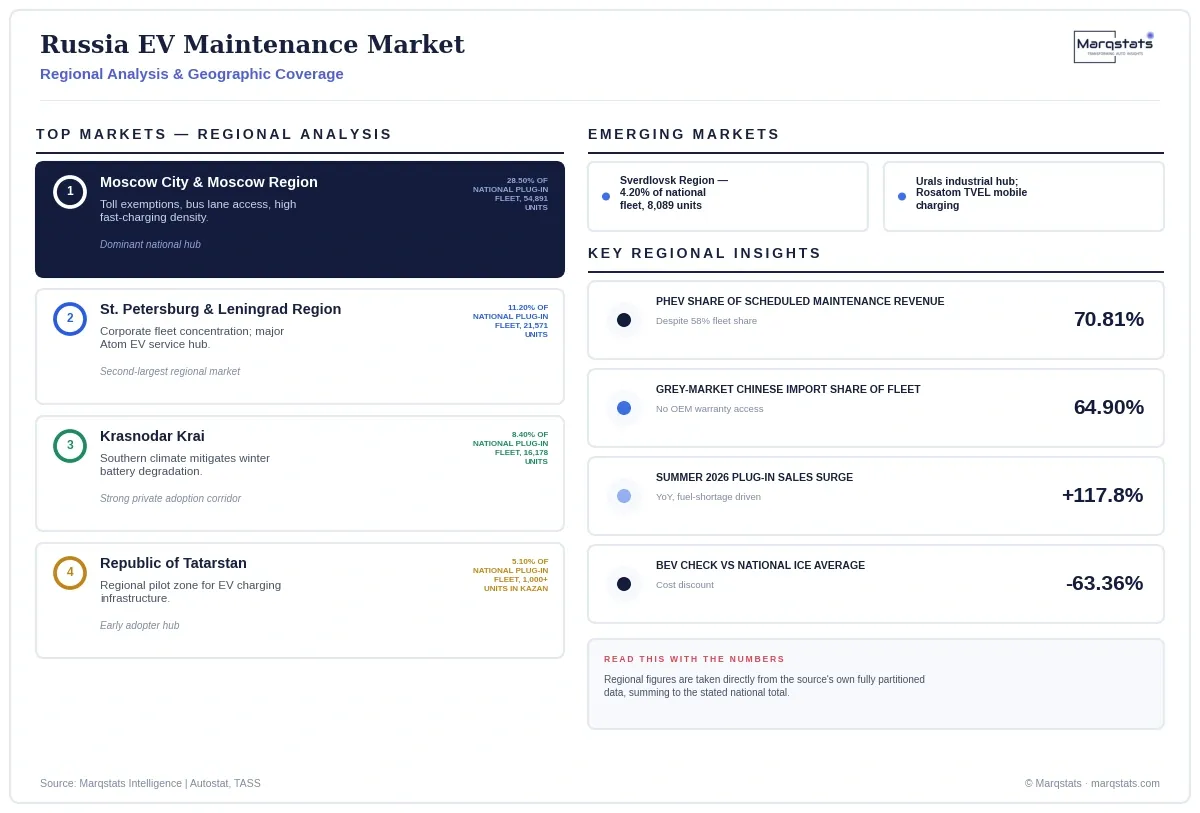
The underlying research's own reconciled revenue data tells a different story. PHEVs and range extenders, despite trailing pure BEVs in unit count by a meaningful margin, generate 70.81% of scheduled fleet maintenance revenue -- because servicing a dual powertrain genuinely costs more. A PHEV technician has to inspect both a complete combustion drivetrain and a full high-voltage electric system on the same visit, and Russian service tickets reflect that directly: PHEV checks run 72.39% higher than BEV checks. For a workshop deciding where to invest technician training capacity, this is a genuinely counterintuitive but directly evidenced signal: the dual-powertrain segment, not the pure-electric one, is where the maintenance revenue concentration actually sits.
A Market Where One Policy Shock Reshaped Demand Overnight
Most EV maintenance markets in this coverage set grow along a relatively smooth trajectory shaped by purchase incentives, charging infrastructure buildout, and gradual consumer adoption curves. Russia's own data shows something genuinely different: a 117.8% year-over-year sales surge triggered not by any EV-specific policy at all, but by domestic gasoline shortages following refinery outages.
That's a structurally different growth driver than anything else in this batch -- fuel supply disruption, not EV policy, moving the needle on plug-in adoption. It also means Russia's own High Demand Acceleration Scenario is explicitly built around a trigger condition ("prolonged domestic liquid fuel supply disruptions") that has nothing to do with the usual right-to-repair, subsidy, or certification triggers driving other markets' own upside scenarios. Anyone modeling this market's forward trajectory needs to track Russian fuel supply stability as a leading indicator, not just EV-specific policy news.
Market Dynamics
Key Drivers
- Rosatom's continued investment in domestic battery cell manufacturing and mobile charging infrastructure signals sustained state-backed commitment to the EV supply chain independent of near-term consumer adoption volatility, providing a genuine long-horizon foundation for this market's own forward growth trajectory.
- Empirical benchmark data from Fit Service and Auto.ru Business confirms BEV routine maintenance checks remain structurally cheaper than the national ICE average even as they rise year over year, a durable consumer-facing economic argument supporting continued adoption momentum independent of the broader grey-import and localization dynamics shaping the fleet's composition.
- Russia's own reconciled sizing data shows plug-in hybrids and range extenders already generating the majority of scheduled maintenance revenue despite trailing pure BEVs in regulatory attention, a structural signal that dual-powertrain diagnostic capability, not pure-electric specialization alone, represents the most immediate revenue opportunity for workshops entering this market.
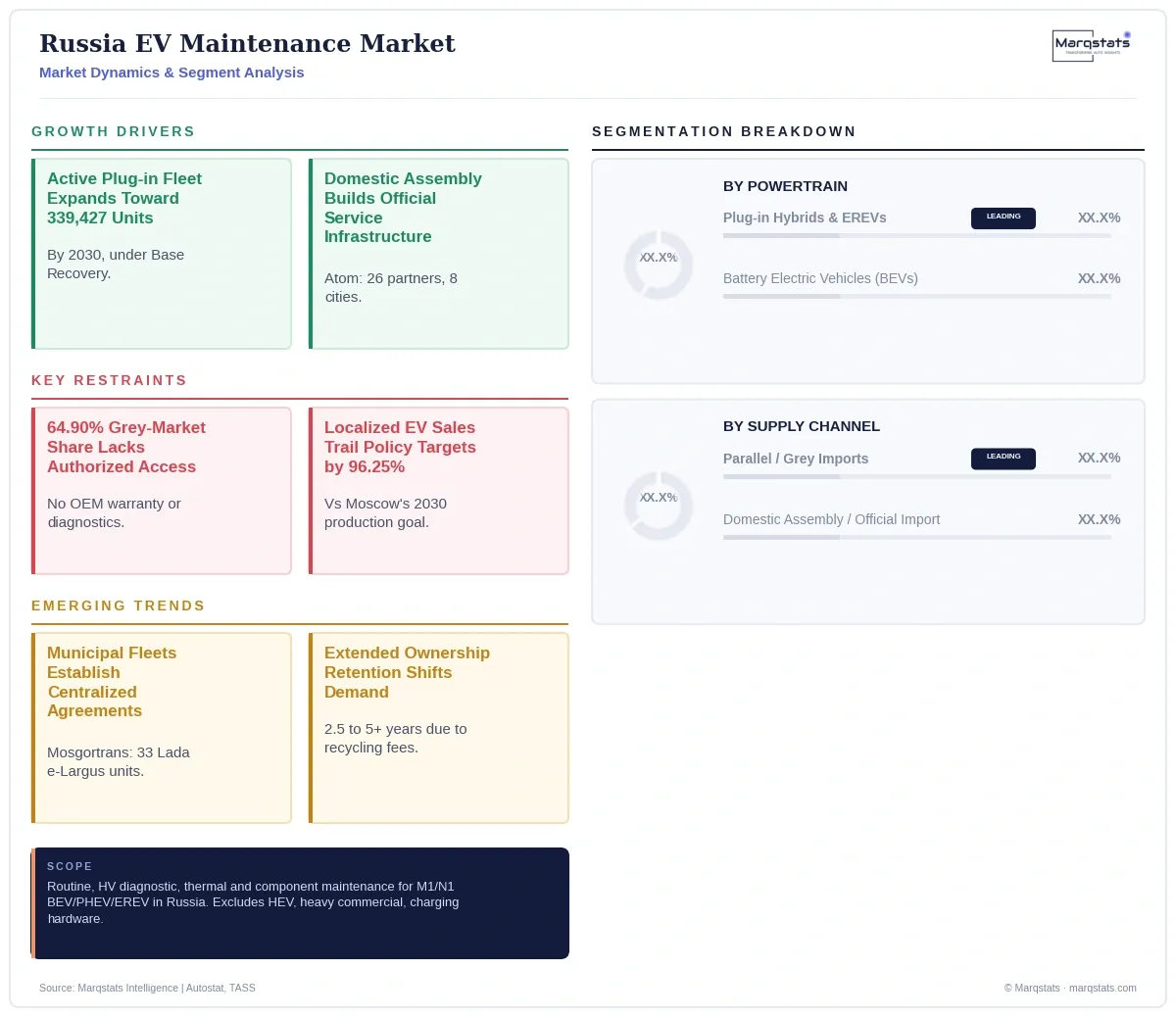
- Russia's active plug-in fleet is expanding rapidly, from 192,600 units in January 2026 toward a projected 339,427 vehicles by 2030 under the Base Recovery Scenario, directly growing the addressable base for recurring EV aftermarket maintenance demand.
- Domestic EV assembly localization through Evolute, Atom and Moskvitch, combined with Atom's September 2026 serial production launch and its accompanying 26-partner, 8-city service network, is building genuinely new official warranty service infrastructure outside the grey-market import ecosystem.
- Government Decree No. 1713's power-based recycling fee structure is redirecting dealer and consumer attention toward post-sale service retention for the vehicles that remain economically viable to import, rather than continuous new-vehicle grey-market churn.
- Rosatom's TVEL division announced a mobile charging gigafactory launch in Moscow Region in July 2026, localizing production of mobile powerbank chargers for EV roadside service and supporting the broader domestic supply chain this market depends on.
- Evolute's announced opening of 39 new dealership centers in 2026, expanding official warranty service coverage across 19 Russian regions, is directly growing the domestic official-channel service footprint available to the localized EV segment.
Key Restraints
- Actual localized EV sales run dramatically below Moscow's own stated 10%-of-production policy target for 2030, a documented 96.25% gap against the implied annual trajectory that signals genuine execution risk in the domestic assembly ramp-up this market's own Base Recovery Scenario depends on.
- This market's own two-scenario framework spans a genuinely wide 2030 range, from USD 118.00 million under the Base Recovery Scenario to USD 165.00 million under the High Demand Acceleration Scenario -- a disclosed spread reflecting real uncertainty in domestic fuel supply stability, a trigger condition unique to this market among the countries covered in this batch.
- Over 64% of Russia's active plug-in fleet consists of parallel-imported Chinese models operating without official OEM warranty coverage, cloud diagnostic access, or authorized spare parts channels, forcing independent service providers to rely on reverse-engineered diagnostic scanners and unauthorized software patches.
- Actual 2025 localized EV sales from Evolute, Moskvitch, Amberavto and Lada totaled just 4,686 units against the roughly 125,000 annual local EV sales Moscow's own 10%-by-2030 production target would imply, a documented 96.25% gap against the policy trajectory.
- Government Decree No. 1713's commercial recycling fees, reaching up to RUB 3,648,000 per vehicle for imports exceeding 80 hp, have effectively halted private grey-market importing of high-power Chinese EVs, constraining near-term fleet growth from the segment that currently dominates the active parc.
- Public charging infrastructure remains concentrated, with 46% of the roughly 8,000 national stations clustered in just five federal subjects, leaving the remaining 78 federal subjects to rely on sparse infrastructure and independent auto repair shops for the 42.60% of the fleet operating outside primary metropolitan regions.
Key Trends
- Regional service capacity is beginning to diverge sharply between primary metropolitan regions and the rest of the country, raising genuine open questions about whether specialized EV repair capability will expand into secondary markets or whether mobile repair units will instead become the default service model for Russia's 78 less-concentrated federal subjects.
- Fleet operators managing commercial electric delivery and taxi vehicles are increasingly negotiating dedicated maintenance contracts directly with domestic OEM service networks rather than independent grey-market specialists, given the documented warranty and parts availability advantages officially imported and domestically assembled platforms carry over parallel-imported Chinese models.
- Independent service networks including Fit Service are documenting rising EV-specific service check growth, driven by increasing diagnostic tool import costs and technician wage inflation, even as BEV checks remain structurally cheaper than the national ICE average.
- Municipal fleet operators including Mosgortrans are establishing centralized service level agreements for commercial electric light vans, bypassing general independent repair shop networks entirely and creating a distinct municipal fleet maintenance market segment.
- Extended ownership retention for imported EVs, projected to shift from 2.5 years to over 5 years as recycling fees raise replacement costs, is shifting aftermarket demand from basic inspection toward complex battery cell rebalancing and module replacement.
- Domestic battery supply chain investment, exemplified by Rosatom's Baltiysk lithium-ion cell and pack manufacturing facility in Kaliningrad, is building localized component infrastructure to support the growing domestically-assembled EV segment.
Strategic Implications
- Independent workshop operators should prioritize reverse-engineered diagnostic capability and technician training specifically for PHEV/EREV dual-powertrain servicing, given the underlying research's own finding that this segment, not pure BEVs, generates the majority of scheduled maintenance revenue despite its smaller unit share.
- Domestic OEMs and their service networks should accelerate official warranty service infrastructure buildout following Atom's 26-partner, 8-city model, given how directly Decree No. 1713's import restrictions are shifting the addressable fleet toward domestically assembled and officially imported vehicles over time.
- Parts distributors and diagnostic equipment suppliers should prioritize localized production of high-voltage diagnostic tooling and battery module components, given how directly the grey-market Chinese import ecosystem's lack of authorized parts channels is constraining independent workshop capability regardless of technician certification levels.
- Investors and analysts should track domestic gasoline supply stability and Decree No. 1713 enforcement consistency across every major federal subject as the two clearest variables separating this market's Base Recovery and High Demand Acceleration scenarios, given how directly both feed the underlying research's own named trigger conditions.
Outlook
The underlying research confirms the Russian EV service market supports two distinct forward scenarios grounded in verifiable policy and infrastructure triggers, having explicitly evaluated and omitted a third scenario for lacking independent regulatory triggers. This market's own forecast horizon reaches 2030 directly, requiring no Marqstats extrapolation.
Under the Base Recovery Scenario, domestic EV assembly through Evolute, Atom and Moskvitch stabilizes at approximately 25,000 units per year combined, Decree No. 1713 recycling taxes are strictly enforced to cap grey imports, and the public fast-charging network expands steadily at roughly 1,500 DC stations per year; the active plug-in fleet reaches 339,427 vehicles by 2030, generating USD 118.00 million (RUB 10,620.00 million) in total market value at a 11.84% CAGR.
Under the High Demand / Fuel Shortage Acceleration Scenario, prolonged domestic liquid fuel supply disruptions repeat Summer 2026 demand trends, state EV purchase subsidies expand past RUB 925,000 per unit, and Atom and Lada e-Largus adoption accelerates across taxi and delivery fleets; the active plug-in fleet reaches 479,250 vehicles by 2030, lifting total market value to USD 165.00 million (RUB 14,850.00 million).
Market Segmentation
USD 28.01 million (41.54% share) in 2025. Anchored by Zeekr 001 and the domestic Evolute i-PRO, the segment federal subsidies exclusively target.
USD 39.43 million (58.46% share) in 2025. Anchored by Li Auto and Voyah Free, generating the majority of scheduled maintenance revenue despite a smaller unit share.
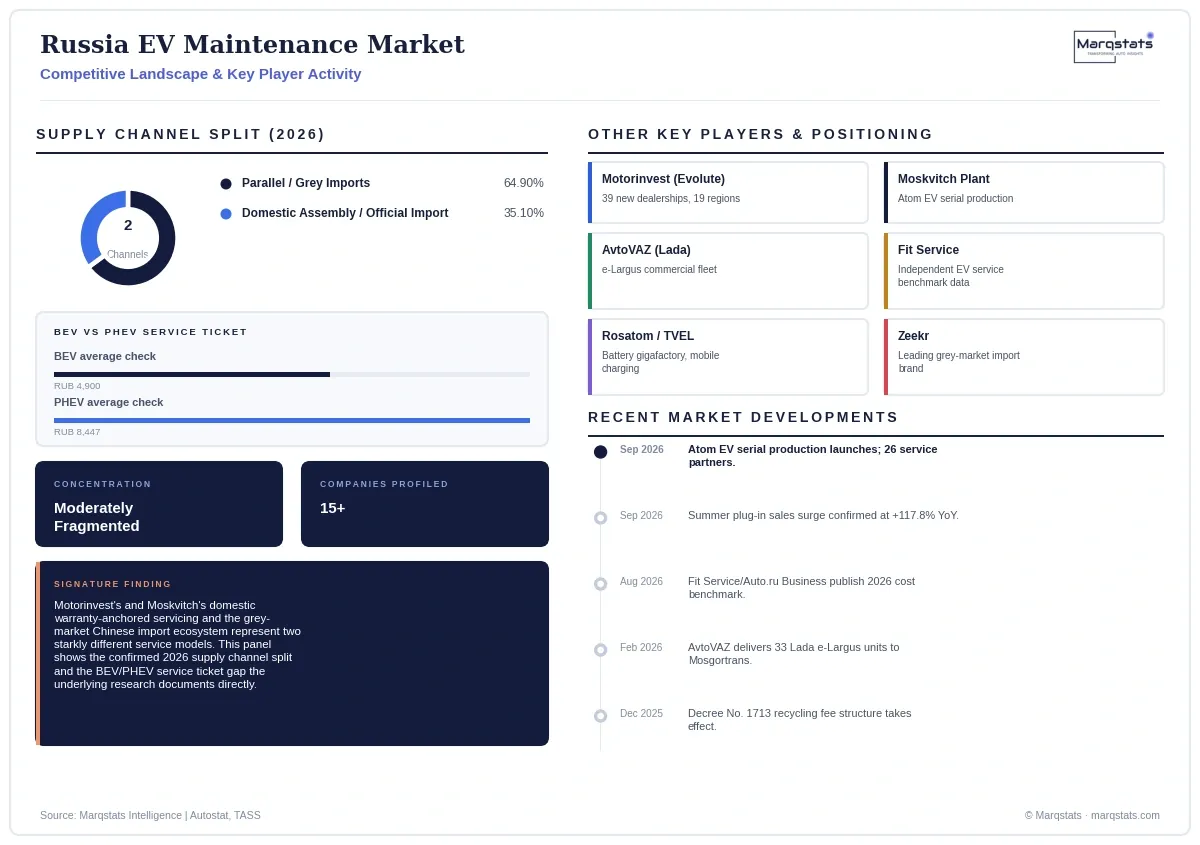
USD 43.77 million (64.90% share) in 2025. Dominated by Zeekr Intelligent Technology, operating without official OEM warranty or diagnostic access.
USD 23.67 million (35.10% share) in 2025. Anchored by Motorinvest (Evolute) and Moskvitch, supported by factory warranties and state subsidies.
USD 65.08 million (96.50% share) in 2025. Anchored by Zeekr, Moskvitch and Amberavto passenger platforms.
USD 2.36 million (3.50% share) in 2025. Anchored by the Lada e-Largus commercial van, including Mosgortrans municipal fleet deployment.
By Geography
Moscow City & Moscow Region
28.50% of the national plug-in fleet (54,891 units), the dominant hub, supported by municipal toll exemptions, bus lane access, and fast-charging density.
St. Petersburg & Leningrad Region
11.20% of the national plug-in fleet (21,571 units), anchored by corporate fleet concentration and parallel-imported premium Chinese models, and the major service hub for Atom EV.
Krasnodar Krai
8.40% of the national plug-in fleet (16,178 units), where southern climate mitigates winter battery degradation, supporting strong private EV adoption along Black Sea transit corridors.
Republic of Tatarstan
5.10% of the national plug-in fleet (over 1,000 units in Kazan), a regional pilot zone for EV charging infrastructure and early adopter hub for Zeekr and Moskvitch 3e models.
Sverdlovsk Region
4.20% of the national plug-in fleet (8,089 units), the Urals industrial hub and primary market for Rosatom TVEL mobile charging and energy storage initiatives.
Rest of Russian Federation (78 subjects)
42.60% of the national plug-in fleet (82,021 units), a fragmented market with sparse charging infrastructure, relying heavily on independent auto repair shops.
How Competition Is Evolving
No single company in this market spans grey-market Chinese import servicing, domestic OEM-warranty dealership operations, and municipal fleet maintenance simultaneously, leaving genuine competitive white space for any group capable of bridging Motorinvest's and Moskvitch's warranty-anchored domestic servicing with the independent and reverse-engineered diagnostic channels this market's own 64.90% grey-import share shows structurally underserved.
Competition spans domestic OEM warranty service networks, grey-market import servicing, and municipal fleet clearinghouses. Motorinvest (Evolute), Moskvitch Plant, Avtotor (Amberavto) and AvtoVAZ (Lada e-Largus) anchor the dominant domestic assembly channel, each backed by factory warranty coverage and, in AO Kama's case for Atom EV, a dedicated 26-partner, 8-city third-party service network launched alongside September 2026 serial production. On the independent side, Fit Service anchors the largest independent service network publishing EV-specific benchmark cost data in partnership with Auto.ru Business. Grey-market Chinese brands Zeekr, Avatr, Changan and BYD dominate the parallel-import fleet without formal Russian service infrastructure.
On energy and component supply, Rosatom and its TVEL division anchor domestic battery cell gigafactory investment in Kaliningrad and mobile charging infrastructure, while Itelma's SAE subsidiary supplies battery packs for the Lada e-Largus. Regulatory oversight rests with Rosstandart (GOST technical standards), Minpromtorg (localization subsidy policy), and the Government of Russia (recycling fee decrees). Analytical agency Autostat and state news agency TASS anchor statutory fleet registration data, with the Association of European Businesses (AEB) tracking official vehicle sales separately.
Companies Covered
The report profiles 15+ companies with full strategy and financials analysis, including:
Recent Market Activity
Table of Contents
Coverage & Segmentation
This report measures routine technical maintenance, high-voltage diagnostic and repair operations, thermal management servicing, and post-warranty component replacements for category M1 passenger cars and category N1 light commercial vehicles powered by BEV and PHEV/EREV powertrains in Russia, across a 2025 base year and a 2026 to 2030 forecast period, denominated in United States dollars at the pack's own stated base exchange rate of 90.0 RUB per USD. It excludes non-plug-in hybrids (HEVs), heavy commercial vehicles, public charging hardware installation, and general body shop repairs unrelated to high-voltage electronics.
The analysis spans three segmentation dimensions — powertrain, supply channel and vehicle class — six regional geographies, and 15 profiled entities across OEMs, independent service networks, energy suppliers and regulatory bodies. Fleet and registration figures trace to Autostat and TASS; market value and all three segmentation dimensions trace directly to the underlying research's own reconciled sizing model.