
Why Is the Public Investment Fund on Both Sides of Saudi Arabia's Connected Car Market?
In brief: the Public Investment Fund (PIF) is not just an investor in Saudi Arabia's connected car market — it sits on the platform side and the vehicle-manufacturing side simultaneously, a dual position with few direct parallels among Gulf sovereign funds. Through iot squared, PIF's joint venture with stc Group, it co-owns the commercial telematics platform layer that fleets are legally required to connect to. Through Ceer, Lucid and Hyundai Motor Manufacturing Middle East, it is also a controlling or part shareholder in three of the manufacturers building the vehicles those platforms will eventually serve.
The Platform Side: iot squared
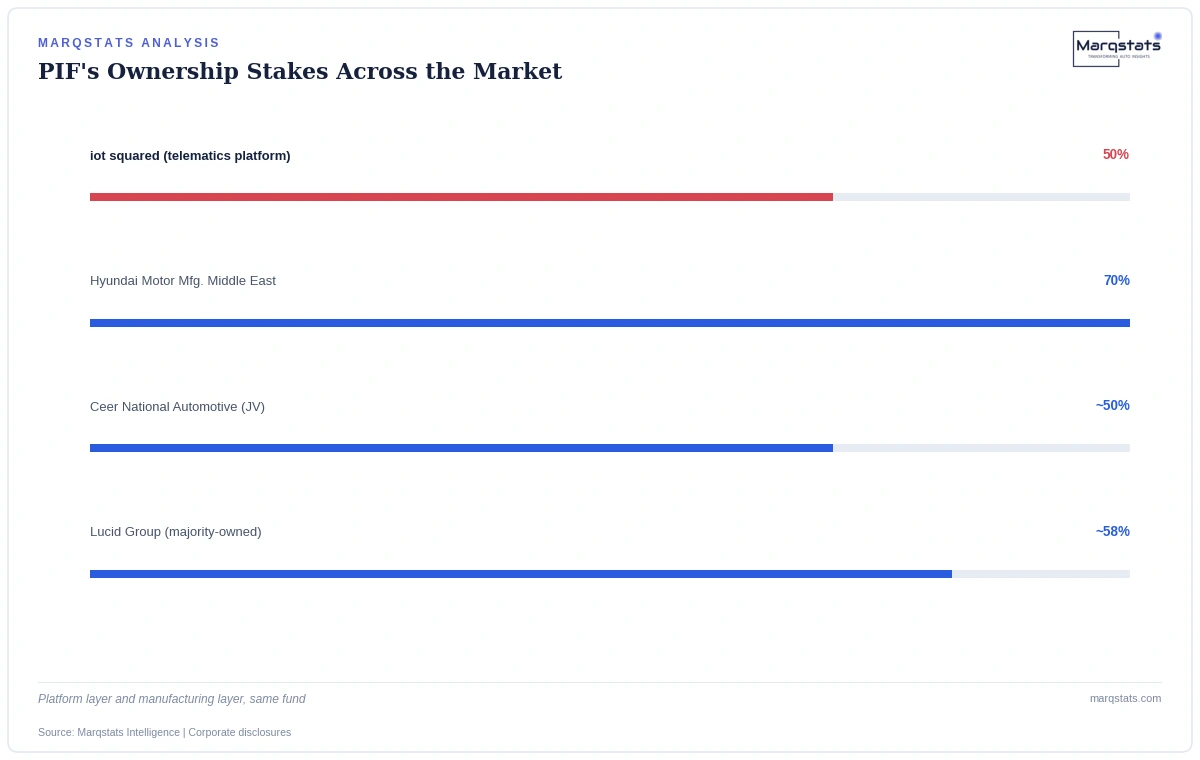
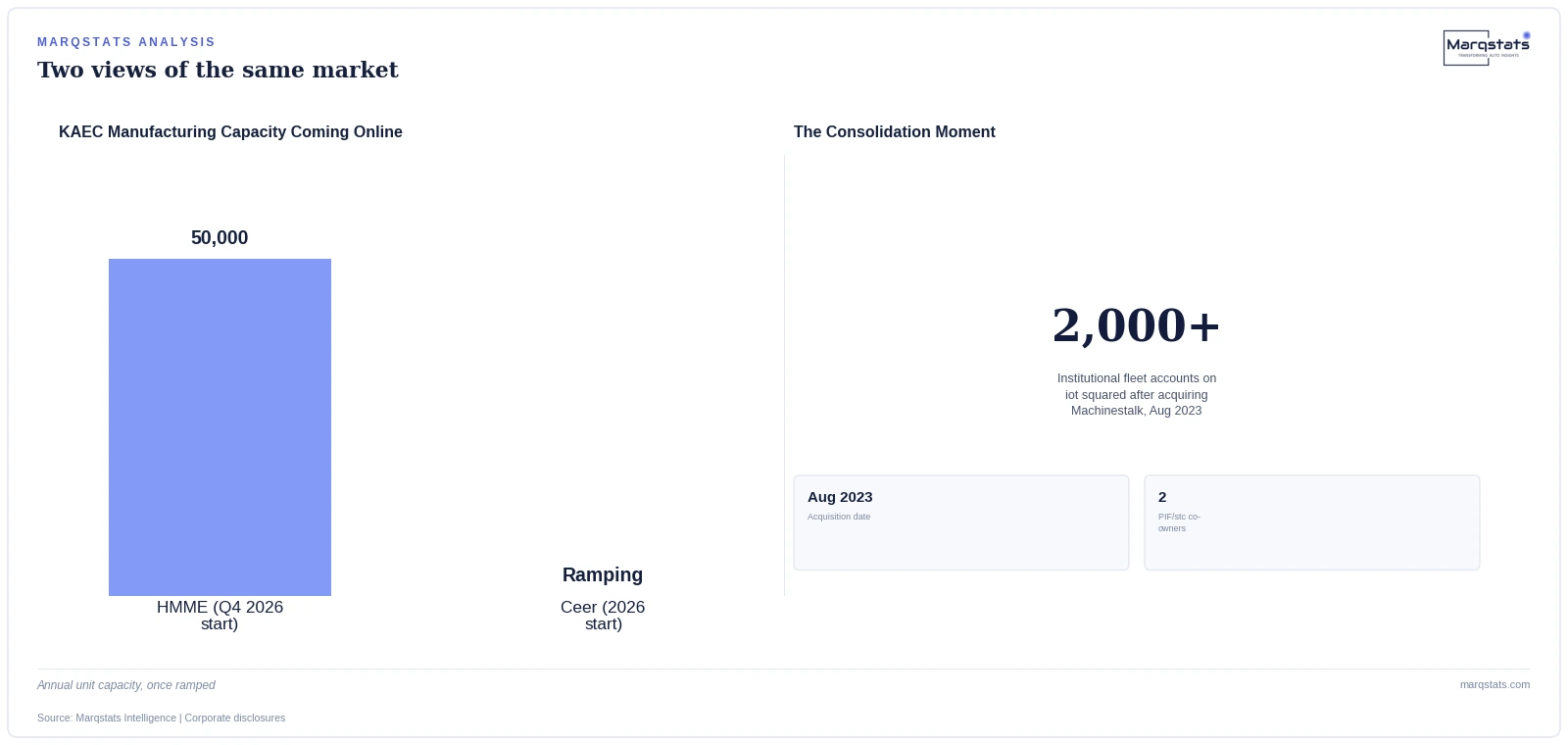
iot squared is a 50-50 joint venture between the Public Investment Fund and stc Group, and its August 2023 acquisition of Machinestalk — one of the Kingdom's largest domestic telematics providers — consolidated enterprise fleet management under a single, PIF-linked entity serving more than 2,000 public and private-sector accounts. It does not operate Elm's Wasl platform itself, but it is the largest independent software layer sitting on top of the mandatory compliance infrastructure the Transport General Authority requires.
The Manufacturing Side: Ceer, Lucid and HMME
Inside King Abdullah Economic City's King Salman Automotive Cluster, three separate manufacturing ventures carry PIF capital. Ceer National Automotive Company is a joint venture between PIF and Hon Hai Precision Industry (Foxconn), building a 530,000 square-metre complex designed to equip 100% of its production with integrated 5G telematics from the first vehicle off the line. Lucid Group, publicly listed but roughly 58% owned by PIF as of its most recent disclosed stake, operates its AMP-2 assembly plant producing the Lucid Air luxury electric sedan. Hyundai Motor Manufacturing Middle East is 70% owned by PIF and 30% by Hyundai Motor Company, with a USD 500 million facility targeting commercial production in the fourth quarter of 2026 at 50,000 units of annual capacity.
One sovereign fund now influences both what a connected Saudi vehicle looks like and which platform it reports to once it is on the road.
— Marqstats Analyst Team
Why the Dual Position Matters More Than Either Position Alone
A platform operator with no manufacturing stake has to win each OEM's integration business separately. A manufacturer with no platform stake has to choose among competing telematics vendors on commercial terms. PIF's position removes both frictions inside its own portfolio: Ceer's vehicles, once in commercial production, have no structural reason not to integrate with an iot squared-adjacent platform, and iot squared has no structural reason to prioritise a competing manufacturer's integration request over PIF's own vehicle lines.
What This Does to Foreign Entrants
A foreign telematics vendor or a non-PIF-linked automaker entering Saudi Arabia is not just competing on technical merit — it is competing for integration priority against a domestic structure where the platform operator and a meaningful share of future vehicle supply answer, directly or indirectly, to the same capital allocator. That does not close the market to outside entrants; Toyota, through Abdul Latif Jameel, still leads new-vehicle sales at an estimated 29.0% share, and General Motors launched OnStar in direct partnership with the CST, stc Group and the Ministry of Interior without any PIF ownership stake at all. It does mean, concretely, that a foreign platform vendor should expect PIF-linked manufacturers to be the harder accounts to win, not the easier ones.
Three Reasons This Structure Persists
Capital concentration. Domestic automotive manufacturing at this scale — three simultaneous assembly plants inside one economic city — requires patient, large-ticket capital that only a sovereign fund can readily supply in the Kingdom's current investment landscape.
Policy alignment. PIF's mandate under Saudi Vision 2030 explicitly includes building domestic industrial capacity, and connected-vehicle manufacturing sits squarely inside that mandate in a way a pure financial investor's would not.
Platform economics favour scale. iot squared's Machinestalk acquisition consolidated enough accounts that a new independent commercial entrant would need a large captive customer base to compete on unit economics — exactly what PIF's manufacturing stakes could eventually supply.
In May 2025, Hyundai Motor Company and PIF held HMME's formal groundbreaking ceremony, confirming the plant's 50,000-unit annual capacity and a commercial rollout target of the fourth quarter of 2026. That timeline sits inside a broader PIF pattern: each of the three KAEC manufacturing ventures was announced, financed and broken ground within a tight sequence rather than staggered opportunistically, which is itself evidence that the cluster was planned as one coordinated programme rather than three unrelated bets that happened to land in the same economic city.
How This Compares to Other Sovereign Automotive Bets
Saudi Arabia is not the first sovereign fund to combine manufacturing and platform ownership in one automotive push, but the Kingdom's version is unusually compressed in time. Abu Dhabi's Mubadala built its automotive and mobility exposure over more than a decade, layering stakes across multiple cycles. PIF's Ceer, Lucid and HMME commitments, by contrast, were all initiated within a roughly three-year window between 2022 and 2025, alongside the iot squared-Machinestalk consolidation in the same period — a deliberate, near-simultaneous build-out rather than an opportunistic accumulation of stakes over time.
That compression is itself a signal. A sovereign fund assembling a platform-and-manufacturing position this quickly is not hedging across unrelated bets; it is constructing a single, coordinated industrial policy instrument, with Saudi Vision 2030's localisation targets as the explicit rationale named in PIF's own public communications around each transaction.
What the Data Localization Rule Adds to the Picture
The Communications, Space and Technology Commission's July 2024 IoT Regulatory Framework, which requires all vehicle-telemetry servers and all cloud infrastructure to sit physically inside the Kingdom, reinforces PIF's dual position in a way that predates the regulation but is strengthened by it. A foreign telematics platform cannot simply serve Saudi fleets from an existing regional cloud footprint; it must stand up in-Kingdom infrastructure specifically, which raises the fixed cost of competing with an already-domestic, already-compliant platform like iot squared by a meaningful margin. The regulation does not name PIF or iot squared, but its practical effect widens the moat around whichever domestic platform is best positioned to absorb the compliance cost — which today is the PIF-linked one.
Foreign vendors do have a documented path around this, but it is not a cheap one. General Motors, BMW and Toyota have each already established localized cloud partitions or infrastructure partnerships with domestic telecom operators to satisfy the same CST framework without routing through a PIF-linked entity at all — proof that the moat is real but not absolute, and that a sufficiently large global OEM can fund its way around it rather than through it.
A Named Comparison Worth Watching
Elm Company itself is worth watching as a separate signal from iot squared. Elm, the Tadawul-listed digital enterprise that operates the mandatory Wasl platform and the Tamm vehicle-registration portal, is not PIF-owned in the same direct way iot squared is — it sits under a different sovereign holding structure entirely. That means the market's actual choke point, the Wasl gateway every compliant commercial vehicle must transmit to, is not the same entity as the PIF-linked platform layer this piece has focused on. iot squared serves fleets that connect through Wasl; it does not control the gateway those fleets are legally required to use. The distinction matters for anyone assuming a single sovereign entity controls the entire commercial compliance stack — it does not, though the two entities' interests are closely aligned in practice. That distinction is worth naming precisely, because it is the difference between a fully state-controlled compliance chokepoint and a state-influenced ecosystem where independent commercial incentives still operate alongside sovereign ones.
Outlook: One Trigger, Not Three
This market does not support a three-scenario outlook. The single evidenced trigger is HMME's commercial production start, targeted for the fourth quarter of 2026: once Ceer and HMME are both shipping vehicles at volume, whether those vehicles integrate preferentially with iot squared-adjacent platforms will become directly observable rather than structurally inferred. Before that point, the dual-ownership thesis remains a structural argument, not yet a measured outcome.