
GM OnStar vs Free Smartphone Mirroring: Is Saudi Arabia's Priciest Connected Service Worth It?
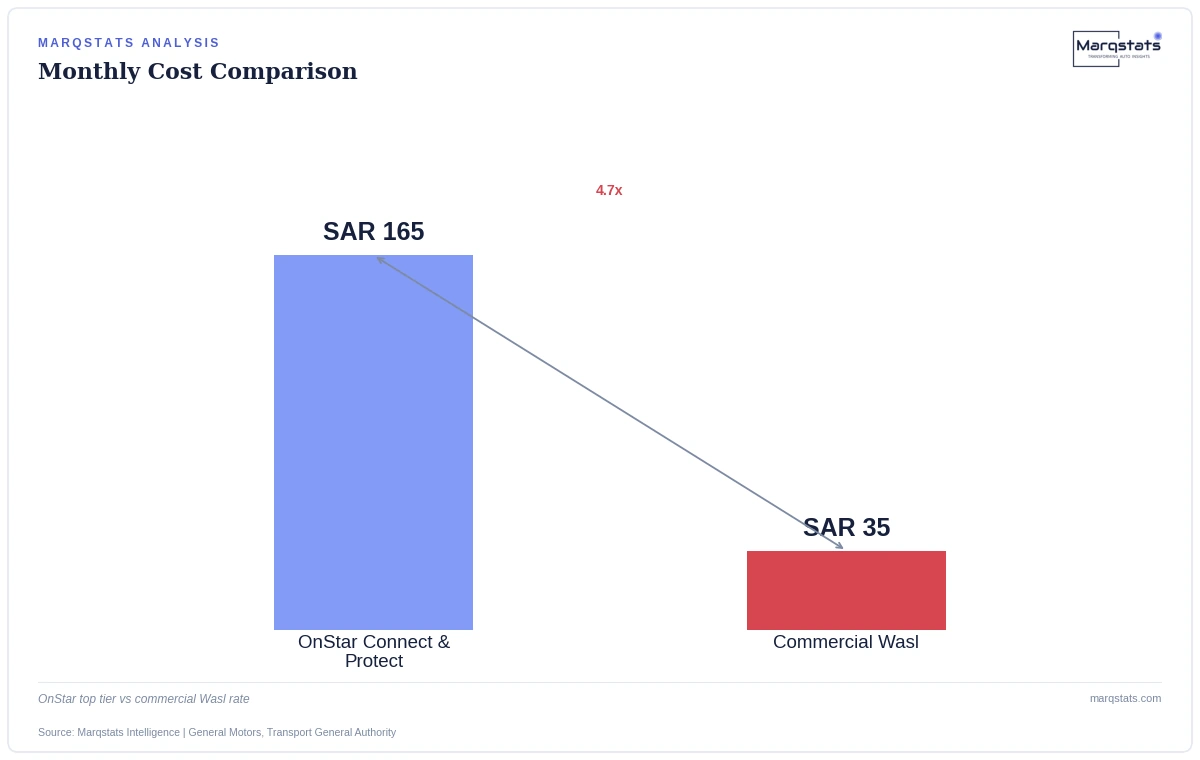
GM's OnStar Connect or Protect plan costs SAR 109 to SAR 165 a month — three to five times the roughly SAR 35 a month Saudi commercial fleets pay for mandatory Wasl compliance — and buys 24/7 bilingual advisor access, remote commands, stolen-vehicle recovery and automatic crash notification direct to Saudi Arabia's 911 system. Apple CarPlay and Android Auto buy navigation and music at zero marginal cost. Whether the premium is worth it depends entirely on which of those features a specific buyer would actually use.
What OnStar Actually Includes
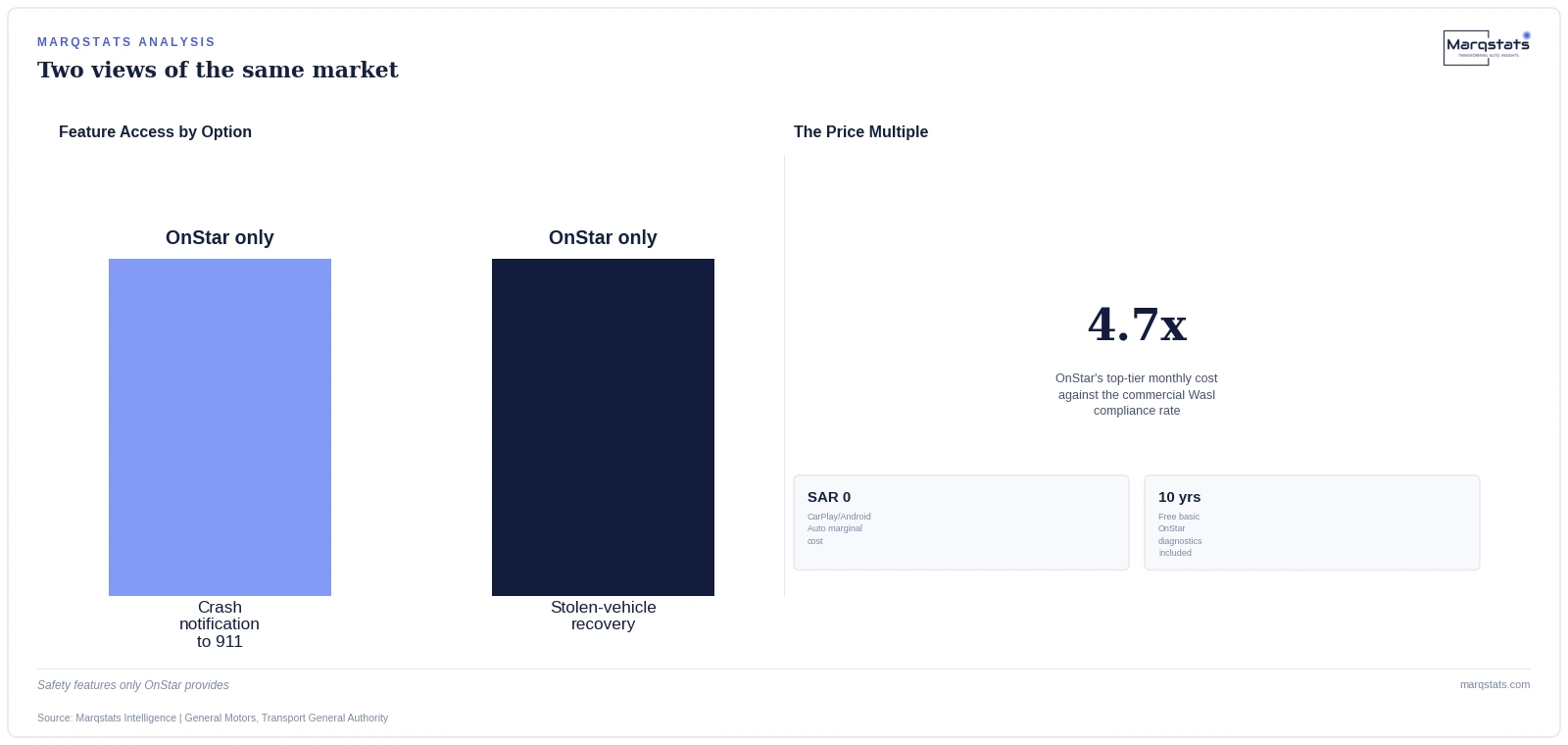
General Motors launched OnStar Connected Services across its Chevrolet, GMC and Cadillac nameplates in January 2024, in partnership with the Communications, Space and Technology Commission, stc Group and the Ministry of Interior. Standard connectivity — basic diagnostic alerts and dealer maintenance notifications — comes free for ten years on model-year 2021 and newer vehicles. The paid tier is where the safety features live: automatic crash notification routed directly to the 911 Unified Operations Centers, stolen-vehicle recovery, and remote app commands including engine start and door lock from a smartphone.
What Smartphone Mirroring Does Not Include
Apple CarPlay and Android Auto project a phone's navigation, music and calling functions onto a car's screen, using the phone's own cellular data rather than any vehicle-integrated connection. That means no automatic crash notification — a mirrored phone does not know a crash happened unless the driver is conscious enough to call for help themselves — and no factory-level stolen-vehicle recovery, because the system has no independent link to the vehicle once the phone is removed or its battery dies.
The Actual Trade-Off
The honest framing is not price versus price — it is safety-feature access versus convenience-feature access. A buyer who mainly wants turn-by-turn navigation and hands-free calling gets both free through smartphone mirroring and gains little from a SAR 165 monthly subscription. A buyer who specifically values automatic crash notification to 911, remote engine start in a country where summer surface temperatures exceed 70°C, or stolen-vehicle recovery is paying for capabilities a mirrored phone genuinely cannot replicate, at any price.
That is also why Saudi Arabia's own market data shows most consumers declining the paid tier once any complimentary trial period ends: for the median driver, the safety features are a real but infrequently-used benefit, while the convenience features — the ones used daily — are already free.
Who the Premium Actually Makes Sense For
Three buyer profiles come out ahead on the paid tier specifically. A family with a teenage driver gains real value from OnStar's remote location and speed-alert features, which a mirrored phone cannot provide once the phone itself is out of the parent's control. A driver who regularly covers long, sparsely populated highway stretches — common on intercity routes between Riyadh and the Eastern Province — gains genuine safety margin from automatic crash notification in an area where a bystander calling for help is less likely. And an owner concerned specifically about theft, in a market where recovery otherwise depends entirely on the vehicle being found through conventional means, gets a capability with no free substitute at all.
Outside those three profiles, the subscription is difficult to justify on the numbers. A driver who mainly commutes inside a single city, does not carry a young or inexperienced second driver, and is not specifically theft-anxious is paying SAR 1,980 a year for a risk they are statistically unlikely to need covered — which is exactly the calculation the pack's own renewal data suggests most Saudi OnStar trial users are making when they let the subscription lapse.