
Why No One Can Publish Saudi Arabia's 2025 Car Fleet Number Yet
Every Saudi connected-car figure quoted for 2025 is an estimate, plainly, and there is a specific, checkable reason why: the General Authority for Statistics (GASTAT), the only body that publishes the Kingdom's registered vehicle fleet total, releases its Road Transport Statistics report roughly ten to eleven months after the year it covers. The 2024 report came out on 6 November 2025. A 2025 report will not exist until approximately November 2026 — which means anyone citing a precise 2025 Saudi fleet total this year is citing a number nobody has published.
The Reporting Lag Is Structural, Not a One-Off Delay
This is not a single missed deadline, and it will not resolve itself next cycle. GASTAT's cadence has been consistent: the 2023 fleet figure (14.86 million vehicles) and the 2024 figure (15.88 million, up 6.9%) both followed the same roughly year-long lag between the reference year closing and the statistical release. A market model that needs a current-year fleet total for Saudi Arabia is, by construction, always working with a base year that is already one full reporting cycle behind the reference year it claims to describe.
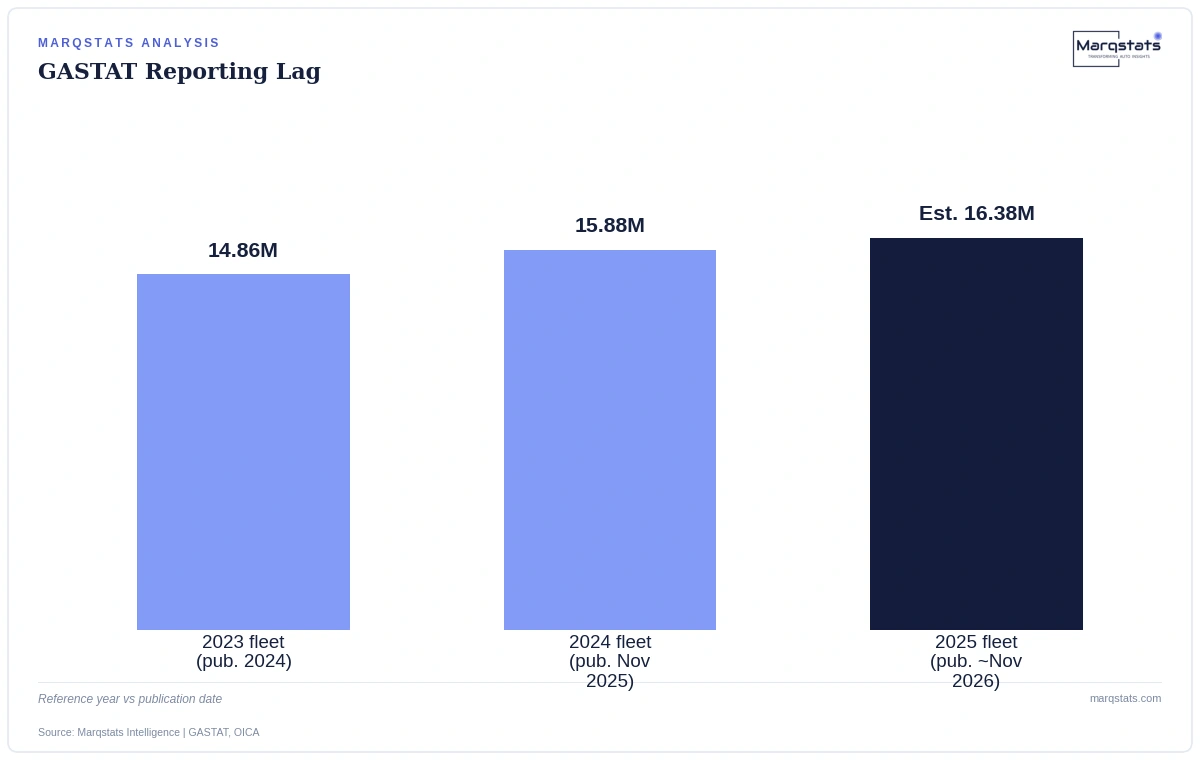
That distinguishes Saudi Arabia from markets where vehicle-registration data updates monthly or quarterly. A connected-car model built on French or Japanese registration data can lean on a fleet total that is weeks old. A model built on Saudi data is, at best, working with a fleet total that is ten months old — and every month closer to the next GASTAT release, the gap between the quoted figure and the true current fleet widens further.
What Actually Updates Faster: New-Vehicle Sales
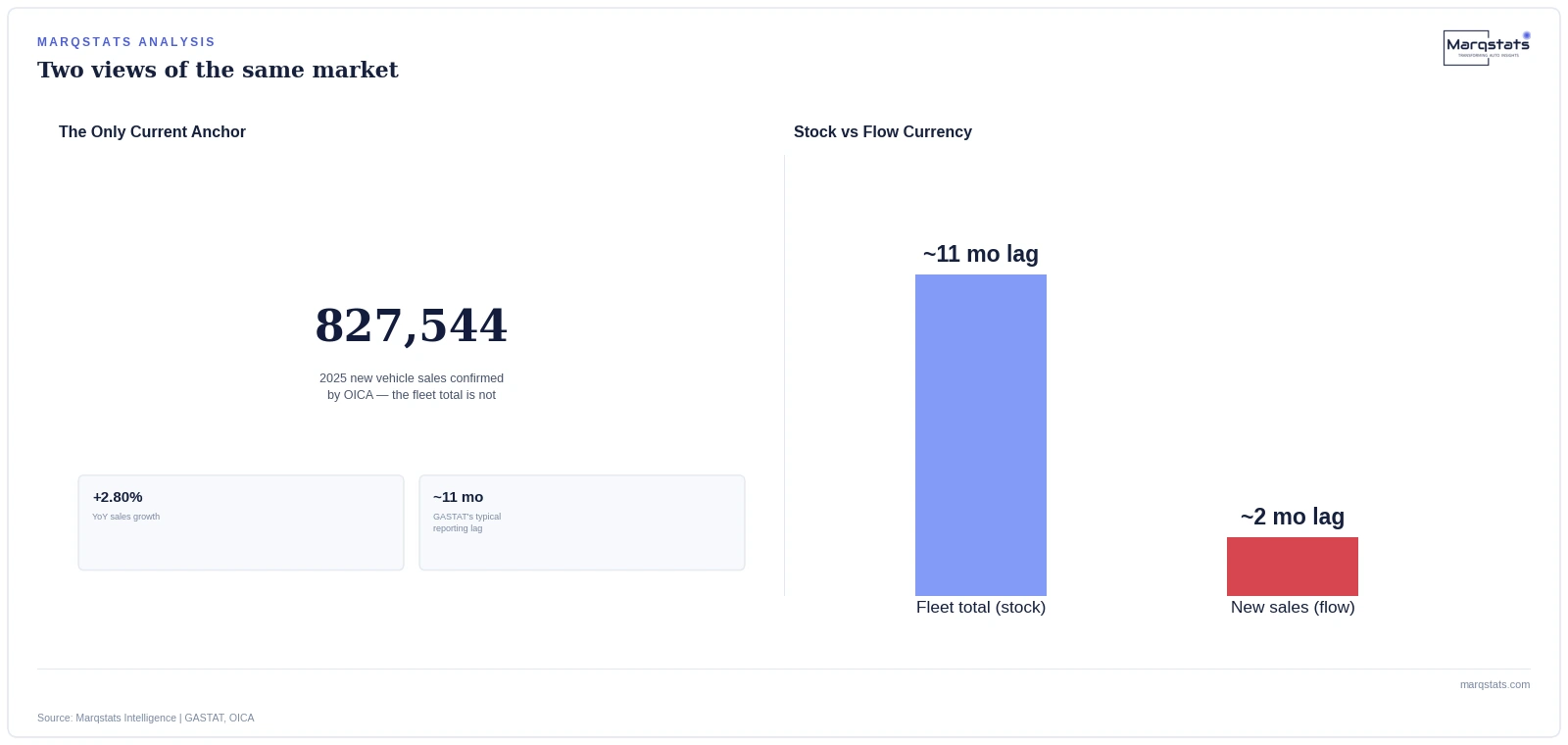
Not every Saudi automotive figure lags the same way. The International Organization of Motor Vehicle Manufacturers (OICA) publishes new-vehicle sales data on a shorter cycle, and a 2025 sales figure was available well before any GASTAT fleet update: 827,544 new vehicles sold in 2025, up 2.80% from 805,034 in 2024, with passenger car sales specifically rising 3.04% to 726,988 units.
That creates an asymmetry a careful model has to manage deliberately: the flow (new sales) is current, while the stock (the total fleet) is not. Multiplying a current sales figure by an outdated fitment rate is defensible. Treating the outdated fleet total as if it were current is not, and the difference matters most for any penetration-rate calculation, because the denominator is exactly the number that lags.
How to Build a Defensible 2025 Estimate Anyway
The honest options are limited to three, and only one of them is defensible. Quoting the 2024 figure as if it were current understates the fleet and overstates any penetration rate calculated against it. Waiting until November 2026 to publish anything makes a report a year stale before it ships. The remaining option — extending the confirmed 2024 baseline along a disclosed, labelled growth assumption — is the only one that gives a current estimate without pretending it is a published fact.
The growth assumption itself matters. A single year's 6.9% jump, the rate GASTAT's own 2023-to-2024 comparison shows, is a noisier basis than a multi-year trend, because one year's figure can reflect improved data capture as much as genuine fleet growth. A more conservative, disclosed extension — in this case built from the source pack's own 2024-to-2026 forecast trajectory rather than the single-year spike — produces a 2025 estimate of roughly 16.38 million vehicles, a figure this analysis labels as an estimate everywhere it appears rather than presenting it as a GASTAT publication.
The Counter-Case: Does the Lag Actually Matter?
A reasonable objection is that a slow-moving stock variable like a national vehicle fleet does not need real-time precision — a fleet of 15 to 16 million vehicles does not swing meaningfully within a single year, so a ten-month-old figure is close enough for most planning purposes. That is true for high-level sizing. It is not true for a penetration-rate calculation specifically, where the denominator's staleness compounds with the numerator's own uncertainty (the active connected count is itself a Marqstats construction), and two layered estimates produce more error than either alone — which is exactly why this analysis labels both, separately, rather than presenting a single confident percentage.
How Other GCC Statistical Offices Handle the Same Lag
Saudi Arabia is not unusual among Gulf Cooperation Council states in running an annual, rather than monthly, vehicle-fleet count. The distinguishing factor is less the existence of a lag than how visibly it is disclosed: GASTAT publishes its release date and reference year plainly on every Road Transport Statistics report, which is precisely what makes the lag traceable and the estimation approach in this piece possible to build and defend. A statistical office that buried its reference date would leave a market analyst no way to distinguish a stale figure from a current one.
The Passenger-Versus-Commercial Split Compounds the Problem
GASTAT's headline fleet figure is a single number — 15.88 million vehicles at end-2024 — but a connected-car model needs the passenger-commercial split specifically, because the two segments behave completely differently. The research pack behind this analysis holds the passenger parc at 13.8 million and the commercial parc at 2.0 million, both anchored to 2024, because GASTAT's published breakdown by vehicle class updates on the same annual cycle as the headline total. A 2025 passenger-commercial split, like the fleet total itself, will not exist as a publication until GASTAT's next release.
That matters most for the commercial side specifically, because commercial vehicle counts also interact with the Transport General Authority's evolving Wasl compliance mandate. A compliance rate calculated against a stale commercial parc denominator will drift further from reality than the same calculation for the passenger segment, where the underlying vehicle count changes more slowly relative to its base.
What This Means for Anyone Building a Saudi Market Model
Treat every current-year Saudi fleet figure as either a GASTAT publication with its actual reference date attached, or a labelled estimate — never as an unlabelled current-year fact. That single habit is the whole discipline. The full fleet reconciliation and the resulting 2025 connected-vehicle penetration estimate are set out in the Marqstats analysis linked below.
Related reportSaudi Arabia Connected Car Market Size, Share & Forecast 2026 – 2030