Market Snapshot
Key Takeaways
Market Overview & Analysis
Report Summary
The Saudi Arabia Chinese vehicle spare parts market comprises replacement and service parts demand associated with Chinese-brand passenger and commercial vehicles operating in the Kingdom, covering both genuine original-equipment parts supplied through franchised channels and independent replacement parts supplied through the open aftermarket. Vehicle sales and workshop labour are excluded from the core revenue estimate. Market value is annual parts demand, calculated as the Chinese-brand vehicle population multiplied by age-weighted annual parts spend per vehicle. On this basis the market stood at USD 290 million in 2025 against a tracked Chinese-brand cohort of 481,453 units.
Chinese-Brand Vehicle Parc and Parts Demand Forecast
The tracked Chinese-brand vehicle cohort rises from 481,453 units in 2025 to approximately 1,176,000 by 2030, a 19.56% compound annual growth rate, and annual parts demand rises alongside it from USD 290 million to USD 698 million. The cohort figure counts Chinese-brand vehicles sold in the Kingdom from 2021 onward and is a hard lower bound on the true parc rather than a census, because pre-2021 cohorts remain in service and are not captured in the tracked dataset.
Spend per vehicle traces a shallow curve rather than a straight line, and the shape carries a commercial signal. It falls through 2028 as a young parc dominated by warranty-period vehicles requires little beyond routine maintenance, then rises again from 2029 as the 2021 to 2023 cohorts pass out of warranty and into the wear-item and collision-repair years where spend per vehicle roughly doubles. A distributor sizing inventory on the current spend rate will be under-stocked by the end of the period, and the mix shifts from filters and fluids toward brakes, suspension, electronics and body panels.
Three boundaries define the market. Vehicle sales are excluded entirely — this measures what happens after the sale, not the sale itself. Workshop labour is excluded from the core revenue estimate, so a service invoice contributes only its parts line, which typically runs at 55 to 65% of the total in franchised networks. Tyres, batteries and lubricants sold independently of a service event are treated as adjacent consumable markets rather than as vehicle parts, because their demand is driven by distance travelled rather than by parc composition.
The tracked cohort is a lower bound and is presented as one. The supplied model-level dataset does not capture every Chinese brand and model consistently, so its 11.9% Chinese share of a same-source total of 876,869 units in 2025 is a tracked-cohort share rather than a national census, and it is not directly comparable with the OICA-aligned national total of 827,544 units. The two datasets count different universes and are never mixed here. Any comparison of Chinese-brand share against the national market carries the basis it uses, and the direction of the bias is understatement.
Market Dynamics
Key Drivers
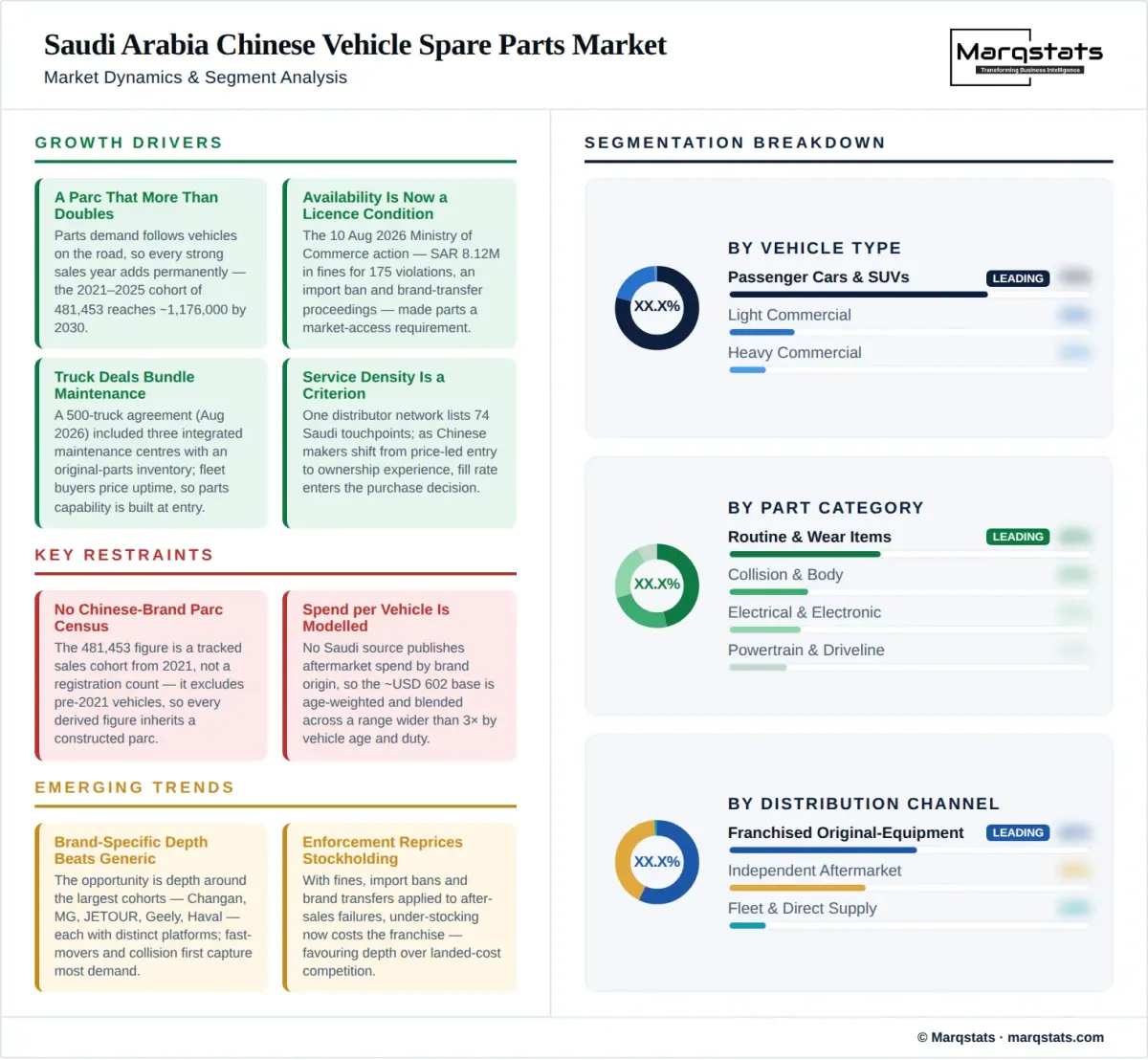
- A parc that more than doubles inside the forecast period. Chinese brands sold 103,981 units in Saudi Arabia in 2025 within the tracked dataset, and the 2021 to 2025 cohort totals 481,453 units. Because parts demand is a function of vehicles on the road rather than vehicles sold, every year of strong Chinese-brand sales adds permanently to the addressable base. The cohort reaching approximately 1,176,000 units by 2030 is the single largest driver in the model.
- Regulatory obligations that make parts availability a licence condition. The Ministry of Commerce action of 10 August 2026 imposed SAR 8.12 million in fines for 175 violations covering spare-parts availability, replacement vehicles during maintenance, maintenance obligations, manufacturing-quality guarantees and after-sales services, alongside a vehicle import ban and proceedings to transfer the brand to another authorised distributor. Aftermarket compliance is now a market-access requirement rather than a service differentiator.
- Commercial vehicle deals bundling maintenance infrastructure into the sale. A strategic agreement signed in August 2026 covering 500 trucks included three integrated maintenance centres in Jeddah, Riyadh and Dammam together with a comprehensive original-spare-parts inventory. A separate commercial vehicle launch in May 2026 arrived with service centres in Riyadh, Jeddah, Dammam and Khobar. Fleet buyers price uptime, so Chinese heavy-truck entrants are building parts capability at the point of entry rather than after it.
- Service network density becoming a brand-selection criterion. One Chinese-brand distributor network in the Kingdom lists 74 touchpoints, comprising 23 service locations, 27 dealers, 21 shop-in-shop sites and three showrooms. As Chinese manufacturers shift from price-led entry toward ownership-experience competition, parts fill rate and service coverage move from back-office metrics into the purchase decision, which in turn justifies deeper local stockholding.
- An ageing cohort moving into higher-spend maintenance years. The 2021 to 2023 Chinese-brand cohorts pass out of warranty during the forecast period and into the wear-item, electronic-component and collision-repair phase where annual spend per vehicle rises materially. This effect works independently of new sales and is what lifts spend per vehicle from 2029 after four years of decline.
Key Restraints
- No published Chinese-brand parc census exists. The 481,453-unit figure is a tracked sales cohort from 2021 onward, not a registration count, and it excludes pre-2021 vehicles still in service as well as brands and models the dataset does not capture consistently. Confidence in this market is medium rather than low because the underlying sales data is solid, but the parc itself is constructed and every derived figure inherits that.
- Parts spend per vehicle is an assumption, not an observation. No Saudi source publishes annual aftermarket spend per vehicle by brand origin, so the USD 602 base figure is age-weighted and modelled rather than measured. It is also a blend across a range wider than a factor of three between a young passenger car under warranty and an out-of-warranty commercial vehicle in high-utilisation service.
- Fragmented independent supply undermining genuine-parts capture. A substantial share of replacement parts for Chinese vehicles reaches the market through independent importers and open-market channels rather than franchised networks, and no published split exists between genuine and independent supply. A distributor building a business case on the full market value will overstate the share it can realistically capture through authorised channels.
- Conformity and traceability requirements on imported parts. Imported spare parts must meet applicable Saudi standards and customs requirements, which imposes product-level conformity and traceability obligations on suppliers. For long-tail and low-value items the compliance cost per line can exceed the margin, which is one reason parts availability failures concentrate in slow-moving categories rather than fast-moving maintenance items.
Key Trends
- Brand-specific stocking displacing generic Chinese-parts strategies. The commercial opportunity is not a generic Chinese parts business but brand-specific depth around the largest installed cohorts — Changan, MG, JETOUR, Geely and Haval account for the bulk of the passenger parc, and each carries distinct platforms and part numbers. A distributor prioritising fast-moving maintenance items, collision and body parts, electronic components and commercial-vehicle uptime parts before long-tail stock-keeping units captures most of the demand at a fraction of the working capital.
- Aftermarket infrastructure arriving with the vehicles rather than after them. Recent Chinese commercial vehicle entries have launched with named service centres and stocked original-parts inventories from day one, reversing the historical pattern in which distribution led and service followed. This compresses the window in which independent parts suppliers can establish position before franchised capability arrives.
- Enforcement shifting the economics of local stockholding. With fines, import bans and brand transfers now applied to after-sales failures, the cost of under-stocking has moved from lost service revenue to lost franchise. That changes the internal calculation on regional warehousing, safety stock levels and fill-rate targets, and it favours distributors able to carry inventory depth over those competing on landed cost alone.
- Commercial vehicles outgrowing passenger cars in parts intensity. Chinese heavy-truck entrants are scaling from a small base with fleet financing, certified service centres and genuine-parts stock built into their market entry. Commercial vehicles generate several times the annual parts spend of a passenger car and are bought by operators who quantify downtime, so this segment grows faster in value than its share of the parc suggests.
Market Segmentation
Routine maintenance and wear items — filters, brake friction, belts, fluids and suspension components — account for the largest share of demand by value across the forecast and almost all of it by transaction count. Demand is predictable from parc age and distance travelled, which makes the category the natural first priority for any distributor building inventory depth. Its share peaks in the middle years as the parc concentrates in the post-warranty maintenance phase.
Collision and body parts cover panels, lighting, glass and structural components supplied after damage rather than wear. Demand correlates with vehicle population and accident frequency rather than with age, so the category scales directly with the parc and is largely insulated from the warranty cycle. Availability failures here are the most visible to customers because a vehicle waits off the road, which makes the category disproportionately important to regulatory compliance.
Electrical and electronic components — control units, sensors, infotainment modules and increasingly high-voltage components on electrified models — are the fastest-growing category by value. Chinese vehicles carry higher electronic content than the market average at equivalent price points, and these parts are typically genuine-only with limited independent supply, which concentrates the demand in franchised channels and raises the value of authorised distribution rights.
Powertrain and driveline parts cover engine, transmission, cooling and exhaust components, and the category behaves differently across the passenger and commercial split. Passenger demand is modest while the parc remains young; commercial demand is immediate and continuous because heavy vehicles enter high-utilisation service from delivery. The category carries the highest value per unit and the longest supply lead times.
Passenger cars and SUVs constitute the large majority of the Chinese-brand parc and the largest share of parts demand throughout. The segment is dominated by the five leading brands that together took the bulk of 2025 Chinese-brand volume, and its parts demand profile is shaped by the warranty cycle — low in the early years, rising sharply as the 2021 to 2023 cohorts age out of coverage during the forecast period.
Light commercial vehicles occupy the middle of the market, combining passenger-car platforms with commercial duty cycles and the higher annual distance that comes with them. Parts consumption per vehicle runs well above passenger cars at similar age, and buyers are more price-sensitive on parts and more tolerant of independent supply, which makes the segment the most contested between franchised and open-market channels.
Heavy commercial vehicles are the smallest share of the Chinese-brand parc and the fastest-growing by parts value. Recent Saudi entries have arrived with certified service centres and stocked original-parts inventories built into the market-entry agreement, because fleet operators quantify downtime and will not buy a truck without a parts answer. Annual spend per vehicle runs several times the passenger-car level.
The franchised channel supplies genuine parts through authorised distributors and their service networks, and it carries the regulatory obligations that the 2026 enforcement action attached to the franchise itself. It holds the majority of value in electronics and warranty-period work, and its share is supported by the growing recognition that parts availability now determines whether a distributor keeps the brand at all.
The independent aftermarket supplies replacement parts through importers, wholesalers and unaffiliated workshops, and it competes most effectively on wear items and routine maintenance for out-of-warranty vehicles. No published split exists between genuine and independent supply for Chinese-brand parts in the Kingdom, which is a material gap for anyone sizing an addressable opportunity, and the channel's share is likely to rise as the parc ages.
Fleet and direct supply covers parts sold under contract to commercial operators, often bundled with maintenance agreements negotiated at the point of vehicle purchase. Recent heavy-truck agreements incorporating dedicated maintenance centres and original-parts inventories fall into this channel. It is the smallest by value and the most defensible, because a contract signed with the vehicle order forecloses both other channels for that fleet's life.
Direct import from Chinese manufacturers and their parts subsidiaries supplies the majority of genuine parts by value, moving through franchised distributor channels under the manufacturer's own part numbering and warranty. Lead times are the longest in the market and stocking decisions must be made months ahead of demand, which is precisely why availability failures concentrate here rather than in locally held fast-moving lines.
Regional warehousing draws parts from Gulf distribution centres rather than from China directly, trading a higher landed cost for a lead time measured in days instead of weeks. The model suits collision and electronic components where a vehicle waits off the road and where the cost of delay exceeds the cost of the part, and its share rises as fill-rate obligations tighten under the 2026 enforcement regime.
Local sourcing covers parts manufactured, packaged or assembled within the Kingdom, currently confined to simple consumables, filtration and some body and trim items. Saudi automotive industrial policy is expected to encourage local component sourcing and warehousing over time, and for import distributors the practical question during the forecast period is local packaging and regional stockholding rather than local manufacture.
By Geography
Riyadh Region
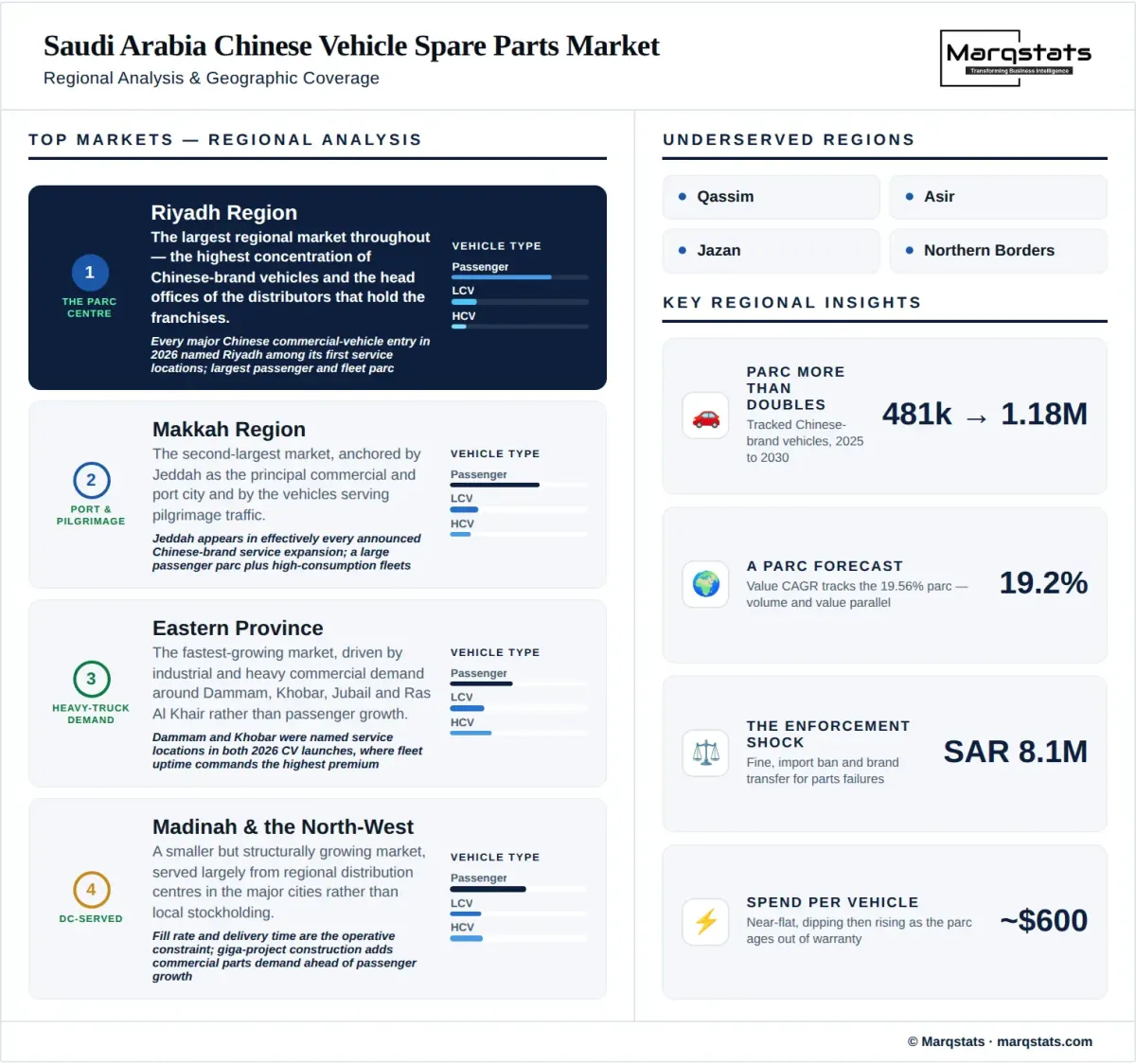
Riyadh is the largest regional market throughout the forecast, holding the highest concentration of Chinese-brand vehicles, the densest dealer and service networks, and the head offices of the distributors that hold the franchises. Every major Chinese commercial vehicle entry announced in 2026 named Riyadh among its first service locations, and the region carries both the largest passenger parc and the highest volume of fleet and government vehicles.
Makkah Region
The Makkah Region is the second-largest market, anchored by Jeddah as the Kingdom's principal commercial and port city and by the vehicle volumes that serve pilgrimage traffic. Jeddah appears alongside Riyadh in effectively every announced Chinese-brand service network expansion, and the region combines a large passenger parc with heavy commercial and passenger-transport fleets that consume parts at a higher rate.
Eastern Province
The Eastern Province is the fastest-growing regional market, driven by industrial and heavy commercial vehicle demand around Dammam, Khobar, Jubail and Ras Al Khair rather than by passenger parc growth. Dammam and Khobar were named service locations in both the Chinese commercial vehicle launches announced during 2026, reflecting where heavy-truck parts demand concentrates and where fleet uptime commands the highest premium.
Madinah Region and the North-West
The Madinah Region and the wider north-west, including Yanbu, Tabuk and the NEOM development area, form a smaller but structurally growing market. Parts demand here is served largely from regional distribution centres in the major cities rather than from local stockholding, which makes fill rate and delivery time the operative constraint rather than parc size. Giga-project construction traffic adds commercial vehicle parts demand ahead of passenger growth.
Rest of Saudi Arabia
The remaining regions, principally Qassim, Asir, Jazan, Najran, Hail and the Northern Borders, together hold a meaningful share of the passenger parc but a small share of franchised service capacity. Vehicles in these regions are disproportionately served by the independent aftermarket, and the gap between parc share and service-network share is the clearest opportunity for network expansion in the second half of the forecast.
How Competition Is Evolving
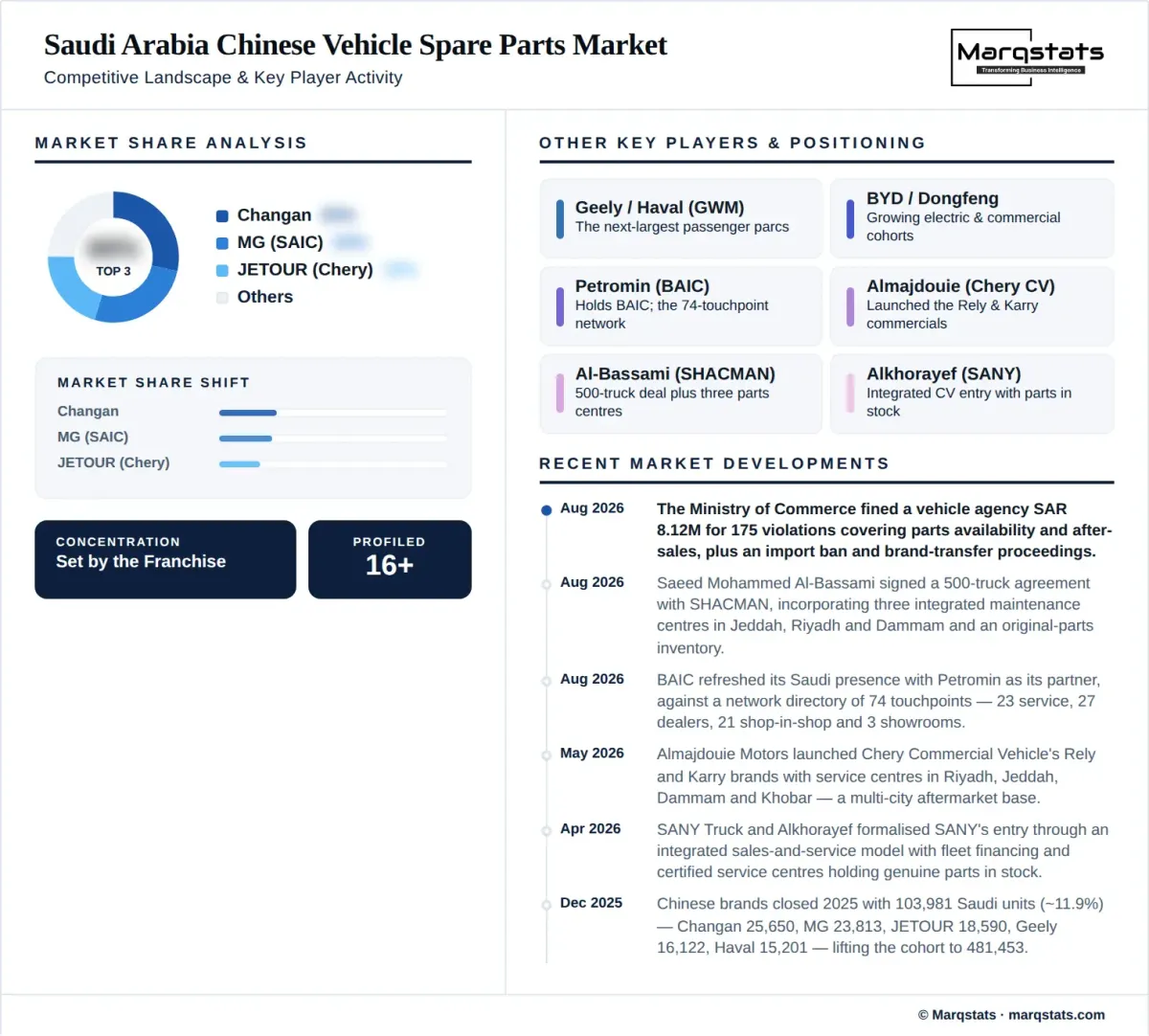
The Saudi Arabia Chinese vehicle spare parts market is moderately fragmented, and its structure is set by the vehicle franchises rather than by parts competition. Each Chinese manufacturer appoints a Saudi distributor that holds both vehicle and parts rights, so genuine-parts supply is effectively allocated brand by brand rather than won in open competition. The independent aftermarket competes underneath that structure on wear items and out-of-warranty work. Concentration is falling as more Chinese brands enter and as the parc spreads across a wider range of platforms.
The distributor names matter more than the manufacturer names in this market, because the distributor holds the stock, the network and the regulatory obligation. Established Saudi groups have taken the leading Chinese franchises — one operates a 74-touchpoint network for its passenger brand, another launched Chinese commercial vehicle brands in May 2026 with service centres across four cities, a third formalised a Chinese truck manufacturer's market entry with certified service centres and stocked genuine parts, and a fourth signed a 500-truck agreement in August 2026 that included three integrated maintenance centres. Parts capability is being built as a condition of winning and keeping these franchises.
Competition is shifting from price to fill rate, and the August 2026 enforcement action is what moved it. A distributor that cannot supply parts now risks fines, an import ban and transfer of the brand to a competitor deemed better prepared — which converts inventory depth from a cost line into the defence of the franchise itself. That advantages groups with balance sheet capacity for working capital and national warehousing over those competing on landed cost, and it makes service-network readiness a criterion in the award of new franchises rather than a commitment made after one.
Merger and acquisition activity in parts distribution has been limited, and the more consequential consolidation is happening at franchise level as brands are reassigned. The most probable path to scale for an independent parts business is not acquisition but specialisation — depth in the electronic components that carry no independent alternative, or in collision parts where availability failures are most visible and most penalised. Both positions are defensible against a franchised network that must carry breadth across every line.
Companies Covered
The report profiles 16+ companies with full strategy and financials analysis, including:
Recent Market Activity
Table of Contents
Coverage & Segmentation
This report covers replacement and service parts demand associated with Chinese-brand passenger and commercial vehicles operating in Saudi Arabia, with 2025 as the base year and 2026 – 2030 as the forecast period. Market size is annual parts demand in US dollars, calculated as the Chinese-brand vehicle population multiplied by age-weighted annual parts spend per vehicle, and corroborated at every point by the tracked vehicle cohort. Segmentation covers part category, vehicle type and distribution channel, with regional analysis for the Riyadh Region, the Makkah Region, the Eastern Province, the Madinah Region and the north-west, and the rest of Saudi Arabia.
Four boundaries define the market perimeter. First, vehicle sales are excluded entirely — this measures what happens after the sale. Second, workshop labour is excluded from the core revenue estimate, so a service invoice contributes only its parts line. Third, tyres, batteries and lubricants sold independently of a service event are treated as adjacent consumable markets, because their demand is driven by distance travelled rather than parc composition. Fourth, the vehicle cohort is a stock and parts demand is an annual flow: the 2030 value is the parts consumed by the 1,176,000-vehicle parc in that year, not the cumulative parts consumed across the period.
The tracked cohort is a lower bound rather than a census, and every derived figure inherits that. The supplied model-level dataset does not capture every Chinese brand and model consistently, so the 481,453-unit 2021 to 2025 cohort excludes both pre-2021 vehicles still in service and untracked brands. Its 11.9% Chinese share of a same-source total of 876,869 units is a tracked-cohort share and is not comparable with the OICA-aligned national total of 827,544 units — the two datasets count different universes and are never mixed here. The direction of the bias is understatement in both parc and market value.
Confidence is medium rather than low, which distinguishes this market from the emerging-technology markets alongside it. The underlying vehicle sales data is solid and recent, and the parc is derived from it by accumulation rather than by assumption. The weaker link is spend per vehicle: no Saudi source publishes annual aftermarket spend by brand origin, so the approximately USD 602 base figure is age-weighted and modelled, blended across a range wider than a factor of three between a young warranty-period passenger car and an out-of-warranty commercial vehicle. Testing this forecast means testing the parc first and the spend rate second.