Market Snapshot
Key Takeaways
Market Overview & Analysis
Report Summary
The Thailand auto parts market is not shrinking and it is not healthy, and reading either half alone produces the wrong conclusion. Output value grows because content per vehicle rises and exports hold, while the vehicle base the industry was built around stagnates and the assembly lines it supplies run at under half capacity. The money arriving is real, and it is arriving to buy positions rather than to add volume.
The measure is the value of automotive parts and components manufactured in Thailand, covering body, chassis and frame, powertrain and driveline, electrical, electronic and wiring, interior and safety, and tyre and rubber content, supplied to domestic vehicle assembly, to export and to replacement demand. Vehicle assembly value added by manufacturers is excluded, as is the retail value of the finished vehicles, which belongs to the vehicle markets that carry them.
The analysis is written for Tier-1 and Tier-2 suppliers deciding whether Thai capacity is worth holding, manufacturers assessing whether the local content they report is local value or local paperwork, investors pricing a supply base whose ownership is changing faster than its output, and policymakers weighing incentive reform against a utilisation rate that no incentive addresses.
Thailand Auto Parts Market Size and Forecast
Parts output is valued at USD 30.60 billion in 2025, an estimated USD 31.10 billion in 2026 and USD 36.90 billion by 2030, an increase of USD 6.30 billion. The 2025 base splits into USD 16.24 billion of domestic original equipment supply, USD 11.50 billion of export supply and USD 2.86 billion of replacement and aftermarket supply, against vehicle production of 1,450,000 units moving to 1,600,000.
Two growth rates apply and the gap between them is a base effect rather than a policy step. The five-year value rate connecting 2025 and 2030 is 3.82%; the four-year rate connecting 2026 and 2030 is 4.37%. The 0.55-point gap exists because 2026 is effectively flat, with value up 1.63% against vehicle production down 0.14%, before content growth and new capacity begin to register.
Value compounds 1.83 points ahead of volume at 3.82% against 1.99%, and the mechanism is content rather than price. Parts output per vehicle produced rises from USD 21,103 to USD 23,062, an increase of 9.28%, because electrification adds component value per unit and because export supply grows faster than the domestic assembly base. That ratio exceeds parts content per vehicle, since it carries exported components against a domestic production denominator. Across the narrower window units compound at 2.53% against a 4.37% value rate.
Capacity utilisation is the series that makes the forecast assessable and it is the one nobody publishes as a forecast. Passenger car lines ran at 40.65% and one-ton pickup lines at 56.54% in January to July 2026. The 2030 terminal assumes utilisation recovers toward the mid-fifties on passenger cars without reaching pre-2020 norms, which is a recovery assumption that can be tested against monthly production directly.
A sizing range is published rather than a point. The 2030 figure sits within a band of USD 32.80 billion to USD 41.50 billion, corresponding to rates of 1.40% and 6.28%, and the spread turns on whether the pickup export decline stabilises and on how much of the 40% local content requirement is met with domestically manufactured value rather than with imported components.
The Industry Runs at 40.65% While Investment Sets Records
The Federation of Thai Industries reported average capacity utilisation of 40.65% for passenger cars and 56.54% for one-ton pickups across January to July 2026, with pickup exports down about 9%. Thailand produced 834,595 vehicles in that period, down 0.1%, while domestic sales rose 15.4% to 406,162 units. Pickups were nearly 63% of vehicle production at over 520,000 units, so the segment carrying almost two thirds of output is the one running furthest below viable loading.
The investment record points the other way with equal force. The Board of Investment recorded THB 18.2 billion of actual investment by the automotive and parts industry in the second quarter of 2026, up 15%, within total actual investment above THB 255 billion that rose 31%. First-quarter applications in automotive and parts reached THB 13,328 million across 63 projects, and Japanese automotive and parts applications reached THB 28.31 billion in 2025, up 57%. Cumulatively since 2017 the board has approved over THB 150 billion of battery-electric investment promotion including 28 battery projects worth over THB 65 billion, against over THB 180 billion of applications.
Both facts are true because they describe different companies. Capacity sitting idle belongs largely to the legacy pickup and passenger chain built for Japanese platforms; capital arriving belongs largely to new entrants building for electrified platforms and for export. Reading the sector as one number produces either a collapse or a boom, and it is neither.
Local Content Is Being Met With Imported Components
The EV3.5 framework requires 40% of electric vehicle component costs to be local in 2026, and the requirement is being satisfied in a way that does not build a Thai supply base. Chinese manufacturers control their own supply chains end to end, rely on imported components to reach the threshold, and confine Thai suppliers to lower value-added parts, which means a compliant 40% figure can carry substantially less than 40% of Thai manufacturing value.
The cost structure explains why no supplier resists this. Producing locally costs 30% to 40% more than importing from China, Chinese raw material inputs run about 20% cheaper, and the import duty on automotive parts is 2%. A manufacturer choosing between a Thai part and a Chinese one is choosing between a 30% to 40% premium and a 2% duty, and the incentive framework does not close a gap of that size.
Thai suppliers have responded politically rather than commercially. Thai Summit Group, Summit Auto Body Industry, Somboon Advance Technology, VCS Group and Thai Forging Parts formed the Thailand Future Automotive Board in July 2026, demanding research support, revised Board of Investment incentives for domestic parts makers and a production-cluster approach, while industry groups separately proposed an excise of at least 32% on fully imported electric vehicles against current rates of 10%, 8% and 2%.
Exits and Entries Are Reshaping Who Owns the Supply Base
Japanese incumbents are withdrawing on a scale that has no recent precedent in Thailand. Unipres announced in June 2026 that it will end production in Thailand and Brazil while cutting Chinese bases from seven to three, in line with Nissan's production reform, and Kasai Kogyo will close its Pinthong interior parts plant by December 2026. Both decisions follow platform volume rather than Thai conditions, which is what makes them structural.
New capacity arrived in the same window and mostly on the Eastern Seaboard. Nexteer opened a 5,000 square metre column electric power steering plant in Rayong on THB 108 million of registered capital, Hengli took over 30,000 square metres at WHA ESIE 3, Yangteng Innovation took 73,000 square metres at WHA Rayong, Baolong began valve stem production in Chachoengsao, Visteon expanded its cockpit electronics site by 2,988 square metres to 4,700 with future capacity near 2 million units a year, and Tuopu and Sanhua committed over THB 3.5 billion and over THB 3.2 billion respectively.
Established suppliers are also deepening rather than leaving. Continental committed over EUR 300 million, about THB 13 billion, to add 3 million passenger and light truck tyres a year in Rayong with about 600 jobs; Yazaki opened an aluminium wire plant in Samut Prakan tripling capacity across 21,791 square metres with 270 employees; Toyobo agreed to acquire the remaining 50% of its airbag fibre joint venture from Indorama with completion on 30 October 2026; and Standard Motor Products took 50% of sensor maker Techstrong Electronics in a July 2026 joint venture explicitly framed as reducing dependence on China.
The Export Book Is Losing Its Largest Growth Region
Thailand exported 495,313 vehicles in January to July 2026, down 6.9%, with pickups and pickup-based utility vehicles accounting for over 62% and 16% of first-half export volume. The concentration means a pickup demand shock in any destination transmits almost undiluted into the parts chain that supplies it.
The Middle East is where that shock landed. Exports of motor vehicles, equipment and parts to the region fell 40.09% to THB 39.98 billion in the first half of 2026, roughly USD 1.23 billion, while Middle East vehicle exports fell 32% to 62,383 units and Asian exports fell 13% to 120,194 units. AAPICO expected those losses to appear in its own results from May and June 2026.
Trade policy is the partial offset and it is working. Preference utilisation reached USD 82.943 billion across all exports in January to November 2025, up 8.7% and covering 81.6% of eligible exports, under the ASEAN, China, India, Japan and Australia-New Zealand agreements, with a European Union agreement targeted for 2026. Thailand's parts base is more exposed to which agreements exist than to which currencies move.
Thailand Is Now Third Choice Among Japanese Investors
The single most consequential number for the next decade of this industry is a survey result rather than a production statistic. In 2026, 38.7% of Japanese firms reported plans to expand in Thailand against 45.9% in Indonesia and 56.9% in Vietnam. Thailand trails the regional leader by 18.2 points in the one investor community that built its automotive sector.
Current investment does not contradict that finding, it dates it. The THB 28.31 billion of Japanese automotive and parts applications recorded in 2025 includes Astemo investing in electric power control unit inverters and Aisin Powertrain in hybrid transmissions, which are commitments to specific electrified programmes rather than to Thai capacity generally. Japanese applications across all sectors ran at 123 applications and THB 32.79 billion in the first half of 2026.
Sourcing ratios show what a committed manufacturer still builds locally. Isuzu sources over 90% locally, the Toyota Land Cruiser FJ reaches 84%, Mercedes-Benz exceeds 50%, Great Wall Motor runs about 50% and Hyundai 46%. The spread between 90% and 46% is the difference between a platform designed around the Thai supply base and one that merely assembles here, and the incoming mix sits at the lower end.
Market Dynamics
Key Drivers
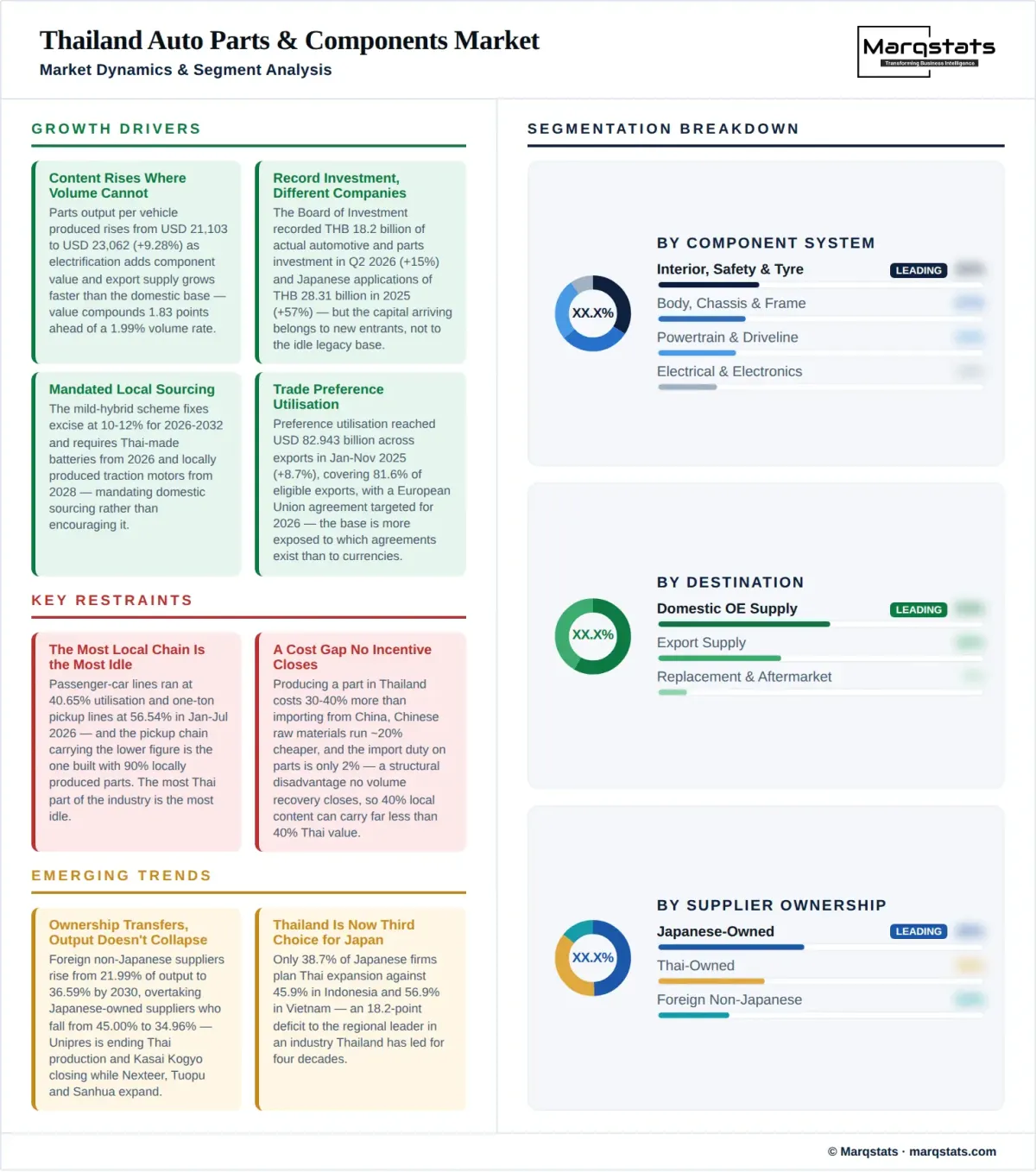
- Board of Investment actual automotive and parts investment reached THB 18.2 billion in the second quarter of 2026, up 15%, within total actual investment above THB 255 billion that rose 31%.
- Approved electrified mobility investment reached THB 137 billion across 198 projects by May 2026, including THB 12.5 billion for key electric vehicle components across 49 projects and THB 33.5 billion for battery and energy storage across 57 projects.
- Electrification raises component value per vehicle, lifting parts output per vehicle produced from USD 21,103 to USD 23,062, an increase of 9.28% across the forecast period.
- The mild hybrid scheme fixes excise at 10% up to 100 g/km and 12% from 101 to 120 g/km for 2026 to 2032 and requires Thai-made batteries from 2026 and locally produced traction motors from 2028, mandating domestic sourcing rather than encouraging it.
- Trade preference utilisation reached USD 82.943 billion in January to November 2025, up 8.7% and covering 81.6% of eligible exports, with a European Union agreement targeted for 2026.
Key Restraints
- Capacity utilisation averaged 40.65% on passenger cars and 56.54% on one-ton pickups in January to July 2026, and the pickup supply chain built with 90% local content ran below 60%.
- Local manufacture costs 30% to 40% more than importing from China against a 2% import duty on automotive parts, a gap no current incentive closes.
- Exports of motor vehicles, equipment and parts to the Middle East fell 40.09% to THB 39.98 billion in the first half of 2026, while total vehicle exports fell 6.9% to 495,313 units in January to July.
- Japanese suppliers are withdrawing, with Unipres ending Thai production and Kasai Kogyo closing its Pinthong plant by December 2026, and only 38.7% of Japanese firms plan Thai expansion against 56.9% for Vietnam.
Key Trends
- Ownership is transferring rather than output collapsing, with foreign non-Japanese suppliers rising from 21.99% of output to 36.59% by 2030 while Japanese-owned suppliers fall from 45.00% to 34.96%.
- Thai suppliers are organising politically, forming the Thailand Future Automotive Board in July 2026 and proposing excise of at least 32% on fully imported electric vehicles against current rates of 10%, 8% and 2%.
- New capacity is concentrating on the Eastern Seaboard, with Nexteer at 5,000 square metres in Rayong, Hengli above 30,000, Yangteng at 73,000 and Visteon expanding to 4,700 with capacity near 2 million units a year.
- Supply chain diversification is now an explicit investment thesis, with Standard Motor Products taking 50% of Techstrong Electronics in July 2026 specifically to reduce dependence on China.
Market Segmentation
Body, chassis and frame components account for an estimated USD 8.26 billion in 2025, or 26.99% of output, and this is where Thai ownership is strongest and most exposed. AAPICO supplies body, chassis, frames and sub-frames to almost all localised Chinese electric vehicle brands, and Press Kogyo's Thai subsidiary won a Mitsubishi ladder frame order for the new Pajero supplied from Thai Summit PKK from August 2026. The segment tracks pickup volume more tightly than any other.
Powertrain and driveline components account for an estimated USD 7.34 billion in 2025, or 23.99%, and carry the sharpest transition risk in the industry. Aisin Powertrain is investing in hybrid transmissions and Astemo in electric power control unit inverters within the THB 28.31 billion of 2025 Japanese applications, while the mild hybrid scheme requires locally produced traction motors from 2028, which converts a supplier choice into a compliance requirement.
Electrical, electronic and wiring components account for an estimated USD 5.51 billion in 2025, or 18.01%, and this is the fastest-growing system group. Yazaki tripled aluminium wire capacity in Samut Prakan across a 21,791 square metre plant employing 270 people, Visteon expanded cockpit electronics by 2,988 square metres toward capacity near 2 million units a year, and Standard Motor Products entered sensors through a 50% stake in Techstrong Electronics.
Interior and safety components account for an estimated USD 4.90 billion in 2025, or 16.01%, and the segment is consolidating in both directions at once. Kasai Kogyo will close its Pinthong interior parts plant by December 2026, while Toyobo agreed in August 2026 to acquire the remaining 50% of its airbag fibre joint venture from Indorama with completion on 30 October 2026, consolidating global airbag supply in Thailand.
Tyres and rubber account for an estimated USD 4.59 billion in 2025, or 15.00%, and the segment is the least exposed to powertrain transition of any in the industry. Continental committed over EUR 300 million, about THB 13 billion, to add 3 million passenger and light truck tyres a year in Rayong with about 600 jobs, and Bekaert acquired Bridgestone's Thai tyre cord plant, both of which are capacity decisions unaffected by what drives the wheel.
Domestic original equipment supply accounts for an estimated USD 16.24 billion in 2025, or 53.07% of output, serving 1,450,000 vehicles produced. It is the segment most directly damaged by utilisation running at 40.65% on passenger cars, since a supplier tooled for a platform cannot redeploy that tooling when the platform underruns, and it is also the segment the 40% local content rule is supposed to protect.
Export supply accounts for an estimated USD 11.50 billion in 2025, or 37.58%, and is the reason output value grows while the domestic base does not. The book is concentrated and that concentration cost it in 2026, with Middle East exports of motor vehicles, equipment and parts down 40.09% to THB 39.98 billion in the first half, against total vehicle exports of 495,313 units in January to July.
Replacement and aftermarket supply accounts for an estimated USD 2.86 billion in 2025, or 9.35%, the smallest destination and the most stable. It is fed by a vehicle parc far larger than annual production and is therefore insulated from the utilisation problem entirely, which makes it the segment a supplier can use to carry fixed cost through an assembly downturn.
Japanese-owned suppliers account for an estimated USD 13.77 billion in 2025, or 45.00% of output, and fall to 34.96% by 2030. The decline is not a forecast so much as an observation extended: Unipres is ending Thai production, Kasai Kogyo closes by December 2026, and only 38.7% of Japanese firms plan Thai expansion against 45.9% in Indonesia and 56.9% in Vietnam.
Thai-owned suppliers account for an estimated USD 10.10 billion in 2025, or 33.01%, and hold roughly 28.46% by 2030 on modest absolute growth. AAPICO Hitech reported FY2025 sales of THB 26,167 million with original equipment parts at 70% of that, and targets revenue growth of 1% to 3% in 2026 on THB 800 million of capital expenditure, which is a defensive plan rather than an expansionary one.
Chinese, European, American and other foreign suppliers account for an estimated USD 6.73 billion in 2025, or 21.99%, and rise to 36.59% by 2030 to become the largest ownership group. Tuopu committed over THB 3.5 billion across two projects and Sanhua over THB 3.2 billion in February 2026, alongside Nexteer, Hengli, Yangteng Innovation and Baolong, and Continental added 3 million tyres a year in Rayong.
Components for internal combustion and pickup platforms account for an estimated USD 20.20 billion in 2025, or 66.01% of output, and this is the segment the utilisation problem sits inside. Pickups were nearly 63% of production at over 520,000 units in January to July 2026 with exports down about 9%, and their supply chain is 90% locally produced while running below 60% utilisation.
Components for hybrid platforms account for an estimated USD 6.43 billion in 2025, or 21.01%, and carry the clearest policy-backed growth path. The mild hybrid scheme fixes excise at 10% or 12% by carbon dioxide band through 2032 and requires Thai-made batteries from 2026 and local traction motors from 2028, while approved hybrid manufacturing investment reached THB 29.9 billion across seven projects by May 2026.
Components for battery electric platforms account for an estimated USD 3.97 billion in 2025, or 12.97%, the smallest segment and the fastest-growing. Approved investment reached THB 12.5 billion across 49 projects for key components including drive motors, battery management and energy control, and THB 33.5 billion across 57 battery and energy storage projects, within THB 137 billion of electrified mobility approvals.
By Geography
Eastern Economic Corridor
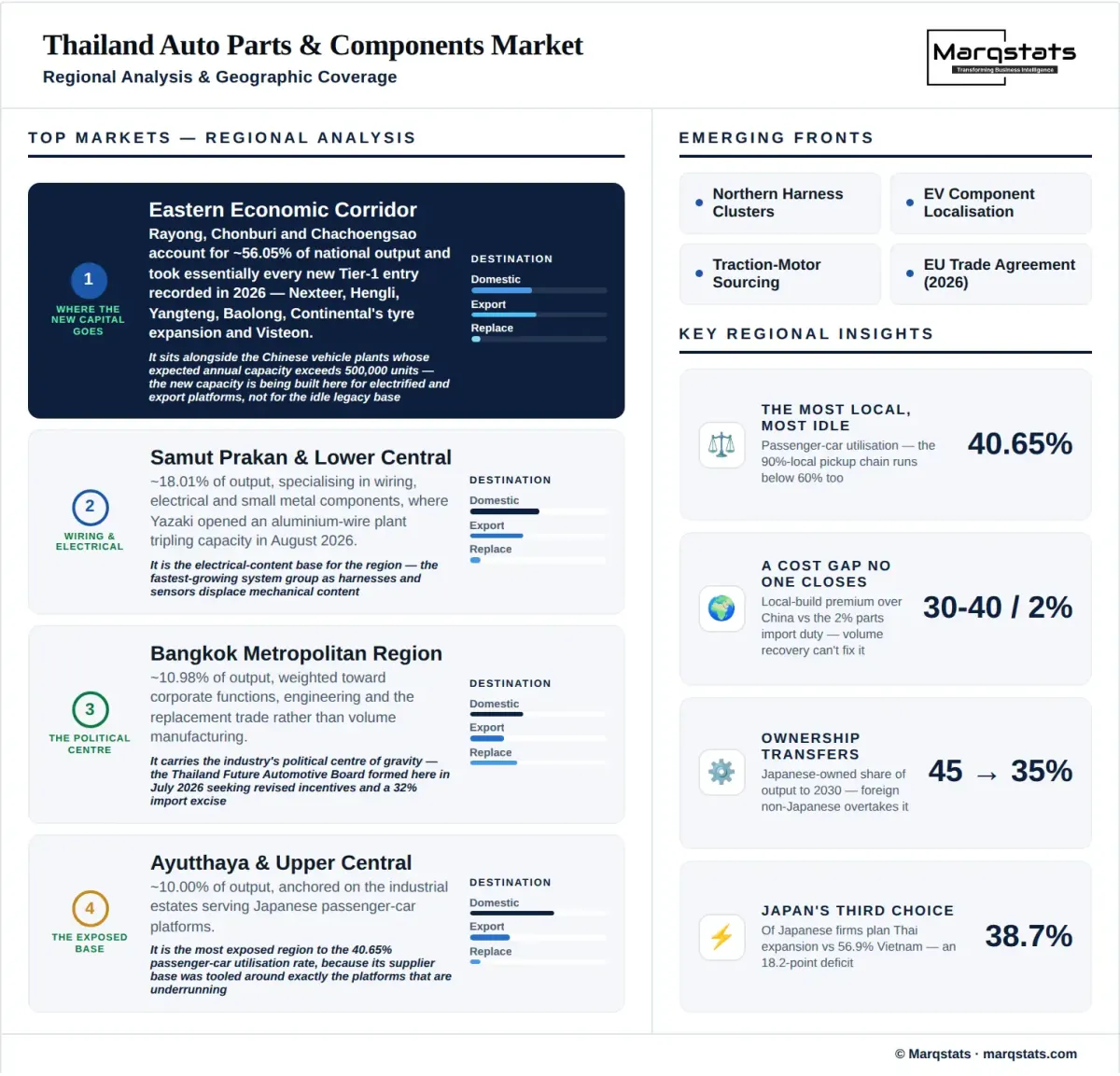
The Eastern Economic Corridor across Rayong, Chonburi and Chachoengsao accounts for an estimated USD 17.15 billion of output in 2025, or 56.05% of the national total, and took essentially every new Tier-1 entry recorded in 2026. Nexteer, Hengli, Yangteng Innovation, Baolong, Continental's 3 million tyre expansion and Visteon's cockpit electronics site all sit here, alongside the Chinese vehicle plants whose expected annual capacity exceeds 500,000 units.
Samut Prakan and the Lower Central Plain
Samut Prakan and the lower central provinces account for an estimated USD 5.51 billion, or 18.01%, and specialise in wiring, electrical and small metal components. Yazaki opened an aluminium wire plant here in August 2026 that tripled capacity across 21,791 square metres with 270 employees, serving as a supply base for automotive aluminium wire harnesses across the region.
Bangkok Metropolitan Region
Greater Bangkok accounts for an estimated USD 3.36 billion, or 10.98%, weighted toward corporate functions, engineering and the replacement trade rather than volume manufacturing. The region carries the industry's political centre of gravity, and the Thailand Future Automotive Board formed here in July 2026 by five Thai suppliers seeking revised incentives and a production-cluster approach.
Ayutthaya and the Upper Central Plain
Ayutthaya and the upper central provinces account for an estimated USD 3.06 billion, or 10.00%, anchored on the industrial estates serving Japanese passenger car platforms. The region is the most exposed of any to the 40.65% passenger car utilisation rate, because its supplier base was tooled around exactly the platforms that are underrunning.
Northern and Northeastern Thailand
Northern and northeastern Thailand account for an estimated USD 1.52 billion, or 4.97%, the smallest cluster and the most labour-cost sensitive. Activity concentrates in wiring harness and sub-assembly work placed there for wage reasons, which makes it the first capacity a supplier relocates when a 30% to 40% cost gap against Chinese imports has to be closed.
How Competition Is Evolving
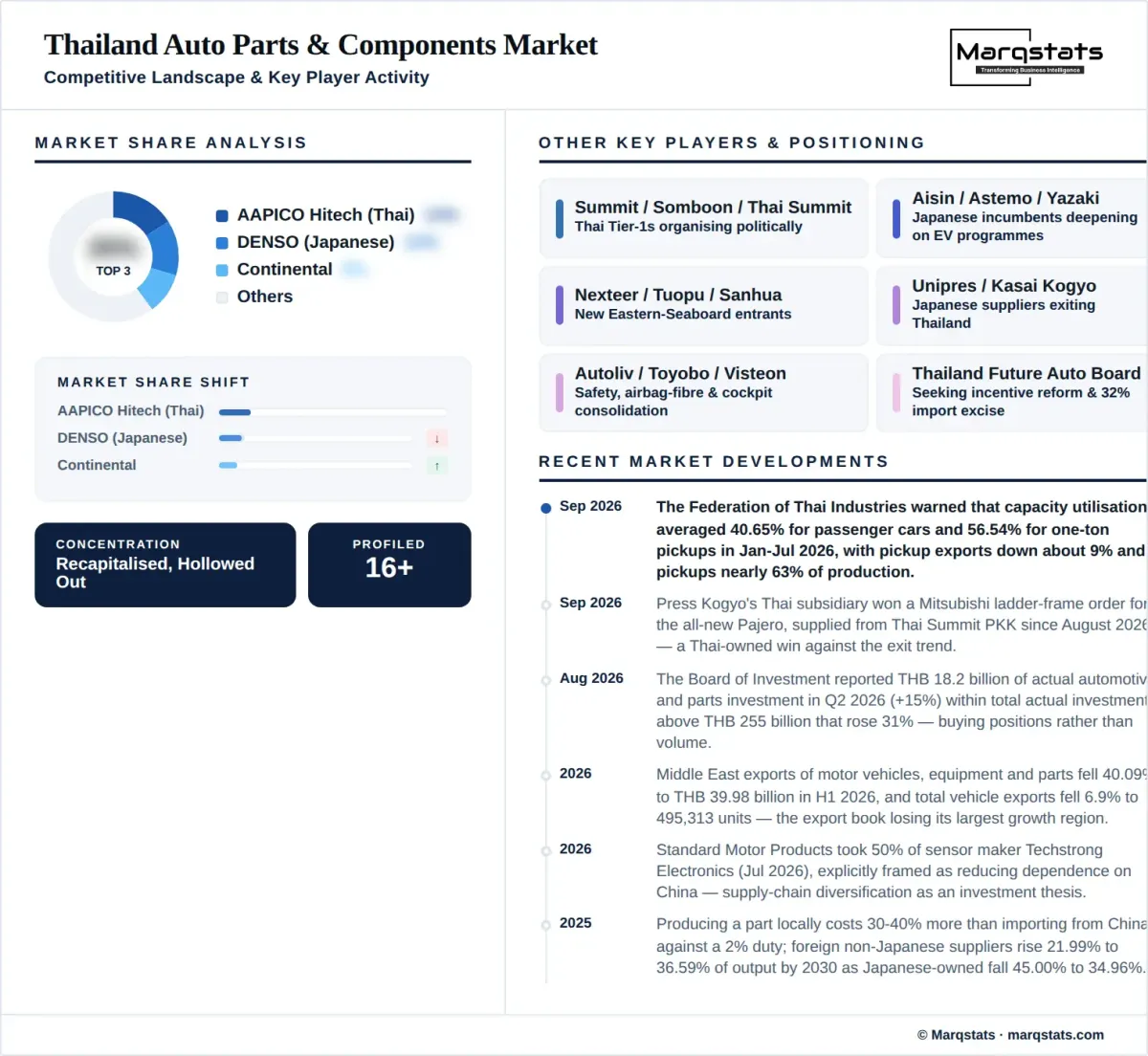
The Thailand auto parts market is fragmented and its fragmentation is being rearranged rather than reduced. No supplier holds a commanding share of a USD 30.60 billion industry, and the largest Thai-owned participant, AAPICO Hitech, reported FY2025 sales of THB 26,167 million, roughly USD 805 million, of which original equipment parts were 70%. That is under 3% of national output from the country's flagship independent supplier, which is the scale problem Thai suppliers are trying to solve politically.
Competition now runs on which manufacturer's platform a supplier is attached to rather than on capability. A supplier tooled for a Japanese pickup platform faces utilisation below 60% and exports down about 9%; a supplier qualified onto a Chinese electric platform faces a manufacturer that controls its own chain end to end, imports components to meet the 40% local content rule and keeps Thai participation in lower value-added parts. Neither position is won or lost on engineering, and that is what makes the incumbent Thai response a lobbying strategy rather than a commercial one.
The clearest signal of where the industry is heading is what changed hands in 2026. Unipres exited, Kasai Kogyo scheduled a closure, Bekaert bought Bridgestone's Thai tyre cord plant, Toyobo bought out Indorama's half of their airbag fibre venture, and Standard Motor Products bought half of Techstrong Electronics to reduce China dependence. Assets are moving from suppliers following declining platforms to suppliers building positions, and the Thai supply base will end the decade with the same plants under different flags.
Companies Covered
The report profiles 15+ companies with full strategy and financials analysis, including:
Recent Market Activity
Table of Contents
Coverage & Segmentation
This analysis measures the value of automotive parts and components manufactured in Thailand from 2021 to 2030, with 2025 as the base year and 2026 to 2030 as the forecast period, covering body, chassis and frame, powertrain and driveline, electrical, electronic and wiring, interior and safety, and tyre and rubber content, supplied to domestic vehicle assembly, to export and to replacement demand. Vehicle assembly value added by manufacturers is excluded, and the retail value of finished vehicles belongs to the vehicle markets that carry them and is never added to this panel. Motorcycle components, construction and agricultural equipment components, and vehicle bodywork repair services are excluded. Values are expressed in USD at a disclosed constant THB 32.5 per USD.
Coverage spans five component systems, three destinations, three supplier ownership groups and three powertrain platforms served, with five regional clusters analysed on installed manufacturing capacity rather than on vehicle demand. Vehicle production is carried as the volume series at 1,450,000 units in 2025 and parts output per vehicle produced as a derived series at USD 21,103, and both are published alongside the value panel because an industry whose output value and whose vehicle base move at different rates cannot be represented by either alone. Fifteen entities are profiled across Thai, Japanese, European, American and Chinese ownership.