Market Snapshot
Middle bar: base-year value × (1 + CAGR), rounded to two decimals. This is a calculated illustration, not a separately researched annual estimate.
The United States hybrid vehicle market was valued at USD 100 billion in 2025 and is projected to reach USD 162 billion by 2030, expanding at a 10.13% CAGR across the 2026–2030 forecast period. Growth is attributed to the withdrawal of federal purchase incentives for battery-electric vehicles, elevated battery-electric prices, and rising consumer preference for affordable electrification that requires no charging. The United States hybrid vehicle market is scaling as automakers convert high-volume models to hybrid-only lineups. Hybrids have become the pragmatic route to electrification for mainstream buyers, combining fuel savings with familiar refuelling and no dependence on charging.
The market covers hybrid electric vehicles, mild-hybrid electric vehicles, and plug-in hybrid electric vehicles across passenger cars, sport-utility vehicles, pickup trucks, and multi-purpose vehicles. Scope spans new-vehicle retail and fleet sales across mainstream and premium brands sold in the United States. Hybrid volumes reached about 2.5 million units in 2025, and the hybrid share of new-vehicle sales rose to roughly 15% by early 2026, more than double the battery-electric share of new sales. Sport-utility vehicles and crossovers account for the largest share of hybrid sales, owing to the hybridization of high-volume models. Pickup trucks add mild-hybrid and full-hybrid volume, extending electrification into the largest vehicle category, while passenger cars retain a substantial share through hybrid-only sedans.
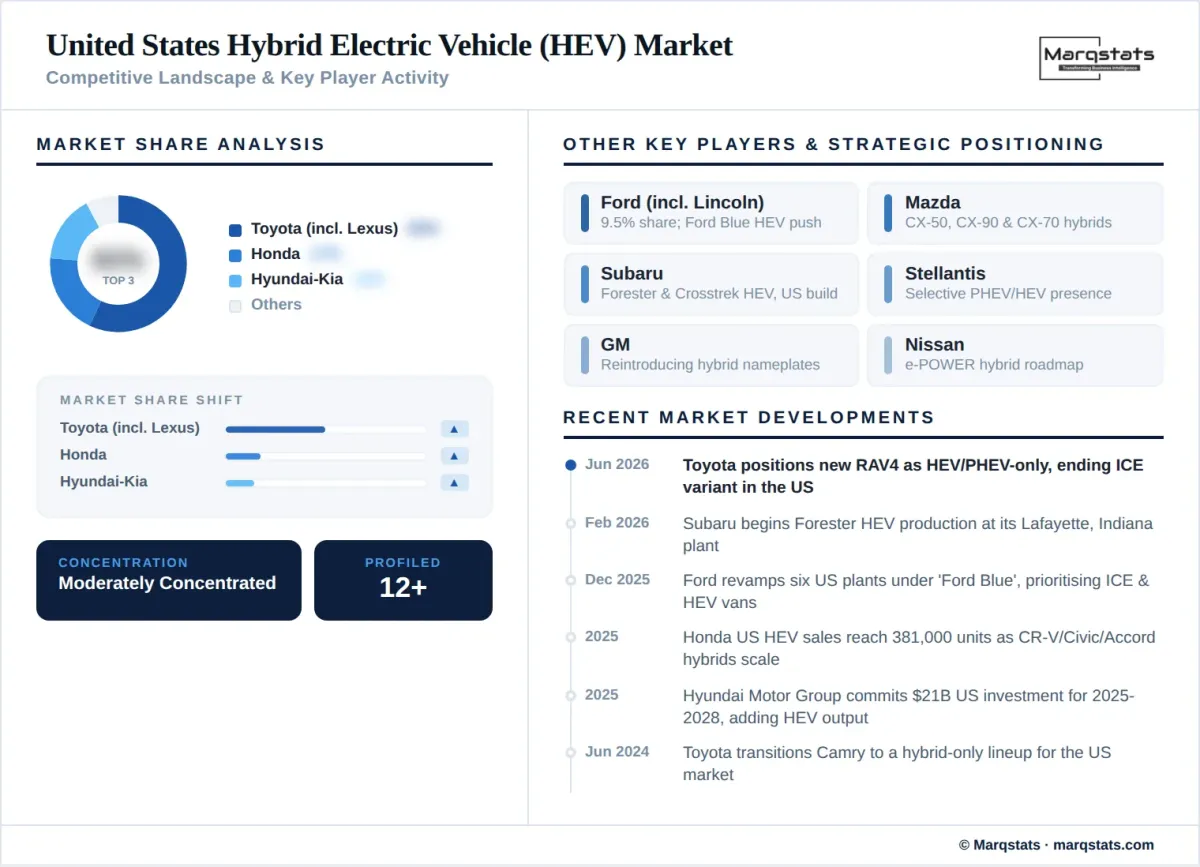
The competitive field is concentrated. Toyota Motor Corporation and Honda Motor Co., Ltd. together hold about two-thirds of hybrid sales, followed by Hyundai Motor Company with Kia Corporation, and Ford Motor Company, with these groups accounting for more than nine-tenths of the market. Japanese and Korean automakers anchor supply, increasingly from United States plants that shield sales from tariffs on imported vehicles, and the West records the largest regional demand while the South grows fastest. The top-selling electrified models include the Toyota Camry, RAV4, and Sienna and the Honda CR-V, alongside the Tesla Model Y among battery-electric vehicles.
Key Takeaways
Market Overview & Analysis
Report Summary
The United States hybrid vehicle market covers vehicles that pair an internal-combustion engine with electric assistance, spanning hybrid electric vehicles that never plug in, mild-hybrid electric vehicles that add efficiency through a small motor, and plug-in hybrid electric vehicles that offer an electric-only range. The market is scaling as buyers seek fuel savings and lower emissions without the price premium and charging dependence of battery-electric vehicles. Hybrid volumes reached about 2.5 million units in 2025, and hybrids have become a central pillar of electrified-vehicle sales. Hybrids reduce fuel consumption by roughly a quarter to two-fifths against comparable combustion models, delivering everyday savings without a charging routine, which underpins their appeal across income levels and regions.
The demand shift is pronounced. Hybrid sales rose sharply in 2025 while battery-electric growth stalled, as federal purchase incentives for battery-electric vehicles ended and battery-electric prices remained high at around USD 60,000. Consumers moved toward hybrids as a more affordable form of electrification, and the hybrid share of quarterly sales climbed to roughly 15% by early 2026, up more than two percentage points year on year. Japanese automakers alone lifted their hybrid sales sharply as domestic production expanded, and hybrids underpinned a broad recovery in their United States volumes to roughly six million total units. Even in California, the most electrified state, registered hybrids rose about 36% in 2025 to roughly 351,000 units while battery-electric registrations edged lower to around 378,000 units. The state has installed tens of thousands of charging ports, yet the experience shows that price and convenience, alongside infrastructure, shape purchase decisions, reinforcing the case for hybrids.
Automakers responded by expanding hybrid supply, much of it produced domestically. Toyota moved the Camry to a hybrid-only lineup, the redesigned RAV4 offers only hybrid and plug-in-hybrid variants, and Honda has hybridized the CR-V, Civic, and Accord that account for most of its United States sales, with hybrid production expanded at its North American plants. Growth is driven by affordability, fuel efficiency, and model availability, and the market is scaling as electrification proceeds through hybrids rather than battery-electric vehicles alone. Hybrids balance fuel efficiency and convenience, positioning them to hold their place in the market as an affordable form of electrification. Over the forecast period, hybrid volume growth is expected to come from wider model coverage and rising hybrid ratios rather than from any single incentive.
Market Dynamics
Key Drivers
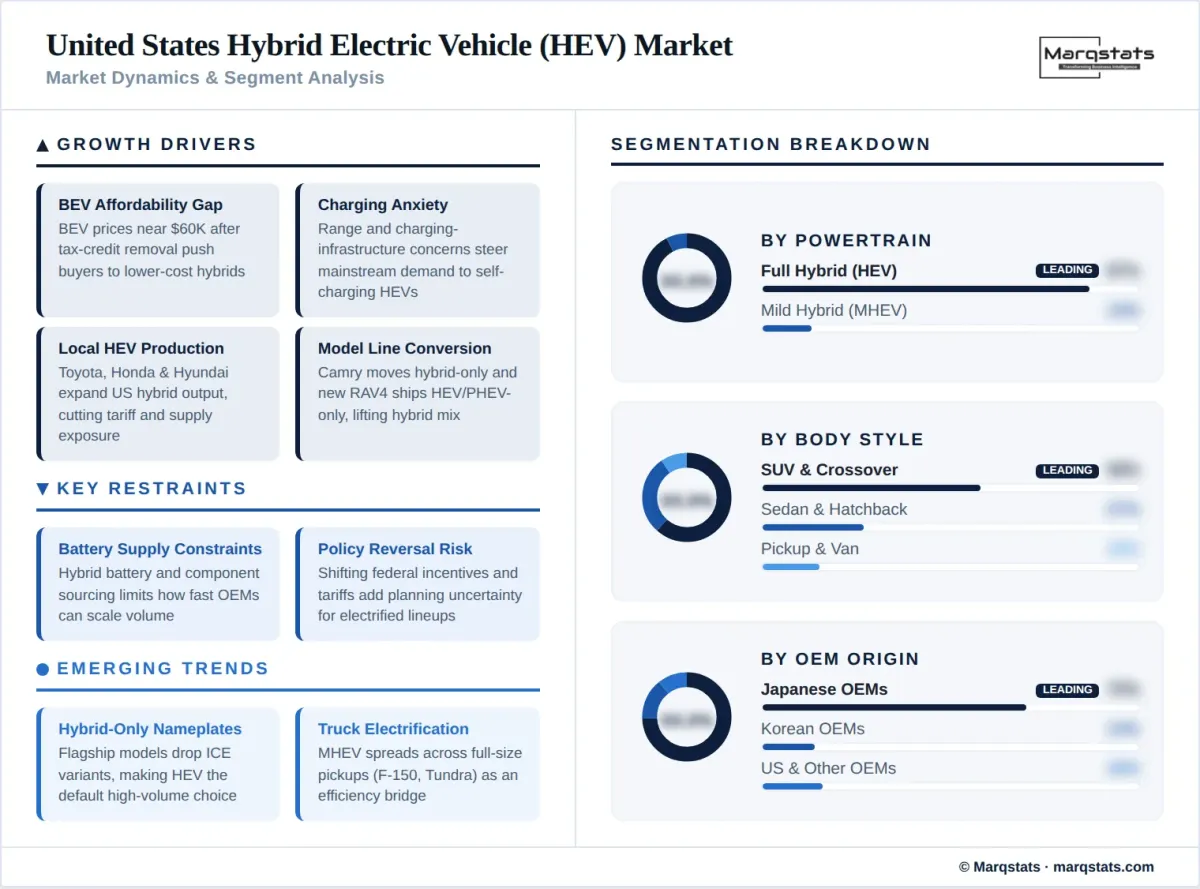
Market is driven by the withdrawal of federal purchase incentives for battery-electric vehicles, shifting demand toward affordable hybrids.
Elevated battery-electric prices, around USD 60,000, make hybrids a lower-cost route to fuel savings and lower emissions for mainstream buyers.
Charging independence appeals to buyers concerned about charging access and convenience, sustaining hybrid demand even where public charging is available.
Automakers are converting high-volume models to hybrid-only or hybrid-led lineups, expanding availability across cars, sport-utility vehicles, and trucks.
Rising domestic hybrid production improves supply and shields sales from tariffs on imported vehicles, encouraging automakers to localize assembly.
Key Restraints
Fleet-emission rules that reward zero-tailpipe operation can favour battery-electric and plug-in models over conventional hybrids.
Hybrid powertrains add cost and complexity over comparable combustion models, pressuring entry-level affordability and lengthening payback for lower-mileage drivers.
Battery-electric price declines and improving range may narrow the hybrid cost advantage over the forecast period.
Key Trends
Plug-in hybrids are gaining share on longer electric range and rely on the EV DC charging station network for daily replenishment.
Hybridization is spreading from cars to sport-utility vehicles and pickup trucks, broadening the addressable market and lifting the average hybrid transaction price.
All-wheel-drive hybrid variants are expanding, aligning electrification with buyer preference for larger vehicles.
Silicon-carbide power electronics and improved battery management are raising hybrid efficiency and performance, narrowing the gap with battery-electric operation in everyday use.
Market Segmentation
Hybrid electric vehicles hold the dominant share of the market, owing to affordability and independence from charging infrastructure. These vehicles recover energy through regenerative braking and never plug in, appealing to buyers who want fuel savings without changing refuelling habits. Their independence from charging makes them attractive across regions with uneven charging access, and they carry the highest hybrid volumes in the market. Full hybrids anchor the highest-volume models, including the Toyota Camry and RAV4 and the Honda CR-V. Rising hybrid ratios on flagship models mean a growing share of each nameplate's sales are hybrids, lifting the segment's overall volume. Full hybrids also carry the deepest model choice, spanning sedans, crossovers, minivans, and trucks.
Mild-hybrid electric vehicles form a growing segment, adding a small electric motor that improves fuel economy at lower cost than a full hybrid. Mild hybrids are increasingly standard on pickup trucks and larger vehicles, where they deliver measurable efficiency gains while preserving towing and payload capability. They add efficiency at low incremental cost, which suits price-sensitive segments and high-volume trucks. Mild hybrids offer high-single-digit to low-double-digit fuel savings at a fraction of a full hybrid's cost, making them a practical option for large vehicles.
Plug-in hybrid electric vehicles are the fastest-growing segment, owing to an electric-only range that supports daily commuting on electricity and longer trips on the engine. Plug-in hybrids benefit from larger policy credits and falling battery costs, and their appeal grows where buyers want electric operation without full dependence on public charging. Fleet demand skews toward plug-in hybrids where urban low-emission rules reward electric operation. Falling battery-pack costs allow automakers to price plug-in hybrids closer to comparable trims, supporting adoption among buyers seeking daily electric driving.
Sport-utility vehicles and crossovers hold the largest share of hybrid sales, reflecting buyer preference for larger vehicles and the hybridization of high-volume models. The Toyota RAV4, Highlander, and Grand Highlander and the Honda CR-V anchor this segment, and most new hybrid models introduced are sport-utility vehicles and crossovers. Crossover buyers increasingly treat a hybrid powertrain as a mainstream option rather than a premium. The compact and mid-size crossover classes carry the highest hybrid volumes, aligning electrification with the fastest-selling body styles in the market, and each redesign tends to raise the hybrid share of the nameplate.
Passenger cars represent a substantial share, anchored by hybrid-only sedans such as the Toyota Camry and by the Honda Civic and Accord. The move of flagship sedans to hybrid-only lineups concentrates car-segment volume in hybrids and sustains demand despite the broader shift toward larger vehicles. High hybrid ratios on these nameplates make the passenger-car segment among the most electrified in the market.
Pickup trucks form a growing segment, anchored by mild-hybrid and full-hybrid options on high-volume models such as the Ford F-150, Maverick, and the Toyota Tundra and Tacoma. Electrified trucks pair efficiency with the towing and payload capability that buyers require, widening hybrid adoption in the largest vehicle category. As mild-hybrid systems become standard on full-size pickups, truck electrification advances without compromising capability.
Multi-purpose vehicles and minivans form a smaller yet stable segment, anchored by the hybrid-only Toyota Sienna. Family buyers value the fuel efficiency and quiet operation of hybrid minivans, sustaining steady demand in this niche. With the segment's top-selling nameplate offered only as a hybrid, minivan electrification is effectively complete for that model, and all-wheel-drive hybrid options extend its appeal to varied climates.
Front-wheel-drive hybrids account for the largest drivetrain share of the market, owing to lower cost and higher efficiency in cars and compact crossovers. This configuration anchors high-volume sedans and smaller sport-utility vehicles across the market, where efficiency and price are decisive for mainstream buyers. It remains the default for entry and mid-trim hybrids that carry the bulk of unit sales.
All-wheel-drive hybrids are expanding quickly, as automakers pair electrification with the traction and capability buyers expect in sport-utility vehicles and trucks. Electric rear axles enable all-wheel drive efficiently, broadening the appeal of hybrid sport-utility vehicles across varied climates. All-wheel-drive hybrid options are now common across mainstream sport-utility ranges, supporting sales in colder and mountainous regions. Buyers increasingly expect all-wheel drive as a hybrid option rather than a combustion-only feature, reinforcing the shift of capable vehicles toward electrified drivetrains.
By Geography
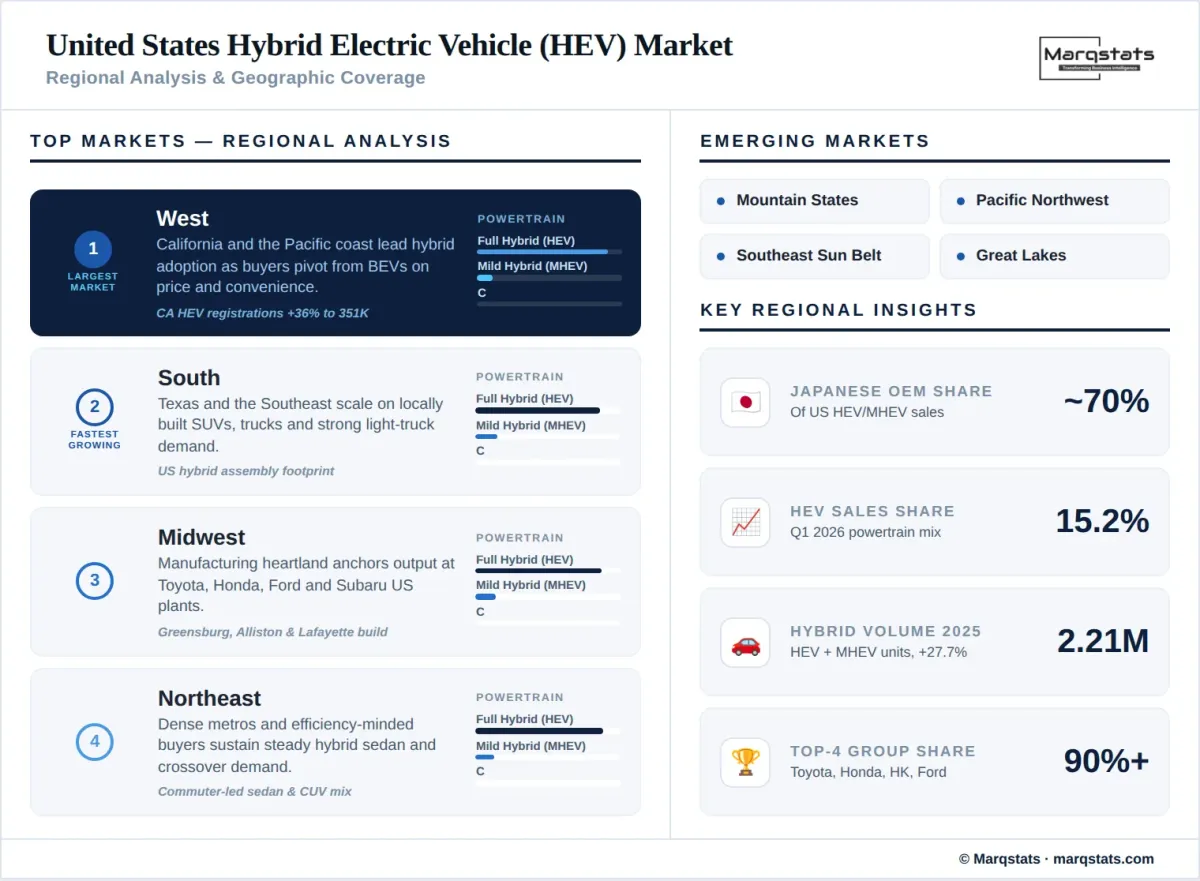
West
The West holds the largest regional share, owing to high electrified-vehicle adoption and supportive state policy, with California the single largest state market. Registered hybrids in California rose about 36% in 2025 to roughly 351,000 units, even as battery-electric registrations edged lower, underscoring the shift toward hybrids in the most electrified state.
South
The South records the fastest regional growth, owing to large light-truck and sport-utility demand, rising population, and the hybridization of popular models. Texas and Florida anchor high sales volumes, and the spread of hybrid trucks and crossovers supports rapid adoption across the region. Sun Belt population growth and strong light-truck demand make the South a decisive market for hybrid volume over the forecast period.
Northeast
The Northeast sustains steady hybrid demand, owing to dense urban markets, higher fuel prices, and state incentives that favour efficient vehicles, with strong uptake in coastal metropolitan areas. Hybrids suit stop-and-go driving in metropolitan corridors from New York through New England, reinforcing adoption. Regenerative braking recovers energy efficiently in congested traffic, improving real-world fuel economy in dense urban markets.
Midwest
The Midwest anchors both demand and production, owing to its automotive-manufacturing base and strong light-truck sales. Domestic hybrid assembly across the region supports supply, while pickup and sport-utility buyers increasingly choose mild-hybrid and full-hybrid options. The region's manufacturing base positions it to benefit as automakers localize hybrid production to manage tariffs and shorten supply chains. Assembly of hybrid crossovers and trucks at regional plants links local employment to the electrification shift and supports steady regional demand.
How Competition Is Evolving
The United States hybrid vehicle market is concentrated, with Japanese and Korean automakers holding the majority of sales. Toyota Motor Corporation leads with roughly half of hybrid sales, followed by Honda Motor Co., Ltd. with about one-sixth, giving the two groups about two-thirds of the market. Hyundai Motor Company with Kia Corporation accounts for roughly one-seventh of hybrid sales, and Ford Motor Company for close to one-tenth, rounding out a top tier that accounts for more than ninety percent of hybrid sales.
Competition centres on model availability, fuel economy, price, and production capacity. Toyota and Honda anchor their positions through United States plants and hybrid-only flagship models, Hyundai and Kia are expanding domestic hybrid capacity backed by a large multi-year investment and a new plant slated to add hybrids, and Ford is refocusing plants on combustion-and-hybrid vehicles while deferring a planned electric van. Mazda Motor Corporation and Subaru Corporation are adding hybrid models and localizing assembly, and General Motors Company and Stellantis N.V. are re-entering the segment with plug-in and hybrid crossovers. European makers including Mercedes-Benz Group AG, Bayerische Motoren Werke AG, and Volkswagen AG contribute mild-hybrid and plug-in-hybrid ranges in the premium tier.
Strategy is shifting toward domestic production and broader hybrid lineups as makers respond to the demand shift and to tariff exposure. Automakers are converting high-volume models to hybrid-only or hybrid-led ranges, expanding all-wheel-drive options, and localizing assembly to manage tariffs and improve supply. Competition on efficiency and price, alongside the depth of each maker's hybrid portfolio, shapes position across a concentrated field where the top groups continue to gain volume. Model breadth, hybrid ratios per nameplate, and domestic capacity are the decisive levers of share, and the makers with the widest hybrid ranges continue to extend their advantage in overall volume.
Companies Covered
Companies covered in the report include:
Recent Market Activity
Table of Contents
Coverage & Segmentation
This report provides a comprehensive analysis of the United States hybrid vehicle market across the 2021–2025 historical period and the 2026–2030 forecast period, with 2025 as the base year. The study covers hybrid electric vehicles, mild-hybrid electric vehicles, and plug-in hybrid electric vehicles across passenger cars, sport-utility vehicles, pickup trucks, and multi-purpose vehicles, segmented by hybrid type, vehicle type, and drivetrain, with coverage of the West, South, Northeast, and Midwest regions. Market sizing is benchmarked against vehicle registration and sales data.
The study examines market size, growth, segment-level value, competitive structure, and the policy and regulatory framework, including fuel-economy standards and vehicle-incentive changes tracked by the Environmental Protection Agency and the Alternative Fuels Data Center. Primary research includes 40+ interviews with automakers, dealers, fleet operators, suppliers, and policy analysts.