Market Snapshot
Key Takeaways
Market Overview & Analysis
Report Summary
The GCC Chinese new energy vehicle market covers new battery electric, plug-in hybrid and range-extended passenger vehicles and light commercial vehicles from Chinese manufacturers, sold through official channels across the six Gulf Cooperation Council states. Range extenders are treated as a full member of the category rather than as a footnote, because they are the technology Chinese manufacturers have chosen to lead with in this region and they behave differently from both battery electric and conventional plug-in hybrid vehicles in Gulf operating conditions.
Two structural conditions shape demand. The first is distance combined with sparse charging: intercity driving in the Gulf routinely exceeds the practical range of a battery electric vehicle between reliable charge points, and Abu Dhabi's 60 superfast chargers with 600 planned across Dubai through public-private partnership describe a network still in construction. The second is heat, which degrades battery performance and raises the auxiliary load from air conditioning at exactly the moment range matters most. A vehicle carrying its own generator addresses both conditions without requiring the network to exist first, which is why the range extender has become the defining Gulf product rather than an interim technology.
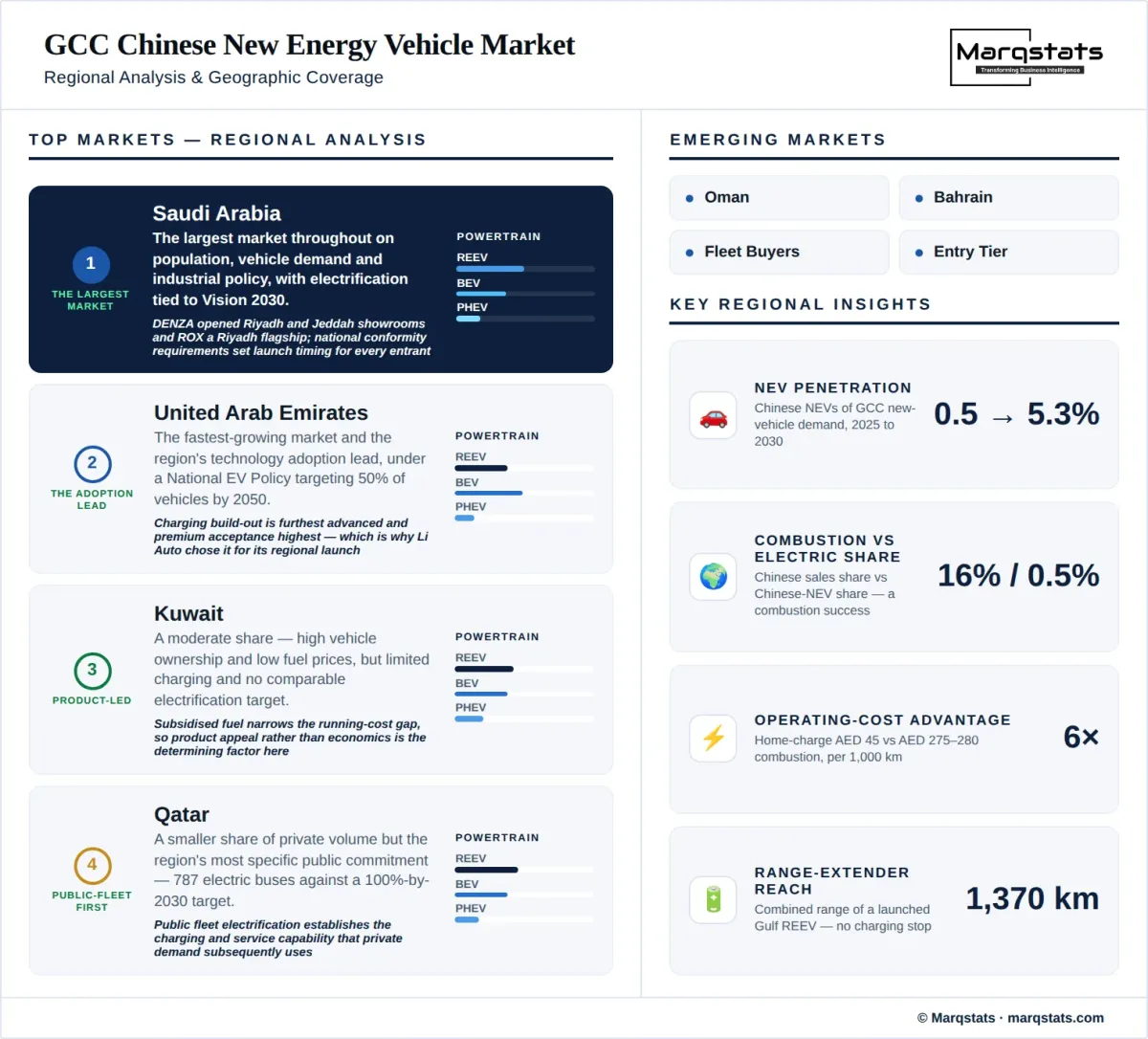
Economics support the switch independently of policy. At April 2026 pump prices of AED 3.28 to AED 3.39 per litre, a combustion vehicle averaging twelve kilometres per litre costs roughly AED 275 to 280 per thousand kilometres in fuel, against approximately AED 45 for a home-charged electric vehicle. A sixfold running cost gap is large enough to drive adoption without purchase subsidies, and it explains why Gulf electrification is proceeding on total cost of ownership arguments while other markets have depended on incentives.
Chinese New Energy Vehicle Sales Volume and Forecast
Chinese new energy vehicle sales across the six Gulf states rise from an estimated 7,500 units in 2025 to 88,000 by 2030, a 63.64% compound annual growth rate, with an indicative 2031 endpoint near 110,000 units. Growth is steepest in the first two forecast years as announced launches reach showrooms, and moderates in proportional terms while continuing to add the largest absolute volumes toward the end of the period.
Penetration is the more revealing measure. Against a reconstructed GCC new-vehicle market of 1,482,837 units in 2025, Chinese NEVs represent approximately 0.51% of demand. By 2030 that share is projected to reach roughly 5.25% on a market growing modestly. Chinese NEVs therefore become a mainstream but still minority part of Gulf demand across the forecast, which is a materially different claim from the electrification trajectories seen in Europe or China and should not be confused with them.
Blended transaction value falls from approximately USD 38,000 to USD 31,000 per vehicle, a 3.99% annual decline, which is why sales value compounds at 57.11% against 63.64% growth in units. The decline is a mix effect rather than discounting. Early Gulf volume has been weighted toward premium products, with the Li Auto L9 and the DENZA B8 sitting well above the segment average, and the composition shifts toward mid-market and entry models as BYD, Geely, Changan and the Chery sub-brands scale. Any forecast that holds price constant will overstate value growth by a wide margin.
Estimates are modelled and the base is a reconstruction rather than a count. Model-level tracking identifies 3,096 Chinese-brand NEV units across Saudi Arabia, the UAE, Kuwait and Oman in 2025, within 17,142 NEV-coded units in those four markets, and the same file records 195,544 units across the ten largest Chinese-brand nameplates there. The 3,096 figure is a lower bound rather than a total, because several fast-growing Chinese brands and models are either absent from the file or not fully powertrain-coded, and because Qatar and Bahrain fall outside its coverage. The 7,500-unit base extends that lower bound to all six states and to the brands the file misses.
Market Dynamics
Key Drivers
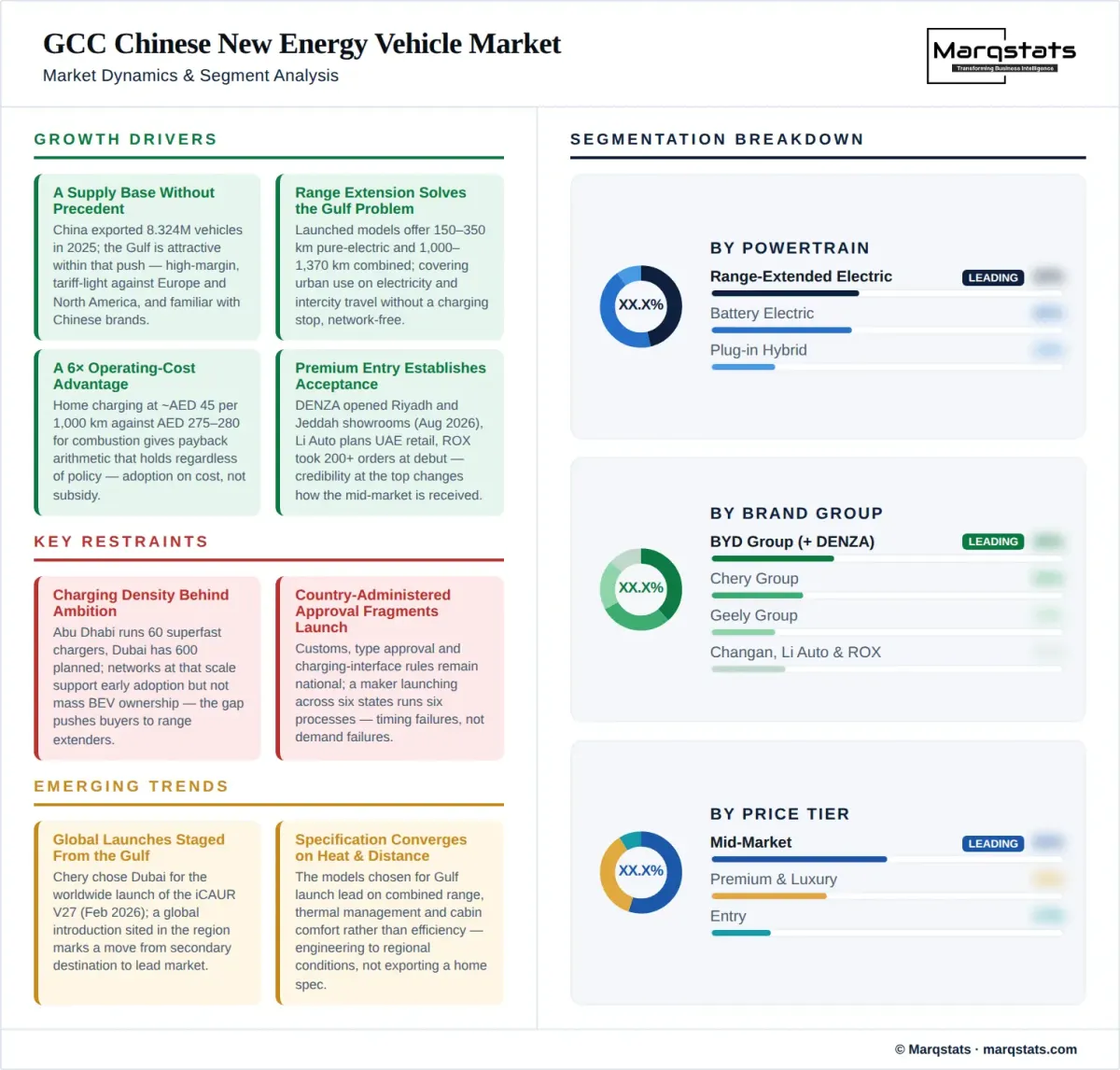
- A supply base without precedent. China exported 8.324 million motor vehicles in 2025, giving Chinese manufacturers capacity, model breadth and export intent on a scale no other supplier group can match. Gulf markets are attractive within that push because they are high-margin, right-hand-drive-free, tariff-light relative to Europe and North America, and already familiar with Chinese brands through a decade of combustion-vehicle sales.
- Range extension resolving the Gulf range problem directly. Launched models offer more than 150 kilometres of pure-electric range with over 1,000 kilometres combined in the case of the iCAUR V27, and 350 kilometres pure-electric with 1,370 kilometres combined for the Li Auto L9. A vehicle that covers daily urban use on electricity and intercity travel without a charging stop removes the principal objection to electrification in this region without waiting for network build-out.
- An operating cost advantage large enough to work without subsidy. Home charging at roughly AED 45 per thousand kilometres against AED 275 to 280 for a comparable combustion vehicle at April 2026 pump prices produces a payback arithmetic that holds regardless of policy. Gulf adoption is proceeding on total cost of ownership rather than on purchase incentives, which makes it less exposed to policy reversal than markets built on subsidy.
- Premium brand entry establishing acceptance at the top of the market. DENZA opened dedicated Riyadh and Jeddah showrooms in August 2026 with the Z and Z9GT confirmed for later in the year, Li Auto plans more than two retail and service centres in the UAE, and ROX Motor opened a Riyadh flagship with a local partner after taking more than 200 orders at its debut. Establishing credibility at premium price points changes how the mid-market products beneath them are received.
- Policy anchors setting direction without carrying the near-term volume. The UAE National Electric Vehicles Policy targets electric vehicles at 50% of vehicles on the road by 2050 and coordinates charging standards nationally. Qatar reported 787 electric public buses by the second quarter of 2025 against a 100% electric public and school bus target for 2030. Saudi electrification is tied to Vision 2030 alongside charging deployment and domestic manufacturing.
Key Restraints
- Charging density well behind vehicle ambition. Abu Dhabi operates 60 superfast chargers capable of an 80% charge in around twenty minutes, and Dubai has 600 superfast units planned through public-private partnership. Networks at that scale support early adoption but not mass battery electric ownership, and the gap between announced and operating capacity is the constraint that pushes buyers toward range extenders rather than pure electric vehicles.
- Country-administered approval fragmenting a regional launch. Customs, type approval, battery transport and charging-interface rules remain administered nationally even where Gulf standards support regional conformity, and Saudi conformity requirements sit alongside them. A manufacturer launching across six states runs six processes, and a GCC-wide plan built without country-level homologation, distributor and residual-value analysis will encounter timing failures rather than demand failures.
- Aftersales and battery service capability lagging the sales network. Showrooms open faster than workshops, and high-voltage diagnostics, battery assessment and parts availability determine retention once the parc reaches the age at which service matters. The installed base is young enough that this constraint has not yet bound, which makes it a forecast risk concentrated in the later years rather than a present difficulty.
- Residual values unproven for brands and powertrains without regional history. Neither Chinese brands at premium price points nor range-extended powertrains have a resale record in the Gulf, and lease and fleet economics depend on residual assumptions that cannot yet be validated. Fleet and corporate buyers, who would otherwise accelerate adoption, are the segment most exposed to that uncertainty.
Key Trends
- Global launches being staged from the Gulf rather than routed through it. Chery Group chose Dubai for the worldwide launch of the iCAUR V27 in February 2026 and for the brand's formal Middle East entry at the same event. A global product introduction sited in the region rather than a localised follow-on launch indicates the Gulf has moved from a secondary export destination to a lead market in Chinese product planning.
- Sub-brand proliferation changing segment shares faster than national data reveals. DENZA, iCAUR, OMODA, JAECOO, Deepal, Geely Galaxy and specialist entrants including ROX Motor and Li Auto have all arrived as distinct propositions rather than as model additions. Annual national totals cannot capture that movement, and model-level tracking is the only way to see category share shifting inside a reporting year.
- Product specification converging on heat and distance rather than on efficiency. The models selected for Gulf launch lead on combined range, thermal management and cabin comfort rather than on the efficiency metrics that dominate European and Chinese positioning. Manufacturers are engineering to regional operating conditions rather than exporting a home-market specification, which is a departure from how Chinese combustion vehicles entered the Gulf.
- Distribution consolidating around established Gulf groups. Chinese entrants are pairing with distributors that already hold major franchises and possess showroom estates, service networks and financing relationships, rather than building independent networks. Al-Futtaim carries DENZA in Saudi Arabia and a local group partnered ROX Motor in Riyadh, and that pattern places the constraint on entry at partner availability rather than at capital.
Market Segmentation
Range-extended electric vehicles are the fastest-growing powertrain and the technology Chinese manufacturers have led with in the Gulf, using an electric drivetrain with an onboard generator to combine urban electric running with intercity capability. Launched products offer 150 to 350 kilometres of pure-electric range and combined ranges from above 1,000 to 1,370 kilometres. The segment resolves both charging sparsity and heat-related range anxiety without requiring network investment first.
Battery electric vehicles hold the largest share of the category through the early forecast years, reflecting the models that entered the Gulf first and the availability of urban-focused products at accessible price points. Growth is real but gated by charging density, and the segment's share of the category declines as range-extended and plug-in hybrid alternatives address the intercity use case that battery electric vehicles serve least well in this region.
Plug-in hybrids occupy an intermediate position, retaining a conventional driveline alongside a modest battery and appealing to buyers unwilling to depend on public charging at all. Model-level tracking identifies 2,623 plug-in hybrid and mixed-code sport-utility units in the four-market Gulf subset in 2025. The segment benefits from familiarity and from service requirements closer to conventional vehicles.
Sport-utility vehicles and crossovers dominate the category throughout, consistent with Gulf buyer preference and with the products Chinese manufacturers have selected for regional launch. Every headline entry identified in the market, from the iCAUR V27 through the DENZA B8 to the Li Auto L9 and the ROX 01, is a sport-utility vehicle, and the segment carries both the premium and the volume propositions.
Sedans and hatchbacks hold a smaller share, serving urban buyers, fleet users and price-sensitive segments where range requirements are lower and running cost advantages are proportionally larger. The segment grows steadily rather than sharply, and its principal role in the forecast is to pull blended transaction value down as mainstream volume scales.
Multi-purpose vehicles and light commercial models are the smallest body type by volume and the segment where fleet purchasing rather than private buying determines outcomes. Delivery and passenger-transport applications generate high daily distances that maximise the operating cost advantage, and the constraint is depot charging capability and residual value certainty rather than product availability.
The premium tier carries a disproportionate share of value relative to volume in the early forecast years and is where Chinese brands have made their most deliberate positioning effort. DENZA's dedicated showrooms, Li Auto's retail and service plans and ROX Motor's flagship sites establish that Chinese products can be sold above the price points the brands historically occupied, and success at this tier is what makes the mid-market proposition credible.
The mid-market tier becomes the largest by both volume and value across the forecast, absorbing the majority of the growth as BYD, Geely, Changan and the Chery sub-brands bring higher-volume products into the region. This is the tier where Chinese manufacturers compete most directly with established Japanese and Korean incumbents, and where the operating cost argument is most decisive for a buyer.
The entry tier is the smallest of the three throughout, constrained by the cost of battery capacity and thermal management relative to the price point rather than by demand. Its expansion depends on battery cost reduction reaching the level at which an electrified vehicle can be delivered at conventional entry-segment pricing without stripping the range and cooling capability that Gulf conditions require.
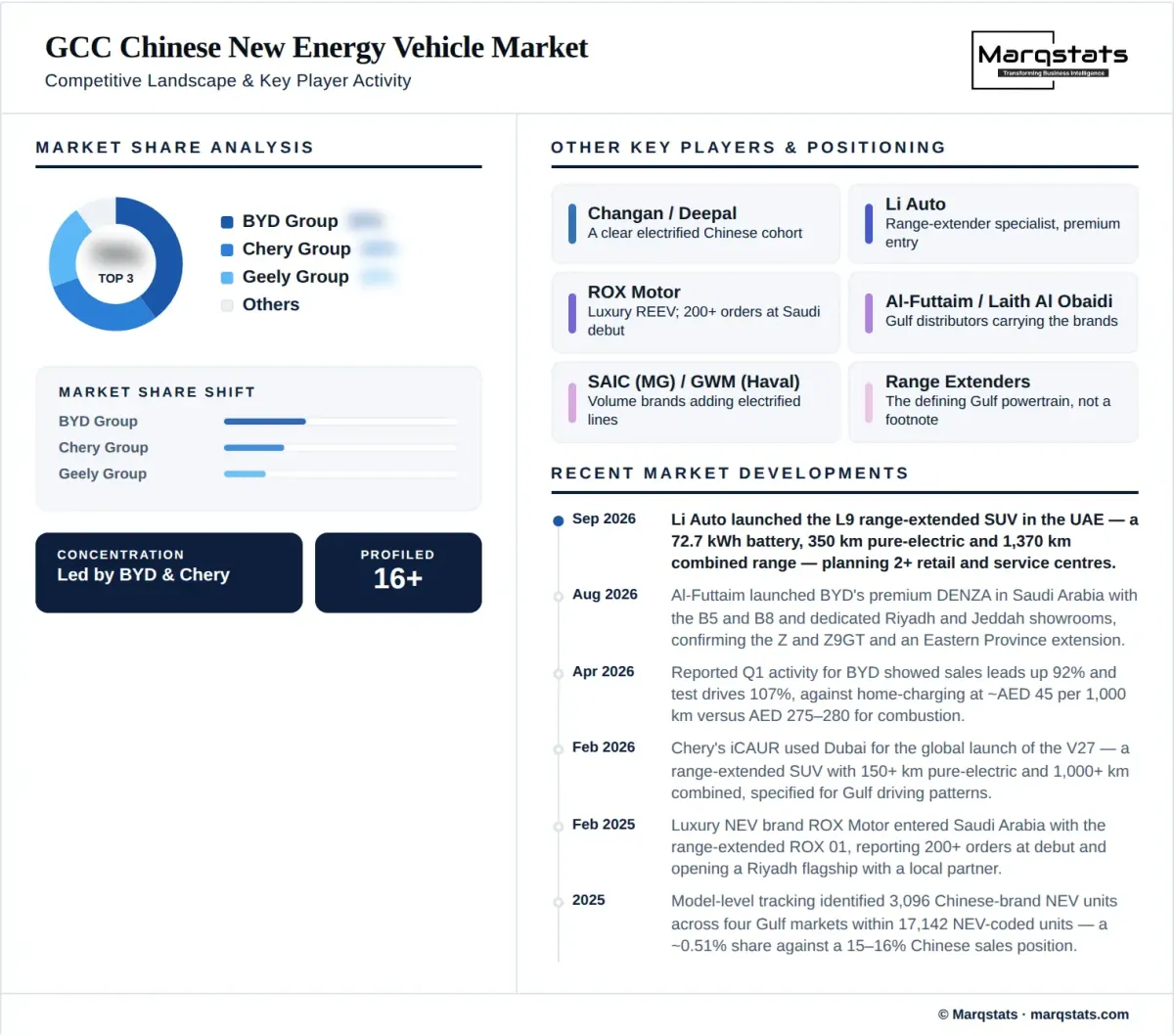
BYD Group holds the largest share of the category, combining volume battery electric and plug-in hybrid products with the premium DENZA brand launched in Saudi Arabia in August 2026. Reported first-quarter 2026 activity in the region showed sales leads rising 92% and test drive activity 107%, indicating demand movement ahead of registration data. The group's distributor relationships with major Gulf franchise holders give it the broadest retail reach of any Chinese entrant.
Chery Group competes through the widest sub-brand portfolio in the region, spanning iCAUR, OMODA and JAECOO alongside the parent marque, and covering plug-in hybrid, range-extended and conventional products. Choosing Dubai for the global launch of the iCAUR V27 in February 2026 placed the group's newest electrified proposition in the Gulf ahead of other markets, which is an unusual sequencing decision and a deliberate one.
Geely Group builds on an established Gulf combustion presence, extending into battery electric and plug-in hybrid products through the Geely Galaxy line. The group's position rests on converting an existing customer base and distributor network to electrified products rather than on establishing a new brand, which is a lower-cost route to volume and a slower one to premium positioning.
Changan and its Deepal sub-brand form one of the clearest electrified Chinese cohorts in Gulf model-level tracking, while Li Auto and ROX Motor represent a different proposition: range-extender specialists entering at premium price points with no combustion legacy in the region. Li Auto brought the L9 to the UAE in September 2026 and ROX Motor entered Saudi Arabia in February 2025 with more than 200 orders at debut, creating a premium range-extended sub-segment that did not previously exist.
By Geography
Saudi Arabia
Saudi Arabia is the largest market throughout on population, vehicle demand and industrial policy, with electrification tied to Vision 2030 alongside charging deployment and domestic manufacturing ambitions. DENZA opened Riyadh and Jeddah showrooms in August 2026 with an Eastern Province extension planned, and ROX Motor established its first flagship in Riyadh with a local partner. Conformity and homologation requirements are administered nationally and set launch timing for every entrant.
United Arab Emirates
The United Arab Emirates is the fastest-growing market and the region's technology adoption lead, supported by the National Electric Vehicles Policy targeting electric vehicles at 50% of vehicles on the road by 2050 with nationally aligned charging standards. Charging build-out is furthest advanced, with 60 superfast chargers in Abu Dhabi and 600 planned across Dubai under public-private partnership, and premium acceptance is highest, which is why Li Auto selected the country for its regional launch.
Kuwait
Kuwait holds a moderate share, combining high vehicle ownership and low fuel prices with limited charging infrastructure and no comparable national electrification target. The operating cost argument is weakest here because subsidised fuel narrows the running cost gap that drives adoption elsewhere in the region, which makes product appeal rather than economics the determining factor.
Qatar
Qatar holds a smaller share of private vehicle volume but carries the region's most specific public electrification commitment, reporting 787 electric public buses by the second quarter of 2025 against a target of 100% electric public and school buses by 2030, with the strategy also supporting domestic electric bus assembly. Public fleet electrification establishes charging and service capability that private demand subsequently uses.
Oman and Bahrain
Oman and Bahrain together hold the smallest share, with lower absolute vehicle volumes and charging networks at an earlier stage. Both sit outside the model-level coverage that anchors the rest of the estimate, which makes their contribution the least precisely measured part of the market. Proximity to larger neighbours means distribution is frequently managed regionally rather than through dedicated national operations.
How Competition Is Evolving
The market is fragmented and unusually crowded for its size, with more distinct Chinese brands and sub-brands present than the annual volume would normally support. BYD Group, Chery Group with three sub-brands, Geely, Changan with Deepal, and specialist entrants including Li Auto and ROX Motor are all competing for a category that sold an estimated 7,500 units across six countries in 2025. That density reflects strategic positioning for a market expected to multiply rather than competition for present volume, and a period of consolidation among the weaker entrants is more likely than not.
Competitive position is determined by distributor partnership rather than by product. Chinese entrants are pairing with established Gulf groups that hold showroom estates, service networks and financing relationships, because building those assets independently would take longer than the launch window allows. Al-Futtaim's role with DENZA in Saudi Arabia and a local group's partnership with ROX Motor in Riyadh follow the same logic, and the practical constraint on a new entrant is the availability of a credible partner rather than access to capital or product.
The decisive competition over the forecast period is against Chinese combustion vehicles rather than against Western or Japanese electrified ones. Chinese brands already hold roughly 15% to 16% of new passenger sales in the two largest Gulf markets on a combustion proposition built around price and specification, and the electrified products arriving now must persuade that existing customer base to pay more for a different powertrain. A buyer already comfortable with a Chinese brand is the most likely first electrified customer, and the incumbent Chinese combustion model is the most likely alternative purchase.
Companies Covered
The report profiles 16+ companies with full strategy and financials analysis, including:
Recent Market Activity
Table of Contents
Coverage & Segmentation
The study covers the six Gulf Cooperation Council states with country-level detail for Saudi Arabia, the United Arab Emirates, Kuwait, Qatar, and Oman and Bahrain combined. It measures new Chinese-brand battery electric, plug-in hybrid and range-extended vehicle sales in units as the primary measure, with annual sales value in United States dollars as the secondary measure. The base year is 2025, the historical period covers 2021 to 2025, and the forecast period runs from 2026 to 2030 with an indicative 2031 endpoint. Segmentation covers powertrain, body type, price tier and brand group.
Four boundaries define the market. Non-Chinese electrified vehicles are excluded, so the study measures a brand-origin cut of the Gulf electrified market rather than the electrified market itself. Conventional hybrids without external charging capability are excluded, as are conventional combustion vehicles from the same manufacturers, which is a material exclusion given that Chinese brands already hold roughly 15% to 16% of new passenger sales in the two largest Gulf markets. Used and re-exported vehicles are excluded, since the Gulf handles substantial transit volume that never registers locally. Commercial vehicles above the light commercial threshold, including electric buses, are excluded.