Market Snapshot
Key Takeaways
Market Overview & Analysis
Report Summary
The GCC Chinese vehicle aftermarket covers the paid parts and work consumed by Chinese-brand vehicles operating across the six Gulf states: replacement parts, scheduled maintenance and mechanical repair labour, body and paint work, and the diagnostics and software services that electrified and connected vehicles require. Demand is a function of two variables, the size of the vehicle population and the annual spend each vehicle generates, and both move quickly and in the same direction across the forecast.
The parc is young by any regional standard and that shapes everything about the market's timing. Model-level tracking records roughly 760,559 Chinese-brand sales across four Gulf markets between 2021 and 2025, and the pack treats that as a lower-bound indicator before Qatar, Bahrain and pre-2021 vehicles are added. Vehicles in their first three years consume scheduled servicing and consumables, much of it under warranty; vehicles beyond that consume the wear items and accumulated repairs that make aftermarket revenue. The commercial thesis rests entirely on the earliest cohorts crossing that threshold inside the forecast period.
Regulation converts service capability from a competitive choice into a licensing condition in the region's largest market. Saudi commercial agency rules impose spare-parts, maintenance, warranty and consumer-service obligations, require continuously demanded parts to be available and rare parts generally supplied within fourteen days, and the Ministry of Commerce publishes dealership performance assessments covering after-sales service, maintenance duration and spare-parts availability while retaining power to fine agencies for violations. Parts depth is therefore a condition of holding a franchise, not a differentiator built on top of one.
Chinese-Brand Vehicle Parc and Aftermarket Spend
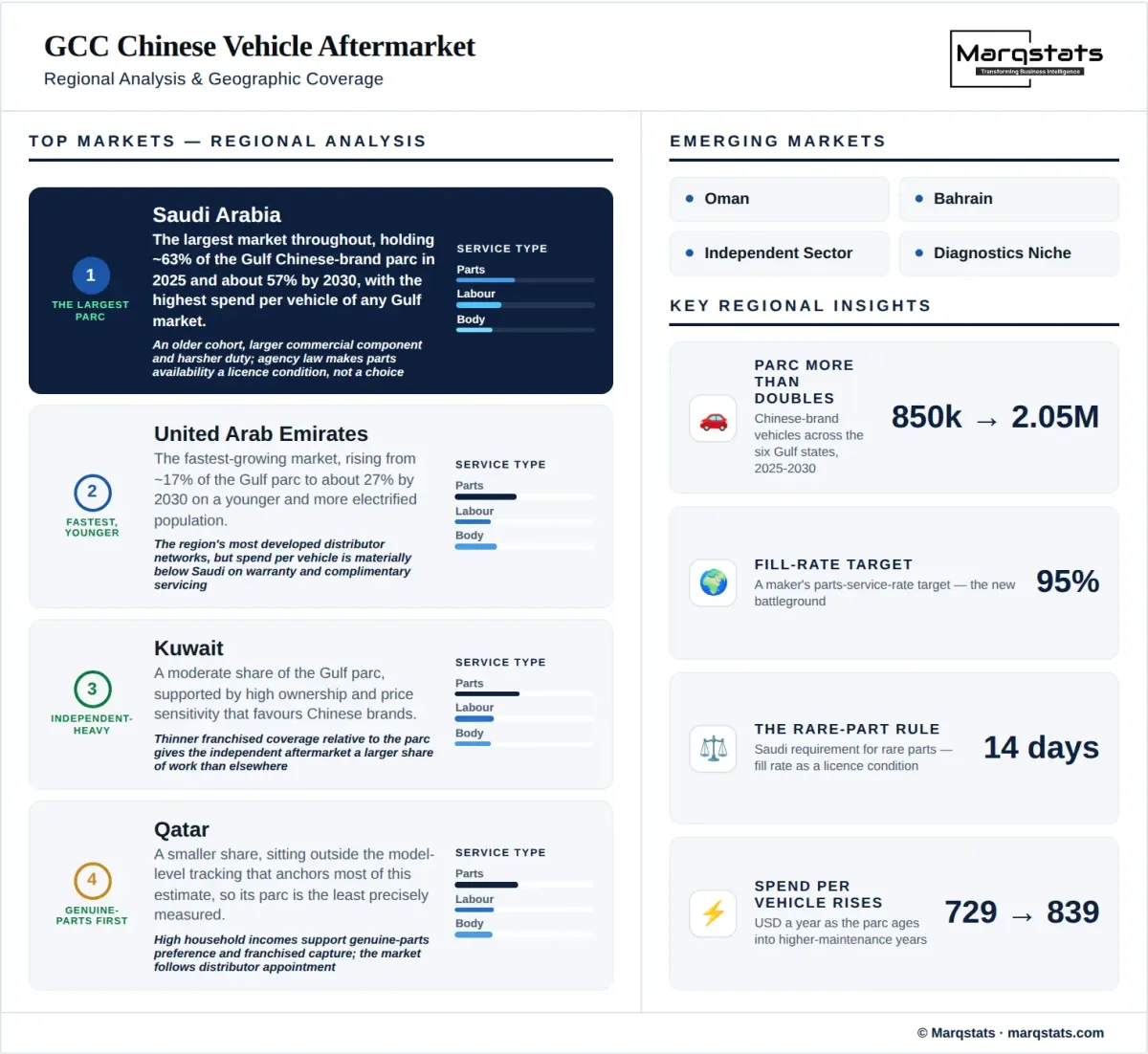
The Chinese-brand vehicle population across the six Gulf states rises from approximately 850,000 in 2025 to 2,050,000 by 2030, a 19.25% compound annual growth rate. The 2025 figure combines the tracked four-market cohort of 760,559 units with pre-2021 vehicles still in service and with Qatar and Bahrain, neither of which falls inside the tracking file. Saudi Arabia contributes roughly 535,000 of the 2025 parc and the United Arab Emirates about 145,000.
The country balance shifts materially across the period. Saudi Arabia holds approximately 63% of the Gulf Chinese-brand parc in 2025, falling to about 57% by 2030 as the Emirati parc grows faster from a smaller and younger base, rising from 17% to roughly 27%. Kuwait, Qatar, Oman and Bahrain together hold the remaining share, which contracts slightly in proportional terms even as it grows in absolute units. Saudi Arabia remains the largest single market throughout by a wide margin.
Blended annual aftermarket spend per vehicle rises from approximately USD 729 to USD 839, a 2.85% annual increase, which is why revenue compounds at 22.65% against 19.25% growth in the parc. The increase is an ageing effect rather than price inflation, and it is heavily weighted by market. Saudi Arabia carries a materially higher spend per vehicle than the Emirates, reflecting an older Chinese cohort, a larger commercial vehicle component and harsher duty cycles, while the Emirati parc is younger and more heavily suppressed by manufacturer warranty and complimentary servicing terms.
Estimates are modelled and the parc figure is a reconstruction rather than a census. The tracking file covers four of six states, records sales rather than vehicles in service, and does not capture every Chinese manufacturer consistently. Per-vehicle spend is derived separately by market and powertrain rather than applied uniformly, because a young Emirati battery electric vehicle and a four-year-old Saudi commercial vehicle generate entirely different service demand. Confidence is medium, with the parc assumption stronger than the spend assumption.
Market Dynamics
Key Drivers
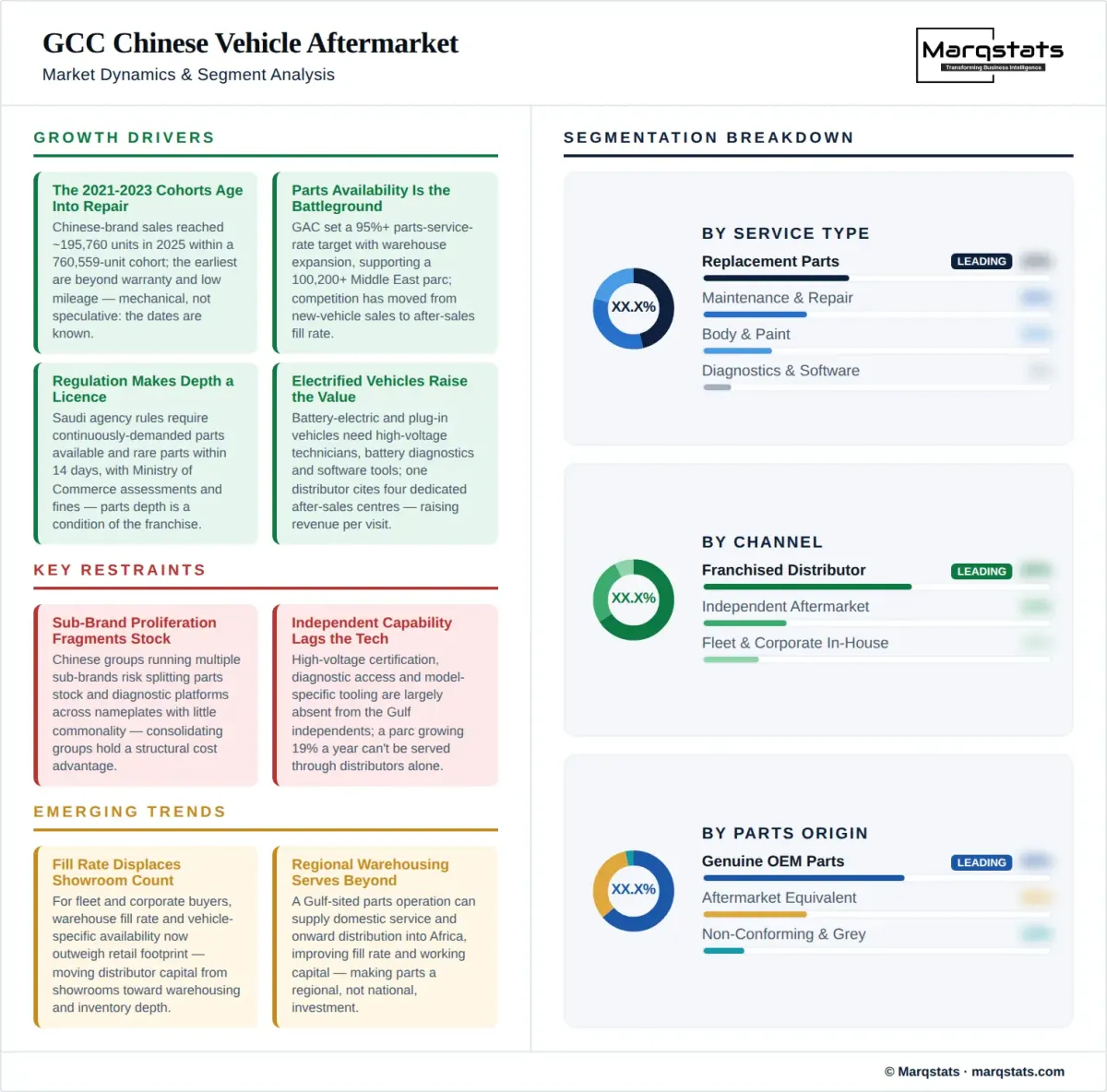
- The 2021 to 2023 cohorts entering higher-maintenance years. Chinese-brand sales across the tracked Gulf markets reached roughly 195,760 units in 2025 alone within a 760,559-unit five-year cohort, and the earliest of those vehicles are now beyond initial warranty and low-mileage periods. The vehicles exist and their sale dates are known, so the only open question is which channel captures the work rather than whether the work occurs.
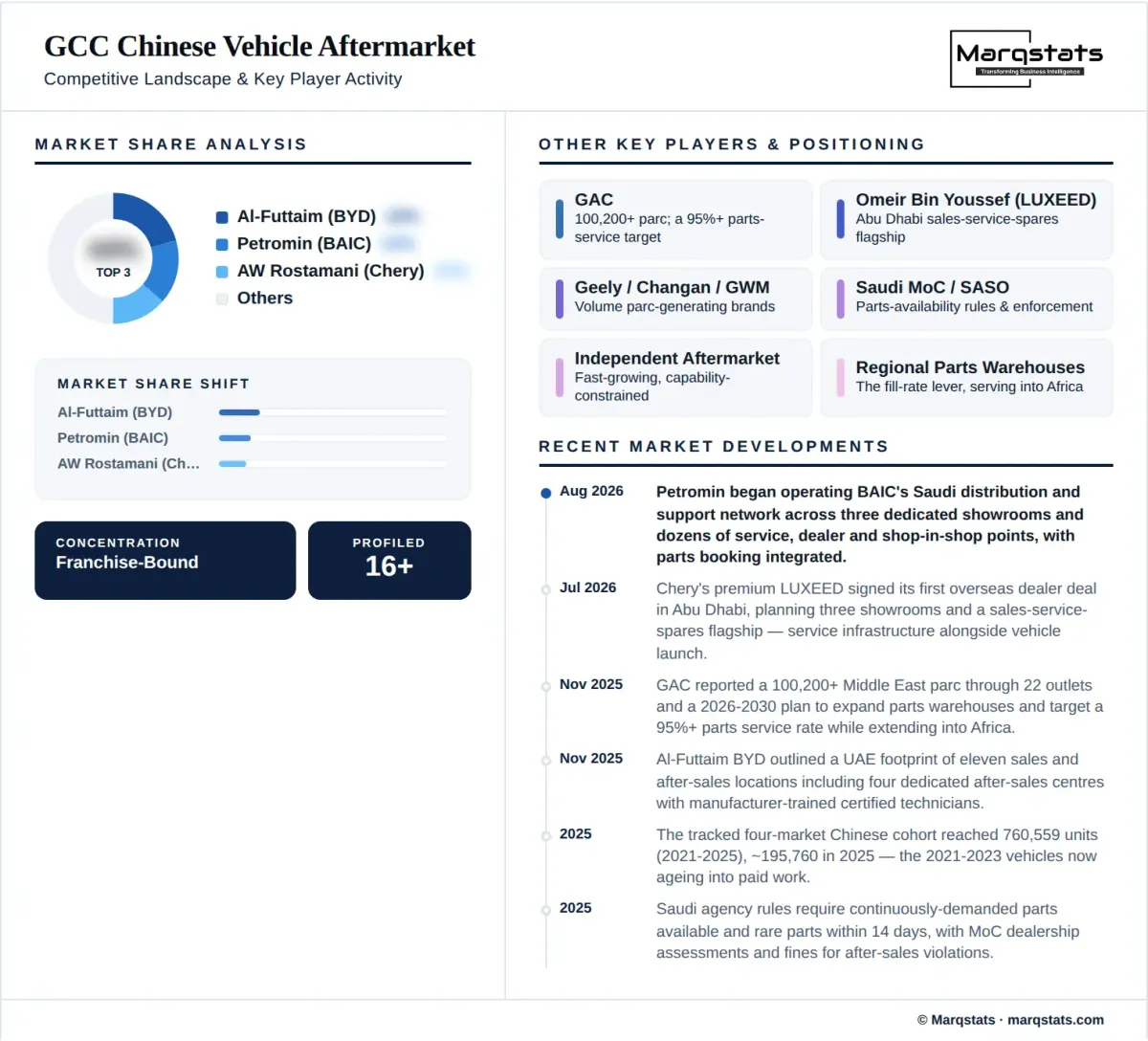
- Parts availability becoming the competitive battleground. GAC set a parts service rate target above 95% alongside warehouse expansion in its 2026 to 2030 regional plan, supporting a Middle East parc above 100,200 vehicles through 22 sales outlets. Competition among Chinese manufacturers in the Gulf has moved from new-vehicle sales toward after-sales execution, and fill rate is the metric on which that competition is now being fought.
- Regulatory obligations making service depth a licensing condition. Saudi agency rules require continuously demanded parts to be available and rare parts generally supplied within fourteen days, and the Ministry of Commerce publishes dealership assessments covering after-sales service, maintenance duration and parts availability with power to fine agencies for violations. A distributor that fails on parts risks the franchise rather than a service job.
- Distribution networks expanding faster than the parc they serve. Petromin took on BAIC's Saudi distribution and support network in August 2026 with three dedicated showrooms and dozens of service, dealer and shop-in-shop points. A premium Chinese sub-brand signed its first overseas dealer agreement in Abu Dhabi in July 2026 with a three-sales-service-spares flagship scheduled by the end of that year, building support infrastructure alongside vehicle launch rather than after it.
- Electrified vehicles raising the technical content and value of a service visit. Battery electric and plug-in vehicles require high-voltage technicians, battery diagnostics, thermal management expertise and manufacturer software tools. One Emirati distributor cites eleven sales and after-sales locations with four dedicated after-sales centres staffed by manufacturer-trained and internationally certified technicians, which raises revenue per visit while narrowing the set of workshops able to perform the work.
Key Restraints
- Sub-brand proliferation fragmenting parts inventory. Chinese groups operating multiple sub-brands in the Gulf risk splitting parts stock and diagnostic platforms across nameplates that share little commonality, which raises working capital per vehicle supported and lowers fill rate at any given inventory investment. Groups that consolidate logistics and diagnostic platforms across their brands hold a structural cost advantage over those that do not.
- Independent sector capability lagging the technology. High-voltage certification, manufacturer diagnostic access and model-specific tooling are largely absent from the Gulf independent aftermarket, which protects franchised margins in the near term but caps total market development. A parc growing at 19% a year cannot be served entirely through distributor networks, and unserved demand suppresses realised revenue rather than transferring it.
- Non-conforming and counterfeit parts creating compliance and reputational exposure. Regional standards conformity applies to imported replacement parts, and non-conforming supply creates risk for distributors and independent workshops alike. The exposure is greatest on fast-moving service items where price competition is sharpest, and it suppresses realisable value for compliant suppliers in exactly the segments that generate the most volume.
- Warranty and complimentary servicing deferring paid work. Chinese brands have used extended warranty and free servicing periods as market-entry instruments across the Gulf, and work performed under those terms is manufacturer-funded rather than customer-paid. The effect is concentrated in the youngest parcs, which is why the Emirati market shows materially lower spend per vehicle than the Saudi one despite comparable vehicle values.
Key Trends
- Fill rate displacing showroom count as the purchase driver. For fleet and corporate buyers, warehouse fill rate and vehicle-specific parts availability now weigh more heavily in brand selection than retail footprint. That shift changes what a distributor must invest in, moving capital from showrooms toward warehousing, inventory depth and the systems that make vehicle-level availability visible to a customer before purchase.
- Regional parts warehousing serving beyond the domestic market. A parts operation sited in the Gulf can supply domestic service and onward distribution across the region and into Africa, improving fill rate and working capital efficiency against a single-market warehouse. One manufacturer has stated it will extend its regional support model into Africa gradually, which makes parts capability a regional investment decision rather than a national one.
- Diagnostics emerging as a higher-margin niche. Battery and advanced driver assistance system diagnostics require capability that neither traditional mechanical workshops nor most independents hold, and they carry margins well above conventional service labour. As the electrified parc expands, these specialisms become the segment where a technically capable independent can compete without matching a distributor's parts inventory.
- Service infrastructure arriving with market entry rather than after it. Recent Gulf brand launches have paired vehicle introduction with sales, service and spares facilities from the outset. The pattern reflects a recognition that Chinese-brand retention in the region now depends on after-sales credibility, and it raises the capital threshold for entry while shortening the lag between vehicle sales and aftermarket revenue.
Market Segmentation
Replacement parts are the largest service type by value throughout, covering wear items, service components, collision parts and the consumables consumed across the parc. Demand is driven by vehicle age, utilisation and operating conditions rather than by sales cycles, which makes it the most stable revenue line in the market and the one on which Saudi regulatory obligations bear most directly.
Maintenance and repair labour is the fastest-growing service type as the parc ages, covering scheduled servicing beyond complimentary periods, mechanical repair, brakes, suspension, cooling and air conditioning work. Labour capture depends on channel: a vehicle serviced in a franchised network generates both parts and labour revenue, while a parts sale through an independent channel generates only the first.
Body and paint work covers collision repair, panel replacement and refinishing, and its volume tracks the vehicle population rather than its age since accident frequency is largely independent of vehicle year. Parts intensity is the highest of any service type, which makes panel availability for recently introduced Chinese models the binding constraint rather than workshop capacity.
Diagnostics and software services are the smallest segment by value and the fastest-growing by rate, covering fault diagnosis, battery and high-voltage system assessment, advanced driver assistance calibration and software updates. Margins are materially above conventional labour, and the capability requirement confines most of the work to franchised networks and specialist independents rather than general workshops.
Internal combustion vehicles account for the majority of the Gulf Chinese-brand parc and of aftermarket revenue throughout the forecast. Service requirements are conventional and workshop capability is widely held, which makes this the segment where independent competition emerges first and where parts price competition is sharpest, including exposure to non-conforming supply.
Plug-in hybrid and range-extended vehicles carry the broadest service requirement of the three categories, combining a combustion powertrain and fuel system with a high-voltage battery and electric drivetrain. Revenue per vehicle is correspondingly the highest, and the dual-domain capability requirement is the reason distributor service investment matters more for these vehicles than for either pure architecture.
Battery electric vehicles are the fastest-growing powertrain in service terms and shift work away from mechanical wear toward high-voltage diagnostics, battery assessment, thermal management and software. Certification and tooling requirements retain most of this work inside franchised networks well beyond the warranty period, which is why the electrified parc supports higher franchised share than the combustion parc does.
Franchised distributor networks hold the dominant share throughout, sustained by parc age, warranty terms, regulatory parts obligations and the technical requirements of electrified models. Every significant service network investment identified in the market sits in this channel, and Saudi agency rules effectively require distributors to maintain the parts depth that underpins their position.
The independent aftermarket is the fastest-growing channel from a small base, entering as vehicles pass beyond warranty and complimentary servicing. Growth is constrained by diagnostic access, high-voltage certification and parts supply rather than by demand. The practical entry strategy is to prioritise high-failure and fast-moving components and collision parts rather than attempting full catalogue coverage, which no independent can fund across the number of Chinese nameplates now in the region.
Fleet and corporate in-house operations cover rental companies, ride-hailing operators, government and corporate users maintaining vehicles internally or under negotiated contracts. Fleet vehicles accumulate distance several times faster than private ones, which pulls service demand forward, and fleet buyers are the segment most responsive to parts fill rate because vehicle downtime carries a direct commercial cost.
Genuine manufacturer parts hold the largest share by value, supported by warranty conditions, franchised network supply and the regulatory obligations that make availability a licensing matter in the region's largest market. Supply depends on manufacturer parts channels with lead times measured against shipments from China, which is why regional warehousing is the principal lever available to improve fill rate.
Aftermarket equivalent parts grow fastest as the parc ages beyond warranty and independent workshops establish supply relationships. The segment is thin today because Chinese models introduced within the past three years have limited independent catalogue coverage, and its development is the clearest single indicator of whether a genuine independent service channel is forming around these brands.
Non-conforming and grey-market parts represent a share that suppresses realisable value for compliant suppliers rather than a legitimate market segment. Regional standards conformity applies to imported replacement parts and non-conforming supply creates compliance and reputational exposure for distributors and workshops alike, with the greatest concentration in fast-moving service items where price competition is sharpest.
By Geography
Saudi Arabia
Saudi Arabia is the largest market throughout, holding roughly 63% of the Gulf Chinese-brand parc in 2025 and about 57% by 2030, with the highest spend per vehicle of any Gulf market on an older cohort, a larger commercial vehicle component and harsher operating conditions. Commercial agency law imposes spare-parts, maintenance and warranty obligations, and the Ministry of Commerce publishes dealership assessments and fines agencies for after-sales violations. Petromin's assumption of BAIC distribution in August 2026 illustrates the scale of network build underway.
United Arab Emirates
The United Arab Emirates is the fastest-growing market, rising from roughly 17% of the Gulf Chinese-brand parc in 2025 to about 27% by 2030 on a younger and more electrified vehicle population. Spend per vehicle is materially below the Saudi level because the parc is younger and more heavily covered by warranty and complimentary servicing. Distributor networks are the most developed in the region, with one carrying eleven sales and after-sales locations including four dedicated after-sales centres.
Kuwait
Kuwait holds a moderate share of the Gulf Chinese-brand parc, supported by high vehicle ownership and strong price sensitivity that favours Chinese brands. Service network development trails the two lead markets, and the independent aftermarket holds a comparatively larger share of work than elsewhere in the region because franchised coverage is thinner relative to the vehicle population.
Qatar
Qatar holds a smaller share and sits outside the model-level tracking that anchors most of this estimate, making its parc the least precisely measured alongside Bahrain. High household incomes support genuine-parts preference and franchised service capture, and the market follows distributor appointment rather than developing independent demand ahead of network investment.
Oman and Bahrain
Oman and Bahrain together hold the smallest share of Gulf Chinese-brand aftermarket value. Oman appears in the model-level tracking and Bahrain does not, so their combined contribution rests on partial evidence. Both are served substantially through regional distribution arrangements rather than dedicated national operations, which links their service capability to decisions taken in larger neighbouring markets.
How Competition Is Evolving
Competition runs between distributor groups rather than between manufacturers, which is the structural fact that shapes this market across every Gulf state. Each Chinese brand operates through an exclusive national distributor that owns the workshops, the parts inventory and the customer relationship, so a brand's aftermarket strength reflects its partner's investment capacity rather than the manufacturer's global standing. Petromin carries BAIC in Saudi Arabia, established Emirati groups carry BYD and Chery, and a premium sub-brand has taken an Abu Dhabi partner with an existing after-sales network.
The competitive instrument has shifted decisively from retail to parts. A manufacturer targeting a parts service rate above 95% and expanding regional warehousing is competing on a metric a fleet buyer can verify, while showroom count is not. That shift favours groups able to fund inventory depth and regional warehousing over those able only to fund retail expansion, and it advantages manufacturers that consolidate parts logistics and diagnostic platforms across their sub-brands rather than allowing each nameplate to carry its own stock.
The contest that determines where value settles over the forecast is between franchised networks and an independent sector that barely exists. Warranty terms, regulatory parts obligations and the certification requirements of electrified vehicles all hold work inside distributor networks at the point where a conventional owner would defect. If those instruments hold, franchised share stays unusually high for a maturing parc and the independent opportunity remains confined to older combustion vehicles and collision work. If they do not, the fastest-growing channel from 2028 is one that today has neither the tooling nor the parts supply to serve the vehicles it would inherit.
Companies Covered
The report profiles 16+ companies with full strategy and financials analysis, including:
Recent Market Activity
Table of Contents
Coverage & Segmentation
The study covers the six Gulf Cooperation Council states with country-level detail for Saudi Arabia, the United Arab Emirates, Kuwait, Qatar, and Oman and Bahrain combined. It measures annual paid aftermarket revenue generated by Chinese-brand vehicles in United States dollars, with the Chinese-brand vehicle population carried as the secondary unit. The base year is 2025, the historical period covers 2021 to 2025, and the forecast period runs from 2026 to 2030 with an indicative 2031 endpoint. Segmentation covers service type, powertrain, channel and parts origin.
Four boundaries define the market. Vehicle sales revenue is excluded; only parts and work consumed after delivery are counted. Manufacturer-funded warranty and complimentary servicing are excluded because the customer pays nothing, which materially reduces the addressable pool in the youngest markets. Service on non-Chinese brands is excluded entirely. Fuel, insurance, registration and financing are excluded. The brand cohort underpinning the parc covers four of six states, records sales rather than vehicles in service, and does not capture every Chinese manufacturer consistently, so the parc figure is a reconstruction rather than a census.
Two national studies measure components of this market at country scale. The Saudi Arabia Chinese vehicle spare parts study covers parts only, without labour, on a 2021-onward cohort basis, and the United Arab Emirates Chinese vehicle after-sales service study covers parts and labour on a parc including pre-2021 vehicles. Both sit inside the Gulf figures reported here, but they use different scope and different parc bases, so neither can be added to the other nor read as directly comparable.