Market Snapshot
Key Takeaways
Market Overview & Analysis
Report Summary
Morocco's end-of-life vehicle market is defined by a gap between how many vehicles retire and how many are processed industrially. Generation is a demographic outcome of a 4,747,215-vehicle parc ageing at a predictable rate; formal treatment is an industrial capacity and feedstock question. Conflating the two produces a market that looks either far too small or far too large depending on which number is quoted.
Before 2026 the country had no automaker-led industrial dismantling capacity at all, and available evidence describes activity as predominantly fragmented and informal. The opening of a 10,000-vehicle-a-year centre at Ain Sebaa changed the structure rather than the volume: national generation did not move, but the share capable of being processed through traceable channels did, and that distinction runs through every section of this analysis.
The audience is circular-economy investors, dismantling and recycling operators, insurers and auction platforms managing total-loss disposal, parts distributors, and policy analysts tracking formalisation. The commercial framing throughout is that the addressable market is formal treatment share and its downstream parts value, with total generation serving as the ceiling rather than the opportunity.
Morocco End-of-Life Vehicle Market Size and Forecast
End-of-life vehicle generation is estimated at 85,000 vehicles in 2025, rising to 90,000 in 2026 and 118,000 by 2031. Confidence is graded low and the estimate is presented with a deliberately broad range, because no official national series for end-of-life vehicle generation exists in the available evidence. The figure is modelled by applying an effective annual retirement rate in the high one-percent range to a growing parc.
Two growth rates apply and both are published. The six-year rate connecting 2025 and 2031 is 5.62%. The five-year rate connecting 2026 and 2031 is 5.57%, and the two are unusually close because generation is a slow demographic process rather than an investment-driven one. Neither rate should be applied to formal processing volumes, which grow at a completely different speed.
The 2026 estimate increases only modestly because generation is driven by the parc and its age profile, not by the opening of a single dismantling centre. That point bears repeating because it is the most common error in reading this market: a 10,000-vehicle-a-year facility changes how many vehicles can be processed formally, not how many reach end of life.
The 2031 forecast reflects a larger parc and gradual ageing. Morocco's vehicle population continues to grow with new registrations of 235,372 units in 2025, and each additional year of parc growth widens the base from which future retirements are drawn. Formal treatment share can grow far faster than total generation, and it does.
The Parc, the Retirement Rate and the Generation Series
Morocco's road vehicle parc reached 4,747,215 units at end-2024, comprising approximately 3.11 million passenger cars, 1.30 million utility vehicles and 339,001 motorcycles. That population is the denominator for every figure on this page, and it is the one number in this market that is officially reported rather than modelled.
Applying the 2025 generation estimate of 85,000 vehicles to that parc implies an effective retirement rate of approximately 1.79%. That is low by European standards, which is consistent with a market where vehicles are repaired and kept in service far longer, informal repair is cheap and no scrappage incentive structure pulls older vehicles out of circulation.
The retirement rate is the single assumption on which the whole generation series rests, and it is disclosed rather than embedded. A rate half a percentage point higher would add roughly 24,000 vehicles to 2025 generation, and any client with better evidence on Moroccan vehicle survival curves should restate the series on their own rate rather than accepting this one.
Formal Treatment Share Against Total Generation
The addressable investment market is formal treatment share, not total generation, and the two should be modelled separately. Vehicles processed through organised industrial channels are estimated at approximately 2,000 in 2025, around 6,000 in 2026 as the Casablanca centre ramps through its first partial year, and 30,000 by 2031 as additional formal operators and higher insurer and auction capture develop.
Expressed as share, formal capture moves from roughly 2.4% of generation in 2025 to about 6.7% in 2026 and approximately 25.4% by 2031. That is a tenfold shift in six years, and it happens while the underlying generation series grows at under 6% a year. Every commercial argument in this market rests on that divergence rather than on the volume of vehicles retiring.
The implied growth rate for formal processing is approximately 38.0% a year across 2026 to 2031, and it must not be applied to total generation or described as market growth. It reflects formalisation from a very small base: a rate that high says the starting point was near zero, not that the market is expanding at that speed.
Even at 30,000 vehicles in 2031, roughly three-quarters of end-of-life vehicles remain outside organised industrial channels. The forecast deliberately does not assume full formalisation, because regulatory structure, collection economics and informal-yard competition all remain unresolved, and a forecast that assumed otherwise would be modelling a policy outcome rather than a market.
Industrial Dismantling Capacity and Economics
Stellantis opened a circular-economy vehicle dismantling centre at Ain Sebaa, Casablanca on 5 May 2026, its first in Morocco and the wider Middle East and Africa region and its third worldwide after Turin and São Paulo. The EUR 1.6 million site covers 6,000 square metres, can dismantle up to 10,000 vehicles annually and is expected to support around 150 direct and indirect jobs at full capacity.
That single facility represents nearly 12% of 2025 national generation in nameplate terms, which is the clearest evidence of how thin organised capacity was beforehand. The 2026 estimate assumes approximately 6,000 vehicles processed during the first partial year rather than full-year nameplate, because a facility opening in May cannot run twelve months and ramp simultaneously.
The operating sequence is vehicle reception, depollution, selective component dismantling, quality inspection, cataloguing and redistribution through aftermarket channels, with non-reusable material proceeding to recycling streams. Depollution and hazardous-fluid and battery handling are the compliance-critical stages and the ones informal yards are least equipped to perform.
Utilisation is determined by collection contracts and parts resale rather than by theoretical national scrappage. A plant sized against 85,000 vehicles of national generation but holding feedstock agreements for 4,000 will run at 4,000, which is why a new entrant should build an insurer and auction network before committing to processing capacity rather than after.
Material Recovery and Scrap Value
A peer-reviewed study published in March 2025 examined Morocco's informal end-of-life vehicle sector at the Salmia scrap market and quantified material recovery from sampled passenger cars at approximately 76% iron and 7% aluminium by weight. That is the only published Moroccan measurement of vehicle material composition in the available evidence, and it establishes the floor value of an end-of-life vehicle independent of any parts recovery.
Ferrous recovery at roughly three-quarters of vehicle weight ties this market directly to domestic steel demand, since scrap is an input to electric-arc steelmaking rather than an export commodity by default. Non-ferrous recovery is smaller by weight but disproportionately valuable per tonne, and aluminium at approximately 7% is where much of the metal value per vehicle actually sits.
Scrap metal value alone understates the opportunity, and this is the most important commercial correction on the page. Recovered-part economics depend on vehicle mix, quality grading, digital inventory and access to resale channels, and a vehicle dismantled for parts and then recycled realises materially more than one shredded directly. That difference is precisely what separates an industrial dismantler from a scrap yard.
Recovered and Remanufactured Parts
Formal remanufactured and professionally reconditioned parts are estimated at USD 35 million in 2025, rising to USD 45 million in 2026 and USD 110 million by 2031, a 21.03% compound rate across six years. The measure intentionally excludes the much larger unverified used-parts channel, which prevents the market from being overstated and keeps the figure comparable with formal treatment volumes.
Recovered components can include mechanical parts, body elements, electronic modules, interior components and traction batteries after quality checks. Morocco's 4.75 million-vehicle parc creates a substantial replacement-parts demand base, and rising new-vehicle sales widen the future pool of vehicles requiring parts at exactly the moment formal supply is becoming available.
The route to market matters as much as the recovery. Parts24 operates as a consumer digital platform, Distrigo as a business-to-business joint venture serving retail networks and insurers, and Piyes as a Moroccan startup supplying insurance companies and fleets, alongside Stellantis aftersales and partner repairers. A traceable commercial pathway is what makes formal collection economically viable, because recovery without a resale channel is cost without revenue.
The fastest value creation is likely in high-value, failure-prone parts where professional testing and warranty close the trust gap with informal used parts. Formal remanufactured parts need product identification, quality grading, warranty and traceability to distinguish them from unverified alternatives, and battery or electronic remanufacturing adds electrical safety, hazardous-material and diagnostic requirements on top.
Feedstock Channels and Reverse Logistics
Insurer, auction and vehicle-deregistration processes are the feedstock channels that determine which operator receives a vehicle. The Casablanca centre sources from insurers, auctions and end-of-life channels, and Distrigo's business-to-business network explicitly serves insurers, which closes a loop between total-loss disposal upstream and recovered-parts supply downstream within one commercial relationship.
Collection logistics and predictable feedstock contracts can be more valuable than dismantling-line capacity itself. Capacity is purchasable and scalable; a contracted flow of vehicles from an insurer network is neither, and it is the asset that determines whether a facility rated at 10,000 vehicles processes 10,000 or 3,000.
Researchers published a reverse-logistics network model for Moroccan end-of-life vehicle management in March 2025, identifying growing volumes and the need for structured collection, dismantling and material-recovery networks. That work frames collection-network design as the infrastructure layer required to feed dismantling facilities consistently, which is the same conclusion the commercial evidence points toward from the opposite direction.
Regulation, Depollution and Traceability
Morocco does not yet expose a single official nationwide end-of-life vehicle volume series, so formalisation should be treated as an evolving policy and market-structure issue rather than a settled regulatory regime. That absence is why confidence on the generation series is graded low, and it is also the largest single source of forecast uncertainty in either direction.
Industrial dismantling requires depollution, hazardous-fluid and battery handling, waste compliance and traceability of both vehicles and parts. Those obligations are what distinguish a licensed industrial operator from an informal yard, and they are also the principal cost the informal channel avoids, which is why formal operators cannot compete on price alone against yards that skip them.
Future formal licensing or collection reform could materially change the share captured by licensed operators, and regulatory formalisation is the mechanism most capable of producing step-change growth for organised operators. An investment case in this market is therefore partly a policy case, and it should be stress-tested against a scenario in which formalisation stalls as well as one in which it accelerates.
Market Dynamics
Key Drivers
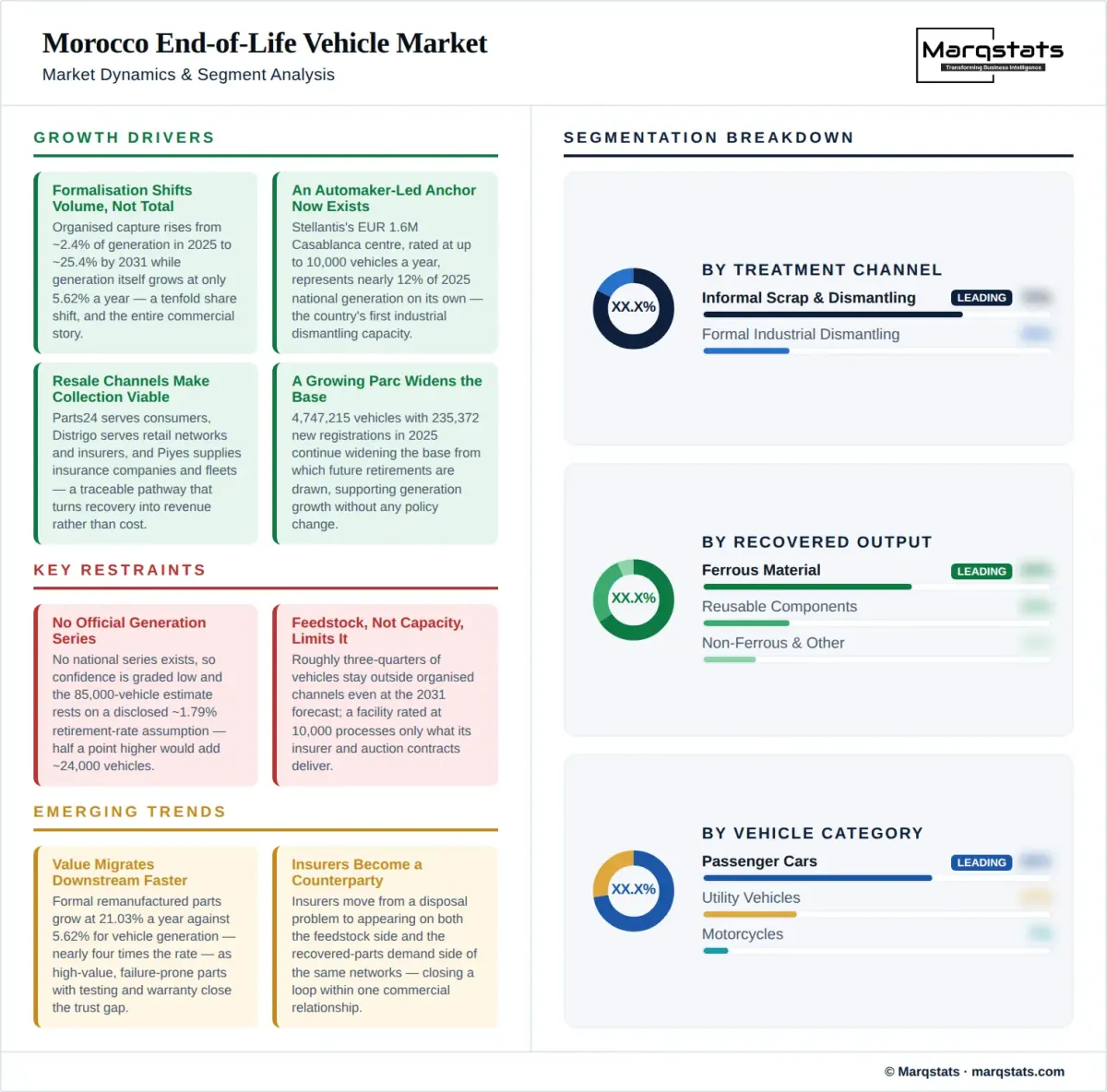
- Formalisation is shifting volume rather than creating it, lifting organised capture from approximately 2.4% of generation in 2025 to around 25.4% by 2031 while generation itself grows at only 5.62% a year.
- An automaker-led industrial anchor now exists, with a EUR 1.6 million Casablanca centre rated at up to 10,000 vehicles a year representing nearly 12% of 2025 national generation on its own.
- Downstream resale channels make collection viable, with Parts24 serving consumers, Distrigo serving retail networks and insurers, and Piyes supplying insurance companies and fleets.
- A 4,747,215-vehicle parc with 235,372 new registrations in 2025 continues to widen the base from which future retirements are drawn, supporting generation growth without any policy change.
- Material value is quantified and substantial, with sampled vehicles yielding approximately 76% iron and 7% aluminium by weight, establishing a floor value independent of parts recovery.
Key Restraints
- No official national generation series exists, so confidence is graded low and the entire 85,000-vehicle 2025 estimate rests on a disclosed retirement-rate assumption of approximately 1.79% of the parc.
- Roughly three-quarters of end-of-life vehicles remain outside organised channels even at the 2031 forecast of 30,000 formally processed vehicles, and informal yards avoid the depollution and compliance costs formal operators carry.
- Feedstock rather than capacity limits throughput, so a facility rated at 10,000 vehicles a year processes only what its insurer and auction contracts deliver.
- Recovered parts must overcome a trust gap against unverified used parts, requiring product identification, quality grading, warranty and traceability that add cost the informal channel does not bear.
Key Trends
- Value is migrating downstream faster than volume, with formal remanufactured parts growing at 21.03% a year against 5.62% for vehicle generation.
- Digital parts channels are becoming the enabling infrastructure, with a consumer platform, a business-to-business network and a fleet-and-insurer startup operating alongside a single 10,000-vehicle dismantling centre.
- Insurers are moving from being a disposal problem to a commercial counterparty, appearing on both the feedstock side and the recovered-parts demand side of the same networks.
- Electrified vehicle components including traction batteries are entering recovery scope, adding electrical safety, hazardous-material and diagnostic requirements to a market built around mechanical parts.
Market Segmentation
Passenger cars account for approximately 3.11 million of Morocco's 4,747,215-vehicle parc, around 65%, and dominate both generation and formal processing. They are also the category the Salmia study sampled, yielding approximately 76% iron and 7% aluminium by weight, and the category the Casablanca dismantling centre is configured around.
Utility vehicles number approximately 1.30 million units, roughly 27% of the parc, and carry different recovery economics from passenger cars: heavier ferrous content per vehicle, more variable body configuration and a parts market weighted toward mechanical and structural components rather than interior and electronic modules. Fleet disposal cycles make their retirement timing more predictable than private-owner vehicles.
Motorcycles account for 339,001 registered units, approximately 7% of the parc, and sit largely outside industrial dismantling economics because material mass per unit is low and the recovered-parts market is served almost entirely through informal repair channels. They are included in the parc denominator but contribute marginally to formal treatment volumes.
Formal industrial dismantling processes an estimated 2,000 vehicles in 2025 rising to 30,000 by 2031, and it is the only channel with depollution, hazardous-fluid and battery handling, waste compliance and parts traceability. The Casablanca centre's rated 10,000 vehicles a year is the national benchmark, and its operating sequence from reception through depollution to cataloguing defines what industrial treatment means in this market.
Informal yards handle the large majority of Morocco's 85,000 annual end-of-life vehicles and will still handle roughly three-quarters of them at the 2031 forecast. They are important existing market activity but poorly measured, and their cost advantage comes substantially from avoiding the depollution and compliance obligations formal operators must carry.
Material recycling absorbs what dismantling does not reuse, and at approximately 76% iron by weight it is the volume destination for most of an end-of-life vehicle. Ferrous scrap feeds domestic steelmaking rather than leaving as an export commodity by default, while aluminium at around 7% by weight carries disproportionate value per tonne.
Reusable components recovered after quality inspection and cataloguing are the highest-value output per vehicle and the reason a dismantled vehicle realises materially more than a shredded one. Recovered components can include mechanical parts, body elements, electronic modules, interior components and traction batteries, each with different inspection and warranty requirements, and they are the output that lifts formal parts value to USD 110 million by 2031.
Formal remanufactured and professionally reconditioned parts are estimated at USD 35 million in 2025 rising to USD 110 million by 2031, a 21.03% compound rate that excludes the much larger unverified used-parts channel. The fastest value creation sits in high-value, failure-prone parts where professional testing and warranty close the trust gap against informal alternatives.
Iron and steel represent approximately 76% of sampled vehicle weight and therefore the bulk of material tonnage from Morocco's 85,000 annual end-of-life vehicles. Ferrous recovery is the most commoditised output, priced against domestic and regional scrap markets rather than against any Morocco-specific value, which is why it establishes a floor rather than a return.
Aluminium at approximately 7% of sampled vehicle weight carries value per tonne several times that of ferrous scrap, alongside copper from wiring and harnesses and precious metals from catalytic converters. Non-ferrous separation requires processing capability informal yards often lack, which is where a formal operator's material economics diverge from a scrap yard's.
Insurer-sourced total-loss vehicles are the most contractable feedstock channel and the one the Casablanca centre explicitly sources from, with Distrigo's business-to-business network serving insurers on the recovered-parts side of the same relationship. Predictable feedstock contracts with insurers can be more valuable than dismantling-line capacity, because capacity is purchasable and contracted vehicle flow is not: a site rated at 10,000 vehicles a year processes only what its contracts deliver.
Auction platforms and fleet disposal programmes supply vehicles with known history and predictable timing, which matters for a facility whose throughput depends on feedstock rather than on national generation of 85,000 vehicles. Fleet cycles make utility-vehicle retirement schedulable in a way private-owner disposal is not.
Owner-initiated deregistration is the largest theoretical channel and the least contractable, since it depends on individual decisions across a 4,747,215-vehicle parc retiring at roughly 1.79% a year. It is also the channel most exposed to informal yards, which can offer immediate cash without documentation, and the one most likely to be reshaped by any future formal collection reform.
By Geography
Casablanca and the Central Region
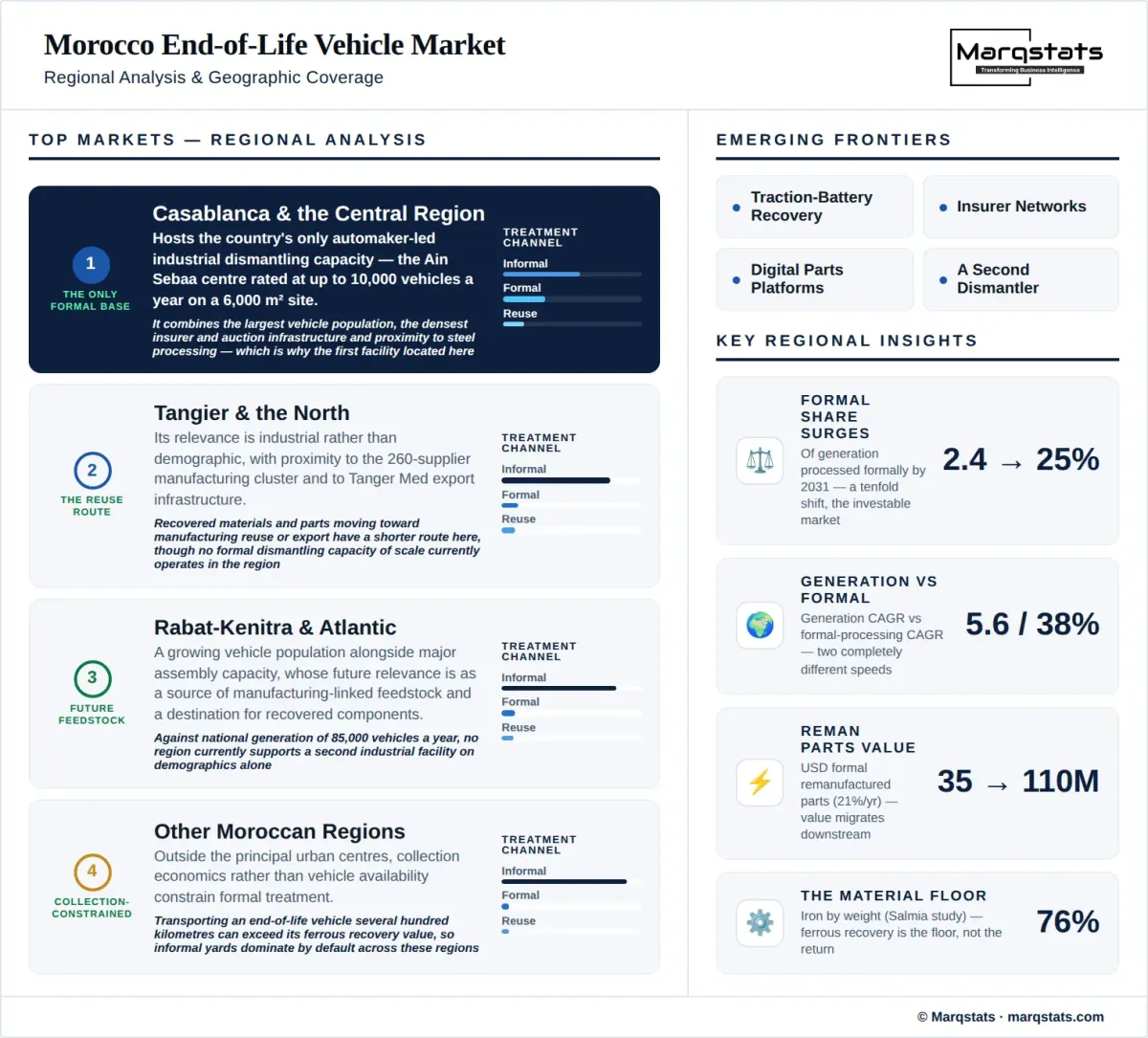
Casablanca hosts the country's only automaker-led industrial dismantling capacity, with the Ain Sebaa centre rated at up to 10,000 vehicles a year on a 6,000 square metre site representing EUR 1.6 million of investment. The region combines the largest vehicle population, the densest insurer and auction infrastructure and proximity to steel and metals processing, which is why the first industrial facility located here rather than elsewhere.
Tangier and the North
The northern corridor's relevance is industrial rather than demographic, with proximity to the automotive manufacturing cluster of more than 260 suppliers and to Tanger Med export infrastructure. Recovered materials and parts moving toward manufacturing reuse or export have a shorter route here, though no formal dismantling capacity of scale currently operates in the region.
Rabat Kenitra and the Atlantic Corridor
The Atlantic corridor carries a growing vehicle population alongside major assembly capacity, and its future relevance to this market is as a source of manufacturing-linked feedstock and a destination for recovered components. Against national generation of 85,000 vehicles a year, no region currently supports a second industrial facility on demographics alone.
Other Moroccan Regions
Outside the principal urban centres, collection economics rather than vehicle availability constrain formal treatment, since transporting an end-of-life vehicle several hundred kilometres can exceed its ferrous recovery value at approximately 76% of weight. Informal yards dominate by default in these regions, and any national formalisation programme would need a collection-network design of the kind Moroccan reverse-logistics research has proposed.
How Competition Is Evolving
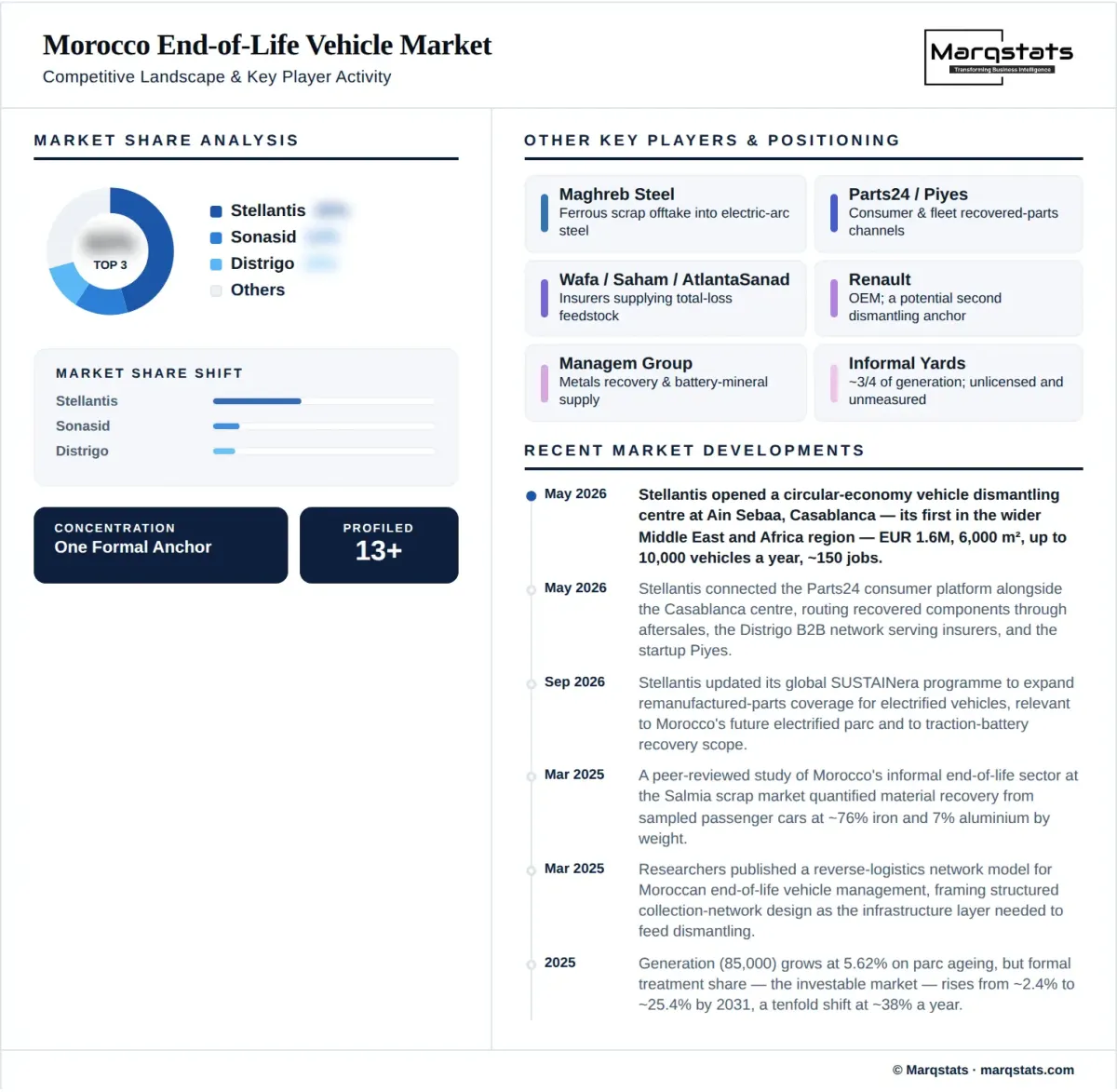
Morocco's formal end-of-life vehicle sector has one industrial anchor and a large unmeasured informal incumbent base. Stellantis' Casablanca centre is the benchmark operator and, at up to 10,000 vehicles a year against national generation of 85,000, it is simultaneously the largest formal participant and a small share of the total market. No participant share is published or estimated, because informal activity is not measured in any available source.
The competitive structure is unusual in that the principal incumbent is a channel rather than a company. Informal scrap and dismantling yards handle the large majority of vehicles and compete substantially by avoiding depollution, hazardous-waste and traceability costs, which means a formal operator cannot win on price and must win on parts quality, warranty, documentation and resale access instead.
Downstream channels are where formal operators build defensible position. Parts24 provides a consumer digital platform, Distrigo a business-to-business joint venture serving retail networks and insurers, and Piyes a Moroccan startup supplying insurance companies and fleets, alongside Stellantis aftersales and partner repairers. That combination converts recovered components into traceable commercial supply, which is what informal yards cannot replicate.
Insurers and auction platforms occupy both sides of the market and are the most commercially important counterparties in it. They supply total-loss vehicles as feedstock and buy recovered parts for repair claims, and an operator holding contracts on both sides captures margin twice on the same vehicle while securing the throughput its capacity depends on.
For a new entrant, the sequence matters more than the scale. A dismantling line is purchasable; an insurer and auction feedstock network is not, and digital part identification and inventory can raise recovered-part value per vehicle and shorten payback more reliably than additional processing capacity can. A sales forecast without a core-return and feedstock model is incomplete.
Companies Covered
The report profiles 13+ companies with full strategy and financials analysis, including:
Recent Market Activity
Table of Contents
Coverage & Segmentation
The study covers Morocco with a 2025 base year, historical analysis from 2021 to 2025 and forecasts for 2026 to 2031. Headline CAGRs connect 2025 and 2031 across six years, and the narrower 2026 to 2031 rate is stated separately wherever used. The quantified measure is end-of-life vehicle generation in units, with formal remanufactured and reconditioned parts value carried as a separate series and formal treatment volumes reported as a share of generation.
Coverage spans passenger cars, utility vehicles and motorcycles; formal industrial dismantling, informal yards and material recycling; reusable components, remanufactured parts and ferrous and non-ferrous material recovery; and insurer, auction and owner-deregistration feedstock channels. The remanufactured-parts measure excludes the much larger unverified used-parts channel, and total generation is never presented as the addressable market.
The analysis addresses investment appraisal, feedstock strategy, plant sizing and policy tracking. Stakeholder questions include why formal treatment share and total generation must be modelled separately, what retirement rate the generation series actually assumes, why feedstock contracts matter more than processing capacity, and how much of an end-of-life vehicle's value scrap metal alone fails to capture.