Market Snapshot
Key Takeaways
Market Overview & Analysis
Report Summary
The Saudi Arabia pickup vehicle market covers the manufacturing, import, distribution, sale, and aftermarket servicing of light- and medium-duty pickup trucks across the Kingdom, spanning single-cab, extended-cab, and double-cab body styles powered by internal combustion engines as well as emerging electric and hybrid powertrains. The study quantifies the market in volume (unit registrations) and value (USD million) across 2021-2025 historical and 2026-2030 forecast horizons, with 2025 as the base year. Pickups are widely used across commercial, industrial, agricultural, construction, oil and gas, logistics, government, and personal applications owing to their durability, payload capacity, off-road capability, and suitability for harsh desert environments.
The market is import-dependent, with demand shaped by oil-price cycles, government spending, and the Vision 2030 diversification programme coordinated through the Public Investment Fund. Volumes peaked at 76,918 units in 2022 before easing to 70,732 units in 2025 as fleet-replacement cycles normalized, and are set to resume steady growth as giga-project construction, logistics expansion, and fleet renewal drive procurement. Marqstats reconciles registration records, import flows, and distributor channel checks against brand-level sales to produce the volume series underlying this report.
Value growth outpaces volume growth over the forecast period. Average selling prices rise as buyers shift toward full-size, premium, and double-cab configurations equipped with advanced safety, connectivity, and comfort features, and as Chinese brands introduce highly specified models that raise feature expectations across price bands. The market adds roughly 14,268 annual units between 2025 and 2030, with premium and full-size segments contributing a disproportionate share of value growth.
The divergence between volume and value trajectories is structurally important for the market. Unit registrations grow at 4.46% while value expands at 6.28%, a gap driven almost entirely by mix enrichment rather than list-price inflation: the entry-level band grows fastest in units as value brands broaden access, yet the premium and full-size bands grow fastest in value as affluent and lifestyle buyers trade up to high-specification double cabs. This two-speed pattern means brand strategies increasingly diverge by objective, with value entrants pursuing unit share at the accessible end and established and premium marques defending margin at the specified end, and it makes headline unit growth an incomplete measure of where profit pools are forming across the forecast period.
The competitive value equation is being redrawn. Japanese platforms retain leadership on durability, spare-parts availability, and resale strength, however Chinese brands are gaining share by offering highly equipped pickups at materially lower prices, appealing to fleet operators and cost-conscious private buyers. This dynamic, combined with premiumization at the top of the market and emerging electrification, defines the strategic landscape through 2030.
Ownership psychology anchors purchasing decisions in ways that shape the competitive contest. Established Japanese pickups command a resale and reliability premium that fleet operators and private buyers price into total cost of ownership, so the incumbents' advantage is not merely brand loyalty yet also a quantifiable residual-value benefit that offsets a higher purchase price. Chinese challengers counter this with aggressive financing, extended warranties of up to six years, and free-maintenance packages that lower the effective monthly cost of ownership, directly targeting the affordability pressure that inflation and financing costs have introduced. The result is a market where buyers increasingly weigh a durable, higher-residual workhorse against a feature-rich, lower-outlay alternative, and where the outcome differs by buyer type: large fleets renewing on fixed cycles still favour proven residuals, while small businesses and budget-conscious private owners are the fastest-converting cohort to value brands.
Market Dynamics
Key Drivers
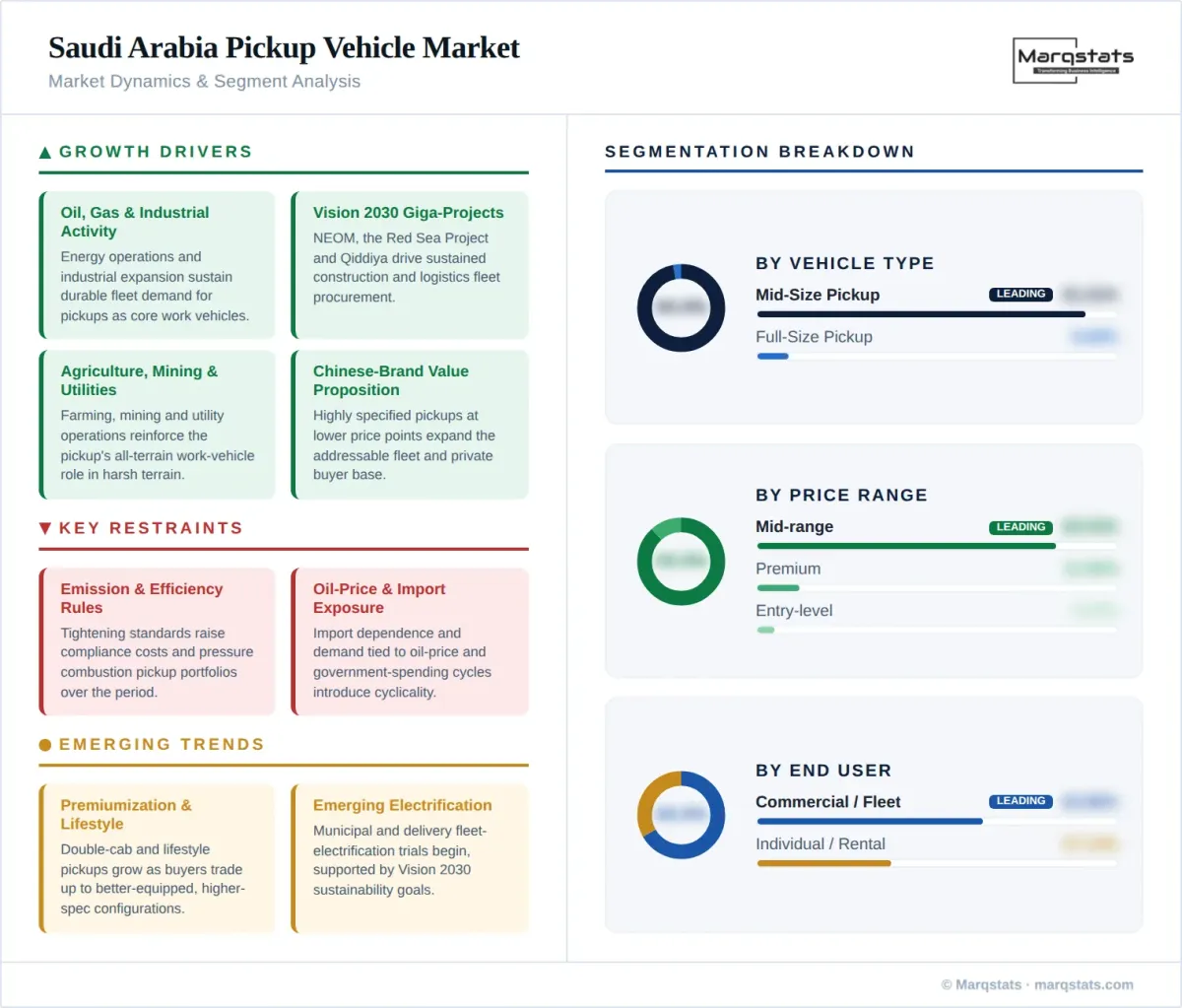
- Oil, gas, and industrial activity: energy-sector operations and industrial expansion sustain durable fleet demand for pickups as core work vehicles across the Kingdom.
- Vision 2030 giga-projects: NEOM, the Red Sea Project, Qiddiya, and related construction and infrastructure programmes drive sustained fleet procurement, with logistics and construction activity peaking across the forecast period.
- Agriculture, mining, and utilities: demand from farming, mining, and utility operations reinforces the pickup's role as an essential all-terrain work vehicle in remote and harsh environments.
- Favourable ownership economics: strong resale-value retention, low fuel costs, and ongoing fleet-replacement cycles support recurring demand and underpin financing and leasing.
- Chinese-brand value proposition: highly specified pickups at lower price points from Chinese OEMs expand the addressable buyer base and accelerate fleet and private adoption.
Key Restraints
- Emission and fuel-efficiency requirements: tightening standards raise compliance costs and pressure combustion pickup portfolios over the forecast period.
- High import dependence: reliance on imported vehicles exposes the market to global supply-chain disruptions and shipping and component constraints.
- Oil-price and government-spending sensitivity: demand is linked to oil-price cycles and public-sector activity, introducing cyclicality tied to macroeconomic and fiscal conditions.
- Feature-cost pressure: rising expectations for safety, connectivity, and comfort features raise product costs and complicate price positioning across segments.
Key Trends
- Advanced safety and connectivity integration: pickups increasingly ship with driver-assistance, connectivity, and telematics features migrating from passenger vehicles.
- Rapid rise of Chinese brands: value-focused Chinese OEMs shift the market's value equation and gain fleet and private share.
- Premiumization and lifestyle demand: double-cab and lifestyle pickups grow as buyers trade up to better-equipped, more comfortable configurations.
- Emerging electrification: fleet-electrification trials by municipalities and delivery firms begin over the forecast period, supported by Vision 2030 sustainability goals.
Market Segmentation
Mid-size pickups accounted for 91.31% of 2025 volume at 64,585 units and are projected to reach 76,206 units by 2030 at a 4.05% CAGR. The segment is the backbone of the market, dominated by durable, spare-parts-rich double-cab and single-cab platforms serving fleet, commercial, and private buyers across every application and region.
The segment's overwhelming share reflects the mid-size pickup's fit with Saudi operating conditions: sufficient payload and towing capacity for most commercial tasks, proven reliability in desert heat, deep parts and service networks, and a purchase price accessible to fleets renewing at scale. It is also the most contested segment, where Japanese incumbents face the sharpest Chinese challenge, since value brands concentrate their most competitive double-cab offerings precisely here. Mid-size therefore sets the market's overall pricing and feature baseline, and shifts in its brand composition drive the headline story of the competitive transition.
Full-size pickups held 8.69% of 2025 volume at 6,147 units and grow faster at a 8.30% CAGR to 8,794 units by 2030. Demand is propelled by lifestyle and premium buyers, heavy-duty commercial applications, and the off-road culture that favours larger, more powerful platforms, making this the faster-growing vehicle type.
Entry-level pickups accounted for 5.03% of 2025 volume at 3,561 units and grow fastest by price band at a 9.72% CAGR to 5,440 units by 2030, propelled by value-focused Chinese models and cost-conscious small-business and private buyers.
Mid-range pickups held the largest price-band share at 83.03% of 2025 volume, or 58,729 units, and grow at a 3.51% CAGR to 67,696 units by 2030. The band anchors fleet and mainstream private demand, and its feature content is rising as competition intensifies.
Premium pickups accounted for 11.94% of 2025 volume at 8,442 units and grow at a 8.11% CAGR to 11,864 units by 2030, driven by lifestyle buyers and high-specification double-cab configurations, contributing a disproportionate share of value growth.
Commercial and fleet buyers accounted for 62.86% of 2025 volume at 44,462 units and grow faster at a 5.43% CAGR to 55,775 units by 2030. Demand is anchored in oil and gas, construction, logistics, mining, and utility operations, and reinforced by Vision 2030 giga-project procurement and fleet-replacement cycles.
Fleet demand is the market's centre of gravity and its most defensible growth engine. Because fleet buyers purchase on total cost of ownership, replacement schedule, and service reliability rather than sentiment, their procurement is more predictable and less cyclical than private demand, and the giga-project construction pipeline provides a multi-year floor of committed activity through the forecast period. This buyer profile favours brands with proven residual values, nationwide service coverage, and the ability to support large tenders, which is why the fleet channel remains the incumbents' stronghold even as value brands make faster inroads among individual buyers.
Individual and rental buyers held 37.14% of 2025 volume at 26,270 units, growing at a 2.71% CAGR to 29,225 units by 2030. This segment spans private owners, agricultural buyers, off-road enthusiasts, and rental operators, with lifestyle and premiumization trends most visible here.
By Geography
Central Region (Riyadh)
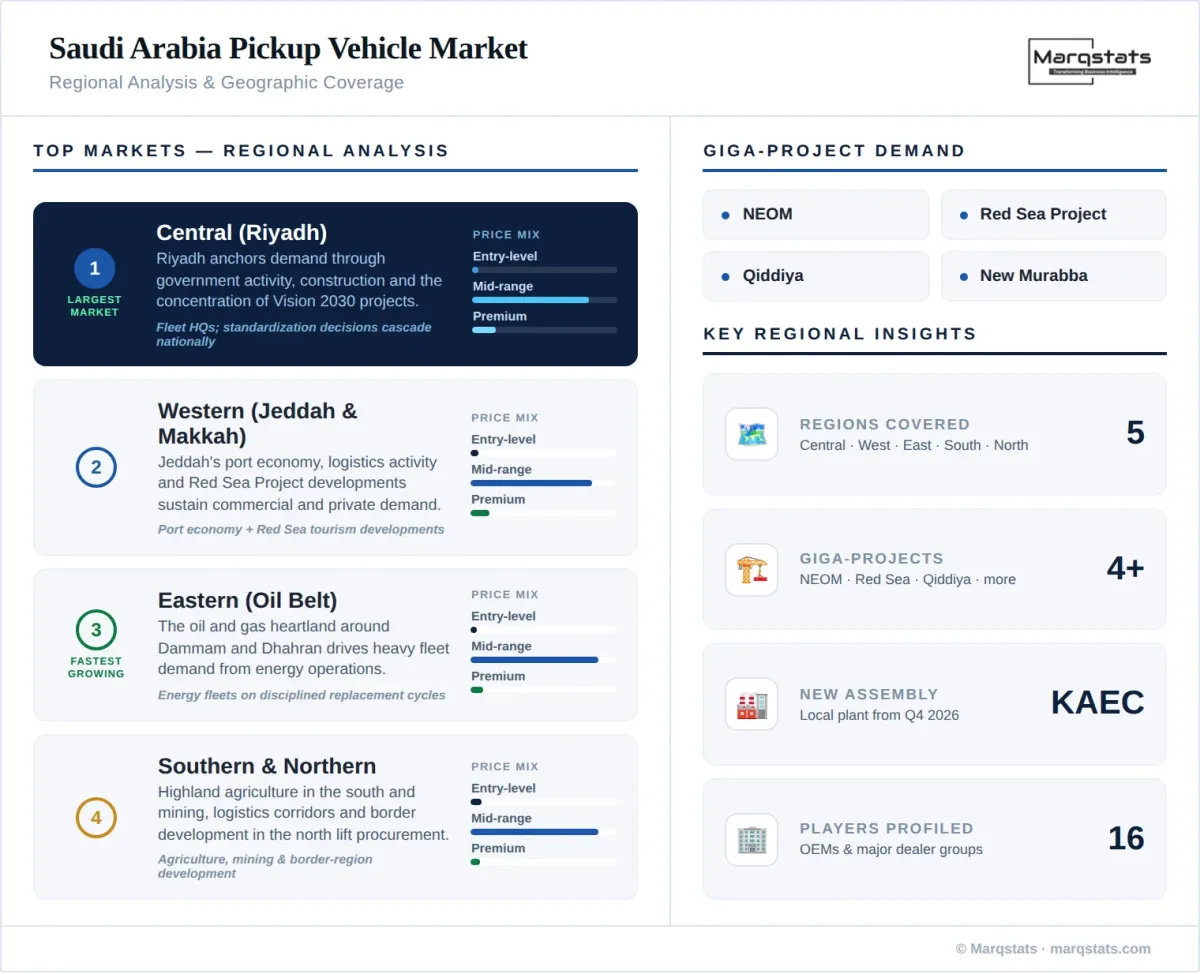
The Central region led with 39.50% of 2025 volume at 27,940 units, growing at a 4.32% CAGR to 33,065 units by 2030. Riyadh anchors demand through government activity, construction, and the concentration of Vision 2030 projects and fleet headquarters, making it the largest and most strategically significant regional market.
The region's dominance reflects the concentration of decision-making and procurement in the capital. National fleet operators, government departments, and the contractors executing giga-projects such as Qiddiya and New Murabba headquarter their purchasing in Riyadh, so vehicle-standardization decisions taken here cascade to sites across the Kingdom. Construction and logistics activity linked to the capital's own expansion, together with a large private and lifestyle buyer base, gives the Central region both the deepest fleet demand and a substantial premium and double-cab market, making it the primary battleground for every brand tier.
Western Region (Jeddah and Makkah)
The Western region held 21.50% of 2025 volume at 15,207 units and grows at a 4.93% CAGR to 19,125 units by 2030. Jeddah's port economy, logistics activity, and the Red Sea Project and tourism developments sustain both commercial and private pickup demand.
Eastern Region (Dammam and the Oil Belt)
The Eastern region accounted for 20.80% of 2025 volume at 14,712 units, growing at the fastest regional pace of 5.19% CAGR to 18,360 units by 2030. The oil and gas heartland around Dammam and Dhahran drives heavy fleet demand from energy operations and industrial activity.
The region's above-average growth reflects the durability of energy-sector procurement. Oil and gas operators, petrochemical complexes, and their contractor networks maintain large pickup fleets on disciplined replacement cycles that are less sensitive to consumer sentiment than private demand elsewhere, giving the Eastern region a steady procurement floor. Industrial expansion around Jubail and the concentration of heavy-duty commercial use also skew the region toward workhorse mid-size and full-size configurations, with fleet specification and total-cost-of-ownership discipline shaping brand selection more than lifestyle considerations.
Southern and Northern Regions
The Southern region held 11.50% of 2025 volume at 8,134 units, growing at a 1.97% CAGR on agricultural and highland demand, while the Northern region, at 6.70% of volume, grows at a 5.20% CAGR as mining, logistics corridors, and border-region development lift procurement.
How Competition Is Evolving
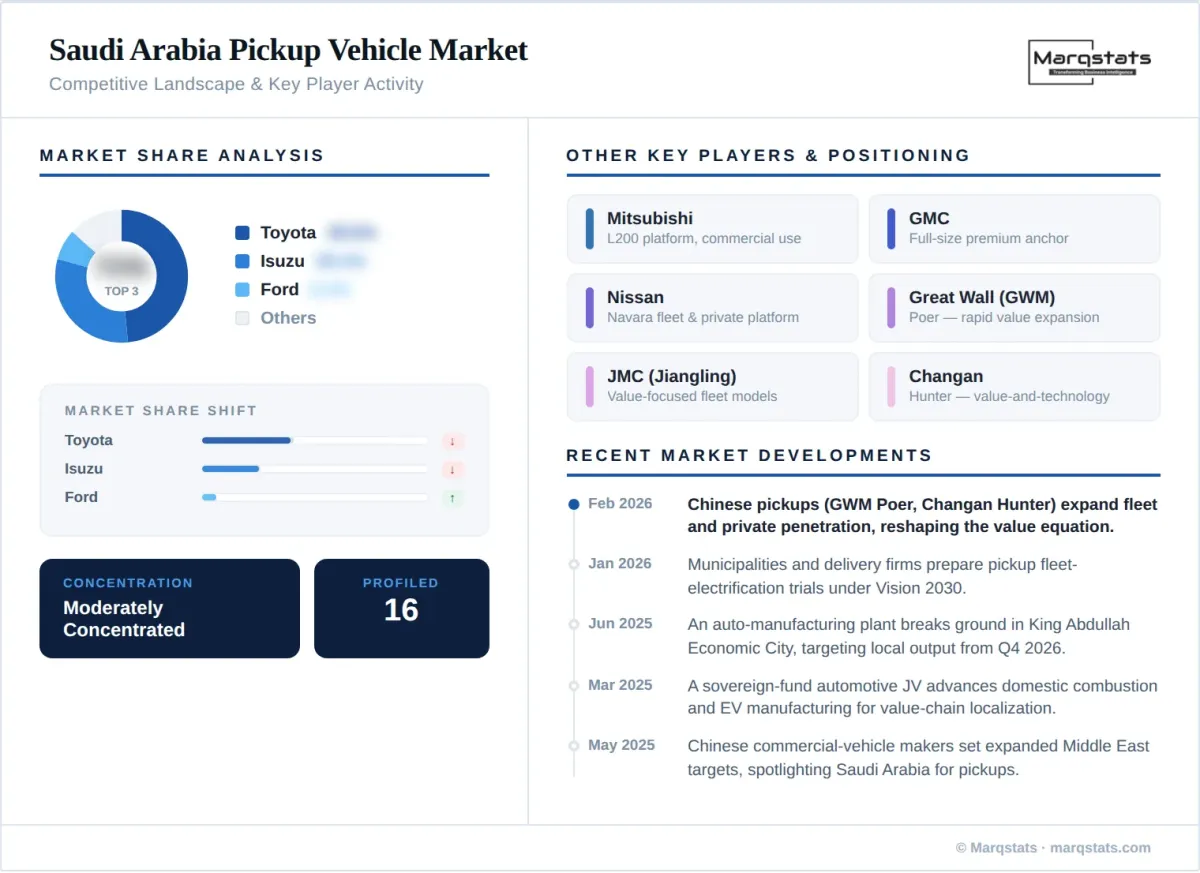
The market is moderately concentrated around established franchises, with Japanese platforms holding a commanding position. Toyota led with an estimated 39.53% of 2025 volume through the Hilux and Land Cruiser pickup range, distributed via a deep dealer and after-sales network, while Isuzu held roughly 25.14% through the D-Max, favoured for durability in fleet and commercial use. Ford and Mitsubishi occupy the next tier at 6.06% and 4.95% respectively, competing through the Ranger and L200 platforms.
Chinese brands are the most dynamic competitive force. JMC, GWM, Foton, Maxus, Changan, and JAC have expanded through highly equipped, competitively priced models such as the Poer and Hunter, gaining fleet and private share and redrawing the market's value equation. GMC anchors the full-size premium segment, and the collective Chinese cohort now shapes pricing and feature expectations across the mid-range and entry-level bands, supported by aggressive financing, warranty, and free-maintenance offers.
Competition centres on durability reputation, resale value, feature content, and price. Established players defend on spare-parts depth, service coverage, and proven residual values, while challengers compete on specification-per-riyal and financing terms. Distribution is controlled by major local dealer groups, and alignment with fleet buyers and Vision 2030 procurement channels confers a demand advantage. Electrification and local-assembly localization are emerging fronts as manufacturing and supply-chain investment expands under national industrial policy.
Local dealer groups are pivotal to competitive outcomes. Major distributors control the showroom, financing, and after-sales relationships through which pickups reach fleet and private buyers, and a brand's success rests substantially on the strength of its dealer partner's coverage, service depth, and fleet-account relationships. As domestic vehicle manufacturing and EV supply-chain investment scale under national industrial policy, brands that localize assembly or component sourcing stand to gain preferential positioning in government-linked procurement, adding a localization dimension to a contest historically decided by product and distribution. The forecast period will test whether incumbent residual-value advantages hold against value-brand momentum and whether early electrification trials convert into commercial fleet demand.
Companies Covered
The report profiles 16+ companies with full strategy and financials analysis, including:
Recent Market Activity
Table of Contents
Coverage & Segmentation
This report quantifies the Saudi Arabia pickup vehicle market in volume (unit registrations) and value (USD million) across a 2021-2025 historical period and a 2026-2030 forecast period, with 2025 as the base year. Segmentation covers vehicle type (mid-size, full-size), price range (entry-level, mid-range, premium), and end user (individual/rental, commercial/fleet), with regional assessment across the Central, Western, Eastern, Southern, and Northern regions. The competitive assessment profiles 16 manufacturers and distributors. Market dynamics are assessed alongside national diversification policy set out under Vision 2030, whose giga-project, industrial, and localization programmes shape fleet demand and the value chain.
The study evaluates powertrain transition and electrification trials, the rise of Chinese brands, premiumization, fleet-procurement patterns, import and localization dynamics, and competitive positioning to support market-entry, portfolio, procurement, and investment decisions by OEMs, distributors, fleet operators, financiers, and policymakers. Forecasts incorporate announced investment programmes with published schedules and demonstrated demand; speculative initiatives without funding are excluded from the base case, and the electrification path is modelled on announced trials and localization capacity rather than aspirational targets.