Market Snapshot
Key Takeaways
Market Overview & Analysis
Report Summary
Morocco automotive electronics is the highest-value layer of an established component economy rather than a standalone industry. Morocco's automotive supplier base has more than 260 companies and generated approximately USD 10.00 billion of component output in 2025, but that base is historically anchored in wiring harnesses, interiors and metal parts. Electronics is where the value density is highest, the growth rate fastest and the competitive field thinnest.
No official statistical series isolates automotive electronics, which is the defining measurement problem on this page. Bank Al-Maghrib reports wiring exports at MAD 57.8 billion for 2025 but does not separate electronic modules, sensors, controllers or power electronics from that electrical aggregate. The measure here is therefore modelled from supplier output, the component export base and documented electronics programmes, and it deliberately excludes most conventional harness value.
The audience is electronics suppliers evaluating Moroccan capacity, European manufacturers assessing nearshored electronic content, semiconductor and power-electronics investors, and policy analysts tracking industrial upgrading. The commercial framing throughout is that electronics is where a new entrant can build a defensible position, because the harness cluster has already commoditised the categories below it.
Morocco Automotive Electronics Market Size and Forecast
Automotive electronics manufacturing output is estimated at USD 950 million in 2025, rising to USD 1,150 million in 2026 and USD 2,100 million by 2031. Confidence is graded low to medium, reflecting the absence of an official series rather than uncertainty about the underlying industrial activity, which is documented through company announcements and investment approvals.
Two growth rates apply and both are published. The six-year rate connecting 2025 and 2031 is 14.13%. The five-year rate connecting 2026 and 2031 is 12.80%, and it is lower because 2026 itself carries a step up driven by the MTA laboratory expansion and new Sanlian and Yunyi investment. Gentex is held in the pipeline rather than in the forecast until its targeted 2028 start of production.
Forecast growth assumes higher electronic content per vehicle, electrified-vehicle and hybrid systems, sensing and driver-assistance content, and European customer nearshoring. It does not assume that every announced project reaches production on schedule: a planned 2028 plant influences supplier decisions well before it generates revenue, and the forecast treats announcements as direction rather than as output.
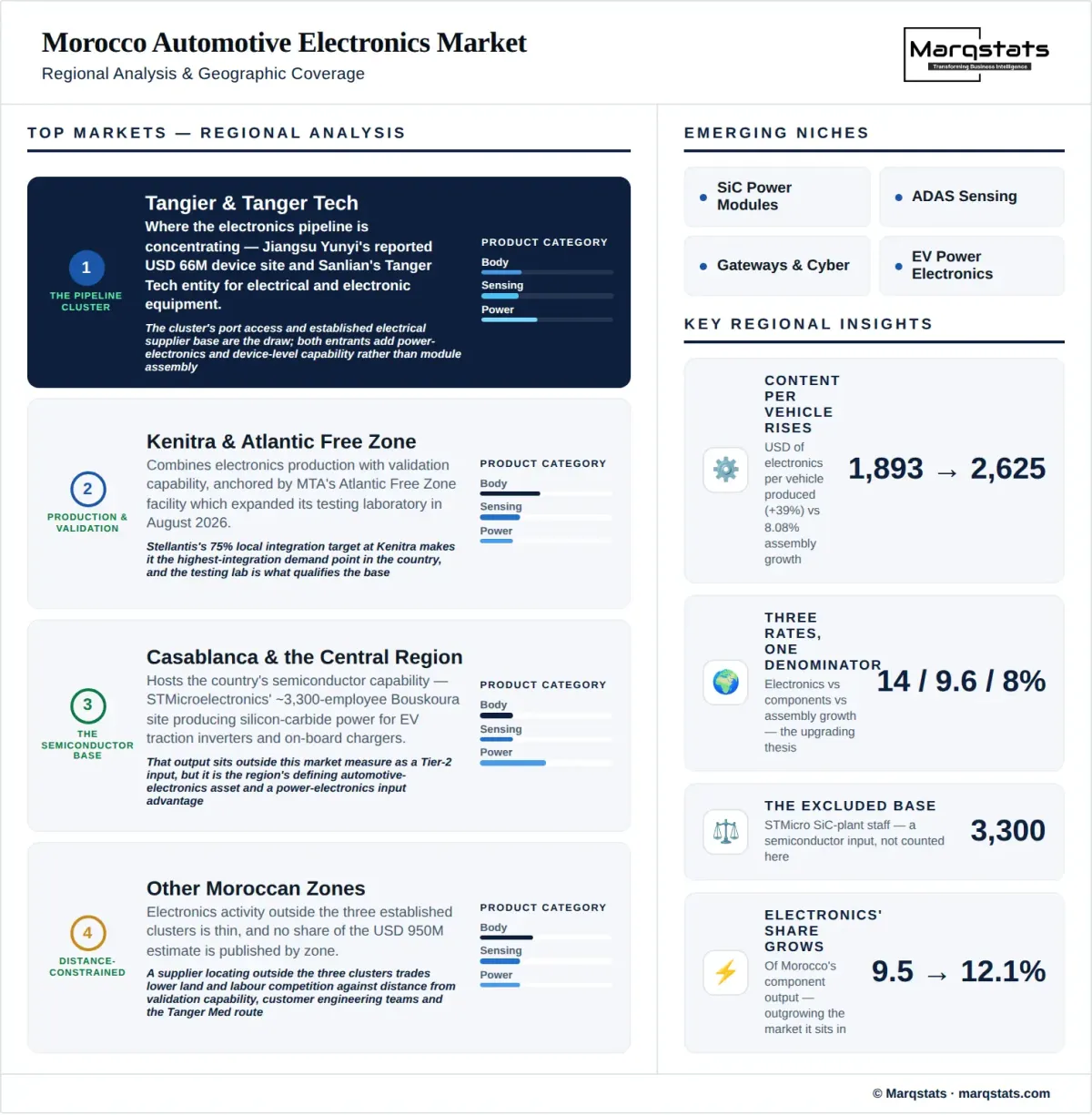
Morocco's vehicle production provides the reference denominator, at 501,965 units in 2025 against AMICA's reported installed capacity of one million vehicles a year, with a 2031 reference of 800,000 vehicles assuming 80% utilisation. The resulting electronics content of roughly USD 1,893 per vehicle produced in 2025 rising to approximately USD 2,625 by 2031 is the clearest expression of the content-deepening thesis.
The Measurement Problem and the Harness Boundary
The single most important editorial decision on this page is what it excludes. Bank Al-Maghrib reports wiring exports of MAD 57.8 billion for 2025, up 7.8%, representing 37.4% of Morocco's total automotive exports. That category is the largest measurable component family in the country and it is counted in full within the Morocco automotive components market. Counting it again here would double the electronics figure and destroy the relationship between the two pages.
Most conventional harness value is therefore excluded from this measure. What remains inside it is electronic content: control units, sensors, power electronics, displays, gateways, mirrors with electronic function, and the electrical components whose value sits in the device rather than in the conductor. The boundary is imperfect because no statistical series draws it, and a supplier reporting combined electrical and electronic revenue cannot be split cleanly from outside.
The practical consequence is that this market is smaller than a naive reading of Morocco's electrical exports would suggest and larger than any published electronics figure, because none exists. A reader comparing the USD 950 million estimate against MAD 57.8 billion of wiring exports is comparing two different things, and the two should never be added or netted against each other without establishing what each contains.
Semiconductor Capability Outside the Measure
Morocco's most technically advanced automotive electronics capability is a semiconductor plant that this measure does not count. STMicroelectronics operates an assembly and test site at Bouskoura employing approximately 3,300 people, of whom about 40% are technicians and engineers, following an investment of approximately USD 240 million that expanded its clean room from 22,500 to 30,000 square metres and installed more than 150 manufacturing machines.
The site's automotive relevance is direct rather than incidental. It manufactures silicon carbide power products used in electric-vehicle main traction inverters and on-board chargers, alongside charging infrastructure applications, as well as secure microcontrollers and other semiconductor packages for automotive and industrial markets. Silicon carbide traction inverter content is among the highest-value semiconductor positions in an electric vehicle.
It is excluded from the USD 950 million estimate because a packaged semiconductor device is a Tier-2 input to an electronic module rather than an automotive electronic product in its own right, and because semiconductor output is not classified within Morocco's automotive component export data. Including it would materially raise the measure and would also double-count value that reappears inside any module built from those devices.
The strategic implication runs the other way, however, and it is the most useful thing an investor can take from this page. A country with an operating silicon carbide assembly and test base has a power-electronics input advantage that a generic module assembler elsewhere does not, and it is the strongest argument for locating high-voltage control and inverter-adjacent electronics production in Morocco specifically.
The Electronics Investment Pipeline
Gentex disclosed plans in July 2026 to establish a Moroccan production site serving European customers with production targeted by 2028, intending to manufacture electrochromic mirrors and advanced electronic modules using Morocco's trade links with the European Union and the United States. That is a five-year lead from disclosure to meaningful volume, and it sits in the pipeline rather than in the 2026 forecast.
Jiangsu Yunyi Electric Group was reported in January 2026 to be planning a USD 66 million production site in Tangier for alternator rectifiers, voltage regulators, semiconductor devices and emissions sensors. Sanlian Forging established Sanlian Technology Morocco Limited at Tanger Tech in August 2026 to manufacture automotive electrical and electronic equipment. Both add power-electronics and device-level capability rather than module assembly.
MTA Morocco's August 2026 expansion of its Kenitra Atlantic Free Zone facility added laboratory and warehouse capacity for electrical, mechanical and environmental testing on a site supplying automotive electrical components to major European manufacturers. That investment is qualitatively different from the others: it deepens validation capability rather than production capacity, which is what converts a low-cost location into a qualified one.
Qualification, Testing and Functional Safety
Product qualification depends on customer functional-safety, electromagnetic compatibility, environmental and reliability standards, which makes laboratory capacity part of market competitiveness rather than an overhead. An electronics supplier without local validation capability sends samples abroad, adding weeks to every design iteration and every corrective action, and that lead time is what loses programmes rather than unit cost.
This is why MTA's expanded Kenitra laboratory for electrical, mechanical and environmental testing matters more than its square metres suggest, and why testing and engineering capability can be as important as labour cost in winning European electronics programmes. Morocco's component cluster of more than 260 suppliers lowers the ecosystem-entry burden for a specialised electronics entrant, but shared infrastructure does not extend to validation.
Electronics exported to European programmes must additionally meet customer traceability requirements and applicable vehicle type-approval and technical standards. Those obligations attach to the product and its documented process history, so record-keeping and change control become commercial capabilities. A supplier that cannot evidence process control has manufacturing capacity rather than a qualified programme.
Where the Addressable Niches Actually Sit
A market entrant should identify electronics categories not already commoditised by the harness cluster. Sensing, power electronics, smart mirrors, gateways and high-voltage controls are the named candidates, and they share a characteristic: value concentrated in the device and its software rather than in copper, assembly labour or footprint. That is precisely the opposite of the profile that built Morocco's MAD 57.8 billion wiring position.
The pipeline confirms the direction. Gentex is entering with electrochromic mirrors and electronic modules, Yunyi with rectifiers, regulators, semiconductor devices and emissions sensors, and Sanlian with electrical and electronic equipment. None is entering the harness business, and none is competing with Lear, Yazaki or Motherson-owned Leoni for the categories those firms already dominate.
Customer nomination and qualification lead times mean planned plants influence supplier decisions well before revenue starts. A Tier-2 supplier deciding where to locate in 2026 is responding to a Gentex programme that produces nothing until 2028, which is why the investment pipeline is a better leading indicator for this market than current output is.
Local Integration and the OEM Demand Pool
Stellantis has launched Smart Car production in Morocco and targets 75% local integration by 2030, against a national sector integration rate of 69% reported by AMICA for 2025 and a Ministry ambition of 80%. Each percentage point of integration deepening on an electrified or electronics-heavy platform is worth disproportionately more to an electronics supplier than to a metal-parts supplier, because electronic content per vehicle is rising while mechanical content is not.
That asymmetry is why electronics output grows at 14.13% while the component market it sits inside grows at 9.57% and vehicle assembly grows at 8.08%. Three rates, one denominator, and the spread between them is the industrial-upgrading thesis expressed numerically rather than rhetorically.
The demand pool is nonetheless nomination-controlled rather than capacity-controlled. Morocco assembled 501,965 vehicles in 2025 against one million vehicles a year of installed capacity, so spare assembly capacity is abundant and an electronics supplier's constraint is winning a programme rather than finding a customer with volume available.
Market Dynamics
Key Drivers
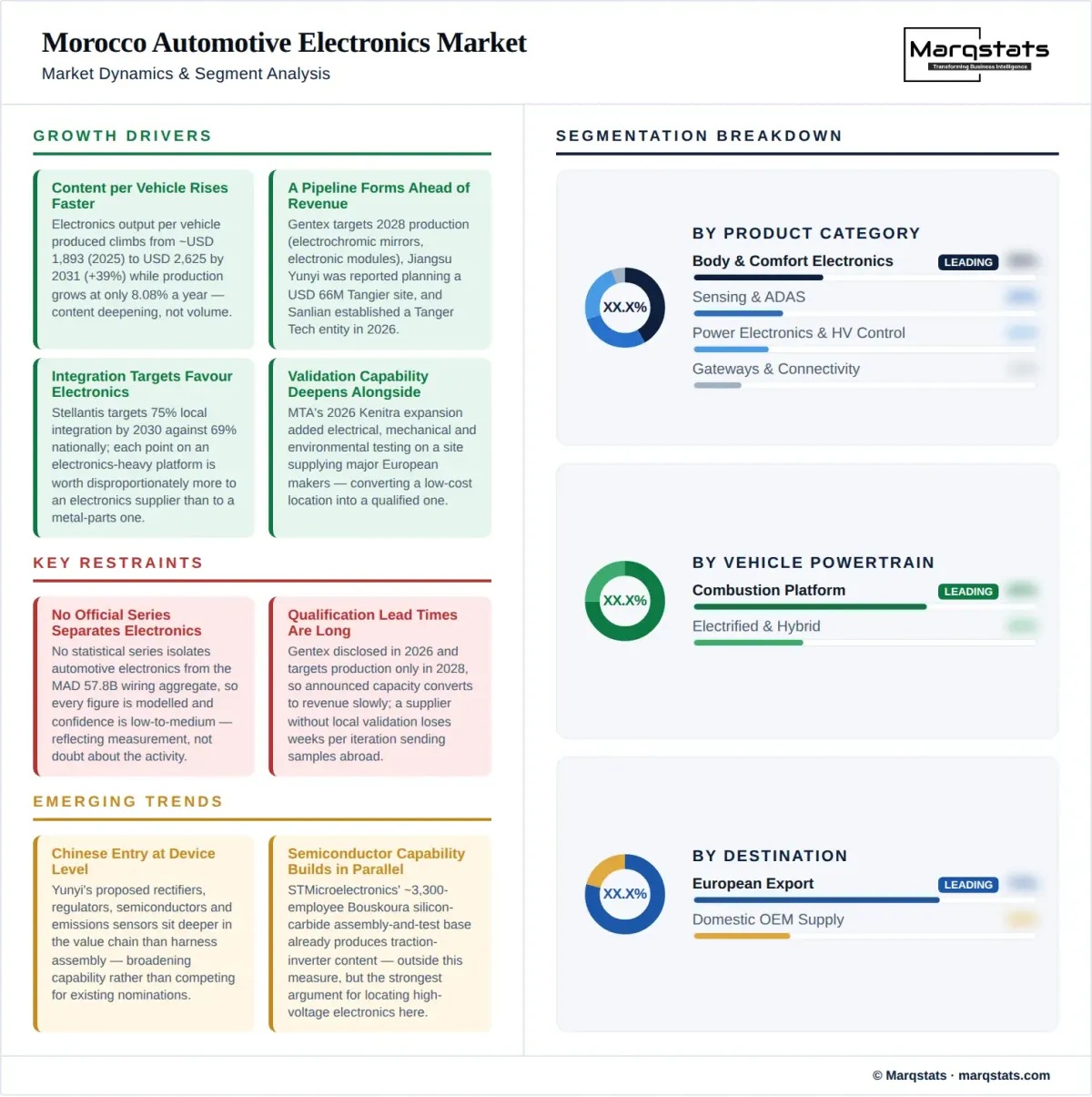
- Electronic content per vehicle is rising faster than assembly volume, lifting electronics output per vehicle produced from approximately USD 1,893 in 2025 toward USD 2,625 by 2031 while production grows at only 8.08% a year.
- A documented investment pipeline is forming ahead of revenue, with Gentex targeting 2028 production, Jiangsu Yunyi reported planning a USD 66 million Tangier site and Sanlian establishing a Tanger Tech entity in 2026.
- Local integration targets favour electronics disproportionately, with Stellantis targeting 75% by 2030 against a national rate of 69% in 2025 and a Ministry ambition of 80%.
- Validation capability is deepening alongside assembly, with MTA's 2026 Kenitra expansion adding electrical, mechanical and environmental testing on a site supplying major European manufacturers.
- An existing cluster of more than 260 automotive suppliers lowers the ecosystem-entry burden for specialised electronics players who would otherwise build supporting infrastructure from nothing.
Key Restraints
- No official series separates automotive electronics from Morocco's MAD 57.8 billion wiring export aggregate, so every figure on this page is modelled and confidence is graded low to medium.
- Qualification lead times are long and customer-controlled, with Gentex disclosing in 2026 and targeting production only in 2028, so announced capacity converts to revenue slowly.
- The harness cluster has commoditised the adjacent categories, leaving a new entrant to compete in sensing, power electronics and controls rather than in the volume electrical business Morocco is known for.
- Validation capacity remains thin relative to production capacity, and a supplier sending samples abroad for electromagnetic compatibility or environmental testing loses weeks on every design iteration.
Key Trends
- Chinese electronics suppliers are entering at device level rather than module level, with Yunyi's proposed rectifiers, regulators, semiconductors and emissions sensors sitting deeper in the value chain than harness assembly.
- Semiconductor capability is building in parallel and outside this measure, with an approximately 3,300-employee silicon carbide assembly and test base already producing traction-inverter content.
- Testing and engineering capability is becoming a competitive differentiator alongside labour cost, which is what converts a low-cost location into a qualified supplier base for European programmes.
- Electronics is outgrowing the component market that contains it, rising from approximately 9.5% of Morocco's USD 10.00 billion component output toward about 12.1% by 2031.
Market Segmentation
Sensing and driver-assistance electronics are among the named categories not commoditised by the harness cluster, and they are where European nearshoring demand concentrates. Jiangsu Yunyi's reported USD 66 million Tangier plan includes emissions sensors alongside power devices, and Gentex's targeted 2028 entry covers electrochromic mirrors and advanced electronic modules that carry sensing function.
Power electronics is the category with the strongest Moroccan input advantage, because an approximately 3,300-employee silicon carbide assembly and test base already operates in the country producing traction-inverter and on-board-charger content. High-voltage control sits in the named entrant niches, and Yunyi's proposed rectifiers, voltage regulators and semiconductor devices are power-electronics positions rather than module assembly.
Body and comfort electronics sit closest to the established electrical cluster and are consequently the most contested categories for a new entrant, given that Lear, Yazaki and Motherson-owned Leoni already anchor a MAD 57.8 billion electrical export base. The value here is in control modules and actuation rather than in distribution, and the boundary between the two is exactly where this market's measure is drawn.
Instrumentation and displays carry rising content per vehicle as cockpits consolidate into larger integrated screens, which supports the forecast rise in electronics content from approximately USD 1,893 to USD 2,625 per vehicle produced. No Moroccan display manufacturing of scale is documented, so this category is currently an import position rather than a production one.
Gateways and connectivity modules are named among the categories a new entrant should target, because value concentrates in software and validated hardware rather than in assembly labour. They also carry the heaviest functional-safety and cybersecurity qualification burden, which is why local laboratory capability such as MTA's 2026 Kenitra expansion is a precondition rather than a convenience for a category inside a market growing at 14.13% a year.
Combustion platforms still account for the large majority of Morocco's 501,965 vehicles produced in 2025 and therefore for most current electronics demand, including emissions sensing, engine control and the alternator rectifiers and voltage regulators in Yunyi's reported Tangier plan. Content per combustion vehicle rises more slowly than on electrified platforms but from a far larger installed programme base.
Electrified platforms carry substantially higher electronic content per vehicle, concentrated in traction inverters, on-board chargers, battery management and high-voltage control, and they are the principal reason electronics output grows at 14.13% against 8.08% for assembly volume. Morocco's silicon carbide assembly base supplies exactly the device class these systems depend on, though that output sits outside this market measure.
Tier-1 electronics suppliers hold direct nominations and are the entrants the pipeline is attracting, with Gentex targeting 2028 production for European customers and MTA already supplying automotive electrical components to major European manufacturers from Kenitra. A Tier-1 programme win precedes the associated output by two to three years, which is why the pipeline leads the revenue series.
Tier-2 suppliers provide the devices inside the modules, and this is where Chinese entry is concentrating: Yunyi's reported USD 66 million plan covers rectifiers, regulators, semiconductor devices and sensors. It is also where STMicroelectronics' approximately 3,300-employee Bouskoura site operates, supplying silicon carbide power products that are counted as semiconductor output rather than automotive electronics.
Validation is a supply position in its own right in a market where qualification rather than cost decides programmes. MTA's 2026 Kenitra expansion added electrical, mechanical and environmental testing capacity, and a supplier without access to it sends samples abroad and loses weeks on every design iteration and corrective action.
European programmes are the primary destination and the explicit rationale for the pipeline, with Gentex citing Morocco's trade links with the European Union and the United States and MTA supplying major European manufacturers from Kenitra. Exports must meet customer traceability requirements and applicable vehicle type-approval and technical standards, which attach to the product and its documented process history, and they absorb the large majority of the USD 950 million of 2025 output.
Domestic supply is smaller but strategically weighted, because Stellantis targets 75% local integration by 2030 against a national rate of 69% and has launched Smart Car production in Morocco. Each integration point on an electronics-heavy platform is worth more to an electronics supplier than to a mechanical one, since electronic content per vehicle is rising while mechanical content is not.
By Geography
Tangier and Tanger Tech
Tangier is where the electronics pipeline is concentrating, with Jiangsu Yunyi reported planning a USD 66 million site for rectifiers, regulators, semiconductor devices and emissions sensors, and Sanlian Technology Morocco Limited established at Tanger Tech in August 2026 for automotive electrical and electronic equipment. The cluster's port access and established electrical supplier base are the draw.
Kenitra and the Atlantic Free Zone
Kenitra combines electronics production with validation capability, anchored by MTA's Atlantic Free Zone facility which expanded its laboratory and warehouse in August 2026 for electrical, mechanical and environmental testing while supplying automotive electrical components to major European manufacturers. Stellantis' 75% local integration target at Kenitra makes it the highest-integration demand point in the country.
Casablanca and the Central Region
Casablanca hosts the country's semiconductor capability, with STMicroelectronics operating an approximately 3,300-employee assembly and test site at Bouskoura producing silicon carbide power products for electric-vehicle traction inverters and on-board chargers. That output sits outside this market measure as a Tier-2 input, but it is the region's defining automotive-electronics asset.
Other Moroccan Industrial Zones
Electronics activity outside Tangier, Kenitra and Casablanca is thin, and no share of the USD 950 million estimate is published by zone because no statistical series supports one. A supplier locating outside the three established clusters trades lower land and labour competition against distance from validation capability, customer engineering teams and the Tanger Med export route.
How Competition Is Evolving
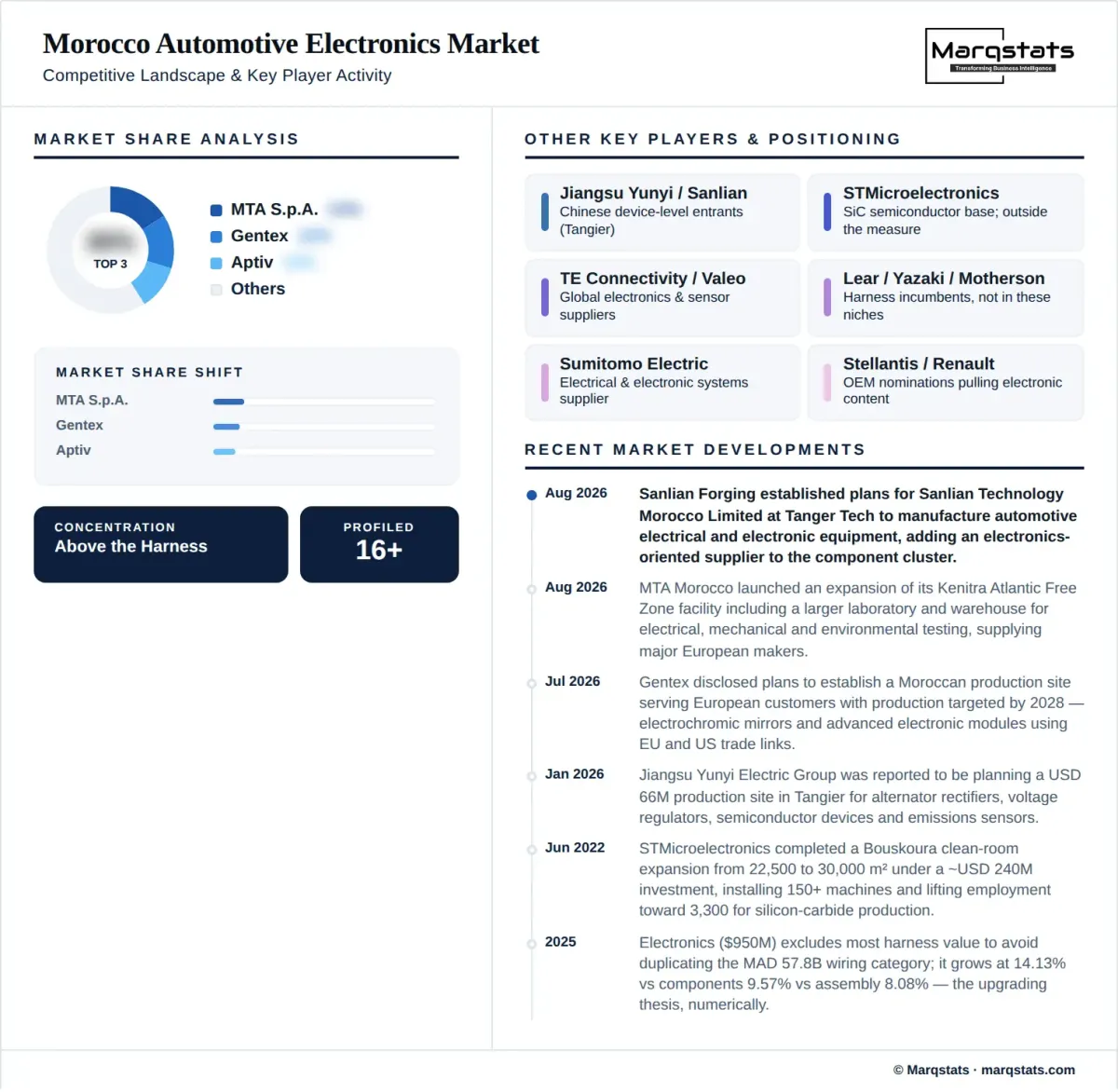
Morocco's automotive electronics field is forming rather than settled, and no participant's share of the estimated USD 950 million output is disclosed or estimated here. The established electrical suppliers anchoring the MAD 57.8 billion wiring category are adjacent rather than direct competitors, because the categories where electronics value concentrates are precisely those the harness cluster has not commoditised.
MTA Morocco is the clearest incumbent in scope, supplying automotive electrical components to major European manufacturers from Kenitra and, unusually for a supplier of its size, investing in its own electrical, mechanical and environmental testing laboratory. That combination of production and validation is the competitive model this market rewards, and it is the benchmark an entrant should expect to match.
The entrant field is predominantly Chinese and is arriving at device level. Sanlian Forging established Sanlian Technology Morocco Limited at Tanger Tech in August 2026 for automotive electrical and electronic equipment, and Jiangsu Yunyi Electric Group was reported in January 2026 planning a USD 66 million Tangier site covering rectifiers, voltage regulators, semiconductor devices and emissions sensors. Neither is competing for harness volume.
Gentex represents a different entry model: a Western Tier-1 selecting Morocco to serve European customers with electrochromic mirrors and advanced electronic modules, targeting production in 2028. The five-year lead from disclosure to volume is characteristic of automotive electronics and is why an investor should read the pipeline rather than current output when assessing competitive position.
The most significant electronics capability in the country belongs to a company that does not appear in automotive component statistics at all. STMicroelectronics' Bouskoura site, with approximately 3,300 employees and a clean room expanded to 30,000 square metres under an investment of approximately USD 240 million, produces silicon carbide power devices for traction inverters and on-board chargers. Any competitive assessment that omits it understates Morocco's electronics depth substantially.
Companies Covered
The report profiles 15+ companies with full strategy and financials analysis, including:
Recent Market Activity
Table of Contents
Coverage & Segmentation
The study covers Morocco with a 2025 base year, historical analysis from 2021 to 2025 and forecasts for 2026 to 2031. Headline CAGRs connect 2025 and 2031 across six years, and the narrower 2026 to 2031 rate is stated separately wherever used. The quantified measure is automotive electronics manufacturing output value, with Morocco vehicle production carried as the physical reference series.
Coverage spans sensing and driver-assistance electronics, power electronics and high-voltage control, body and comfort electronics, instrumentation and displays, and gateways and connectivity, across combustion and electrified platforms, Tier-1, Tier-2 and validation supply positions, and export and domestic destinations. Most conventional wiring-harness value is excluded so it does not duplicate the wiring export category counted in the broader components market, and semiconductor device manufacturing is excluded as a Tier-2 input.
The analysis addresses entry-niche selection, location choice, qualification planning and investment appraisal. Stakeholder questions include which electronics categories remain uncommoditised by the harness cluster, why an official market size does not exist, how far a 2028 production target should influence a 2026 location decision, and what an operating silicon carbide assembly base means for a power-electronics entrant.