Market Snapshot
Key Takeaways
Market Overview & Analysis
Report Summary
The Egypt automotive tire manufacturing market covers automotive tires physically manufactured in Egypt, separating actual output from announced nameplate capacity. Passenger car, truck and bus and industrial and heavy-duty tire projects are all included but identified by product type. The distinction between output and capacity is not a methodological footnote in this category; it is the category's defining problem, because Egypt is moving from a single operating incumbent to a multi-project cluster in which nearly all the announced volume has not yet been built.
The 2025 base is unusually solid for a market of this kind. Prometeon Tyre Egypt's Alexandria facility produces approximately 1.10 million heavy-duty and engineering tires a year and exports close to 70% of output, and that single plant is effectively Egypt's operational tire manufacturing base. Sailun broke ground on its Suez Canal Economic Zone plant in September 2025 and is therefore excluded from 2025 operational output entirely. The 2026 estimate of 1.20 million tires remains close to existing output for the same reason: the largest new lines are still in construction or approval.
What has changed since the underlying research was compiled is the scale of the announced pipeline rather than the operational base. Sailun's disclosed project now carries total investment of USD 1.141 billion, with a first phase of 9 million passenger car radials and 1.65 million truck and bus radials annually and a second phase adding 18 million passenger car radials, 1.65 million truck and bus radials and 20,000 tonnes of off-the-road tires, the second phase subject to shareholder and Egyptian regulatory approval. Combined with Prometeon, quantified announced capacity now exceeds 32.9 million tires a year rather than the 13 million a narrower reading of the pipeline would suggest.
Automotive Tire Manufacturing Output in Egypt
Annual output rises from 1.10 million tires in 2025 to 6.54 million in 2030, a 42.84% compound annual growth rate and an absolute increase of 5.44 million tires. The indicative 2031 endpoint is approximately 9.99 million tires. The 2026 estimate of 1.20 million is anchored on the fact that no new line is expected to contribute meaningful volume that year, with Prometeon's expansion targeted at early 2028 and the Sailun commissioning sequence running through 2027 to 2029. The shape is the reverse of a normal launch curve: because 2026 is almost flat at roughly 9% growth, the 42.84% five-year rate understates rather than overstates the pace once capacity arrives, and output compounds at 52.79% from 2026 to 2030.
The forecast is deliberately conservative against the announced pipeline and the arithmetic makes that explicit. A 2030 output of 6.54 million tires represents 19.9% of the 32.9 million tires of quantified announced capacity, and the true denominator is higher still because ZC Rubber's proposed Sokhna complex and Long March Tyre's Suez Canal Economic Zone development carry no published capacity figures. Even the 2031 endpoint of 9.99 million sits at roughly 30% of quantified capacity. Anyone building a bottom-up model from plant announcements will arrive at a number three to five times larger than this forecast, and the difference is entirely utilisation and commissioning timing.
Output value rises from USD 181.50 million to USD 621.30 million, a 27.90% compound annual growth rate, and the fifteen-percentage-point gap against unit growth is the mix story. Average value per tire falls from approximately USD 165 to USD 95, a decline of about 10.45% each year, because Egypt's 2025 output is entirely Prometeon's heavy-duty and engineering tires while the incoming capacity is overwhelmingly passenger car radial. Egypt's truck and bus tire imports in 2024 averaged roughly USD 163 a unit against typical passenger radial values near a third of that, which is the price gap driving the decline.
The relationship with Egypt's other component measures is straightforward here because tire manufacturing sits mostly outside them. Egypt's automotive components market counts domestic component demand of USD 2.10 billion in 2025 and excludes export manufacturing output; with roughly 70% of Egyptian tire output exported in the base year, most of this market's value falls outside that figure and only the domestic original equipment and replacement portion sits inside it. Egypt's automotive tire components market, covering steel cord, bead wire and rubber chemical inputs, is upstream of this measure rather than a subset of it, and Zenith Steel's 120,000 tonnes of steel cord capacity feeds the plants counted here rather than adding to their output.
Market Dynamics
Key Drivers
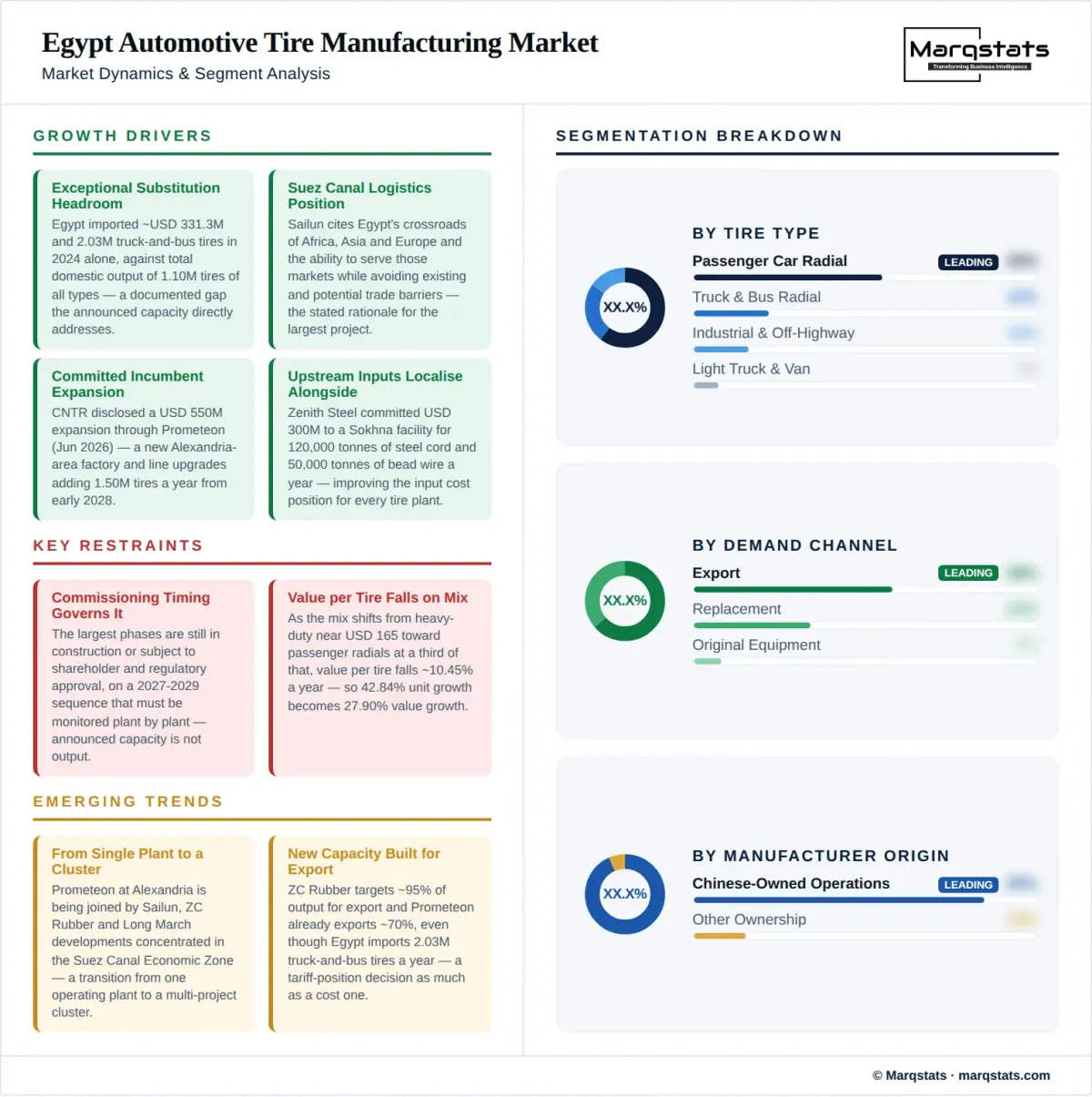
- Import substitution headroom is exceptional in truck and bus tires, with Egypt importing about USD 331.3 million and 2.03 million units of that category alone in 2024 against total domestic output of 1.10 million tires across all types.
- Suez Canal logistics position is the stated rationale for the largest project, with Sailun citing Egypt's position at the crossroads of Africa, Asia and Europe and the ability to serve customers in Africa, Europe and North America while avoiding existing and potential international trade barriers.
- Incumbent expansion is committed rather than exploratory, with China National Tire and Rubber disclosing a USD 550 million expansion through Prometeon Tyre Egypt in June 2026 covering a new Alexandria-area factory and line upgrades, adding 1.50 million tires a year from early 2028.
- The project pipeline is broadening beyond two participants, with ZC Rubber signing a letter of intent in September 2026 for an estimated USD 500 million integrated complex on about 600,000 square metres in Sokhna, developed in three phases with roughly 95% of output targeted for export.
- Upstream input localisation is arriving alongside tire capacity, with Zenith Steel Group committing USD 300 million to a Sokhna facility for 120,000 tonnes of steel cord and 50,000 tonnes of bead wire annually, materially improving the input cost position for every tire plant in the country.
Key Restraints
- Commissioning timing rather than capacity governs the forecast, with the largest phases still in construction or subject to shareholder and Egyptian regulatory approval, and a 2027 to 2029 sequence that must be monitored plant by plant rather than assumed.
- Non-compliant and subsidised imports are a named commercial threat to domestic producers, raised specifically by Prometeon in 2026 discussions, and import quality and anti-dumping enforcement is therefore a policy variable with direct bearing on plant utilisation.
- Export-oriented plants require destination-market type approvals and quality certification in Europe, Africa and MENA, which is a longer and more capital-intensive path than domestic supply and gates the export share these projects are designed around.
- Value per tire falls about 10.45% a year as mix shifts from heavy-duty and engineering products near USD 165 toward passenger car radials, so unit growth of 42.84% translates into value growth of only 27.90%.
Key Trends
- Egypt is transitioning from a single-plant market to a cluster, with Prometeon at Alexandria joined by Sailun, ZC Rubber and Long March Tyre developments concentrated in the Suez Canal Economic Zone.
- New capacity is designed for export rather than substitution, with ZC Rubber targeting roughly 95% of output for export and Prometeon already exporting close to 70%, even though Egypt imports 2.03 million truck and bus tires a year.
- Chinese ownership now dominates the pipeline, with Sailun, ZC Rubber and Long March Tyre all Chinese groups and Prometeon itself majority-held by China National Tire and Rubber.
- Project scale has escalated sharply within a single year, with Sailun's Egyptian commitment moving from a USD 291 million first-phase groundbreaking in September 2025 to a total project investment of USD 1.141 billion and average annual revenue projected at USD 1.16 billion.
Market Segmentation
The category with the clearest import substitution case, since Egypt imported about 2.03 million units worth USD 331.3 million in 2024 at roughly USD 163 a unit. Sailun's disclosed phases add 3.30 million truck and bus radials annually across both stages, which alone would exceed the entire 2024 import volume, making this the segment where announced capacity most directly addresses a documented domestic gap.
The segment that will dominate volume and dilute value, with Sailun's disclosed phases covering 27 million passenger car radials annually against Egypt's total 2025 output of 1.10 million tires of all types. Passenger radials sell for roughly a third of a truck and bus tire's value, which is why average value per tire falls from about USD 165 to USD 95 across the forecast period.
Egypt's established strength and the base year's entire output, comprising Prometeon's approximately 1.10 million heavy-duty and engineering tires a year from Alexandria with close to 70% exported. Sailun's second phase adds 20,000 tonnes of off-the-road tires, and the segment retains the highest value per unit of any category even as its share of total volume falls sharply.
The smallest disclosed category and the one least addressed by announced projects, sitting between passenger radial and truck and bus specifications. It follows Egypt's commercial vehicle assembly, which recorded 28,447 trucks and 11,343 buses in 2025, and its domestic original equipment pull is correspondingly modest against a market heading toward 6.54 million tires by 2030.
The channel that most new capacity is designed around, with ZC Rubber targeting roughly 95% of output for export and Prometeon already exporting close to 70% of its 1.10 million tires. Sailun cites customers in Africa, Europe and North America and the ability to avoid existing and potential international trade barriers, which makes Egyptian production a tariff-position decision as much as a cost decision.
The larger domestic channel, tied to Egypt's installed vehicle parc rather than to assembly output, and the channel Egypt's 2.03 million truck and bus tire imports in 2024 predominantly served. It is where import substitution actually happens, because replacement buyers are price-sensitive and specification-flexible in a way that original equipment nomination is not.
The smallest channel by volume, tied to local vehicle assembly of about 99,600 units in 2025 rising toward 206,000 by 2030. At roughly four to five tires per vehicle including spare, original equipment fitment accounts for well under a million tires a year even at the end of the forecast period, against total output of 6.54 million.
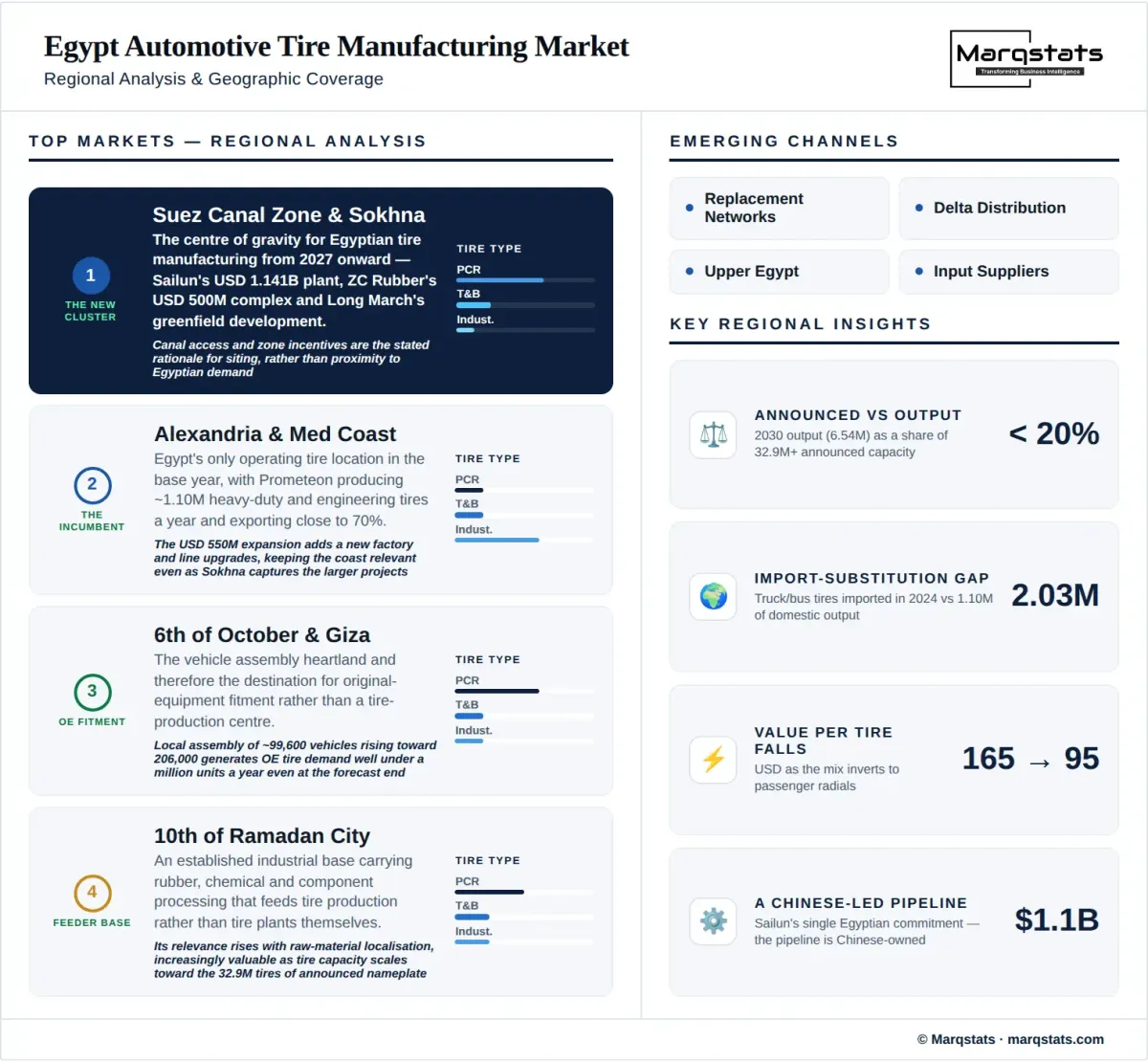
The location of essentially all new capacity, hosting Sailun's plant, ZC Rubber's proposed 600,000 square metre integrated complex and Long March Tyre's greenfield development. Zone status combines industrial and Investment Law incentives with canal logistics, which is the stated basis for Sailun's USD 1.141 billion commitment and its Africa, Europe and North America customer strategy.
The incumbent cluster and the whole of Egypt's 2025 operational output, comprising Prometeon's facility producing approximately 1.10 million tires a year. The USD 550 million expansion adds a new Alexandria-area factory alongside upgrades to existing lines, keeping the coast relevant even as the Suez Canal Economic Zone captures the larger projects.
Covering upstream input capacity rather than tire production, most significantly Zenith Steel Group's USD 300 million Sokhna-adjacent facility for 120,000 tonnes of steel cord and 50,000 tonnes of bead wire annually. Input localisation becomes more valuable as tire capacity scales, and this is the segment that determines whether Egypt's cost position improves as volume grows.
Effectively the entire pipeline and, through China National Tire and Rubber's control of Prometeon, most of the existing base as well. Sailun at USD 1.141 billion, ZC Rubber at an estimated USD 500 million and Long March Tyre together account for all quantified new capacity beyond Prometeon's 1.50 million tire expansion.
Represented by Prometeon, which retains European technology and brand heritage while operating under Chinese ownership, and which alone accounts for Egypt's entire 1.10 million tires of 2025 output. Its heavy-duty and engineering specialisation gives it the highest value per unit in the market at roughly USD 165 against passenger radial values near a third of that.
By Geography
Suez Canal Economic Zone and Sokhna
The centre of gravity for Egyptian tire manufacturing from 2027 onward, hosting Sailun's plant on a USD 1.141 billion total commitment, ZC Rubber's proposed USD 500 million integrated complex across 600,000 square metres in three phases, and Long March Tyre's 2026 greenfield development. Canal access and zone incentives are the stated rationale for siting rather than proximity to Egyptian demand.
Alexandria and the Mediterranean Coast
Egypt's only operating tire manufacturing location in the base year, with Prometeon producing approximately 1.10 million heavy-duty and engineering tires a year and exporting close to 70%. The June 2026 USD 550 million expansion adds a new Alexandria-area factory and line upgrades, contributing 1.50 million tires a year from early 2028.
6th of October City and Giza
The vehicle assembly heartland and therefore the destination for original equipment fitment rather than a tire production centre. Local assembly of about 99,600 vehicles in 2025 rising toward 206,000 by 2030 generates original equipment tire demand well under a million units a year even at the end of the forecast.
10th of Ramadan City
An established industrial base carrying rubber, chemical and component processing that feeds tire production rather than tire plants themselves. Its relevance rises with raw material localisation, which the pack identifies as increasingly valuable as tire capacity scales toward the 32.9 million tires of announced nameplate.
Rest of Egypt
Covering distribution, replacement channel infrastructure and smaller rubber processing operations across the Delta and Upper Egypt. The replacement channel served roughly 2.03 million imported truck and bus tires in 2024 and reaches buyers through networks that sit outside the industrial clusters where manufacturing concentrates.
How Competition Is Evolving
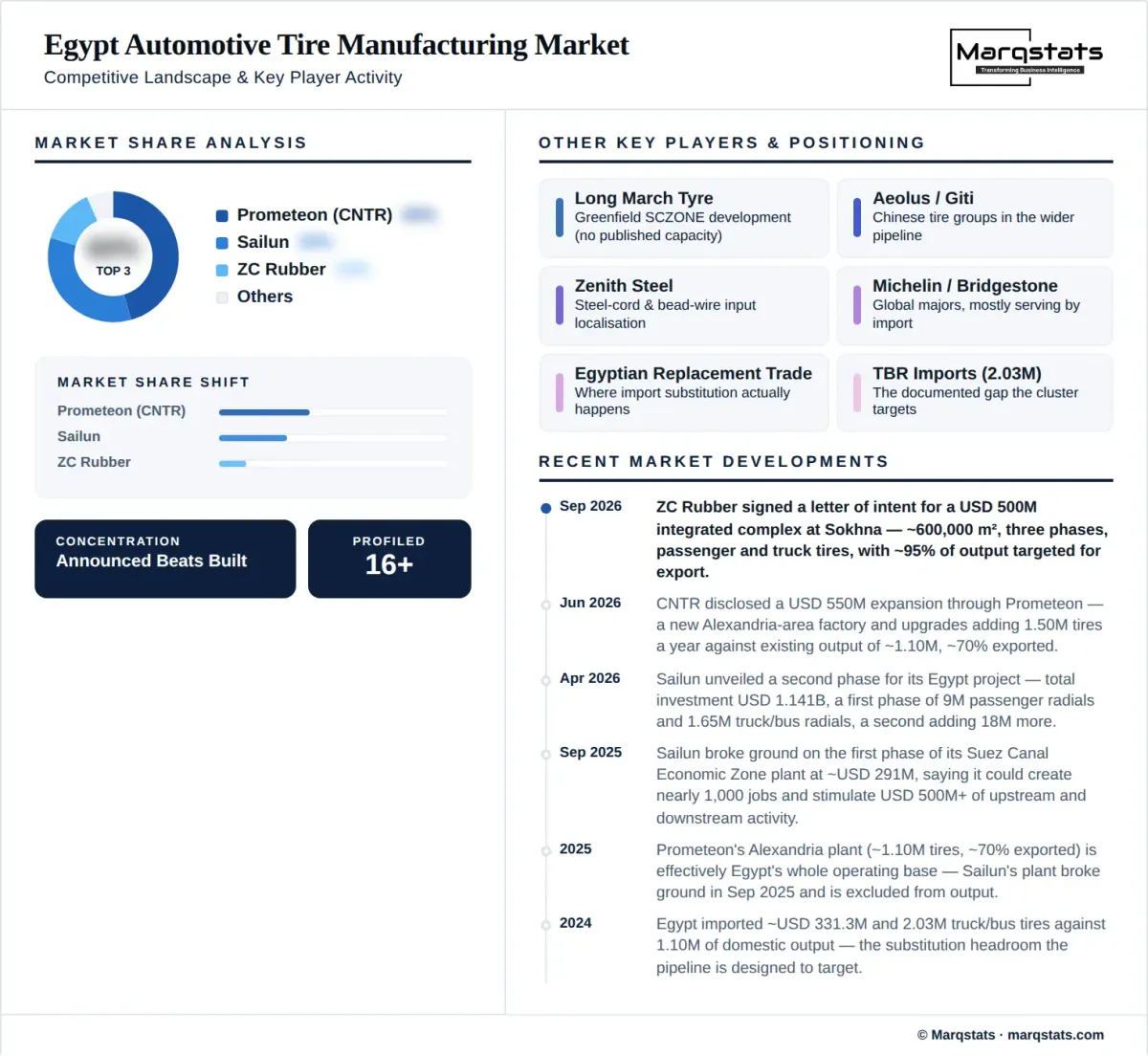
Egypt's tire manufacturing sector had one meaningful producer in 2025 and will have four or more by 2030, and the transition is being financed almost entirely from China. Prometeon Tyre Egypt, majority-held by China National Tire and Rubber, produces about 1.10 million heavy-duty and engineering tires a year at Alexandria with close to 70% exported, and is committing USD 550 million to add 1.50 million tires from early 2028. Sailun Group broke ground at the Suez Canal Economic Zone in September 2025 and now carries total project investment of USD 1.141 billion. ZC Rubber signed a letter of intent in September 2026 for an estimated USD 500 million complex. Long March Tyre added a further Suez Canal Economic Zone development during 2026.
The competitive question is not who wins Egyptian customers but whose capacity actually commissions, and on what schedule. Sailun's first phase covers 9 million passenger car radials and 1.65 million truck and bus radials annually; its second phase adds 18 million passenger car radials, 1.65 million truck and bus radials and 20,000 tonnes of off-the-road tires, subject to shareholder and Egyptian regulatory approval. Total project revenue is projected at an average USD 1.16 billion a year with net profit near USD 170 million. Those figures describe an operation several times the size of Egypt's entire current tire industry, and the second phase has not been approved. Treating either phase as forecast supply before commissioning is the error the output-versus-capacity distinction exists to prevent.
The strategic tension worth naming is that Egypt imports the tires its own plants are being built to export. The country brought in about 2.03 million truck and bus tires worth USD 331.3 million in 2024 while its only producer exported close to 70% of output, and the largest incoming project targets Africa, Europe and North America. The explanation is product mix and channel rather than irrationality: Prometeon builds heavy-duty and engineering tires that do not substitute for the standard truck and bus radials Egypt imports, and export nominations carry certification and offtake commitments that domestic replacement demand cannot match. Whether that changes depends on Sailun's 3.30 million truck and bus radials finding Egyptian buyers rather than European ones, which is a commercial decision rather than a capacity one.
For a client the decision this page supports is which number to underwrite, and the answer depends on what is being financed. A supplier sizing an addressable market for rubber chemicals, steel cord or bead wire should work from output, because inputs are consumed by tires actually made, and that is 6.54 million tires by 2030. An investor assessing whether Egypt becomes a regional tire hub should work from the commissioning schedule, because the question is when the 32.9 million tires of announced nameplate converts and how much of it is approved. A policymaker assessing import substitution should work from neither, and instead from the 2.03 million truck and bus tires Egypt imported in 2024 against the 3.30 million truck and bus radials Sailun has disclosed, because that comparison determines whether the new capacity displaces imports or simply exports past them.
Companies Covered
The report profiles 16+ companies with full strategy and financials analysis, including:
Recent Market Activity
Table of Contents
Coverage & Segmentation
The study covers automotive tires physically manufactured in Egypt across the 2021 to 2025 historical period and the 2026 to 2030 forecast period, with 2025 as the base year and an indicative 2031 endpoint. Passenger car, truck and bus, light truck and van, and industrial and off-highway tire production are all included and identified by product type. The measure is actual output, and announced nameplate capacity is reported separately rather than incorporated, because the two differ by a factor of five in this market and conflating them is the principal way it gets oversized.
Sizing proceeds from operating plants rather than from announcements. The 2025 base of 1.10 million tires is Prometeon's Alexandria output, effectively the whole of Egypt's operational manufacturing. Sailun's September 2025 groundbreaking places its plant outside 2025 output entirely, and the 2026 estimate of 1.20 million reflects that the largest lines remain in construction or approval. Forward volume is built by applying commissioning schedules and utilisation assumptions to confirmed phases, with unapproved phases and unquantified projects excluded. The published sizing range runs from 1.1 to 1.2 million tires for 2025 and 8 to 12 million for 2031, and confidence is graded moderate.