Market Snapshot
Key Takeaways
Market Overview & Analysis
Report Summary
Morocco is an export-manufacturing components market before it is anything else. Domestic new-vehicle demand of 235,372 registrations in 2025 is useful context but it is not the denominator that drives component output, and a market model built on registrations would understate the sector by roughly an order of magnitude. The relevant denominators are vehicle production, export programmes and OEM sourcing commitments, all of which are larger and all of which are disclosed.
The commercial question for an inbound supplier is not whether Morocco has capacity but whether a nominated programme exists to fill it. AMICA reports more than 260 suppliers and one million vehicles a year of installed assembly capacity against actual 2025 production of 501,965 vehicles, so spare capacity is abundant and customer nomination is the scarce resource. A plant-feasibility model should use contracted programmes as the near-term revenue base, never total installed vehicle capacity.
The analysis addresses supplier location choice, sourcing depth, incentive eligibility and export-programme access. It separates the roughly USD 10.00 billion of component export output from the approximately USD 5.70 billion of OEM sourcing measured by AMICA, explains why the two are not additive, and treats announced investment such as a new plant opening as evidence of direction rather than as realised output.
Morocco Automotive Components Market Size and Forecast
Component manufacturing output is estimated at USD 10.00 billion in 2025, rising to USD 11.50 billion in 2026 and USD 17.30 billion by 2031. The published range is USD 9.5 to 10.5 billion for 2025, USD 10.8 to 12.2 billion for 2026 and USD 15.5 to 19.5 billion for 2031. Confidence is graded medium, which is the highest grading available in this cluster, because the 2025 anchor is derived from official trade statistics rather than from modelled assumptions.
Two growth rates apply to the same series and both are published. The six-year rate connecting 2025 and 2031 is 9.57%. The five-year rate connecting 2026 and 2031 is 8.51%, and it is lower because 2026 itself carries an unusually strong uplift: H1 2026 automotive exports reached MAD 93.7 billion, up 17.4% year on year. A reader applying the 2026 to 2031 rate backwards from the base year will understate the market, and one extrapolating the 2026 export surge forwards will overstate it.
Forecast growth is driven by higher vehicle assembly capacity, deeper local integration, supplier relocation into Morocco and rising electronics and electrified-vehicle content per vehicle. It is not a mechanical continuation of the H1 2026 export rate. Announcements such as new plant openings raise the capacity ceiling; they enter the output series only as those plants ramp, which is why the forecast sits below the sum of announced project capacity.
Morocco's vehicle production provides the physical reference for the value series. Output was 501,965 vehicles in 2025, below the 559,645 recorded in 2024, against AMICA's reported installed capacity of one million vehicles a year. The 2031 reference of 800,000 vehicles assumes 80% utilisation of that installed capacity and is a disclosed modelling assumption rather than a published projection.
The Export Bridge and How the Market Is Measured
The measure is total automotive exports less finished-vehicle construction exports. For 2025 that is MAD 154.7 billion less approximately MAD 61.4 billion, leaving MAD 93.3 billion, or about USD 10.00 billion at the 2025 average convention of 9.344 MAD per USD. The method is transparent, reproducible from published trade statistics and free of any assumption about component content per vehicle.
The bridge validates almost exactly on 2026 data. Components represented 60.31% of automotive exports in 2025. Across January to July 2026, total automotive exports reached MAD 107.1 billion with vehicle construction at MAD 42.5 billion, leaving MAD 64.6 billion of components, or 60.32% of the total. Two independent periods produce a component share that agrees to two decimal places, which is far stronger evidence for the method than any single-year calculation could provide.
Annualising the January to July 2026 residual gives roughly MAD 110.7 billion, or approximately USD 11.85 billion, against the modelled 2026 estimate of USD 11.50 billion. The 3% variance sits well inside the published USD 10.8 to 12.2 billion range and provides a live cross-check that the forecast has not drifted from observable trade data.
The measure deliberately excludes finished-vehicle export value, because counting an assembled car and its constituent components would double-count the same manufacturing activity. It also excludes trading and re-export activity that carries no Moroccan manufacturing value, which is the same distinction the incentive framework applies when assessing local-integration eligibility.
OEM Sourcing Against Component Export Output
Two measures of the Moroccan supplier economy circulate and they are routinely confused. AMICA reports more than EUR 5 billion of sourcing from Morocco in 2025, approximately USD 5.70 billion at the year's EUR to USD convention. Component export output is approximately USD 10.00 billion. The sourcing figure is deliberately the smaller of the two because not every exported component euro is captured within domestic OEM sourcing, and the definitions differ.
Sourcing value is forecast to reach approximately USD 10.00 billion by 2031, a trajectory supported by Stellantis alone targeting more than EUR 6 billion of purchases from Morocco-based suppliers by 2030. That forecast reflects supplier expansion, deeper local integration and larger OEM assembly capacity, without assuming that all announced plant capacity is fully utilised.
Adding the two series produces a combined figure of nearly USD 16 billion describing a supplier economy that does not exist at that scale, because a component manufactured in Morocco and sourced by a Moroccan OEM appears in both. Any competitive benchmarking exercise should state which measure it is using before comparing suppliers, since a firm's share of sourcing and its share of export output are different numbers.
Component Output Against Domestic Vehicle Absorption
Morocco produced 501,965 vehicles in 2025 and generated approximately USD 10.00 billion of component output, implying roughly USD 19,922 of component value per vehicle produced. That figure exceeds the ex-factory value of most vehicles Morocco assembles, which is the clearest possible proof that component output is not consumed by domestic assembly.
A realistic component content of USD 6,000 to 7,000 per assembled vehicle implies domestic absorption of roughly USD 3.0 to 3.5 billion, leaving around two-thirds of component output destined for export to European assembly plants. That structure is what makes Morocco a components exporter first and a vehicle assembler second, and it is why European OEM programme nominations matter more to a Moroccan supplier than Moroccan vehicle sales.
By 2031 the ratio widens modestly to approximately USD 21,625 of component output per vehicle produced on the 800,000-vehicle reference. Rising electronics and electrified-vehicle content per vehicle lifts the numerator faster than assembly volume lifts the denominator, which is the quantitative expression of the localization and content-deepening thesis.
Local Integration and the Road to Eighty Percent
AMICA reports a 69% sector integration rate for 2025. The Ministry has articulated an 80% integration ambition, and Stellantis specifically targets 75% local integration at Kenitra by 2030. Those three figures describe different scopes and should not be presented as a single national trajectory, but together they establish that integration depth is the sector's governing policy objective.
Integration deepening is what separates component output growth from vehicle production growth. A vehicle assembled in Morocco with 69% local content generates materially less domestic component demand than the same vehicle at 80%, so a five-point move in integration is worth more to suppliers than several percentage points of assembly volume. That is the mechanism behind a component forecast growing at 9.57% while the vehicle production reference grows at 8.08%.
Localization benefits depend on real manufacturing value rather than simple trading activity. Export-focused suppliers must maintain destination-market OEM quality, traceability and technical standards, and incentive eligibility does not substitute for customer nomination. A supplier that assembles imported sub-components without adding process value will not qualify for integration credit even where it holds a Moroccan address.
Supplier Ecosystem and Industrial Geography
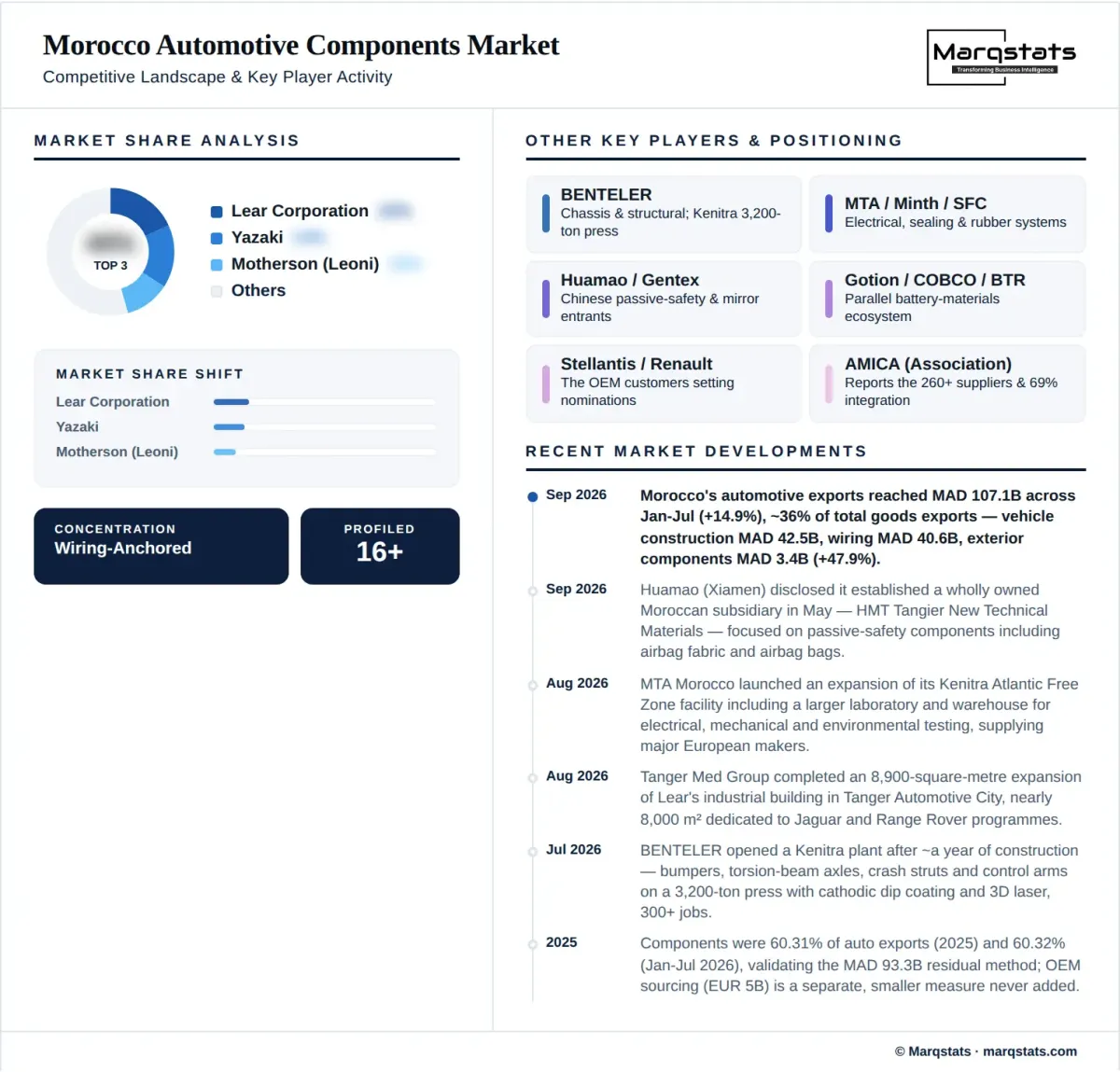
AMICA reports more than 260 automotive suppliers, three vehicle manufacturers and over 280,000 sector jobs. The electrical and wiring cluster anchored by Lear, Yazaki and Motherson-owned Leoni is the largest measurable segment, generating MAD 57.8 billion of 2025 exports. BENTELER's Kenitra plant adds chassis and structural capability, MTA supplies automotive electrical components with expanded testing, and Minth, SFC Solutions and ACAPLAST cover sealing, rubber and plastic systems.
Chinese Tier-1 and Tier-2 suppliers are entering steadily and broadening the mix beyond conventional wiring and metal parts. Huamao established a wholly owned Tangier subsidiary in 2026 for airbag fabric and passive-safety products, while battery and materials investors including Gotion, COBCO and BTR are building an entirely new supplier ecosystem alongside the established component base.
Supplier concentration around Tangier and Kenitra creates strong logistics benefits and real competition for labour, land and capacity. Location choice should compare the two ecosystems on customer proximity, port access, labour availability and free-zone incentives rather than on headline incentive rates alone, because the binding constraint in an established cluster is usually recruitment rather than land.
Investment Incentives and Free Zone Structures
Morocco provides automotive ecosystem investment support covering local integration, skills development, industrial land and free-zone structures. The Investment Promotion Fund can support eligible land, external infrastructure and vocational-training costs subject to scheme rules and caps, and the Hassan II Fund can support eligible automotive industrial investments.
Large qualifying projects may benefit from import-VAT relief on capital equipment under the Ministry framework, which materially changes the cash profile of a plant carrying equipment such as the 3,200-ton press installed at BENTELER's Kenitra facility. Eligibility and caps are scheme-specific and should be confirmed against current rules rather than assumed from a headline description.
Incentives are necessary but not sufficient. A supplier serving a market of more than 260 established competitors qualifies for support on the same terms as its rivals, so the incentive framework equalises rather than differentiates. The defensible advantages are OEM proximity, European nearshoring economics and rising local content in high-value parts, which is where new supplier niches actually sit.
Market Dynamics
Key Drivers
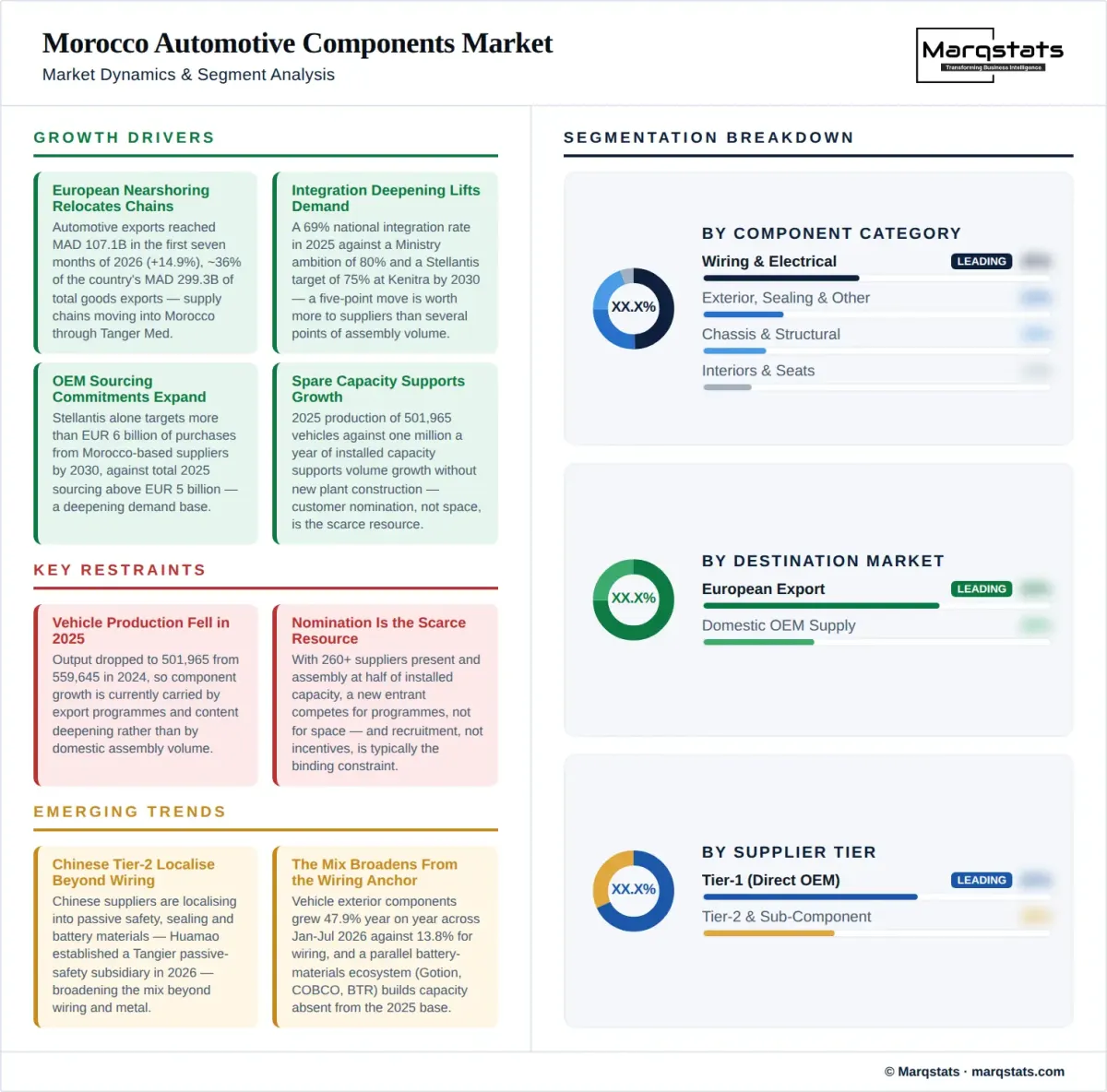
- European nearshoring is relocating supply chains into Morocco, with automotive exports reaching MAD 107.1 billion in the first seven months of 2026, up 14.9% and representing roughly 36% of the country's MAD 299.3 billion of total goods exports.
- Integration deepening lifts component demand faster than assembly volume, with a 69% national rate in 2025 against a Ministry ambition of 80% and a Stellantis target of 75% at Kenitra by 2030.
- OEM sourcing commitments are expanding, with Stellantis alone targeting more than EUR 6 billion of purchases from Morocco-based suppliers by 2030 against total 2025 sourcing above EUR 5 billion.
- Spare assembly capacity supports volume growth without new plant construction, with 2025 production of 501,965 vehicles against one million vehicles a year of installed capacity.
- Electronics and electrified-vehicle content is rising per vehicle, lifting component value per assembled unit from approximately USD 19,922 in 2025 toward USD 21,625 by 2031.
Key Restraints
- Vehicle production fell in 2025 to 501,965 units from 559,645 in 2024, so component growth is currently being carried by export programmes and content deepening rather than by domestic assembly volume.
- Supplier concentration around Tangier and Kenitra creates competition for labour, land and capacity, and recruitment rather than incentive availability is typically the binding constraint in an established cluster.
- Customer nomination is the scarce resource rather than capacity. With more than 260 suppliers already present and assembly running at half of installed capacity, a new entrant competes for programmes, not for space.
- Component exports depend heavily on European demand, and wiring alone at MAD 57.8 billion represents 37.4% of automotive exports, concentrating exposure in one category and one destination region.
Key Trends
- Chinese Tier-1 and Tier-2 suppliers are localising beyond wiring into passive safety, sealing and battery materials, with Huamao establishing a Tangier passive-safety subsidiary during 2026.
- Established suppliers are reinvesting rather than only new entrants arriving, with Lear adding 8,900 square metres at Tanger Automotive City and MTA expanding its Kenitra laboratory and warehouse in 2026.
- The component mix is broadening beyond the wiring anchor, with vehicle exterior components growing 47.9% year on year across January to July 2026 against 13.8% for wiring.
- Battery and materials investment is creating a parallel supplier ecosystem, with Gotion, COBCO and BTR building capacity that did not exist in the 2025 component base at all.
Market Segmentation
Wiring is the largest measurable category at MAD 57.8 billion of 2025 exports, up 7.8% and representing 37.4% of total automotive exports. The share proved stable into 2026 at 37.9% across January to July on MAD 40.6 billion, growing 13.8% year on year. Lear, Yazaki and Motherson-owned Leoni anchor the cluster, and Lear's 2026 expansion dedicated nearly 8,000 square metres to Jaguar and Range Rover programmes.
Interiors and seats generated MAD 9.7 billion of 2025 exports, up 7.1% and representing approximately 6.3% of automotive exports. The category is labour-intensive and benefits directly from Morocco's 280,000-strong sector workforce, but it carries lower value density than electronics and is more exposed to wage competition from alternative nearshoring locations.
Chassis and structural parts are the fastest-developing heavy category, anchored by BENTELER's Kenitra plant which opened in July 2026 producing bumpers, torsion-beam axles, crash struts and control arms with a 3,200-ton press, advanced welding, cathodic dip coating and 3D laser systems. The plant created more than 300 direct jobs and represents the capital-intensive end of the supplier base.
Vehicle exterior components are the fastest-growing reported category, reaching MAD 3.4 billion across January to July 2026 at 47.9% year-on-year growth, far ahead of the 14.9% recorded for automotive exports overall. The base is small relative to wiring, so the growth rate reflects category formation rather than a mature expansion, but the direction confirms mix broadening.
Powertrain, safety, rubber and plastic components and remaining Tier-1 and Tier-2 families make up the balance of the MAD 93.3 billion residual. Minth, SFC Solutions and ACAPLAST cover sealing and rubber systems, while Huamao's 2026 Tangier subsidiary adds airbag fabric and passive-safety products to a mix that was dominated by wiring and metal parts only a few years ago.
Passenger vehicles dominate both domestic assembly and export programmes, with AIVAM recording 208,848 passenger-car registrations of Morocco's 235,372 total in 2025. Component programmes are correspondingly weighted toward passenger platforms, and the European premium programmes served from Tangier, including Jaguar and Range Rover wiring work, sit in this application.
Light utility vehicles accounted for 26,524 registrations of the 235,372 total in 2025, approximately 11.3%. Component demand from this application is smaller domestically but carries different specification and durability requirements, and export programmes for commercial platforms are assessed separately from passenger nominations because the customer sets and volumes differ.
European programmes absorb the large majority of the roughly two-thirds of component output that is exported rather than domestically assembled. Nearshoring economics, tariff access and proximity through Tanger Med are the structural advantages, and the MAD 107.1 billion of automotive exports recorded across January to July 2026 is overwhelmingly European-facing.
Domestic supply to Morocco's three vehicle manufacturers absorbs roughly USD 3.0 to 3.5 billion of component value against USD 10.00 billion of output, on a realistic content assumption of USD 6,000 to 7,000 per assembled vehicle. AMICA's EUR 5 billion sourcing figure is the more precise measure of this channel and is carried separately.
Non-European destinations represent a small and less-documented share of the MAD 93.3 billion component residual. Trade statistics do not disaggregate component exports by destination at the category level, so destination analysis relies on programme-level evidence rather than on published splits, and no numeric destination share is published here.
Tier-1 suppliers hold direct OEM nominations and account for the bulk of the more than 260 suppliers AMICA reports. Lear, Yazaki, BENTELER, MTA and Minth operate at this level, and their expansions are the most reliable leading indicator of component output because a Tier-1 programme win precedes the associated export value by one to three years.
Tier-2 and sub-component suppliers serve the Tier-1 base and are where the 69% integration rate is actually won or lost, because a Tier-1 importing its sub-components generates less local content than its headline output suggests. Chinese entrants such as Huamao are arriving predominantly at this level, adding specialised capability rather than competing for existing nominations.
Materials and process suppliers, including the battery-materials investments by Gotion, COBCO and BTR, are building an ecosystem layer that contributed essentially nothing to the 2025 component base. Their output is tracked separately from the component measure, because cathode materials and cells are inputs to a different value chain and counting both would overstate the components market.
By Geography
Tangier and Tanger Automotive City
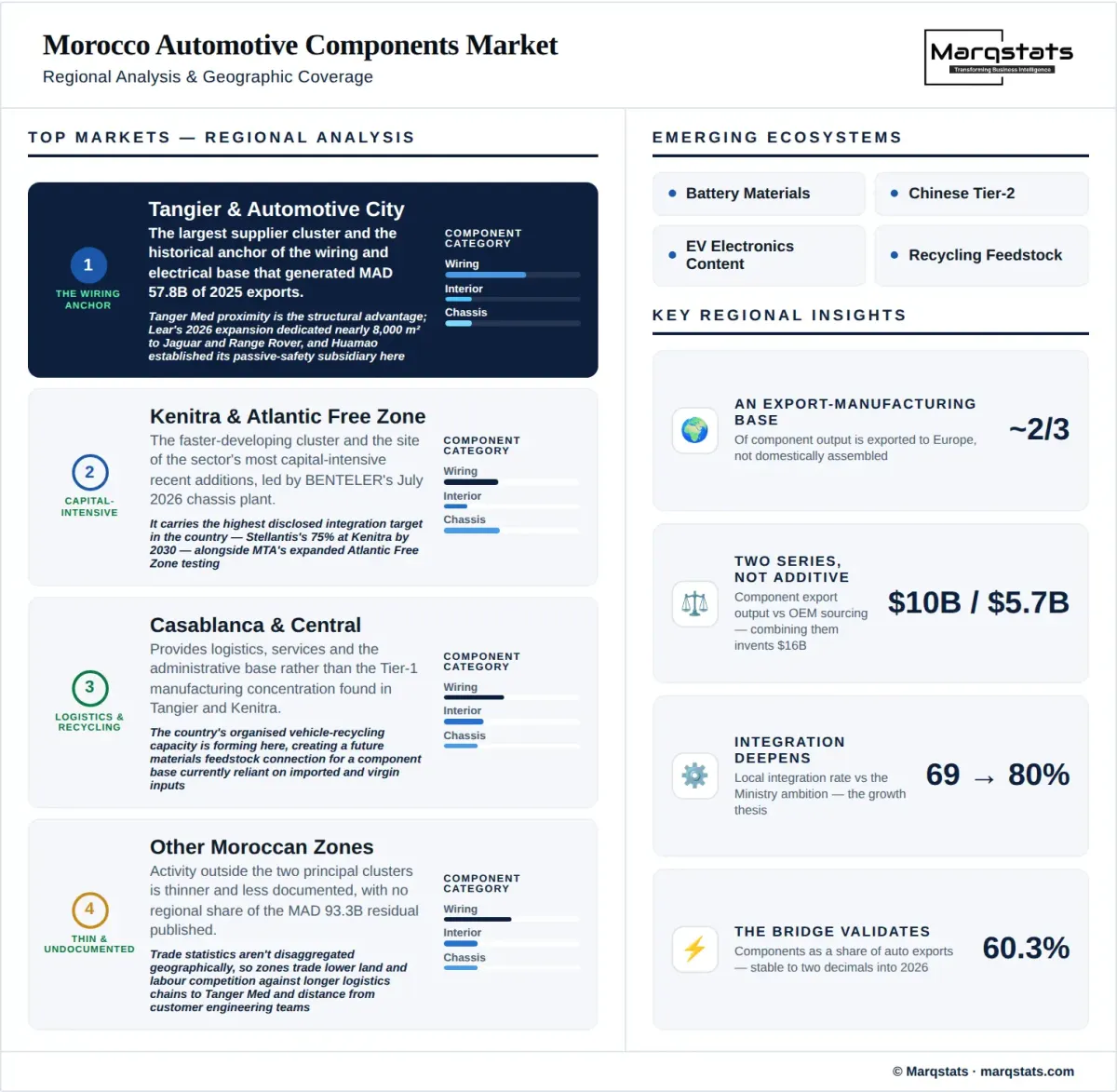
Tangier is the largest supplier cluster and the historical anchor of the wiring and electrical base that generated MAD 57.8 billion of 2025 exports. Tanger Med Group completed an 8,900-square-metre expansion of Lear's building in 2026, with nearly 8,000 square metres dedicated to Jaguar and Range Rover production, and Huamao established its passive-safety subsidiary here the same year.
Kenitra and the Atlantic Free Zone
Kenitra is the faster-developing cluster and the site of the sector's most capital-intensive recent additions. BENTELER opened its plant in July 2026 after roughly a year of construction, creating more than 300 jobs, while MTA expanded its Atlantic Free Zone laboratory and warehouse in August 2026. Stellantis targets 75% local integration at Kenitra by 2030, the highest disclosed integration target in the country.
Casablanca and the Central Region
Casablanca provides logistics, services and the administrative base for the sector rather than the concentration of assembly and Tier-1 manufacturing found in Tangier and Kenitra. It is also where the country's organised vehicle-recycling capacity is forming, which over the forecast period creates a materials feedstock connection to a component base currently reliant on imported and virgin inputs.
Other Moroccan Industrial Zones
Activity outside the two principal clusters is thinner and less documented, and no regional share of the MAD 93.3 billion component residual is published because trade statistics are not disaggregated geographically. Zone selection outside Tangier and Kenitra trades lower land and labour competition against longer logistics chains to Tanger Med and greater distance from customer engineering teams.
How Competition Is Evolving
Morocco's supplier base is broad rather than concentrated, with AMICA reporting more than 260 automotive suppliers alongside three vehicle manufacturers and more than 280,000 sector jobs. No single supplier's share of the roughly USD 10.00 billion component output is disclosed, and none is estimated here, because export statistics are reported by category rather than by company.
The electrical and wiring cluster is the closest thing to a concentrated segment, with Lear, Yazaki and Motherson-owned Leoni accounting for the bulk of the MAD 57.8 billion wiring category. Lear's 2026 expansion at Tanger Automotive City, adding nearly 8,000 square metres of production space for Jaguar and Range Rover programmes, demonstrates that incumbents are defending position through reinvestment rather than ceding share to entrants.
Chinese suppliers are entering at pace and broadening the competitive field into categories Morocco did not previously serve. Huamao's 2026 Tangier subsidiary covers airbag fabric and passive-safety products, while battery and materials investors including Gotion, COBCO and BTR are constructing an adjacent ecosystem. These entries add capability rather than displacing established programmes, which is why supplier count is rising without evident consolidation.
For an inbound supplier the decisive metric is nominated sourcing opportunity by manufacturer and platform, not the headline count of more than 260 suppliers. Competitive benchmarking must include suppliers serving Europe from Morocco rather than only domestic-market peers, because the relevant comparison set is defined by the customer programme rather than by geography.
Investment in the sector is running well ahead of realised output, and the distinction matters commercially. BENTELER's plant opening, Lear's expansion and MTA's laboratory investment all raise the capacity ceiling during 2026, but they enter the output series only as programmes ramp. A feasibility model that treats announced capacity as available revenue will overstate the near-term opportunity substantially.
Companies Covered
The report profiles 15+ companies with full strategy and financials analysis, including:
Recent Market Activity
Table of Contents
Coverage & Segmentation
The study covers Morocco with a 2025 base year, historical analysis from 2021 to 2025 and forecasts for 2026 to 2031. Headline CAGRs connect 2025 and 2031 across six years, and the narrower 2026 to 2031 rate is stated separately wherever it is used. The quantified measure is automotive component manufacturing output value, derived as total automotive exports less finished-vehicle construction exports, with vehicle production carried as the physical reference series.
Coverage spans wiring and electrical systems, interiors and seats, chassis and structural parts, exterior and body components, powertrain and other Tier-1 and Tier-2 families, across passenger and light commercial applications, export and domestic destinations, and supplier tiers. Finished-vehicle export value, trading and re-export activity carrying no Moroccan manufacturing value, and battery cell and materials output are all excluded from the component measure.
The analysis addresses supplier location choice, sourcing depth, programme nomination, incentive eligibility and investment appraisal. Stakeholder questions include why component output is roughly twice what domestic assembly absorbs, how OEM sourcing value differs from component export output, what a five-point move in local integration is worth to the supplier base, and why announced plant capacity is not near-term revenue.