Market Snapshot
Key Takeaways
Market Overview & Analysis
Report Summary
The Egypt automotive components market covers components supplied to vehicle manufacturing and original equipment operations and to replacement demand within Egypt. It spans mechanical, electrical and electronic, body and chassis, interior, tire and battery and other component categories. Workshop labour, fuel and vehicle sales are excluded. The 2025 value of USD 2.10 billion is triangulated from an aftermarket demand pool, original equipment demand generated by local assembly, component imports and domestic supply, and it is a working estimate rather than a published government statistic.
The distinction that governs how the figure should be used is between demand and output. Domestic component demand is what Egyptian vehicles and Egyptian vehicle owners consume. Export-oriented component manufacturing is what Egyptian factories produce for customers elsewhere, and it exceeded USD 1 billion in 2025 within an engineering export basket of USD 6.482 billion. A supplier evaluating Egypt as a manufacturing base is looking at the second number. A distributor evaluating Egypt as a sales market is looking at the first. Combining them produces roughly USD 3.1 billion, a figure that describes no single addressable market.
Growth rates diverge sharply between the two. Domestic demand compounds at 10.05% through the forecast period, tracking vehicle output and parc expansion. Component exports grew 7.5% across the first nine months of 2025 and were reported up 43% year on year in the first two months of 2026, and the engineering export basket as a whole rose 13% during 2025 to USD 6.482 billion against a 2026 target of USD 7.5 billion. Export capacity is being built faster than domestic demand is growing, and the new 2026 investments are pointed accordingly.
Automotive Component Demand Value in Egypt
Domestic component demand rises from USD 2.10 billion in 2025 to USD 3.39 billion in 2030, a 10.05% compound annual growth rate and an absolute increase of USD 1.29 billion. The indicative 2031 endpoint is approximately USD 3.70 billion. The 2026 estimate of USD 2.40 billion is anchored on the observed trajectory rather than interpolated, and the resulting 2026 to 2030 rate of 9.02% is the figure that describes the forecast period as it behaves once the base year is behind it.
The original equipment side is driven by locally assembled vehicle output, which rises from 99,600 units in 2025 to 206,000 by 2030 at a 15.64% compound annual growth rate. That is materially faster than the 10.05% component value rate, and the gap is informative rather than contradictory: replacement demand tied to the slower-expanding vehicle parc is the larger half of the market, and it dilutes the faster original equipment growth. A supplier reading the headline rate as the growth available on an original equipment nomination will understate the opportunity.
Capacity utilisation sets a ceiling that is easy to miss. Egypt's installed vehicle assembly capacity is estimated near 300,000 units annually against 2025 output of about 99,600, implying roughly 33% utilisation across a base of more than 15 assembly plants and 75 facilities employing over 75,000 workers. Original equipment component demand is therefore constrained by throughput, not by physical capacity, and the fastest route to a larger original equipment component market is higher utilisation of plants that already exist rather than new assembly investment.
One measurement discrepancy should be named rather than smoothed over. Sector commentary has cited Egyptian domestic content above 45%, while component value embedded in vehicle output calculates near 22% against output value of USD 1.54 billion in 2025. Both figures circulate and they are not reconcilable as stated. The higher number appears to rest on a broader base that includes assembly labour, overhead and locally incurred cost, while the lower one measures component value alone. If domestic content genuinely stood above 45%, the Automotive Industry Development Programme's target of at least 20% rising toward 35% would already be met and the policy would be redundant, which is the strongest available evidence that the two are measuring different things.
Market Dynamics
Key Drivers
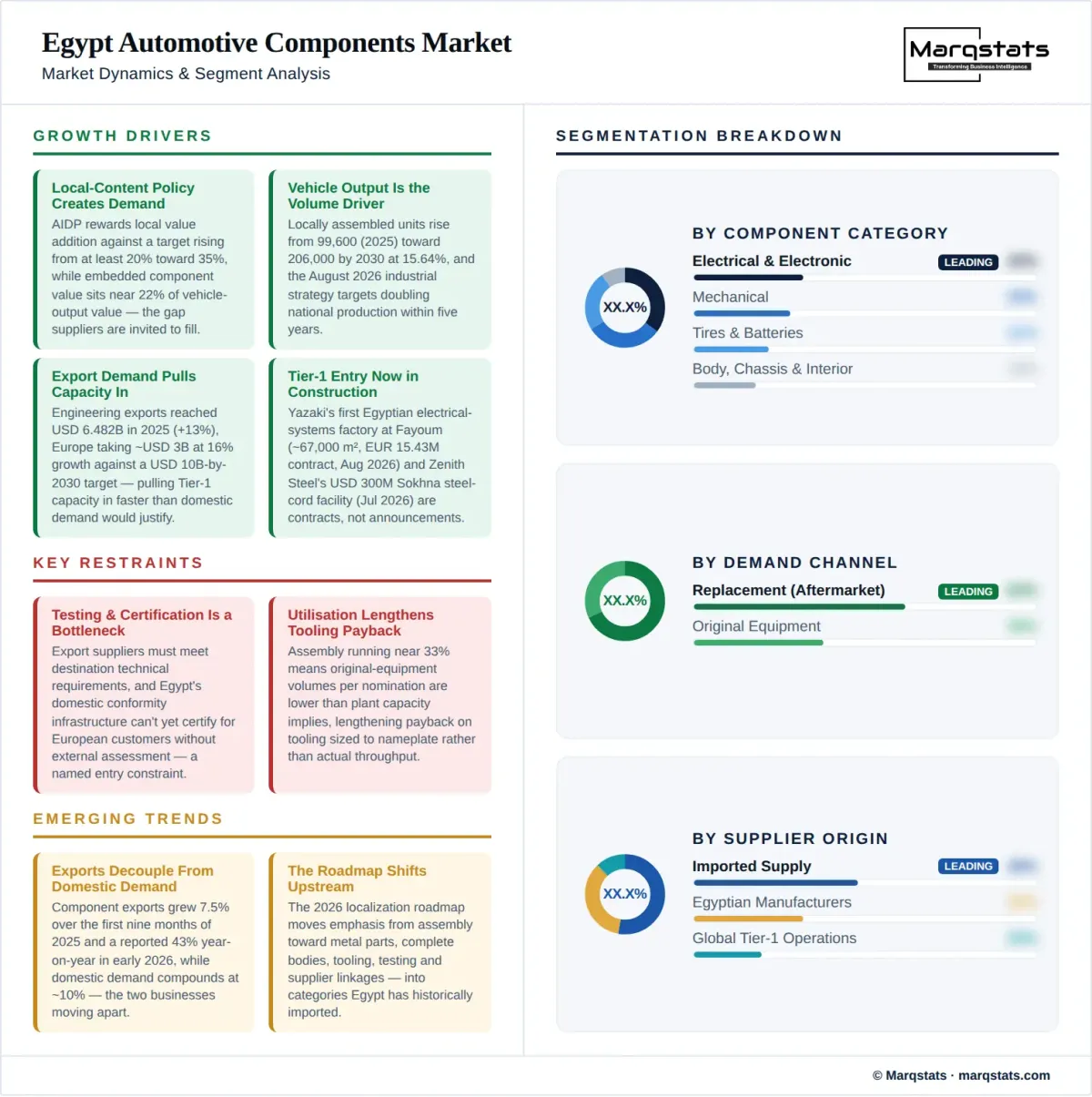
- Local content policy is creating addressable demand directly, with the Automotive Industry Development Programme rewarding local value addition and higher local industrial content ratios against a target rising from at least 20% toward 35%, while embedded component value currently sits near 22% of vehicle output value.
- Vehicle output growth is the primary volume driver, with locally assembled units rising from 99,600 in 2025 toward 206,000 by 2030 at a 15.64% compound annual growth rate and the August 2026 industrial strategy targeting a doubling of national vehicle production within five years.
- Export demand is pulling capacity into Egypt faster than domestic demand would justify, with engineering exports reaching USD 6.482 billion in 2025 at 13% growth, Europe taking approximately USD 3 billion of that at 16% growth and a sector target of USD 10 billion by 2030.
- Tier-1 entry is accelerating and is now visible in construction contracts rather than announcements, with Yazaki EDS Egypt's first electrical systems factory at Fayoum covering about 67,000 square metres on an initial EUR 15.43 million construction contract awarded in August 2026.
- Upstream depth is being added where Egypt previously imported, with Zenith Steel Group committing USD 300 million in July 2026 to a 320,000 square metre Sokhna facility designed for 120,000 tonnes of steel cord and 50,000 tonnes of bead wire annually.
Key Restraints
- Accredited testing and certification capability is a named market-entry bottleneck, since export-oriented suppliers must meet destination-market technical requirements and Egypt's domestic conformity infrastructure is not yet sufficient to certify for European customers without external assessment.
- Tooling cost is a structural barrier for Tier-1 entry that low labour cost does not offset, and local components must meet value-added and manufacturing-process criteria rather than simple assembly or repackaging to qualify as local content under programme rules.
- Assembly utilisation near 33% means original equipment component volumes per nomination are lower than plant capacity implies, which lengthens payback on tooling investment sized to nameplate rather than to actual throughput.
- Original equipment nomination cycles run ahead of policy cycles, so a supplier qualifying for local-content credit today may be designing into a vehicle programme whose sourcing decisions were fixed two or three years earlier.
Key Trends
- Component exports are decoupling from domestic demand, growing 7.5% across the first nine months of 2025 and a reported 43% year on year in the first two months of 2026 while domestic demand compounds at roughly 10%.
- The localization roadmap published in 2026 has shifted emphasis from assembly toward metal parts, complete vehicle bodies, tooling, testing and supplier linkages, which moves the addressable market upstream into categories Egypt has historically imported.
- Free zones and canal-adjacent industrial zones are capturing the new Tier-1 capacity, with Diniz Adient opening at Ismailia Free Zone in August 2026 and Zenith Steel committing to Sokhna, both siting for export logistics rather than for proximity to Egyptian assembly.
- Definitional divergence on local content is widening, with sector commentary citing domestic content above 45% while embedded component value against vehicle output value calculates near 22%, a gap that reflects different measurement bases rather than different data.
Three Egyptian measures overlap this market and none is additive to it. Egypt's vehicle manufacturing and localization market counts locally assembled vehicles and their output value at USD 1.54 billion in 2025, of which the component portion appears inside this measure as original equipment demand. Egypt's automotive components localization market counts only the share of component value created inside Egypt, roughly USD 340 million, which is a subset of this measure rather than an addition to it. The export series above is a fourth quantity, outside all three. Each pair intersects partially and no pair sums.
Market Segmentation
The category with the deepest Egyptian manufacturing base and the strongest export orientation, anchored by wiring harness operations from LEONI, Sumitomo Electric and now Yazaki, whose Fayoum plant covers about 67,000 square metres on an initial EUR 15.43 million construction contract. Cables were Egypt's largest engineering export category in 2025 at USD 1.5 billion, and the harness segment is the clearest example of capacity built for European customers rather than Egyptian assembly.
The category receiving the largest single upstream commitment, with Zenith Steel Group investing USD 300 million from July 2026 in a Sokhna facility designed for 120,000 tonnes of steel cord and 50,000 tonnes of bead wire annually and roughly 30% of output targeted for export. Prometeon and Sailun operate in tire manufacturing with ZC Rubber a prospective entrant, and the category spans both original equipment fitment and a substantial replacement pool.
The category adding capacity fastest through direct Tier-1 entry, with Diniz Adient opening its first Egyptian manufacturing operation at the Ismailia Free Zone in August 2026 after establishing Diniz Adient Egypt Automotive LLC in March 2026 and beginning hiring in May. Seating and trim carry high transport cost relative to value, which normally favours local supply, yet the siting choice at a free zone signals regional rather than purely domestic intent.
The category the 2026 localization roadmap prioritises most explicitly, covering metal parts, complete vehicle bodies and the tooling required to produce them. It is also the category where Egypt's dependency is deepest, since body stamping requires domestic steel sheet supply and press tooling that the August 2026 industrial strategy identifies as a target rather than an existing capability.
The broadest and most fragmented category, covering powertrain, driveline, suspension and braking components supplied by numerous smaller metal, plastic and rubber manufacturers tied to original equipment assembly programmes. Kader and the Arab Organization for Industrialization and comparable local engineering companies are expanding localized component programmes here. The category carries the largest share of a replacement demand pool worth approximately USD 1.7 billion in 2025, and its heavy skew toward that channel is why it grows closer to the 10.05% market rate than to the 15.64% assembly output rate.
The larger half of domestic demand and the reason total component value compounds at 10.05% while vehicle output grows at 15.64%. A commercial benchmark places Egypt's automotive aftermarket near USD 1.7 billion in 2025 excluding service labour, and the channel is tied to the installed vehicle parc, which expands far more slowly than annual assembly volume.
The faster-growing channel and the one policy is designed to expand, driven by locally assembled output rising from 99,600 units in 2025 toward 206,000 by 2030. It is also the channel where local content is measured for programme qualification, and where embedded component value near 22% of vehicle output value against an Automotive Industry Development Programme target of at least 20% rising toward 35% defines the gap suppliers are being invited to fill.
The segment growing fastest and carrying the export business, comprising LEONI, Sumitomo Electric, Yazaki, Adient through Diniz Adient and comparable multinationals. Their Egyptian plants are typically sized for regional and European supply, which is why component exports exceeded USD 1 billion in 2025 while domestic embedded content remained near 22%.
The segment carrying most of the replacement demand pool and the deepest exposure to local assembly volumes, including Delmar, Darwish and Dr Greiche in glass, Trust in trim, Kader and the Arab Organization for Industrialization in engineering components, and a long tail of metal, plastic and rubber suppliers. Their growth depends on assembly utilisation rising from roughly 33% rather than on new plants opening.
Still the dominant source of value inside Egyptian-assembled vehicles, since embedded local content near 22% of output value implies close to four fifths of each vehicle's component value is created abroad. The 2026 localization roadmap targets this share directly, and the categories it names first are precisely those with the highest current import dependency.
Component output consumed inside Egypt, whether by assembly plants or by the replacement channel, and the only destination inside the USD 2.10 billion measure. It is the smaller destination for the newest Tier-1 capacity, which is being sited at Sokhna, Ismailia and Fayoum with export logistics rather than assembly proximity as the determining factor.
Component output shipped abroad, exceeding USD 1 billion in 2025 within an engineering export basket of USD 6.482 billion and explicitly excluded from the market measure above. Europe took approximately USD 3 billion of total engineering exports at 16% growth, and Zenith Steel's Sokhna project targets roughly 30% of its steel cord and bead wire output for export from the outset.
By Geography
6th of October City and Giza
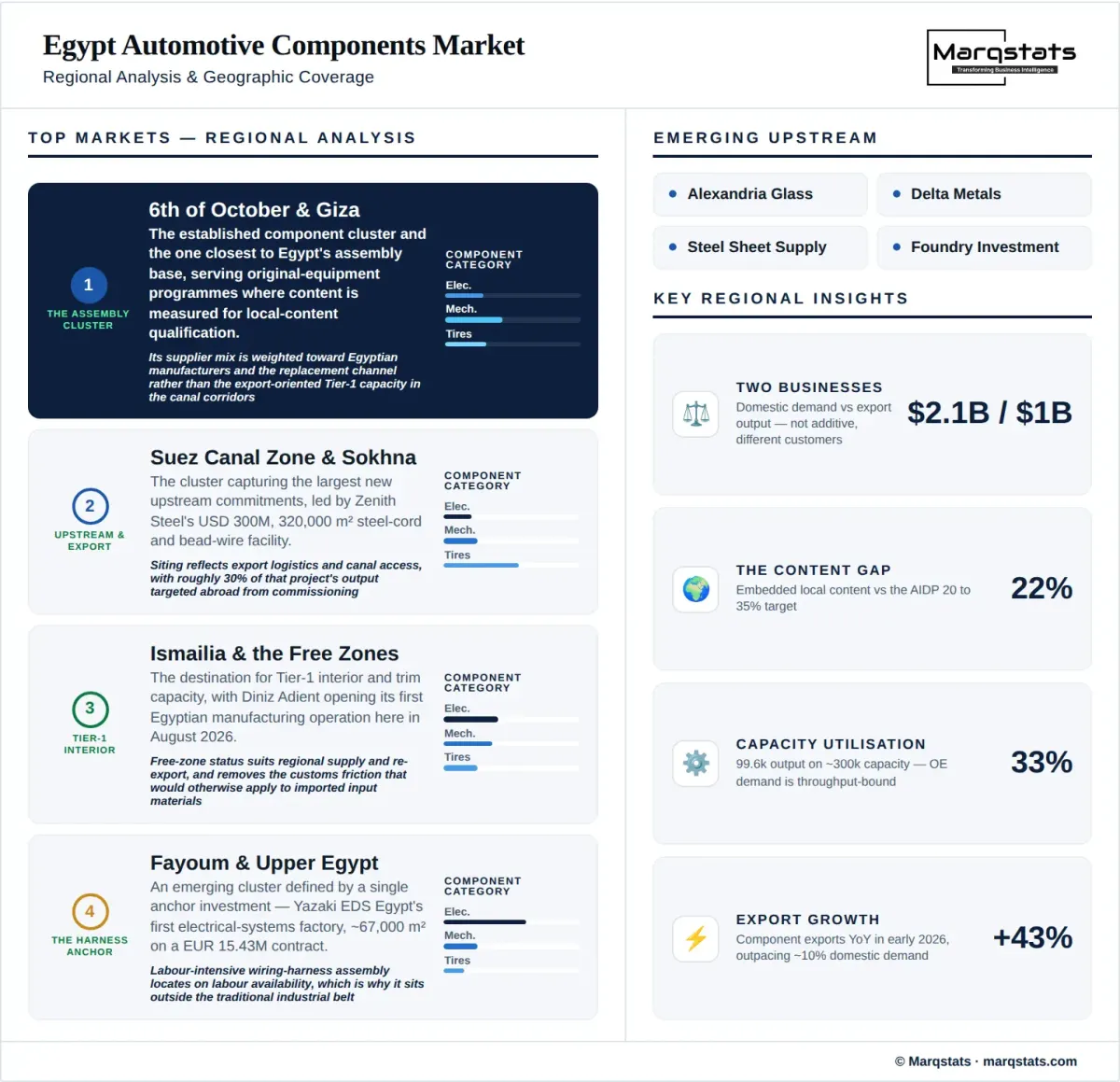
The established component cluster and the one closest to Egypt's assembly base, serving original equipment programmes where component value is measured for local-content qualification. Its supplier mix is weighted toward Egyptian manufacturers and the replacement channel rather than toward the export-oriented Tier-1 capacity arriving in the canal and free-zone corridors.
Suez Canal Economic Zone and Sokhna
The cluster capturing the largest new upstream commitments, led by Zenith Steel Group's USD 300 million, 320,000 square metre facility for 120,000 tonnes of steel cord and 50,000 tonnes of bead wire annually. Siting reflects export logistics and canal access, with roughly 30% of that project's output targeted abroad from commissioning.
Ismailia and the Free Zones
The destination for Tier-1 interior and trim capacity, with Diniz Adient opening its first Egyptian manufacturing operation there in August 2026 following company establishment in March and hiring from May. Free-zone status suits regional supply and re-export, and it removes the customs friction that would otherwise apply to imported input materials.
Fayoum and the Upper Egypt Corridor
An emerging cluster defined by a single anchor investment, Yazaki EDS Egypt's first electrical systems factory covering about 67,000 square metres on an initial EUR 15.43 million construction contract awarded to Korra Energi in August 2026. Wiring harness assembly is labour-intensive and locates on labour availability rather than on proximity to customers, which is why it sits outside the traditional industrial belt.
Alexandria and the Delta
The upstream materials cluster rather than a final component base, carrying glass production through Delmar, Darwish and Dr Greiche alongside metal and rubber processing. It feeds both the assembly corridor and the export plants, and its role expands as the 2026 localization roadmap moves emphasis toward metal parts, bodies and the materials behind them.
How Competition Is Evolving
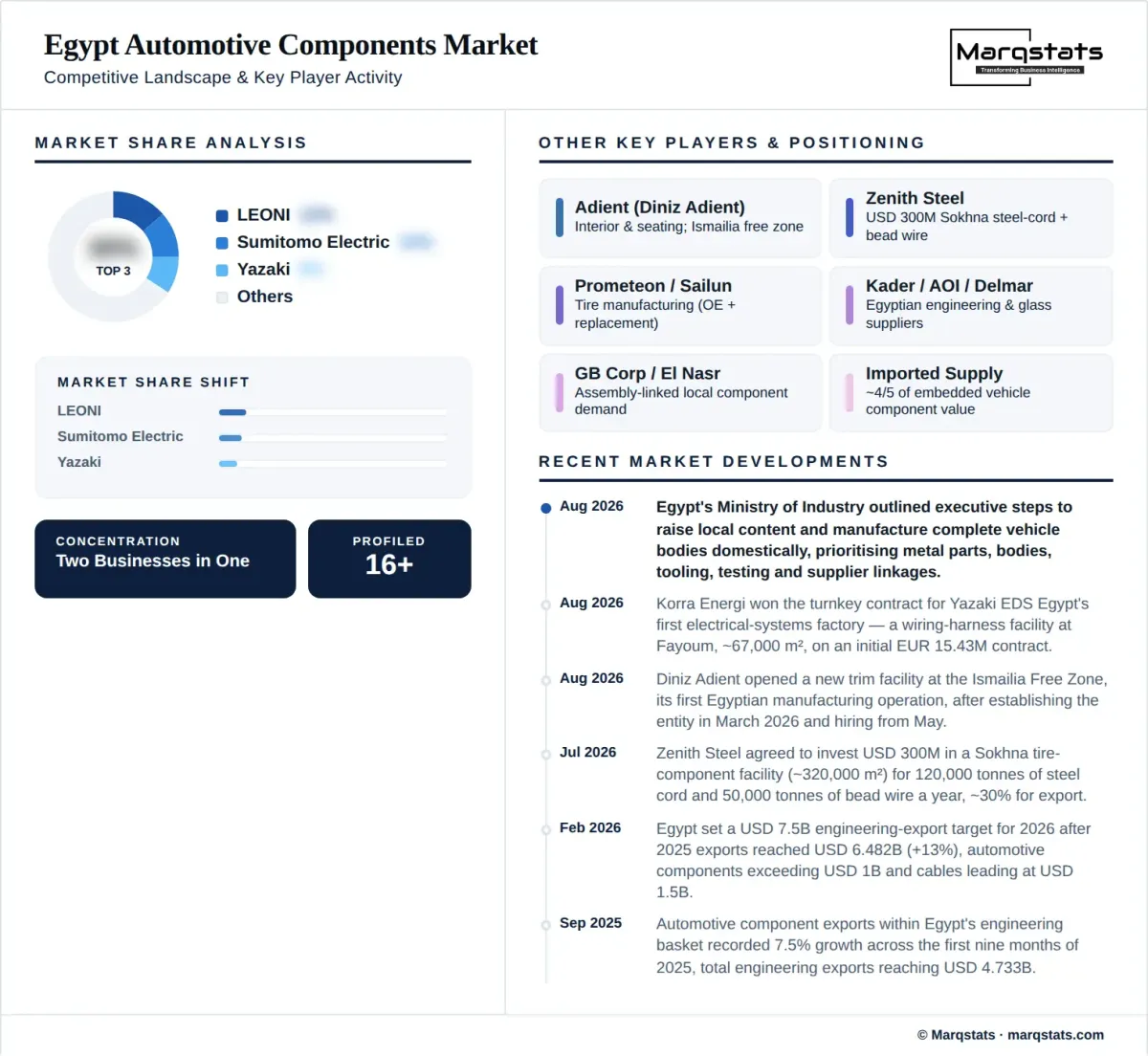
The competitive structure divides cleanly along the demand-versus-output line that governs the market definition. Export-oriented Tier-1 operations, principally LEONI, Sumitomo Electric, Yazaki and Adient, compete on quality systems, tooling capability and destination-market certification, and their Egyptian customers are incidental to a business built around European and regional supply contracts. Egyptian manufacturers, including Delmar, Darwish and Dr Greiche in glass, Trust in trim and Kader and the Arab Organization for Industrialization in engineering components, compete for local assembly nominations and for a replacement pool worth roughly USD 1.7 billion. The two groups rarely bid against each other.
Entry economics reward capability rather than cost, which is the finding most likely to surprise a client evaluating Egypt on labour rates alone. Industry participants identify accredited testing capacity and tooling cost as the material bottlenecks, and local components must satisfy value-added and manufacturing-process criteria rather than assembly or repackaging to earn local-content credit. A Tier-1 entrant without quality systems, tooling capability and destination-market certification cannot convert a labour cost advantage into a nomination, and the 2026 roadmap's explicit inclusion of testing alongside metal parts and tooling is an acknowledgement of that constraint.
The 2026 investment wave changes the competitive map upstream rather than at the component interface. Zenith Steel's USD 300 million commitment brings steel cord and bead wire production into Egypt for the first time at scale, which alters the input cost position of every tire manufacturer in the country including Prometeon, Sailun and prospective entrant ZC Rubber. Yazaki's arrival adds a third global wiring harness manufacturer alongside LEONI and Sumitomo Electric in a category where Egypt already exports at scale, intensifying competition for skilled assembly labour rather than for customers. Diniz Adient's Ismailia entry establishes seating and trim capability that did not previously exist in-country.
The strategic question a supplier should carry away is which of Egypt's two component businesses it is entering, because the answer changes almost every input. Entering domestic demand means competing for original equipment nominations against a 33% assembly utilisation ceiling and for a replacement pool near USD 1.7 billion, with local-content credit under programme rules as the principal policy lever. Entering export manufacturing means competing on destination-market certification and tooling capability for European customers who took approximately USD 3 billion of Egypt's engineering exports in 2025, with Egyptian demand as an incidental byproduct. Suppliers that assume the two are the same market underwrite the wrong volumes, site in the wrong governorate and qualify to the wrong standard.
Companies Covered
The report profiles 16+ companies with full strategy and financials analysis, including:
Recent Market Activity
Table of Contents
Coverage & Segmentation
The study covers automotive components supplied to vehicle manufacturing and original equipment operations and to replacement demand within Egypt across the 2021 to 2025 historical period and the 2026 to 2030 forecast period, with 2025 as the base year and an indicative 2031 endpoint. Coverage spans mechanical, electrical and electronic, body and chassis, interior, tire and battery and other component categories. Workshop labour, fuel and vehicle sales are excluded. Export-oriented component manufacturing output is measured and reported separately rather than added to domestic demand, because the two serve different customers and cannot be combined into a single addressable market.
Sizing is triangulated rather than reported. The 2025 value of USD 2.10 billion draws on an aftermarket demand benchmark near USD 1.7 billion, original equipment demand generated by local assembly of about 99,600 vehicles, component imports and domestic supply. The published sizing range runs from USD 1.8 billion to USD 2.4 billion for 2025 and from USD 3.1 billion to USD 4.4 billion for 2031, and confidence is graded moderate. Announced supplier investment values are treated as capacity signals rather than added to demand, since a plant's investment figure describes cost of construction rather than the value of components it will sell into Egypt.