Market Snapshot
Key Takeaways
Market Overview & Analysis
Report Summary
Thailand's automotive semiconductor and electronics market is a content story attached to a flat production base, and the two halves move at completely different speeds. Vehicle output is forecast to grow under 1% a year while the electronic value inside each vehicle grows more than seven times faster, so the addressable market expands even as the number of vehicles barely does.
The measure is the value of semiconductor and electronic component content fitted to vehicles produced in Thailand, at component supplier level. Chips and electronics made in Thailand for non-automotive end markets are excluded, which is the boundary most likely to be crossed, because Thailand's electronics investment headlines are dominated by data centre, artificial intelligence and consumer applications. Aftermarket electronics and vehicle charging equipment are excluded and covered separately.
The analysis is written for semiconductor suppliers sizing an automotive design win against a flat Thai volume base, printed circuit board and electronic manufacturing service providers deciding how much automotive work to take against non-automotive demand, Tier-1 suppliers whose Thai plants were built around mechanical content, and policy analysts assessing whether a 25-year semiconductor roadmap reaches the automotive sector at all.
Thailand Automotive Semiconductor Market Size and Forecast
Market value is estimated at USD 1.82 billion in 2025, USD 1.98 billion in 2026 and USD 2.72 billion by 2030, an increase of USD 0.90 billion. Vehicle production moves from 1,450,000 units through 1,460,000 in 2026 to 1,520,000, an increase of 70,000 units, while content per vehicle rises from about USD 1,255 through USD 1,356 in 2026 to USD 1,789, or THB 40,788 to THB 58,142 at a disclosed constant THB 32.5 per USD.
Two growth rates apply and both are published. The five-year value rate connecting 2025 and 2030 is 8.37%; the four-year rate connecting 2026 and 2030 is 8.26%. The two are unusually close because neither driver is lumpy: vehicle production compounds at 0.95% over five years and 1.01% over four, and content per vehicle compounds steadily as electrified models and driver assistance content replace mechanical specification.
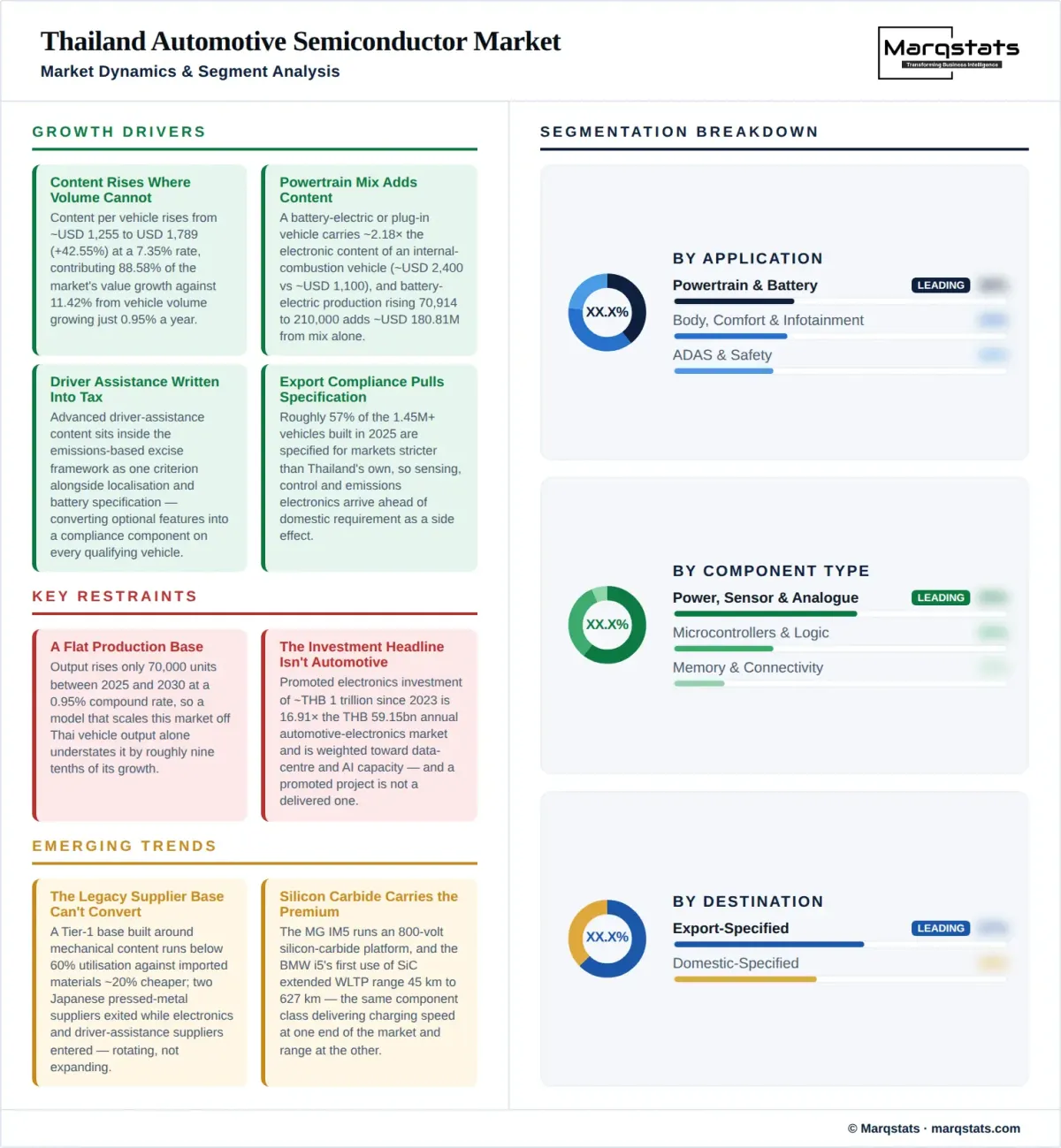
The decomposition is worth carrying publicly because it is what separates this forecast from a production forecast. Content per vehicle compounds at 7.35% against vehicle volume at 0.95%, so 88.58% of the growth is content and 11.42% is volume. Any model that scales this market off Thai vehicle output will understate it by roughly nine tenths of its growth.
Restating the terminal as a content requirement makes it assessable. Reaching USD 2.72 billion in 2030 asks the average vehicle built in Thailand to carry USD 1,789 of semiconductor and electronic content against USD 1,255 in 2025, a 42.55% increase over five years, on a production base that grows by 70,000 units in total.
A sizing range is published rather than a point. The 2030 figure sits within a band of USD 2.35 billion to USD 3.10 billion, corresponding to rates of 5.24% and 11.24%, and the spread is driven almost entirely by the content assumption rather than by the volume assumption, because the volume base is stable and well reported.
This Market Grows on Content, Not on Vehicles
Thailand builds roughly the same number of vehicles each year and will keep doing so, which makes it an unpromising market by the usual measure and an attractive one by the right measure. Production of more than 1,450,000 vehicles in 2025 is forecast at 1,520,000 in 2030, an increase of 70,000 units across five years and a 0.95% compound rate.
Electronic content inside those vehicles is moving on a completely different curve. Content per vehicle rises from about USD 1,255 to USD 1,789, a 42.55% increase at a 7.35% compound rate, and the resulting value growth of USD 0.90 billion is attributable 88.58% to content and 11.42% to volume.
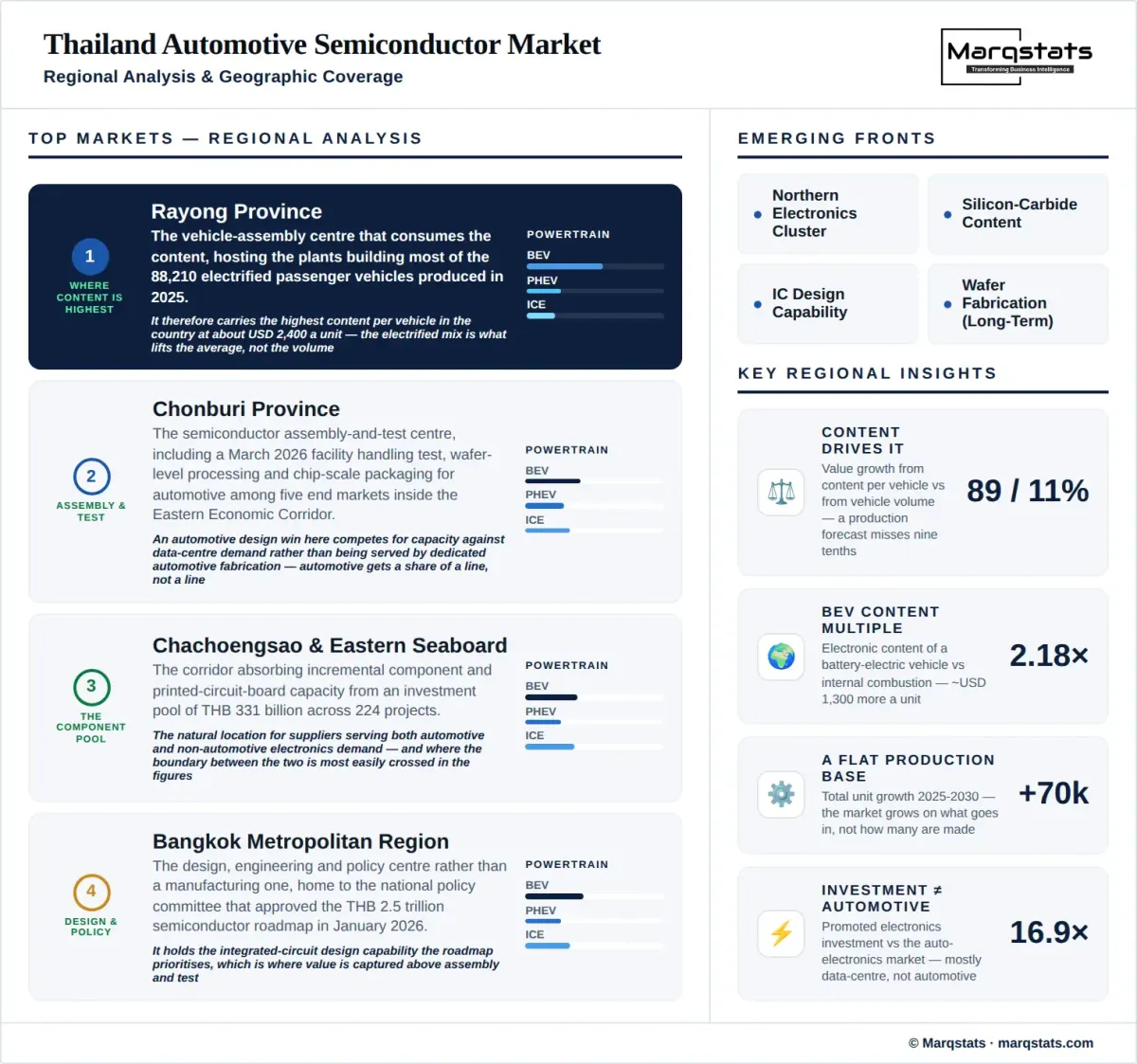
The first driver is powertrain. A battery-electric or plug-in vehicle carries roughly USD 2,400 of content against about USD 1,100 for an internal combustion vehicle on the conventions disclosed here, a multiple of 2.18 and a difference of about USD 1,300, so each substitution adds more than a whole internal combustion vehicle's worth of electronics.
The arithmetic of that substitution is specific rather than directional. Battery-electric production rising from 70,914 units in 2025 to an assumed 210,000 in 2030 is 139,086 additional units at roughly USD 1,300 of incremental content each, which is about USD 180.81 million of the USD 0.90 billion the market adds, or a fifth of the total growth from one powertrain shift alone.
The second driver is regulation rather than demand, and it applies to every vehicle rather than to the electrified minority. Driver assistance content sits inside the emissions-based excise framework as one criterion alongside localisation and battery specification, which means an assistance package is now priced into a tax band rather than sold as an option, and it lands on internal combustion vehicles that would otherwise carry the lowest content in the mix.
The Electronics Investment Headline Is Not an Automotive Headline
Thailand's electronics investment figures are large enough to be misread, and the misreading is commercially expensive. Promoted electronics investment reached about THB 1 trillion across projects accumulated since 2023, which is 16.91 times the THB 59.15 billion that this entire automotive electronics market is worth in a year.
The composition explains the gap. Printed circuit boards and electronic components account for THB 331 billion across 224 projects, an average of THB 1.478 billion each and 33.1% of the total, and the balance is weighted toward data centre and artificial intelligence capacity rather than toward automotive semiconductor supply.
A promoted project is also not a delivered one, and the distinction is explicit in the source. These are accumulated promotion approvals rather than deployment figures for a single period, so the THB 1 trillion is a pipeline measured over roughly three years rather than annual capital expenditure, and any comparison against an annual market figure carries that caveat with it.
For an automotive supplier the practical consequence is that Thailand's chip capacity is being built for someone else. A semiconductor assembly and test site serving industrial, automotive, communications, consumer and healthcare markets allocates automotive a share of a line rather than a line, which is why an automotive design win in Thailand competes for capacity against data centre demand rather than being served by dedicated automotive fabrication.
The Roadmap Targets a Slower Rate Than the Recent Past
Thailand approved a 25-year national semiconductor strategy in January 2026, running from 2026 to 2050, under a national policy committee chaired by the Deputy Prime Minister and Finance Minister. It targets more than THB 2.5 trillion in investment and training for more than 230,000 people by 2050, which is about THB 10.87 million of targeted investment per trained worker.
Measured as a rate, the ambition is more modest than the headline suggests. THB 2.5 trillion across 25 years averages THB 100 billion a year against roughly THB 333.3 billion of electronics investment promoted annually across the three years to 2026, so the long-term target implies about 30.0% of the recent rate.
The comparison needs its caveat stated rather than buried. The two figures are not identical in definition: one is a 25-year target for semiconductor and advanced electronics specifically, the other is accumulated promotion across all electronics including data centres. Read carefully, that difference is itself the point, because it says the semiconductor-specific ambition is a fraction of what the wider electronics category is already attracting.
The strategy's own sequencing tells a supplier where to sit. It prioritises strengthening existing advantages in assembly and testing and in integrated circuit design, with upstream wafer fabrication named as a long-term goal rather than a near-term one, across five chip categories covering power, sensor, photonics, analogue and discrete devices for automotive alongside six other end markets.
Those five categories are the automotive-relevant ones, which is the encouraging half. Power, sensor, analogue and discrete devices are precisely what a vehicle consumes in volume, so a roadmap built around them is better aligned to automotive demand than a logic-led strategy would be, even if the capital rate behind it is lower than the electronics sector's recent run.
The Legacy Supplier Base Cannot Simply Convert
Thailand's Tier-1 base was built around mechanical and metal content for a pickup-led industry, and the electronic transition does not redeploy those assets. Supplier capacity utilisation running below 60% sits alongside imported materials priced roughly 20% below domestic equivalents, which is a margin squeeze arriving at the same moment as a content transition that requires different capability.
The exits are the visible evidence. Two Japanese pressed-metal and interior suppliers withdrew from Thailand during the period covered here, while electronics and driver assistance suppliers entered, so the parts base is rotating rather than expanding and the arriving capability is not owned by the departing companies.
The entrants arrive with the content the excise structure now rewards. Sensing, cockpit electronics, steering electronics and power electronics suppliers have established or expanded Thai positions, and a lidar supplier entering a market where driver assistance is a tax criterion is making a policy bet as much as a product one.
For an incumbent supplier the choice is narrower than it looks. A plant at below 60% utilisation making mechanical parts for a segment losing share cannot fund an electronics capability from its own cash flow, which is why the realistic routes are a joint venture with an arriving electronics supplier or a contract manufacturing relationship rather than organic conversion.
Export Compliance Sets the Specification, Not Thai Demand
Most of what Thailand builds leaves the country, and that is what actually determines the electronic specification fitted. More than 1.45 million vehicles were produced in 2025 against domestic sales of 621,166 units, so roughly 57% of output is specified for markets whose safety and emissions rules are stricter than Thailand's own.
That gap is why driver assistance content arrives ahead of domestic requirement. A pickup line being re-equipped for Euro 6 to serve European and other developed markets carries the sensing, control and emissions electronics those markets require, and the same line produces the domestic version, so export compliance pulls content into vehicles sold in Thailand as a side effect.
It also changes who the supplier's customer really is. A semiconductor or electronics supplier winning Thai business is supplying a platform whose specification is set in Tokyo, Detroit or Brussels rather than in Bangkok, which means the design-win cycle and the content roadmap follow the export destination rather than the 621,166-unit domestic market.
The commercial consequence is that Thai content per vehicle tracks external regulation rather than Thai purchasing power. Content rising from USD 1,255 to USD 1,789 across the forecast is driven by what the destination markets require, and a domestic-demand model would have no mechanism to produce that increase.
The Investment Register Behind the Content Growth
Thailand endorsed a national semiconductor strategy on 7 January 2026 targeting over THB 2.5 trillion of investment, about USD 79 billion, and more than 230,000 skilled workers by 2050, with phased milestones for 2030, 2040 and 2050 and a near-term focus on assembly, testing, integrated circuit design and advanced electronics. That is the frame every automotive electronics decision in the country now sits inside.
The anchor investor is already at scale and expanding. Analog Devices committed over THB 19 billion in a further expansion against total Thai investment above THB 30 billion, exported over THB 98 billion from Thailand in 2025 with more than THB 130 billion expected in 2026, and is growing a workforce of more than 1,300 employees toward 2,500. Printed circuit board capacity arrived alongside it, with ZDT and Sahapat approved in January 2026 for over THB 65 billion across four projects creating more than 5,600 jobs, the first of which has been in production since September 2025.
Sensing and cockpit capacity followed within months. Hesai Technology committed over THB 1.5 billion to its first manufacturing base outside China; Visteon expanded its cockpit electronics site by 2,988 square metres to 4,700 square metres with future capacity near 2 million units a year; and Nexteer opened a 5,000 square metre column electric power steering plant on THB 108 million of registered capital. Nine companies engaged at the 2026 World Economic Forum carry existing and planned Thai investment exceeding THB 500 billion. The demand base beneath all of it produced 596,821 vehicles in January to May 2026, down 0.4%.
The supporting apparatus is being built at the same time. The higher education and science ministry signed workforce agreements with 12 organisations for electric vehicle skills and 8 for artificial intelligence curriculum in January 2026, the Board of Investment and Amata enrolled over 200 companies in an SME marketplace in March 2026, and French investment applications reached 93 projects worth over THB 29 billion since 2021 against over THB 180 billion of electric vehicle related applications since 2017.
What the Content Actually Looks Like at Model Level
Electronic content per vehicle is an abstraction until it is read off a specification sheet, and the 2026 Thai launch calendar makes it concrete. The XPeng L03 Long Range Ultra carries two TURING artificial intelligence chips for driver assistance plus an MT8676 cockpit chipset and 193 to 236 kW direct current charging, from a range starting at THB 899,000, while the Chery Q carries 21 driver assistance functions, a 360-degree camera and six airbags at an expected THB 4xx,000 to 5xx,000.
Silicon carbide is where the premium content is concentrating. The MG IM5 runs an 800-volt silicon carbide platform with a 100 kWh battery and 396 kW charging from THB 1.5499 million, and the BMW i5 eDrive40's first use of silicon carbide semiconductors extended its WLTP range by 45 kilometres to 627 kilometres at a price from THB 3,499,000. The same component class is delivering charging speed at one end of the market and range at the other.
Driver assistance content is now a tax variable rather than a trim decision. Driver assistance installation is one of five excise assessment criteria from 1 January 2026, and the mild hybrid incentive requires at least four of six driver assistance features for the 10% or 12% rate running 2026 to 2032. Japanese automotive and parts investment applications of THB 28.31 billion in 2025, up 57%, include Astemo electric power control unit inverters and Aisin hybrid transmissions, which is electronic content arriving as powertrain investment.
Market Dynamics
Key Drivers
- Content per vehicle rising from about USD 1,255 to USD 1,789, a 42.55% increase contributing 88.58% of the market's value growth.
- Powertrain mix, with battery-electric and plug-in vehicles carrying about 2.18 times the content of an internal combustion vehicle and production rising from 70,914 to an assumed 210,000 units.
- Driver assistance content written into the emissions-based excise framework as a criterion alongside localisation and battery specification, applying to every qualifying vehicle.
- Export compliance requirements on roughly 57% of the more than 1.45 million vehicles produced in 2025, pulling specification ahead of domestic regulation.
- A 25-year semiconductor roadmap targeting more than THB 2.5 trillion and 230,000 trained workers by 2050 across power, sensor, photonics, analogue and discrete categories.
Key Restraints
- A flat production base, with output rising only 70,000 units between 2025 and 2030 at a 0.95% compound rate.
- Promoted electronics investment of about THB 1 trillion weighted toward data centre and artificial intelligence capacity rather than automotive, at 16.91 times the annual automotive electronics market.
- A legacy Tier-1 base running below 60% capacity utilisation against imported materials priced roughly 20% cheaper, unable to fund electronic conversion organically.
- A semiconductor roadmap averaging THB 100 billion a year against about THB 333.3 billion promoted annually since 2023, or 30.0% of the recent rate.
Key Trends
- Value compounding at 8.37% against vehicle volume at 0.95%, the widest such divergence across the Thai catalogue.
- Printed circuit board and component investment reaching THB 331 billion across 224 projects, 33.1% of promoted electronics investment.
- Supplier base rotation rather than expansion, with mechanical and interior suppliers exiting as sensing and cockpit electronics suppliers enter.
- Assembly, test and integrated circuit design prioritised over upstream wafer fabrication, which is named as a long-term rather than near-term goal.
Market Segmentation
Power, sensor, analogue and discrete devices, the four automotive-relevant categories among the five named in the national roadmap, carried inside content per vehicle rising from about USD 1,255 to USD 1,789. This is the segment the roadmap's THB 2.5 trillion target is aimed at.
The largest disclosed investment category in Thai electronics, at THB 331 billion across 224 projects and 33.1% of promoted electronics investment, averaging THB 1.478 billion per project and serving automotive alongside larger non-automotive demand.
The integration layer where semiconductor content becomes vehicle function, growing fastest on vehicles carrying driver assistance content that the excise framework now treats as a criterion, and the layer where a Tier-1 rather than a chip supplier captures the margin.
Instrument clusters, centre displays and cockpit domain controllers, the most visible content increment on a vehicle and a significant part of the USD 1,300 gap between an electrified vehicle at about USD 2,400 of content and an internal combustion vehicle at about USD 1,100.
The application growing fastest because it is a tax criterion rather than an option, sitting inside the emissions-based excise framework alongside localisation and battery requirements, and pulled further by export compliance on roughly 57% of more than 1.45 million units produced.
Inverters, converters, battery management and charging electronics, concentrated in the 88,210 electrified passenger vehicles Thailand produced in 2025 and rising with battery-electric output assumed at 210,000 units by 2030.
The broadest and slowest-growing application, fitted across all 1,450,000 vehicles produced in 2025 and rising with content per vehicle at 7.35% a year rather than with the 0.95% production rate.
Head units, telematics and connected services hardware, an application where Chinese entrants specify higher content at lower price points than incumbents and where the 2.18 times content multiple on electrified vehicles is most visible to the buyer.
About 1,147,473 of the 1,450,000 vehicles produced in 2025 at roughly USD 1,100 of content each, the largest block by volume and the lowest by content, and the group on which driver assistance criteria add the most incremental value.
214,317 units of 2025 production at roughly USD 1,600 of content each, the middle tier, and the powertrain whose Thai output grows for export even as domestic hybrid demand grows at about 2.75%.
88,210 units of 2025 production at roughly USD 2,400 of content each, about 2.18 times an internal combustion vehicle, and the segment contributing about USD 180.81 million of incremental content as battery-electric output rises toward an assumed 210,000 units.
One of the two stages the national roadmap prioritises alongside assembly and test, against a target of more than 230,000 trained workers by 2050 and about THB 10.87 million of targeted investment per worker.
Thailand's established strength and the stage the roadmap builds on first, including a Chonburi facility opened in March 2026 for test, wafer-level processing, chip scale packaging and final integrated circuit test across automotive and four other end markets.
Printed circuit boards, modules and electronic assemblies at THB 331 billion across 224 projects, the stage where Thailand has the deepest existing base and where automotive competes with non-automotive demand for the same capacity.
Roughly 57% of more than 1.45 million units produced in 2025, the share whose electronic specification is set by destination-market regulation rather than by Thai rules, and the reason content rises ahead of domestic requirement.
The balance against domestic sales of 621,166 vehicles in 2025, carrying specification pulled through from export variants built on the same line, so domestic content tracks external regulation rather than Thai purchasing power.
By Geography
Chonburi Province
The semiconductor assembly and test centre of Thailand, including a facility opened in March 2026 handling test, wafer-level processing, chip scale packaging and final integrated circuit test for automotive among five end markets, inside the Eastern Economic Corridor.
Rayong Province
The vehicle assembly centre that consumes the content, hosting the plants building most of the 88,210 electrified passenger vehicles produced in 2025 and therefore the highest content per vehicle in the country at about USD 2,400 a unit.
Chachoengsao and the Eastern Seaboard
The corridor absorbing incremental component and printed circuit board capacity from an investment pool of THB 331 billion across 224 projects, and the natural location for suppliers serving both automotive and non-automotive electronics demand.
Bangkok Metropolitan Region
The design, engineering and policy centre rather than a manufacturing one, home to the national policy committee that approved a THB 2.5 trillion semiconductor roadmap in January 2026 and to the integrated circuit design capability the roadmap prioritises.
Northern Thailand
The established electronics manufacturing cluster outside the eastern corridor, historically serving consumer and industrial electronics and the region with the clearest route to absorb part of the THB 331 billion component investment pool into automotive work.
How Competition Is Evolving
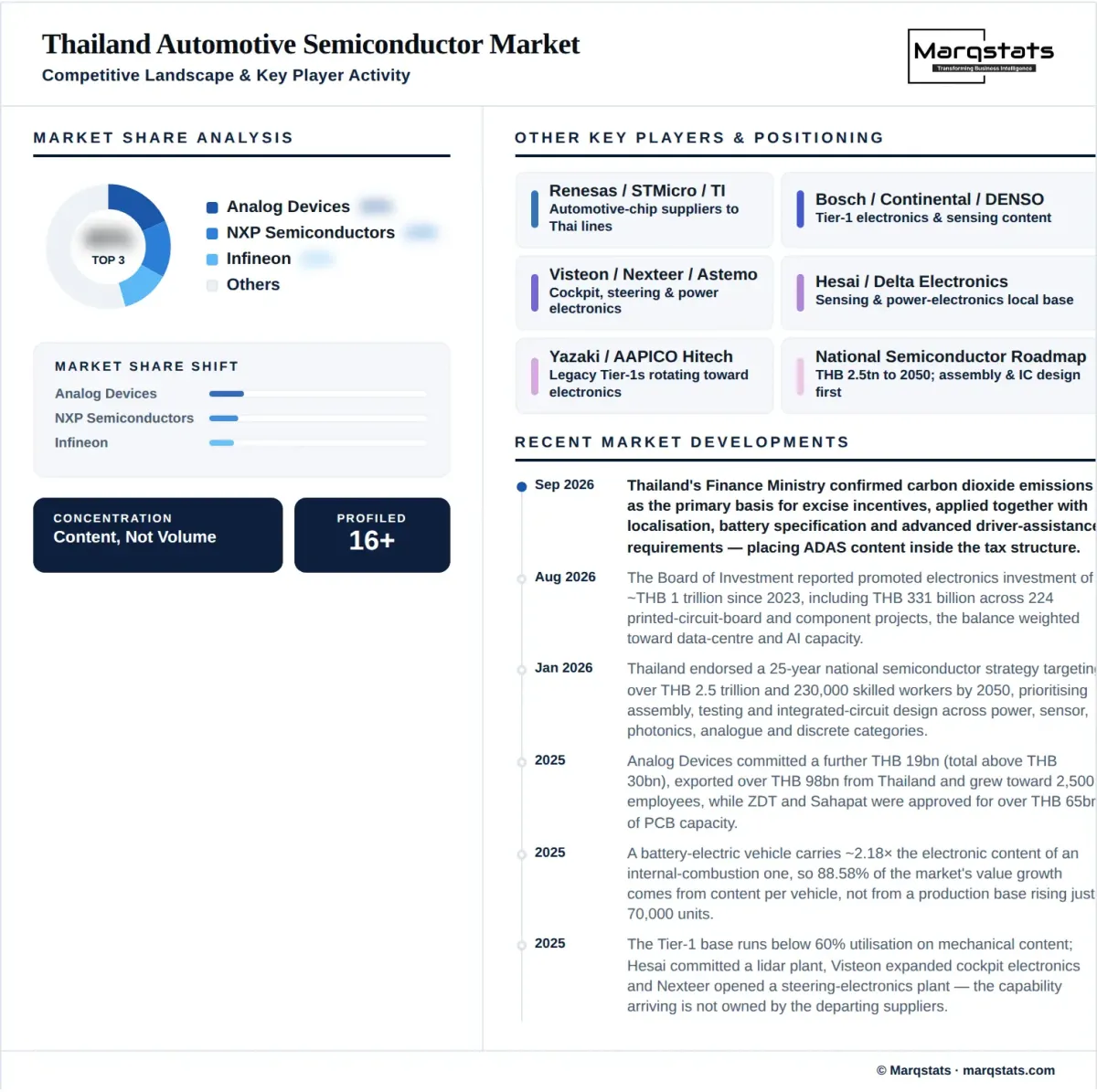
This market is contested by three groups that do not compete with each other directly, which is what makes it hard to read from a single share table. Semiconductor suppliers sell devices into a Thai assembly and test base, Tier-1 suppliers integrate those devices into modules, and electronic manufacturing service providers build boards for whoever pays best, and only the second group is automotive by nature.
Among semiconductor suppliers the Thai position is backend rather than fabrication. A Chonburi site opened in March 2026 performs test, wafer-level processing, chip scale packaging and final integrated circuit test across industrial, automotive, communications, consumer and digital healthcare markets, which means automotive competes for allocation on a shared line rather than commanding its own.
Among Tier-1 suppliers the field is rotating rather than consolidating. Sensing, cockpit, steering and power electronics suppliers have established or expanded Thai positions while two Japanese mechanical and interior suppliers exited, so the capability arriving is not owned by the capability leaving and the incumbent base cannot simply follow the content.
The electronic manufacturing service layer is the one with genuine pricing power. With THB 331 billion committed across 224 board and component projects and non-automotive demand growing faster than automotive, a board maker can choose its end market, and automotive programmes compete on volume commitment rather than on price.
For an entrant the decisive judgement is which flat number to accept. Thai vehicle production will add 70,000 units across five years and is not the opportunity; content per vehicle will add 42.55% and is. A strategy built on Thai vehicle volume reaches the wrong conclusion about a market growing at 8.37%.
Companies Covered
The report profiles 16+ companies with full strategy and financials analysis, including:
Recent Market Activity
Table of Contents
Coverage & Segmentation
This analysis measures the value of semiconductor and electronic component content fitted to vehicles produced in Thailand from 2021 to 2030, with 2025 as the base year and 2026 to 2030 as the forecast period, at component supplier level. Semiconductors and electronics manufactured in Thailand for non-automotive end markets are excluded, which is the boundary most likely to be crossed given that promoted electronics investment of about THB 1 trillion is 16.91 times this market's annual value. Aftermarket electronics, vehicle charging equipment and battery cells are excluded and covered separately. Market value is expressed in USD on disclosed content-per-vehicle conventions of roughly USD 1,100 for internal combustion, USD 1,600 for hybrid and USD 2,400 for plug-in and battery-electric vehicles in 2025, at a constant THB 32.5 per USD.
Coverage spans four component types, four applications, three vehicle powertrains, three value chain stages and two destinations, with five regional clusters analysed on industrial cluster presence rather than on population. Vehicle production is carried as the volume series at 1,450,000 units in 2025 and content per vehicle as a derived series at about USD 1,255, and the two are published separately because the market grows on the second rather than the first. Sixteen entities are profiled across semiconductor suppliers, Tier-1 integrators, sensing specialists and Thai electronics and component manufacturers.