Market Snapshot
Key Takeaways
Market Overview & Analysis
Report Summary
The Egypt automotive glass manufacturing market covers laminated and tempered automotive glazing processed or manufactured in Egypt for original equipment, replacement and export channels. Unlike Egypt's automotive components market, which measures domestic demand and excludes export output, this measure includes exported glazing, because Egyptian automotive glass plants are built with export share designed in from the outset and a domestic-only lens would misdescribe their economics.
The market is expressed in equivalent pieces rather than tonnes or currency, and the reason is a data limitation rather than a preference. Egypt's major glass producers operate combined architectural and automotive lines and report consolidated tonnage, so no official nationwide automotive glass output figure exists. Converting to a piece basis using vehicle output, average glazing content per vehicle, dedicated automotive capacity anchors and replacement and export demand produces a measure that can be compared across years and against plant capacity announcements. Confidence is graded moderate and the sizing range is published rather than implied.
Egypt's position in this category is unusual against its wider automotive record. Component value embedded in Egyptian-assembled vehicles sits near 22% of output value, yet in automotive glass the country imports almost nothing, supplies its own assembly lines, and ships glazing to Tunisia, Jordan and Saudi Arabia. Laminated vehicle safety glass imports were only about USD 0.87 million in 2024. Glass is heavy, fragile and expensive to transport relative to its value, which favours local supply in a way that wiring harness and electronics do not, and Egypt has converted that natural advantage into an export position.
Automotive Glass Output in Egypt
Annual output rises from 950,000 equivalent pieces in 2025 to 2,100,000 in 2030, a 17.19% compound annual growth rate and an absolute increase of 1,150,000 pieces. The indicative 2031 endpoint is approximately 2,390,000 pieces. The 2026 estimate of 1,250,000 pieces is anchored on confirmed plant additions rather than interpolated, reflecting the Darwish dedicated facility and the Dr Greiche expansion ramp while deliberately avoiding assignment of Delmar's full mixed-product capacity to automotive use.
The two-phase shape matters less here than in Egypt's electrified vehicle categories, but it is present. Output rises approximately 31.6% between 2025 and 2026 as dedicated automotive capacity comes online, then compounds at 13.85% from 2026 to 2030. The 17.19% five-year rate blends a capacity-arrival year with four years of ordinary expansion, and the 13.85% rate is the one that describes the forecast period once the new plants are running.
Value grows faster than volume, from USD 42.75 million to USD 121.80 million at a 23.29% compound annual growth rate, because value per piece rises from approximately USD 45 to USD 58. That six-percentage-point gap is the technology story: advanced thin glass, solar-control coatings, digital printing to original equipment specification and windshields compatible with driver assistance systems lift value per piece faster than unit volume grows. Dr Greiche's package explicitly covers processing down to 2.1 millimetres for electric vehicle applications alongside digital printing and thermal roofs.
Two Egyptian measures overlap this market and neither is additive to it. Egypt's automotive components market counts domestic component demand of all categories at USD 2.10 billion in 2025 and excludes export manufacturing output entirely; the domestic original equipment and replacement portion of this market sits inside that figure, while the export portion sits outside it. Egypt's vehicle manufacturing and localization market counts locally assembled vehicle output value at USD 1.54 billion, of which glazing is a component input rather than a share. At roughly USD 42.75 million, automotive glass is about 2% of Egypt's domestic component demand, which is the proportion a reader should carry rather than any impression of scale drawn from plant investment figures.
Market Dynamics
Key Drivers
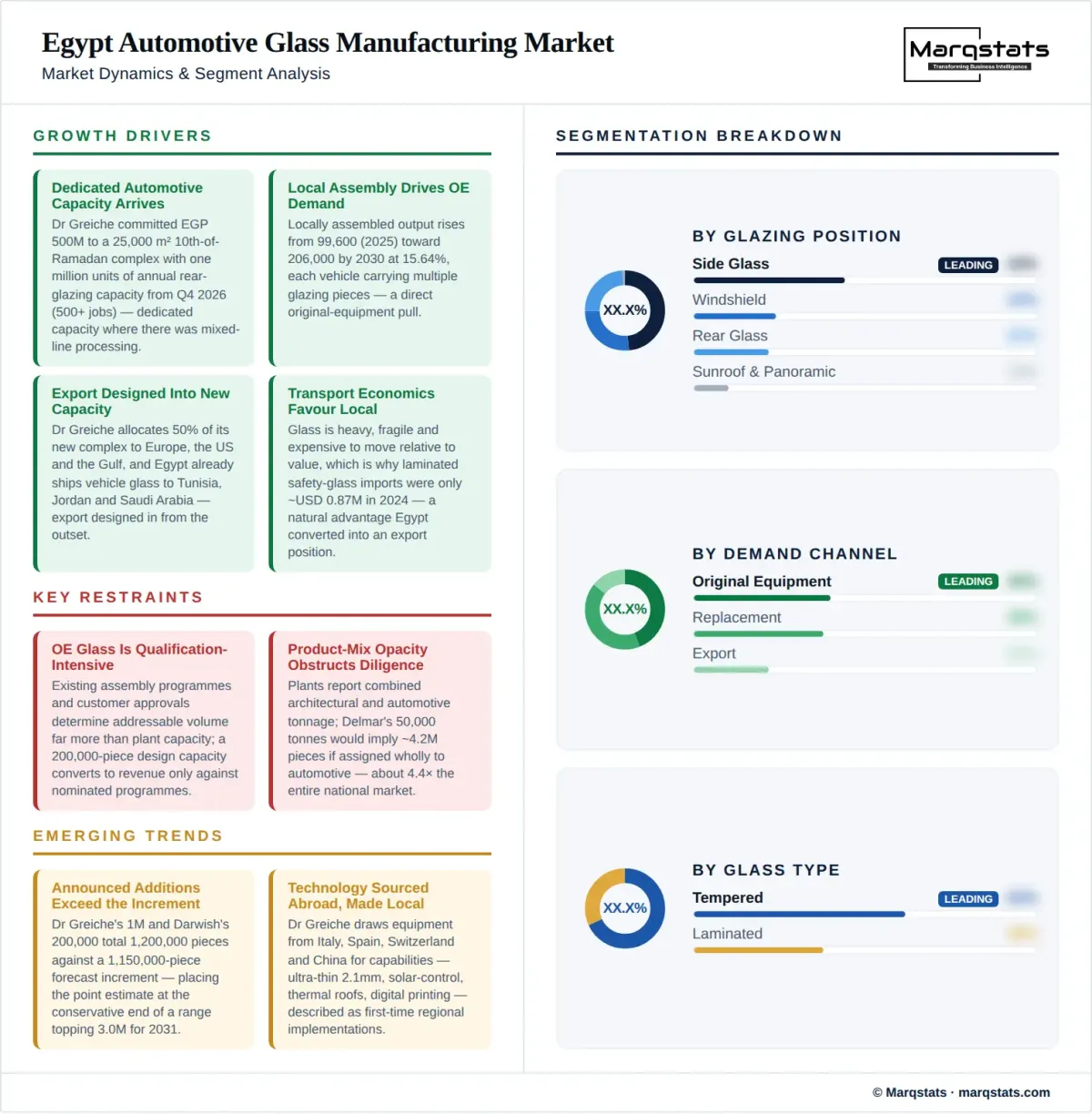
- Dedicated automotive capacity is arriving where previously there was mixed-line processing, with Dr Greiche committing EGP 500 million to a 25,000 square metre complex at 10th of Ramadan City carrying one million units of annual rear glazing capacity from the fourth quarter of 2026 and creating over 500 direct jobs.
- Local vehicle assembly growth drives original equipment demand directly, with locally assembled output rising from 99,600 units in 2025 toward 206,000 by 2030 at a 15.64% compound annual growth rate and each vehicle carrying multiple glazing pieces.
- Export markets are designed into new capacity rather than pursued afterwards, with Dr Greiche allocating 50% of its new complex to exports directed at Europe, the United States and the Gulf, and Egypt already shipping vehicle glass to Tunisia, Jordan and Saudi Arabia.
- Transport economics favour local supply in a way they do not for lighter components, which is why laminated vehicle safety glass imports were only about USD 0.87 million in 2024 despite embedded local content across all components sitting near 22% of vehicle output value.
- Technology content is lifting value per piece from approximately USD 45 to USD 58 across the forecast period, with ultra-thin processing to 2.1 millimetres, solar-control glass for electric vehicles, thermal roofs and digital printing to original equipment specification entering Egyptian capability for the first time.
Key Restraints
- Original equipment glass is qualification-intensive, so existing vehicle assembly programmes and customer approvals determine addressable volume far more than theoretical plant capacity, and a 200,000-piece design capacity converts to revenue only against nominated programmes.
- Product mix opacity is a genuine due-diligence obstacle rather than a presentational one, since Delmar's 50,000 tonnes of combined glass and aluminium capacity would imply roughly 4.2 million pieces if assigned wholly to automotive, about 4.4 times the entire national market.
- Automotive safety glass must satisfy Egyptian and recognised vehicle safety and optical standards alongside customer-specific original equipment requirements, and the expanding efficiency-label and homologation framework adds documentation burden for glazing tied to energy performance.
- Assembly utilisation near 33%, with installed vehicle capacity around 300,000 units against 2025 output of about 99,600, caps original equipment glazing demand below what Egypt's plant base could otherwise absorb.
Key Trends
- Announced capacity additions of 1,200,000 pieces, comprising Dr Greiche's one million units and Darwish's 200,000, now exceed the entire 1,150,000-piece forecast increment through 2030, which places the point estimate at the conservative end of a published range topping 3.0 million pieces for 2031.
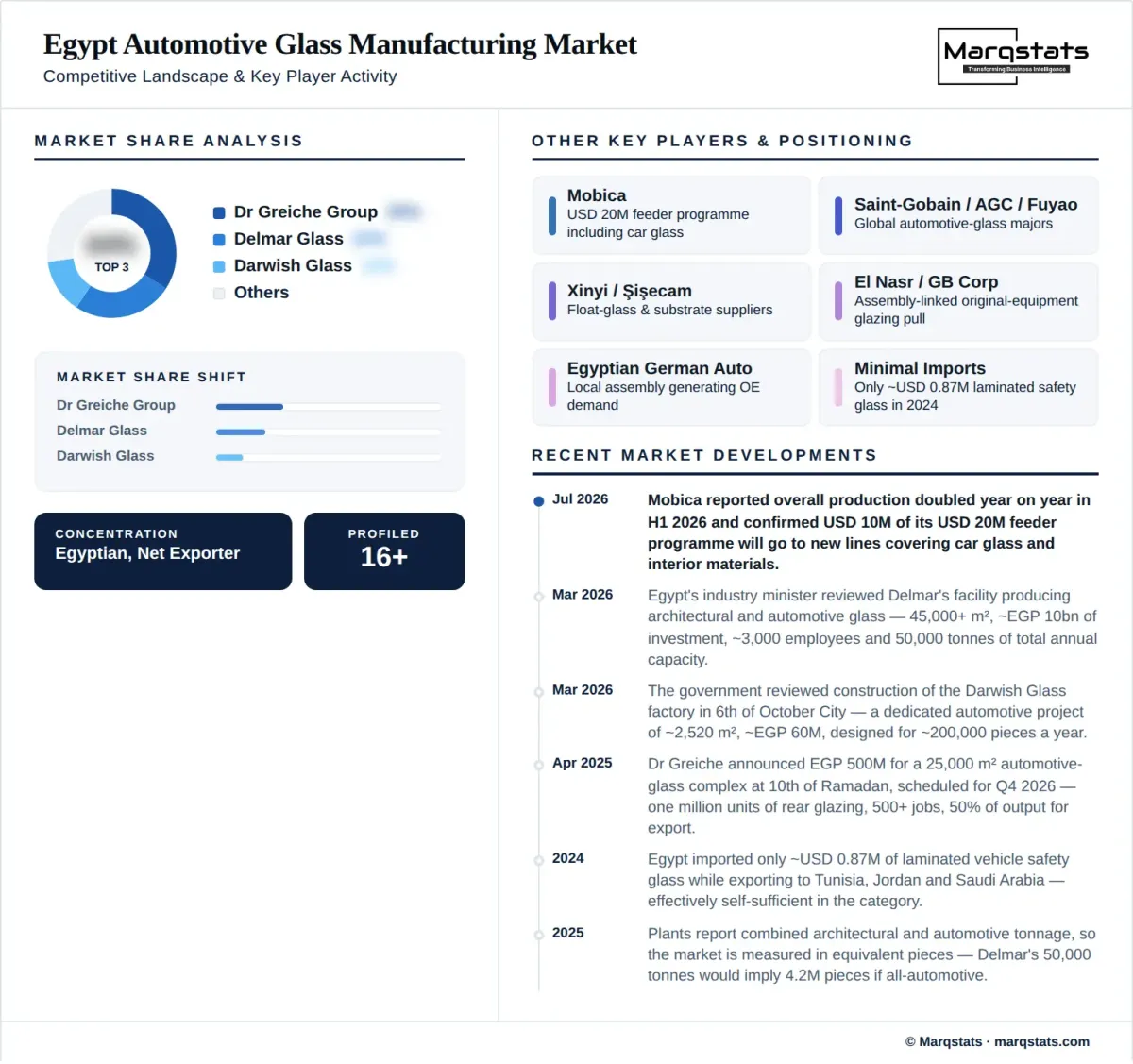
- Feeder-industry investment is broadening beyond specialist glass producers, with Mobica outlining USD 20 million for Egyptian automotive feeder industries including car glass and interior materials, half of it directed to new production lines, and reporting that overall production doubled year on year in the first half of 2026.
- Technology sourcing is international while manufacturing is local, with Dr Greiche drawing equipment from Italy, Spain, Switzerland and China for capabilities described as first-time regional implementations.
- Replacement demand is diverging from original equipment demand as the vehicle parc expands faster than assembly output, and the two channels require separate modelling because replacement glazing carries different specification, distribution and margin structures.
Market Segmentation
The highest-value position and the one carrying almost all technology content, since driver assistance camera mounting, acoustic interlayers and solar-control coatings concentrate here. Windshields are laminated by regulation and carry value per piece well above the roughly USD 45 category average, which is why the position drives the value series toward 23.29% growth against 17.19% for units.
The highest-count position at four to six pieces per vehicle and the volume anchor of the equivalent-piece measure. Side glazing is tempered rather than laminated, carries the lowest value per piece and the least technology content, and its growth tracks vehicle assembly output rising from 99,600 units in 2025 toward 206,000 by 2030 more closely than any other position.
The position where Egypt's largest single capacity commitment sits, with Dr Greiche's new complex carrying one million units of annual rear glazing capacity from the fourth quarter of 2026 and doubling the group's existing output. Rear glazing carries heating elements and antenna printing, which places it above side glass in value per piece and makes it a natural entry point for digital printing capability.
The smallest position by count and the fastest-growing by value, driven by thermal roof and solar-control products that Dr Greiche's technology package explicitly targets for electric vehicles. Panoramic glazing carries the highest value per piece of any position and its share rises as Chinese brands, which took 37.8% of Egypt's passenger car market in 2025, bring higher specification levels into mainstream segments.
Required for windshields by safety regulation and increasingly specified for side and roof glazing on acoustic and security grounds. Laminated glass carries the interlayer processing and optical quality requirements that make original equipment qualification demanding, and it accounts for the large majority of the value in a market rising from USD 42.75 million to USD 121.80 million.
The volume type, covering side and most rear glazing at four to six pieces per vehicle against one windshield. Tempered processing is less capital-intensive and less qualification-intensive than lamination, which is why a dedicated 200,000-piece facility such as Darwish can be built for around EGP 60 million on 2,520 square metres.
The channel that determines plant economics through nomination rather than volume alone, tied to locally assembled output rising from 99,600 vehicles in 2025 toward 206,000 by 2030. It is also the channel constrained by assembly utilisation near 33% against installed capacity around 300,000 units, so original equipment glazing demand sits well below what Egypt's assembly base could theoretically generate.
The channel tied to the installed vehicle parc rather than to annual assembly, and therefore growing on a steadier curve than the 15.64% rate at which locally assembled output expands. Replacement glazing is the reason Egyptian automotive glass demand does not collapse when assembly output fluctuates, and it carries specification, distribution and margin structures different enough from original equipment supply that the two channels behave as separate businesses inside one 2,100,000-piece 2030 total.
The channel designed into new capacity from the outset, with Dr Greiche allocating 50% of its new complex to Europe, the United States and the Gulf. Egypt already exports vehicle glass to Tunisia, Jordan and Saudi Arabia, and against laminated safety glass imports of only about USD 0.87 million in 2024 the country runs a clear net export position in this category.
The baseline technology covering most side and rear glazing, competing on cost and delivery rather than capability. It carries value per piece below the roughly USD 45 category average and its share of value falls through the forecast period even as its share of the 2,100,000-piece 2030 volume remains substantial.
The mid-tier technology and the fastest-broadening one, covering solar-control glass that Dr Greiche's package targets specifically at electric vehicle applications alongside thermal roofs. Coatings lift value per piece toward the USD 58 the category averages by 2030 without requiring the capital of ultra-thin processing, which makes them the most accessible upgrade path for existing Egyptian processors working from the roughly USD 45 baseline.
The frontier capability and the reason value per piece rises from about USD 45 to USD 58, covering processing down to 2.1 millimetres and windshields compatible with driver assistance systems. Dr Greiche's thermal treatment systems for ultra-thin glass and its digital printing to original equipment specification are described as first-time regional implementations, drawing equipment from Italy, Spain, Switzerland and China.
By Geography
10th of Ramadan City
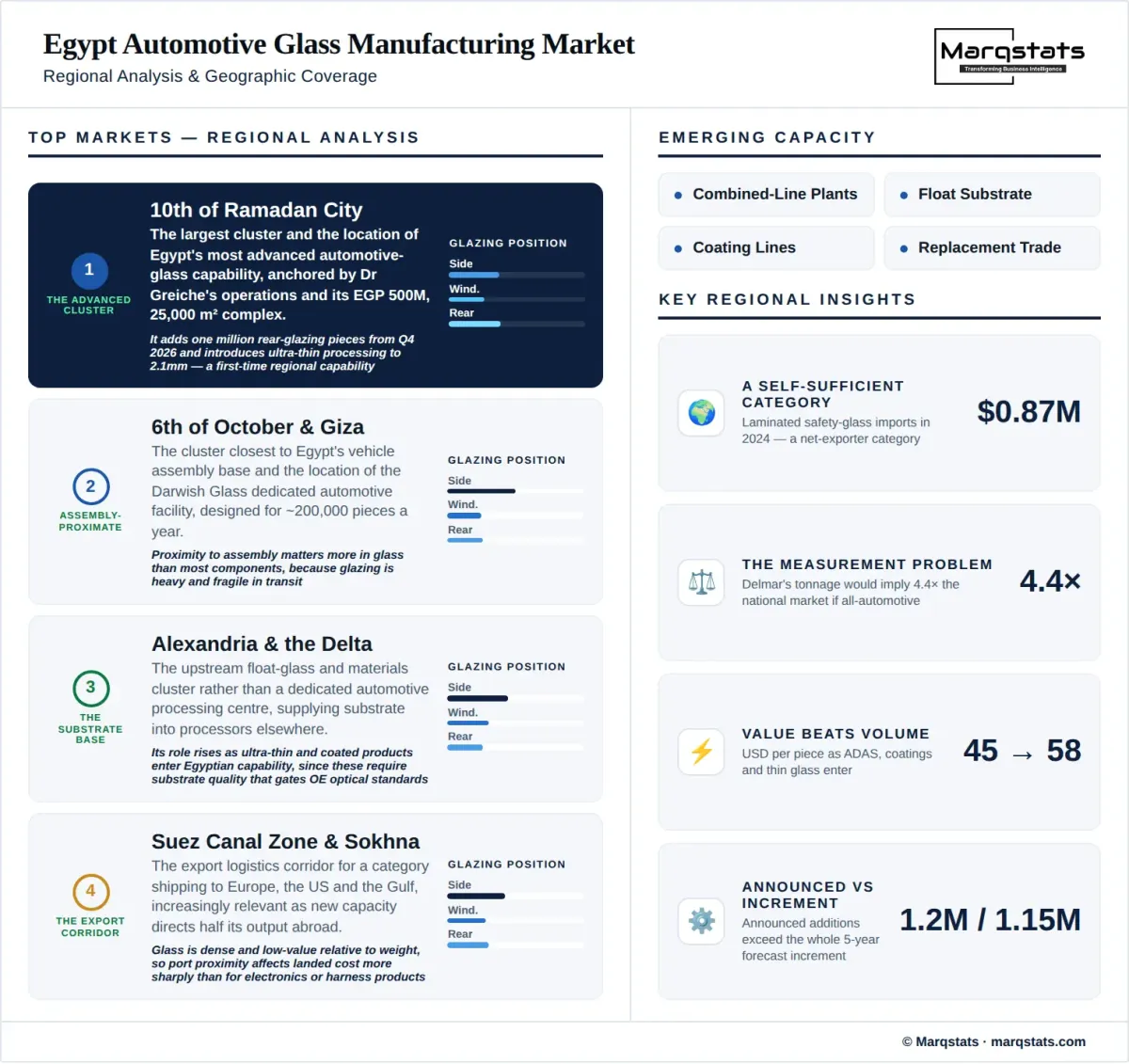
The largest cluster and the location of Egypt's most advanced automotive glass capability, anchored by Dr Greiche's existing operations and the EGP 500 million, 25,000 square metre complex carrying one million units of annual rear glazing capacity from the fourth quarter of 2026. The site supports over 500 direct and roughly 150 indirect jobs and introduces ultra-thin processing to 2.1 millimetres.
6th of October City and Giza
The cluster closest to Egypt's vehicle assembly base and the location of the Darwish Glass dedicated automotive facility, a 2,520 square metre project carrying around EGP 60 million of investment and designed for approximately 200,000 automotive glass pieces a year. Proximity to assembly matters more in glass than in most components because glazing is heavy and fragile in transit.
Alexandria and the Delta
The upstream float glass and materials cluster rather than a dedicated automotive processing centre, supplying substrate into processors elsewhere. Its role rises as ultra-thin and coated products enter Egyptian capability, since these require substrate quality that determines whether a processor can meet original equipment optical standards at all.
Suez Canal Economic Zone and Sokhna
The export logistics corridor for a category shipping to Europe, the United States and the Gulf, and increasingly relevant as Dr Greiche directs 50% of new capacity abroad. Glass is dense and low-value relative to weight, so port proximity affects landed cost more sharply than it does for electronics or harness products.
Rest of Egypt
Covering diversified industrial complexes producing architectural and automotive glass on combined lines, including Delmar's site of more than 45,000 square metres carrying about EGP 10 billion of investment, around 3,000 employees and 50,000 tonnes of total annual glass and aluminium capacity. The automotive share of that capacity is not separately disclosed, which is precisely the measurement problem described above.
How Competition Is Evolving
The competitive field divides between diversified glass groups and dedicated automotive projects, and the distinction determines how their capacity should be read. Delmar operates a complex exceeding 45,000 square metres with about EGP 10 billion of investment, around 3,000 employees and 50,000 tonnes of combined annual glass and aluminium capacity, of which the automotive share is not disclosed. Dr Greiche is the most advanced dedicated player, expanding at 10th of Ramadan City with EGP 500 million and one million units of annual rear glazing capacity. Darwish Glass is purpose-built for automotive at approximately 200,000 pieces a year. Mobica enters as a feeder-industry investor with USD 20 million across car glass and interior materials.
Capacity announcements in this category require unusual care because the numbers arrive in incompatible units. A tonnage figure covering architectural and automotive lines together, a piece figure for a dedicated plant, and an investment figure for a mixed feeder-industry programme cannot be added or compared without conversion, and the conversion is where the error enters. Delmar's 50,000 tonnes, if treated as automotive glass, would imply roughly 4.2 million pieces at typical glazing weights, about 4.4 times the entire national market and nearly double the 2030 forecast, from one site. That single arithmetic step is the most common way this market gets oversized.
The commercially decisive variable is original equipment qualification rather than capacity. Automotive glazing must satisfy Egyptian and recognised safety and optical standards before a customer-specific approval process begins, and a plant without nominations converts its design capacity into replacement and export volume at lower margin. That is why Dr Greiche's 50% export allocation is a strategic hedge as much as a growth plan, and why announced additions totalling 1,200,000 pieces against a 1,150,000-piece forecast increment do not simply raise the forecast. The forecast is implicitly assuming that new capacity ramps below full utilisation, which is consistent with Egyptian vehicle assembly running near 33% of installed capacity, and the published range top of 3.0 million pieces for 2031 is the case a client evaluating entry should model.
The strategic reading for an investor is that Egypt has already won this category and the open question is value rather than volume. Imports of laminated vehicle safety glass at about USD 0.87 million in 2024 mean there is effectively no import substitution left to capture domestically, and incremental domestic volume is capped by assembly output and parc growth. The growth available is in value per piece, which rises from approximately USD 45 to USD 58 across the forecast, and in export share, where Dr Greiche is directing half of new capacity toward Europe, the United States and the Gulf. A greenfield entrant competing on standard tempered side glazing enters a self-sufficient market against incumbents with existing nominations; an entrant bringing coating, thin-glass or driver-assistance windshield capability enters a segment Egypt is still building.
Companies Covered
The report profiles 16+ companies with full strategy and financials analysis, including:
Recent Market Activity
Table of Contents
Coverage & Segmentation
The study covers laminated and tempered automotive glazing processed or manufactured in Egypt for original equipment, replacement and export channels, across the 2021 to 2025 historical period and the 2026 to 2030 forecast period, with 2025 as the base year and an indicative 2031 endpoint. Export output is included, unlike in Egypt's automotive components market, which measures domestic demand only. The inclusion follows the structure of the industry: new Egyptian automotive glass capacity is built with export share designed in, and a domestic-only lens would misdescribe plant economics.
The equivalent-piece basis is a response to a reporting limitation rather than an analytical preference. Egyptian glass producers operate combined architectural and automotive lines and disclose consolidated tonnage, so no official nationwide automotive output figure exists. The conversion uses local assembly of about 99,600 vehicles, average multi-piece glazing content per vehicle, dedicated automotive capacity anchors and replacement and export demand. Delmar's full 50,000-tonne mixed capacity is deliberately not assigned to automotive use. Confidence is graded moderate and the sizing range is published: 0.7 to 1.2 million pieces for 2025, 1.0 to 1.6 million for 2026 and 1.8 to 3.0 million for 2031.