Market Snapshot
Middle bar: base-year value × (1 + CAGR), rounded to two decimals. This is a calculated illustration, not a separately researched annual estimate.
The Saudi Arabia electric vehicle manufacturing market size is estimated at USD 0.34 billion in 2025 and is projected to reach USD 4.07 billion by 2030, expanding at a 64.29% CAGR across the 2026 – 2030 forecast period. The market covers battery-electric vehicle manufacturing and assembly within the Kingdom, valued at factory-gate output and measured in annual vehicles produced rather than nameplate capacity. Output rises from approximately 4,000 vehicles in 2025 to 107,000 by 2030, a 92.96% unit CAGR. Internal-combustion output from mixed plants is excluded from the electric vehicle volume.
Market size and forecast figures are generated using Marqstats' proprietary estimation framework, updated as of September 2026.
This is a supply-led market, and that is the single most important thing to understand about it. Saudi Arabia assembled roughly 4,000 electric vehicles in 2025 while the supplied national model-level dataset records only 1,394 battery-electric and 1,173 plug-in hybrid units sold domestically in the same year. The Kingdom already manufactures close to three times more electric vehicles than it retails, and the gap widens across the forecast period. Announced nameplate capacity across the three confirmed plants already exceeds 205,000 vehicles a year against a total national new-vehicle market of 827,544 units in 2025 of all powertrains. Capacity is being created ahead of domestic demand by deliberate industrial policy, which makes this an export and localisation story before it is a domestic adoption story.
Unit growth and revenue growth diverge sharply, and the gap between them is commercially significant. Output grows at a 92.96% compound rate while market value grows at 64.29%, because the product mix shifts from premium vehicles assembled today to mass-market vehicles built at scale later. The blended factory-gate value per vehicle falls from approximately USD 85,000 in 2025 to USD 38,000 by 2030, a 14.87% annual decline driven entirely by mix rather than by discounting. A supplier sizing its addressable revenue from the unit curve alone would overstate it by roughly a third.
Key Takeaways
Market Overview & Analysis
Report Summary
The Saudi Arabia electric vehicle manufacturing market comprises battery-electric vehicle manufacturing and assembly carried out within the Kingdom, measured as annual vehicles produced and valued at factory-gate output. Annual output and nameplate installed capacity are reported separately throughout, because the two are frequently conflated in this market and the difference between them is where most of the commercial risk sits. Internal-combustion output from mixed-powertrain plants is excluded from the electric vehicle volume even where it shares a production line. On this basis the market stood at USD 0.34 billion and approximately 4,000 vehicles in 2025.
Actual 2025 electric vehicle output is not publicly disclosed by any Saudi authority or by the manufacturers individually, so the base is constructed rather than reported. It rests on the 5,000-vehicle initial semi-knocked-down capacity of the operating facility at King Abdullah Economic City with a conservative utilisation assumption applied. A useful external check is that the operator produced 18,378 vehicles globally in 2025, up 104% on roughly 9,000 the prior year, so a Saudi assembly contribution of approximately 4,000 units represents about 22% of that global total. That is plausible for a facility running near its stated semi-knocked-down capacity, but it is an inference rather than a disclosure and the range around it runs from 3,000 to 5,000 units.
A definitional boundary matters more here than in most manufacturing markets. Semi-knocked-down assembly, in which kits produced elsewhere are re-assembled locally, counts as local manufacturing output under the conventional treatment, and it is what the Kingdom's capacity currently delivers. It is not, however, the same industrial activity as complete built-up manufacturing from stamped body panels, and the transition between the two is the central ramp assumption in the forecast. The 2025 and 2026 figures therefore represent assembly rather than full local manufacture, and a vehicle built from an imported kit may also appear in the exporting country's production statistics.
The forecast is calibrated to confirmed project milestones rather than extrapolated, because there is no historical series to extrapolate from. Three plants anchor it: an operating premium facility transitioning from semi-knocked-down assembly to complete built-up manufacturing with production readiness guided to early 2027; a domestic mass-market brand scheduled to begin production in the fourth quarter of 2026; and a joint-venture plant targeting 50,000 mixed-powertrain units a year with first vehicle planned for the same quarter. The resulting path is deliberately back-loaded, with modest output through 2026, a step change in 2027 and 2028 as two plants ramp simultaneously, and 107,000 units by 2030 at roughly half of announced nameplate capacity.
Electric Vehicle Production Volume and Output Forecast
Saudi Arabia produced approximately 4,000 electric vehicles in 2025 and is forecast to produce 107,000 by 2030, a 92.96% compound annual growth rate. Output here means vehicles actually built, never announced nameplate capacity, and the distinction is large: announced capacity across the three confirmed plants exceeds 205,000 vehicles a year, so the 2030 output forecast represents approximately 52% utilisation. Treating capacity as production overstates the market by roughly a factor of two, and treating it as current production overstates it by more than forty.
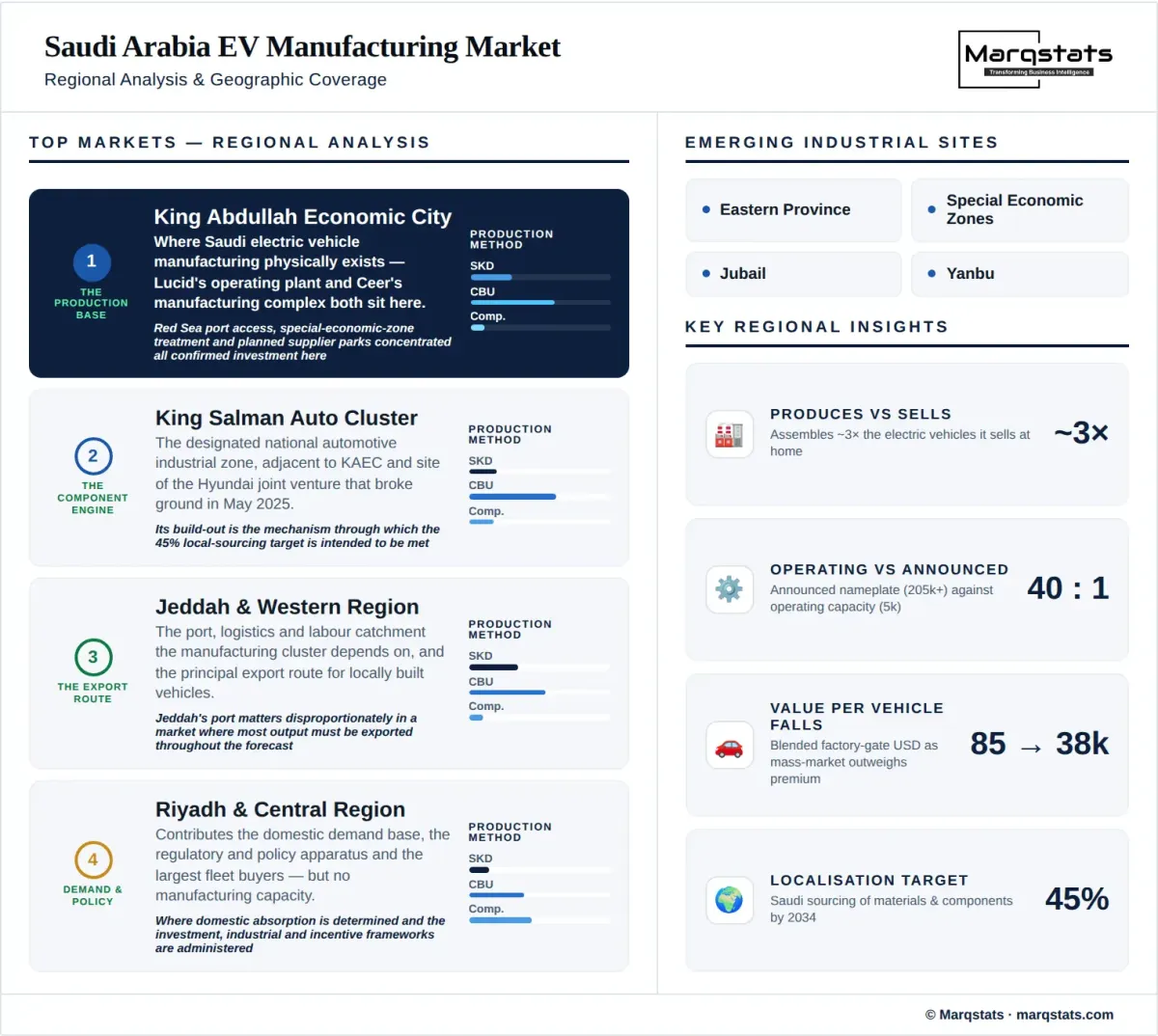
Production volume and market value diverge by 28 percentage points, 92.96% against 64.29%, and the gap is mix rather than discounting: the blended factory-gate value per vehicle falls from approximately USD 85,000 to USD 38,000 as premium output is outweighed by mass-market production. Addressable revenue sized from the unit curve alone is overstated by roughly a third, and component suppliers should size content per vehicle against a falling rather than a rising vehicle price. Output volume also exceeds domestic demand throughout: 4,000 vehicles produced in 2025 against 1,394 battery-electric units sold domestically means the Kingdom builds close to three times more electric vehicles than it retails.
Market Dynamics
Key Drivers
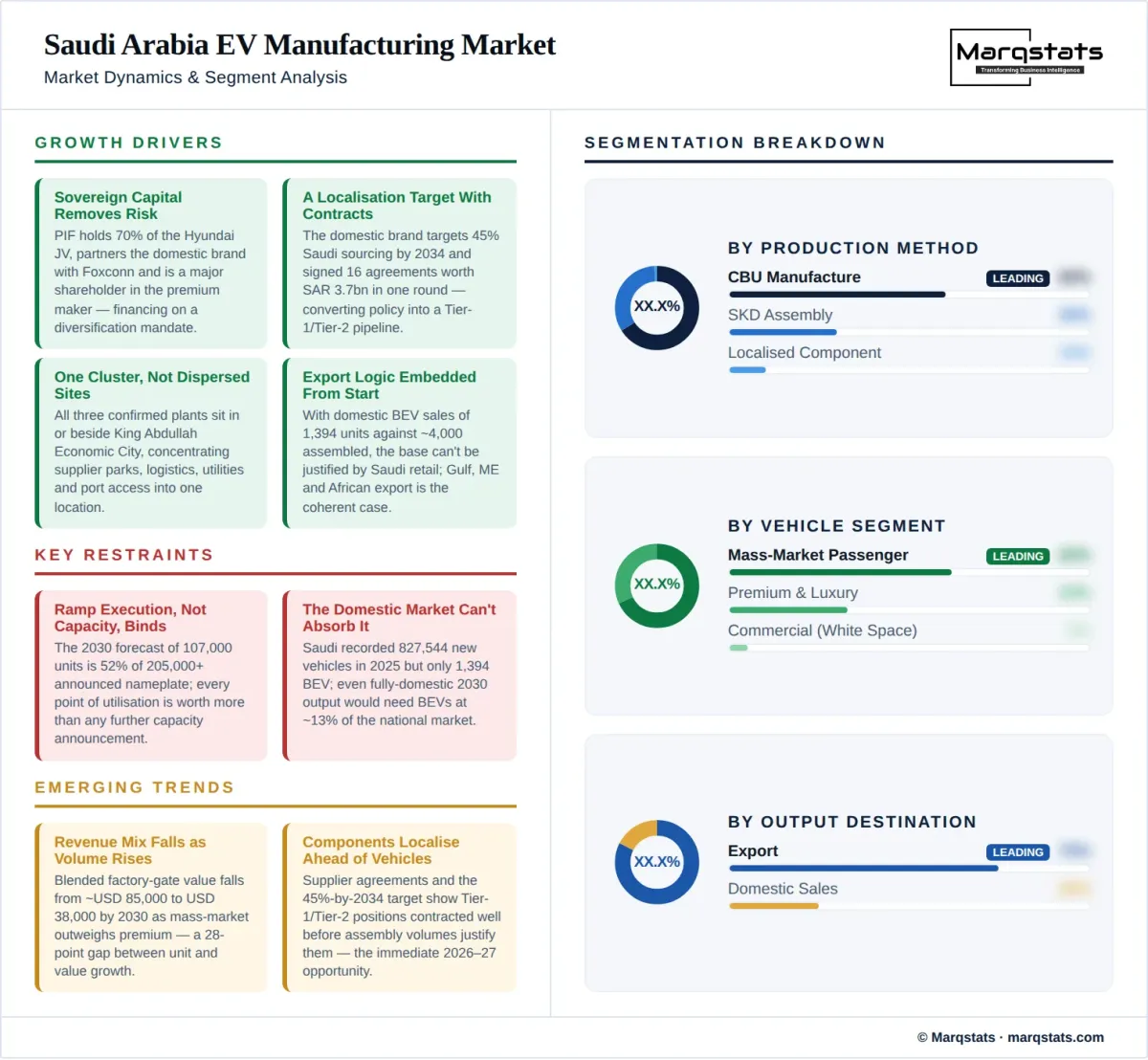
- Sovereign capital removing the demand-risk barrier to capacity. The Public Investment Fund holds 70% of the Hyundai joint venture, is a joint-venture partner in the domestic mass-market brand alongside Foxconn, and is a major shareholder in the premium manufacturer. Plants that would not be financed on the strength of Saudi domestic electric vehicle demand alone are being financed on an industrial diversification mandate, which decouples capacity creation from near-term retail volume.
- A localisation target with contracts already behind it. The domestic brand targets 45% Saudi sourcing of vehicle materials and components by 2034 and has signed 16 commercial agreements worth more than SAR 3.7 billion in a single round, following SAR 5.5 billion the prior year. That converts a policy objective into a Tier-1 and Tier-2 supplier pipeline, which is where the earlier and more accessible commercial opportunity sits for most entrants.
- A concentrated industrial cluster rather than dispersed sites. All three confirmed plants sit in or adjacent to King Abdullah Economic City and the King Salman Automotive Cluster, which concentrates supplier parks, logistics, utilities, port access and workforce development in one location. Co-location materially lowers the entry cost for a component supplier compared with serving three plants across separate regions.
- Manufacturing technology being installed at frontier specification rather than to a cost floor. The domestic brand's plant includes a highly automated modular paint shop using oven technology that reduces body-heating time by up to 30% against conventional systems, with automated guided vehicles moving bodies between process stations. Building at current-generation specification from the outset avoids the retrofit burden that constrains established plants elsewhere.
- Export logic embedded from the start. With domestic battery-electric sales at 1,394 units in 2025 against roughly 4,000 assembled, the manufacturing base cannot be justified by the Saudi retail market at any point in this forecast. Gulf, wider Middle East and African export access, supported by port infrastructure and trade positioning, is the demand assumption that makes the 2030 case coherent.
Key Restraints
- Ramp execution, not announced capacity, is the binding constraint. The 2030 forecast of 107,000 units is 52% of the more than 205,000 vehicles a year of announced nameplate capacity. Every additional point of utilisation is worth more to this market than any further capacity announcement, and utilisation depends on yield stabilisation, supplier readiness and demand access rather than on investment.
- Timelines have already moved. The premium facility was guided in January 2026 to begin full-scale production during 2026, and by August 2026 was described as moving from construction into industrialisation with production readiness expected in early 2027 and the midsize programme entering production in the second half of 2027. A single quarter of slippage at one plant moves several thousand units of national output in this period.
- The domestic market cannot absorb the output. Saudi Arabia recorded 827,544 new vehicles of all powertrains in 2025 and, within that, a supplied national model-level dataset shows only 1,394 battery-electric and 1,173 plug-in hybrid units. Even a fully domestic-absorbed 107,000-unit output in 2030 would require battery-electric vehicles to reach roughly 13% of the entire national new-vehicle market, which is a far larger adoption shift than current sales indicate.
- Semi-knocked-down assembly carries thin industrial value. The activity that exists today re-assembles kits produced elsewhere, which generates local employment and logistics activity but limited component value capture, limited technology transfer and limited supplier depth. The market's industrial significance depends entirely on completing the transition to complete built-up manufacture, and that transition is scheduled rather than achieved.
- No official output series exists to measure against. No Saudi authority publishes annual electric vehicle production, and manufacturers do not disclose Saudi output separately from global figures. Every available figure is constructed rather than counted, and any supplier, investor or policymaker working on this market is doing so without an observable baseline.
Key Trends
- The revenue mix is falling even as volume rises. Blended factory-gate value per vehicle declines from approximately USD 85,000 in 2025 to USD 38,000 by 2030 as premium output is joined and then outweighed by mass-market production. The consequence is a 28-point gap between the unit growth rate and the value growth rate, and it means component suppliers should size content-per-vehicle against a falling, not rising, vehicle price.
- Component localisation is moving ahead of finished-vehicle volume. The supplier agreements signed to date, and the 45% local sourcing target for 2034, indicate that Tier-1 and Tier-2 opportunity is being contracted well before the assembly volumes that would normally justify it. For most international suppliers this is the more immediate commercial opportunity in 2026 and 2027, ahead of finished-vehicle throughput.
- Mixed-powertrain plants blur the electric vehicle boundary. One of the three anchor plants is designed for both internal-combustion and electric production on the same 50,000-unit annual capacity. Its electric share will be a management decision responding to demand rather than a fixed engineering constraint, which introduces a genuine forecasting uncertainty that no capacity announcement resolves.
- Technology partnership rather than wholly indigenous development. The domestic mass-market brand is a joint venture built with a contract-manufacturing partner and uses component technology licensed from an established premium manufacturer. The model prioritises speed to production over vertical technology ownership, which shortens the timeline but locates part of the long-term value outside the Kingdom.
Market Segmentation
Lucid operates the Kingdom's first and currently only producing vehicle plant, the AMP-2 facility at King Abdullah Economic City, which began with 5,000 vehicles a year of semi-knocked-down capacity and carries a stated future total capacity of 155,000 electric vehicles a year. It accounts for effectively all Saudi electric vehicle output in 2025 and 2026. The facility moved from construction into industrialisation during 2026 with manufacturing systems being installed and tuned across stamping, body, paint and final assembly, and production readiness guided to early 2027.
Ceer is Saudi Arabia's first homegrown electric vehicle brand, a Public Investment Fund joint venture with Hon Hai Precision Industry using component technology licensed from BMW. Production at the Ceer Manufacturing Complex in King Abdullah Economic City is scheduled to begin in the fourth quarter of 2026. Ceer is the mass-market volume anchor of the national manufacturing case and the principal driver of both the unit growth and the blended price decline modelled across the forecast period.
The Hyundai joint venture, 70% owned by the Public Investment Fund and 30% by Hyundai Motor Company, broke ground at the King Salman Automotive Cluster in May 2025 and is Hyundai's first plant in the Middle East. It targets 50,000 vehicles a year across internal-combustion and electric output, with first vehicle planned for the fourth quarter of 2026. Only its electric share counts toward this market, and that share is a commercial decision rather than a fixed capacity, which makes it the least predictable component of the national forecast.
Beyond the three confirmed plants, the Kingdom's industrial policy actively courts additional assembly and component investment through the automotive cluster, special economic zone framework and investment incentives. No further finished-vehicle plant has reached construction with a disclosed capacity and timeline at the time of writing, so none is included in the forecast. Any additional entrant would represent upside to the 2030 case rather than a substitute for the plants modelled here.
Semi-knocked-down assembly is the entirety of current Saudi electric vehicle output. Kits produced elsewhere are shipped in and re-assembled locally at a stated initial capacity of 5,000 vehicles a year. The method delivers local employment, logistics activity and workforce development, but limited component value capture and limited supplier depth, and it is the reason this market's 2025 and 2026 figures should not be read as evidence of full local manufacture.
Complete built-up manufacturing from stamped body panels through paint and final assembly is the industrial destination of all three plants and the transition on which the entire forecast depends. The premium facility's industrialisation across stamping, body, paint and final assembly, and the domestic brand's automated modular paint shop, are both evidence that this capability is being installed rather than merely announced. The commercial significance is that complete built-up production multiplies the local component content available to Tier-1 suppliers.
Component manufacture within the Kingdom is the deepest form of localisation and the explicit target of the 45% Saudi sourcing objective for 2034. It is not counted in this market's vehicle output but it determines how much of the vehicle's value stays in the country. On current evidence it is being contracted ahead of the assembly volumes that would normally justify it, which is unusual and commercially advantageous for early supplier entrants.
Premium vehicles are the whole of the market in 2025 and 2026 and the reason the blended factory-gate value starts near USD 85,000. Their share of units falls steadily as mass-market capacity comes online, but they remain the highest value-per-unit output and the segment where the local manufacturing base has an established production record. Premium output is also the most export-dependent, since domestic demand at this price point is narrow.
Mass-market passenger vehicles are the volume story from 2027 onward and the source of nearly all incremental units in the forecast. They are also the reason market value grows more slowly than output: a mass-market vehicle contributes a fraction of the factory-gate value of a premium one while consuming comparable plant capacity. This segment determines whether the Kingdom's capacity utilisation improves, because volume at accessible price points is what fills a 205,000-unit nameplate.
Commercial and fleet electric vehicles are not currently a confirmed part of Saudi electric manufacturing output, with the three anchor plants configured for passenger vehicles. Commercial vehicles represented 100,556 of the Kingdom's 827,544 new vehicles in 2025, so the domestic base exists, but no announced plant addresses it with electric production. This is a genuine white space in the national manufacturing footprint rather than a forecast segment.
Export is the destination that makes the manufacturing case coherent and it is where most output must go throughout the forecast period. With domestic battery-electric sales at 1,394 units in 2025 against roughly 4,000 assembled, the Kingdom is already a net exporter of electric vehicles by a factor of nearly three. Gulf, wider Middle East and African markets, reached through the Kingdom's Red Sea port infrastructure, are the addressable destinations, and export access is the assumption most worth stress-testing in any investment case built on this market.
Domestic absorption is small and will remain the minority destination. Saudi Arabia recorded 1,394 battery-electric and 1,173 plug-in hybrid units in the supplied national model-level dataset for 2025 against 827,544 new vehicles of all powertrains. Domestic electric adoption is growing from a very low base, and locally built mass-market vehicles at accessible price points are the most credible mechanism for accelerating it, but domestic demand cannot fill the capacity being built within this period.
Final assembly is where all current activity sits and where the capacity announcements are measured. It is the most visible stage and the least value-dense, and its economics turn almost entirely on utilisation. A plant running at half its nameplate carries the full fixed-cost burden of the whole, which is why the 52% utilisation implied by the 2030 forecast is the number an investor should focus on rather than the capacity headline.
Body, paint and stamping represent the transition from assembly to manufacture and carry the heaviest capital intensity of any stage. Their installation is the clearest physical evidence that complete built-up production is genuinely being built: an automated modular paint shop with advanced oven technology and automated guided vehicles at one plant, and industrialisation across stamping, body, paint and final assembly at another. These are not stages a semi-knocked-down operation requires.
Battery and powertrain localisation is the highest-value component opportunity and the least developed stage in the Kingdom. No cell manufacturing at scale has been confirmed alongside the vehicle plants, which means battery value currently flows out of the country on every vehicle assembled. For a national programme targeting 45% local sourcing, the battery is both the largest single obstacle to that target and the largest available prize.
Tier-1 and Tier-2 component supply is where the near-term commercial opportunity is most accessible, and where contracts are already being signed ahead of volume. Sixteen commercial agreements worth more than SAR 3.7 billion in one round, following SAR 5.5 billion previously, indicate a supplier base being assembled deliberately rather than emerging in response to demand. Co-location within the automotive cluster lowers the entry cost of serving all three plants.
Operating capacity is limited to the 5,000 vehicles a year of semi-knocked-down capability at the premium facility, and it is the only capacity that has produced a vehicle. Distinguishing it from announced capacity is the single most important discipline in reading this market, because the ratio between the two currently exceeds forty to one.
Capacity under commissioning covers the plants with equipment installed or being installed and production dates scheduled within the next four quarters: the mass-market complex targeting fourth-quarter 2026 production, the joint-venture plant targeting its first vehicle in the same quarter, and the premium facility's complete built-up capability guided to early 2027. This is the capacity that converts the forecast from projection into output, and its schedule is the forecast's principal risk.
Announced nameplate capacity exceeds 205,000 vehicles a year across the three plants, combining a stated 155,000 future total at the premium facility, 50,000 at the joint venture and the mass-market complex's own capability. Nameplate is a statement of engineering potential at full ramp rather than a production forecast, and the 2030 case models 107,000 units against it. Any analysis that treats nameplate as output overstates this market by roughly a factor of two.
By Geography
King Abdullah Economic City
King Abdullah Economic City is where Saudi electric vehicle manufacturing physically exists. The premium facility that produced the Kingdom's first locally assembled vehicles sits here, as does the mass-market brand's manufacturing complex with its automated modular paint shop. The city's combination of Red Sea port access, special economic zone treatment, utilities and planned supplier parks is the reason all confirmed investment has concentrated in one location rather than dispersing across the Kingdom.
King Salman Automotive Cluster
The King Salman Automotive Cluster, adjacent to and integrated with King Abdullah Economic City, is the designated national automotive industrial zone and the site of the Hyundai joint venture that broke ground in May 2025. Its purpose is to concentrate assembly, component supply, logistics and workforce development in a single ecosystem, and its build-out is the mechanism through which the 45% local sourcing target is intended to be achieved.
Jeddah and the Western Region
The wider Western Region provides the port, logistics and labour catchment that the manufacturing cluster depends on. Jeddah's port infrastructure is the principal export route for locally built vehicles reaching Gulf, African and wider Middle East destinations, which matters disproportionately in a market where most output must be exported throughout the forecast period.
Riyadh and the Central Region
Riyadh contributes the domestic demand base, the regulatory and policy apparatus and the largest concentration of corporate and government fleet buyers, but not manufacturing capacity. Its relevance to this market is as the location where domestic absorption is determined and where the investment, industrial and incentive frameworks that govern the sector are administered.
Eastern Province and Emerging Industrial Sites
The Eastern Province holds the Kingdom's established heavy industrial and petrochemical base and the supplier capabilities that component localisation will eventually draw on, particularly in materials, plastics and metals. It hosts no confirmed vehicle assembly, and its role in this market is as a Tier-2 supply catchment rather than a production location, alongside the special economic zones being developed elsewhere in the Kingdom.
How Competition Is Evolving
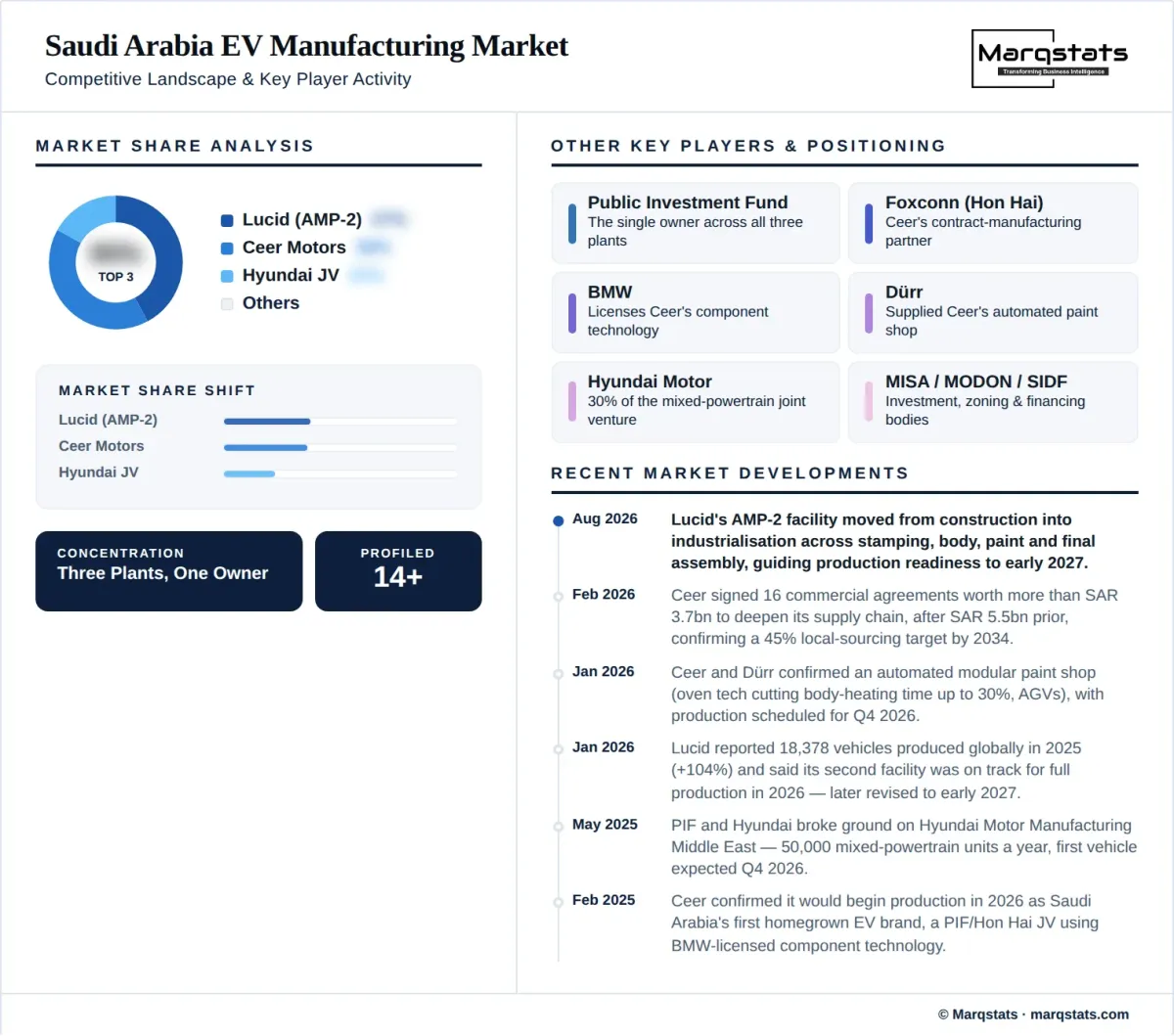
The Saudi Arabia electric vehicle manufacturing market is highly concentrated and shares a single controlling shareholder across its entire footprint. The Public Investment Fund holds 70% of the Hyundai joint venture, is a joint-venture partner in the domestic mass-market brand alongside Hon Hai Precision Industry, and is a major shareholder in the premium manufacturer operating the Kingdom's only producing plant. Three plants, one sovereign investor. This is not a competitive market in the conventional sense and no manufacturer share table derived from it would describe competitive outcome, since any such split reflects allocation within a coordinated national programme.
The three producers occupy deliberately non-overlapping positions. The premium manufacturer supplies high-value vehicles from an operating facility with a proven, if small, production record and the largest announced future capacity. The domestic brand is the mass-market volume anchor, built with a contract manufacturer and licensed component technology to compress the development timeline. The joint-venture plant brings an established global manufacturer's production system and a mixed-powertrain configuration that hedges between electric and internal-combustion demand. Their competition is for supplier capacity, skilled labour and cluster infrastructure rather than for customers.
The genuinely competitive layer of this market is the supply chain, and it is opening earlier than finished-vehicle volume would normally allow. Sixteen commercial agreements worth more than SAR 3.7 billion signed in a single round, following SAR 5.5 billion previously, alongside a 45% local sourcing target for 2034, indicate that Tier-1 and Tier-2 positions are being allocated now against volumes that arrive later. Specialist equipment suppliers are visible in the same way: a modular paint shop with advanced oven technology and automated guided vehicles has already been contracted at one plant. For an international supplier the practical conclusion is that the window to secure a position is the commissioning phase, not the production phase.
Two cautions govern any competitive read of this market. First, only the premium facility has produced vehicles; the other two plants have equipment, schedules and agreements but no output, and a competitive ranking built on announced capacity would invert once actual production begins. Second, the mixed-powertrain plant's electric share is a management decision rather than a fixed capacity, so its position in this specific market can change without any change to its investment or its plant.
Companies Covered
Companies covered in the report include:
Recent Market Activity
Table of Contents
Coverage & Segmentation
This report covers battery-electric vehicle manufacturing and assembly within Saudi Arabia, with 2025 as the base year and 2026–2030 as the forecast period. Market size is reported as factory-gate output value in US dollars and corroborated throughout by annual vehicles produced. Annual output is reported separately from nameplate installed capacity at every point, and internal-combustion output from mixed-powertrain plants is excluded from the electric vehicle volume even where it shares a production line. Segmentation covers manufacturer, production method, vehicle segment, output destination, value chain stage and capacity status, with regional analysis for King Abdullah Economic City, the King Salman Automotive Cluster, Jeddah and the Western Region, Riyadh and the Central Region, and the Eastern Province.
Four boundaries define the market perimeter. First, semi-knocked-down assembly counts as local manufacturing output, which is the conventional treatment, but it is not the same industrial activity as complete built-up manufacture and the 2025 and 2026 figures should not be read as evidence of the latter. Second, no Saudi authority publishes annual electric vehicle production and no manufacturer discloses Saudi output separately from global figures, so the base and every forecast year are constructed rather than reported. Third, nameplate capacity and annual output are never used interchangeably: announced capacity exceeds 205,000 vehicles a year while modelled 2030 output is 107,000, and treating the former as the latter overstates this market by roughly a factor of two. Fourth, component and battery localisation are analysed but excluded from vehicle output value.
The forecast is calibrated to confirmed project milestones rather than extrapolated, because no historical production series exists. It is deliberately back-loaded: modest output through 2026 from the single operating facility, a step change across 2027 and 2028 as two further plants ramp, and 107,000 units by 2030 at approximately 52% of announced nameplate capacity. The unit path carries the forecast and the value CAGR follows from it, the two diverging by 28 percentage points as the product mix shifts from premium to mass market. Addressable revenue sized from the unit curve alone is materially overstated, and utilisation is the variable to which the outcome is most sensitive.