Market Snapshot
Key Takeaways
Market Overview & Analysis
Report Summary
The India flex-fuel vehicle components market sits at an inflection point between mainstream E20 ethanol compatibility and emerging E85/E100 flex-fuel commercialization. The current market is dominated by E20-readiness components covering material upgrades, ethanol-resistant seals, hoses, gaskets, and engine calibration. The future opportunity sits in true flex-fuel components for E85/E100 vehicles, requiring higher-value content per vehicle including ethanol sensors, heated fuel rails, flex-fuel ECUs, and cold-start heating systems. Component value per vehicle ranges from approximately INR 1,000–2,000 for E20-compatible two-wheelers to INR 25,000 or more for full E85/E100 flex-fuel passenger cars.
Component cost economics are anchored to the NITI Aayog Roadmap for Ethanol Blending in India 2020-25, which estimated that E20-compatible vehicles cost INR 3,000–5,000 more for four-wheelers and INR 1,000–2,000 more for two-wheelers compared with ordinary gasoline vehicles. ARAI seminar industry estimates further indicate that full flex-fuel transition cost can reach INR 25,000 for cars and INR 12,000 for two-wheelers, reflecting the higher-value content required for E85/E100-capable systems including ethanol sensing, heated fuel rails, and flex-fuel ECUs.
Component category split in 2025 places fuel lines, hoses, seals, gaskets, and tank materials at the largest share of 32-38%, followed by injectors, fuel pumps, and fuel rails at 25-30%, ECU and calibration at 15-20%, ethanol sensors at 3-8%, and testing and validation services at 5-10%. The split shifts substantially in true E85/E100 systems by 2030, where ECU and software rises to 22-28%, fuel injection and rail to 20-25%, ethanol sensors to 12-18%, ethanol-resistant materials to 15-20%, heated fuel rail and cold-start to 10-15%, and aftertreatment calibration to 8-12%.
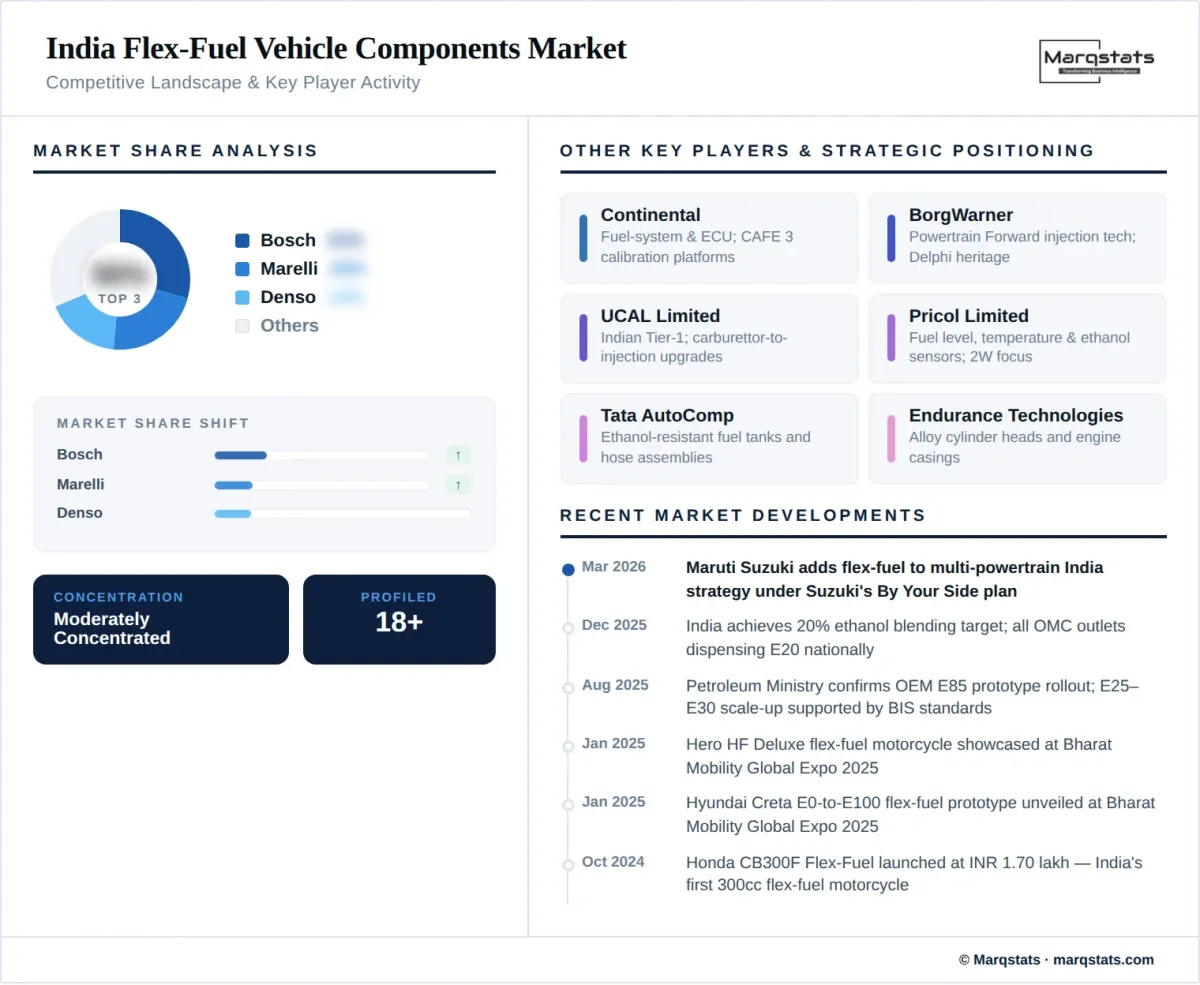
The competitive environment combines global Tier-1 fuel-system specialists with Indian fuel-system suppliers and ECU integrators. Bosch, Marelli, Denso, Continental, Delphi, BorgWarner, and Visteon anchor global capability; Indian Tier-1 suppliers are scaling localization in hoses, seals, gaskets, fuel tanks, wiring, and calibration support. The same OEM-Tier-1 ecosystem driving flex-fuel transition is also scaling Advanced Automotive Technology localization across the India ADAS Sensors Market, with both component categories sharing PLI Auto scheme eligibility, BS6 compliance pathways, and the upcoming CAFE 3 framework from April 2027.
Market Dynamics
Key Drivers
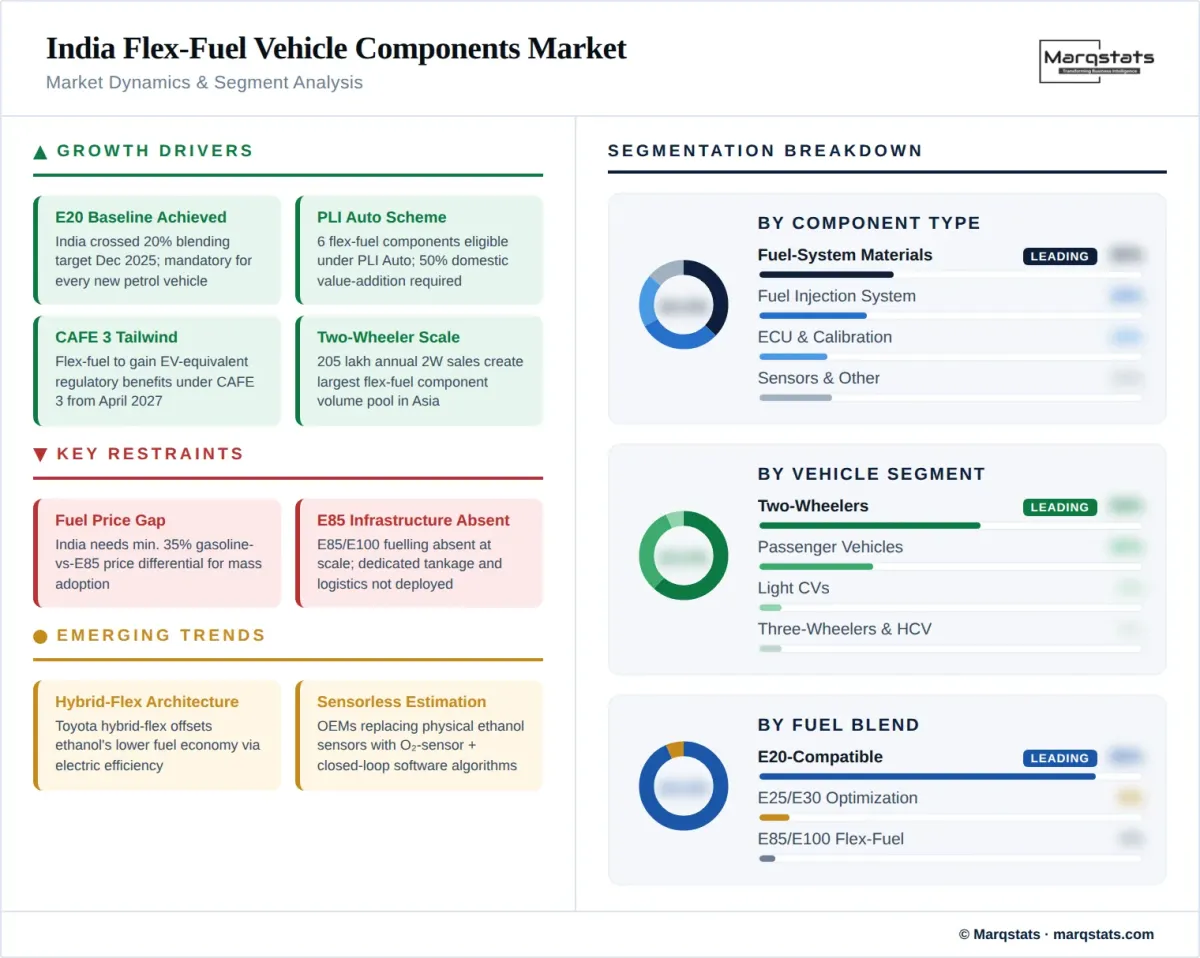
- E20 has become the base petrol grade nationally. Public Sector oil marketing companies achieved 19.93% blending in July 2025 and crossed 20% in December 2025, making ethanol-compatible fuel-system materials, calibration, and ECU logic mandatory for every new petrol vehicle platform sold in India.
- Government policy direction is moving beyond E20. The Petroleum Ministry confirmed in August 2025 that Indian OEMs had begun rolling out E85-compatible prototypes, with gradual scale-up toward E25, E27, and E30 supported by Bureau of Indian Standards (BIS) standards and fiscal incentives.
- PLI Auto scheme directly supports flex-fuel component manufacturing. The scheme officially lists BS6 compliant flex-fuel engine up to E85, heated fuel rail, heating element, heating control unit, ECU for flex-fuel engine, and ethanol sensor as eligible Advanced Automotive Technology products with 50% domestic value-addition requirement.
- Mass emission standards for E85/E100 flex-fuel vehicles were notified under G.S.R. 682(E) dated July 12, 2016 by the Ministry of Road Transport and Highways. The E20 roadmap mandated E20 material-compliant vehicles from April 2023 and E20-tuned engines from April 2025, creating a phased compliance pathway.
- Upcoming CAFE 3 framework from April 2027 is expected to grant flex-fuel vehicles regulatory benefits closer to electric vehicles. The framework would offset ethanol’s lower energy density penalty and create a structural cost advantage for OEMs deploying flex-fuel and hybrid-flex platforms.
- Two-wheeler scale anchors volume opportunity. India sold 205 lakh two-wheelers in 2025, making this the most scalable flex-fuel component segment. Honda, Hero MotoCorp, TVS, and Bajaj have all confirmed flex-fuel motorcycle platforms at the Bharat Mobility Global Expo and through individual launches.
Key Restraints
- Consumer economics remain unresolved without sufficient gasoline-ethanol price gap. Industry participants have indicated that India needs a minimum 35% price gap between gasoline and E85, similar to Brazil’s experience, to drive mass adoption of true flex-fuel vehicles.
- Vehicle cost penalty constrains mass-market adoption. ARAI seminar estimates indicate flex-fuel transition costs reach INR 25,000 for cars and INR 12,000 for two-wheelers, materially higher than the simpler E20 compatibility cost, creating affordability barriers in price-sensitive segments.
- Cold-start and fuel-quality issues challenge high ethanol blends. Bosch India has highlighted the need for fuel heating systems and fuel-quality standards to address cold-start reliability and long-term durability concerns, especially in northern winter conditions.
- E85/E100 fuel infrastructure remains absent at scale. While E20 is available widely, E85 and E100 require separate logistics, dedicated tankage, dispensing infrastructure, and quality control systems that have not yet rolled out beyond demonstration corridors.
- Electric vehicle and CNG competition limits flex-fuel addressability. Two-wheelers face EV substitution; three-wheelers face both CNG and EV competition; passenger vehicles face EV and strong-hybrid alternatives. Flex-fuel must compete on total cost of ownership rather than only emissions reduction.
Key Trends
- Hybrid flex-fuel architectures are emerging as the preferred passenger vehicle pathway. Toyota Kirloskar Motor has positioned strong-hybrid flex-fuel as a way to offset ethanol’s lower fuel economy through electric efficiency gains. Hyundai Creta flex-fuel prototype demonstrated E0-to-E100 capability at Bharat Mobility Global Expo 2025.
- ECU and calibration software is becoming the highest-margin component category. Marelli launched new PFI ECUs for gasoline, flex-fuel, and CNG applications targeted at Brazil, India, and EMEA markets, supporting calibration, homologation, OEM-specific tuning, wide-range oxygen sensors, and OBD diagnostics for flex-fuel platforms.
- Component manufacturers are localizing flex-fuel-specific hardware. Royal Enfield enhanced its testing facilities in FY2024-25 to include flex-fuel emission testing up to E100. Hero MotoCorp showcased the Hero HF Deluxe flex-fuel motorcycle at Bharat Mobility Global Expo 2025, designed to operate on E20 to E85 ethanol-blended gasoline.
- Sensorless ethanol-recognition algorithms are emerging as cost-down alternatives. Some OEMs are deploying software-based ethanol percentage estimation using oxygen sensors, combustion data, and closed-loop control instead of physical ethanol sensors, particularly relevant for mass-market two-wheelers where cost sensitivity is acute.
Market Segmentation
Fuel injection components account for approximately 25-30% of the broad ethanol-compatible component market in 2025. Ethanol’s lower energy density requires higher fuel flow for equivalent power output, increasing the importance of injectors, fuel pumps, fuel rails, and calibration. Bosch flex-fuel injection systems support gasoline, gasoline-ethanol mixtures, and pure ethanol operation. The category is expected to scale fastest in the 2027-2030 window as E85/E100 platforms achieve commercial production. Bosch, Denso, Delphi, BorgWarner, and Marelli anchor global supply, with Indian Tier-1 suppliers scaling injector and fuel rail localization.
Fuel rail components account for approximately 8-10% of the 2025 market and are expected to grow substantially with E85/E100 adoption. Bosch flex-fuel fuel rails use ethanol-resistant plastic or stainless steel, while heated fuel rail and heating element systems support reliable cold-starts with E85/E100 without requiring an auxiliary gasoline tank. The PLI Auto scheme specifically lists heated fuel rail, heating element, and heating control unit as eligible Advanced Automotive Technology components, providing direct localization incentive.
Ethanol sensors and fuel-recognition systems account for approximately 3-8% of the 2025 market. Physical ethanol sensors inform the ECU of fuel ethanol percentage, enabling adjustment of ignition timing, injection duration, and air-fuel ratio. Sensorless software-based estimation using oxygen sensors and closed-loop combustion control offers a cost-down alternative for mass-market two-wheelers. The PLI-Auto eligible component list specifically names ethanol sensors for flex-fuel engines, confirming strategic policy backing for the category.
Engine control unit, calibration, and OBD components account for approximately 15-20% of the 2025 market and represent the highest-margin category. Flex-fuel ECUs handle varying ethanol content, cold starts, emissions compliance, driveability, misfire control, and OBD diagnostics. Marelli, Bosch, Denso, and Continental anchor ECU supply. The category is expected to rise to 22-28% of value share in true E85/E100 systems by 2030, supported by India-specific calibration service providers and engineering capability builds.
Fuel-system materials including hoses, seals, gaskets, fuel tank, and fuel lines account for approximately 32-38% of the 2025 market, the largest single category. Ethanol compatibility is fundamentally a materials problem involving swelling, corrosion, permeation, deposits, and long-term durability. Higher ethanol blends such as E85 and E100 require additional material considerations beyond E20 specifications. Indian Tier-1 suppliers and rubber-component specialists hold strong localization positions in this category.
Cold-start systems including fuel rail heaters, heating elements, and heating control units account for less than 5% of the 2025 market. The category is small today but is forecast to grow substantially with E85/E100 adoption from 2027 onward, particularly in northern Indian markets where winter cold-start performance is critical. Bosch heated fuel rail technology eliminates the auxiliary gasoline tank typically required in early-generation flex-fuel systems.
Testing and validation services account for approximately 5-10% of the 2025 market. ARAI homologation, ICAT certification, OEM internal validation, and supplier-side calibration testing anchor the segment. Royal Enfield’s FY2024-25 facility upgrades included NABL accreditation for evaporative emission testing and flex-fuel emission testing capability up to E100. The category is expected to grow as E85/E100 testing norms are formally notified and OEM platform validation requirements expand.
Two-wheelers anchor approximately 58% of broad ethanol-compatible component value in 2025. India sold 205 lakh two-wheelers in calendar year 2025, the largest scalable flex-fuel component pool. Honda CB300F Flex-Fuel launched in October 2024 at INR 1.70 lakh, designed for up to E85 fuel with intelligent ethanol indicator. TVS Apache RTR 200 Fi E100 was India’s first ethanol-based motorcycle, available in Maharashtra, Uttar Pradesh, and Karnataka. Hero MotoCorp showcased the Hero HF Deluxe flex-fuel motorcycle at Bharat Mobility Global Expo 2025, designed for E20 to E85 ethanol-blended gasoline. Bajaj has presented the Pulsar NS160 Flex.
Passenger vehicles account for approximately 30% of broad ethanol-compatible component value in 2025. India sold 44.9 lakh passenger vehicles in 2025, providing a substantial addressable base. Per-unit component value is significantly higher than two-wheelers, particularly for full E85/E100 systems. Hyundai Creta flex-fuel prototype showcased at Bharat Mobility Global Expo 2025 demonstrated E0-to-E100 capability. Maruti Suzuki Brezza, Toyota Hycross, Tata Punch, and Mahindra XUV 3XO have all been displayed in flex-fuel configurations. Toyota Kirloskar has positioned hybrid-flex as the most viable mass-market pathway.
Three-wheelers account for approximately 4% of broad ethanol-compatible component value in 2025. India sold 7.9 lakh three-wheelers in 2025. The segment is shifting toward CNG and electric powertrains, limiting flex-fuel addressability. However, ethanol-compatible engines remain relevant in markets where CNG availability is poor or where fleet operators prioritize lower fuel costs. Bajaj Auto and Mahindra Last Mile Mobility maintain three-wheeler petrol portfolios that benefit from E20 component upgrades.
Light commercial vehicles account for approximately 6% of broad ethanol-compatible component value in 2025. India sold 10.3 lakh commercial vehicles in 2025, with light commercial vehicles representing a significant share. Tata Motors showcased the Ace Flex-fuel at Bharat Mobility Global Expo 2025, demonstrating commercial-grade ethanol compatibility. The segment is most relevant for last-mile cargo, urban delivery fleets, and small commercial operators who can capture fuel-cost benefits from ethanol blends.
Heavy commercial vehicles account for approximately 2% of broad ethanol-compatible component value in 2025. The segment is diesel-dominant, limiting petrol-ethanol flex-fuel relevance. Tata Motors has demonstrated alternative-fuel HCV platforms including the Prima G.55S LNG prime mover and biodiesel-powered Magna Coach and Azura T.19, however ethanol-petrol flex-fuel applications remain niche. The category may expand if dual-fuel diesel-ethanol or biodiesel-ethanol blends gain regulatory approval.
E20-compatible components account for approximately 88% of the 2025 component value pool. The category covers material upgrades, ECU calibration, ethanol-resistant seals and gaskets, fuel-line materials, and modest fuel-system tuning. With E20 now the national petrol baseline, every new petrol vehicle platform requires E20 compatibility, making this the mainstream component category. Per-vehicle cost increment is INR 1,000–2,000 for two-wheelers and INR 3,000–5,000 for four-wheelers per the NITI Aayog roadmap.
E25/E30 optimization components account for approximately 8% of the 2025 component value pool, with rapid expansion expected in the 2026-2028 window. The category requires higher ethanol tolerance materials, improved engine mapping, fuel-quality calibration, and updated ECU software. The Petroleum Ministry has indicated India will gradually scale toward E25, E27, and E30 with BIS standards and fiscal incentives, making this an emerging procurement focus for OEMs and Tier-1 suppliers.
E85/E100 flex-fuel components account for approximately 4% of the 2025 component value pool but represent the highest-value future opportunity. The category includes ethanol sensors, heated fuel rails, heating elements, heating control units, flex-fuel ECUs, ethanol-resistant materials at higher specifications, and cold-start systems. Honda CB300F Flex-Fuel and TVS Apache RTR 200 Fi E100 anchor early commercial volumes. Mass adoption awaits final E85/E100 testing certification norms, CAFE 3 incentive framework from April 2027, and E85/E100 fuel infrastructure rollout.
Spark-ignition petrol engines account for approximately 76% of the 2025 component value pool. The category is the natural fit for ethanol-petrol blending across all displacement classes from sub-150cc two-wheelers through 1.5L+ passenger car engines. Component manufacturers benefit from existing petrol engine integration relationships and high-volume manufacturing scale.
Hybrid electric vehicles account for approximately 14% of the 2025 component value pool, with strong growth expected. Toyota Kirloskar Motor has positioned hybrid-flex as the optimal four-wheeler pathway, where electric efficiency offsets ethanol’s lower fuel economy. Toyota Hycross flex-fuel demonstration anchors the segment. The category is expected to scale rapidly as CAFE 3 incentives align with hybrid-flex platform investments from 2027 onward.
CNG-petrol bi-fuel vehicles account for approximately 8% of the 2025 component value pool. Maruti Suzuki, Hyundai, and Tata Motors maintain extensive CNG portfolios where the petrol fuel-system requires E20 ethanol compatibility. The category is expected to remain stable as CNG infrastructure scales alongside ethanol-blended petrol availability, supporting bi-fuel vehicle demand.
Other configurations including ethanol-only engines, direct-injection variants, and emerging port-and-direct combined systems account for approximately 2% of the 2025 component value pool. The category is small but technically significant, representing the engineering frontier for true E100 dedicated engines and advanced flex-fuel architectures.
By Geography
Western India
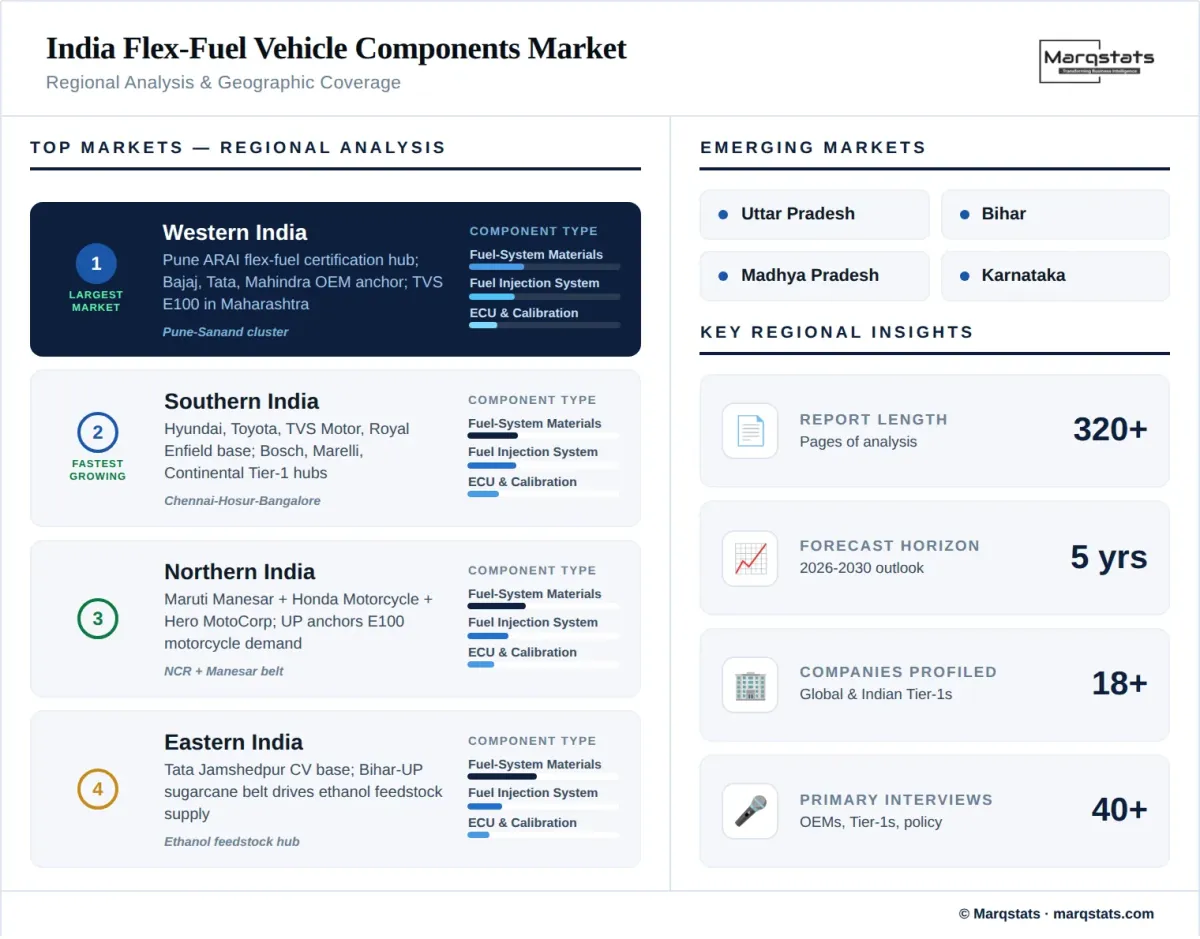
Western India accounts for approximately 36% of India flex-fuel component demand in 2025. Maharashtra (Pune, Mumbai, Nashik, Aurangabad, Chakan), Gujarat (Sanand, Halol, Ahmedabad), and Goa anchor the cluster. Mahindra and Mahindra (Pune, Chakan, Nashik), Tata Motors (Pune), Bajaj Auto (Pune, Chakan), Maruti Suzuki Hansalpur (Gujarat), and Volkswagen-Skoda (Pune) drive OEM-side demand. ARAI Pune anchors flex-fuel testing and certification capability. TVS Apache RTR 200 Fi E100 is available in Maharashtra, supporting regional ethanol fuel demonstration.
Southern India
Southern India accounts for approximately 32% of demand in 2025. Tamil Nadu (Chennai, Hosur, Tiruvallur), Karnataka (Bangalore, Mysore, Kolar), Andhra Pradesh, Telangana, and Kerala anchor the cluster. Hyundai Motor India (Sriperumbudur), Renault Nissan (Chennai), Toyota Kirloskar (Bidadi), TVS Motor (Hosur), Royal Enfield (Chennai), Bosch (Bangalore), Continental (Bangalore), and Marelli (Chennai) drive both OEM and supplier capability. The TVS Apache RTR 200 Fi E100 is also available in Karnataka, supporting regional ethanol motorcycle demand.
Northern India
Northern India accounts for approximately 24% of demand in 2025. Haryana (Manesar, Gurgaon, Faridabad), Uttar Pradesh (Greater Noida, Lucknow, Kanpur, Pithampur adjacent), Uttarakhand (Pantnagar), Rajasthan, Punjab, and Delhi-NCR anchor the cluster. Maruti Suzuki Manesar, Honda Cars India (Greater Noida historical), Honda Motorcycle and Scooter (Manesar), Hero MotoCorp (Manesar, Gurgaon, Haridwar), and Suzuki Motorcycle (Gurgaon) drive demand. The TVS Apache RTR 200 Fi E100 is available in Uttar Pradesh, anchoring early ethanol motorcycle commercialization.
Eastern India and Other Regions
Eastern India and other regions account for approximately 8% of demand in 2025. West Bengal, Odisha, Jharkhand, Bihar, and Northeast states anchor smaller manufacturing clusters. Tata Motors Jamshedpur drives heavy commercial vehicle demand, while regional ethanol production from sugar-belt states including Bihar and Uttar Pradesh creates structural fuel-feedstock support. The cluster is positioned as a long-term growth region as ethanol blending and flex-fuel adoption expands beyond the current metro and tier-1 city focus.
How Competition Is Evolving
The competitive environment in the India flex-fuel vehicle components market is concentrated at the global Tier-1 supplier level and fragmenting at the Indian Tier-1 and Tier-2 level. The top six global suppliers — Bosch, Marelli, Denso, Continental, Delphi, and BorgWarner — anchor approximately 68% of the high-value flex-fuel component segments including injection systems, fuel rails, ECUs, and ethanol sensors in 2025. Indian fuel-system suppliers and rubber-component specialists hold approximately 22% share concentrated in hoses, seals, gaskets, fuel tanks, and fuel lines. The remaining share is split across testing service providers, calibration specialists, and emerging Indian Tier-1 component integrators.
Bosch flex-fuel injection systems support gasoline, gasoline-ethanol mixtures, and pure ethanol operation, with heated fuel rail technology eliminating the need for an auxiliary gasoline tank. Marelli launched new PFI ECUs for gasoline, flex-fuel, and CNG applications targeted at India, Brazil, and EMEA markets, supporting wide-range oxygen sensors and OBD diagnostics. Denso, Continental, and Visteon maintain global flex-fuel capabilities applicable to India localization. Delphi (now part of BorgWarner Powertrain Forward) and traditional fuel-injection suppliers serve OEM-tier programs across Maruti Suzuki, Hyundai, Tata, and Mahindra.
OEM-side competition is reshaping rapidly through 2025-2026. Honda Motorcycle & Scooter India launched the CB300F Flex-Fuel in October 2024 as India’s first 300cc flex-fuel motorcycle. Hero MotoCorp showcased the Hero HF Deluxe flex-fuel motorcycle at Bharat Mobility Global Expo 2025. TVS Apache RTR 200 Fi E100 anchors early commercial ethanol motorcycle volumes. Maruti Suzuki under Suzuki Motor Corporation’s By Your Side mid-term plan (March 2026) explicitly added flex-fuel to its multi-powertrain strategy alongside BEV, hybrids, and CNG/CBG. Toyota Kirloskar Motor positions hybrid-flex as the optimal mass-market four-wheeler pathway, while Hyundai, Tata, and Mahindra have demonstrated flex-fuel passenger vehicle prototypes.
Companies Covered
The report profiles 18 company profiles+ companies with full strategy and financials analysis, including:
Recent Market Activity
Table of Contents
Coverage & Segmentation
The India Flex-Fuel Vehicle Components Market report analyzes the component opportunity linked to vehicles capable of operating on ethanol-blended petrol across passenger vehicles, two-wheelers, three-wheelers, light commercial vehicles, and heavy commercial vehicles for the period 2021 to 2030. The report covers historical data for 2021-2025, with 2025 as the base year, and forecasts spanning 2026-2030. Market sizing is conducted in USD millions and Indian rupee crore. The study examines fuel delivery components, ethanol sensing and control systems, engine hardware modifications, fuel containment materials, cold-start systems, exhaust calibration, and testing/validation services across E20, E25/E30, E85, and E100 fuel-grade compatibility levels.
The scope evaluates regulatory frameworks including the National Policy on Biofuels, the NITI Aayog Roadmap for Ethanol Blending in India 2020-25, mass emission standards under G.S.R. 682(E) of July 2016, BS6 emission compliance pathways, the PLI Auto scheme covering BS6 flex-fuel engine up to E85, heated fuel rail, heating element, heating control unit, ECU for flex-fuel engine, and ethanol sensor as eligible Advanced Automotive Technology components, and the upcoming CAFE 3 framework from April 2027. The scope excludes fuel production economics, ethanol distillery infrastructure, and fuel distribution infrastructure beyond their direct impact on component demand. Competitive profiling covers 18 component supplier groups operating across global Tier-1 and Indian Tier-1 capability tiers.