Market Snapshot
Key Takeaways
Market Overview & Analysis
Report Summary
The India electric vehicle components market addresses the production and supply of parts specific to, or meaningfully modified for, electric vehicle applications, distinguishing it from the broader ICE auto-component industry. Coverage spans seven primary value pools — traction motors and controllers, battery packs and BMS, power electronics (traction inverters, DC-DC converters, on-board chargers, power distribution units), thermal management systems (battery cooling, motor cooling, cabin HVAC), EV wiring harnesses and high-voltage connectors, integrated electric drive units (e-axles), and regenerative braking and brake-by-wire systems — each with distinct supply chains, technology stacks, and localisation trajectories.
Demand drivers are well established across vehicle categories. Electric two-wheeler retail sales crossed 1.40 million units in FY 2025-26, representing 6.54% of the overall two-wheeler market. Electric three-wheelers remain the volume backbone of India's EV sales. The electric passenger vehicle segment nearly doubled to 1,99,923 units in FY 2025-26, up 83.63% year-on-year, with new entries including Maruti Suzuki e Vitara, the expanded Tata Punch.ev range, Mahindra XUV 3XO EV, and JSW MG Windsor Pro. Two-wheelers and three-wheelers accounted for over 93% of India's approximately 2 million EVs sold in 2024. Domestic EV demand for lithium-ion cells is projected at 11–13 GWh in FY 2025 and 60–65 GWh by FY 2030.
The competitive landscape spans four tiers. Large Indian conglomerates are building vertically integrated EV component platforms — Tata AutoComp Systems, Sona BLW Precision Forgings (Sona Comstar), Uno Minda, Samvardhana Motherson International, Bharat Forge, and Endurance Technologies lead this cohort. Global Tier-1 suppliers are scaling India manufacturing: Bosch, Continental, ZF Group, Valeo, BorgWarner, Dana, Denso, Hitachi Astemo, Mahle, and Schaeffler are all investing in India-specific EV capacity. Pure-play EV component startups — Log9 Materials, Electrodrive Powertrain Solutions, Raptee Energy, Grinntech, and Sterling E-Mobility — occupy the technology-forward edge. Semiconductor and software enablers including KPIT Technologies, Tata Elxsi, Tata Technologies, Infineon India, and STMicroelectronics India complete the ecosystem.
Market Dynamics
Key Drivers
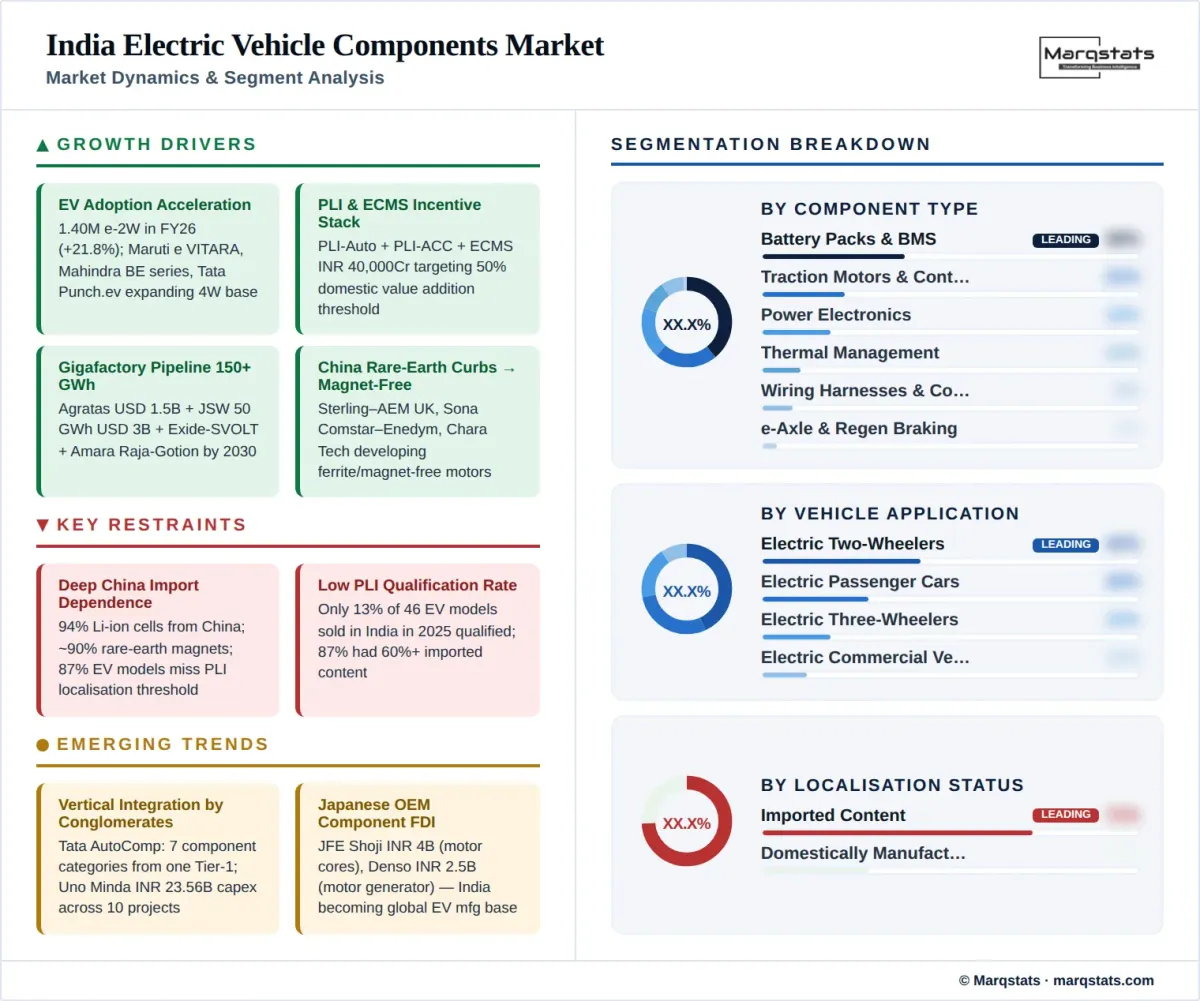
- Accelerating EV adoption across all vehicle segments — electric two-wheeler volumes grew 21.8% year-on-year to 1.40 million units in FY 2025-26, electric passenger vehicles grew 83.63%, creating component value pools of USD 800–1,200 per electric two-wheeler and USD 8,000–15,000 per electric passenger car.
- PLI and ECMS schemes creating financial incentives for localisation — the ECMS INR 40,000 crore outlay targets domestic semiconductor, PCB, and electronic component manufacture, with seven projects worth INR 55.32 billion approved in October 2025 covering multi-layer PCBs, HDI boards, camera modules, and polypropylene capacitor films.
- Gigafactory investments building domestic cell supply — over 150 GWh of lithium-ion battery manufacturing capacity in India is committed by 2030, with Agratas at USD 1.5 billion, JSW at USD 3 billion (50 GWh Odisha), Exide-SVOLT, and Amara Raja-Gotion all active.
- Rare-earth export restrictions accelerating magnet-free motor development — Sterling E-Mobility Solutions partnered with Advanced Electric Machines (UK), Sona Comstar is developing domestic magnet production and reduced-rare-earth motors, Chara Technologies and Conifer are commercialising ferrite-magnet and switched-reluctance architectures.
- Declining lithium-ion battery pack prices in India fell approximately 20% year-on-year in 2024 to around USD 115/kWh at the cell level, improving EV affordability and expanding the addressable EV components market.
Key Restraints
- Deep import dependence across the component stack — 94% of India's lithium-ion cells come from China, roughly 90% of rare-earth magnet production is controlled by China, and 88% of integrated circuit imports originate from China. Batteries, motors, and power electronics together account for 50–60% of an EV's cost.
- Low PLI qualification rates — only 13% of EV models sold in India in 2025 met the 50% domestic value addition threshold (40% excluding cells), indicating that actual component localisation is trailing sales growth.
- Technology complexity and offtake risk in cell manufacturing — independent credit assessments have flagged high-risk profiles for greenfield cell plants, with technology partnerships with Chinese firms de-risking execution but perpetuating technology dependence.
- Semiconductor and PCB import dependence — India's electronics sector still imports 70–80% of electronic components, limiting EV power electronics localisation to 20–30% until domestic fabs and PCB capacity scale under ECMS and India Semiconductor Mission 2.0.
- Skilled workforce shortage — EV-specific skills in high-voltage engineering, battery chemistry, thermal modelling, and power electronics design remain scarce, slowing in-house R&D and forcing reliance on foreign technology partners.
Key Trends
- Vertical integration by Indian conglomerates — Tata AutoComp produces battery packs, BMS, thermal management, e-compressors, integrated motors, controllers and reducers, on-board and off-board chargers, DC-DC converters, bus bars, and power distribution units; Uno Minda's JV with Inovance Automotive targets high-voltage EV powertrain; Sona Comstar offers motors, e-axles, and controllers.
- Japanese investment accelerating motor and component localisation — JFE Shoji INR 4 billion motor core plant (Karnataka), Denso INR 2.5 billion motor generator plant (UP), NTN constant velocity joints with 85% local procurement, Nidec-Ashok Leyland e-drive motor partnership for commercial vehicles.
- Rare earth corridors and critical minerals policy — Union Budget 2026-27 established rare earth corridors in Odisha, Kerala, Andhra Pradesh, and Tamil Nadu for mining, processing, and magnet manufacture; Rare Earth Permanent Magnet Scheme expanded alongside critical mineral customs duty exemptions.
- Software-defined EV components and connected integration — BMS with AI-driven analytics and cloud connectivity (Tata Technologies WATTSync), AUTOSAR-compliant electronic control unit platforms, and integrated cockpit domain controllers (Minda Corporation) are redefining the EV component boundary.
- Shift to 800V high-voltage architecture and SiC power semiconductors — Tata AutoComp is developing 300–850V high-voltage EV components for global markets; SiC MOSFET inverters are replacing IGBT in premium electric passenger car platforms, supporting faster DC charging and higher efficiency.
Market Segmentation
Traction motors are the kinematic core of every electric vehicle. The Indian market supports four motor architectures: Permanent Magnet Synchronous Motors (PMSM) — dominant in electric passenger cars and premium two-wheelers for power density and efficiency; Brushless DC Motors (BLDC) — dominant in electric two-wheelers and three-wheelers for cost-effectiveness and simplicity; Induction Motors for select four-wheelers; and Switched Reluctance Motors — an emerging magnet-free architecture gaining traction after China's rare-earth export disruptions. Power ratings span from sub-3 kW for low-speed two-wheelers to above 100 kW for buses and trucks. Sona BLW Precision Forgings is one of India's largest EV traction motor manufacturers, having produced over 180,000 indigenous motors from its Chennai plant. Tata AutoComp's Prestolite Electric JV crossed a 100,000-unit integrated e-drivetrain milestone in November 2024. Motor localisation is highest for two-wheeler and three-wheeler motors (40–60%), below 20% for passenger cars, and near zero for buses and trucks.
Battery packs and BMS represent the highest-value EV component, accounting for 35–45% of an electric two-wheeler's cost and 30–40% of an electric passenger car's cost. Pack assembly in India is led by Tata AutoComp, Exide Energy Solutions, Amara Raja Energy & Mobility, Log9 Materials, Grinntech, and Montra Electric, but virtually all lithium-ion cells are still imported. Cell chemistries include Lithium Iron Phosphate (LFP), dominant across Indian EVs for safety and cost; Nickel Manganese Cobalt (NMC) for higher energy density in premium four-wheelers; Lithium Titanate (LTO) for niche fast-charge applications; and Sodium-Ion emerging through the ARCI-Voltasun MoU for NVP-based pouch cells (December 2025). Pack capacities range from 1.5–5 kWh for two-wheelers, 2–5 kWh for three-wheelers, 30–53 kWh for passenger cars, and above 200 kWh for electric buses. BMS architectures span centralised (2W/3W), distributed (4W/bus), and cloud-connected AI-enabled platforms (Tata Technologies WATTSync).
Power electronics cover traction inverters, DC-DC converters, on-board chargers (OBC), and power distribution units. The traction inverter converts DC battery power to AC for motor drive; IGBT-based platforms dominate today with SiC MOSFET platforms emerging for 400V and 800V architectures. DC-DC converters step down high-voltage traction power to 12V and 48V for auxiliary systems. On-board charger manufacturers in India supply 3.3 kW units for two-wheelers up to 22 kW for premium passenger cars. Varroc Engineering secured an eight-year contract for high-voltage inverters, OBC, BMS, and DC-DC converters with peak annual volumes of INR 8,000 million. Bosch commissioned the CharCon integrated on-board power supply assembly line at Naganathapura near Bengaluru in December 2025. Power electronics localisation stands at 20–30% pending ECMS and India Semiconductor Mission 2.0 scale-up.
EV thermal management covers battery cooling (air, liquid, refrigerant), motor cooling (oil, water-glycol), inverter cooling, and cabin climate control (heat pumps, PTC heaters, electric compressors). Tata AutoComp produces battery cooling plates, inverter cooling modules, chillers, and e-compressors. Subros Limited has developed integrated thermal management systems for hydrogen fuel cell buses and engineered thermal components for electric cars, trucks, and tractors. Valeo India and Mahle India supply thermal solutions for global and domestic OEM platforms. The shift to DC fast-charging and 800V architectures is making liquid-cooled thermal management mandatory for premium EVs.
Electric vehicles require fundamentally different wiring harness architectures: shielded orange-coded high-voltage harnesses rated 200–800V for the traction circuit, and modified low-voltage harnesses for auxiliary and signal systems. High-voltage connectors must meet demanding standards for current carrying capacity, insulation resistance, and electromagnetic compatibility. Samvardhana Motherson International and Uno Minda are India's dominant EV wiring harness manufacturers, both scaling EV-specific capacity. Dhoot Transmission's merger of FourFront into its automotive electronics platform targets end-to-end electronics and electrical solutions for EV programmes. The migration from 400V to 800V platforms and rising electronics content per vehicle are expanding harness value per EV.
The e-axle integrates the traction motor, inverter, and speed reducer into a single compact unit, reducing weight and simplifying vehicle architecture. Configurations span 2-in-1 (motor + reducer), 3-in-1 (motor + inverter + reducer), and emerging 4-in-1 systems with integrated thermal management. Sona Comstar offers e-axles for electric three-wheelers and is developing high-voltage integrated applications for four-wheelers through its Equipmake (UK) partnership. Dana Incorporated, ZF Group, and BorgWarner supply e-axle systems to Indian OEMs from domestic and global facilities. Uno Minda's JV with Inovance Automotive is advancing a greenfield high-voltage EV powertrain plant with Phase 1 production expected in Q2 FY27.
Regenerative braking recovers kinetic energy during deceleration, extending range by 10–20%. Brake-by-wire replaces mechanical linkages with electronic control, enabling seamless integration of regenerative and friction braking. Ola Electric holds patents for brake-by-wire deployed in its Gen 3 scooters. Bosch and Continental provide integrated braking systems combining ABS, electronic stability control, and regenerative braking for Indian EV platforms. ZF developed Air Disc Brakes specifically for electric buses and ADAS-equipped trucks, and has deployed its second-generation electric compressor (eComp 2.0) across leading EV platforms.
Electric two-wheelers lead EV component demand by volume, with 1.40 million units sold in FY 2025-26. The component stack includes a BLDC or PMSM motor (1–8 kW), lithium-ion battery pack (1.5–5 kWh LFP), motor controller, BMS, DC-DC converter, wiring harness, and thermal management. Localisation is highest here (40–60% for motors and controllers) thanks to lower technology complexity and a deep domestic supplier base including Sona Comstar, Electrodrive, and Tata AutoComp. Key OEMs are TVS Motor, Ather Energy, Bajaj Auto, Hero MotoCorp (VIDA), and Ola Electric.
Electric three-wheelers, led by e-rickshaws and e-autos, form the volume backbone of India's EV market and the most mature segment for component localisation. Component specifications parallel two-wheelers with higher payload: BLDC motors (1–3 kW), LFP battery packs (2–5 kWh), basic BMS, rugged wiring harnesses. Bajaj Auto's WEGO electric three-wheeler range, Atul Auto's L5 electric three-wheeler business, and Kinetic Engineering's push into EV components reflect segment maturity. Battery-swapping is particularly well-suited for three-wheelers, driving demand for standardised swappable battery packs.
Electric passenger cars offer the highest component value per vehicle at USD 8,000–15,000. Components include PMSM traction motors (50–150 kW), large-format battery packs (30–53 kWh LFP or NMC), multi-cell cloud-connected BMS, SiC-based traction inverters for 400V/800V platforms, on-board chargers (6.6–22 kW), liquid-cooled thermal management, high-voltage wiring harnesses, and integrated e-axles. Localisation is lowest here (<20% for motors, near-zero for SiC inverters). Tata AutoComp is developing 300–850V high-voltage components for global markets; Bosch's Naganathapura CharCon line supports localised power electronics for passenger EV programmes.
Electric commercial vehicles demand the most rigorous component specifications: high-power traction motors (100–300+ kW), large battery packs (200–400+ kWh), heavy-duty liquid-cooled thermal management, industrial-grade BMS, and ruggedised power electronics. The CESL tender for 10,900 electric buses across five cities and the PM E-Drive INR 150 billion allocation for e-buses and e-trucks are catalysing commercial EV component demand. Ashok Leyland partnered with Nidec for next-generation e-drive motors. Montra Electric's Manesar plant has 1.7 GWh of in-house battery pack assembly capacity. PMI Electro Mobility is investing INR 12 billion in Rajasthan for electric bus and component manufacturing. Localisation is lowest here — 0–10% for motors and controllers — representing the largest single opportunity.
BEVs account for approximately 88% of EV component demand value in India, covering pure-electric two-wheelers, three-wheelers, passenger cars, buses, and trucks. The BEV component stack is the most comprehensive — full traction drive, large-format battery pack, full BMS, bi-directional power electronics, thermal systems, and high-voltage harnessing. Almost all India EV component manufacturing capacity is oriented toward BEV platforms.
PHEV adoption in India remains limited, with the category contributing under 2% of EV component demand. Component requirements include smaller traction motors (40–90 kW), mid-sized battery packs (8–20 kWh), on-board chargers, and power electronics alongside conventional ICE components. PHEV component opportunities are expected to expand modestly as select premium OEMs introduce PHEV variants for the INR 25–50 lakh band.
Mild-hybrid (12V/48V) and strong-hybrid components contribute roughly 10% of EV component value in India. Strong hybrids led by Toyota (Innova HyCross, Urban Cruiser Hyryder) and Maruti Suzuki (Grand Vitara, Ertiga) drive demand for smaller electric motors (10–40 kW), compact battery packs (0.8–1.6 kWh NiMH or Li-ion), inverters, and power-split devices. Mild-hybrid systems are becoming near-universal on petrol powertrains ahead of CAFE III fuel-efficiency norms effective April 2027.
OEM supply channels account for roughly 88% of India EV component demand, routed through direct Tier-1 relationships with vehicle manufacturers. Standard commercial frameworks include multi-year programme contracts (5–8 years), price-volume linked agreements, and joint development programmes. Tata AutoComp, Sona Comstar, Uno Minda, Samvardhana Motherson, Bosch, Varroc, and Endurance dominate OEM Tier-1 supply across the EV component stack.
The EV aftermarket in India accounts for approximately 12% of component value today but is projected to grow at above 35% CAGR through 2030 as the installed EV parc expands and early two-wheelers and three-wheelers enter battery-replacement and motor-overhaul cycles. EV spare parts demand is concentrated in replacement battery packs, motor bearings and rotors, controllers, DC-DC converters, wiring harnesses, and brake components. Online EV spare parts platforms (Zelio, MotovoltX) and OEM-authorised service networks (TVS Saathi, Ather Service Centres, Ola Service Network) are formalising what was previously an unorganised channel.
By Geography
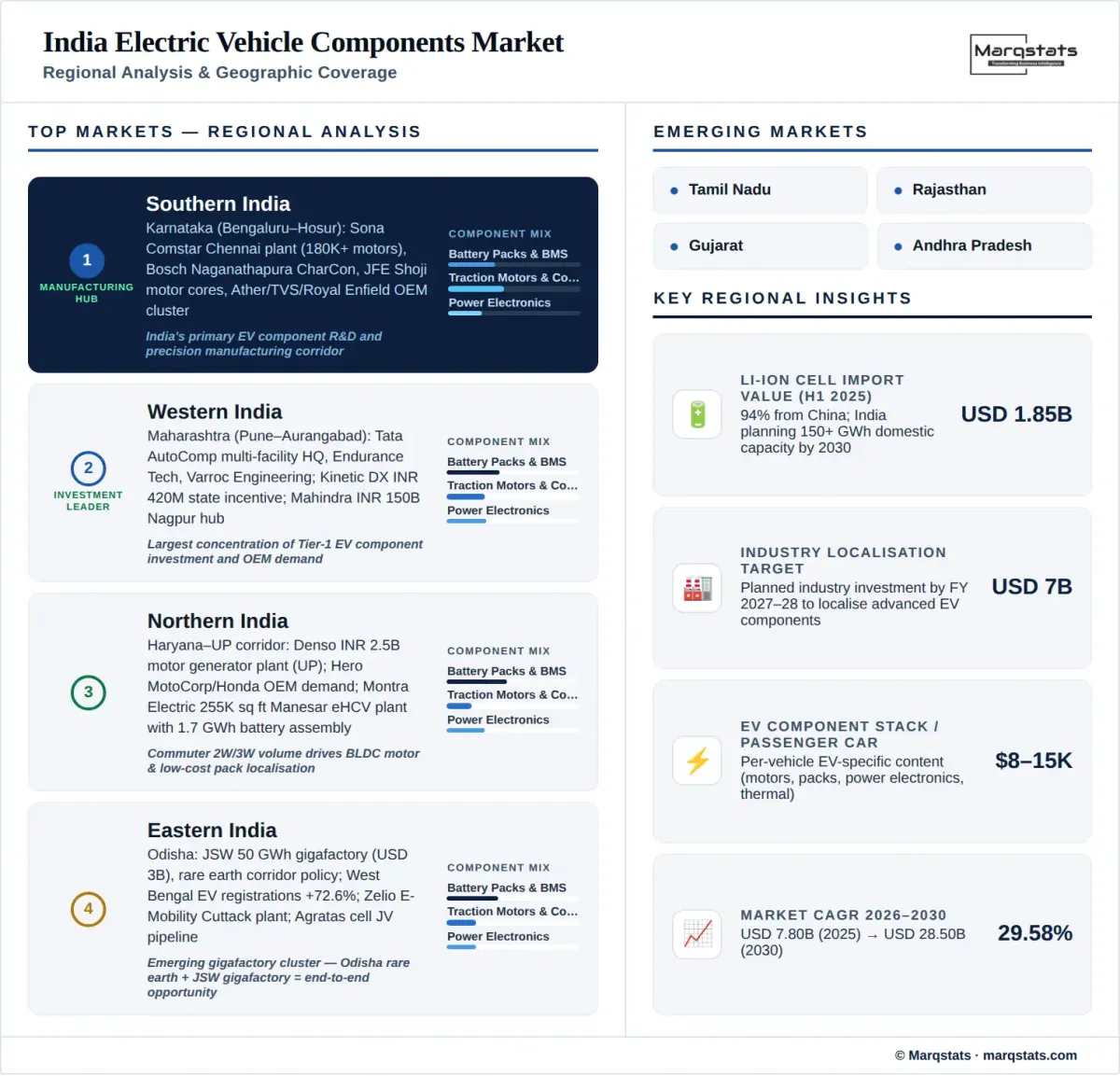
Southern India
Southern India is the largest EV component manufacturing cluster, contributing approximately 38% of India EV component production value. The Chennai–Hosur–Bengaluru automotive corridor anchors the region. Chennai hosts Sona BLW Precision Forgings (180,000+ traction motors produced at its Chennai plant), ZF Group's Oragadam facility (Electric Park Brake production line with 800,000-unit annual peak capacity), Hyundai's manufacturing base and its EV supplier ecosystem, and Ashok Leyland's commercial EV programmes. Bengaluru is the power electronics and software hub — Bosch commissioned its CharCon assembly line at Naganathapura in December 2025, while KPIT Technologies, Tata Elxsi, and Continental run major India R&D centres. Karnataka also hosts the JFE Shoji INR 4 billion motor core plant for BEVs and Ola Electric's Krishnagiri factory (on the Tamil Nadu border). Tamil Nadu's EV Policy incentives and Karnataka's EV ecosystem supports position the south as India's EV tech and manufacturing leader.
Western India
Western India accounts for roughly 31% of India EV component manufacturing. The Pune–Chakan–Aurangabad corridor in Maharashtra hosts a deep Tier-1 supplier base including Tata AutoComp's multiple plants (Pune, Chakan), Bharat Forge, Endurance Technologies, Varroc Engineering, Uno Minda, and Kinetic Engineering. Mahindra Group unveiled a INR 150 billion Nagpur mega-manufacturing hub plan for 500,000+ vehicles annually spanning ICE, electric, and future powertrains. Gujarat hosts Tata Motors' Sanand EV cluster, the India unit of Exide-SVOLT, and attractive state EV policies. JSW Group is building a 50 GWh battery plant in Odisha's Jajpur district — a critical cell-supply anchor for western India OEMs. Maharashtra's draft EV Policy 2025-30 commits INR 1,993 crore to manufacturing and infrastructure incentives. Kinetic Watts & Volts received a INR 420 million Maharashtra EV Policy incentive for its 99%-localised Kinetic DX EV expansion.
Northern India
Northern India contributes approximately 21% of India EV component manufacturing value, anchored by the Manesar–Gurugram–Faridabad NCR automotive cluster. Manesar hosts Bosch Chassis Systems India (now part of Bosch Limited after the April 2026 INR 90.69 billion acquisition), Endurance Technologies, and Montra Electric's 255,000 sq ft eHCV facility with 1.7 GWh in-house battery pack assembly. Uttar Pradesh hosts Denso's INR 2.5 billion motor generator plant for hybrid and electric vehicles and Mahindra's Haridwar component clusters (Uttarakhand border). Rajasthan is emerging as an EV bus hub with PMI Electro Mobility's INR 12 billion investment for 33,000-unit annual capacity. Haryana and Delhi NCR's dense dealer and aftermarket network supports EV component aftermarket distribution across north India.
Eastern India
Eastern India accounts for approximately 7% of India EV component manufacturing today but is the fastest-growing region, anchored by Odisha's emergence as India's battery hub. JSW Group's 50 GWh battery plant in Jajpur, Odisha is the single largest battery manufacturing investment announced in India at USD 3 billion. The Union Budget 2026-27 established a rare earth corridor in Odisha for mining and processing, while Kolkata hosts Exide Industries' long-established presence and Tata Motors' Jamshedpur commercial vehicle complex (Jharkhand). The 4,000 e-buses allocated for eastern states under the 2026 Union Budget are catalysing commercial EV component demand across West Bengal, Odisha, and the North-Eastern states.
Central India
Central India contributes approximately 3% of India EV component manufacturing but is scaling with Mahindra's planned INR 150 billion Nagpur mega-hub. Madhya Pradesh and Chhattisgarh are expanding EV infrastructure through state-level charging network build-outs, while Vidarbha region's proximity to the Pune–Mumbai manufacturing belt positions it for Tier-2 supplier expansion. Central India's role is expected to grow materially as commercial vehicle electrification and rare-earth processing capacity come online through 2028.
How Competition Is Evolving
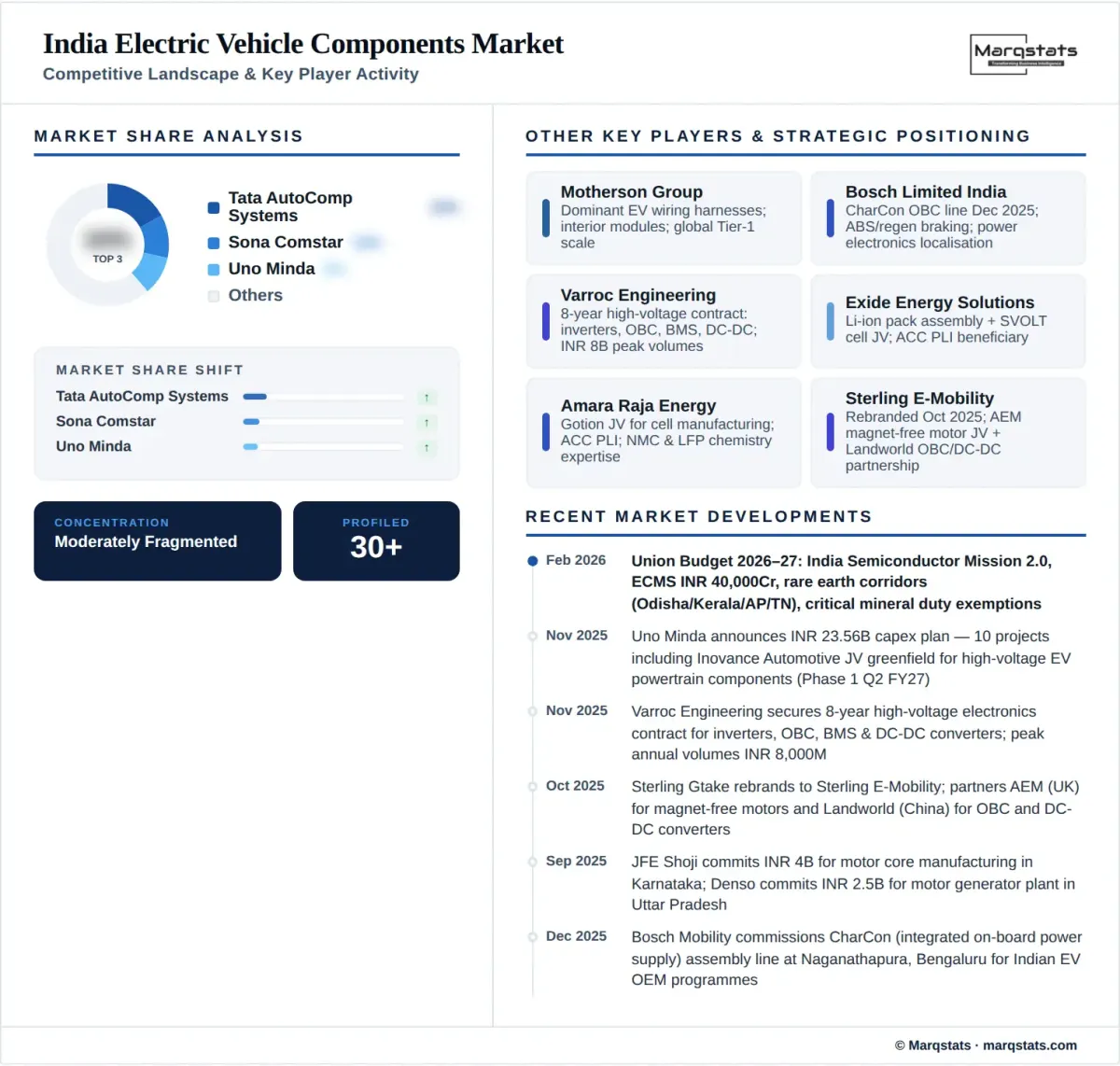
The India EV components market is shaped by rapid vertical integration among Indian conglomerates building end-to-end EV component platforms to reduce Chinese import dependence. Tata AutoComp Systems stands as India's most comprehensive EV Tier-1 supplier, manufacturing battery packs, BMS, thermal management systems, electric compressors, integrated motors with controllers and reducers, on-board and off-board chargers, DC-DC converters, bus bars, and power distribution units from 18 business units including nine joint ventures with global manufacturers. Tata AutoComp is a major PLI beneficiary with over INR 2,500 crore in planned investment, roughly 50% directed toward EV components.
Sona BLW Precision Forgings is one of India's largest EV traction motor manufacturers with 180,000+ indigenous motors produced at its Chennai plant. Sona Comstar offers BLDC motors, PMSM motors, motor controllers, and e-axles, with partnerships with Equipmake (UK) for patented powertrain technology and Enedym for magnet-free motors positioning it for the next phase of localisation. Uno Minda is executing a INR 23.56 billion capex plan across ten expansion projects, including a joint venture with Inovance Automotive for high-voltage EV powertrain components alongside leadership in wiring harnesses, sensors, and controllers. Samvardhana Motherson International leads EV-specific wiring harness capability, while Bharat Forge and Endurance Technologies are scaling forged and precision machined EV components.
Global Tier-1 suppliers are deepening India manufacturing presence. Bosch commissioned the CharCon assembly line in Bengaluru for localised EV power electronics. ZF Group secured ADAS and braking-system nominations from Indian electric commercial vehicle OEMs and developed Air Disc Brakes for electric buses. Varroc Engineering secured an eight-year high-voltage contract for inverters, OBC, BMS, and DC-DC converters. JFE Shoji (Japan) is investing INR 4 billion for motor core manufacturing in Karnataka, Denso is setting up a INR 2.5 billion motor generator facility in UP, and Nidec partnered with Ashok Leyland for commercial vehicle e-drive motors. Continental, Valeo, Dana, BorgWarner, Hitachi Astemo, Mahle, and Schaeffler each run India facilities with growing EV-specific capacity. The pure-play EV startup tier — Log9 Materials, Grinntech, Electrodrive Powertrain Solutions, Raptee Energy, Sterling E-Mobility Solutions, and Chara Technologies — occupies the technology-forward edge, particularly in battery packs, magnet-free motors, and fast-charging systems.
Companies Covered
The report profiles 30+ companies with full strategy and financials analysis, including:
Recent Market Activity
Table of Contents
Coverage & Segmentation
This report provides a comprehensive analysis of the India electric vehicle components market covering the historical period 2021–2025 and forecast period 2026–2030, with 2025 as the base year. The study examines market size in value (USD billion) with segmentation by component type (traction motors and controllers, battery packs and BMS, power electronics, thermal management, wiring harnesses, e-axles, regenerative braking), by vehicle type (two-wheelers, three-wheelers, passenger cars, commercial vehicles), by propulsion type (BEV, PHEV, HEV), and by sales channel (OEM supply, aftermarket). A dedicated localisation analysis quantifies import dependence by component category and vehicle segment, and a regional analysis maps Southern, Western, Northern, Eastern, and Central India manufacturing clusters.
Primary research included structured interviews with more than 40 industry stakeholders spanning EV component manufacturers, OEM procurement and engineering leaders, lithium-ion battery cell and pack suppliers, semiconductor companies, industry associations (ACMA, SIAM, India Energy Storage Alliance), and government policy analysts from the Ministry of Heavy Industries, the Ministry of Electronics and Information Technology, and NITI Aayog. Secondary research drew from ACMA industry data, SIAM production statistics, ICRA research reports, company annual reports and investor presentations, PLI-Auto and PLI-ACC scheme disclosures, ECMS notifications, Union Budget 2026-27 announcements, patent databases, and proprietary Marqstats Intelligence datasets.