Market Snapshot
Key Takeaways
Market Overview & Analysis
Report Summary
The Egypt automotive tire components market covers core reinforcement material demand associated with automotive tire production in Egypt, focused on steel cord and bead wire as the most quantifiable upstream categories. Rubber compounds, carbon black, chemicals and textile reinforcement are covered qualitatively and are deliberately excluded from the tonnage denominator, because their content varies far more widely by compound recipe than steel does and including them would produce a figure that could not be verified against any physical constant.
This market is derived rather than observed, and the distinction shapes every figure that follows. There is no Egyptian reinforcement production to measure in the base year and no separate trade line that isolates tire-grade steel cord from other steel wire, so demand is modelled from tire output multiplied by reinforcement content per tire. The method's reliability rests entirely on the content assumption, which is why the assumption here is anchored on a physical constant rather than on a blended industry average.
The constant is that tires are 14 to 15% steel by weight across both passenger and truck types. What differs is total tire weight: a passenger car radial weighs approximately 11.3 kilograms and therefore carries about 1.6 kilograms of steel cord and bead wire, while a truck and bus radial weighs around 54.4 kilograms and carries close to 7.9. Applying that to Egypt's 2025 output of 1.10 million heavy-duty and engineering tires produces 12,000 tonnes, which matches the base-year figure exactly and validates the method before it is projected forward.
Tire Reinforcement Demand in Egypt
Reinforcement demand rises from USD 24.00 million in 2025 to USD 71.06 million in 2030, a 24.25% compound annual growth rate and an absolute increase of USD 47.06 million. Underlying tonnage rises from 12,000 tonnes to 37,400 tonnes, a 25.53% compound rate and an increase of 25,400 tonnes. The 2026 estimate of 13,100 tonnes reflects tire output still running close to its 2025 level, since Egypt's major new tire lines remain in construction or approval through that year.
The forecast departs materially from a straight-line reinforcement assumption and the arithmetic is worth stating in full. Egypt's 2030 tire output of 6.54 million tires comprises approximately 2.60 million heavy-duty and engineering tires from the incumbent producer at roughly 10.9 kilograms of reinforcement each, and around 3.94 million tires from greenfield capacity that is close to 89% passenger car radial by disclosed phase design. Passenger radials carry about 1.6 kilograms. The blended result is 37,400 tonnes, equivalent to roughly 5.7 kilograms per tire, down from 10.9 in the base year.
A forecast that holds reinforcement content flat as tire volume grows produces a figure two to three times higher, and the direction of the error is always the same. Egyptian tire output grows 5.9 times between 2025 and 2030 while reinforcement demand grows only 3.1 times, because the incremental tires are the lightest and least steel-intensive type made. Any bottom-up supplier model that multiplies total tire count by a truck-derived content figure will overstate addressable tonnage, and the overstatement compounds as the passenger car share rises.
The departure from the underlying research pack is the largest in the Egypt cluster and is stated rather than absorbed. The pack carries 12,000 tonnes for 2025, 15,000 for 2026 and 120,000 for 2031, derived by applying a blended reinforcement content assumption to forecast tire output. The 2025 figure is sound and is carried forward unchanged. The 2031 figure implies approximately 12.0 kilograms of reinforcement per tire against 9.99 million tires, which is marginally higher than the 10.9 kilograms implied by the 2025 base even though the intervening output mix shifts from entirely heavy-duty product to close to 89% passenger car radial. Reinforcement content per tire cannot rise while the mix moves toward the lightest tire type made, and the corrected series carries 37,400 tonnes for 2030 and approximately 45,300 for 2031.
Market Dynamics
Key Drivers
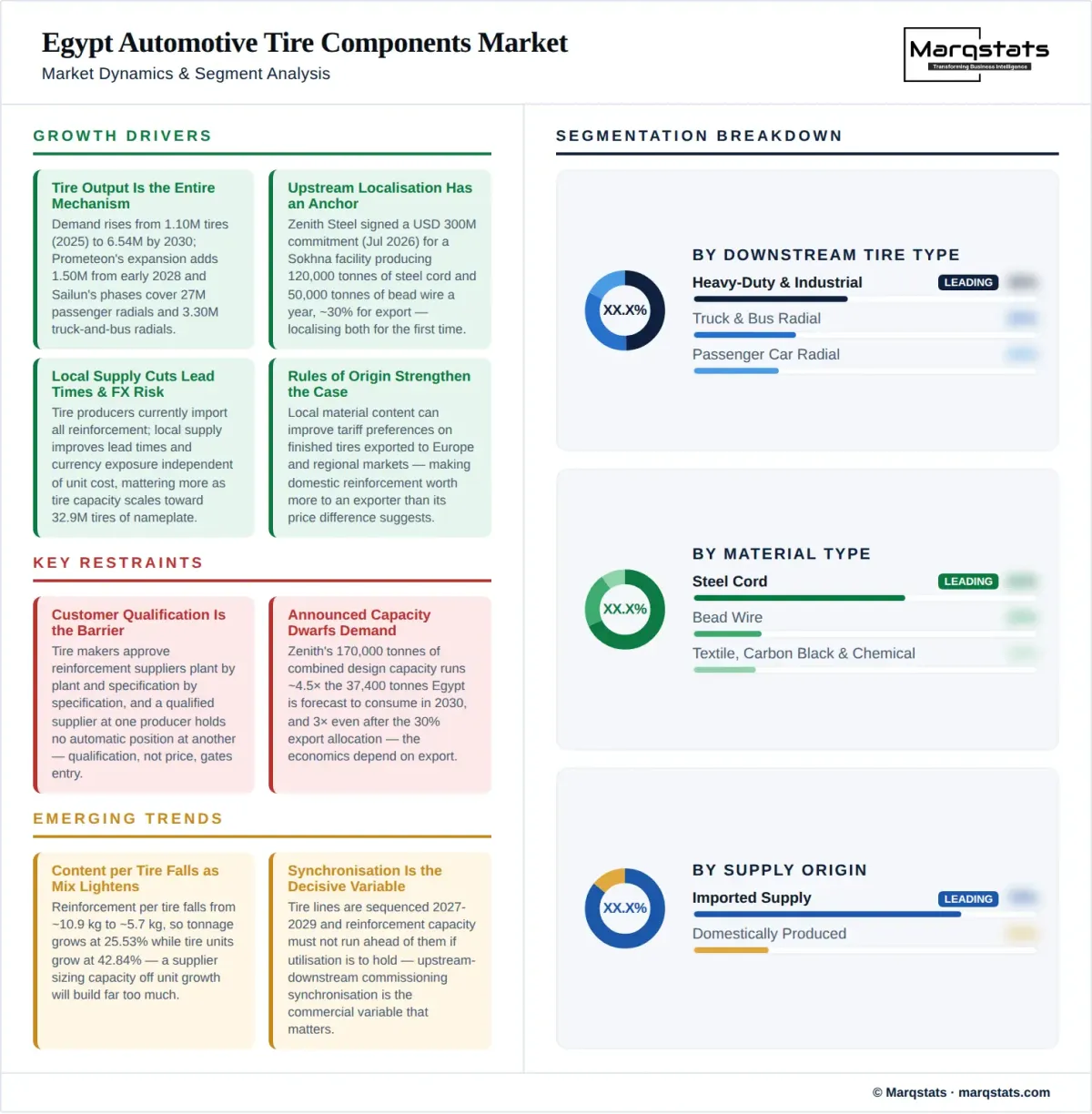
- Tire output is the entire demand mechanism, rising from 1.10 million tires in 2025 to 6.54 million by 2030, with Prometeon's expansion adding 1.50 million tires from early 2028 and Sailun's disclosed phases covering 27 million passenger car radials and 3.30 million truck and bus radials.
- Upstream localisation is arriving with a named anchor project, as Zenith Steel Group signed a USD 300 million commitment in July 2026 for a Sokhna facility producing 120,000 tonnes of steel cord and 50,000 tonnes of bead wire annually with roughly 30% of output targeted for export.
- Local supply improves lead times and currency exposure for tire producers who currently import all reinforcement, which is a strategic argument for localisation independent of unit cost and matters more as tire capacity scales toward 32.9 million tires of announced nameplate.
- Rules of origin strengthen the case beyond cost, since local material content can improve tariff preferences on finished tires exported to Europe and regional markets, making domestic reinforcement worth more to an exporter than its price difference suggests.
- Downstream project scale creates pull well beyond current demand, with Sailun estimating its first phase alone could stimulate more than USD 500 million of supporting upstream and downstream activity and ZC Rubber proposing a USD 500 million integrated complex across roughly 600,000 square metres.
Key Restraints
- Customer qualification is the central entry barrier, since tire makers approve reinforcement suppliers plant by plant and specification by specification, and a qualified supplier at one producer holds no automatic position at another.
- Announced upstream capacity exceeds domestic demand by a wide margin, with Zenith's 170,000 tonnes of combined design capacity running roughly 4.5 times the 37,400 tonnes Egypt is forecast to consume in 2030 and more than three times even after the stated 30% export allocation.
- Demand is entirely derivative, so every commissioning delay, utilisation shortfall or unapproved phase in Egypt's tire build-out transmits directly into this market with no independent demand base to cushion it.
- Reinforcement content per tire falls from roughly 10.9 kilograms to about 5.7 across the forecast period, so tonnage grows at 25.53% while tire units grow at 42.84%, and a supplier sizing capacity off unit growth will build too much.
Key Trends
- Synchronisation between upstream and downstream commissioning is becoming the decisive commercial variable, with tire lines sequenced through 2027 to 2029 and reinforcement capacity that must not run ahead of them if utilisation is to hold.
- Steel cord and bead wire are localising together rather than separately, since Zenith's single project covers both at 120,000 and 50,000 tonnes respectively, which removes the usual pattern of one material localising years ahead of the other.
- Textile reinforcement, carbon black and chemical inputs remain entirely imported with no announced Egyptian capacity, leaving a localisation gap that grows in absolute terms as tire output rises toward 6.54 million tires.
- Egypt's own steel industry is a potential Tier-2 route into this market, since tire cord requires high-carbon steel at nominal tensile strength around 2,750 meganewtons per square metre, a specification adjacent to but distinct from construction-grade output.
Market Segmentation
The larger reinforcement category by tonnage and the one Zenith's project sizes at 120,000 tonnes a year, against total Egyptian reinforcement demand of 37,400 tonnes in 2030. Steel cord forms the belt package under the tread and its content scales directly with tire size, which is why a truck and bus radial carries close to five times the steel of a passenger radial at the same 14 to 15% weight fraction.
The smaller category at 50,000 tonnes of Zenith's design capacity, and the more qualification-sensitive of the two because bead failure is a safety event rather than a performance one. Bead wire content varies less with tire size than steel cord does, so its share of the 37,400-tonne 2030 total rises as the mix shifts toward lighter passenger radials.
Covered qualitatively and deliberately excluded from the tonnage denominator, because polyester, nylon and rayon content varies with construction in ways that cannot be pinned to the 14 to 15% steel constant the rest of this measure rests on. No Egyptian textile reinforcement capacity has been announced against tire output heading toward 6.54 million tires by 2030.
The largest tire input category by weight after rubber itself and entirely absent from Egyptian production, also excluded from the tonnage denominator for the same verification reason. ZC Rubber's proposed USD 500 million integrated complex would materially enlarge demand for these inputs alongside reinforcement, and they represent the clearest remaining upstream gap in the cluster.
The whole of 2025 demand and still the largest single contributor in 2030 at roughly 28,300 tonnes from the incumbent's 2.60 million tires. At approximately 10.9 kilograms of reinforcement per tire this segment carries more steel per unit than any other, which is why 2.60 million tires generate more tonnage than 3.94 million tires of greenfield output.
The middle tier at close to 7.9 kilograms of reinforcement per tire, drawn from a 54.4 kilogram tire at 14 to 15% steel by weight. Sailun's disclosed phases include 3.30 million truck and bus radials, and this segment is where incremental reinforcement demand is most sensitive to whether those tires are actually built for Egyptian and regional customers or deferred behind passenger car lines.
The segment driving tire volume and diluting reinforcement demand, at roughly 1.6 kilograms per tire from an 11.3 kilogram tire. Sailun's disclosed phases cover 27 million passenger car radials, and because each carries less than a sixth of the steel of a heavy-duty tire, this segment adds volume to the tire market far faster than it adds tonnage to this one.
The entirety of Egyptian reinforcement supply through 2026 and the majority through the forecast period, exposing tire producers to freight, currency and lead-time risk on a material representing 14 to 15% of finished tire weight. No separate trade line isolates tire-grade steel cord from other steel wire, which is part of why this market has to be modelled from output rather than measured from imports.
A segment that does not yet exist and begins with Zenith Steel's Sokhna facility, designed for 120,000 tonnes of steel cord and 50,000 tonnes of bead wire annually against Egyptian demand of 37,400 tonnes in 2030. The gap is the segment's defining feature: domestic capacity will exceed domestic demand from the moment it commissions.
Demand from the established heavy-duty producer, accounting for the whole 12,000 tonnes of 2025 consumption and roughly 28,300 tonnes of the 37,400-tonne 2030 total. It is the most predictable demand in the market because the plant is operating, its output mix is known and its USD 550 million expansion has a stated early-2028 target rather than an approval condition.
Demand from tire plants not yet operating, contributing roughly 9,000 tonnes by 2030 against 3.94 million tires because the mix is close to 89% passenger car radial. This is where all the forecast risk concentrates, since Sailun's second phase remains subject to shareholder and Egyptian regulatory approval and two further projects publish no capacity figures at all.
Demand for Egyptian-produced reinforcement from tire makers outside Egypt, which Zenith's project targets at roughly 30% of output. Given 170,000 tonnes of design capacity against 37,400 tonnes of domestic demand in 2030, the stated 30% export share is materially below what the project's economics would require, and the gap between the two is the clearest commercial question in this market.
By Geography
Suez Canal Economic Zone and Sokhna
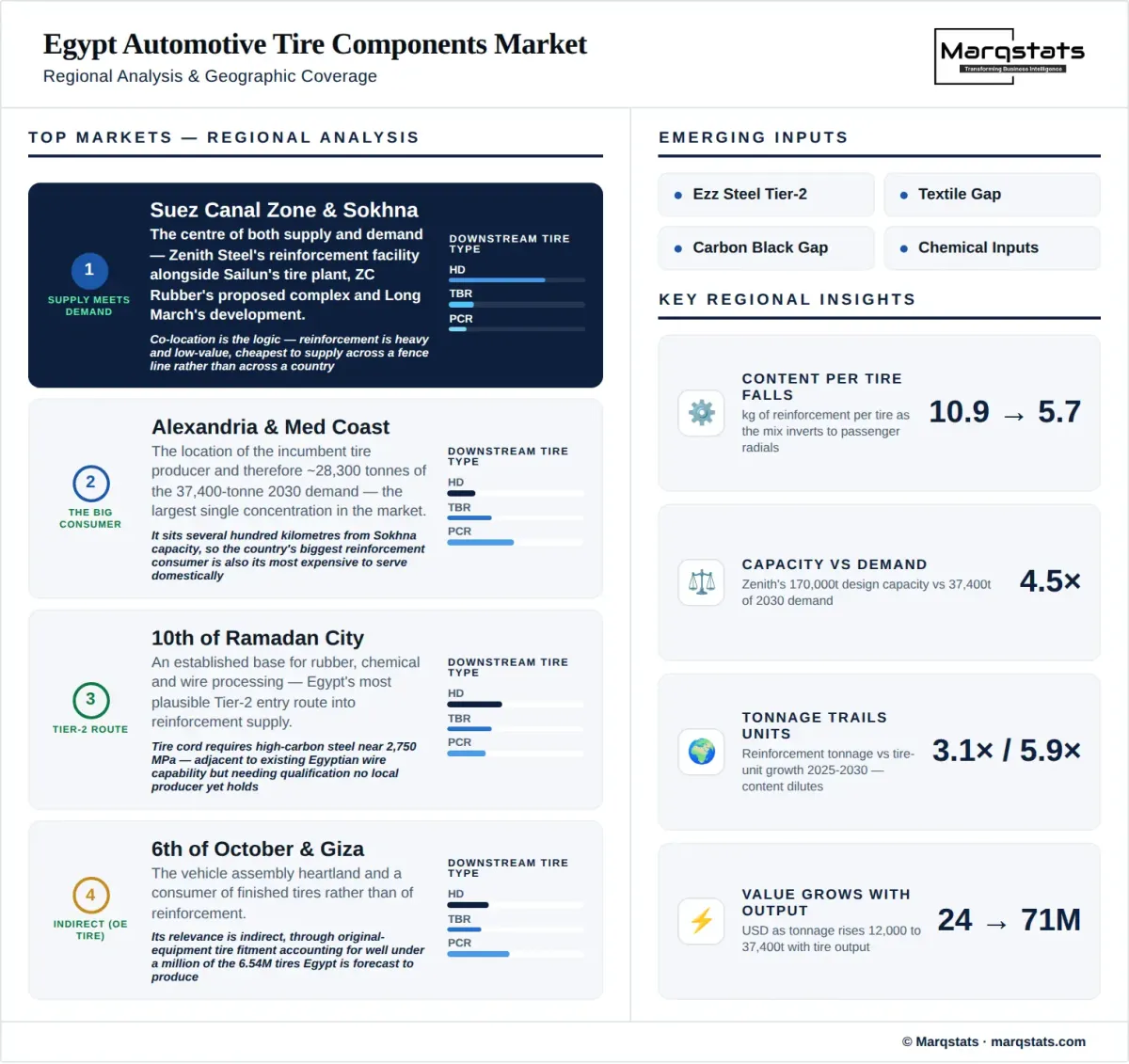
The centre of both supply and demand in this market, hosting Zenith Steel's USD 300 million reinforcement facility alongside Sailun's tire plant, ZC Rubber's proposed 600,000 square metre complex and Long March Tyre's development. Co-location is the project's principal logic: reinforcement is heavy, low-value relative to weight, and cheapest to supply across a fence line rather than across a country.
Alexandria and the Mediterranean Coast
The location of the incumbent tire producer and therefore of roughly 28,300 tonnes of the 37,400-tonne 2030 demand, the largest single concentration in the market. It sits several hundred kilometres from the Sokhna reinforcement capacity, which means the country's biggest reinforcement consumer is also its most expensive to serve domestically.
10th of Ramadan City
An established base for rubber, chemical and wire processing that represents Egypt's most plausible Tier-2 entry route into reinforcement supply. Tire cord requires high-carbon steel at nominal tensile strength near 2,750 meganewtons per square metre, a specification adjacent to existing Egyptian wire capability but requiring qualification no local producer currently holds.
6th of October City and Giza
The vehicle assembly heartland and a consumer of finished tires rather than of reinforcement, with local assembly of about 99,600 vehicles in 2025 rising toward 206,000 by 2030. Its relevance here is indirect, through original equipment tire fitment that accounts for well under a million of the 6.54 million tires Egypt is forecast to produce.
Rest of Egypt
Covering the wider steel and wire industry that could supply reinforcement inputs, including Egypt's substantial construction-grade steel base. The specification gap between construction steel and tire cord is the barrier, not capacity: high-carbon tire cord steel is a different product requiring different drawing, plating and quality systems from the 37,400 tonnes of demand it would serve.
How Competition Is Evolving
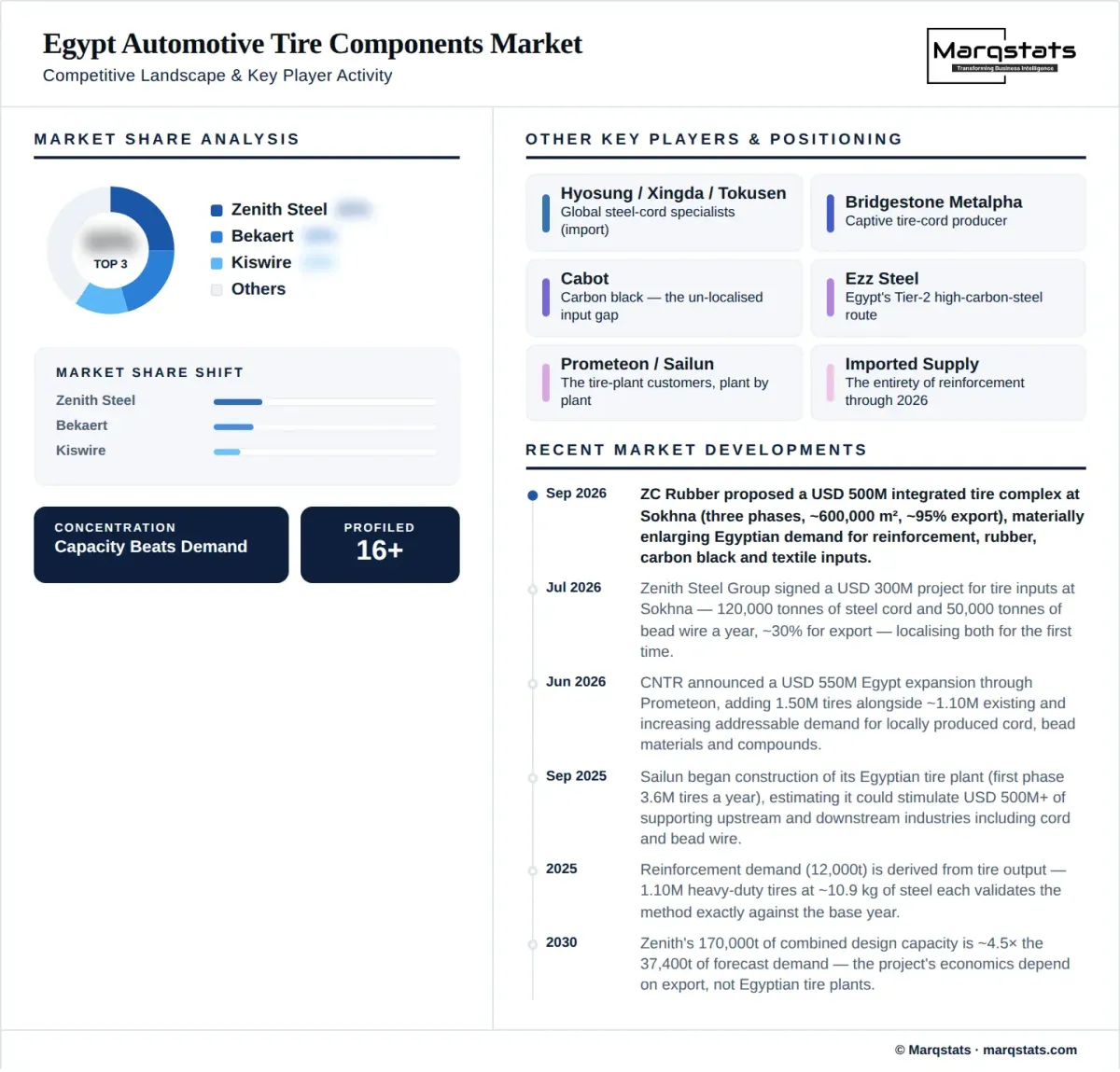
This market has no Egyptian incumbent, one announced entrant and a customer base that does not yet exist at scale. Zenith Steel Group's July 2026 commitment of USD 300 million to a Sokhna facility for 120,000 tonnes of steel cord and 50,000 tonnes of bead wire is the only announced domestic reinforcement capacity. Its competition is the incumbent import channel supplying every tonne Egypt currently consumes, and its customers are Prometeon, Sailun, ZC Rubber and Long March Tyre, of which only the first is operating. The competitive question is therefore not market share but whether supply and demand commission in a compatible sequence.
The capacity arithmetic makes the project's positioning unavoidable. Zenith's 170,000 tonnes of combined design capacity runs approximately 4.5 times the 37,400 tonnes Egypt is forecast to consume in 2030, and even the stated 30% export allocation leaves 119,000 tonnes chasing domestic demand of 37,400. That is a threefold oversupply against the domestic market at full utilisation. Either the export share is materially understated, or the plant runs well below nameplate for years, or Egyptian tire output arrives far faster than the commissioning evidence supports. The most probable reading is the first: this is an export project with an Egyptian anchor tenant rather than an import substitution project with export upside.
For a supplier evaluating entry behind Zenith, the barrier is qualification rather than capacity or cost. Tire makers approve reinforcement suppliers plant by plant and specification by specification, and a position at one producer confers nothing at another. That fragmentation cuts both ways: it protects an incumbent import supplier already qualified across Prometeon's heavy-duty lines, and it means Zenith's qualification at Sailun's passenger car radial lines is a separate exercise from qualification at Prometeon's. A client mapping this market should build the qualification matrix by producer and product line before assuming any tonnage is interchangeable, because the physical material is commoditised in a way the commercial relationship is not.
The practical consequence of the content correction is that this market is smaller and slower than tire volume growth suggests, and a supplier who sizes from tire counts will build the wrong plant. Egyptian tire output multiplies 5.9 times between 2025 and 2030 while reinforcement tonnage multiplies 3.1 times, and the ratio worsens through the 2031 endpoint as passenger car radial share rises further. For an entrant that means capacity sized against tire units overshoots by a factor approaching two, and for a policymaker assessing localisation it means reinforcement is a smaller prize than the tire build-out implies. It also means the export requirement in Zenith's project is structural rather than opportunistic, because no plausible Egyptian tire mix generates domestic demand approaching 170,000 tonnes within the forecast period.
Companies Covered
The report profiles 16+ companies with full strategy and financials analysis, including:
Recent Market Activity
Table of Contents
Coverage & Segmentation
The study covers core reinforcement material demand associated with automotive tire production in Egypt across the 2021 to 2025 historical period and the 2026 to 2030 forecast period, with 2025 as the base year and an indicative 2031 endpoint of approximately 45,300 tonnes. Steel cord and bead wire form the tonnage denominator. Rubber compounds, carbon black, chemicals and textile reinforcement are covered qualitatively and excluded from that denominator, because their content varies by compound recipe in ways that cannot be anchored to a verifiable physical constant.
The measurement basis requires explanation because tonnage is not among the four unit bases the reporting framework accepts. The panel therefore carries value in United States dollars and the reference block carries tonnage, the same treatment applied in Egypt's wiring harness market, where kilograms are the natural physical measure. Reinforcement is valued at approximately USD 2,000 a tonne in 2025 easing to USD 1,900 by 2030 as domestic supply displaces freight-inclusive imported material, so the value and tonnage series diverge slightly rather than moving in lockstep.