Market Snapshot
Key Takeaways
Market Overview & Analysis
Report Summary
The Middle East plug-in hybrid SUV market covers passenger sport utility vehicles fitted with a traction battery capable of external charging alongside a combustion powertrain able to propel or support the vehicle. The definition deliberately separates plug-in hybrids from dedicated range-extended electric vehicles wherever propulsion architecture permits, because the two answer different buyer questions: a plug-in hybrid retains full mechanical drive from its engine, while a range-extended vehicle drives on its motor and uses the engine only to generate electricity. Where a model's architecture cannot be cleanly separated in registration data, it is treated as mixed-code and its allocation is stated rather than assumed.
The regional market is early, small in absolute terms and growing very fast. A base of 4,800 vehicles across the whole region is smaller than a single month of passenger car sales in Saudi Arabia, which means the growth rate carries far less information than the product pipeline behind it. Almost all of the forecast increase is attributable to Chinese manufacturers extending plug-in hybrid variants across SUV ranges that already sell in volume in the Gulf on combustion powertrains, rather than to any change in consumer preference toward electrification for its own sake. The buyer is generally purchasing a larger, faster, better-equipped SUV at a competitive price, and the plug is an included feature rather than the purchase rationale.
That distinction governs how the market should be forecast and how its risks should be read. A plug-in hybrid that is regularly charged delivers most of the running-cost and emissions benefit of a battery vehicle with none of the range anxiety. A plug-in hybrid that is never charged is a heavy combustion SUV carrying a redundant battery, and delivers worse fuel consumption than the equivalent conventional hybrid. The gap between those two outcomes is entirely behavioural and is determined by charging access at home, at work and at fleet depots. In a region where charger deployment is still early outside the principal cities, the architecture's commercial success and its environmental performance can diverge sharply.
Plug-in Hybrid SUV Sales Volume and Forecast
Annual plug-in hybrid SUV sales across the Middle East rise from 4,800 vehicles in 2025 to 52,600 in 2030, a 61.42% compound annual growth rate and an absolute increase of 47,800 units. The indicative 2031 endpoint is approximately 84,900 vehicles. The trajectory is steep because the base is small and the product pipeline is unusually dense: models confirmed for Gulf and Levant markets across 2026 alone span mainstream seven-seat family SUVs, high-output all-wheel-drive off-road vehicles and luxury six-seat flagships, which between them address most of the region's SUV demand rather than a niche within it.
Retail value grows from USD 220.80 million to USD 1,893.60 million, a 53.69% compound annual growth rate. Value compounds almost eight points more slowly than volume because blended transaction prices fall from USD 46,000 to USD 36,000, a decline of about 4.78% each year. The price fall is a mix effect rather than discounting. Early regional plug-in hybrid volume skewed toward established premium and Japanese nameplates at higher price points, and the incoming Chinese product competes at materially lower prices while offering comparable or greater range and power. As that product takes share, the average falls even where individual model prices hold.
Confidence in these figures is moderate and deliberately stated as such. Registration data across the region does not consistently separate plug-in hybrids from conventional hybrids, and several high-volume models appear under mixed powertrain codes that combine battery-electric and plug-in variants. The observed 2,623 units across four Gulf states form a firm floor rather than a complete count, and the regional base adds Qatar, Bahrain and non-Gulf markets including Jordan and Israel where premium plug-in adoption is not captured in that dataset. Any user of these figures should treat the model-level table as the verified core and the regional total as an estimate built outward from it.
Market Dynamics
Key Drivers
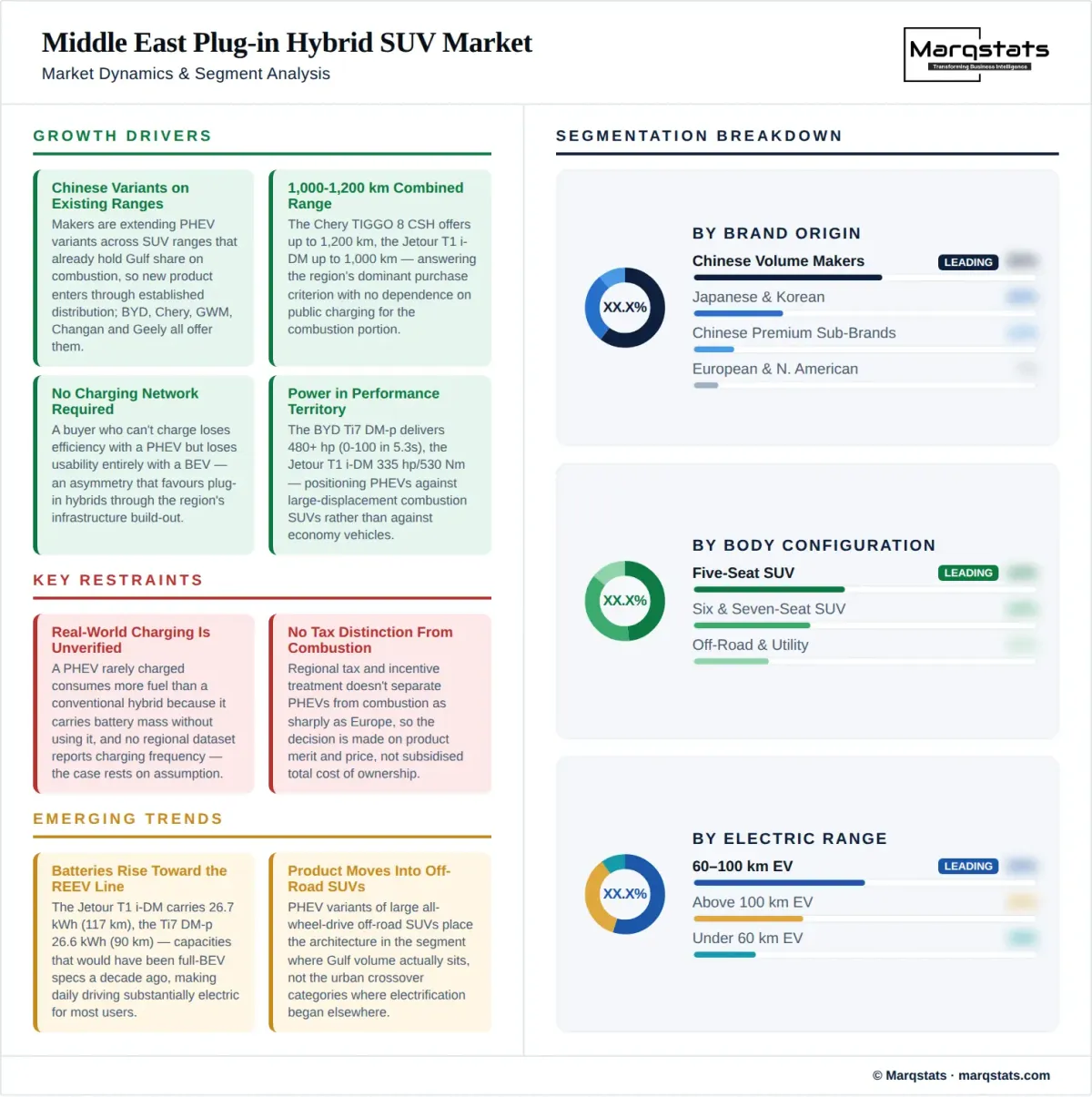
- Chinese manufacturers are extending plug-in hybrid variants across SUV ranges that already hold Gulf market share on combustion powertrains, so the new product enters through established distribution rather than needing to build it. BYD, Chery, Great Wall Motor, Changan and Geely all now offer plug-in hybrid SUVs in the region.
- Combined range figures of 1,000 to 1,200 kilometres answer the region's dominant purchase criterion directly. The Chery TIGGO 8 CSH offers up to 1,200 kilometres, the Jetour T1 i-DM up to 1,000 kilometres on a 26.7 kWh battery, and the KAIYI X7 Hybrid more than 1,200 kilometres, all with no dependence on public charging for the combustion portion.
- The architecture requires no charging network to function, which removes the single largest constraint on battery-electric adoption in the region. A buyer who cannot charge reliably loses efficiency with a plug-in hybrid but loses the vehicle's usability entirely with a battery-electric one, and that asymmetry favours plug-in hybrids during infrastructure build-out.
- Power outputs have moved into performance territory that the Gulf market rewards. The BYD Ti7 DM-p delivers more than 480 horsepower and reaches 100 kilometres per hour in 5.3 seconds, while the Jetour T1 i-DM produces 335 horsepower and 530 newton metres, positioning plug-in hybrids against large-displacement combustion SUVs rather than against economy vehicles.
- Levant market entry is broadening the addressable base beyond the Gulf. Jordan received both the HAVAL V7 with up to 135 kilometres of all-electric range and the BYD Ti7 DM-p in July 2026, extending mainstream plug-in hybrid SUV availability into markets where import duty structures treat electrified powertrains more favourably than the Gulf states do.
Key Restraints
- Real-world electric utilisation is unverified and may be low. A plug-in hybrid that is rarely charged consumes more fuel than an equivalent conventional hybrid because it carries battery mass without using it, and no regional dataset currently reports charging frequency, so the fuel-saving case rests on assumption rather than evidence.
- Tax and incentive treatment across the region does not distinguish plug-in hybrids from combustion vehicles as sharply as European markets do, so the purchase decision is made largely on product merit and price rather than on subsidised total cost of ownership. That removes a lever that accelerated adoption elsewhere.
- Gulf ambient temperatures place sustained load on battery thermal management, and the effect on usable electric range, battery degradation and warranty exposure over a full ownership cycle is not yet established for most of the models now entering. The KAIYI X7 Hybrid was specifically calibrated for United Arab Emirates heat and road conditions, which indicates the issue is recognised rather than resolved.
- Residual values carry unquantified risk because dual-system complexity and battery state of health both affect resale, and the region's used-vehicle trade has limited experience pricing plug-in hybrids. Leasing and fleet operators setting residual assumptions from combustion or conventional hybrid comparables may be materially wrong in either direction.
Key Trends
- Competition has shifted to total range, power and price rather than environmental positioning. Manufacturers market combined range figures and acceleration times ahead of emissions performance in the region, which reflects an accurate reading of what Gulf buyers actually weigh.
- Battery sizes are rising toward the boundary with range-extended vehicles. The Jetour T1 i-DM carries 26.7 kWh for 117 kilometres of WLTC electric range and the BYD Ti7 DM-p 26.6 kWh for 90 kilometres, capacities that would have been full battery-electric specifications a decade ago and that make daily driving substantially electric for most users.
- Charging speed is becoming a plug-in hybrid specification rather than a battery-electric one. The Jetour T1 i-DM charges from 30% to 80% in half an hour on a fast charger and from 30% to 100% in under four hours on a slow one, which makes opportunistic public charging practical and directly addresses the utilisation risk.
- Product is moving into the off-road and utility SUV space that the region buys most heavily. Plug-in hybrid variants of large all-wheel-drive off-road SUVs place the architecture in the segment where Gulf volume actually sits, rather than in the urban crossover categories where electrification began elsewhere.
Market Segmentation
Models offering more than 100 kilometres of certified electric range cover the daily distance of most regional users entirely on battery, and they represent the fastest-growing band. The Jetour T1 i-DM at 117 kilometres WLTC and the HAVAL V7 at up to 135 kilometres sit here, as does the Denza N9 at 202 kilometres. Vehicles in this band deliver the strongest running-cost case and are the most exposed to it if owners do not charge, because the battery they carry is the largest.
The 60 to 100 kilometre band is the current volume core and holds most of the models now selling in the Gulf, including the BYD Ti7 DM-p at 90 kilometres WLTC and the Chery TIGGO 8 CSH at approximately 90 kilometres. The Omoda 7, a seven-seat plug-in hybrid announced for Emirati availability, sits in the same band with a 19.27 kWh battery, approximately 90 kilometres of electric range, around 1,200 kilometres combined and 320 horsepower. The band balances battery cost against useful daily electric coverage and supports a competitive transaction price, which is why it dominates mainstream Chinese product entering the region.
Sub-60 kilometre systems are largely a legacy of earlier European and Japanese plug-in hybrid architectures and are declining as a share of regional sales. The band retains relevance in premium models where the plug-in system supplements performance rather than substituting for fuel, but it offers the weakest running-cost case in a region of long average trip distances and is being displaced by larger batteries at similar price points.
Five-seat plug-in hybrid SUVs form the entry point to the segment and carry the highest unit volumes in the observed data, led by the Deepal S05 at 698 units in the United Arab Emirates in 2025. The configuration competes directly against established combustion crossovers on price and equipment, and it is where Chinese manufacturers have concentrated their first plug-in hybrid launches in the region.
Larger family configurations are strategically the most important body type for the region, where extended households and long intercity journeys make three-row seating a mainstream rather than a premium requirement. The Chery TIGGO 8 CSH is a seven-seat plug-in hybrid with up to 1,200 kilometres of combined range, and the Denza N9 addresses the luxury six-seat position. This is the configuration where plug-in hybrid range advantages are most decisive against battery-electric alternatives.
Plug-in hybrid variants of ladder-frame and heavy-duty all-wheel-drive SUVs are the newest and most distinctive part of the regional segment. The BYD Ti7 DM-p combines all-wheel drive, more than 480 horsepower and a 26.6 kWh Blade battery in a large off-road-oriented body, placing electrified propulsion in the desert and utility use cases that define Gulf SUV demand. Electric torque delivery is genuinely advantageous in low-speed off-road work, which gives the architecture a functional argument beyond fuel cost.
Chinese volume brands account for the majority of regional plug-in hybrid SUV sales and effectively all of the forecast growth, with approximately 1,747 of the 2,623 units observed across four Gulf states in 2025. Changan's Deepal, Chery's JETOUR and Soueast lead the observed data, and BYD, Great Wall Motor, Geely and Kaiyi are all now present. Their advantage is product cadence: variants reach the region within months of domestic launch.
Premium sub-brands including Denza extend the Chinese proposition upward into the luxury multi-row segment with specifications such as 202 kilometres of electric range and triple-motor powertrains. The sub-brands matter disproportionately to segment value rather than volume, because they defend transaction prices against the downward mix pressure that mainstream Chinese product otherwise creates.
Japanese and Korean plug-in hybrid SUVs represent the established position in the region, with the Mitsubishi Outlander the clearest benchmark at 348 units in Saudi Arabia and 338 in the United Arab Emirates in 2025. These models hold buyer trust on durability and service network depth, but their electric ranges and power outputs now sit below incoming Chinese competition at comparable or higher prices.
European and North American plug-in hybrid SUVs occupy the premium and luxury positions, appearing in the observed data at low volumes such as the Land Rover Discovery Sport at 37 units in the United Arab Emirates. Their plug-in systems are typically specified for performance and refinement rather than for maximum electric range, and their regional relevance rests on brand position rather than on the running-cost argument that drives the mainstream segment.
Private retail buyers account for the large majority of regional plug-in hybrid SUV sales and purchase primarily on product attributes: range, power, equipment and price. Charging behaviour in this group is determined by home charging access, which is high in villa housing and materially lower in apartment stock, and which therefore varies sharply between and within regional markets.
Corporate fleets are the segment where total cost of ownership analysis is performed properly and where plug-in hybrid economics are most contested. Fleets should be segmented by daily distance and by access to depot or home charging, because a fleet vehicle that returns to a charging-equipped depot each night realises most of the architecture's benefit while one that does not can deliver total cost of ownership indistinguishable from combustion.
Government and institutional buyers are a small but growing share, driven by public-sector fleet electrification commitments in the United Arab Emirates and Saudi Arabia. Plug-in hybrids offer these buyers a route to reported fleet emissions improvement without the operational risk of full battery-electric conversion, though the reported benefit depends on charging compliance that few procurement frameworks currently monitor.
By Geography
United Arab Emirates
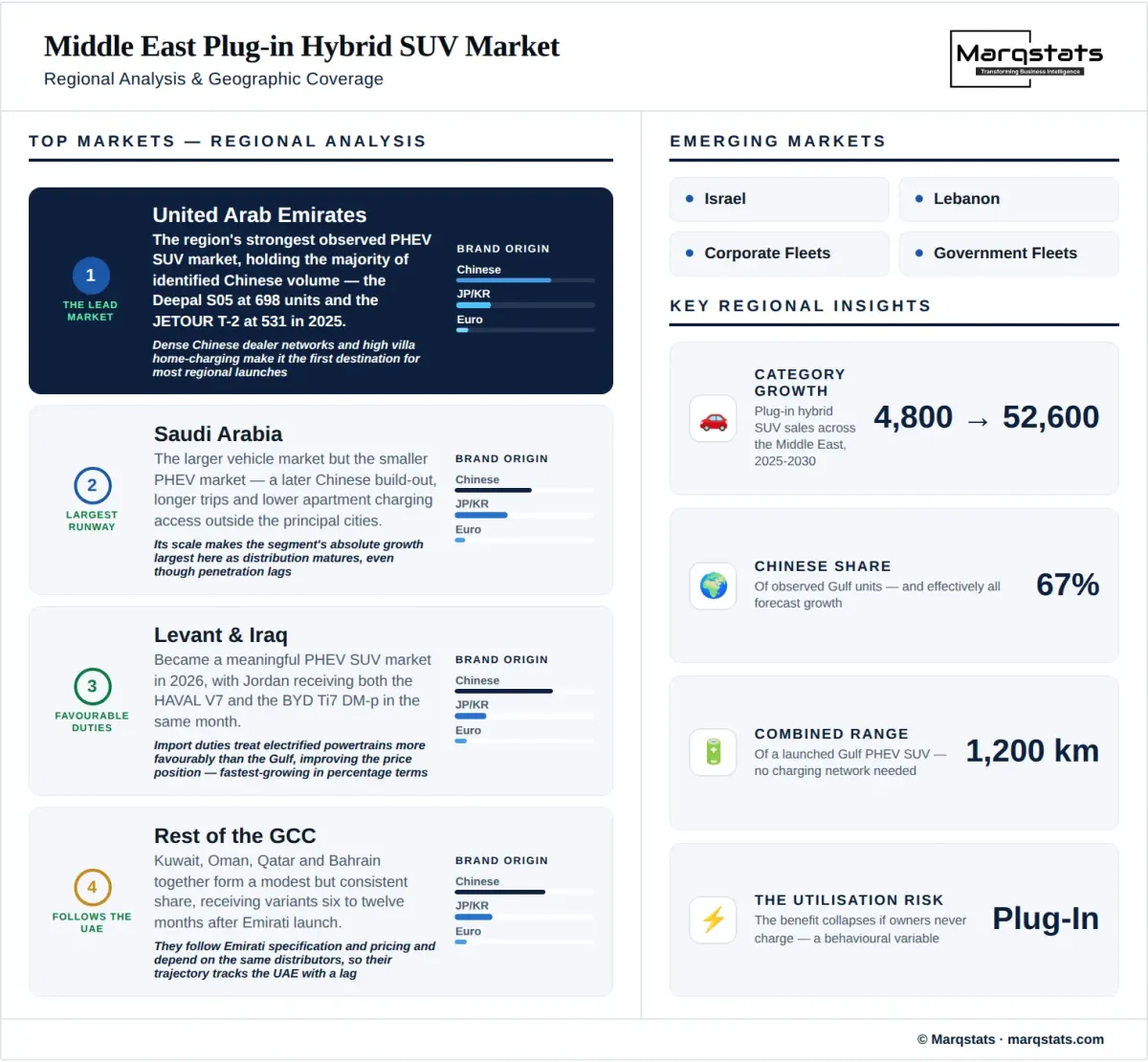
The United Arab Emirates is the region's strongest observed plug-in hybrid SUV market, holding the majority of the identified Chinese model volume including the Deepal S05 at 698 units and the JETOUR T-2 at 531 units in 2025. Dense dealer networks for Chinese brands, high villa housing penetration supporting home charging, and a buyer base that adopts new nameplates quickly combine to make the country the first market for most regional launches. Both the Chery TIGGO 8 CSH and the KAIYI X7 Hybrid entered the region through Emirati distributors in 2026.
Saudi Arabia
Saudi Arabia is the larger vehicle market but the smaller plug-in hybrid SUV market, with the Mitsubishi Outlander at 348 units and the JETOUR T-2 at 160 units leading the observed 2025 data. The gap reflects a later Chinese brand build-out, longer average trip distances that favour combustion range, and lower apartment-independent charging access outside the principal cities. The Kingdom's scale means its share rises materially across the forecast as distribution matures, and it is the market where the segment's absolute growth is largest even though its penetration lags.
Levant and Iraq
The Levant became a meaningful plug-in hybrid SUV market during 2026, with Jordan receiving both the HAVAL V7 offering up to 135 kilometres of all-electric range and up to 1,000 kilometres total, and the BYD Ti7 DM-p with its 26.6 kWh Blade battery, in the same month. Import duty structures in several Levant markets treat electrified powertrains more favourably than the Gulf states do, which improves the price position of plug-in hybrids against equivalent combustion SUVs and makes the cluster the fastest-growing in percentage terms from a small base.
Rest of the GCC
Kuwait, Oman, Qatar and Bahrain together form a modest but consistent share of regional volume, with Kuwait and Oman represented in the observed model-level data. These markets typically receive plug-in hybrid variants six to twelve months after Emirati launch, follow Emirati specification and pricing closely, and depend on the same regional distributor structures, so their trajectory tracks the United Arab Emirates with a lag rather than developing independently.
Rest of the Middle East
The remaining regional markets including Israel, Lebanon and the wider area contribute a smaller share and are the least well captured in available registration data. Israel in particular has a mature plug-in hybrid buyer base and taxation that has historically favoured electrified powertrains, but its data is not consolidated with Gulf registration sources, so its contribution is estimated rather than observed and is a recognised gap in the regional total.
How Competition Is Evolving
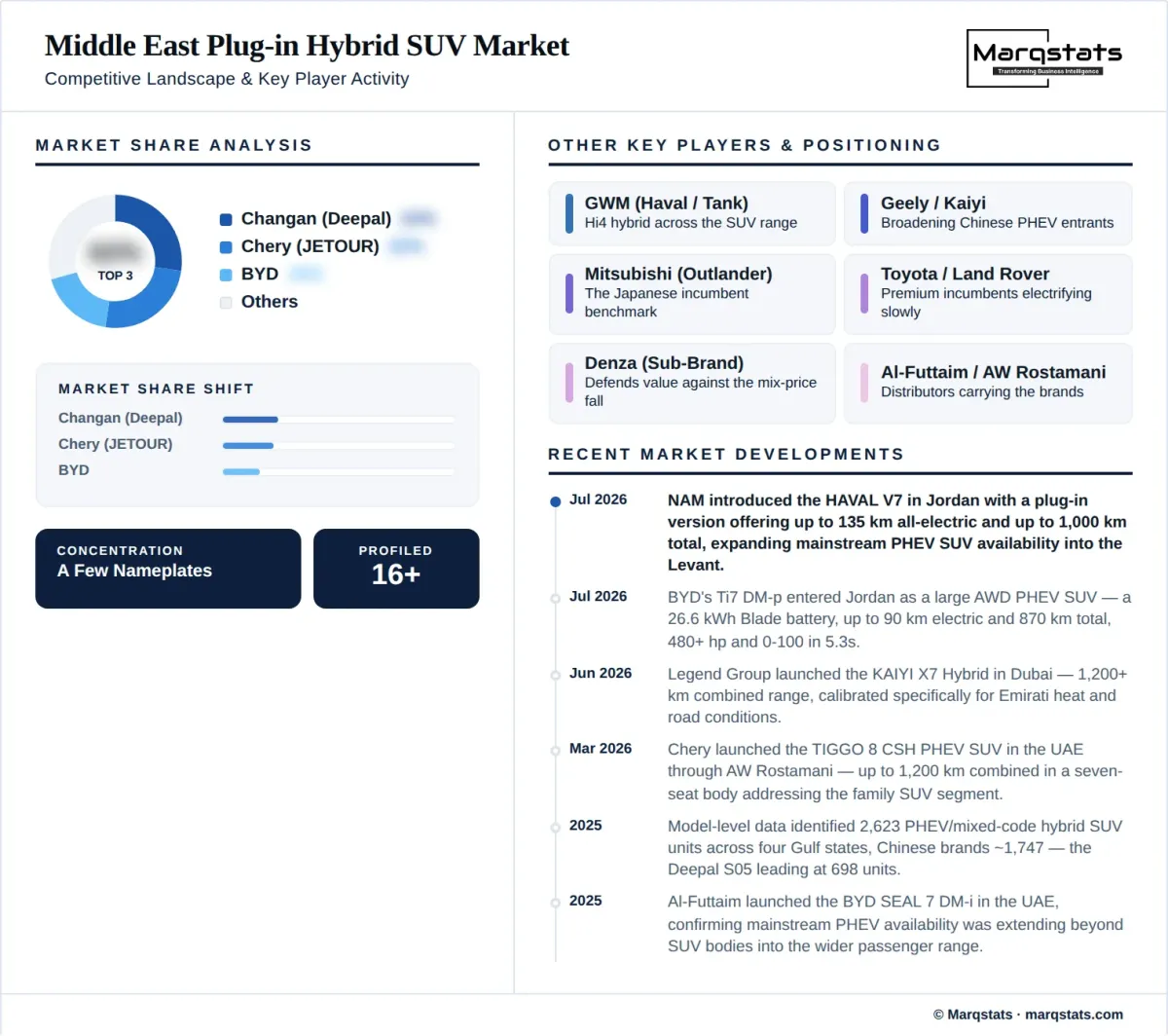
The Middle East plug-in hybrid SUV market is moderately fragmented and shifting rapidly toward Chinese manufacturers. No single brand approaches a dominant position in the observed data: Changan's Deepal leads on combined model volume in the United Arab Emirates, Chery's JETOUR holds the strongest dual-market presence across the Emirates and Saudi Arabia, and Mitsubishi retains the established benchmark position built over a decade of Outlander sales. Below those three, volumes fall away quickly to models selling in the tens of units, which is characteristic of a market at this stage and means share rankings can invert on a single launch.
Competition is being fought on specification rather than on price alone, and the specifications are escalating quickly. Within 2026 the region saw plug-in hybrid SUVs launched with 1,000 to 1,200 kilometres of combined range, batteries of 19 to 27 kWh, electric ranges from 90 to 202 kilometres, and outputs from 320 to more than 480 horsepower, with one flagship at 925 horsepower announced for Emirati availability. Established Japanese and European plug-in hybrids in the region do not currently match those figures, and the competitive question is whether brand trust and service network depth hold volume against a specification gap of that width.
Distribution is the quiet determinant of outcomes and it is concentrated. Major regional groups control the dealer networks, service infrastructure and marketing reach that any manufacturer needs to convert product advantage into sales, and their portfolio choices effectively decide which brands scale. The 2026 launches illustrate the pattern: the Chery TIGGO 8 CSH entered the Emirates through AW Rostamani Group, the KAIYI X7 Hybrid through Legend Group, and BYD's mainstream plug-in hybrid range through Al-Futtaim. A manufacturer without a strong regional partner faces a structural disadvantage no product specification can offset.
Companies Covered
The report profiles 16+ companies with full strategy and financials analysis, including:
Recent Market Activity
Table of Contents
Coverage & Segmentation
The study covers the Middle East with country and cluster-level detail for the United Arab Emirates, Saudi Arabia, the Levant and Iraq, the rest of the Gulf Cooperation Council, and the remaining regional markets. It measures annual new plug-in hybrid SUV registrations and sales as the primary unit and annual retail value in United States dollars as the secondary measure. The base year is 2025, the historical period covers 2021 to 2025, and the forecast period runs from 2026 to 2030 with an indicative 2031 endpoint. Segmentation covers electric range, body configuration, brand origin and buyer type.
Three boundaries define the market. Dedicated range-extended electric vehicles are excluded from the core denominator wherever propulsion architecture can be separated, because those vehicles drive on their motor and use the engine only as a generator, and they are measured in a separate regional study. Conventional hybrids without external charging capability are excluded entirely. Passenger body styles outside the sport utility definition are excluded, so plug-in hybrid saloons, estates and multi-purpose vehicles fall outside this scope even where they share a powertrain with an included SUV.
Two adjacent studies measure related populations and neither is additive to this one. The regional range-extended electric vehicle market is a separate architecture by the definition above, running at roughly one third of this market's volume in 2025 and closing to about two thirds by 2030 as range-extended product proliferates. Gulf sales of Chinese new energy vehicles is a broader measure covering battery-electric, plug-in hybrid and range-extended powertrains across all body styles, within which Chinese-brand Gulf plug-in hybrid SUVs represent approximately 23% in 2025 rising to about 28% by 2030.