Market Snapshot
Key Takeaways
Market Overview & Analysis
Report Summary
The Middle East range-extended electric vehicle market covers vehicles in which the wheels are driven electrically at all times and an onboard combustion engine functions solely as a generator to replenish the battery. That architecture separates them from conventional plug-in hybrids, where the engine can drive the wheels directly, and from conventional hybrids, which cannot be charged externally at all. The distinction is commercial as much as technical: the driving experience is electric while the refuelling behaviour is conventional.
Regional conditions favour the architecture more strongly than almost anywhere else. Middle East vehicle demand carries a large sport-utility mix and a long intercity-distance use case, and both work in the technology's favour. Heat degrades battery performance while raising auxiliary load, charging networks are under construction across most of the region, and towing and desert use are ordinary rather than exceptional requirements. A vehicle carrying its own generator addresses all of that without waiting for infrastructure.
Supply rather than demand sets the pace, which changes how the market should be forecast. Adoption follows model availability and the price bands those models occupy, not a fixed percentage of electric vehicle sales, because a buyer cannot choose an architecture that no distributor represents in their market. That is why regional volume concentrates so heavily in the two Gulf states where the flagship launches have taken place, and why the forecast tracks announced model pipelines and distributor appointments rather than an adoption curve applied to vehicle demand.
Range-Extended Electric Vehicle Sales Volume and Forecast
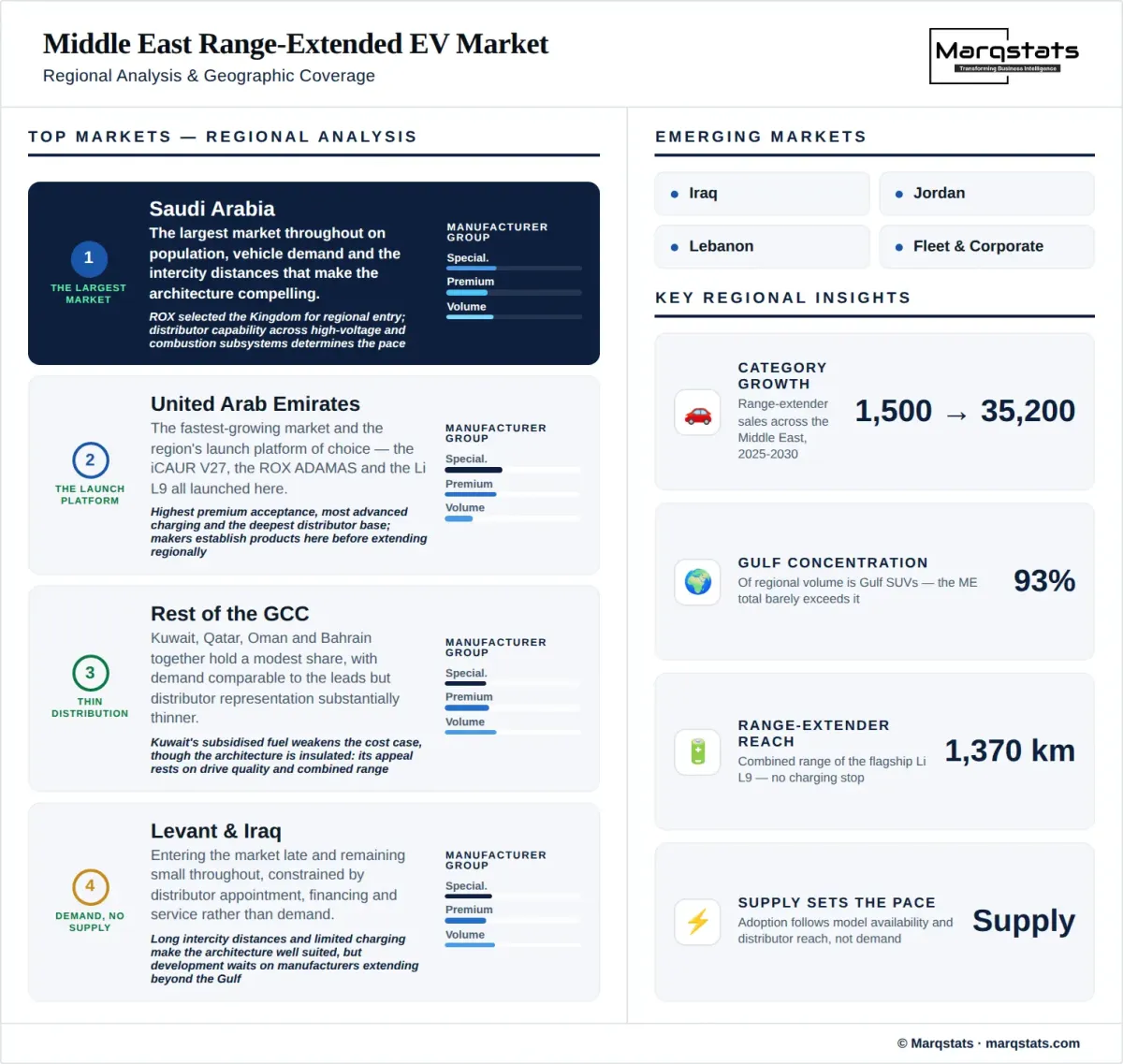
Range-extended electric vehicle sales across the Middle East rise from 1,500 units in 2025 to 35,200 by 2030, an 87.97% compound annual growth rate, with an indicative 2031 volume near 44,000 units. Growth is steepest in the first two forecast years as announced launches reach showrooms across additional markets, and the region adds its largest absolute volumes toward the end of the period as mid-market products broaden the addressable price range.
Concentration is the defining structural feature and it eases only slowly. Gulf sport-utility vehicles account for approximately 93% of regional units in 2025 and about 88% by 2030, with the balance comprising non-sport-utility body styles within the Gulf and all range-extender sales beyond it. Saudi Arabia and the United Arab Emirates carry the large majority of that Gulf volume between them. Markets in the Levant, Iraq and the wider region enter late and remain small throughout, constrained by distributor representation rather than by demand conditions.
Blended transaction value falls from approximately USD 61,000 to USD 43,000 per vehicle, a 6.75% annual decline, which is why sales value compounds at 75.27% against 87.97% growth in units. Early regional volume is weighted toward flagship products positioned well above the segment average, and the composition shifts as volume manufacturers and premium sub-brands introduce accessible products. Markets outside the Gulf skew less premium still, which adds a second downward influence on the blended figure as regional coverage widens.
Estimates are reconciled working figures rather than a direct count. Model-level tracking records 1,049 Changan Deepal units across Gulf markets in 2025 on coding that combines battery electric and plug-in variants, with no range-extender-only allocation available. Specialist deliveries and orders are not fully represented in that file, and markets beyond the Gulf fall outside it entirely. The base is assembled from launch records, order disclosures and distributor appointments, then reconciled against the Gulf range-extended sport-utility vehicle market so that the region and its dominant component remain consistent.
Market Dynamics
Key Drivers
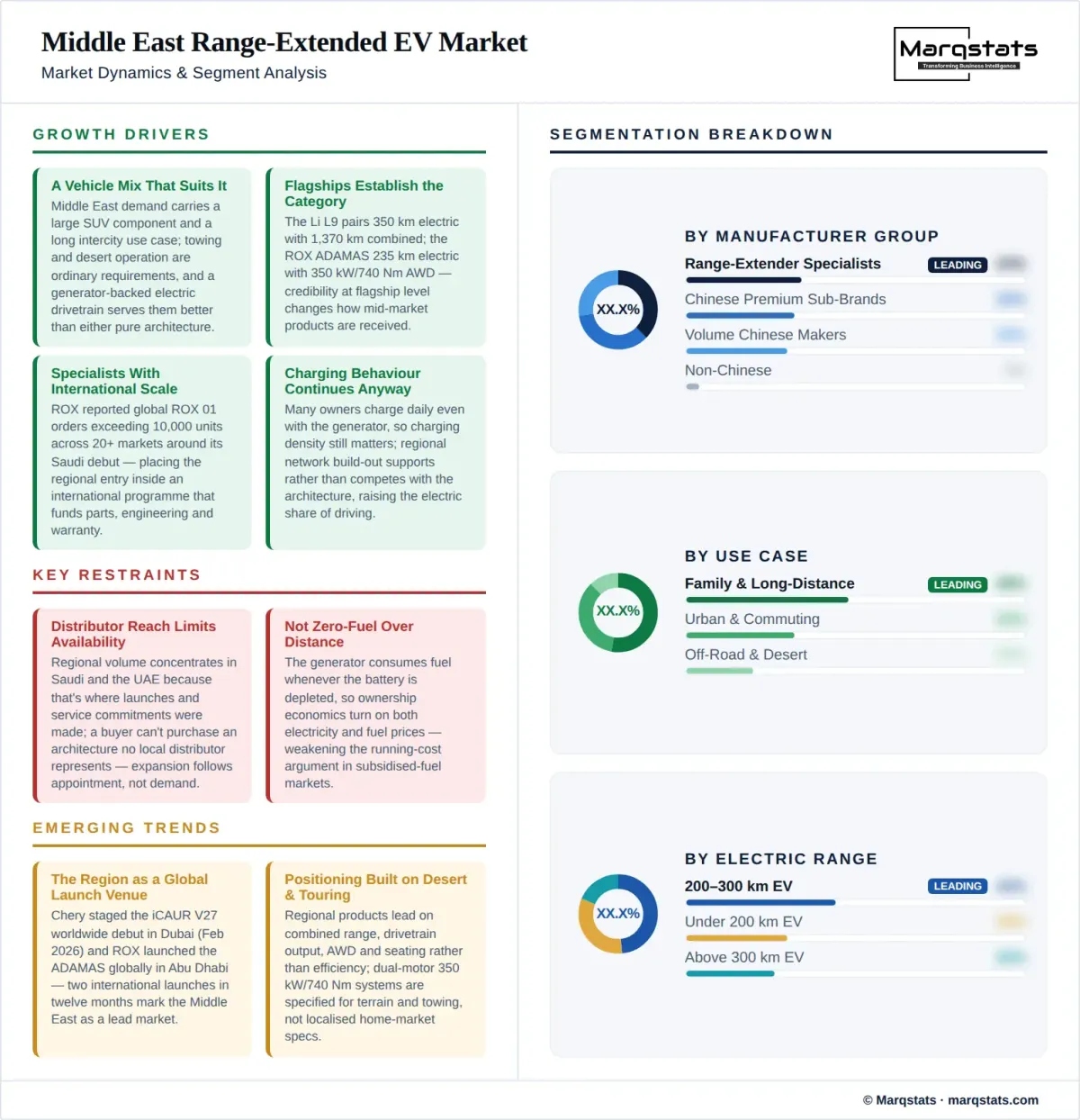
- A regional vehicle mix that suits the architecture unusually well. Middle East demand carries a large sport-utility component and a long intercity-distance use case, and range extension addresses both directly. Towing capability and desert operation are ordinary requirements across much of the region rather than niche ones, and an electric drivetrain delivering instant torque with a generator removing range concern serves them better than either pure architecture.
- Flagship products establishing the category before volume products arrive. The Li Auto L9 combines a 72.7 kWh battery with 350 kilometres electric and 1,370 kilometres combined range. The ROX ADAMAS pairs a 56.01 kWh battery with dual-motor all-wheel drive delivering 350 kW and 740 Nm for 235 kilometres electric and 1,226 kilometres total. Establishing credibility at flagship level changes how mid-market products beneath them are received.
- Specialist manufacturers with genuine international scale behind regional entries. ROX Motor reported global ROX 01 orders exceeding 10,000 units across more than 20 sales and service markets around its Saudi debut, which places the Middle East entry inside an international programme rather than as an isolated regional experiment. Scale of that kind supports parts supply, engineering resource and warranty capability that a market-by-market entry could not fund.
- Charging behaviour that continues despite the generator. Many range-extender owners charge daily even though the onboard generator supports long-distance travel, which means public charging standards and network availability still matter to the ownership proposition. Regional charging build-out therefore supports rather than competes with the architecture, and improvements in network density raise the share of driving performed electrically.
- Homologation through established vehicle frameworks. Range-extended vehicles are approved through normal vehicle homologation, emissions and fuel-consumption labelling and high-voltage requirements rather than through a stand-alone legal category in most regional markets. Market entry timing therefore depends on distributor readiness and model availability rather than on new legislation, which removes the regulatory delay that has slowed genuinely novel vehicle categories.
Key Restraints
- Distributor representation limiting availability outside two markets. Regional volume concentrates in Saudi Arabia and the United Arab Emirates because those are the markets where flagship launches, showrooms and service commitments have been made. Demand conditions elsewhere in the region are comparable, but a buyer cannot purchase an architecture no local distributor represents, so expansion depends on appointment decisions rather than on market development.
- Consumer confusion between three similar-sounding architectures. Buyers frequently conflate range-extended, plug-in hybrid and conventional hybrid vehicles, which are meaningfully different in how they drive, how they refuel and what they cost to run. Retail education is a genuine commercial requirement rather than a marketing preference, and a distributor that cannot explain the difference clearly loses sales to alternatives the buyer already understands.
- Total cost of ownership dependent on fuel as well as electricity. The technology is not zero-fuel in long-distance use, and the generator consumes fuel whenever the battery is depleted. Ownership economics therefore turn on both electricity and fuel prices, which weakens the running-cost argument in markets with subsidised fuel and complicates the comparison against a battery electric vehicle that a buyer may be considering alongside it.
- Dual-system aftersales capability that few distributors hold. Battery warranty, generator maintenance and dual-system diagnostics must all be covered in distributor aftersales policy, and competence across a high-voltage drivetrain and a combustion generator is uncommon in the region. The requirement is least visible to a buyer at the point of purchase and most consequential to their ownership experience afterwards.
Key Trends
- The Middle East selected as a global launch venue. Chery Group staged the worldwide market debut of the iCAUR V27 in Dubai in February 2026, and ROX Motor launched the ADAMAS globally in Abu Dhabi in October 2025. Two international product launches sited in the region within twelve months indicates the Middle East has moved from a secondary export destination to a lead market in range-extender product planning.
- Electric range escalating as the primary competitive metric. Pure-electric range among launched regional products runs from more than 150 kilometres to 350 kilometres, and the upper figures now approach the total range of some battery electric vehicles sold in the same markets. As that number rises, the vehicle operates electrically for a growing share of journeys and the generator becomes a long-journey provision rather than a routine part of operation.
- Positioning built around desert and touring capability rather than efficiency. Regional products lead on combined range, drivetrain output, all-wheel drive capability and seating configuration rather than on the efficiency metrics that dominate European and Chinese marketing. Dual-motor systems delivering 350 kW and 740 Nm are specified for terrain and towing rather than for acceleration claims, which reflects engineering to regional use rather than localisation of a home-market product.
- Specialist brands building service alongside sales from entry. Regional entrants have paired vehicle launch with showroom and service commitments rather than following sales with support, reflecting recognition that dual-system service capability determines retention. That pattern raises the capital threshold for entry and shortens the interval between a first sale and a credible ownership proposition.
Market Segmentation
Sport-utility vehicles and crossovers dominate the market throughout and account for essentially all current regional volume, consistent with Middle East buyer preference and with the products manufacturers have selected for launch. The architecture suits a large body style because a generator and fuel system require packaging space that a compact vehicle cannot easily provide, and the region's family and touring use cases reinforce the concentration.
Sedans and multi-purpose vehicles hold a small share and grow from a very low base as manufacturers extend range-extender platforms beyond their initial sport-utility applications. Multi-purpose vehicles suit the architecture better than sedans, since the packaging requirement is more easily accommodated and the passenger-carrying use case aligns with long-distance travel patterns.
Light commercial range extenders are the smallest body type and the latest to develop, covering vans and pickups where an electric drivetrain with generator backup addresses the range and payload requirements that constrain battery electric adoption in commercial use. Fleet purchasing rather than private buying determines outcomes, and residual value certainty is the binding constraint.
The 200 to 300 kilometre band is the segment's commercial centre and includes the ROX ADAMAS at 235 kilometres WLTC on a 56.01 kWh battery. Electric range at this level covers daily and most weekly driving without recourse to the generator while keeping battery cost and mass below the level the top tier requires, and the band is expected to hold the largest share of volume across the forecast.
Range extenders offering more than 300 kilometres of pure-electric operation occupy the top of the market and grow fastest in value terms, exemplified by the Li Auto L9 at 350 kilometres on a 72.7 kWh battery. At this level the vehicle functions as a battery electric car for most weekly use, and the generator becomes a provision for long journeys rather than a routine part of operation.
Vehicles offering under 200 kilometres of electric range, including the iCAUR V27 at more than 150 kilometres, prioritise combined range and price over electric-only capability. The band grows fastest in unit terms as mid-market products enter, because a smaller battery is the most direct route to a lower transaction price while retaining the long combined range that defines the architecture's appeal.
Family and long-distance touring is the largest use case and the one the architecture serves most distinctively, covering multi-occupant intercity travel across the long distances that characterise regional driving. Six and seven-seat configurations, combined ranges above 1,000 kilometres and cabin comfort specification all address it, and it is the use case where a battery electric alternative performs least well.
Urban and commuting use is where the electric portion of the powertrain does most of the work, with daily distances well within pure-electric range and the generator rarely engaged. Buyers in this use case are the most likely to also consider a battery electric vehicle, which makes the segment the point of most direct competition between the two architectures and the one most sensitive to charging network improvement.
Off-road and desert utility covers terrain capability, towing and remote-area operation, and the architecture serves it unusually well. Electric drive delivers instant torque for low-speed traction while the generator removes the range concern that makes remote-area travel impractical in a battery electric vehicle, and dual-motor all-wheel drive systems delivering 350 kW and 740 Nm are specified for exactly these conditions.
Range-extender specialists led the category into the region and hold the strongest premium positions, comprising manufacturers whose product strategy is built entirely around the architecture. Li Auto and ROX Motor both entered with flagship products and dedicated retail commitments, and ROX Motor's global order book exceeding 10,000 units across more than 20 markets demonstrates that regional entries sit inside international programmes rather than standing alone.
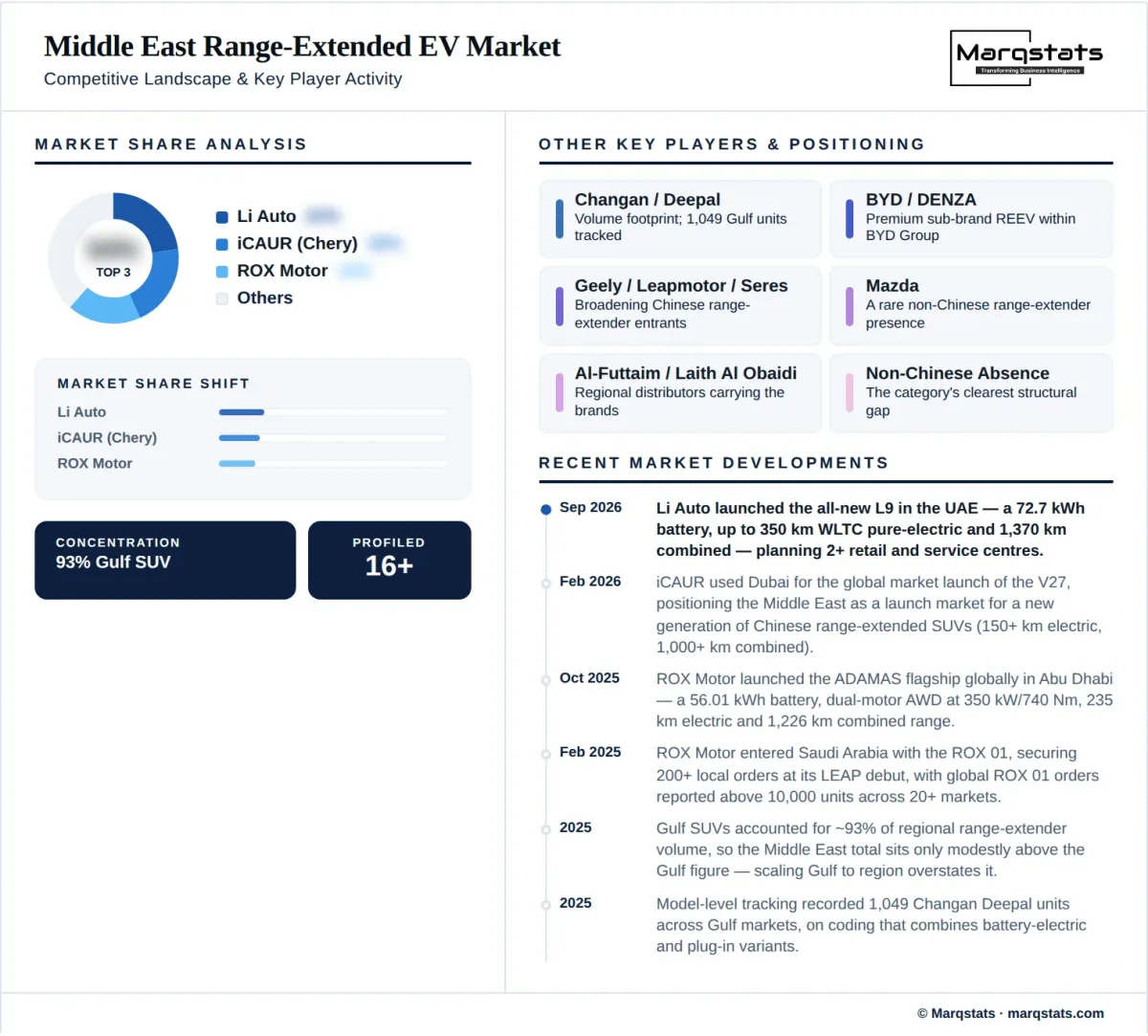
Volume Chinese manufacturers including Changan through its Deepal line supply the broadest model-level footprint in regional tracking data, with 1,049 units recorded across Gulf markets in 2025 on coding combining battery electric and plug-in variants. These manufacturers convert established combustion customer bases and distributor networks, giving them the faster route to volume and the slower route to premium positioning.
Chinese premium sub-brands including iCAUR within Chery Group occupy the ground between specialists and volume manufacturers, combining parent-group manufacturing scale with distinct retail identities. Staging the iCAUR V27 global launch from Dubai illustrates the approach, presenting a sub-brand rather than a parent marque as the regional proposition and positioning it toward the boxy off-road segment of demand.
Non-Chinese manufacturers hold a marginal share of regional range-extender volume and represent the category's clearest structural gap. Established Japanese, Korean, European and American brands hold the distributor networks, service depth and residual value credibility that Chinese entrants are still building, and their absence from the architecture allows Chinese manufacturers to define regional positioning and specification benchmarks without external reference.
By Geography
Saudi Arabia
Saudi Arabia is the largest market throughout on population, vehicle demand and the intercity distances that make the architecture compelling. ROX Motor selected the Kingdom for its regional entry in February 2025 with the ROX 01 all-terrain range extender, securing more than 200 orders around its debut and opening a Riyadh showroom. Distributor capability across both high-voltage and combustion subsystems determines how quickly the market develops beyond the launch phase.
United Arab Emirates
The United Arab Emirates is the fastest-growing market and the region's launch platform of choice, hosting the iCAUR V27 global debut in Dubai in February 2026, the ROX ADAMAS global launch in Abu Dhabi in October 2025 and the Li Auto L9 arrival in September 2026. Premium acceptance is highest, charging infrastructure is most advanced and the distributor base is deepest, so manufacturers consistently establish products there before extending them regionally.
Rest of the GCC
Kuwait, Qatar, Oman and Bahrain together hold a modest share, with demand conditions broadly comparable to the two lead markets but distributor representation substantially thinner. Kuwait's subsidised fuel weakens the running-cost argument specifically, though the architecture is less exposed to that than a battery electric vehicle because its appeal rests on drive quality and combined range rather than primarily on fuel savings.
Levant and Iraq
The Levant and Iraq enter the market late and remain small throughout the forecast, constrained by distributor appointment, financing availability and service infrastructure rather than by demand conditions. Long intercity distances and limited charging networks make the architecture theoretically well suited to these markets, and their development depends on whether manufacturers extend regional representation beyond the Gulf.
Rest of the Middle East
The remaining regional markets hold a negligible share across the forecast. Range-extender adoption requires distributor representation, dual-system service capability and access to premium vehicle financing, and that combination exists in few markets outside the Gulf. Their contribution is the least precisely measured part of the estimate, since none appears in the model-level tracking that anchors the Gulf figures.
How Competition Is Evolving
The category is fragmented among Chinese entrants and effectively uncontested by anyone else, which shapes every aspect of how it is developing. Range-extender specialists, volume manufacturers and premium sub-brands compete against one another for a market that reached an estimated 1,500 units across the entire region in 2025, while established Japanese, Korean, European and American manufacturers remain largely absent from the architecture here. Chinese manufacturers are therefore setting the positioning, price expectations and specification benchmarks without external reference points.
Competitive position is determined by distributor partnership and market representation rather than by product specification. A manufacturer with a superior vehicle and no regional distributor sells nothing, while one with an established partner reaches buyers immediately, which is why regional volume concentrates so heavily in the two markets where launch and service commitments have been made. The practical constraint on expansion is the availability of a credible partner in each additional market rather than product readiness or capital.
The contest that will determine long-term position is retail education and aftersales rather than specification. Buyers routinely confuse range-extended, plug-in hybrid and conventional hybrid architectures, and a distributor unable to explain the difference clearly loses the sale to something the buyer already understands. Behind that, battery warranty, generator maintenance and dual-system diagnostics must all be credibly covered, and the manufacturers investing in both capabilities alongside showroom expansion are building the assets that convert a launch into a market.
Companies Covered
The report profiles 16+ companies with full strategy and financials analysis, including:
Recent Market Activity
Table of Contents
Coverage & Segmentation
The study covers the Middle East with country and cluster-level detail for Saudi Arabia, the United Arab Emirates, the rest of the Gulf Cooperation Council, the Levant and Iraq, and the remaining regional markets. It measures new range-extended electric vehicle sales in units as the primary measure, with annual sales value in United States dollars as the secondary measure. The base year is 2025, the historical period covers 2024 to 2025, and the forecast period runs from 2026 to 2030 with an indicative 2031 endpoint. Segmentation covers body type, electric range, use case and manufacturer group.
Four boundaries define the market. Conventional plug-in hybrids are excluded, because their combustion engine can drive the wheels directly and the ownership proposition differs accordingly. Conventional hybrids without external charging capability are excluded, as are battery electric vehicles. Used and re-exported vehicles are excluded. Commercial vehicles above the light commercial threshold are excluded.
Gulf range-extended sport-utility vehicles account for approximately 93% of regional units in 2025 and about 88% by 2030, so this market and the Gulf sport-utility market describe a region and its dominant component rather than two populations that combine. The regional total sits only modestly above the Gulf figure, and the difference comprises non-sport-utility body styles within the Gulf together with all range-extender sales beyond it.