Market Snapshot
Key Takeaways
Market Overview & Analysis
Report Summary
This analysis sizes Mexico's plug-in hybrid electric vehicle market on the basis of official registration data published by the National Institute of Statistics and Geography through the Administrative Registry of the Light Vehicle Automotive Industry, cross-referenced against the Mexican Automotive Industry Association and the Mexican Association of Automotive Distributors. The market is measured as annual light-vehicle registrations, with 2025 as the base year. Coverage distinguishes plug-in hybrids from conventional non-plug-in hybrids and battery-electric vehicles throughout, consistent with the statutory distinction applied by the Megalopolis Environmental Commission's Holograma Exento certification. Value figures are presented in USD millions using a constant peso-to-dollar conversion rate consistent throughout the historical and forecast series.
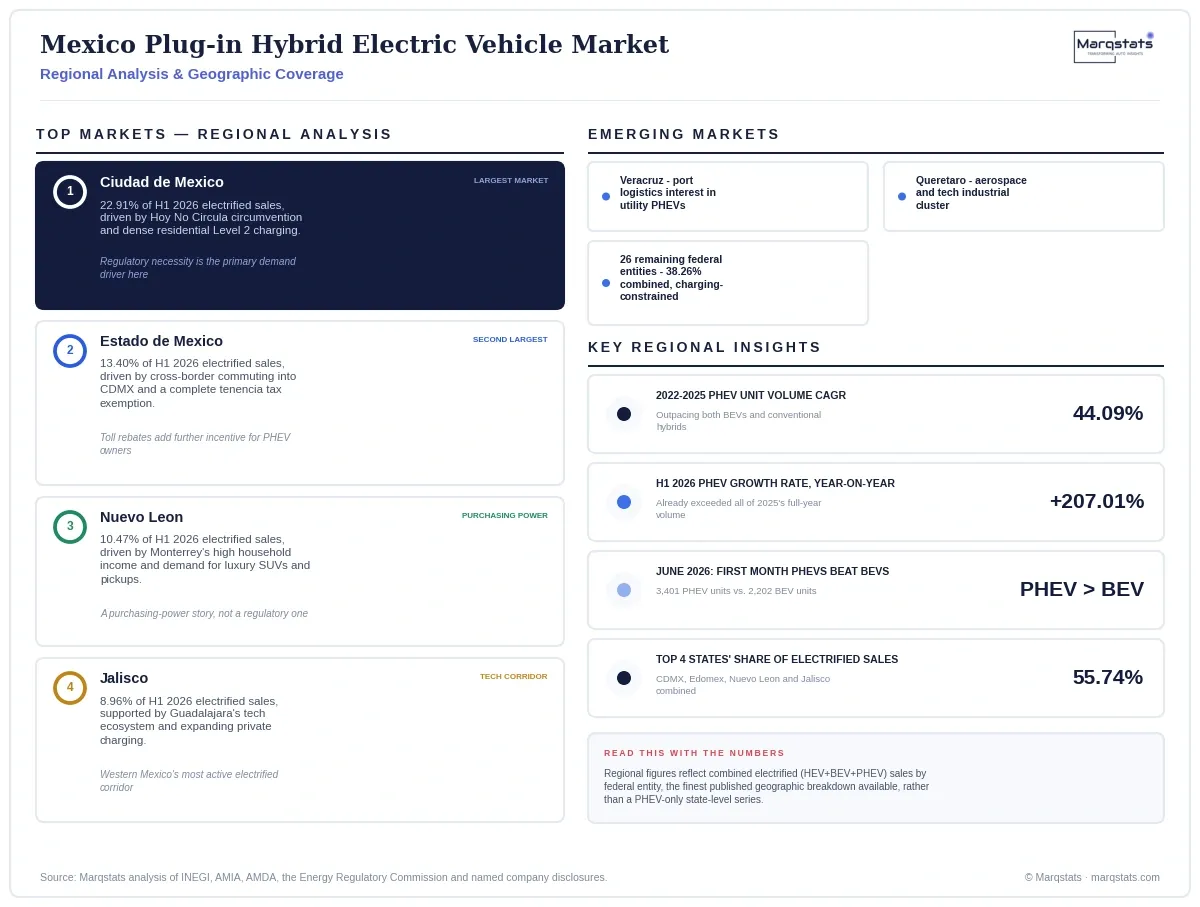
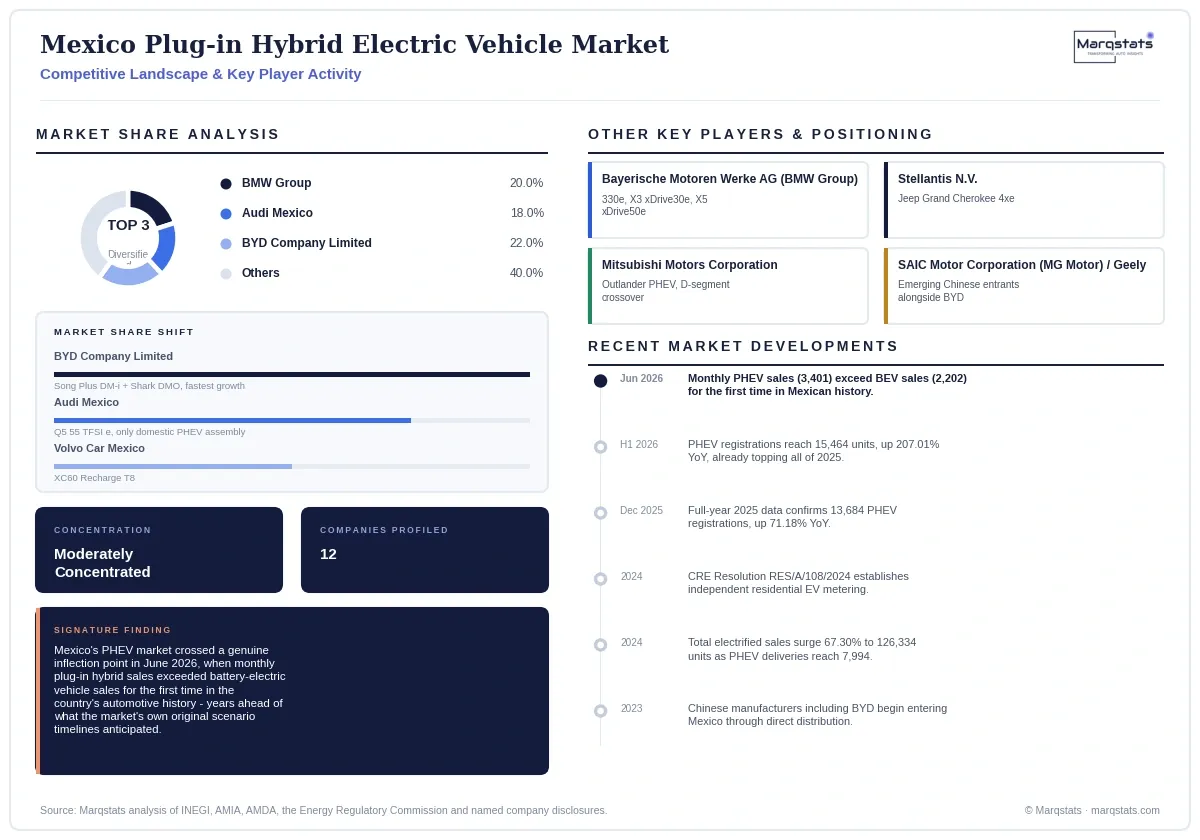
Mexico's PHEV market expanded from 4,575 units in 2022 to 13,684 units in 2025, a 44.09% compound annual growth rate, before accelerating further to 207.01% year-on-year growth in the first half of 2026. This acceleration reached a genuine inflection point in June 2026, when monthly PHEV sales exceeded battery-electric vehicle sales for the first time in Mexican automotive history, reflecting both an expanding roster of competitively priced Asian nameplates and the structural advantage plug-in hybrids hold over battery-electric vehicles on Mexico's unevenly electrified intercity highway network.
The 2030 base-case forecast of 48,500 annual registrations rests on continuation of current federal ISAN tax exemptions and Megalopolis circulation privileges, with public direct-current charging infrastructure expanding gradually along major interstate corridors without closing the national charging gap. The binding upside condition is whether foreign automotive groups commit to domestic completely-knocked-down assembly and the federal government expands green financing guarantees beyond the Megalopolis; the binding downside condition is whether USMCA joint-review trade friction produces import tariffs of 20% to 35% on non-FTA vehicles combined with metropolitan authorities restricting circulation privileges to pure battery-electric vehicles only.
Market Dynamics
Key Drivers
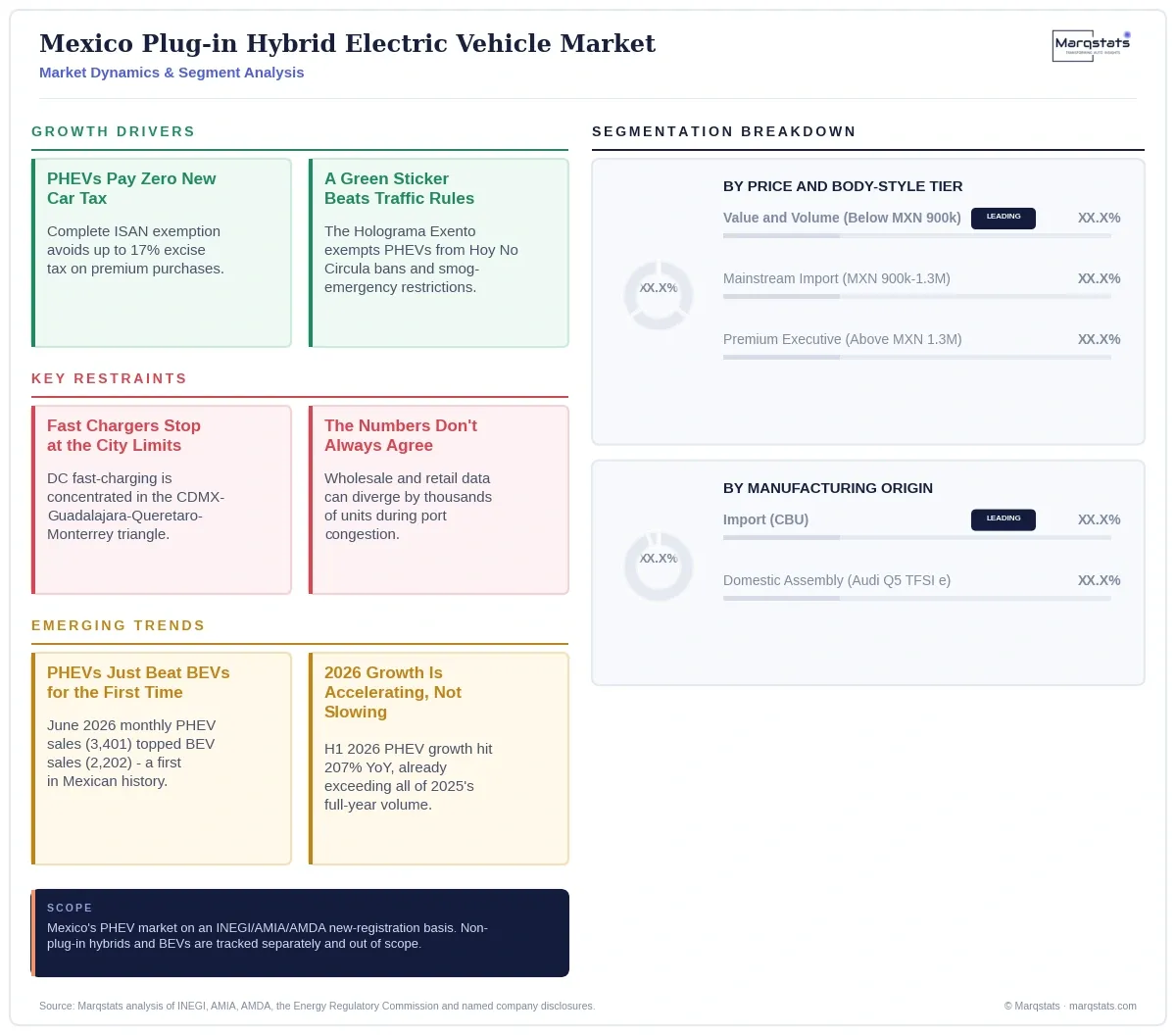
- Complete exemption from the federal New Car Tax under Article 4, Section IV of LFISAN avoids excise liabilities of up to 17% on premium purchase prices, providing immediate acquisition-price relief that compounds with corporate lease depreciation ceilings of MXN 285 per day for electrified vehicles against MXN 200 for conventional internal combustion vehicles.
- The Megalopolis Environmental Commission's Holograma Exento designation exempts qualifying PHEVs from bi-annual tailpipe testing, the Hoy No Circula rationing program, and Level 1 and Level 2 Atmospheric Environmental Contingency driving bans, guaranteeing uninterrupted circulation for executive commuters and commercial operators across Mexico City, the State of Mexico, Hidalgo, Morelos, Puebla, Tlaxcala and Queretaro.
- The Energy Regulatory Commission's 2024 resolution establishing the Federal Electricity Commission's independent residential metering protocol isolates vehicle charging consumption from baseline household electricity use, allowing PHEV owners to charge at subsidized rates of MXN 1.50 to 3.00 per kilowatt-hour rather than escalating into the High Consumption Domestic tariff bracket that previously penalized home charging.
- Competitively priced Chinese manufacturers, led by BYD's Song Plus DM-i and Shark DMO body-on-frame pickup, have broadened the addressable PHEV market below MXN 900,000, a price point roughly half of the MXN 1.15 million to 2.20 million range that historically defined the European luxury segment, extending PHEV demand into commercial fleets and suburban households.
- Domestic manufacturing anchors such as Audi Mexico's San Jose Chiapa facility, the exclusive global assembly site for the Q5 crossover family outside China, demonstrate that localized PHEV production is commercially viable within Mexico's USMCA-integrated automotive supply chain, offering a template incumbent manufacturers can replicate to defend domestic market share.
Key Restraints
- Public direct-current fast-charging infrastructure remains concentrated within the core highway triangle linking Mexico City, Guadalajara, Queretaro and Monterrey, leaving trans-peninsular and rural routes across southern and northern Mexico largely without operational high-voltage Level 3 public chargers, a structural constraint that favors PHEVs over battery-electric vehicles for intercity travel but caps electrified adoption overall outside the four primary metropolitan markets.
- Statistical reporting gaps complicate market measurement: wholesale dispatch data published by the National Institute of Statistics and Geography can diverge from retail distributor sales tracked by the Mexican Association of Automotive Distributors by several thousand units during periods of port congestion, while several Chinese manufacturers report through channels outside the Mexican Automotive Industry Association's traditional statistical framework, understating true market volume in official association tables.
- Pending review of the United States-Mexico-Canada Agreement introduces genuine trade-policy risk, with foreign original equipment manufacturers importing fully assembled PHEVs under general Most Favored Nation tariff regimes facing potential protectionist tariff escalation or rules-of-origin penalties designed to protect the integrated North American automotive manufacturing footprint.
- Powertrain classification boundaries remain imprecise in regional statistical reporting, with some dealership associations grouping 48-volt mild hybrids lacking any all-electric driving capability into broader electrified categories, inflating claimed adoption rates relative to the stricter definition the Megalopolis Environmental Commission applies when certifying vehicles for Holograma Exento privileges.
Key Trends
- Mexico's PHEV market crossed a genuine inflection point in June 2026, when monthly plug-in hybrid sales exceeded battery-electric vehicle sales for the first time in the country's automotive history, a milestone that occurred years ahead of the market's own original scenario timelines and signals that plug-in hybrids, not battery-electric vehicles, may be the more durable near-term electrified powertrain choice for Mexican driving conditions.
- Chinese manufacturers are converting price competitiveness into genuine mainstream market share rather than remaining a niche import phenomenon, with BYD's commercial performance across the King, Song Plus DM-i and Shark DMO demonstrating that sub-MXN 600,000 to 900,000 plug-in hybrids can challenge established Japanese and North American brands directly rather than merely supplementing the luxury segment.
- Regional adoption patterns are bifurcating between regulatory-necessity-driven demand in the Megalopolis, where Hoy No Circula circumvention is a primary purchase motivation, and purchasing-power-driven demand in Nuevo Leon and Jalisco, where household income and corporate sustainability programs rather than circulation restrictions drive adoption of luxury SUVs and high-performance dual-motor pickups.
- Legacy manufacturers with existing Mexican production footprints face a widening strategic gap between their export-oriented battery-electric investments and their domestic showroom offerings, as companies including General Motors, Ford, Stellantis and Volkswagen direct capital toward export-bound battery-electric platforms priced above MXN 1.0 million while ceding the affordable domestic PHEV segment to Asian entrants.
- Charging infrastructure investment is shifting toward destination-based Level 2 Mode 3 installations in suburban residential complexes, shopping centers and corporate office parks rather than highway fast-charging corridors, reflecting the commercial reality that plug-in hybrids dwelling for multiple hours at these locations generate more reliable recurring revenue than battery-electric-focused highway charging under low outside-metropolitan utilization rates.
Strategic Implications
For a prospective market entrant, particularly an Asian original equipment manufacturer seeking Latin American volume, plug-in hybrids offer the most viable path to market share, as demonstrated by BYD's commercial performance with sub-MXN 600,000 passenger models and high-torque hybrid utility pickups; however, entrants relying on fully assembled imports under general Most Favored Nation tariff regimes face rising rules-of-origin scrutiny ahead of the USMCA joint review, and should prioritize securing national spare-parts distribution and evaluating domestic assembly footprints within the Bajio or northern industrial corridors to protect long-term market access.
For an incumbent manufacturer with existing Mexican production capacity, the strategic imperative is closing the gap between export-oriented battery-electric investment and domestic showroom offerings; Audi Mexico's model of manufacturing the Q5 55 TFSI e at San Jose Chiapa demonstrates that retooling existing lines for localized, affordable PHEV derivatives of popular midsize crossovers and compact trucks can satisfy USMCA regional value content requirements while directly defending domestic market share against lower-cost Chinese imports.
For a fleet operator, corporate leasing firm or charging infrastructure investor, plug-in hybrid growth provides a clear signal to prioritize destination-based Level 2 charging installations at suburban residential complexes, shopping centers and corporate office parks over highway fast-charging corridors, since plug-in hybrids dwelling for extended periods at these locations generate more reliable revenue under the Energy Regulatory Commission's residential and commercial metering framework than battery-electric-focused highway infrastructure serving currently low outside-metropolitan utilization rates.
Outlook
Base case: 48,500 new registrations by 2030 (28.79% five-year volume CAGR), USD 2,667.5 million annual value. This trajectory assumes federal ISAN tax exemptions and corporate lease depreciation benefits persist unchanged, Megalopolis jurisdictions preserve Holograma Exento privileges, and standard Most Favored Nation tariffs on non-FTA vehicles remain stable while public direct-current charging infrastructure expands gradually along major interstate corridors.
Upside case: 68,000 new registrations by 2030 (37.82% five-year volume CAGR), USD 3,400.0 million annual value. The specific trigger is foreign automotive groups, including Chinese original equipment manufacturers and legacy North American and Japanese joint ventures, committing to domestic completely-knocked-down assembly within Mexico, combined with the federal government expanding green financing guarantees through national development banks and state governments outside the Megalopolis introducing their own circulation incentives and vehicle ownership tax waivers.
Downside case: 27,000 new registrations by 2030 (14.56% five-year volume CAGR), USD 1,620.0 million annual value. The specific trigger is the federal government enacting import tariffs of 20% to 35% on finished vehicles from non-FTA nations following USMCA joint-review trade friction, combined with metropolitan transit authorities in Mexico City and the State of Mexico restricting Holograma Exento privileges strictly to pure battery-electric vehicles due to grid capacity constraints and urban road congestion.
Market Segmentation
Led by BYD's Song Plus DM-i (MXN 778,800) and Shark DMO pickup (MXN 899,980), this tier has broadened the addressable PHEV market beyond luxury buyers into commercial fleets and suburban households, with Chinese manufacturers' aggressive pricing roughly halving the entry cost relative to the historical European-dominated segment.
Anchored by the Mitsubishi Outlander PHEV (MXN 883,900) and Audi's domestically manufactured Q5 55 TFSI e quattro (MXN 1,199,900), this tier bridges the value segment and the premium executive tier, combining established Japanese reliability positioning with Audi's unique domestic manufacturing cost advantage at its San Jose Chiapa facility.
Anchored by the Volvo XC60 Recharge T8 (MXN 1,215,000) and the Jeep Grand Cherokee 4xe (MXN 1,549,900), alongside BMW's 330e, X3 xDrive30e and X5 xDrive50e, this tier represents the historical core of Mexico's PHEV market and continues to command transaction values between MXN 1.15 million and 2.20 million among executive and luxury buyers.
Audi Mexico's San Jose Chiapa facility in Puebla, the exclusive global assembly site for the Q5 crossover family outside China, manufactures the Q5 55 TFSI e domestically, having surpassed 1.5 million total Q5 units produced; this remains the only confirmed domestic PHEV manufacturing anchor identified in the current market, though the source material's upside scenario depends on additional manufacturers replicating this model.
The substantial majority of Mexico's active PHEV nameplates arrive as completely built-up imports, spanning European brands (BMW, Volvo, Mercedes-Benz, Jeep) subject to standard or FTA-preferential tariffs and Chinese entrants (BYD) whose Most Favored Nation tariff treatment and rules-of-origin status face rising scrutiny ahead of the USMCA joint review.
By Geography
Ciudad de Mexico (Mexico City)
Mexico City led all federal entities with 21,776 electrified vehicle sales in the first half of 2026, a 22.91% national share, driven primarily by Hoy No Circula circumvention, a high density of residential Level 2 chargers, and concentration of corporate executive fleets that value the Holograma Exento's guarantee of uninterrupted circulation during air-quality emergencies.
Estado de Mexico (State of Mexico)
The State of Mexico captured second position with 12,736 units, a 13.40% national share, reflecting sub-urban cross-border commuting into Mexico City, a complete state exemption from the annual tenencia vehicle ownership tax, and a 20% toll rebate on peripheral concession viaducts.
Nuevo Leon
Nuevo Leon ranked third with 9,947 units, a 10.47% national share, driven by the Monterrey metropolitan area's high household purchasing power and a preference for luxury sport-utility vehicles and high-performance dual-motor pickups such as the BYD Shark and Jeep 4xe, a purchasing-power-driven pattern distinct from the regulatory-necessity-driven demand of the Megalopolis.
Jalisco
Jalisco captured fourth position with 8,513 units, an 8.96% national share, supported by Guadalajara's technology ecosystem, corporate sustainability programs, and a growing private charging network that has established western Mexico as an active electrified vehicle corridor.
Veracruz, Queretaro and the Remaining Federal Entities
Veracruz (2,880 units, 3.03% share) and Queretaro (2,818 units, 2.97% share) form secondary hubs along major trade corridors, driven respectively by port logistics interest in utility PHEV platforms and an aerospace and technology industrial cluster; the remaining 26 federal entities together account for 38.26% of national electrified sales, constrained by scarce public charging availability and weighted heavily toward conventional non-plug-in hybrids rather than PHEVs specifically.
How Competition Is Evolving
Mexico's PHEV market is moderately concentrated across an established tier of European and North American premium manufacturers alongside a rapidly expanding tier of competitively priced Chinese entrants; BMW Group, Volvo Car Mexico and Audi Mexico defined the technical and price standard for executive commuter vehicles historically, while BYD's commercial performance with the Song Plus DM-i and Shark DMO has established the fastest-growing competitive position in the market.
Competitors differentiate primarily on price tier and manufacturing origin rather than a single dominant specification: European and North American brands compete on brand prestige, executive positioning and, in Audi's case, a unique domestic manufacturing cost advantage at San Jose Chiapa, while Chinese entrants compete on price, undercutting comparable European models by roughly half while still meeting the pure-electric range and safety standards required for Megalopolis Holograma Exento certification.
The most significant recent competitive-landscape shift is the accelerating commercial performance of Chinese manufacturers entering through direct distribution strategies, with BYD's Song Plus DM-i, Shark DMO and King establishing genuine mainstream market share rather than remaining a niche import phenomenon, a shift that has introduced statistical reporting gaps as some Chinese brands report through channels outside the Mexican Automotive Industry Association's traditional framework. Whether this shift proves durable will depend heavily on the outcome of the pending USMCA joint review, since Chinese manufacturers' current pricing advantage rests substantially on Most Favored Nation tariff treatment that could change.
Companies Covered
The report profiles 12+ companies with full strategy and financials analysis, including:
Recent Market Activity
Table of Contents
Coverage & Segmentation
Coverage spans Mexico's Plug-in Hybrid Electric Vehicle market on a new light-vehicle registration basis, as reported by the National Institute of Statistics and Geography, the Mexican Automotive Industry Association, and the Mexican Association of Automotive Distributors, across a 2021-2025 historical period and a 2026-2030 forecast period, with 2025 as the base year. The market is sized in both USD value and unit volume, covering PHEVs distinguished from conventional non-plug-in hybrids and battery-electric vehicles under the Megalopolis Environmental Commission's Holograma Exento statutory framework. Two segmentation dimensions are quantified: price and body-style tier, and manufacturing origin.
Excluded from scope: conventional non-plug-in and mild hybrid vehicles, which are tracked as separate, larger categories under Mexican registration statistics; commercial heavy trucks and two/three-wheeler plug-in hybrids, which are not separately sized; and a fully reconciled Chinese-manufacturer volume figure, since several brands report through channels outside the Mexican Automotive Industry Association's traditional statistical framework. A separate Marqstats study addresses Mexico's battery-electric vehicle market on a comparable basis. Regional figures reflect combined electrified (HEV plus BEV plus PHEV) sales by federal entity, the finest published geographic breakdown available, rather than a PHEV-only state-level series.