Market Snapshot
Key Takeaways
Market Overview & Analysis
Report Summary
This analysis sizes Canada's plug-in hybrid electric vehicle market on the statutory basis administered by Transport Canada, Natural Resources Canada and Environment and Climate Change Canada, drawing on Statistics Canada's active quarterly new motor vehicle registrations database (Table 20-10-0025-01) and the annual road motor vehicle registration census (Table 23-10-0308-01). The market is measured as new light-duty vehicle registrations, with 2025 as the base year given the most recent complete annual dataset available. Coverage incorporates the Electric Vehicle Availability Standard's still-pending repeal status as of the date of this analysis, a genuinely current regulatory uncertainty independently verified rather than treated as a completed policy change.
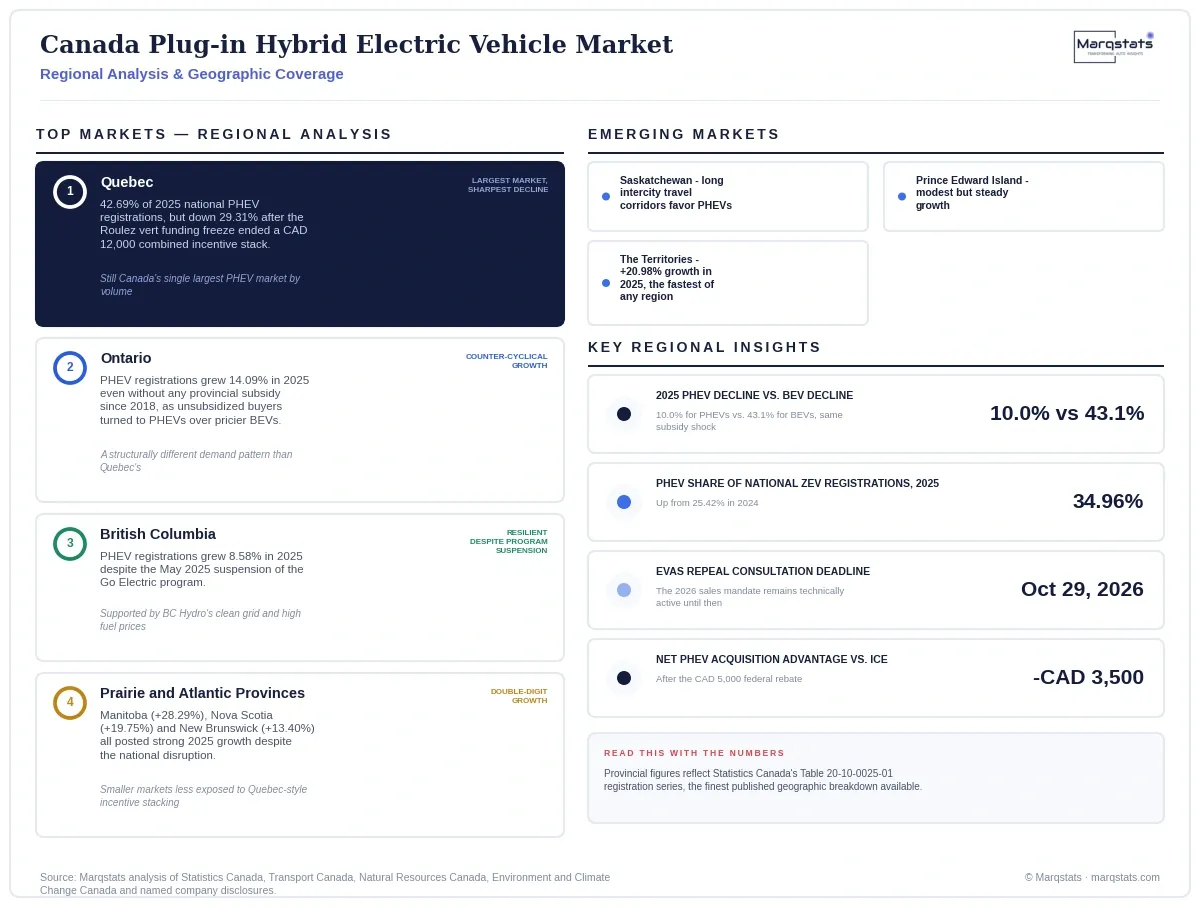
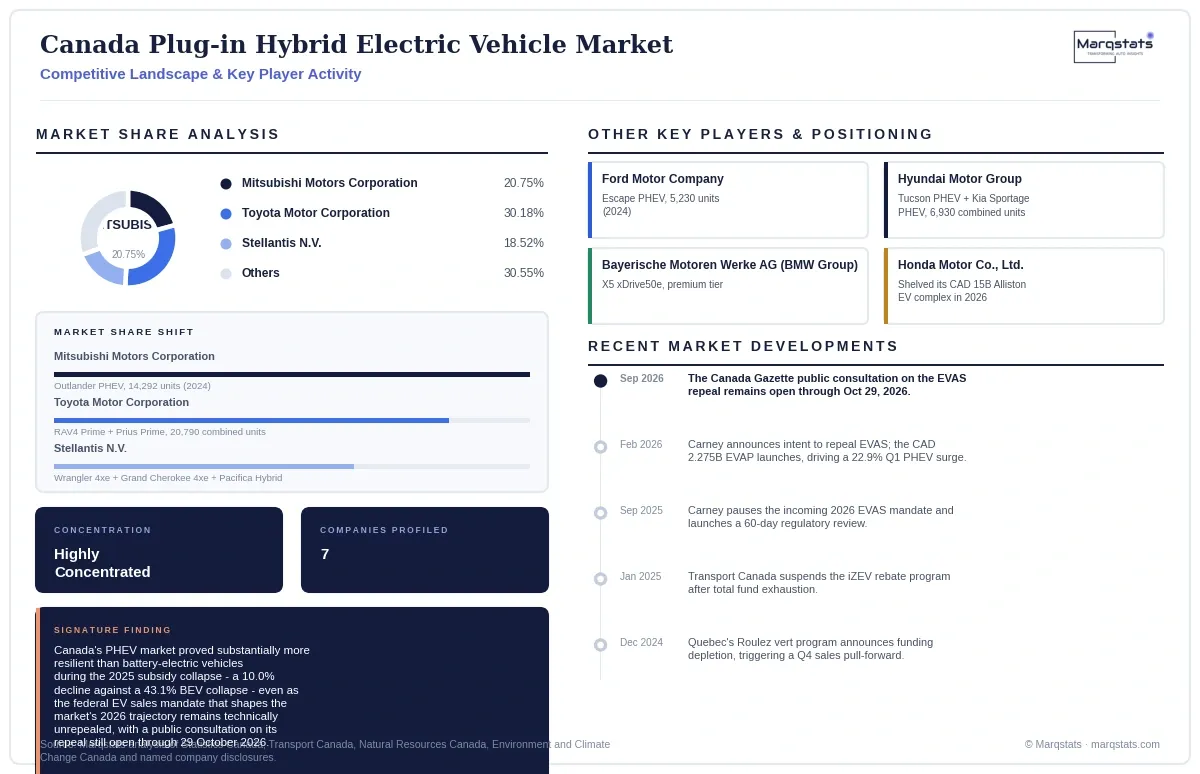
Canada's PHEV market contracted 10.0% to 62,001 units in 2025 following the simultaneous exhaustion of federal and major provincial purchase incentives, a substantially smaller decline than the 43.1% collapse battery-electric vehicles experienced over the same period. This differential resilience, expanding PHEVs' zero-emission vehicle share from 25.42% to 34.96% in a single year, demonstrates that Canadian consumers facing subsidy withdrawal preferentially retained dual-propulsion platforms over pure battery-electric vehicles, likely reflecting PHEVs' smaller acquisition premium, winter-weather thermodynamic reliability, and reduced dependence on public charging infrastructure outside major metropolitan corridors.
The 2030 base-case forecast of 135,000 annual registrations assumes the Electric Vehicle Availability Standard repeal process, still under public consultation as of this analysis, completes without major legal disruption, and that the CAD 2.275 billion Electric Vehicle Affordability Program remains funded through fiscal 2030 without early termination. The binding upside condition is whether Clean Fuel Regulations-driven gasoline prices exceeding CAD 2.10 per litre in Ontario and British Columbia make extended-range PHEV platforms economically compelling to a broader consumer base; the binding downside condition is whether cross-border trade friction and component tariffs elevate landed vehicle costs while federal fiscal restraint caps Electric Vehicle Affordability Program funding ahead of schedule, pushing consumers toward non-plug-in hybrids that require no charging infrastructure investment.
Market Dynamics
Key Drivers
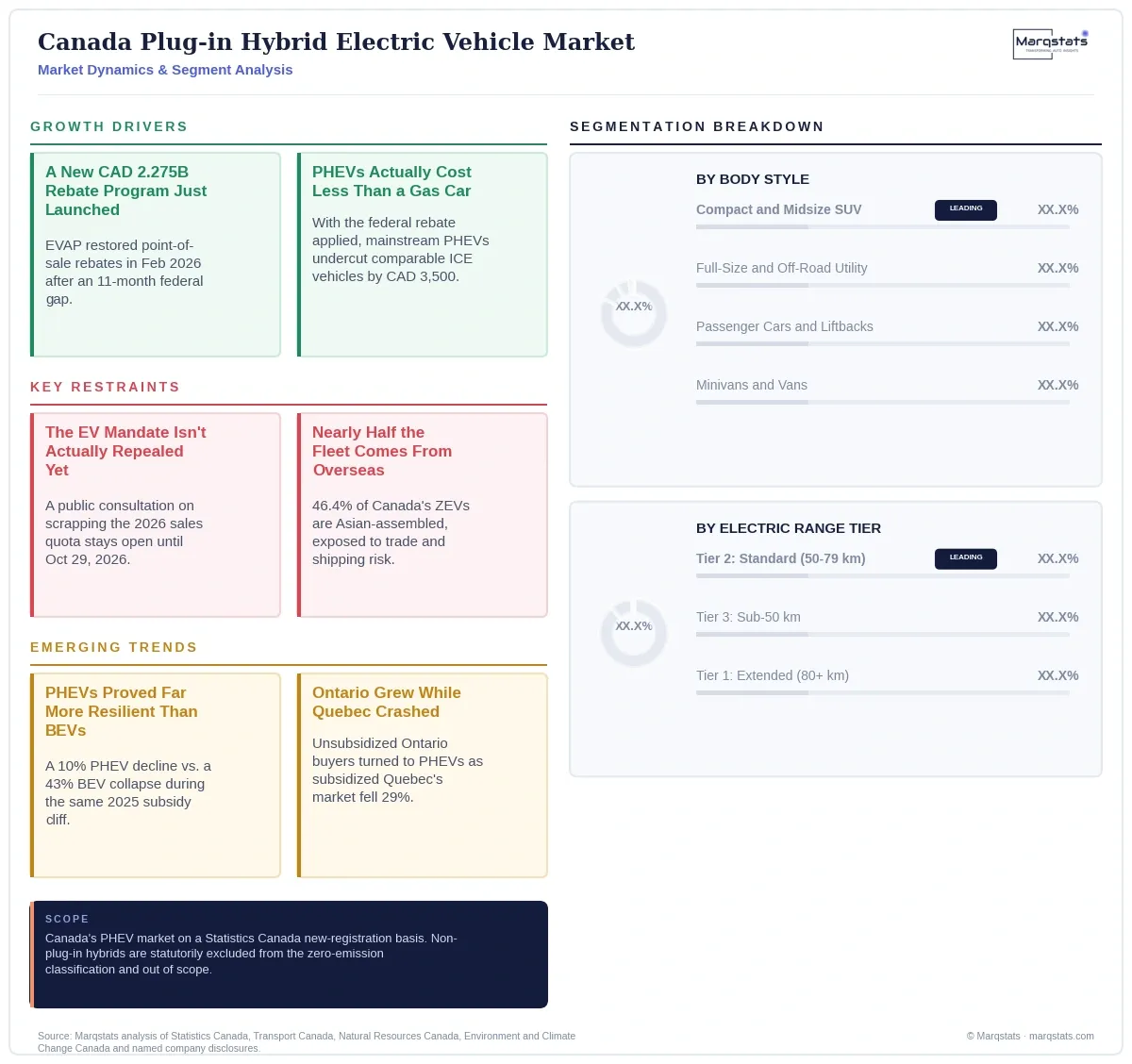
- The CAD 2.275 billion Electric Vehicle Affordability Program, launched 16 February 2026, restored point-of-sale rebates nationally after the eleven-month gap left by the January 2025 iZEV suspension, driving a 22.9% year-on-year surge in first-quarter 2026 PHEV registrations as consumer demand responded immediately to renewed federal support.
- A mainstream PHEV utility vehicle's modest CAD 1,500 upfront premium over a comparable internal combustion vehicle, reduced to a net CAD 3,500 acquisition advantage once the CAD 5,000 federal rebate applies, gives PHEVs a fundamentally different value proposition than battery-electric vehicles, which retain a CAD 10,000 net capital premium even after incentives.
- PHEVs deliver genuine winter-weather operational reliability that battery-electric vehicles cannot match in Canada's sub-zero climate: engine coolant waste heat handles cabin warming rather than drawing directly from the traction battery, limiting electric-mode range degradation to 25% to 40% against 30% to 50% for BEVs, while eliminating the stranding risk BEVs face once their traction pack depletes on rural highway corridors.
- The Electric Vehicle Availability Standard's compliance credit mechanism continues to reward PHEVs achieving 80 kilometers or more of certified electric range with full manufacturer compliance credit, sustaining original equipment manufacturer investment in extended-range PHEV platforms even as the broader sales-mandate framework undergoes formal repeal review.
- Manufacturers have specifically engineered introductory trim pricing to clear the CAD 60,000 base-MSRP federal rebate threshold for utility vehicles, exemplified by Mitsubishi's Outlander PHEV ES S-AWC starting at CAD 48,198 and Toyota's RAV4 Prime SE starting below CAD 52,000, ensuring their full model lines qualify for the maximum CAD 5,000 federal rebate.
Key Restraints
- The Electric Vehicle Availability Standard's 2026 sales mandate remains technically unrepealed as of this analysis: proposed regulations published in the Canada Gazette on 15 August 2026 opened a 75-day public consultation running through 29 October 2026, leaving manufacturers facing genuine statutory uncertainty about whether the original 20% zero-emission sales quota could still take effect depending on the consultation's outcome.
- Canada's PHEV supply chain carries a structural import dependency on Asian assembly, with 46.4% of all zero-emission vehicles registered in 2024 assembled in Japan or South Korea, including both the Outlander PHEV and RAV4 Prime, exposing the segment to trans-Pacific maritime logistics disruption and international trade action risk independent of any domestic Canadian policy decision.
- Rural and non-metropolitan regions, home to 18% of Canada's population, contain just 4% of dealership zero-emission vehicle inventory and less than 7% of operational public charging stations, a geographic imbalance that structurally favors PHEVs capable of home Level 1 or Level 2 charging supplemented by combustion-mode rural transit over battery-electric vehicles dependent on public fast-charging infrastructure.
- Domestic PHEV manufacturing investment has retrenched between 2024 and 2026: Honda shelved its planned CAD 15 billion Alliston, Ontario electric vehicle manufacturing complex in early 2026 citing slower North American market growth, while Ford deferred electric vehicle retooling at its Oakville Assembly Complex to prioritize conventional Super Duty truck production, leaving Stellantis's Windsor Assembly Plant as Canada's sole domestic PHEV manufacturing site.
Key Trends
- PHEVs demonstrated genuine structural resilience during Canada's 2025 subsidy collapse that battery-electric vehicles could not match: a 10.0% PHEV registration decline against a 43.1% BEV collapse is not a marginal difference but a fundamentally different market response, suggesting Canadian consumers view PHEVs as a more durable purchase decision when fiscal support becomes uncertain.
- Provincial responses to the 2025 subsidy withdrawal diverged sharply and counterintuitively: Quebec, which had offered Canada's most generous incentive stacking, suffered the steepest PHEV decline at 29.31%, while Ontario, which has operated without any provincial subsidy since 2018, saw PHEV registrations grow 14.09% as unsubsidized consumers turned to dual-propulsion vehicles specifically to avoid battery-electric capital premiums.
- The Electric Vehicle Availability Standard's formal repeal status remains a genuinely open regulatory question rather than a settled fact: Prime Minister Carney's February 2026 announcement of intent to repeal has not yet been finalized, with the Canada Gazette consultation period extending to 29 October 2026, meaning the manufacturer compliance obligations this market's forecast scenarios depend on remain formally undetermined at time of writing.
- Automotive manufacturing investment in Canada is bifurcating along a resilience axis distinct from powertrain type alone: Stellantis's flexible Windsor Assembly Plant, capable of producing the Chrysler Pacifica Plug-in Hybrid alongside conventional platforms, has proven more durable than the dedicated battery-electric investments Honda and Ford both scaled back between 2024 and 2026.
- Extended-range PHEV platforms with battery packs of 25 to 30 kilowatt-hours and standard direct-current fast charging represent a genuinely distinct emerging product category from the sub-25-kilowatt-hour mainstream PHEVs that currently dominate Canadian registrations, with the market's own upside scenario treating this technology shift as the primary trigger for accelerated 2030 growth.
Strategic Implications
For an international automotive importer or prospective entrant, Canada's regulatory landscape now favors a diversified powertrain strategy over an exclusive battery-electric focus, since the Electric Vehicle Availability Standard's pending repeal removes the statutory penalty for missing pure-electric sales quotas; entrants should price introductory utility-vehicle trims below the CAD 60,000 federal rebate threshold, equip battery packs with liquid-glycol thermal conditioning to preserve winter range and charging performance, and prioritize direct-current fast-charging capability as a meaningful differentiator in suburban and rural regions where public Level 2 charging remains limited.
For a domestic or continental manufacturer operating Ontario assembly facilities, flexible production architecture capable of assembling conventional combustion, hybrid and plug-in hybrid variants on shared lines represents a genuine risk hedge against battery-electric demand's demonstrated sensitivity to subsidy fluctuations, following the model Stellantis has already established at its Windsor Assembly Plant rather than the dedicated battery-electric capital commitments Honda and Ford both retrenched from between 2024 and 2026.
For a component supplier or charging infrastructure investor, sustained PHEV demand for parallel combustion and electric powertrain development maintains genuine demand for Atkinson-cycle engines, exhaust gas recirculation systems, compact 15 to 25 kilowatt-hour traction batteries and cabin heat pumps independent of battery-electric vehicle trajectories, while charging network operators should prioritize Level 2 workplace and residential infrastructure over high-power direct-current corridors, since the expanding PHEV fleet sustains commercial viability for daily commuter charging without overburdening high-voltage transmission nodes.
Outlook
Base case: 135,000 new registrations by 2030 (16.84% five-year volume CAGR), CAD 8.505 billion (USD 6.294 billion) annual value. This trajectory assumes the Electric Vehicle Availability Standard repeal process, still under public consultation as of this analysis, completes without major legal disruption, the CAD 2.275 billion Electric Vehicle Affordability Program remains funded through fiscal 2030, and Japanese and South Korean manufacturers continue expanding utility vehicle shipments to Canada without further trade disruption.
Upside case: 170,000 new registrations by 2030 (22.35% five-year volume CAGR), CAD 10.710 billion (USD 7.925 billion) annual value. The specific trigger is Clean Fuel Regulations and rising carbon-price trajectories pushing retail gasoline prices above CAD 2.10 per litre across southern Ontario and British Columbia, prompting automakers to introduce extended-range PHEVs with 25 to 30 kilowatt-hour battery packs exceeding 100 kilometers of electric range and standard direct-current fast charging, while original equipment manufacturers allocate North American assembly capacity toward these flexible platforms.
Downside case: 80,000 new registrations by 2030 (5.23% five-year volume CAGR), CAD 5.040 billion (USD 3.730 billion) annual value. The specific trigger is cross-border North American trade friction and component tariffs elevating landed vehicle costs, combined with federal fiscal restraint capping Electric Vehicle Affordability Program funding by 2028 ahead of schedule, pushing consumers toward non-plug-in hybrid electric vehicles that require no external charging infrastructure or residential electrical upgrades.
Market Segmentation
Compact and midsize sport-utility vehicles captured 82.50% of 2024 PHEV registrations, anchored by the Mitsubishi Outlander PHEV and Toyota RAV4 Prime, reflecting Canadian consumers' overwhelming preference for multipurpose vehicle body styles, which represented 80.0% of all zero-emission vehicle registrations nationally that year.
Full-size and off-road utility vehicles held 9.20% of 2024 registrations, anchored by the Jeep Wrangler 4xe and Grand Cherokee 4xe, competing on mechanical four-wheel-drive capability and commercial lease structures rather than electric range, since their 34 to 42 kilometer certified range confined them to the partial CAD 2,500 federal rebate tier.
Passenger cars and liftbacks held 6.10% of 2024 registrations, anchored by the Toyota Prius Prime, offering the segment's longest certified electric range at up to 72 kilometers and full CAD 5,000 federal rebate eligibility at the lowest average base MSRP of any active PHEV body style.
Minivans and vans held 2.20% of 2024 registrations, anchored by the Chrysler Pacifica Plug-in Hybrid, Canada's only domestically assembled PHEV nameplate, produced at Stellantis's Windsor Assembly Plant in Ontario.
Extended-range PHEVs certifying 80 kilometers or more of electric driving remain below 1.00% of 2024 registrations, representing pipeline architectures expected from 2026 onward that would qualify for full Electric Vehicle Availability Standard compliance credit rather than the diminishing partial credit shorter-range models receive.
Standard-range PHEVs certifying 50 to 79 kilometers captured 88.60% of 2024 registrations, anchored by the Mitsubishi Outlander PHEV and Toyota RAV4 Prime, and qualify for the full CAD 5,000 federal rebate under the iZEV and successor Electric Vehicle Affordability Program eligibility criteria.
Sub-50-kilometer PHEVs held 10.40% of 2024 registrations, anchored by the Jeep Wrangler 4xe and Lincoln Corsair GT, confined to the partial CAD 2,500 federal rebate tier and facing diminishing Electric Vehicle Availability Standard compliance credit value as the standard's range thresholds phase toward 2030.
The entry-to-mid tier held 14.50% of 2024 registrations, anchored by the Toyota Prius Prime and Ford Escape PHEV, fully eligible for federal rebates and delivering the segment's strongest fuel-cost value proposition for budget-conscious buyers.
The core mainstream tier held 74.30% of 2024 registrations, anchored by the Mitsubishi Outlander PHEV and Toyota RAV4 Prime, with manufacturers specifically pricing introductory trims below the CAD 60,000 federal rebate threshold to preserve full CAD 5,000 rebate eligibility across their model lines.
The premium and luxury tier held 11.20% of 2024 registrations, anchored by the Lexus RX 450h+ and BMW X5 xDrive50e, ineligible for federal purchase subsidies given their pricing exceeds the CAD 70,000 upper rebate ceiling even at base trim levels.
By Geography
Quebec
Quebec suffered the steepest 2025 PHEV decline of any province, contracting 29.31% to 26,468 units after its Roulez vert program's funding freeze curtailed incentives that had previously stacked with federal iZEV rebates to provide up to CAD 12,000 in direct consumer purchase support, even as the province continues accounting for the largest single share of national PHEV volume at 42.69% in 2025.
Ontario
Ontario PHEV registrations grew 14.09% in 2025 to 16,413 units even as Quebec's collapsed, a counter-cyclical pattern reflecting the province's structural position: having operated without provincial EV subsidies since 2018, Ontario consumers facing the 2025 federal incentive gap turned to plug-in hybrids specifically to hedge against fuel costs without the capital premium of a battery-electric vehicle.
British Columbia
British Columbia PHEV registrations grew 8.58% in 2025 to 12,630 units despite the May 2025 suspension of its Go Electric provincial incentive program, supported by BC Hydro's clean grid, elevated retail gasoline prices, and consumers using PHEV crossovers to bridge the province's persistent public charging gaps.
Manitoba, New Brunswick and Nova Scotia
Manitoba, New Brunswick and Nova Scotia each recorded double-digit PHEV growth in 2025 despite the national subsidy disruption, expanding 28.29%, 13.40% and 19.75% respectively, reflecting smaller provincial markets less dependent on the large-scale Quebec-style incentive stacking that made that province's contraction so severe.
Saskatchewan, Prince Edward Island and the Territories
Saskatchewan, Prince Edward Island and the Territories together account for a modest but consistently growing share of national PHEV registrations, with growth rates of 8.13%, 2.65% and 20.98% respectively in 2025, driven by long intercity travel corridors and continental winter climates that position PHEVs as the primary practical electrified powertrain across the Prairie provinces and Atlantic Canada.
How Competition Is Evolving
Canada's PHEV market is highly concentrated: Mitsubishi Motors alone captured 20.75% of 2024 registrations with the Outlander PHEV, and the top five nameplates, spanning Mitsubishi, Toyota, Stellantis and Ford, together captured nearly two-thirds of all plug-in hybrid registrations nationally that year.
Competitors differentiate primarily on electric range relative to federal rebate thresholds and body-style positioning; Mitsubishi and Toyota compete on standard-range crossovers qualifying for the full CAD 5,000 rebate, Stellantis competes on off-road capability and commercial lease structures for its shorter-range Jeep nameplates despite their reduced CAD 2,500 rebate tier, and premium entrants including Lexus and BMW compete on brand prestige at price points that forfeit federal subsidy eligibility entirely.
The most significant recent competitive-landscape shift is the retrenchment of domestic manufacturing investment: Honda shelved its planned CAD 15 billion Alliston, Ontario electric vehicle complex in early 2026 citing slower North American market growth, while Ford deferred electric vehicle retooling at its Oakville Assembly Complex to prioritize conventional Super Duty truck production, leaving Stellantis's Windsor Assembly Plant, which produces the Chrysler Pacifica Plug-in Hybrid, as Canada's sole domestic PHEV manufacturing site.
Companies Covered
The report profiles 7+ companies with full strategy and financials analysis, including:
Recent Market Activity
Table of Contents
Coverage & Segmentation
Coverage spans Canada's Plug-in Hybrid Electric Vehicle market on a new light-duty vehicle registration basis, as tracked by Statistics Canada's active quarterly new motor vehicle registrations database and annual road motor vehicle registration census, across a 2020-2025 historical period and a 2026-2030 forecast period, with 2025 as the base year. The market is sized in both CAD/USD value and unit volume, covering PHEVs statutorily distinguished from non-plug-in hybrids and grouped with battery-electric vehicles under the zero-emission vehicle classification. Three segmentation dimensions are quantified: body style, electric range tier, and price tier.
Excluded from scope: non-plug-in hybrid electric vehicles, which are statutorily excluded from the zero-emission vehicle classification; medium- and heavy-duty commercial PHEVs, where dual-powertrain adoption remains negligible; and a fully finalized status for the Electric Vehicle Availability Standard repeal, since the underlying public consultation remained open through 29 October 2026 at time of writing. A separate Marqstats study addresses Canada's battery-electric vehicle market on a comparable basis.