Market Snapshot
Key Takeaways
Market Overview & Analysis
Report Summary
This analysis sizes Japan's plug-in hybrid electric vehicle market on the statutory basis administered by the Ministry of Land, Infrastructure, Transport and Tourism and the Ministry of Economy, Trade and Industry, tracking new passenger vehicle registrations reported by the Japan Automobile Dealers Association. The market is measured as new registered-vehicle sales, excluding the Kei light-vehicle segment where no series-production PHEV currently exists, with 2025 as the base year given the most recent complete annual dataset available. Coverage incorporates the April 2026 Clean Energy Vehicle subsidy increase, a genuinely current development independently verified as postdating the original fiscal policy description in the source material.
Japan's PHEV market grew from 14,604 units in 2020 to a cyclical peak of 52,143 units in 2023, before contracting to 43,132 units in 2024 and stabilizing at 41,186 units in 2025 as national subsidy tranches exhausted and manufacturer qualification criteria tightened. Effective April 2026, the national subsidy ceiling for qualifying PHEVs rose substantially from JPY 550,000 to JPY 850,000, a development independently verified as materially revising the source material's original fiscal framework and already producing a documented consequence: combined incentives now make certain Toyota Prius PHEV configurations cheaper to own than the equivalent conventional hybrid, a genuine subsidy-driven price inversion this analysis discloses as a current, verified market condition rather than a hypothetical policy outcome.
The 2030 base-case forecast of 66,325 annual registrations assumes the Ministry of Economy, Trade and Industry maintains its Clean Energy Vehicle subsidy structure, now confirmed at the higher JPY 850,000 ceiling implemented in April 2026, and that Tokyo Metropolitan Government incentives continue through the late 2020s while domestic manufacturers add 2 to 3 new plug-in configurations across mainstream platforms. The binding upside condition is whether Chinese manufacturers including BYD successfully introduce competitively priced, CHAdeMO-compatible PHEVs below JPY 4.2 million that meet the 200-point Clean Energy Vehicle qualification rubric while national fuel-economy standards tighten further; the binding downside condition is whether public charging network operators impose surcharges or time limits on PHEVs occupying high-power direct-current stalls, or whether fifth-generation non-plug-in hybrids achieving 30 to 35 kilometers per liter erode PHEVs' total-cost-of-ownership advantage among cost-conscious buyers.
Market Dynamics
Key Drivers
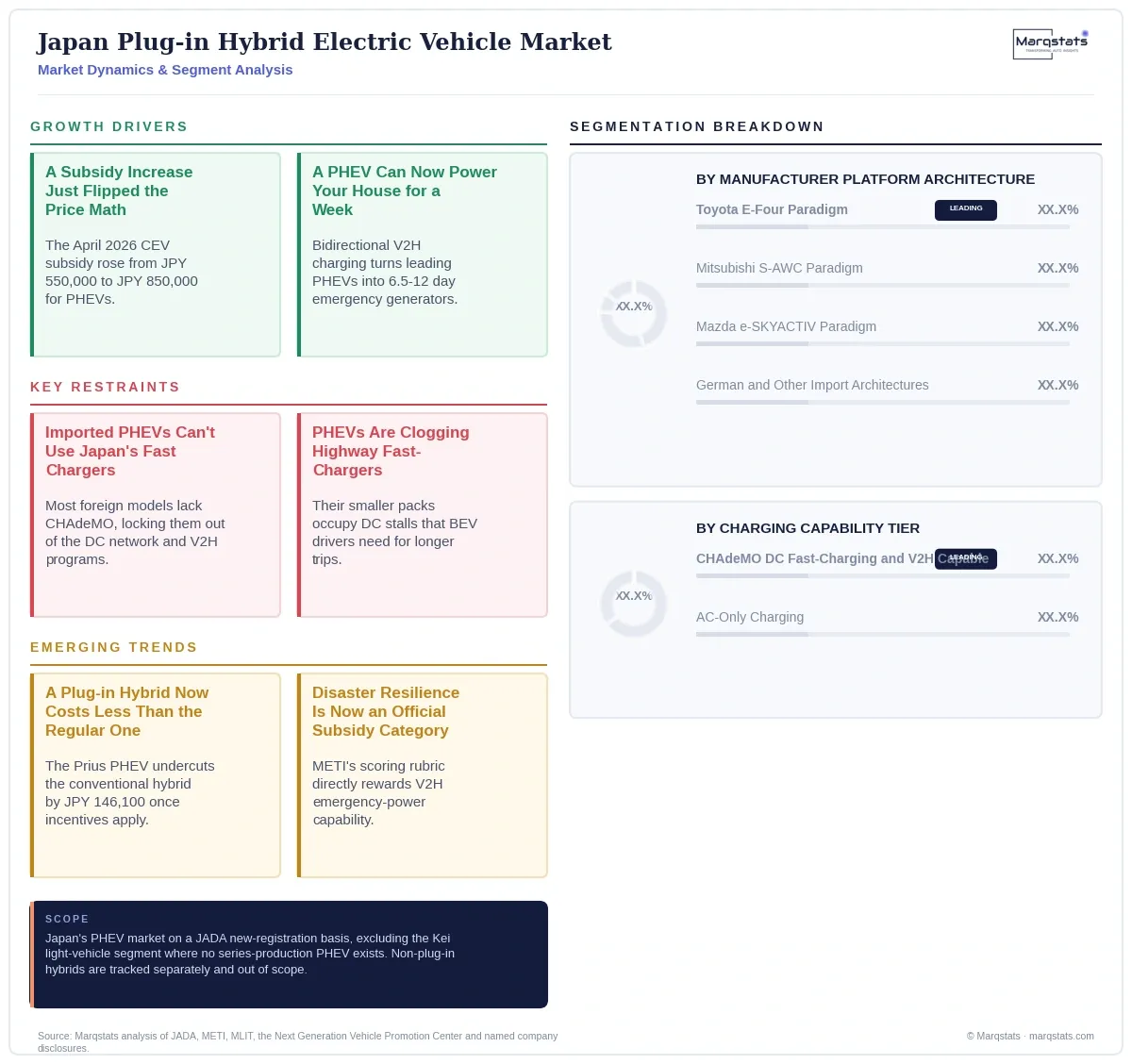
- The April 2026 increase of Japan's national Clean Energy Vehicle subsidy ceiling for qualifying PHEVs from JPY 550,000 to JPY 850,000 has already produced a documented price inversion in which the Toyota Prius PHEV Z grade costs JPY 146,100 less to own than the conventional hybrid Z grade once combined national and tax incentives apply, fundamentally altering the historical PHEV price-premium narrative.
- Bidirectional vehicle-to-home charging capability, standard on leading nameplates including the Mitsubishi Outlander PHEV and Toyota Crown Sport RS PHEV, allows a single vehicle with a full fuel tank to supply a typical household's daily 10 kilowatt-hour electricity consumption for 6.5 to 12 consecutive days, a disaster-resilience function explicitly rewarded under METI's revised Cross-Sector Resilience subsidy scoring category.
- Municipal incentive stacking through the Tokyo Metropolitan Government's Cool Net Tokyo program adds up to JPY 250,000 on top of national subsidies for buyers contracting renewable electricity or installing approved vehicle-to-home hardware, compressing the retail price gap between a conventional hybrid and plug-in hybrid to within JPY 300,000 to JPY 400,000 on models including the Toyota Harrier and Crown Sport.
- Standard CHAdeMO direct-current fast-charging integration on major domestic PHEVs delivers 60 to 80 kilometers of driving range in a 20-to-30-minute quick-charge session, making zero-emission city driving genuinely accessible to apartment dwellers who lack dedicated home-charging parking stalls, a structural advantage unique among global PHEV markets.
- Off-peak overnight electricity tariffs of JPY 20 to 25 per kilowatt-hour reduce PHEV electric-mode operating costs to JPY 383 per 100 kilometers against JPY 1,346 for a pure gasoline vehicle, generating annual fuel savings of roughly JPY 96,300 for a suburban commuter driving 10,000 kilometers predominantly in electric mode.
Key Restraints
- Foreign import PHEVs face a structural competitive disadvantage: most non-Japanese models lack CHAdeMO fast-charging and bidirectional vehicle-to-home capability, restricting them to single-phase 3.2 to 6.0 kilowatt Type 1 AC charging that prevents access to Japan's public fast-charging network and disaster-resilience emergency power programs valued by domestic buyers.
- Public charging network operators report that PHEVs drawing only 20 to 37 kilowatts at expressway Service Area and Parking Area direct-current stalls occupy charging capacity that could otherwise serve battery-electric vehicles requiring 50 to 90 kilowatt output, creating queuing bottlenecks that have prompted operator complaints about PHEV usage patterns.
- Because conventional Japanese non-plug-in hybrids already achieve thermal efficiencies exceeding 40%, the operational payback window for a PHEV's retail price premium can span 7 to 10 years without public subsidies, meaning the market's continued growth remains structurally dependent on the Clean Energy Vehicle subsidy program's continuation at its current elevated funding level.
- Japan's Kei light-vehicle segment, which accounts for a substantial share of total domestic new-car sales, remains entirely closed to PHEV technology, since packaging an internal combustion engine, electric traction motors, an onboard charger and a traction battery within Kei dimensional and weight limits has proven economically and physically prohibitive for every manufacturer that has attempted it.
Key Trends
- The April 2026 subsidy increase has produced a genuine, documented price inversion rather than merely narrowing the historical PHEV premium: for the Toyota Prius specifically, combined incentives now make the plug-in hybrid configuration cheaper to actually own than the conventional hybrid, a verified current market condition this analysis discloses as distinct from the source material's original static subsidy assumption.
- Bidirectional vehicle-to-home charging has evolved from a premium convenience feature into an explicitly subsidized policy priority: METI's revised Cross-Sector Resilience scoring category now directly rewards manufacturers demonstrating disaster-response contracts with municipal bodies, formalizing PHEVs' role as decentralized emergency power infrastructure in a nation prone to earthquakes and typhoons.
- Chinese manufacturer entry into Japan's PHEV market has moved from evaluation to genuine commercial commitment: BYD Auto Japan launched its first Japanese PHEV in December 2025 and announced two additional plug-in models for the second half of 2026, a meaningful shift from the pure battery-electric strategy the company initially pursued in Japan.
- Domestic manufacturers have shifted PHEV positioning from compliance-oriented economy cars toward premium performance flagships, exemplified by Toyota's Crown Sport RS PHEV at JPY 7.65 million and Mazda's three-row CX-80 PHEV, using electric motor torque to enhance driving dynamics rather than solely to minimize fuel consumption.
- Regional PHEV adoption increasingly correlates with single-family detached housing density and cold-climate reliability requirements rather than income alone: Tohoku and Hokkaido buyers favor four-wheel-drive PHEVs specifically for cabin-heating reliability and emergency backup power generation despite winter range degradation of 25% to 35%.
Strategic Implications
For a Chinese or other new market entrant, resolving the CHAdeMO fast-charging and bidirectional vehicle-to-home compatibility gap is the single most consequential near-term priority, since foreign imports lacking these features remain structurally excluded from Japan's disaster-resilience subsidy incentives and public fast-charging network; entrants should price below JPY 4.2 million to compete in the value tier BYD is targeting, while investing in certified nationwide maintenance networks to satisfy METI's 200-point Clean Energy Vehicle qualification rubric.
For an incumbent Japanese manufacturer, the April 2026 subsidy increase and the documented Prius price inversion demonstrate that PHEV positioning can now credibly compete on total cost of ownership rather than solely on efficiency or performance messaging; manufacturers should engineer battery capacities toward 100 to 120 kilometers of WLTC electric-only range to preserve top-tier subsidy eligibility as statutory standards evolve, and should standardize bidirectional vehicle-to-home hardware across mid- and high-tier trims to capture the full scope of municipal emergency-resilience incentives.
For a Tier-1 component supplier or charging infrastructure investor, sustained demand for integrated power electronics, bidirectional DC-DC converters and specialized rear e-Axles will continue independent of near-term volume fluctuations, while charging network operators should prioritize turnkey residential and multi-unit-residential AC charging deployment paired with smart vehicle-to-home energy management software that captures daytime solar overproduction and provides evening peak-load shaving.
Outlook
Base case: 66,325 new registrations by 2030 (10.00% five-year volume CAGR), JPY 404.58 billion (USD 2.697 billion) annual value. This trajectory assumes METI maintains its Clean Energy Vehicle subsidy structure at the elevated JPY 850,000 ceiling implemented in April 2026, Tokyo Metropolitan Government incentives continue through the late 2020s, and domestic manufacturers add 2 to 3 new plug-in configurations across mainstream D-segment and minivan platforms without major disruption to current charging infrastructure access.
Upside case: 88,000 new registrations by 2030 (16.38% five-year volume CAGR), JPY 545.60 billion (USD 3.762 billion) annual value. The specific trigger is national fuel-economy standards tightening toward 2030 targets in a way that financially penalizes non-plug-in gasoline and hybrid fleets, combined with Chinese manufacturers including BYD successfully introducing competitively priced, CHAdeMO-compatible PHEVs between JPY 3.5 million and JPY 4.2 million, and the rollout of dynamic time-of-use vehicle-to-home grid tariffs establishing PHEVs as genuine revenue-generating home batteries.
Downside case: 45,000 new registrations by 2030 (1.79% five-year volume CAGR), JPY 261.00 billion (USD 1.684 billion) annual value. The specific trigger is METI scaling down PHEV subsidies below JPY 250,000 to redirect the national green-vehicle budget toward commercial zero-emission trucks and passenger battery-electric vehicles, combined with public charging operators imposing differential tariffs or time limits on PHEVs at high-power CHAdeMO stalls, and fifth-generation non-plug-in hybrids achieving 30 to 35 kilometers per liter attracting cost-sensitive buyers away from the plug-in segment.
Market Segmentation
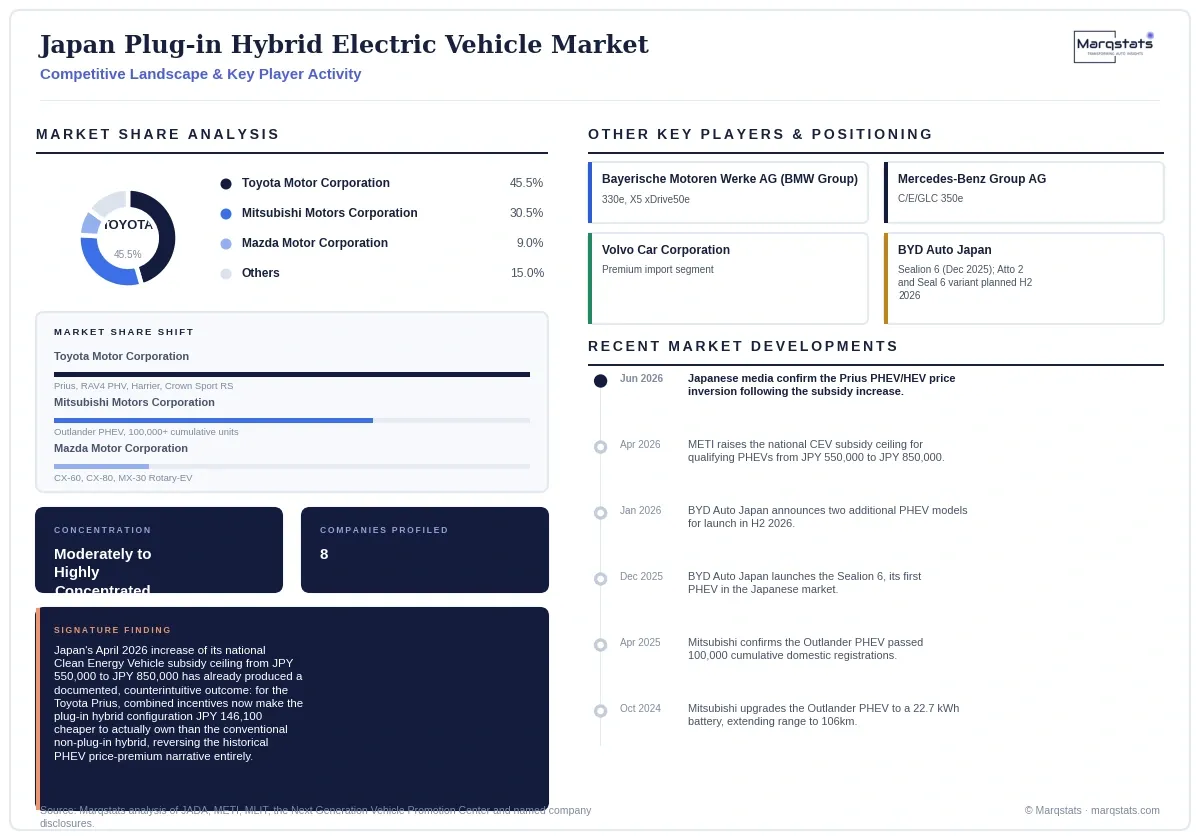
Toyota's series-parallel transaxle power-split architecture, integrated across the Prius, RAV4 PHV, Harrier PHEV and Crown Sport RS platforms, commanded 45.5% of 2024 domestic PHEV share, reflecting Toyota's strategy of embedding plug-in powertrains within mainstream nameplates rather than manufacturing standalone dedicated models.
Mitsubishi's twin-motor series-parallel architecture with independent front and rear e-Axles, anchored by the Outlander PHEV and Eclipse Cross PHEV, held 30.5% of 2024 share, distinguished by standard CHAdeMO direct-current fast-charging across all grades and Super All Wheel Control capability favored in suburban and snowy prefectures.
Mazda's longitudinal parallel motor-in-bellhousing architecture, spanning the CX-60 PHEV, CX-80 PHEV and MX-30 Rotary-EV, held 9.0% of 2024 share, offering a mechanically distinct rear-wheel-drive-biased layout including the series rotary-engine range-extender configuration unique to the MX-30.
German premium P2 motor-layout imports from BMW, Mercedes-Benz and Porsche held 8.5% of 2024 share, while other domestic and import architectures including the Lexus NX450h+ and RX450h+ and BYD's newly launched Sealion 6 accounted for the remaining 6.5%, together representing the segment most structurally exposed to CHAdeMO compatibility limitations.
Vehicles equipped with standard CHAdeMO direct-current fast-charging and bidirectional vehicle-to-home power feed, including the Mitsubishi Outlander PHEV, Toyota Crown Sport RS PHEV and RAV4 PHV, represented the majority of 2024 domestic registrations, qualifying for METI's Cross-Sector Resilience subsidy scoring category and Tokyo's vehicle-to-home municipal grant add-on.
Vehicles restricted to Type 1 single-phase alternating-current charging, comprising most German and other foreign import nameplates alongside Mazda's non-rotary CX-60 and CX-80 platforms, face structural exclusion from Japan's public fast-charging network and disaster-resilience emergency power initiatives, a genuine competitive disadvantage in a market where these capabilities are explicitly subsidized.
By Geography
Kanto (Greater Tokyo)
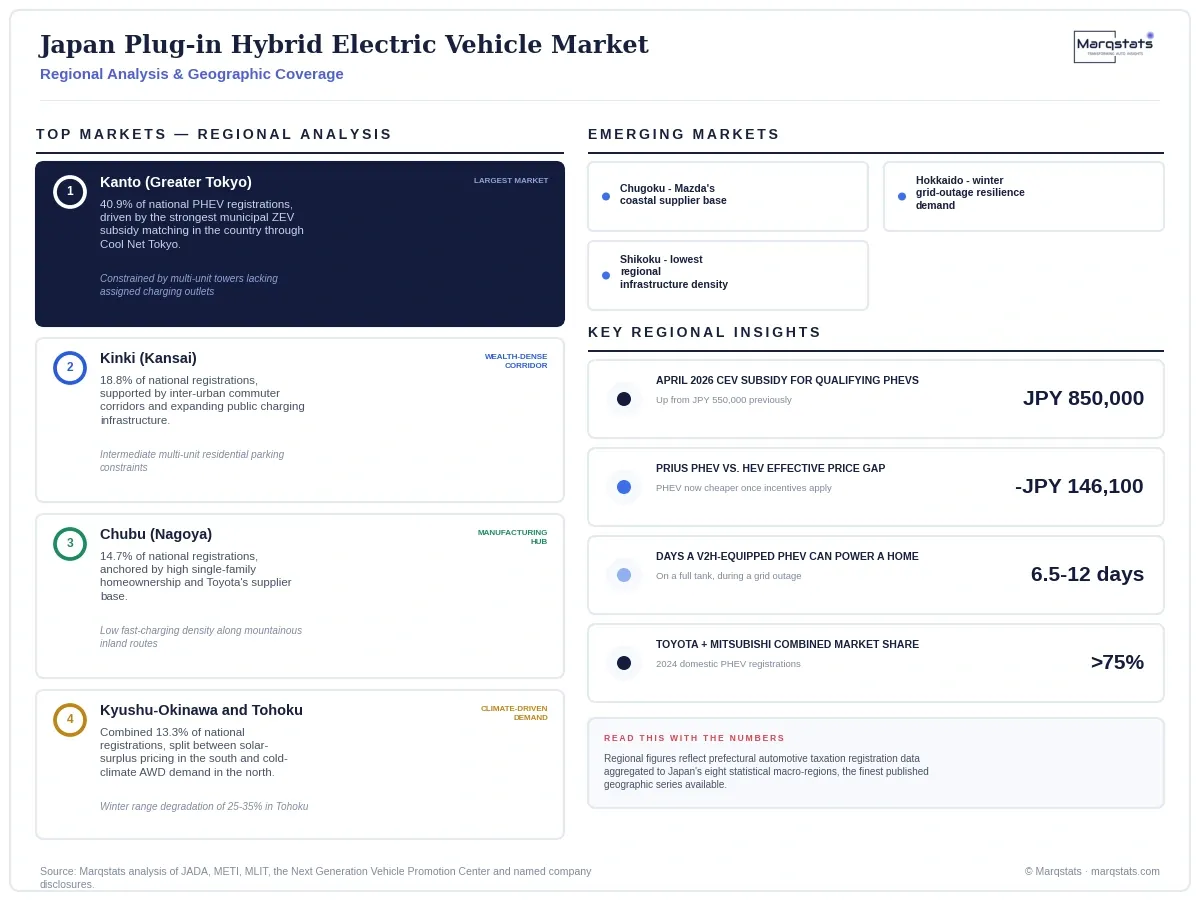
Kanto accounts for 40.9% of national PHEV registrations, driven by the strongest municipal ZEV subsidy matching in the country through the Tokyo Metropolitan Government's Cool Net Tokyo program, extensive corporate fleet demand and dense dealership networks, constrained primarily by a high share of multi-unit residential towers lacking assigned Level 2 charging outlets.
Kinki (Kansai - Osaka and Kyoto)
Kinki holds 18.8% of national registrations, supported by inter-urban commuter corridors, expanding public charging infrastructure and high regional wealth density, with intermediate multi-unit residential parking constraints limiting further household charging penetration.
Chubu (Nagoya and Aichi)
Chubu holds 14.7% of national registrations, anchored by high single-family detached homeownership rates and its position as the central manufacturing hub for Toyota group suppliers, constrained by low public fast-charging density along inland mountainous arteries.
Kyushu-Okinawa and Tohoku
Kyushu-Okinawa holds 7.3% of national registrations, supported by high solar penetration and midday renewable energy surplus pricing, while Tohoku holds 6.0%, driven by demand for four-wheel-drive traction and severe cold-climate winter driving reliability requirements that favor PHEVs over battery-electric alternatives.
Chugoku, Hokkaido and Shikoku
Chugoku holds 4.8% of national registrations, anchored by Mazda's supplier base and coastal manufacturing logistics corridors; Hokkaido holds 4.2%, driven by cold-weather operations and winter grid-outage resilience concerns; and Shikoku holds the smallest share at 3.3%, reflecting the lowest regional public PHEV infrastructure installation density nationally.
How Competition Is Evolving
Japan's PHEV market exhibits moderate-to-high concentration: Toyota Motor Corporation and Mitsubishi Motors Corporation together control more than 75% of domestic sales volume, with Toyota holding 45.5% and Mitsubishi holding 30.5% of 2024 registrations, while Mazda Motor Corporation functions as the secondary domestic challenger at 9.0% share.
Competitors differentiate primarily on platform architecture and charging capability; Toyota integrates plug-in powertrains across mainstream nameplates using its series-parallel E-Four architecture, Mitsubishi competes on standard CHAdeMO fast-charging and Super All Wheel Control twin-motor capability across its Outlander PHEV lineup, and Mazda differentiates through longitudinal rear-wheel-drive-biased architecture including its unique MX-30 series rotary-engine range extender.
The most significant recent competitive-landscape shift is Chinese manufacturer BYD Auto Japan's entry into the domestic PHEV segment: after initially competing exclusively with battery-electric vehicles, BYD launched the Sealion 6 PHEV in December 2025 and announced plans in January 2026 to introduce two additional plug-in models, the Atto 2 and a Seal 6 variant, in the second half of 2026, representing the first substantive Chinese PHEV entry into a market historically dominated by domestic manufacturers.
Companies Covered
The report profiles 8+ companies with full strategy and financials analysis, including:
Recent Market Activity
Table of Contents
Coverage & Segmentation
Coverage spans Japan's Plug-in Hybrid Electric Vehicle market on a new registered-vehicle (Torokusha) basis, as tracked by the Japan Automobile Dealers Association, across a 2020-2025 historical period and a 2026-2030 forecast period, with 2025 as the base year given the most recent complete annual dataset available. The market is sized in both JPY/USD value and unit volume, covering PHEVs classified as Next-Generation Vehicles under Japan Automobile Manufacturers Association taxonomy. Two segmentation dimensions are quantified: manufacturer platform architecture and charging capability tier.
Excluded from scope: the Kei light-vehicle segment, where no series-production PHEV currently exists due to dimensional and weight packaging constraints; non-plug-in hybrid electric vehicles, tracked as a separate, larger category; and commercial medium- and heavy-duty PHEVs, which represent a negligible 0.1% of registrations. A separate Marqstats study addresses Japan's battery-electric vehicle market on a comparable basis.