Market Snapshot
Key Takeaways
Market Overview & Analysis
Report Summary
The Middle East hybrid off-road vehicle market covers sport utility vehicles with genuine off-road orientation fitted with hybrid, plug-in hybrid or range-extended propulsion. Inclusion turns on capability rather than on body shape: rugged all-wheel-drive and four-wheel-drive products designed for sand, mountain, towing, wading or adventure use are counted, while conventional soft-road crossovers sharing a nameplate family but not the capability are excluded. The definition is deliberately architecture-agnostic because Gulf buyers of these vehicles are cross-shopping a mild-hybrid body-on-frame incumbent against a range-extended Chinese newcomer, and a study that separated them by powertrain would not describe the choice being made.
That breadth is the market's defining analytical problem and it must be handled explicitly rather than absorbed. Of the 2,414 units identified in Saudi Arabia and the United Arab Emirates in 2025, mild hybrids represent about 28%, full hybrids about 38% and plug-in variants about 33%. The mild-hybrid share matters most: a 48-volt system recovers braking energy and smooths engine restart but cannot propel the vehicle, so those units deliver no electric-driving benefit whatever. Counting them produces a larger and faster-growing market than a strict definition would, and a reader who assumes the whole base plugs in will overstate the segment's electrification substantially.
The segment's commercial logic is nevertheless coherent, and it rests on a point that applies with unusual force in this region. Off-road use is where battery-electric vehicles are least viable: remote-site range, towing loads, sustained high ambient temperatures and the absence of charging beyond the metropolitan areas all work against pure battery propulsion. Electrified architectures that retain a combustion path answer those constraints while delivering the low-speed torque control that genuinely improves off-road driving. That is why the Gulf 4x4 is being electrified through hybrid rather than battery routes, and why the transition here will look different from the passenger-car transition.
Hybrid Off-Road Vehicle Sales Volume and Forecast
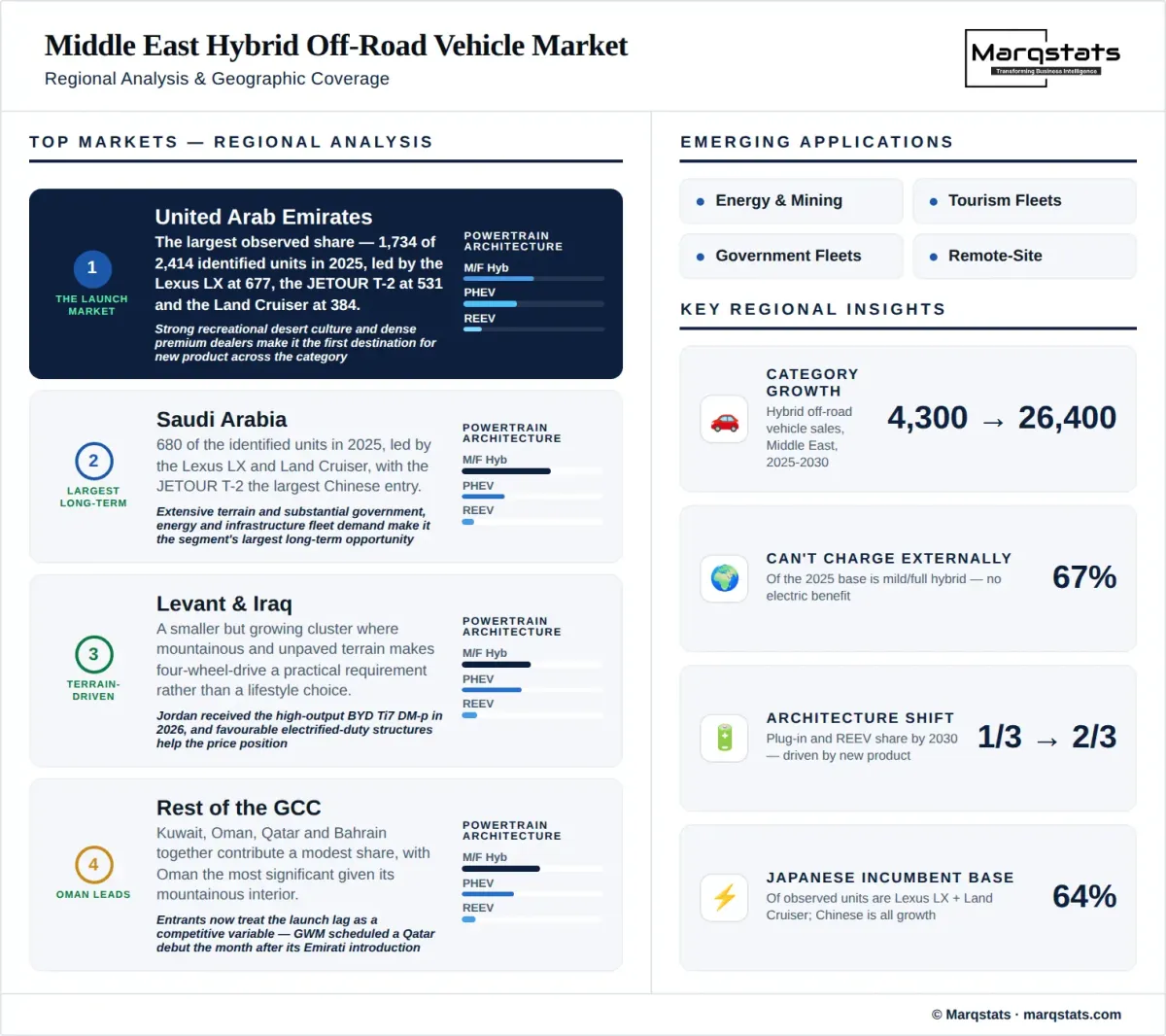
Annual hybrid off-road vehicle sales across the Middle East rise from 4,300 in 2025 to 26,400 in 2030, a 43.76% compound annual growth rate and an absolute increase of 22,100 units. The indicative 2031 endpoint is approximately 38,000 vehicles. The composition shifts materially across the period: plug-in and range-extended architectures move from about a third of the market to roughly two thirds, as Chinese entrants launching purpose-built platforms take share from the mild and full hybrid incumbents that dominate the base today. The headline growth therefore understates how much the market changes in character.
Retail value grows from USD 344.00 million to USD 1,478.40 million, a 33.86% compound annual growth rate. Value compounds almost ten points more slowly than volume because blended transaction prices fall from USD 80,000 to USD 56,000, a decline of about 6.89% each year. The starting price is high because the 2025 base is dominated by premium incumbents: the Lexus LX alone accounts for 926 of the 2,414 observed units across the two largest markets, with the Toyota Land Cruiser at 624 and Land Rover models adding a further 116. As Chinese product priced well below those nameplates takes volume share, the average falls sharply even where individual model prices hold firm.
Confidence is moderate and the reasons are specific. The identified 2,414 units are an acknowledged lower bound rather than a count, because several hybrid variants of qualifying models are not powertrain-coded in available registration data and are therefore invisible to the model-level extract. The regional base of 4,300 adds Kuwait, Oman, Qatar, Jordan and other markets, plus off-road electrified models missing or unclassified in that dataset. Judgement also enters at the definitional boundary, since deciding whether a given nameplate is off-road-oriented or a soft-road crossover is a capability assessment rather than a data lookup.
Market Dynamics
Key Drivers
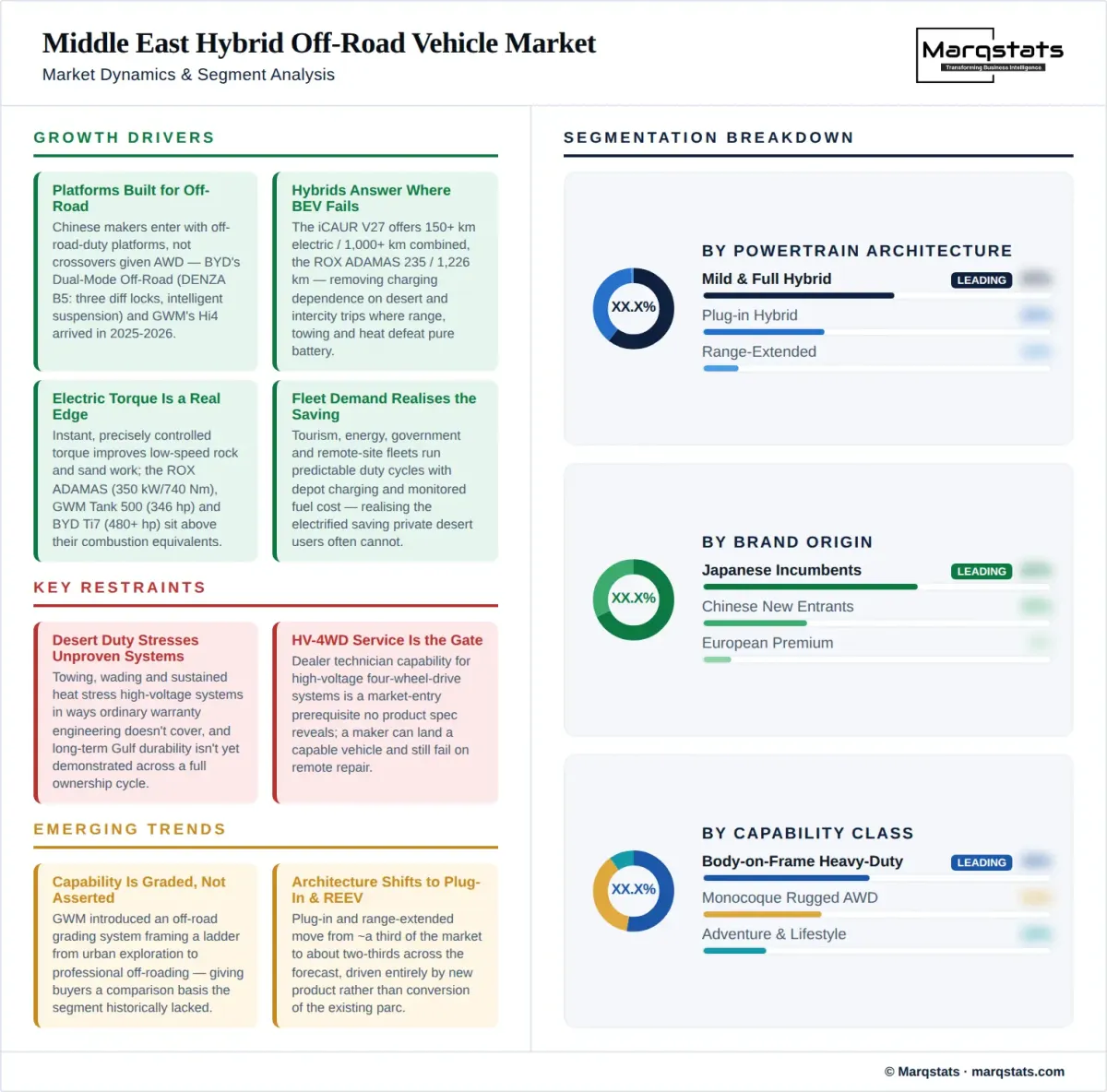
- Chinese manufacturers are entering with platforms engineered for off-road duty rather than with crossovers given all-wheel drive. BYD's Dual Mode Off-Road architecture underpinning the DENZA B5 combines three differential locks, intelligent suspension and cell-to-chassis battery integration, and GWM introduced its Hi4 intelligent four-wheel-drive hybrid system to the region in December 2025.
- Electrified architectures answer the constraints that make battery-electric vehicles unsuitable for off-road use. The iCAUR V27 offers more than 150 kilometres of pure-electric range with over 1,000 kilometres combined, and the ROX ADAMAS 235 kilometres WLTC with 1,226 kilometres total, which removes charging dependence on desert and intercity trips entirely.
- Electric torque delivery is a genuine capability advantage rather than a marketing claim. Instant, precisely controlled torque improves low-speed rock and sand work, and outputs such as the ROX ADAMAS at 350 kW and 740 Nm, the GWM Tank 500 HEV at 346 horsepower and 648 newton metres, and the BYD Ti7 DM-p at more than 480 horsepower place electrified products above their combustion equivalents.
- Fleet demand extends well beyond private buyers into tourism, energy, government and remote-site transport, where duty cycles are predictable, depot charging is feasible and fuel consumption is a monitored operating cost. These buyers can realise the electrified saving that private desert users often cannot.
- Incumbent premium nameplates are electrifying their own ranges, which legitimises the category rather than defending against it. Toyota, Lexus and Land Rover electrified variants account for the majority of the observed 2025 base, so buyers already accept electrification in this body style before the Chinese entrants arrive.
Key Restraints
- Desert and off-road duty places demands on thermal management and battery protection that ordinary warranty engineering does not cover. Towing loads, water wading and sustained high ambient temperature all stress high-voltage systems, and the long-term durability of these architectures under Gulf conditions is not yet demonstrated across a full ownership cycle.
- Dealer technician capability for high-voltage four-wheel-drive systems is a market-entry prerequisite that no product specification reveals. A manufacturer can land a capable vehicle and still fail if its network cannot diagnose and repair a high-voltage fault in a remote location, and this constraint bears hardest on the newest entrants.
- Residual value support is unproven for the Chinese entrants in a segment where incumbent nameplates have decades of resale credibility. Gulf off-road buyers are unusually residual-conscious because these vehicles hold value strongly, and a premium Chinese product without demonstrated resale performance faces a total cost of ownership disadvantage regardless of purchase price.
- Combustion remains important in genuinely remote use cases where any electrified complexity is a liability. Where a vehicle operates days from a dealer network, mechanical simplicity and universal parts availability outweigh fuel savings, and this constrains the category's ceiling in exactly the applications the region romanticises.
Key Trends
- Off-road capability is being formalised and marketed as a graded specification rather than asserted. GWM introduced an off-road grading system alongside its regional Hi4 launch, framing a product ladder from urban exploration to professional off-roading, which gives buyers a comparison basis the segment has historically lacked.
- Architecture is shifting from mild and full hybrid toward plug-in and range-extended systems, moving from roughly a third of the market to about two thirds across the forecast. The shift is driven entirely by new product rather than by conversion of the existing parc.
- Purpose-built off-road hybrid platforms are displacing adapted powertrains, with dedicated architectures such as Dual Mode Off-Road and Hi4 designed around differential locks, suspension articulation and terrain modes rather than fitted to an existing crossover base.
- Terrain-mode software is becoming a differentiator alongside hardware. The ROX ADAMAS carries dedicated road, mountain, mud, snow, wading and sand modes under desert-specific thermal management, and calibration for regional conditions is increasingly named at launch rather than left implicit.
Market Segmentation
Mild and full hybrids account for approximately 67% of the observed 2025 base and represent the incumbent position, led by the Lexus LX at 926 units and the Toyota Land Cruiser at 624 across Saudi Arabia and the United Arab Emirates. Neither charges externally, and the mild-hybrid portion cannot propel the vehicle on electricity at all. The segment declines as a share across the forecast while growing modestly in absolute terms, and it is the only part of this market that appears in no other study in the catalogue.
Plug-in hybrid off-road vehicles account for about a third of the 2025 base, led by the JETOUR T-2 at 691 units across the two largest markets and including the Deepal G318 and Land Rover Range Rover and Range Rover Sport variants. The architecture retains full mechanical drive from the engine, which matters off-road where a mechanical path to the wheels is a reliability argument, and the DENZA B5 and B8 and BYD Ti7 DM-p extend it into purpose-built platforms.
Range-extended off-road vehicles are the newest and fastest-growing architecture, effectively absent from the 2025 base and arriving through the ROX ADAMAS and the iCAUR V27. These drive on their motors and use the engine only to generate electricity, which delivers the smoothest low-speed torque control of the three architectures and the longest combined ranges, at the cost of no mechanical drive path if the electric system fails.
Body-on-frame vehicles are the segment's traditional core and the class Gulf buyers most associate with genuine capability, covering the Toyota Land Cruiser, Lexus LX and GWM Tank ranges. Ladder-frame construction supports towing and sustained rough-terrain loading that monocoque designs cannot match, and electrification here is generally conservative, using mild or full hybrid systems that add torque without compromising the mechanical architecture.
Monocoque rugged vehicles combine unitary construction with genuine terrain capability through differential locks, suspension articulation and terrain-mode software rather than through frame construction. This is where most new Chinese product sits, including the DENZA B5 with its three differential locks and the JETOUR T-2, and it is the fastest-growing capability class because it accepts electrified packaging more readily than ladder-frame designs.
Adventure and lifestyle vehicles carry authentic off-road hardware in styling aimed at recreational rather than professional use, exemplified by the boxy positioning of the iCAUR V27 with its combination of city usability and off-road ability. The class matters commercially because it converts buyers who want capability as an option rather than a requirement, and it carries the segment's highest proportion of first-time electrified purchases.
Japanese manufacturers hold the largest share of the current base and the deepest Gulf off-road credibility, with the Lexus LX and Toyota Land Cruiser together accounting for roughly 64% of observed 2025 units. Their advantage is service network depth and demonstrated durability in regional conditions over decades. Their exposure is architectural: their electrified variants are predominantly mild and full hybrids, which now sit below incoming plug-in and range-extended products on every electric metric.
European premium manufacturers occupy the luxury position through Land Rover Discovery, Range Rover and Range Rover Sport variants, appearing at low volumes totalling 116 units across the two largest markets in 2025. Their plug-in systems are specified for refinement and performance alongside capability, and their regional relevance rests on brand position and established off-road heritage rather than on the running-cost or specification arguments driving the segment's growth.
Chinese manufacturers account for a minority of the 2025 base and effectively all of the forecast growth, entering through BYD and DENZA, Chery's JETOUR and iCAUR brands, Changan's Deepal, GWM's Tank range and ROX Motor. Their distinguishing feature in this segment is that they are competing on engineered capability rather than on price alone, with dedicated off-road hybrid platforms, formal capability grading and specifications calibrated for regional heat and terrain.
Private and recreational buyers form the largest application and purchase on capability, prestige and range, with desert driving, camping and long intercity journeys the defining use cases. Charging behaviour in this group is inconsistent because recreational use is exactly where charging access is weakest, so the electrified benefit realised is often below the specification even where the hardware is capable of delivering it.
Government and institutional fleets buy for security, civil defence, municipal and infrastructure duties where four-wheel-drive capability is a functional requirement rather than a preference. These buyers offer electrified products their strongest total cost of ownership case because vehicles return to equipped depots, duty cycles are predictable, and fleet emissions reporting increasingly carries policy weight in the United Arab Emirates and Saudi Arabia.
Energy, mining and remote-site operators run the most demanding duty cycles in the region and apply the strictest procurement standards on durability, parts availability and field serviceability. This application is simultaneously the segment's most valuable opportunity and its hardest to win, because operational reliability at distance from a dealer network outweighs both purchase price and fuel cost in the evaluation.
Tourism and desert operations cover safari fleets, resort transport and adventure operators running high daily mileage over sand in concentrated locations. The application suits electrified vehicles particularly well because operations are depot-based, allowing reliable overnight charging, while the low-speed torque control and reduced cabin noise of electric propulsion improve the passenger experience these operators sell.
By Geography
United Arab Emirates
The United Arab Emirates holds the largest share of observed hybrid off-road volume, with 1,734 of the 2,414 identified units in 2025, led by the Lexus LX at 677, the JETOUR T-2 at 531 and the Toyota Land Cruiser at 384. The country is the region's launch market for the category: the iCAUR V27 debuted in Dubai in February 2026, the ROX ADAMAS in Abu Dhabi in October 2025, and GWM introduced its Tank 700 and Hi4 hybrid system to the region through the Emirates in December 2025. Strong recreational desert driving culture and dense premium dealer networks combine to make it the first destination for new product.
Saudi Arabia
Saudi Arabia accounts for 680 of the identified units in 2025, led by the Lexus LX at 249 and the Toyota Land Cruiser at 240, with the JETOUR T-2 at 160 the largest Chinese entry. The Kingdom's far larger vehicle market, extensive terrain and substantial government, energy and infrastructure fleet demand make it the segment's largest long-term opportunity, and Al-Futtaim's launch of DENZA there in August 2026 signals that premium Chinese entrants now regard it as a primary rather than a secondary market.
Levant and Iraq
The Levant and Iraq form a smaller but growing cluster where mountainous and unpaved terrain makes four-wheel-drive capability a practical requirement rather than a lifestyle choice. Jordan received the BYD Ti7 DM-p with intelligent all-wheel drive and more than 480 horsepower in July 2026, extending high-output electrified capability into the cluster, and import duty structures in several of these markets treat electrified powertrains more favourably than the Gulf states do.
Rest of the GCC
Kuwait, Oman, Qatar and Bahrain together contribute a modest share, with Oman the most significant given its mountainous interior and established off-road culture. These markets typically receive new product after Emirati launch and follow Emirati specification closely, though GWM's scheduling of a Qatar debut in the month following its Emirati introduction suggests entrants now treat the lag as a competitive variable rather than a constraint.
Rest of the Middle East
The remaining regional markets contribute the smallest share and are the least well captured in consolidated registration data. Terrain and use cases across these markets favour capable four-wheel-drive vehicles, but constrained purchasing power, limited premium dealer infrastructure and thin high-voltage service capability all slow electrified adoption, so the contribution is estimated rather than observed and is a recognised gap in the regional total.
How Competition Is Evolving
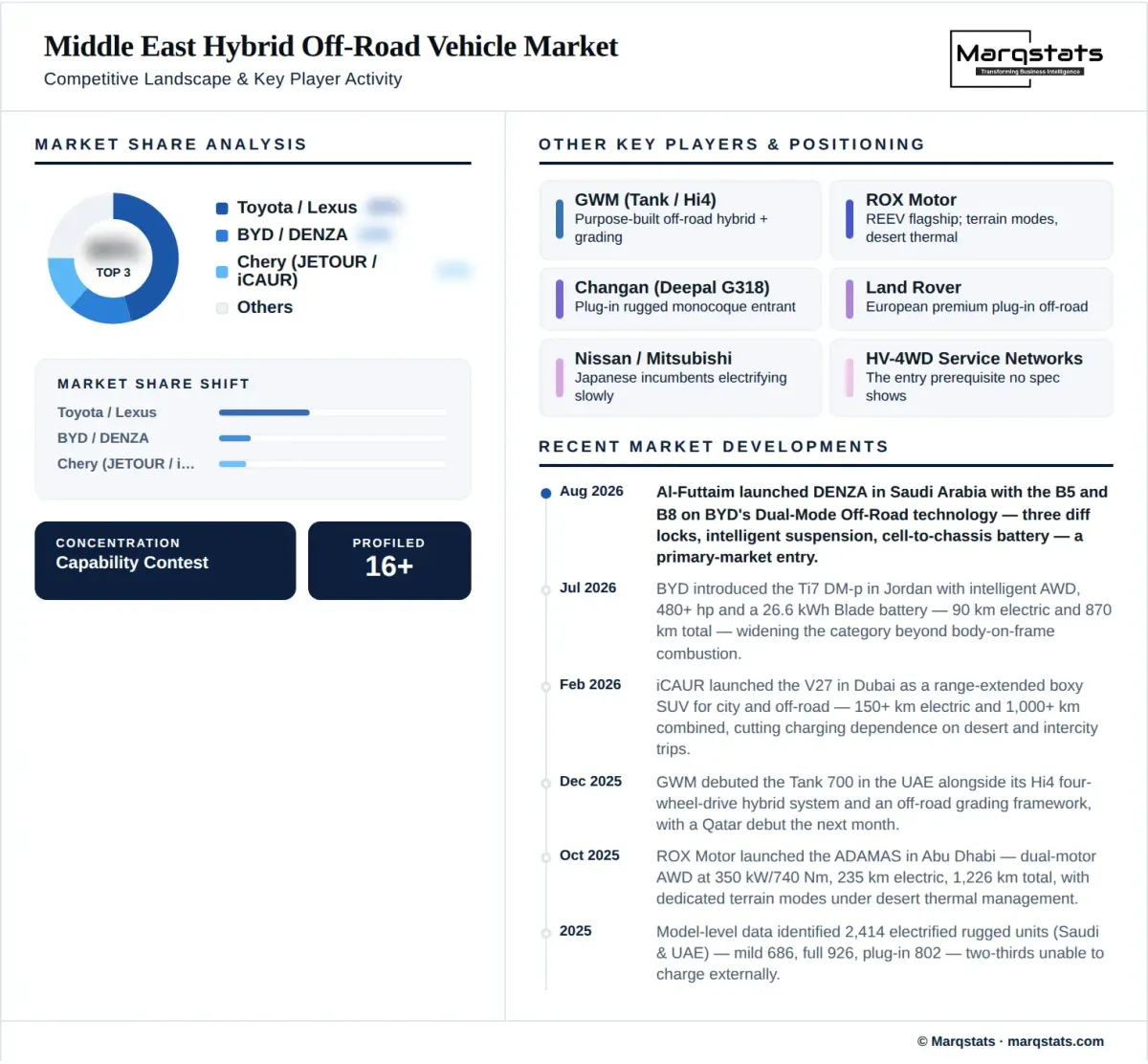
The Middle East hybrid off-road vehicle market is moderately concentrated at the top and fragmenting rapidly below it. Toyota and its Lexus division hold roughly 64% of observed 2025 volume through the Land Cruiser and LX, a position built over decades of demonstrated durability in regional conditions and supported by the deepest service network in the segment. Land Rover holds the luxury position at low volume. Below those incumbents the field is opening quickly, with Chery's JETOUR the largest Chinese presence and BYD, Changan, GWM, ROX Motor and Chery's iCAUR brand all having entered or expanded during 2025 and 2026.
What distinguishes this contest from the wider electrified SUV market is that the challengers are competing on engineering rather than on price positioning. The DENZA B5 arrived with three differential locks, intelligent suspension and cell-to-chassis battery integration on a platform designed for off-road duty. The ROX ADAMAS carries 350 kW, 740 Nm and six terrain modes with desert thermal management. GWM's Tank 500 HEV pairs a 2.0-litre turbocharged engine with a nine-speed hybrid transmission for 346 horsepower and 648 newton metres in a seven-seat four-wheel-drive body. These are credible capability claims rather than badge exercises, which is why the incumbent position is genuinely contested here.
Two constraints will decide outcomes more than product specification does, and neither appears in a brochure. The first is high-voltage service capability across a dispersed network: an off-road vehicle that fails far from a city requires diagnostic and repair capability that most new entrants have not yet built, and the segment's buyers know it. The second is residual value, which Gulf off-road buyers weigh unusually heavily because these vehicles traditionally hold value well. A premium Chinese product without demonstrated resale performance carries a total cost of ownership penalty that a lower purchase price does not automatically offset, and closing that gap takes ownership cycles rather than marketing.
Companies Covered
The report profiles 16+ companies with full strategy and financials analysis, including:
Recent Market Activity
Table of Contents
Coverage & Segmentation
The study covers the Middle East with country and cluster-level detail for the United Arab Emirates, Saudi Arabia, the Levant and Iraq, the rest of the Gulf Cooperation Council, and the remaining regional markets. It measures annual sales and registrations of electrified off-road-oriented sport utility vehicles as the primary unit and annual retail value in United States dollars as the secondary measure. The base year is 2025, the historical period covers 2021 to 2025, and the forecast period runs from 2026 to 2030 with an indicative 2031 endpoint. Segmentation covers powertrain architecture, capability class, brand origin and application.
Three boundaries define the market. Conventional soft-road crossovers are excluded regardless of powertrain, so inclusion turns on demonstrated terrain capability rather than on body shape or nameplate family. Purely combustion off-road vehicles are excluded, as are battery-electric off-road vehicles, since the study measures the electrified-with-combustion middle ground specifically. Commercial and utility four-wheel-drive vehicles outside passenger sport utility classification, including pickups and purpose-built site vehicles, fall outside scope even where they serve identical applications.
This market overlaps two studies in the catalogue and contains a portion measured nowhere else, so its figures are not additive to either. The plug-in portion, approximately a third of the market in 2025 rising toward a half by 2030, intersects regional plug-in hybrid SUV sales, where it represents roughly 30% falling to about 23%. The range-extended portion, negligible in the base and reaching roughly a fifth by 2030, intersects regional range-extended vehicle sales at approximately 15%. The mild and full hybrid portion, about two thirds of the base today, appears in no other study.