Market Snapshot
Key Takeaways
Market Overview & Analysis
Report Summary
Thailand's hybrid market is two businesses wearing one name, and they are moving in opposite directions. The domestic business sold 146,059 passenger hybrids in 2025 and is now growing at about 2.75% a year. The export business built 214,317 units in the same year, is still expanding, and has just attracted a THB 7.4 billion commitment to add mild-hybrid capacity from 2027. Reading either half as the market produces a wrong answer about the other.
The measure is annual new passenger hybrid electric vehicles sold domestically in Thailand, covering full hybrids and mild hybrids, and requiring that the vehicle cannot be charged from an external supply. Plug-in hybrids and range-extended vehicles are excluded and sold 8,621 and 990 units respectively in 2025; battery-electric vehicles are excluded at 120,301 units; commercial vehicles and motorcycles are excluded. Production is carried as a named dimension with its own series at 214,317 units and is never merged into the sales panel.
The analysis is written for Japanese and Chinese manufacturers weighing hybrid capacity against battery-electric capacity in the same plant footprint, component suppliers sizing hybrid system content against a shrinking domestic and growing export volume, distributors planning a powertrain mix that reversed in one year, and policy analysts modelling an excise structure that now prices hybrids on carbon dioxide rather than on category.
Thailand Hybrid Electric Vehicle Market Size and Forecast
Domestic hybrid passenger car sales were 146,059 units in 2025, up 24%, are estimated at 151,000 in 2026 and reach 186,000 by 2030, an increase of 39,941 units a year. Market value moves from USD 4.85 billion to USD 5.78 billion on an average transaction price falling from about USD 33,231 to USD 31,077, which at a disclosed constant THB 32.5 per USD is THB 1,080,008 falling to THB 1,010,002.
Two growth rates apply and this page is the one place in the Thai catalogue where the narrower rate is the higher of the two. The five-year value rate connecting 2025 and 2030 is 3.57%; the four-year rate connecting 2026 and 2030 is 3.95%. The gap runs the unusual way because 2026 is a stall year rather than a step-change year: domestic volume grew about 2.75%, which drags the five-year rate below the rate that applies once the segment settles into tracking the total market. Units compound at 4.95% across the five-year window and at 5.35% across the four-year one.
Value compounds behind units at 3.57% against 4.95%, a 1.38-point inversion, and the mechanism is the arrival of mild hybrids and smaller full hybrids rather than discounting on existing models. The Yaris Cross hybrid range at THB 809,000 to THB 929,000 sits well below the blended transaction price, and prices in that range were raised by THB 10,000 to THB 20,000 on 1 January 2026 rather than cut.
Restating the terminal as a share is the honest test of it. Reaching 186,000 units in 2030 asks hybrids to hold about 23.85% of an assumed 780,000-unit domestic market, against 23.51% of the 621,166 vehicles sold in 2025 and 21.55% of the 406,162 sold between January and July 2026. The forecast therefore assumes share stabilisation rather than share recovery, and a band is published rather than a point: 158,000 to 228,000 units and USD 4.91 billion to USD 7.09 billion.
The bear case is unusually easy to state and worth carrying publicly. If hybrids continue to lose share at the rate observed between 2025 and the first seven months of 2026, the segment settles near 158,000 units and USD 4.91 billion in 2030, a 0.25% value rate across five years. That is a market worth essentially the same in 2030 as in 2025, and it is a realistic downside rather than a stress test.
The Crossover Happened Inside One Year
The two powertrains traded places between 2025 and the middle of 2026 and both sides of the trade are reported. Hybrid passenger car sales were 146,059 units in 2025 against 120,301 battery-electric vehicles, so hybrids led by 21.41%. Between January and July 2026 battery-electric sales were 125,411 against 87,543 hybrids, so battery-electric led by 43.26%.
What changed was the growth rate rather than the level. Hybrid sales grew 24% in 2025 and annualise to about 150,074 in 2026, a rise of roughly 2.75%, while battery-electric registrations grew 88.0% over the same seven months after 80.27% growth in 2025. Hybrids have not contracted; they have stopped compounding, which in a market growing 15.4% means losing share every month.
Share is the cleaner way to read it. Hybrids took 23.51% of 621,166 domestic sales in 2025 and 21.55% of the 406,162 sold between January and July 2026, while battery-electric moved from 19.37% to 30.88% across the same comparison. Electrified vehicles together reached 55% of the new-car market in those seven months, so the category is expanding while its largest component is not.
The pricing moved against hybrids in the same window, which is at least a contributing mechanism. Hybrid list prices in the highest-volume range rose by THB 10,000 to THB 20,000 with effect from 1 January 2026, while excise on compliant domestically produced battery-electric vehicles can fall as low as 2% from the same date and entry battery-electric models are listed from THB 429,900. The relative price of a hybrid against a battery-electric vehicle moved the wrong way at exactly the moment battery-electric volume doubled.
Quarterly registration data shows the same pattern with a sharper edge. Hybrid registrations were 47,505 in the first quarter of 2026, up 29.8%, against 57,108 battery-electric registrations, up 120.5%, and the two powertrains together accounted for 52.0% of light vehicle registrations in the quarter.
The Export Business Is the One That Is Growing
Domestic demand and domestic output have decoupled and the gap is measurable. Thailand produced 214,317 passenger hybrids in 2025 against 146,059 sold domestically, a surplus of 68,258 units equal to 31.85% of output, and the country builds 1.47 hybrids for every one it sells at home.
That surplus is the opposite of the battery-electric position and stating the pair is the most useful thing this page does. Thailand sold 125,411 passenger battery-electric vehicles between January and July 2026 and built 47,452, importing at least 62.16% of them, while it builds nearly half again as many hybrids as it sells. The country imports the powertrain it buys and exports the powertrain it builds.
Production is still rising while domestic demand flattens, which confirms which business the capacity serves. Hybrid passenger production rose 12.69% year on year in March 2026 in the same month that internal combustion passenger production fell 22.08%, so hybrid lines are absorbing capacity released by combustion rather than following the domestic hybrid order book.
The most recent capital commitment is explicitly an export commitment. The Board of Investment approved more than THB 7.4 billion in July 2026 for an upgrade at the AutoAlliance plant on the Eastern Seaboard in Rayong to build mild-hybrid vehicles from 2027, with output directed at Japan and ASEAN markets. Domestic mild-hybrid registrations were 846 units in the first quarter of 2026 against 859 a year earlier, so the investment case rests on demand that is not in Thailand.
For a supplier the practical consequence is that hybrid system content in Thailand should be sized on production, not on registrations. A component plan built from 146,059 domestic sales understates the addressable volume by 68,258 units, which is 46.73% more than the domestic figure alone implies.
Capital Is Rotating Out of Hybrids, Not Into Them
The Board of Investment's approvals across the three electrified powertrains give a clean read on where manufacturers are placing their money. Hybrid manufacturing accounts for THB 29.9 billion against THB 39.5 billion for battery-electric across 18 projects and THB 9.429 billion for plug-in hybrids across 7 projects, so hybrids hold 37.93% of the approved capital.
Set that against output and the direction becomes explicit. Hybrids were 214,317 of the 302,527 electrified passenger vehicles Thailand produced in 2025, or 70.84%, so the powertrain took 37.93% of the capital for 70.84% of the output, a ratio of 0.54. Plug-in hybrids ran the opposite way at 2.09, taking 11.96% of capital for 5.72% of output.
Capital running at roughly half the output share is what disinvestment looks like before it appears in the volume figures. It does not mean hybrid production falls; it means the incremental plant, tooling and battery capacity being approved today is weighted toward the plug-in and battery-electric powertrains, and hybrid lines will increasingly be maintained rather than expanded.
The state target for hybrid investment gives a second reading and it is more encouraging. The Board of Investment opened hybrid-specific incentives in July 2024 with a stated ambition of attracting at least THB 50 billion over four years, and THB 29.9 billion had been approved by May 2026, which is 59.80% of a four-year target in roughly 46% of the window. The scheme is running ahead of its own timetable even as hybrids lose ground against the other two powertrains.
The Excise Basis Changed Under the Segment
Hybrids were incentivised in Thailand as a category, and from 2026 they are incentivised as an emissions outcome. The Finance Ministry confirmed in September 2026 that carbon dioxide emissions would be the primary basis for excise incentives, with lower rates for manufacturers investing in local production, and that the framework covers conventional hybrids, plug-in hybrids and range-extended vehicles alongside battery-electric vehicles.
Compliant hybrids and plug-in hybrids face bands running from single-digit rates to the low 20% range, conditional on localisation, battery specification and advanced driver assistance content. Three conditions in one instrument means a hybrid designed for another market cannot simply be landed in Thailand and priced into the favourable band, which is the same structural point that applies to plug-in hybrids and which favours the manufacturers already building locally.
The tiering is being drawn on localised value rather than on powertrain, which changes who wins. The structure under discussion sets the highest duties on importers with no domestic manufacturing, moderate relief for existing Thai assemblers testing the market with imports, preferential brackets for domestic assembly with moderate local content, and the best rates for models with deep localisation of electronic components. On that ladder a locally built hybrid from an established Thai assembler sits close to the top.
The immediate effect on prices was upward, not downward. Hybrid list prices in the highest-volume range rose by THB 10,000 to THB 20,000 effective 1 January 2026, to THB 809,000 to THB 929,000 in one core model line, while compliant battery-electric excise fell as low as 2% from the same date. Whatever the eventual bands, the transition itself has so far cost hybrids relative price position.
A Parc Twice the Size of the Electric One
The installed base is where hybrids remain unambiguously dominant and it is the part of the market that does not reverse quickly. EVAT recorded 605,017 hybrids on the road as of December 2025 against 282,312 electric passenger vehicles, so the hybrid parc is 2.14 times the electric one.
Dividing stock by flow sizes the aftermarket rather than the showroom. The hybrid parc holds 4.14 years of 2025 sales, and it will keep growing for years after the sales crossover because a parc responds to cumulative flow rather than to current share. A service, parts and battery replacement business sized on 146,059 annual sales understates its addressable base by more than four times.
The three measures are kept strictly apart on this page because conflating them is the standard error in this category. Annual domestic sales of 146,059 units size the new vehicle opportunity; annual production of 214,317 units sizes the component and assembly opportunity; the parc of 605,017 vehicles sizes the aftermarket, and none of the three is a subset or a sum of another.
Hybrid battery replacement is the dimension that follows from the parc and it is not yet a market. A parc of 605,017 vehicles built up mostly since the early 2020s reaches first-replacement age across the forecast window, which is a service volume arriving on a schedule set by 2020 to 2025 sales rather than by anything happening in the showroom now.
Toyota Holds 47.4%, and the Japanese Incumbents Are Doubling Down
Hybrid supply in Thailand is a Japanese franchise and one company holds close to half of it. Toyota took 47.4% of the Thai hybrid market in 2025, and exported 42,800 hybrids within total exports of 208,500 units in January to July 2026 against 163,700 internal combustion units, so roughly one in five vehicles it ships abroad from Thailand is now electrified.
Honda has gone further on mix than anyone. Its e:HEV-led electrified sales reached 55,495 units in 2025, around a 20% electrified share, within total Honda sales of 74,044 and an 18% passenger car share, and it set a 2026 production target of 100,000 units at its full-capacity Prachinburi plant split roughly 76,000 domestic and 24,000 to 25,000 export, with the City the only remaining pure combustion model in its range.
Mazda has selected Thailand as its primary mild hybrid base on an explicitly export-weighted plan. It intends 100,000 hybrid units across 2027 and 2028 split 30% domestic and 70% export on investment above THB 5 billion, underwritten by a Board of Investment approval of over THB 7.4 billion for the Rayong upgrade. Japanese automotive and parts investment applications reached THB 28.31 billion in 2025, up 57%, within 302 Japanese applications worth THB 113.7 billion across all sectors.
The tariff arithmetic explains why building here beats shipping here. Customs duty on Japan-made imported vehicles runs up to 80%, so a Japanese manufacturer serving Thailand from Japan competes against its own Thai plant at a structural disadvantage. That is the same duty wall that shapes the premium segment, applied to a mass-market powertrain, and it is why hybrid localisation in Thailand is an export decision rather than a domestic one.
Market Dynamics
Key Drivers
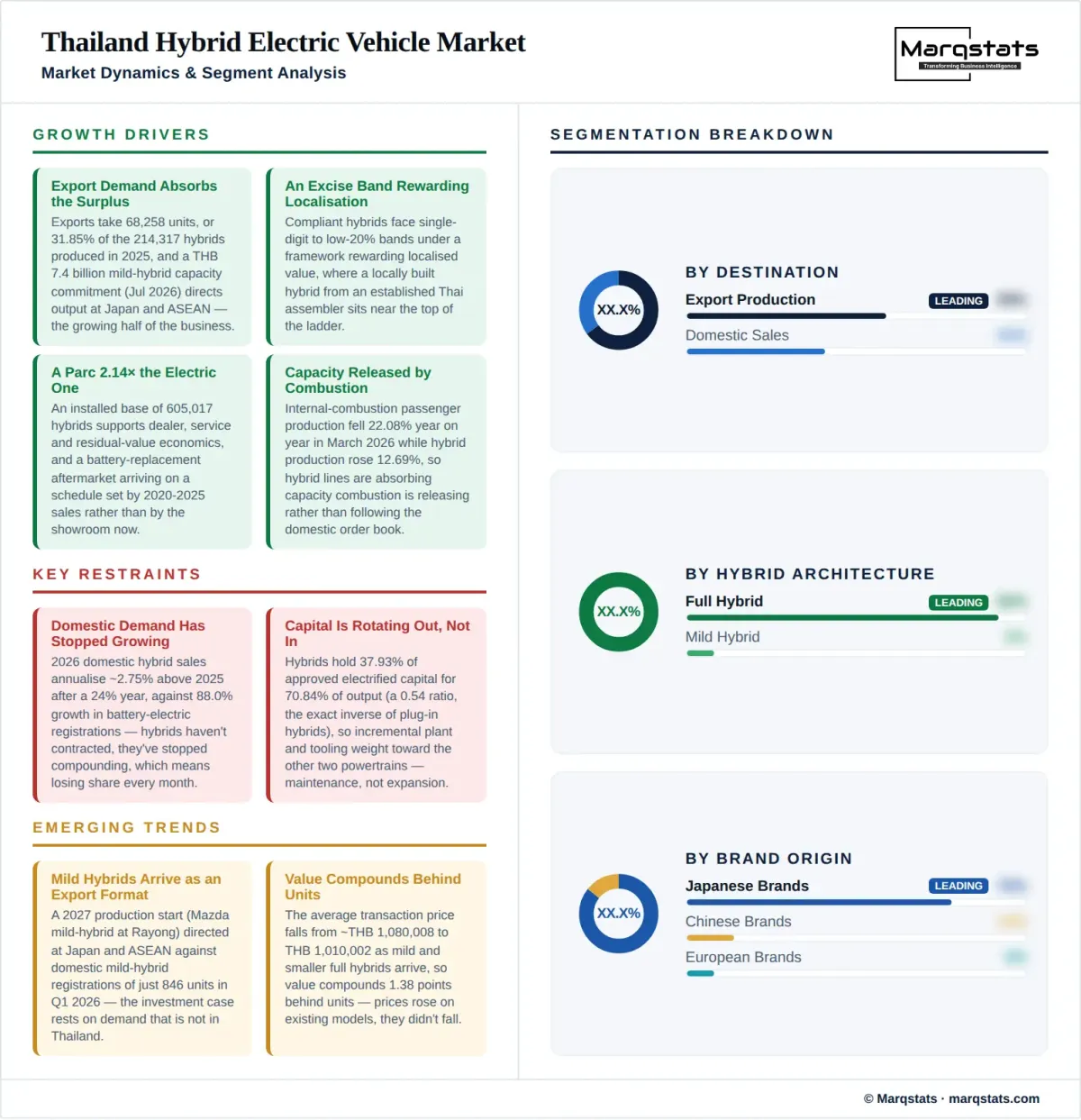
- Export demand absorbing 68,258 units, or 31.85% of the 214,317 hybrids produced in 2025, and a THB 7.4 billion mild-hybrid capacity commitment approved in July 2026.
- Excise bands running from single-digit rates to the low 20% range for compliant hybrids under a framework that rewards localised value.
- An installed base of 605,017 vehicles, 2.14 times the electric passenger parc, supporting dealer, service and residual value economics.
- A Board of Investment hybrid incentive opened in July 2024 with a stated THB 50 billion four-year ambition, 59.80% of which had been approved by May 2026.
- Capacity released by falling combustion output, with internal combustion passenger production down 22.08% year on year in March 2026 as hybrid production rose 12.69%.
Key Restraints
- Domestic demand growth of about 2.75% in 2026 after 24% in 2025, against 88.0% growth in battery-electric registrations over the same months.
- Relative price movement against the segment, with hybrid list prices up THB 10,000 to THB 20,000 from 1 January 2026 while compliant battery-electric excise fell as low as 2%.
- Approved capital at 37.93% of the electrified total for 70.84% of electrified output, a 0.54 ratio that points to maintenance rather than expansion.
- Share erosion from 23.51% of 621,166 domestic sales in 2025 to 21.55% of the 406,162 sold in January to July 2026.
Key Trends
- Mild hybrids arriving as an export format first, with a 2027 production start against domestic registrations of 846 units in the first quarter of 2026.
- Carbon dioxide emissions replacing powertrain category as the excise basis, applied with localisation, battery and driver assistance conditions together.
- Value compounding behind units at 3.57% against 4.95% as smaller hybrids priced from THB 809,000 take a larger share of the mix.
- Electrified vehicles reaching 55% of the new-car market in January to July 2026, so the category grows while its largest component holds flat.
Market Segmentation
Series-parallel systems capable of driving on electric power alone, accounting for effectively all of the 146,059 units sold in 2025 and the 87,543 sold between January and July 2026. Core model lines are priced from THB 809,000 to THB 929,000 at the volume end and above THB 989,000 in the next size class up.
Belt-driven starter-generator systems that cannot drive the vehicle alone, at 846 registrations in the first quarter of 2026 against 859 a year earlier. A THB 7.4 billion plant upgrade approved in July 2026 brings volume mild-hybrid production from 2027, directed at export markets rather than at this domestic base.
The largest hybrid body type and the one carrying the core volume model lines from THB 809,000, in a market where the same body type dominates battery-electric launches. Sport utility vehicles account for the majority of the 146,059 units sold in 2025.
The traditional hybrid body types, now under the most direct pressure from battery-electric models listed from THB 429,900, a price point no full hybrid in the market matches. This is where most of the 1.96-point share loss between 2025 and January to July 2026 was concentrated.
A smaller body type where electrified models of all kinds held around 35% of the multi-purpose and van market in 2025, well above the 23.51% hybrid share of total 2025 domestic sales. Hybrid powertrains suit the duty cycle but compete against plug-in models entering the same segment.
The volume band anchored by model lines at THB 809,000 to THB 929,000 and from THB 989,000, sitting below the blended transaction price of about THB 1,080,008 and therefore pulling it down as the band gains share across the forecast.
Larger full hybrids above the volume band, the segment most exposed to premium battery-electric models and to the 43.26% battery-electric lead recorded in January to July 2026. Volume here is stable rather than growing.
Imported and locally assembled premium hybrids, a small band competing against premium battery-electric models priced from THB 2.29 million where two European brands held a 45% share of the premium battery-electric segment in 2025.
The 146,059 units sold in Thailand in 2025 and the 87,543 sold between January and July 2026, which is the panel measured on this page and 68.15% of the 214,317 units produced.
The 68,258-unit surplus between 2025 production of 214,317 and domestic sales of 146,059, equal to 31.85% of output, and the destination of the mild-hybrid capacity approved in July 2026 for Japan and ASEAN markets from 2027.
The dominant origin and the source of effectively all hybrid volume, holding 69.3% of the total Thai market in 2025 after 76.7% in 2024. Hybrids at 146,059 units represent about 33.93% of the estimated Japanese-brand volume in that year, which is the scale of the defence being mounted.
Entrants offering hybrid variants alongside battery-electric and plug-in models, including one manufacturer that sold 8,528 units across hybrid, plug-in, battery-electric and diesel powertrains in the first half of 2026, up 19%. Hybrid is a secondary format for this group rather than a primary one.
A premium position built on hybrid and plug-in variants above THB 2 million, where the same brands held a 45% share of the premium battery-electric segment in 2025 and are transitioning the tier toward locally assembled battery-electric models.
The majority of the 146,059 units sold in 2025, a buyer set increasingly presented with a battery-electric alternative from THB 429,900 against a hybrid entry point of THB 809,000 in the same body class.
Company and leasing fleets valuing the 605,017-vehicle parc's established residual values and service coverage, and the powertrain's independence from a public network of roughly 4,356 charging stations.
High-mileage operators where fuel saving repays the price premium fastest, and the buyer type most likely to switch to battery-electric as entry prices reach THB 429,900 and the parc of 387,000 electric vehicles normalises the format.
By Geography
Bangkok Metropolitan Region
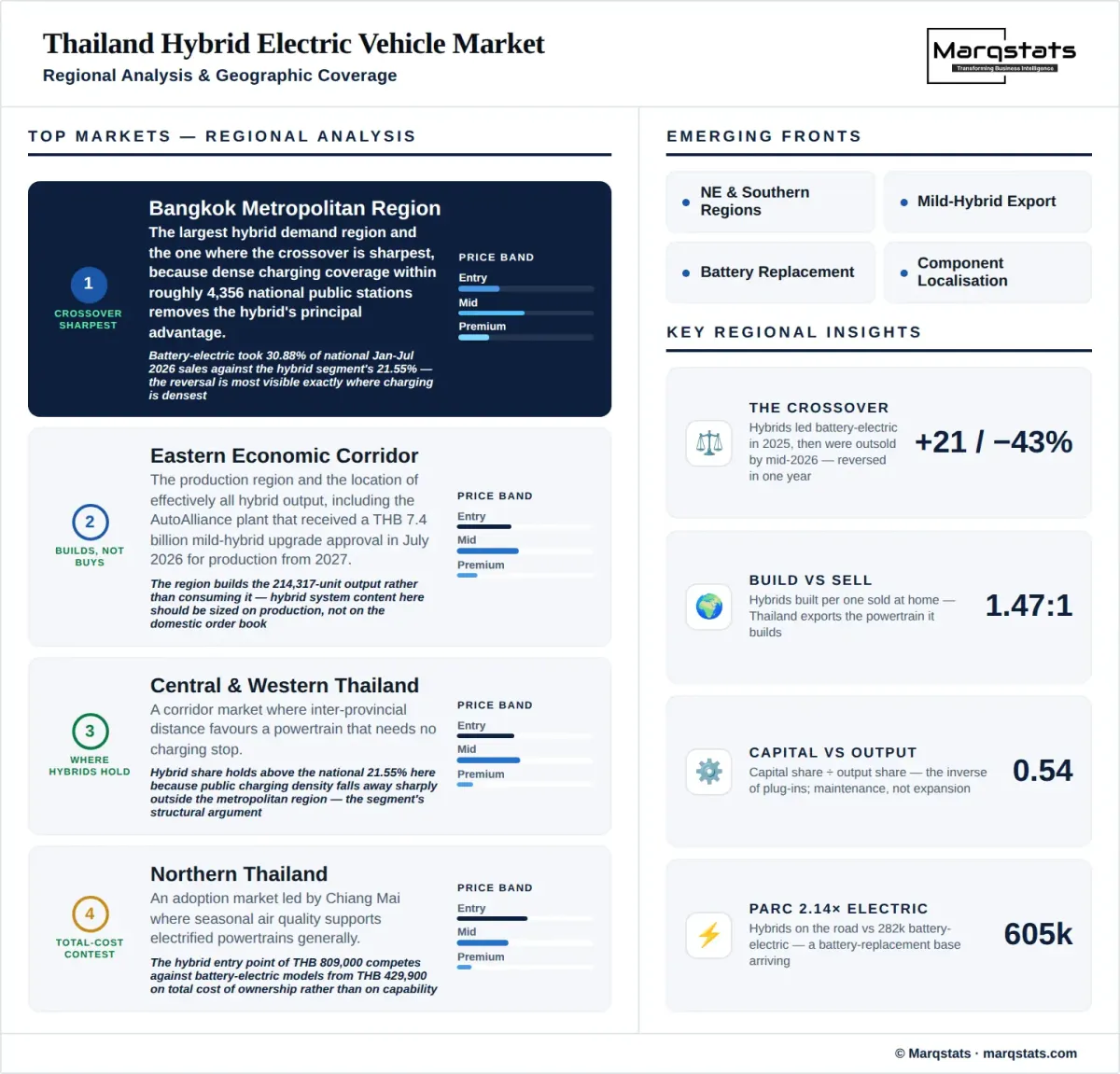
The largest hybrid demand region and the one where the crossover is sharpest, because dense charging coverage within roughly 4,356 national public stations removes the hybrid's principal advantage. Battery-electric took 30.88% of national January to July 2026 sales against the hybrid segment's 21.55%.
Eastern Economic Corridor
The production region and the location of effectively all hybrid output, including the AutoAlliance plant on the Eastern Seaboard in Rayong that received a THB 7.4 billion mild-hybrid upgrade approval in July 2026 for production from 2027. The region builds the 214,317-unit output rather than consuming it.
Central and Western Thailand
A corridor market where inter-provincial distance favours a powertrain that needs no charging stop, and where hybrid share holds above the national 21.55% because public charging density falls away sharply outside the metropolitan region.
Northern Thailand
An adoption market led by Chiang Mai where seasonal air quality supports electrified powertrains generally, and where the hybrid entry point of THB 809,000 competes against battery-electric models from THB 429,900 on total cost rather than on capability.
Northeastern and Southern Thailand
The most price-sensitive regional markets, where combustion pickups accounted for 80,823 of 406,162 January to July 2026 national sales and where hybrid penetration trails the 23.51% national 2025 share by the widest margin.
How Competition Is Evolving
This is the least contested electrified segment in Thailand and that is its defining feature. Japanese manufacturers hold effectively all hybrid volume, and with 69.3% of the total market in 2025 they are defending a position rather than competing for one, which is why the competitive action on this page is between powertrains rather than between brands.
The defence has a scale and a number. Hybrids at 146,059 units are roughly 33.93% of estimated Japanese-brand volume in 2025, so about a third of what the incumbents sell in Thailand now depends on a powertrain growing at 2.75% a year. That is a coherent strategy while excise treats hybrids and battery-electric vehicles comparably, and an exposed one under a carbon dioxide basis that does not.
Chinese entrants treat hybrids as a range filler rather than a position. One manufacturer sold 8,528 units across hybrid, plug-in, battery-electric and diesel powertrains in the first half of 2026, up 19%, and the group's Thai investment is concentrated in battery-electric and plug-in assembly, which leaves the hybrid segment structurally uncontested from that direction.
European brands are transitioning out of the segment at the top rather than defending it. The same brands that held a 45% share of the premium battery-electric segment in 2025 are moving premium volume to locally assembled battery-electric models, which removes the price ceiling that had kept premium hybrids commercially visible.
For a supplier the decisive judgement is which volume to plan against. Domestic sales of 146,059 units are growing at 2.75%; production of 214,317 units is growing and has just attracted THB 7.4 billion of additional mild-hybrid capacity for export. A hybrid component business in Thailand is an export business with a domestic tail, and planning it the other way around understates the addressable volume by 46.73%.
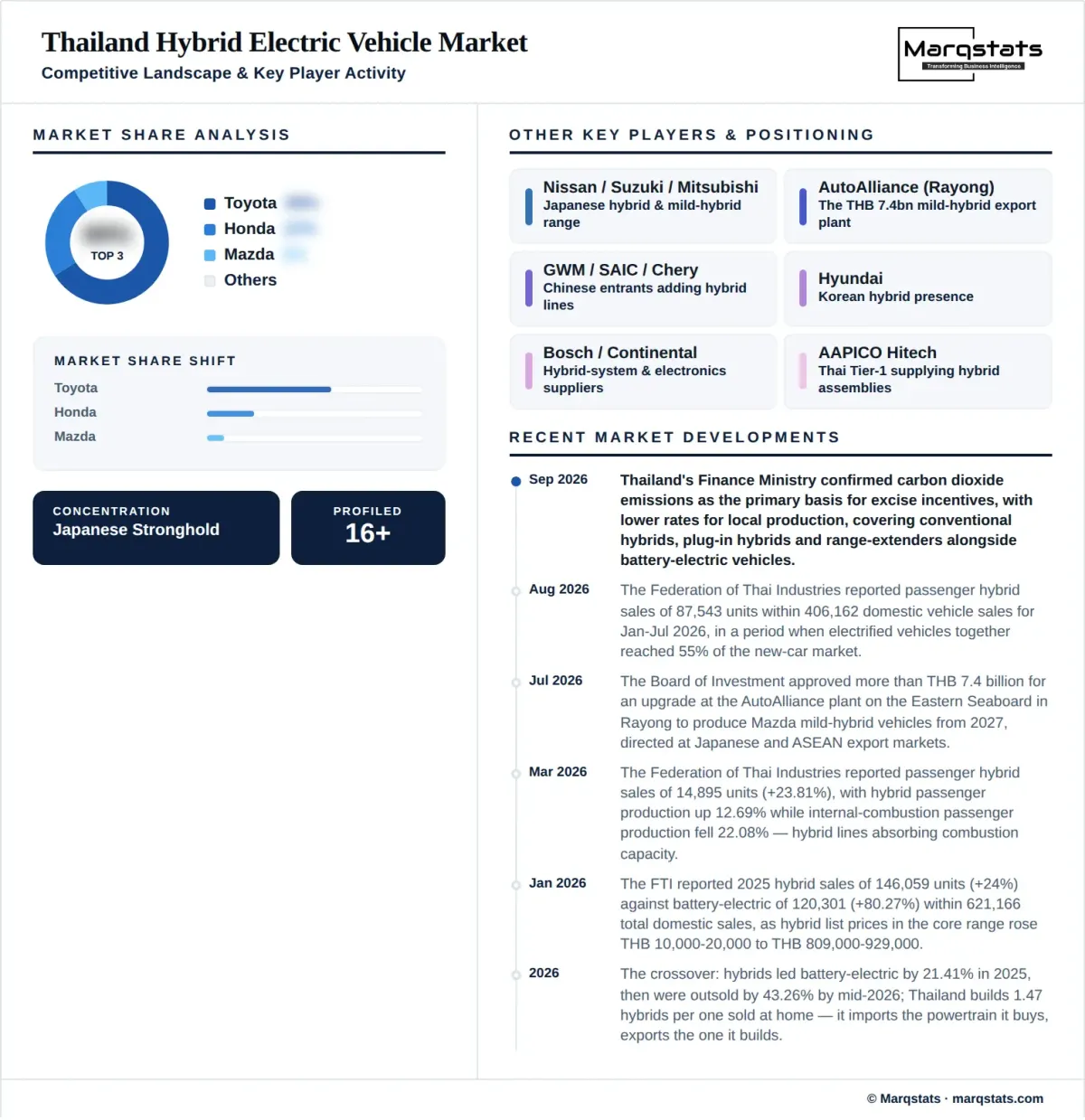
Companies Covered
The report profiles 15+ companies with full strategy and financials analysis, including:
Recent Market Activity
Table of Contents
Coverage & Segmentation
This analysis measures annual new passenger hybrid electric vehicles sold domestically in Thailand from 2021 to 2030, with 2025 as the base year and 2026 to 2030 as the forecast period, covering full hybrids and mild hybrids and requiring that the vehicle cannot be charged from an external supply. Plug-in hybrids at 8,621 units and range-extended vehicles at 990 units in 2025 are excluded and covered separately, as are battery-electric vehicles at 120,301 units; commercial vehicles and motorcycles are excluded. Market value is expressed in USD on a disclosed average transaction price falling from about USD 33,231 to USD 31,077 at a constant THB 32.5 per USD, so value moves on volume and mix rather than on exchange rate assumptions.
Coverage spans two hybrid architectures, three body types, three price bands, two destinations, three brand origins and three buyer types, with five regional clusters analysed on demand concentration, charging density and manufacturing presence. Production is carried as a named dimension with its own series at 214,317 units in 2025, and the 605,017-unit parc is carried as a third measure; none of the three is merged into another, because they size the new vehicle, component and aftermarket opportunities respectively. Fifteen entities are profiled across Japanese, Chinese, Korean and European manufacturers, a Thai contract assembler and two hybrid system suppliers.