Market Snapshot
Key Takeaways
Market Overview & Analysis
Report Summary
The Middle East EV charging station market comprises publicly accessible electric vehicle charging points installed across Saudi Arabia, the United Arab Emirates, Qatar, Kuwait, Oman, Bahrain and the remaining regional markets, together with the equipment, installation and network services that support them. This study segments the market by charging type, power rating, application, connector standard, ownership model and country, with a 2025 base year, historical coverage from 2021 to 2025, and forecasts to 2030.
Two measurement conventions require clarification. First, this report counts charging points, meaning individual connectors capable of serving one vehicle, rather than charging stations or sites, which typically host between two and sixty points. Published figures that count stations will therefore be substantially lower than those counting points, and much of the apparent disagreement between regional infrastructure estimates resolves once that distinction is applied. Second, the installed base is a cumulative stock figure while market value is an annual flow, so the two grow at different rates by construction.
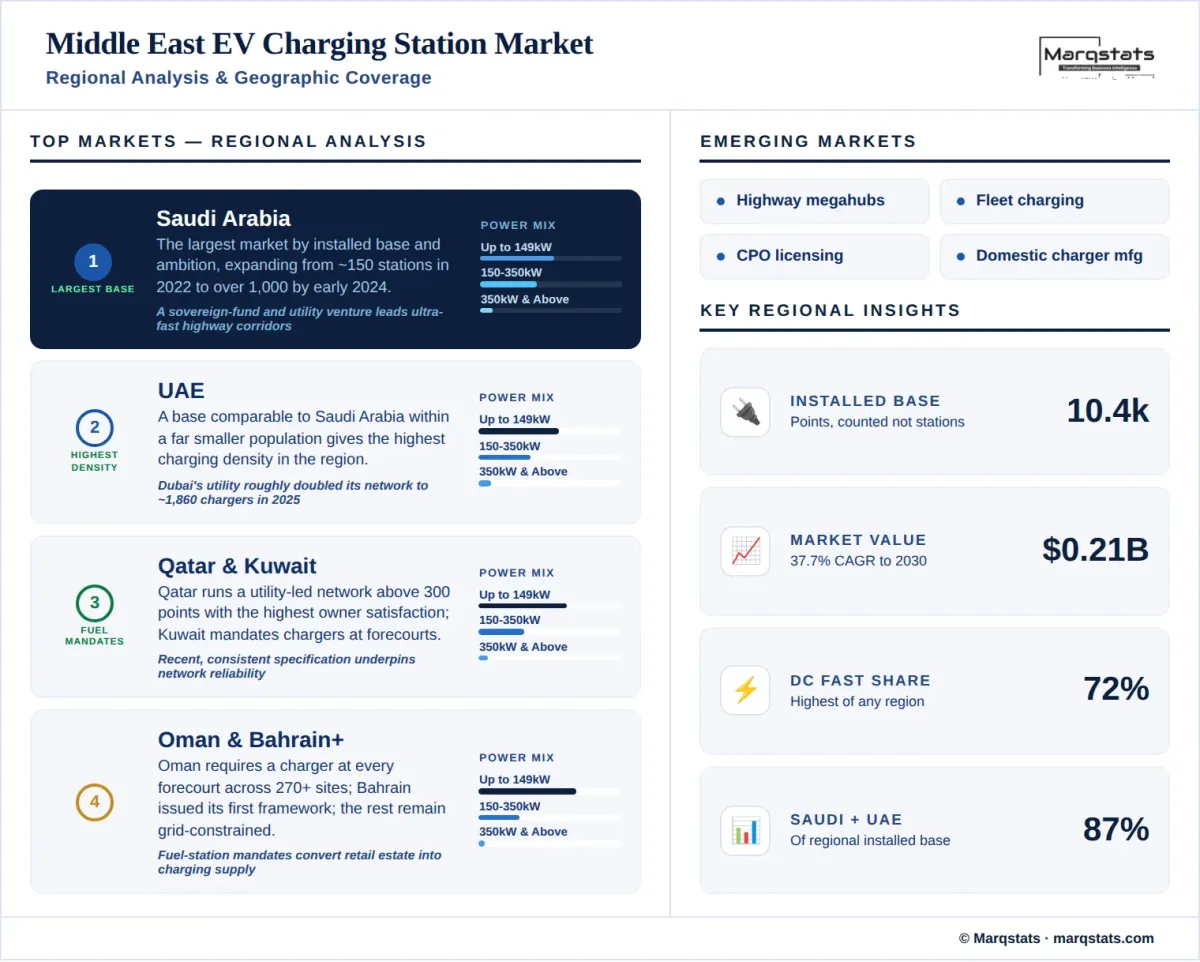
Regional concentration is extreme. Saudi Arabia and the United Arab Emirates each hold about 4.50 thousand public charging points, together about 87% of the regional installed base, while Qatar holds about 350 points, Oman about 300, Kuwait about 250 and Bahrain about 200. That distribution tracks vehicle parc size, electricity infrastructure maturity and the presence of state-backed deployment vehicles rather than population or land area.
The deployment model is what most distinguishes this region. In Europe and North America, public charging grew substantially through independent operators and destination hosts. In the Middle East, the dominant deployers are national fuel retailers and state electricity utilities, often through joint ventures with sovereign investment vehicles. That structure gives the region access to forecourt real estate, grid connections and capital that independent operators elsewhere spent years assembling, and it explains why deployment can move faster than adoption.
Market Dynamics
Key Drivers
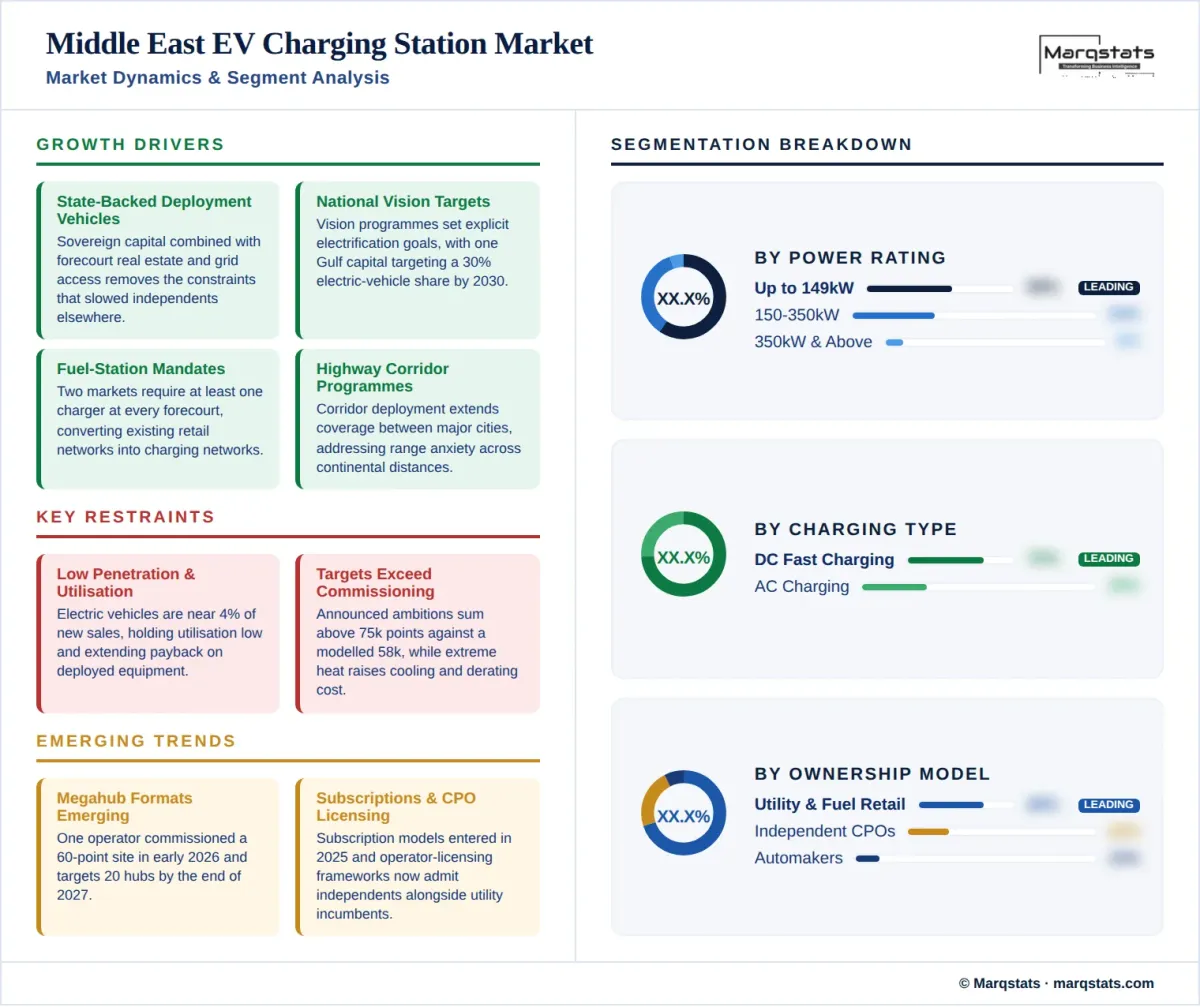
- State-backed deployment vehicles combine sovereign capital with forecourt real estate and grid access, removing the constraints that slowed independent operators elsewhere.
- National vision programmes set explicit electrification targets, with one Gulf capital targeting a 30% electric vehicle share by 2030.
- Fuel-station mandates require at least one charger at every forecourt in two regional markets, converting existing retail networks into charging networks.
- Highway corridor programmes are extending coverage between major cities, addressing the range anxiety that constrains adoption across continental distances.
- Domestic charger manufacturing began in the region during 2026, shortening supply chains and reducing equipment costs.
Key Restraints
- Electric vehicle penetration remains near 4% of new sales across surveyed Gulf states, limiting utilisation and extending payback periods on deployed equipment.
- Announced targets exceed realistic commissioning capacity, with published ambitions summing above 75 thousand points against a modelled 58.00 thousand by 2030.
- Extreme ambient temperatures raise cooling requirements and derating risk for high-power equipment, increasing both capital and maintenance cost.
- Regulatory frameworks for independent charge-point operators remain incomplete across several markets, with one only introducing its first comprehensive framework in November 2025.
Key Trends
- Megahub formats are emerging, with one operator commissioning a 60-point site in January 2026 and targeting 20 hubs by the end of 2027.
- Subscription-based charging models entered the region during 2025, shifting revenue from per-session to recurring.
- Charge-point operator licensing frameworks are being formalised, opening the market to independent operators alongside utility incumbents.
- Ultra-fast equipment rated between 150 and 350 kilowatts is becoming the highway standard, displacing lower-power installations.
Market Segmentation
Direct-current fast charging accounts for about 72% of the 2025 installed base and rises to about 78% by 2030, the highest fast-charging concentration of any region covered in Marqstats infrastructure studies. Three factors drive the mix. Inter-city distances across the Gulf make high-power charging a practical necessity rather than a convenience. Extreme summer temperatures discourage the extended dwell times that alternating-current charging requires. And the dominant deployers are fuel retailers whose existing customer behaviour is built around short forecourt visits.
Alternating-current charging accounts for about 28% of the 2025 installed base and falls to about 22% by 2030 while still growing in absolute terms. Deployment is concentrated in residential compounds, workplace parking and shopping destinations where dwell times are naturally long. The segment is under-represented relative to European markets because residential charging in the region is frequently installed privately rather than as publicly accessible infrastructure, and private installations fall outside the public count reported here.
Equipment rated at or below 22 kilowatts represents the alternating-current installed base and serves destination and workplace applications. The 23 to 149 kilowatt band covers most urban direct-current deployment, including the majority of utility-installed public chargers in the two largest markets. Together these bands represent the substantial majority of the 2025 installed base, though their combined share declines steadily as highway and megahub deployment shifts the mix upward.
Equipment rated between 150 and 350 kilowatts is becoming the regional highway standard, with corridor programmes across the largest market specifying ultra-fast units on the routes linking its principal cities. Equipment rated at or above 350 kilowatts remains a small share of installed points while growing fastest of any power band, concentrated in megahub formats and in sites serving both passenger and light commercial fleets. High ambient temperatures make thermal management a material specification consideration in this band.
Publicly accessible urban and highway charging accounts for the majority of installed points and is the segment against which national targets are set. Highway corridor coverage has been the priority of the largest market's deployment programme, which has specified ultra-fast equipment on the routes connecting its capital to the eastern province and to the western coastal cities. Coverage density remains far below European levels on a per-kilometre basis.
Workplace and commercial destination charging accounts for a substantial minority of points, concentrated in office districts, malls and hotels across the principal metropolitan areas. Fleet charging is emerging as ride-hailing, delivery and government fleets electrify, and it commands a disproportionate share of energy throughput relative to its point count because utilisation rates are far higher. Publicly accessible residential charging remains a small segment, since most residential charging in the region is privately installed.
The combined charging system in its European variant is the dominant direct-current standard across the region, reflecting vehicle import patterns weighted toward European, Korean and Chinese models built to that specification. The associated alternating-current connector is correspondingly dominant on lower-power equipment. Standardisation on this pairing has been faster and cleaner in the Middle East than in markets that accumulated infrastructure across multiple competing standards over a longer period.
The Chinese direct-current standard appears on a small share of installed points, associated with imported Chinese vehicles and with equipment sourced from Chinese manufacturers. The Japanese standard holds a residual position on older installations and is not being specified in new deployment. Proprietary connectors associated with a single manufacturer's network form a further small share, though that operator has begun opening its regional network to other vehicles.
State electricity utilities and national fuel retailers together own the majority of the regional installed base, an ownership concentration found in no comparable charging market. Utilities in the two largest markets have deployed networks directly, while fuel retailers have converted forecourt estate into charging sites through joint ventures with sovereign investment vehicles and power companies. This structure provides land, grid connection and balance-sheet capacity that independent operators would otherwise need years to assemble.
Independent charge-point operators hold a modest share of the installed base, constrained until recently by the absence of licensing frameworks in several markets. One market introduced independent operator licensing during 2024 and another introduced its first comprehensive charging regulatory framework in November 2025, both of which should widen participation. Automotive manufacturers operate proprietary networks at limited scale, principally to support their own vehicle sales rather than as standalone infrastructure businesses.
Saudi Arabia holds about 4.50 thousand public charging points, having expanded from roughly 150 public stations in 2022 to more than 1,000 by early 2024, with a national deployment vehicle formed between the sovereign wealth fund and the state electricity company targeting more than 5,000 fast chargers across over 1,000 hubs by 2030. The United Arab Emirates holds a comparable installed base, with the Dubai utility operating roughly 1,860 chargers by early 2026 against about 740 a year earlier, and the national fuel retailer's charging venture holding more than 400 chargepoints.
Qatar holds about 350 public charging points, with the national utility reporting more than 300 in service by August 2025. Oman holds about 300 points under a 2023 decree requiring every fuel station to host at least one charger across more than 270 forecourts. Kuwait applies a comparable fuel-station requirement and holds about 250 points. Bahrain holds about 200 points and introduced its first comprehensive charging regulatory framework in November 2025, following a 64% year-on-year rise in home-charger installations during 2024.
By Geography
Saudi Arabia
Saudi Arabia is the largest national market by installed base and by announced ambition. Public charging expanded from roughly 150 stations in 2022 to more than 1,000 by early 2024, and the national deployment vehicle formed between the sovereign wealth fund and the state electricity company has prioritised highway corridors with ultra-fast equipment rated between 150 and 350 kilowatts. Electric vehicle registrations rose sharply from a very small base across 2021 to 2023, and the capital has set a 30% electric vehicle share target for 2030.
United Arab Emirates
The United Arab Emirates holds a comparable installed base to Saudi Arabia within a far smaller population, giving it the highest charging density in the region. The Dubai utility roughly doubled its network across 2025 to about 1,860 chargers, and the national fuel retailer's charging venture opened a 60-chargepoint megahub in January 2026, described as the largest superfast site in the wider region, with a stated roadmap to 20 hubs by the end of 2027. Abu Dhabi has announced a further programme across 400 locations.
Qatar & Kuwait
Qatar operates a utility-led network exceeding 300 charge points, with deployment concentrated in Doha and along the principal highway corridors. Charging experience satisfaction surveyed among Gulf electric vehicle owners was highest in Qatar, which reflects a network built comparatively recently to a consistent specification. Kuwait requires every fuel station to host at least one fast charger, a mandate that converts an existing retail network into charging infrastructure without requiring separate site acquisition.
Oman, Bahrain & Rest of Middle East
Oman requires every fuel station to host at least one charger under a decree issued in November 2023, covering more than 270 forecourts and anchored to its national vision programme. Bahrain introduced its first comprehensive electric vehicle charging regulatory framework in November 2025, having recorded a 64% year-on-year increase in home-charger installations during 2024. The remaining regional markets, including Jordan, Iraq and Lebanon, hold a combined installed base of roughly 300 points with deployment constrained by grid reliability and vehicle availability.
How Competition Is Evolving
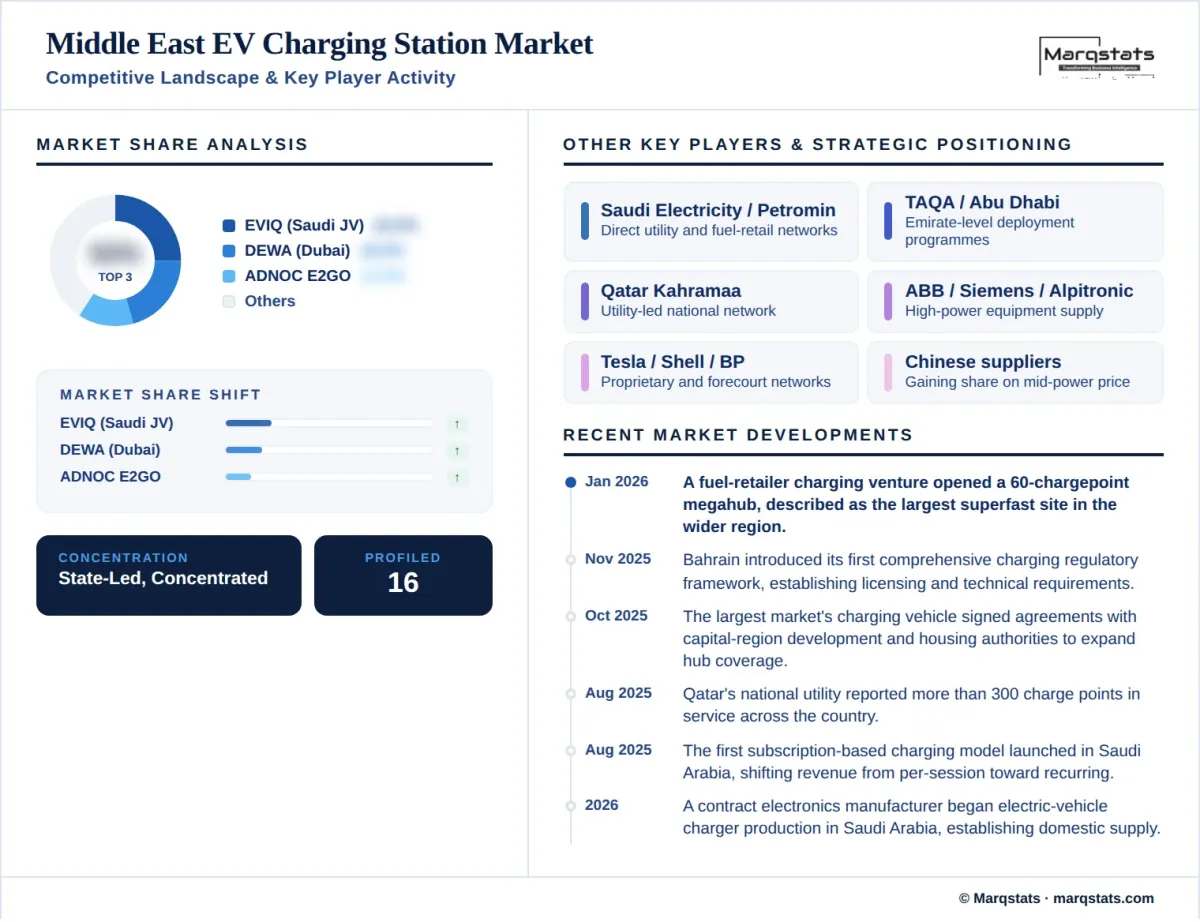
The Middle East EV charging station market is concentrated among state-linked deployers rather than fragmented among independent operators. National fuel retailers and state electricity utilities together own the majority of installed points across the region, and in the two largest markets a small number of entities account for the substantial majority of public infrastructure. This is the inverse of European and North American charging markets, where independent operators and destination hosts built much of the early network.
Deployment vehicles formed between sovereign investment funds, power companies and fuel retailers are the defining organisational form. In the largest market, a joint venture between the sovereign wealth fund and the state electricity company holds the national fast-charging mandate. In the second-largest, the national fuel retailer operates its charging network through a venture with a state power and water company. These structures resolve land access, grid connection and capital simultaneously, which is why regional deployment has run ahead of vehicle adoption rather than behind it.
Equipment supply is dominated by European and Chinese manufacturers, with the major power-electronics groups supplying most high-power installations alongside specialist ultra-fast charger makers. Domestic manufacturing entered the region during 2026 when a contract electronics manufacturer began charger production in Saudi Arabia, which should shorten lead times and reduce landed equipment costs. Chinese suppliers have gained share on price, particularly in the mid-power band.
Competition is beginning to shift from land and capital toward utilisation and service quality. With penetration near 4% of new vehicle sales, most deployed equipment operates well below economic utilisation, and operators are competing on network reliability, payment interoperability and subscription propositions rather than on site count. The first subscription charging model in the largest market launched during 2025, and charge-point operator licensing frameworks introduced in two markets will admit independent competitors to a field previously closed.
Companies Covered
The report profiles 16+ companies with full strategy and financials analysis, including:
Recent Market Activity
Table of Contents
Coverage & Segmentation
This report provides a comprehensive assessment of the Middle East EV charging station market across a 2025 base year, historical data from 2021 to 2025, and forecasts spanning 2026 to 2030. Seven national markets are covered, namely Saudi Arabia, the United Arab Emirates, Qatar, Kuwait, Oman, Bahrain and the remaining regional markets. The volume metric is the installed base of publicly accessible charging points, counted as individual connectors rather than as sites, and market value covers annual expenditure on charging equipment, installation and network services.
The scope covers deployment drivers, restraints and structural trends, with particular focus on the separation of installed infrastructure from announced targets, the utility and fuel-retail ownership model that distinguishes this region, direct-current dominance and its causes, and country-level installed base and target data. Vehicle-side demand context across the same territory is available in the Saudi Arabia used car market report. An extended forecast to 2035 is available under customization, alongside site-level deployment mapping on request.