Market Snapshot
Middle bar: base-year value × (1 + CAGR), rounded to two decimals. This is a calculated illustration, not a separately researched annual estimate.
The Malaysia EV charging station market was valued at USD 112 million in 2025 and is projected to reach USD 472 million by 2030, expanding at a 33.34% CAGR across the 2026–2030 forecast period. Growth is attributed to the National Energy Transition Roadmap, the Low Carbon Mobility Blueprint, and battery-electric adoption that reached 5.56% of total industry volume by September 2025. The Malaysia EV charging station market is scaling from a low base, anchored by tax incentives, highway-corridor deployment, and a concentrated charge-point operator field. The market is among the larger absolute charging-hardware bases in Southeast Asia, even as utilization per charger trails denser city-state markets.
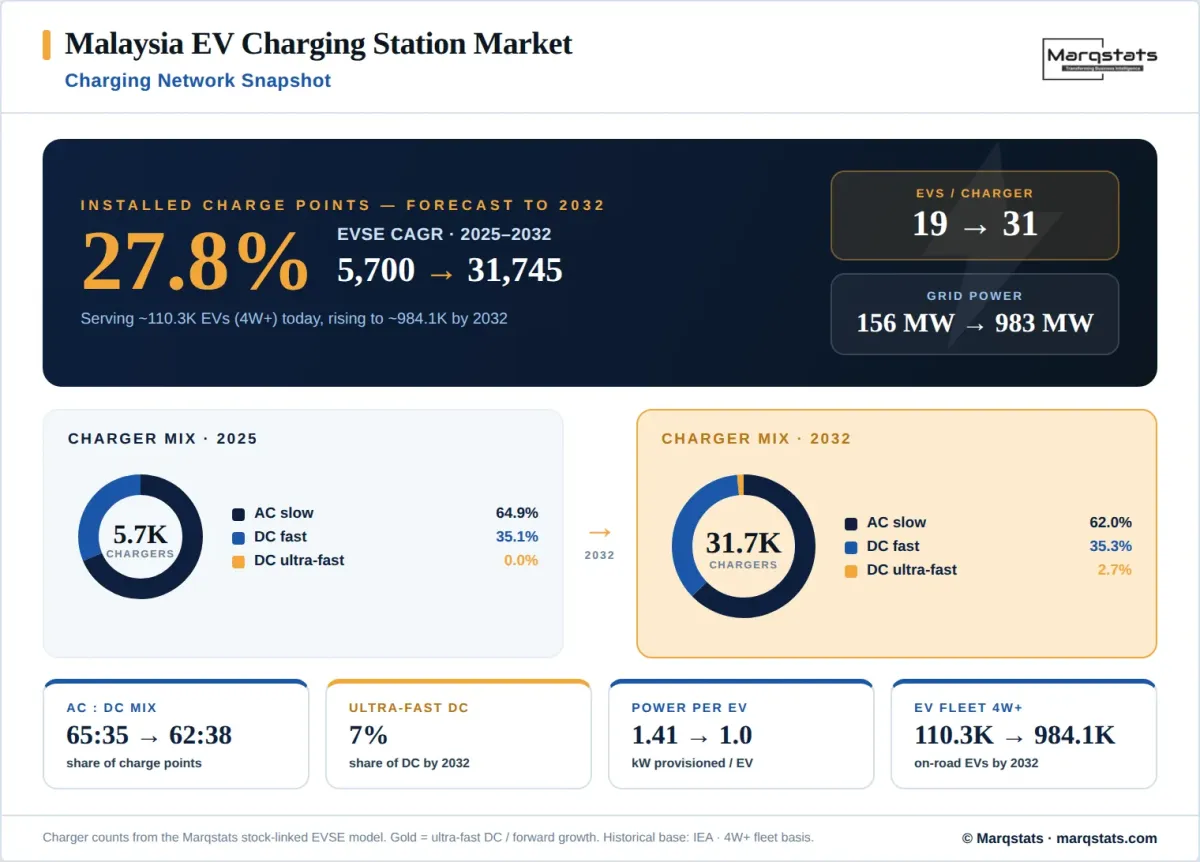
The market spans alternating-current and direct-current charging hardware, installation, networking software, and charging services across residential, commercial, public, and highway applications. Coordinated through the Malaysia Electric Vehicle Charging Network platform maintained by the Malaysian Green Technology and Climate Change Corporation, the public network reached roughly 5,700 chargers in 2025, of which alternating-current units form the majority. Direct-current fast chargers concentrate along the North-South Expressway and major urban hubs.
Charge-point operation is concentrated among a small group of operators. Gentari, the Petronas clean-energy arm, expands aggressively along highways and fuel stations, JomCharge operated by EV Connection holds the widest CCS2 fast-charging footprint, and ChargEV operated by Yinson GreenTech covers malls and corporate sites, alongside TNB Electron and Shell Recharge. Type 2 alternating-current and CCS2 direct-current connectors form the national standard. Charging deployment concentrates in Klang Valley, Penang, and Johor Bahru, while the east coast and East Malaysia remain comparatively under-served.
Key Takeaways
Market Overview & Analysis
Report Summary
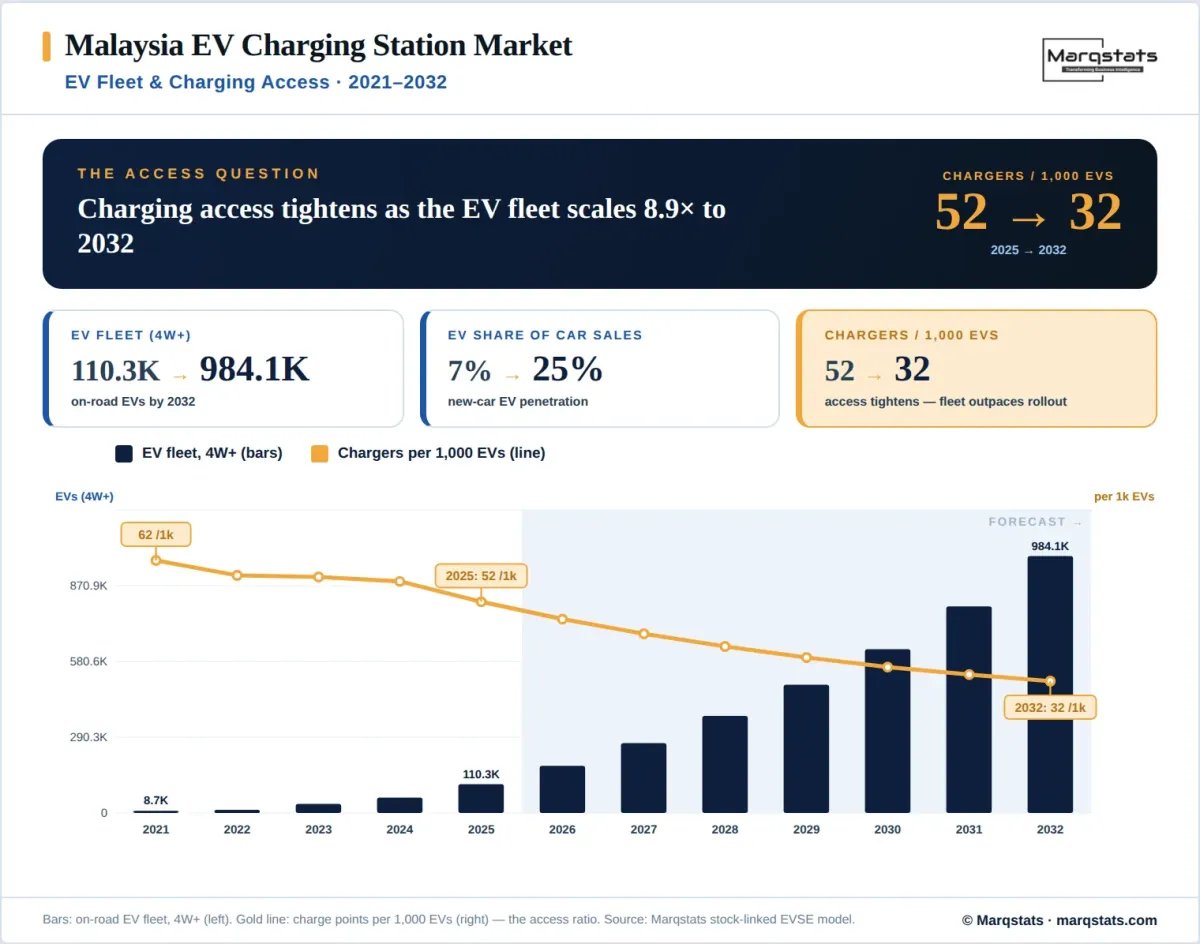
The Malaysia EV charging station market sits at the intersection of transport, energy, and digital infrastructure, and is scaling from a modest base within a large, dispersed geography. Battery-electric adoption reached 5.56% of total industry volume by September 2025, and electric-vehicle registrations more than doubled in the first quarter of 2026, with 4,717 units registered in March alone, a 58.5% year-on-year increase. Falling vehicle prices and oil-price volatility are nudging buyers toward electrification. Adoption remains in the middle tier of Southeast Asia, below Thailand and Vietnam, leaving substantial headroom as affordable models reach the market.
The charge-point operator field is concentrated, with the three largest networks holding the majority of public points between them. This concentration reflects the capital intensity of direct-current deployment and the advantage held by energy and utility groups able to fund nationwide rollouts, secure grid connections, and integrate charging with fuel-station and retail footprints.
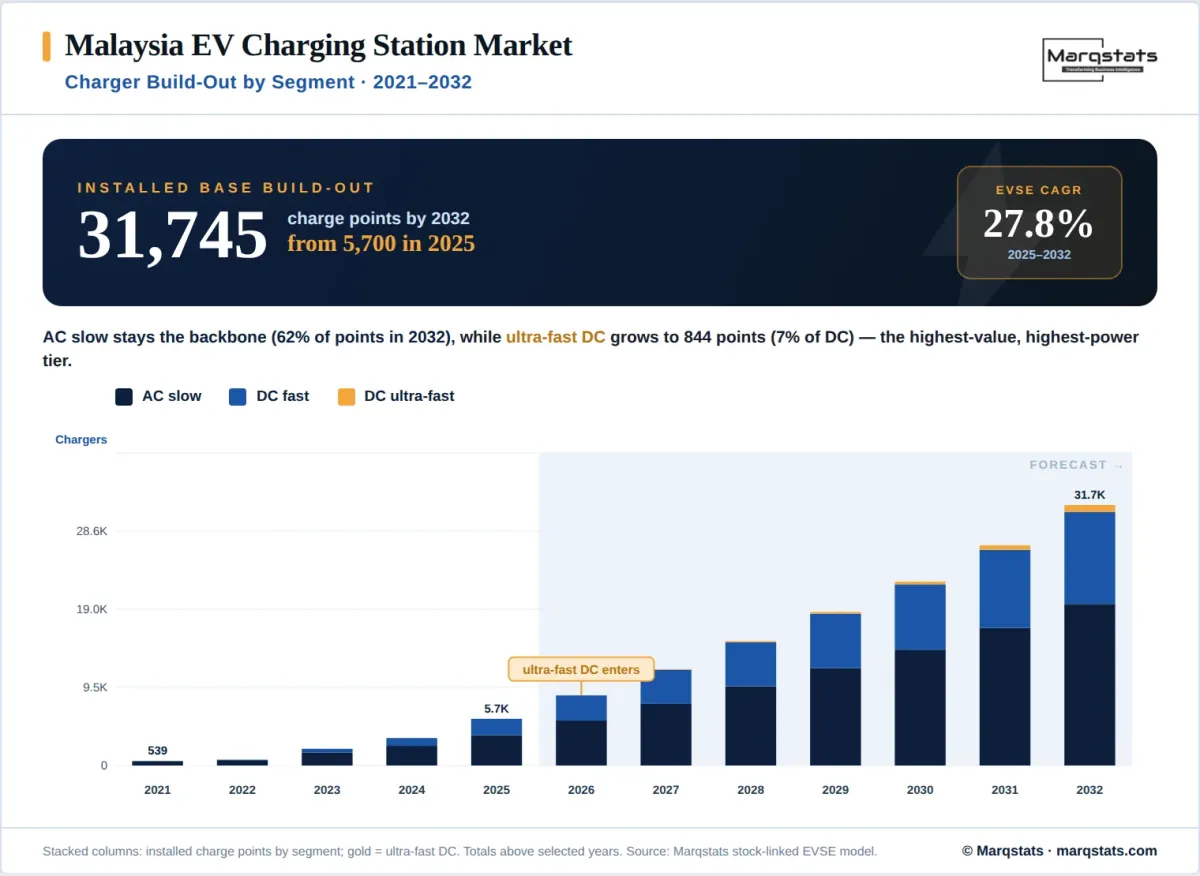
Public charging supply has expanded sharply, advancing from roughly 1,400 chargers in late 2023 to about 5,700 by the end of 2025. The 10,000-point target under the Low Carbon Mobility Blueprint was not met on schedule and has been rescheduled, even as the direct-current fast-charging segment exceeded its interim goal of 1,500 units. Backed by approved investments in charging components and rising private deployment, public charging supply continues to widen. Investment promotion by the Malaysian Investment Development Authority supports both deployment and local charger manufacturing.
Policy support is broad. Budget incentives exempt completely-built-up electric vehicles from import and excise duty through 2025 and components for local assembly through 2027, while charging-equipment manufacturers receive a tax holiday to 2032. A revised road-tax structure effective January 2026 lowers electric-vehicle rates substantially, basing charges on motor power output. Charging installations fall under the Energy Commission, which issued dedicated charging-system guidelines in 2025 requiring registered competent installers and prohibiting unsafe domestic-socket charging. Manufacturer incentives, including a full income-tax exemption over ten years and an investment-tax allowance, have drawn investment into local charger production. The first domestic charger manufacturing lines have begun operation, supporting a localization agenda alongside deployment.
Market value is built from hardware, installation, networking software, and charging-service revenue. The network is alternating-current-led, giving alternating-current charging the larger installed base, while direct-current fast chargers carry higher unit prices and anchor highway corridors. Growth is driven by incentives, rising battery-electric penetration, and a maturing operator market, even as grid connections, high-rise retrofitting, and uneven rural coverage remain points of attention.
Market Dynamics
Key Drivers
Market is driven by the National Energy Transition Roadmap and Low Carbon Mobility Blueprint, converting national targets into sustained charging demand.
Tax incentives, including duty exemptions and a charging-equipment manufacturer tax holiday to 2032, lower the cost of deployment and local production.
Rapid registration growth supports demand, with electric-vehicle registrations more than doubling in the first quarter of 2026.
Affordable local models, including a sub-RM100,000 battery-electric vehicle, broaden adoption beyond premium buyers.
Highway-corridor deployment along the North-South Expressway extends charging access and supports inter-state travel.
Key Restraints
High direct-current capital expenditure and uneven charger utilization constrain operator returns as networks expand ahead of demand.
Grid connection lead times and load constraints slow high-power deployment at new sites.
High-rise residential retrofitting is complex, requiring management-body consent and dedicated circuits under Energy Commission rules.
Charging access remains concentrated in urban centres, leaving the east coast and East Malaysia under-served.
Key Trends
Operators are shifting from raw point counts toward higher-capacity fast charging in the right locations, mirroring the upgrade cycle across the global EV DC charging station market.
Highway charging hubs with multiple high-power bays are emerging, including retail-integrated sites developed with expressway concessionaires.
Interoperability is advancing through the national charging-network platform, consolidating planning and real-time charger status across operators.
Idle and overstay fees are being introduced to curb charger hogging and improve availability at busy sites.
Market Segmentation
Alternating-current charging holds the largest installed base, accounting for the majority of public chargers and most residential installations. Onboard chargers in mass-market models draw 7 kW to 22 kW, suited to overnight and long-dwell replenishment at homes, offices, hotels, and shopping destinations where lower hardware and installation cost favours dense deployment. Public alternating-current tariffs settle around RM0.60 to RM1.15 per kWh, keeping everyday charging affordable, and home charging on time-of-use tariffs is cheaper still. The segment scales with residential and workplace installation, where operators increasingly place alternating-current points in offices, hotels, and residential areas where vehicles dwell for extended periods.
Direct-current charging commands higher per-unit value and is the fastest-growing segment, owing to premium hardware and faster turnaround at highway rest stops, fuel stations, and urban hubs. The installed base is migrating toward 50 kW to 350 kW classes, with 200 kW and higher units deployed along major corridors. Direct-current tariffs sit around RM1.20 to RM1.80 per kWh, reflecting the speed premium, and the segment exceeded its interim deployment target of 1,500 units. Highway corridors are the top expansion priority, owing to festive-season queues that exposed capacity gaps on inter-state routes, prompting higher-power deployment at rest stops.
Malaysia follows the European connector standard. Type 2 serves alternating-current charging across homes, workplaces, and public sites, while CCS2, the Combined Charging System, is the dominant direct-current connector across fast-charging networks. The single-standard environment lowers interoperability friction, allowing drivers to use any major operator with common physical connectors while payment remains app-based.
CHAdeMO and legacy GB/T units hold a small and declining share tied to early deployments, while newer hardware standardizes on CCS2 for direct-current charging. Domestic manufacturers have migrated charger designs toward the CCS interface, reinforcing the standard and reducing stranded-asset risk for operators, and aligning Malaysia with the connector ecosystem used across much of Southeast Asia. New installations are required to follow this standard under national charging-system guidelines, easing procurement for operators and improving cross-network compatibility for drivers.
Passenger cars represent the largest vehicle segment by charging demand, owing to battery-electric registrations led by affordable imported and locally assembled models. Rising volumes from mass-market launches broaden charging utilization beyond the premium segment that defined early adoption. Registration growth has spread beyond the largest cities as affordability improves, lifting demand for charging in secondary urban centres.
Commercial vehicles, spanning fleets, ride-hail, goods vehicles, and buses, form the fastest-growing vehicle segment, supported by fleet electrification and government procurement that favours electric vehicles for ministries and linked companies. Depot and destination charging for fleets adds steady, predictable demand that complements passenger-car utilization.
Electric motorcycles and light vehicles contribute a growing share, supported by targeted incentives for lower-income buyers, served mainly by alternating-current and home charging rather than the public direct-current network. Incentives for electric motorcycles aimed at lower-income buyers support gradual uptake in this segment.
Residential charging anchors everyday replenishment for landed homes, while commercial and workplace sites at malls, offices, and hotels add destination capacity. High-rise residential retrofitting is constrained by management-body consent and electrical-load requirements, shaping where alternating-current points are installed. A high share of urban residents in apartments makes street and visitor-bay charging an important complement to home installation.
Public and highway charging is the strategic priority, anchored by direct-current corridors along the North-South Expressway and emerging retail-integrated hubs. These sites reduce range anxiety for inter-state travel and concentrate the highest-power, highest-value chargers in the network. Retail-integrated hubs combining multiple high-power bays with food and rest facilities are being developed with expressway concessionaires to serve peak-period demand.
By Geography
Klang Valley
Klang Valley, covering Kuala Lumpur, Selangor, and Putrajaya, holds the largest installed base and market value, owing to the highest vehicle density, commercial-site availability, and concentration of malls, offices, and corporate fleets. The region accounts for the single largest share of national charging value. The region anchors both alternating-current destination charging and a dense cluster of direct-current hubs serving residents and visiting drivers. Putrajaya and the wider conurbation host early government and corporate fleet charging, reinforcing the region as the centre of network density. The region also carries the highest concentration of premium and mass-market electric vehicles, sustaining utilization across both charger classes.
Northern Region
The Northern Region, spanning Penang, Kedah, Perak, and Perlis, is emerging as a competitive charging hub, owing to strong local-government commitment and industrial activity around Penang. Charging investment follows manufacturing clusters and tourism corridors across the north, with Penang combining electronics-manufacturing fleets and rising private adoption to support a denser charging footprint than other secondary regions.
Southern Region
The Southern Region, anchored by Johor with Melaka and Negeri Sembilan, records the fastest regional growth, owing to cross-border traffic with Singapore, the Johor-Singapore economic zone, and major industrial and data-centre investment. Highway charging along the southern corridor supports rising inter-state and cross-border travel. Proximity to Singapore drives demand from cross-border commuters and fleets, while industrial and logistics growth around Johor anchors workplace and depot charging.
East Coast Region
The East Coast Region, covering Pahang, Terengganu, and Kelantan, expands more gradually, owing to lower vehicle density and longer inter-town distances. Direct-current deployment along the East Coast Expressway and key trunk roads addresses charging gaps and supports holiday-season travel, when inter-state journeys to the east coast peak and highway charging demand rises sharply.
East Malaysia
East Malaysia, comprising Sabah and Sarawak, remains the least-served region, owing to dispersed population and grid constraints. Targeted highway deployment, including operator partnerships with the Sarawak state utility, is opening mid-point charging between major towns such as Kuching and Sibu. Closing the coverage gap in the east is central to extending adoption beyond the peninsula, where dispersed towns and longer distances make reliable fast charging a prerequisite for electric-vehicle uptake.
How Competition Is Evolving
The Malaysia EV charging station market is concentrated, with three operators holding the majority of charge points between them. Gentari, wholly owned by Petronas, expands aggressively along the North-South Expressway and at fuel stations, and switched on a 200 kW direct-current unit at a Klang Valley site in early 2026. JomCharge, operated by EV Connection, holds the widest CCS2 fast-charging footprint and serves both highway and urban locations, while ChargEV, operated by Yinson GreenTech, covers malls, hotels, and corporate offices on a pay-per-use basis after discontinuing its annual subscription. These three networks anchor the market and set the reference tariffs that most drivers encounter.
TNB Electron, the national utility charging arm, deploys high-power direct-current units along trunk roads, and Shell Recharge operates at fuel stations along major expressways. The market also drew a global manufacturer hub launch in Petaling Jaya, and a global automaker opened its fast-charging network to other vehicles at selected Klang Valley sites in early 2026. Hardware suppliers, including ABB, Schneider Electric, Siemens, Delta Electronics, and Star Charge, provide the underlying equipment, while domestic manufacturing of chargers has begun to scale.
Competition centres on network reliability, highway coverage, charging speed, and tariff structure. Operators differentiate through expressway corridors, fuel-station partnerships, app-based access, and subscription or pay-per-use pricing, while idle and overstay fees address congestion at busy sites. Standardization on CCS2 and a national interoperability platform are shifting the basis of competition toward uptime, coverage, and customer experience. Scale economics favour operators with dense highway and urban footprints, as utilization and maintenance efficiency improve with network density, reinforcing the concentrated market structure.
Companies Covered
Companies covered in the report include:
Recent Market Activity
Table of Contents
Coverage & Segmentation
This report provides a comprehensive analysis of the Malaysia EV charging station market across the 2021–2025 historical period and the 2026–2030 forecast period, with 2025 as the base year. The study covers alternating-current and direct-current charging hardware, installation, networking software, and charging services across residential, commercial, public, and highway applications, segmented by charging type, connector type, vehicle type, and application, with coverage of Klang Valley, the Northern, Southern, and East Coast regions, and East Malaysia. Market sizing is benchmarked against national charging-point data and International Energy Agency charging datasets.
The study examines market size, growth, segment-level value, competitive structure, and the policy and regulatory framework, including the National Energy Transition Roadmap, the Low Carbon Mobility Blueprint, and Energy Commission charging-system guidelines administered by the Energy Commission of Malaysia. Primary research includes 40+ interviews with charge-point operators, hardware manufacturers, fleet operators, utilities, and policy makers.