Market Snapshot
Middle bar: base-year value × (1 + CAGR), rounded to two decimals. This is a calculated illustration, not a separately researched annual estimate.
The Myanmar EV charging station market was valued at USD 8 million in 2025 and is projected to reach USD 26 million by 2030, expanding at a 26.58% CAGR across the 2026–2030 forecast period. Growth is attributed to duty-free electric-vehicle import notifications, a state-led charging pilot along the Yangon-Mandalay Expressway, and rising interest in electric vehicles as a hedge against fuel shortages. The Myanmar EV charging station market is the smallest and earliest-stage in Southeast Asia, scaling from a very small base concentrated in Yangon, Mandalay, and Naypyitaw. Small absolute size is paired with meaningful percentage growth as the state pilot and vehicle imports expand from a low starting point.
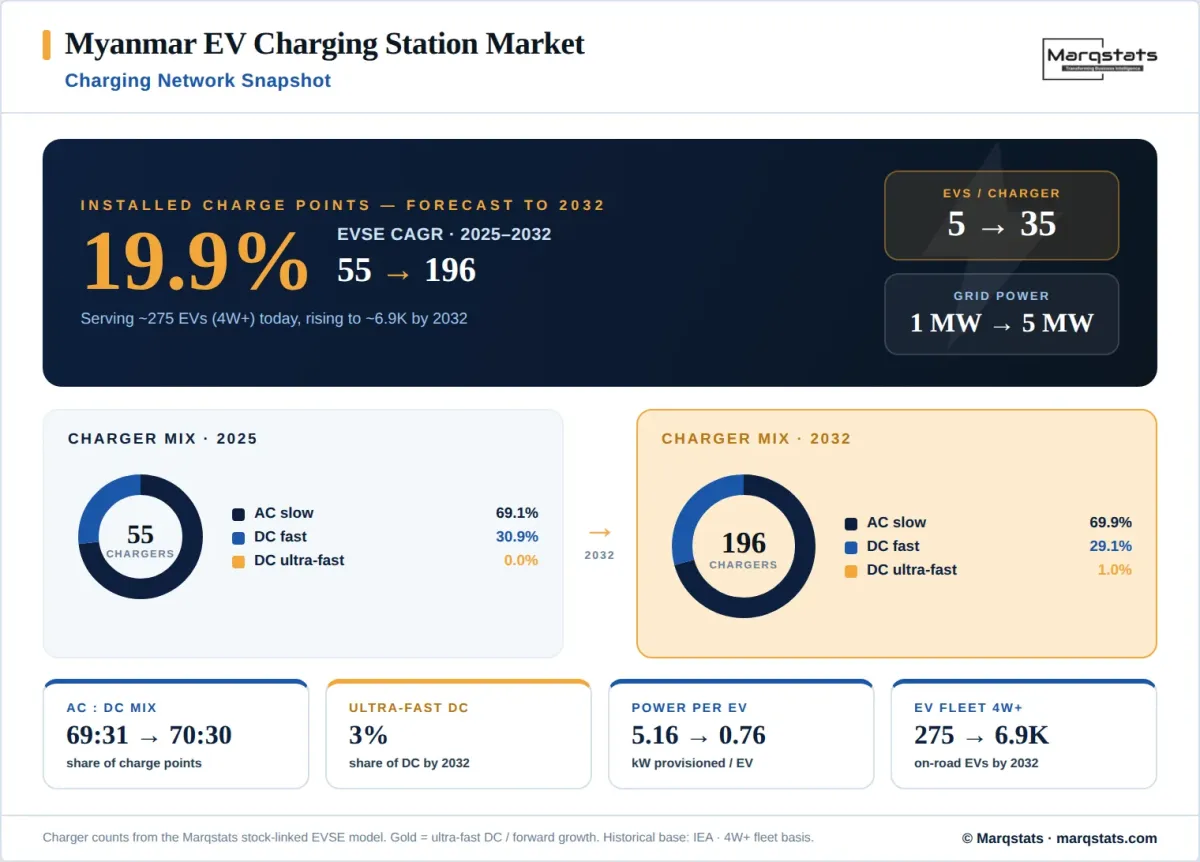
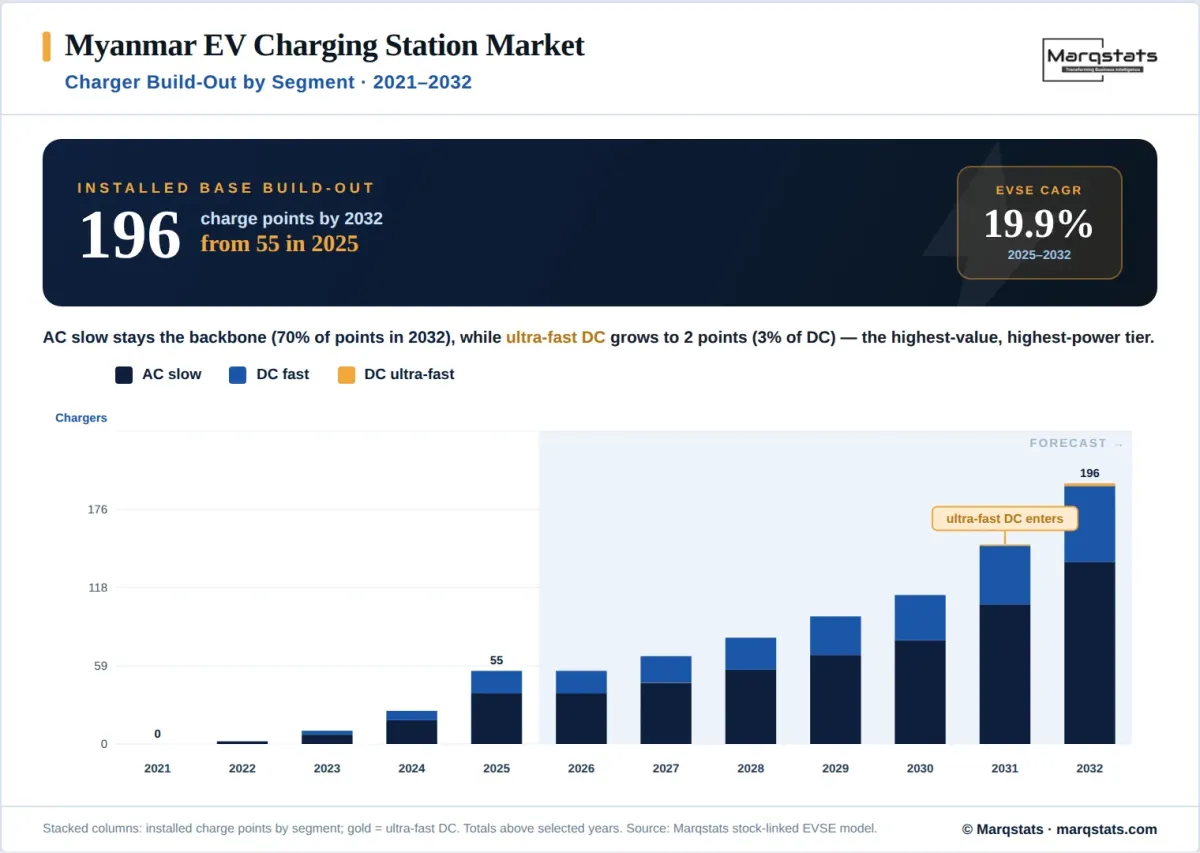
The market spans alternating-current and direct-current charging hardware, installation, networking software, and charging services across public, commercial, and residential applications. The public network expanded from pilot sites in 2022 to a charger base near fifty to sixty units by 2025, developed under a national committee and investment incentives administered by the Directorate of Investment and Company Administration, of which alternating-current chargers form about two-thirds. Direct-current fast chargers concentrate in the three main cities and along the expressway, which links the commercial capital, the administrative capital, and the second-largest city.
The operator structure is early-stage and state-anchored. Ministries and state electricity corporations lead deployment, with private builders such as Yar Zar Min Industry and vehicle distributors adding sites, often co-located at fuel stations. Battery-electric adoption is led by Chinese brands including MG, BYD, and Wuling, alongside a legacy Nissan fleet of a few hundred vehicles that seeded early charging demand in Yangon. Chinese GB/T, CCS2 direct-current, and Type 2 alternating-current connectors anchor a mixed standard. Deployment concentrates in the central corridor, leaving most states and regions with minimal charging access.
Key Takeaways
Market Overview & Analysis
Report Summary
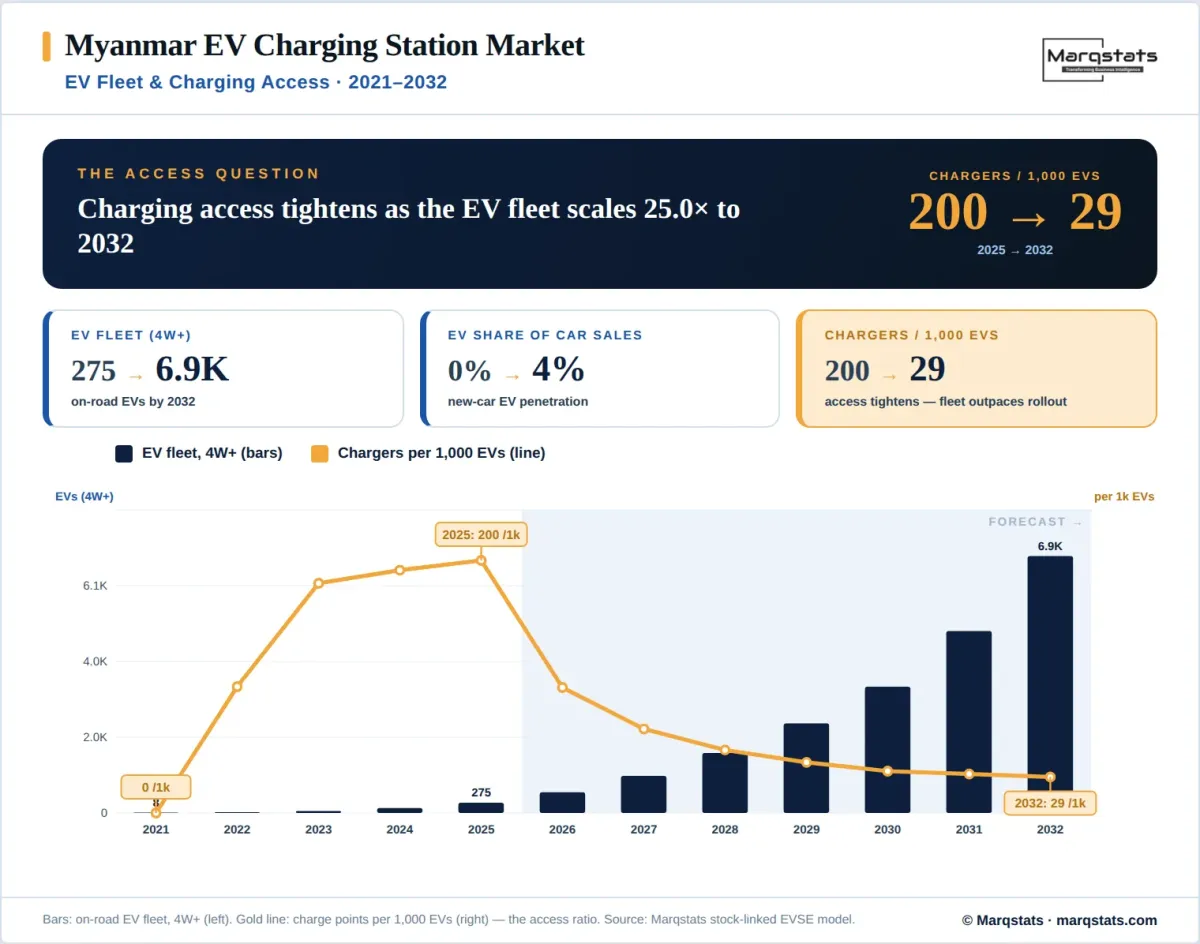
The Myanmar EV charging station market sits at the intersection of transport, energy, and industrial policy, and is scaling from a very small base amid difficult operating conditions. Electric-vehicle adoption remains early, with battery-electric vehicles a fraction of new sales, though interest has risen as fuel shortages and high imported-fuel cost make electric mobility an appealing alternative. Rising interest is expanding a small parc that depends on a thin public and home charging network concentrated in the largest cities. Adoption is the least developed among Southeast Asian markets, and the base is small enough that a few hundred vehicles and dozens of chargers move the market meaningfully.
The vehicle supply is shaped by trade with China. Most electric cars, motorcycles, and chargers are imported from or assembled with Chinese technology, and a locally assembled Chinese-technology model has been produced in an industrial zone near Yangon. This orientation shapes both the connector mix and the pace at which new hardware reaches the market.
Charging infrastructure is a stated government priority. Authorities issued import notifications granting duty-free treatment for electric vehicles, motorcycles, and tricycles, exempted electric vehicles from road-usage fees, and set aspirational targets for electric-vehicle registration shares. A national committee coordinates ministries, businesses, and academic institutions to build a roadmap for electric-vehicle development, and regional context is tracked by bodies such as the ASEAN Centre for Energy. A pilot placed charging stations across the three main cities and the expressway corridor.
Policy support is offset by structural constraints. The authorities have prioritized electric-vehicle rollout despite insufficient electricity supply to meet demand from existing grid customers, and economic and political instability has created uncertainty for investors. Investment incentives, including tax relief and zero customs for charging, battery, and electric-bus businesses, aim to attract capital, while imported electric-vehicle brands are required to open local showrooms. The rollout has proceeded despite the constraints, reflecting a policy choice to encourage electric mobility as a way to reduce imported-fuel dependence.
Market value is built from hardware, installation, networking software, and charging-service revenue. The network is alternating-current-led, giving alternating-current charging the larger installed base, while direct-current fast chargers carry higher unit prices and anchor the main expressway corridor. Growth is driven by import incentives, fuel-substitution interest, and the state pilot, even as a thin network outside the main cities, grid reliability, and the small absolute market size remain the defining points of attention. The pairing of a very low base with binding grid and economic constraints gives the market modest absolute values and a growth rate below its regional peers.
Market Dynamics
Key Drivers
Market is driven by duty-free import notifications for electric vehicles, motorcycles, and tricycles that lowered upfront ownership cost.
Fuel shortages and high imported-fuel cost increase interest in electric vehicles as a substitute for petrol and diesel.
A state-led charging pilot in the three main cities and along the expressway created the early public network.
Investment incentives grant tax relief and zero customs for charging, battery, and electric-bus businesses as priority sectors.
Road-usage-fee exemptions and highway access for electric vehicles support early adoption and inter-city travel.
Key Restraints
Chronic electricity shortages limit charging reliability and constrain deployment, especially for high-power sites.
Economic and political instability creates uncertainty for investors and complicates long-term planning.
The charging network is thin and concentrated in Yangon, Mandalay, and Naypyitaw, leaving most regions under-served.
Currency volatility and import dependence raise the cost of chargers, vehicles, and spare parts.
Key Trends
Direct-current fast charging is being added at fuel stations and expressway rest areas, mirroring the upgrade cycle across the global EV DC charging station market.
Chinese brands and locally assembled Chinese-technology models anchor vehicle supply and shape connector standards, tying the charging market closely to overland trade with China.
Solar and off-grid solutions are being explored to work around grid shortages at charging sites, drawing on the country's abundant solar and hydropower resources.
Fuel-station operators are co-locating charging to serve early adopters along key corridors, using existing retail sites and forecourts to extend the network at low incremental cost.
Market Segmentation
Alternating-current charging holds the largest installed base, accounting for roughly two-thirds of public chargers and most home installations. Units drawing 7 kW to 22 kW suit overnight and long-dwell replenishment at homes and city sites, where lower hardware and installation cost favours deployment in a price-sensitive and grid-constrained market. Many early owners rely on household sockets that can take several hours to charge a vehicle, so public alternating-current points offer a meaningful improvement in charging time. Regulated, affordable alternating-current charging suits the overnight patterns of most private owners.
Direct-current charging commands higher per-unit value and is the fastest-growing segment, owing to premium hardware and faster turnaround at expressway rest areas and fuel stations. Public direct-current sites can replenish vehicles far more quickly than household charging, and pilot stations were designed to serve multiple vehicles simultaneously. Faster turnaround makes direct-current charging central to serving drivers without reliable home charging and to enabling inter-city travel on the expressway. Grid capacity and substation upgrades condition where higher-power direct-current charging can be deployed, and authorities have identified substation and grid works to support charging along the expressway. Expressway rest-area chargers were designed to serve several vehicles at once, including buses at some sites.
The connector mix reflects a vehicle fleet dominated by Chinese imports, giving GB/T a significant share, while CCS2 is the emerging standard for newer direct-current sites and Type 2 serves alternating-current charging. A legacy Nissan fleet retains CHAdeMO, adding to the mix. The reliance on imported vehicles keeps the standard fragmented relative to more mature markets, and interoperability depends on operators supporting several plug types at public sites. As Chinese models dominate new imports, GB/T remains widely used even as CCS2 gains ground at newer sites.
Newer public deployments increasingly add CCS2 for direct-current charging, while alternating-current sites standardize on Type 2. The direction of travel follows the vehicle mix, which is weighted toward Chinese imports for now. Gradual consolidation would simplify procurement, though the pace depends on which vehicle brands dominate future imports.
Passenger cars represent the largest vehicle segment by charging-station value, owing to imports of Chinese battery-electric models and a small legacy fleet. Growing volumes broaden charging utilization across public and home settings and anchor the four-wheeler charging network in the main cities. Passenger cars contribute the largest share of charging-station revenue given the higher energy and hardware intensity of four-wheelers.
Electric two-wheelers and three-wheelers form a significant vehicle segment by volume, supported by duty-free import treatment and lower purchase cost. These vehicles rely mainly on home and small-site charging, and their electrification supports urban and last-mile mobility. Lower battery and charging requirements make two-wheelers and three-wheelers a natural early step in a grid-constrained market, and duty-free treatment lowered their upfront cost.
Commercial vehicles and buses form an emerging segment, anchored by electric-bus manufacturing agreements and logistics interest. Fleet and depot charging would concentrate demand where reliable grid capacity is available. An agreement to manufacture electric buses and vehicles points to future fleet demand, though realization depends on grid and economic conditions. Public-transport electrification would concentrate high-utilization charging at depots along the main corridors.
Public and commercial charging is the defining application, anchored by stations at fuel stations, city sites, and expressway rest areas. Fuel-station operators host much of the public network, while expressway sites add en-route capacity that supports travel between Yangon, Naypyitaw, and Mandalay. Co-locating chargers at fuel stations makes the network visible and accessible to early adopters.
Home charging anchors everyday replenishment for private owners, though many rely on household sockets given the thin public network, while fleet and depot charging serves early commercial adopters. These applications convert import incentives and pilot deployment into gradual demand as the vehicle base grows. Home charging remains the default for most owners, shaping where public investment adds the most value in a network still finding its footing.
By Geography
Yangon Region
Yangon Region, the commercial capital, holds the largest installed base and market value, owing to the highest vehicle density and the concentration of dealerships, fuel stations, and city sites. Yangon received the largest share of the initial charging rollout, anchoring both alternating-current and direct-current deployment in the country. The city also hosts the legacy electric fleet and the earliest dealership-linked charging, giving it the deepest base of charging experience in the country.
Mandalay Region
Mandalay Region records the fastest regional growth, owing to its role as the second-largest city and a hub for trade with China, which supplies most electric vehicles and chargers. Mandalay received a substantial share of the pilot stations, and proximity to overland trade routes supports vehicle and hardware supply. Growth from a small base is rapid as dealerships and chargers expand in and around the city, and the China trade corridor gives the region a clear advantage in sourcing electric vehicles and charging equipment.
Naypyitaw Union Territory
Naypyitaw, the administrative capital, hosts government-linked charging and pilot stations. Public deployment tracks government facilities and the expressway junction, giving the territory a concentration of early sites relative to its population. The capital's planned layout and government fleets support orderly charger placement, and its position on the expressway links it to both larger cities along the central corridor.
Bago and Central Regions
Bago and the central regions anchor the Yangon-Mandalay Expressway corridor, where charging stations at rest areas enable inter-city electric travel. A planned electric-vehicle manufacturing zone in Bago adds an industrial dimension to the region's role, linking charging demand to assembly and logistics along the corridor.
Other States and Regions
The remaining states and regions are the least-served, owing to dispersed population, limited grid capacity, and security and logistics constraints. Charging access is minimal outside the central corridor, and closing this gap depends on grid expansion and stability. Off-grid and solar solutions offer a partial path to extending access where the grid is weak, though security and logistics conditions shape the pace of any provincial rollout.
How Competition Is Evolving
The Myanmar EV charging station market is early-stage and fragmented, with the state anchoring the sector through ministries and electricity corporations. Deployment has proceeded through a national committee and a pilot programme, with public sites often located at fuel stations. No single private operator dominates, and the market remains dependent on state coordination, imported hardware, and vehicle-brand partnerships. The national committee overseeing electric-vehicle development coordinates ministries, city authorities, and companies as the sector takes shape.
Private participation is emerging. Local builders such as Yar Zar Min Industry have constructed city stations, vehicle distributors have added charging to support brand sales, and an electric-vehicle and electric-bus manufacturing agreement points to a nascent domestic-assembly ambition in the country. Global hardware suppliers, including ABB, Schneider Electric, Siemens, Delta Electronics, and Star Charge, provide equipment imported and installed by local integrators connected to the grid, with limited domestic manufacturing at this stage.
Competition centres on siting, charging speed, and reliability rather than price, given a regulated and grid-constrained environment. Operators differentiate through fuel-station and expressway locations, brand-linked charging, and the ability to maintain uptime despite power interruptions. Reliability is a genuine differentiator where grid supply is intermittent, favouring sites with backup or on-site generation. Standardization on CCS2 for newer direct-current sites and the concentration of demand in the main cities shape an emerging field where reliability and coverage matter most.
Companies Covered
Companies covered in the report include:
Recent Market Activity
Table of Contents
Coverage & Segmentation
This report provides a comprehensive analysis of the Myanmar EV charging station market across the 2021–2025 historical period and the 2026–2030 forecast period, with 2025 as the base year. The study covers alternating-current and direct-current charging hardware, installation, networking software, and charging services across public, commercial, and residential applications, segmented by charging type, connector type, vehicle type, and application, with coverage of Yangon, Mandalay, Naypyitaw, the Bago and central regions, and the other states and regions. Market sizing is benchmarked against national charging-station data and independent charging datasets.
The study examines market size, growth, segment-level value, competitive structure, and the policy and regulatory framework, including import notifications and investment incentives, benchmarked against regional and international datasets such as those of the International Energy Agency. Primary research includes interviews with charge-point developers, hardware suppliers, vehicle distributors, utilities, and policy makers, given the limited public data on this early-stage market.