Market Snapshot
Middle bar: base-year value × (1 + CAGR), rounded to two decimals. This is a calculated illustration, not a separately researched annual estimate.
The Cambodia EV charging station market was valued at USD 14 million in 2025 and is projected to reach USD 64 million by 2030, expanding at a 35.52% CAGR across the 2026–2030 forecast period. Growth is attributed to the National Policy for the Development of Electric Vehicles, sharp cuts to electric-vehicle import tax, and a state-led push to expand a small charging network toward national coverage. The Cambodia EV charging station market is the fastest-growing and smallest in Southeast Asia, scaling from an early base concentrated in Phnom Penh. Small absolute size is paired with a very high growth rate as adoption, incentives, and private deployment plans reinforce one another.
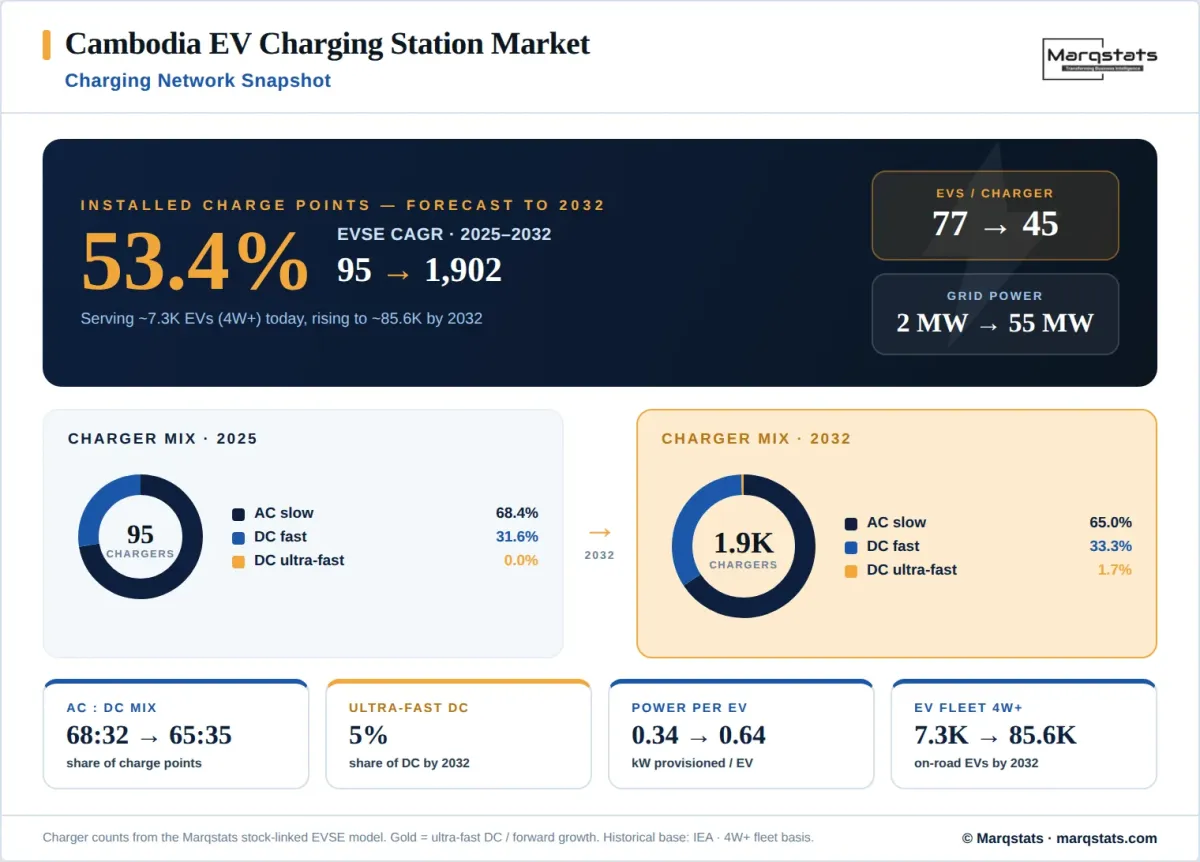
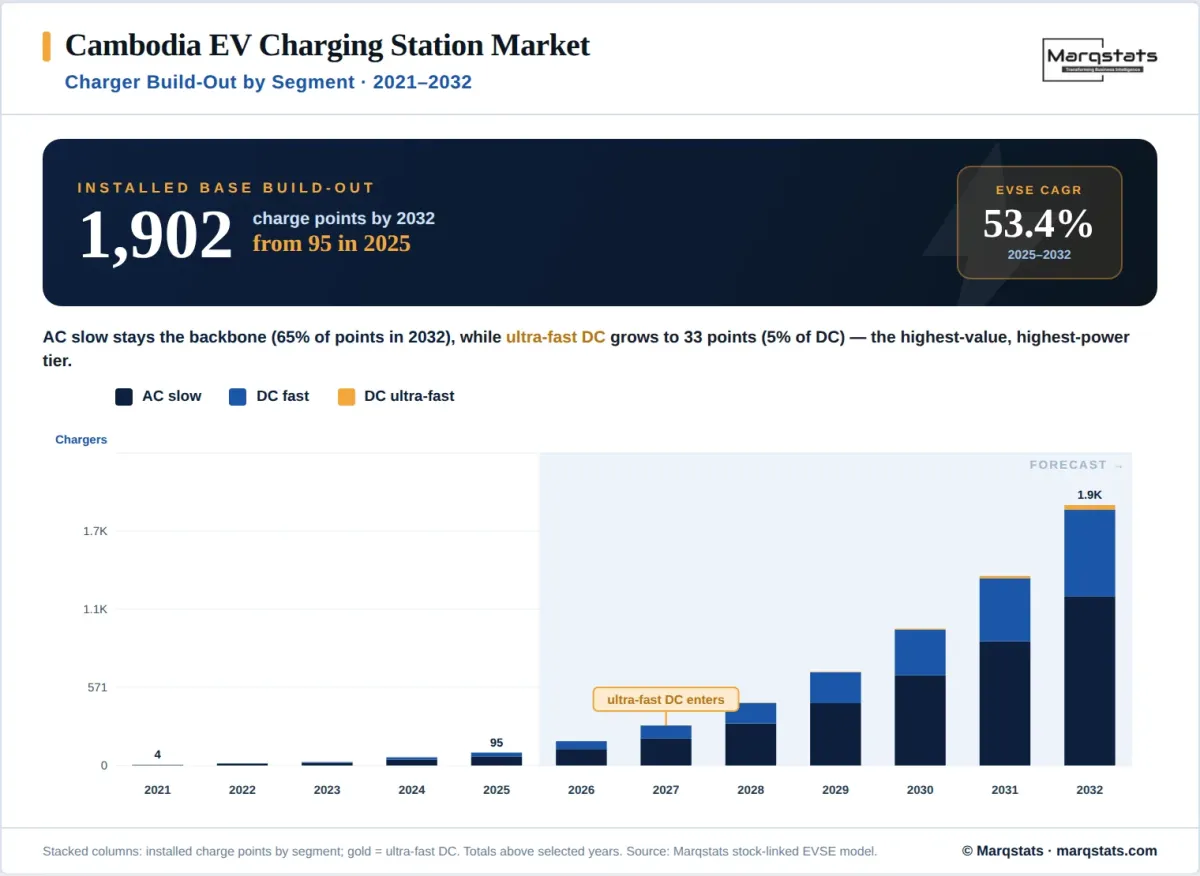
The market spans alternating-current and direct-current charging hardware, installation, networking software, and charging services across public, commercial, and residential applications. The public network expanded from a handful of sites in 2021 toward a charger base near one hundred units by 2025, coordinated by the Ministry of Mines and Energy, of which alternating-current chargers form about two-thirds. Direct-current fast chargers concentrate in Phnom Penh and along the Phnom Penh-Sihanoukville Expressway, which links the capital to the main port and coastal economic zones.
The operator structure is early-stage and state-anchored. Electricité du Cambodge sets tariffs and operates charging alongside private entrants including ZO Motors, the Singapore-based Charge+, and fuel retailer PTT, with mall and tourism sites adding coverage. Battery-electric adoption is led by BYD, followed by Toyota and Tesla, reflecting a market shaped by affordable Chinese models and premium imports. Type 2 alternating-current and CCS2 direct-current connectors anchor the standard, alongside GB/T units from Chinese models. Deployment concentrates in the capital and the coastal corridor, with tourist and provincial areas served by development-partner-funded and off-grid solutions.
Key Takeaways
Market Overview & Analysis
Report Summary
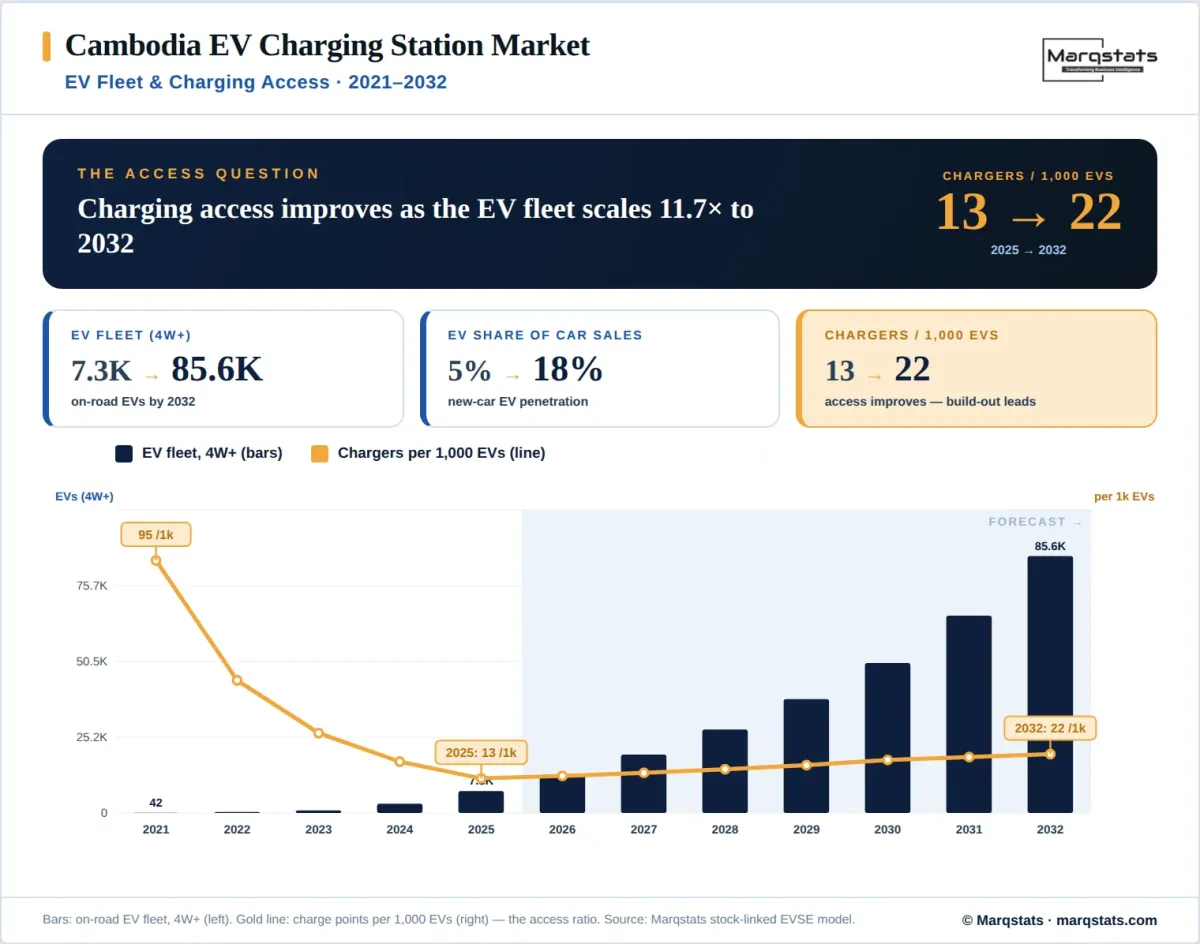
The Cambodia EV charging station market sits at the intersection of transport, energy, and industrial policy, and is scaling rapidly from a very small base. Electric-vehicle adoption accelerated from tens of vehicles in 2021 to roughly fifteen hundred by the end of 2023, and continued to climb through 2025 as car imports rose about 60% to USD 1.1 billion, with battery-electric models at the forefront of demand. Rising adoption is expanding a parc that depends on a still-thin public and home charging network. Adoption remains the least developed among the larger Southeast Asian markets, leaving substantial headroom as more brands and models enter and charging widens.
Charging is central to the government's clean-energy agenda, with clean sources expected to supply a large share of national electricity. Officials have framed charging build-out as a driver of socio-economic development, encouraging private investment in stations along highways, in economic zones, and in tourist cities while prioritizing safety and technical standards.
Charging infrastructure is a stated government priority. The National Policy for the Development of Electric Vehicles targets 40% electric cars and urban buses and 70% electric motorbikes by 2050, and the Electricity Authority of Cambodia introduced unified charging tariffs in 2025 to lower operating cost and support adoption. The government has pushed to expand the network from a handful of sites toward a target of about 200 stations across highways, economic zones, and tourist cities.
Policy support is broad and increasingly structured. Electric-vehicle import tax was cut sharply against conventional vehicles, road tax was lowered for electric vehicles, and the Ministry of Mines and Energy advanced a regulatory framework for charging services with private-sector consultation. Development partners have funded stations in provincial and tourist areas, and a technology partnership introduced smart-microgrid solutions for off-grid charging. A government-private forum mechanism brings together ministries, the chamber of commerce, and development agencies to coordinate the sector as it formalizes, giving investors a clearer framework for planning deployment. Regulated tariffs set a national ceiling while allowing operators to price below it, creating room for competition as the network expands and giving operators a predictable basis for pricing.
Market value is built from hardware, installation, networking software, and charging-service revenue. The network is alternating-current-led, giving alternating-current charging the larger installed base, while direct-current fast chargers carry higher unit prices and anchor the main expressway corridor. Growth is driven by adoption incentives, private deployment plans, and expressway build-out, even as a thin network outside Phnom Penh, grid readiness in provincial areas, and the small absolute market size remain points of attention. The pairing of a low base with strong policy momentum gives the market one of the highest growth rates in the region, though from modest absolute values.
Market Dynamics
Key Drivers
Market is driven by the National Policy for the Development of Electric Vehicles and long-term electrification targets to 2050.
Sharp cuts to electric-vehicle import tax, from 122% to 63%, and lower road tax accelerated registrations from a small base.
Unified charging tariffs set in 2025 lowered operating cost and improved the economics of electric-vehicle ownership.
Ambitious private deployment plans, including hundreds of fast chargers and thousands of alternating-current units, signal a shift toward commercial-scale rollout and expand coverage.
Expressway charging along the Phnom Penh-Sihanoukville corridor reduces range anxiety and supports inter-city travel.
Key Restraints
The charging network remains thin, concentrated in Phnom Penh, leaving provincial and rural areas under-served.
Grid readiness and connection capacity in provincial areas constrain high-power deployment outside the capital.
The small absolute market size and early-stage utilization pressure operator returns on new sites.
Limited local hardware supply leaves the market dependent on imported chargers and components.
Key Trends
Direct-current fast charging is expanding along highways and at fuel stations as inter-city travel grows, mirroring the upgrade cycle across the global EV DC charging station market.
Private operators are announcing large deployment plans, signalling a shift from state-led pilots to commercial rollout.
Smart-microgrid and solar solutions are being explored to enable charging in off-grid and provincial locations.
Tourism and coastal corridors are emerging as deployment priorities, alongside the capital and economic zones.
Market Segmentation
Alternating-current charging holds the largest installed base, accounting for roughly two-thirds of public chargers and most home installations. Units drawing 7 kW to 22 kW suit overnight and long-dwell replenishment at homes, workplaces, and malls, where lower hardware and installation cost favours deployment in a price-sensitive market. Regulated alternating-current tariffs near USD 0.26 per kWh keep everyday charging affordable relative to fuel. Most owners rely on overnight alternating-current charging, keeping the running cost of an electric vehicle well below that of a comparable petrol vehicle over typical distances.
Direct-current charging commands higher per-unit value and is the fastest-growing segment, owing to premium hardware and faster turnaround at expressway sites and fuel stations. The installed base is migrating toward 60 kW and higher classes as operators deploy fast chargers along the main corridor. Direct-current tariffs near USD 0.34 per kWh reflect the speed premium, and announced fast-charging plans point to rapid expansion from a small base. Faster turnaround makes direct-current charging central to serving drivers without home charging and to enabling travel between the capital and the coast. Expressway and fuel-station siting concentrates the highest-power, highest-value chargers where inter-city traffic and dwell economics support them.
Type 2 serves alternating-current charging across homes, workplaces, and public sites, while CCS2, the Combined Charging System, is the emerging standard for direct-current fast charging. The single-standard direction for fast charging lowers interoperability friction across newer sites, while payment and station location increasingly run through operator applications and a national charging map.
GB/T and other connectors hold a share tied to Chinese battery-electric models that lead adoption, while newer public deployments add CCS2. The mix reflects the dominance of imported vehicles, and consolidation around CCS2 for fast charging simplifies procurement for operators building out new sites, aligning Cambodia with the direct-current standard used across much of the region.
Passenger cars represent the largest vehicle segment by charging-station value, owing to rising imports of affordable battery-electric models led by BYD. Growing volumes broaden charging utilization across public and home settings and anchor the four-wheeler charging network in Phnom Penh and along the expressway. Passenger cars contribute the largest share of charging-station revenue given the higher energy and hardware intensity of four-wheelers, and this share is set to widen as more affordable models arrive.
Electric two-wheelers and three-wheelers, including tuk-tuks, form a significant vehicle segment by volume, tied to urban mobility and last-mile transport. Three-wheeler electrification is a natural early step given lower battery and charging requirements, and it broadens the base of drivers relying on affordable alternating-current charging. These vehicles rely mainly on home and small-site charging, and their electrification supports the long-term motorbike target of 70% electric two-wheelers by 2050. Two-wheelers and tuk-tuks are central to urban mobility, so their gradual electrification adds distributed charging demand across dense districts.
Commercial vehicles and buses form an emerging segment, anchored by urban-bus electrification goals and logistics operators. Fleet electrification concentrates demand at depots and along freight corridors, supporting the case for higher-power charging. Logistics operators serving the Phnom Penh-Sihanoukville route are early candidates for depot and en-route charging.
Public and commercial charging is the defining application, anchored by stations at ministries, malls, fuel stations, and expressway rest points, several of which are among the earliest public sites in the country. Fuel retailers and mall operators host much of the public network, while expressway sites add en-route capacity that supports travel between Phnom Penh and the coast. Provisioning at high-traffic retail and transport sites accelerates visible, accessible charging that builds consumer confidence.
Home charging anchors everyday replenishment for private owners, given affordable regulated tariffs and the prevalence of overnight charging, while fleet and depot charging serves logistics and transport operators. These applications convert adoption incentives and deployment plans into steady demand as the vehicle base grows. Affordable regulated tariffs make home charging the default for most owners, shaping where public investment adds the most value.
By Geography
Phnom Penh Capital
Phnom Penh, the capital, holds the largest installed base and market value, owing to the highest vehicle density and the concentration of malls, ministries, and commercial sites. The city anchors both alternating-current destination charging and the densest cluster of direct-current hubs, including stations at government headquarters and major shopping centres. The capital carries the highest concentration of battery-electric vehicles, sustaining utilization across both charger classes.
Coastal Region
The Coastal Region, anchored by Preah Sihanouk with Kampot and Kep, records the fastest regional growth, owing to the Phnom Penh-Sihanoukville Expressway, special economic zones, coastal tourism, and planned local vehicle production. Freight and port activity around Sihanoukville adds commercial-vehicle charging demand alongside passenger travel. Expressway charging stations along the corridor open inter-city electric travel to the coast, and planned local vehicle production in Sihanoukville reinforces the region's role in the electric-mobility ecosystem.
Northwest Region
The Northwest Region, covering Siem Reap and Battambang, expands on tourism demand and development-partner-funded stations. Siem Reap, a major tourist hub, supports destination charging for visitors and rental fleets, extending access beyond the capital. Coastal and heritage tourism corridors are early beneficiaries of charger deployment aimed at visiting drivers.
Central Region
The Central Region, spanning Kampong Speu, Kampong Cham, and Kampong Thom, grows on expressway and national-road corridors that connect the capital to the provinces. Charging deployment tracks highway rest points and provincial towns along key routes, extending the network outward from the capital as inter-provincial travel grows.
Eastern and Northeastern Provinces
The eastern and northeastern provinces remain the least-served region, owing to dispersed population and limited grid capacity. Targeted and off-grid solutions, including solar and microgrid pilots, are opening early charging access. Closing this gap is central to extending adoption nationwide, where dispersed towns and longer distances make phased, hub-based deployment the practical near-term approach.
How Competition Is Evolving
The Cambodia EV charging station market is early-stage and fragmented, with the state utility anchoring the sector and private entrants scaling quickly. Electricité du Cambodge sets charging tariffs and operates charging infrastructure, while the Ministry of Mines and Energy shapes the regulatory framework in consultation with the private sector. No single private operator yet dominates, leaving room for newcomers as the market matures. The government-private forum mechanism coordinates policy and investment as the sector formalizes.
Private deployment is accelerating. ZO Motors has announced plans for hundreds of fast-charging stations nationwide, the Singapore-based Charge+ has signalled deployment of thousands of alternating-current and direct-current chargers, and fuel retailers such as PTT and TotalEnergies add charging at stations. Mall operators including AEON host public chargers, and a technology partnership supports smart-microgrid deployment. Global hardware suppliers, including ABB, Schneider Electric, Siemens, Delta Electronics, and Star Charge, provide the underlying equipment, imported and installed by local integrators connected to the utility grid, with limited domestic manufacturing at this stage.
Competition centres on network coverage, charging speed, tariff structure, and location. Operators differentiate through expressway and fuel-station siting, mall partnerships, and app-based access, within a regulated tariff ceiling that caps pricing while allowing competition below it. Standardization on CCS2 for fast charging and a national charging map are shifting the basis of competition toward coverage, reliability, and customer experience across an emerging field. As the network scales, grid access, siting, and partnership breadth increasingly determine competitive position.
Companies Covered
Companies covered in the report include:
Recent Market Activity
Table of Contents
Coverage & Segmentation
This report provides a comprehensive analysis of the Cambodia EV charging station market across the 2021–2025 historical period and the 2026–2030 forecast period, with 2025 as the base year. The study covers alternating-current and direct-current charging hardware, installation, networking software, and charging services across public, commercial, and residential applications, segmented by charging type, connector type, vehicle type, and application, with coverage of Phnom Penh, the Coastal, Northwest, and Central regions, and the eastern and northeastern provinces. Market sizing is benchmarked against national charging-station data and International Energy Agency charging datasets.
The study examines market size, growth, segment-level value, competitive structure, and the policy and regulatory framework, including the National Policy for the Development of Electric Vehicles and charging-services regulation, supported by data from development partners such as the United Nations Development Programme. Primary research includes 40+ interviews with charge-point operators, hardware manufacturers, fleet operators, utilities, and policy makers.