Market Snapshot
Middle bar: base-year value × (1 + CAGR), rounded to two decimals. This is a calculated illustration, not a separately researched annual estimate.
The India EV charging station market was valued at approximately USD 487 million in 2025 and is projected to reach USD 1,652 million by 2030, expanding at a CAGR of 27.67% during the 2026–2030 forecast period. India's installed base of public EV charging stations has grown from 5,151 at end-2022 to 25,202 at end-2024 and approximately 29,000+ by August 2025 — a nearly sixfold increase in under three years — with the network now spanning a ratio of roughly one charging station per 135 registered EVs. The market encompasses public DC fast charging for passenger EVs, AC slow/destination charging for two-wheelers and three-wheelers, fleet and depot charging for commercial operators, highway corridor fast charging, and the software and interoperability layer that determines whether installed chargers are actually discoverable, reliable, and usable.
The India EV charging infrastructure market has moved decisively past the proof-of-concept phase into a structured build-out driven by aggressive policy intent. Under PM E-DRIVE, INR 2,000 crore has been earmarked for public EV charging infrastructure, with the scheme targeting approximately 72,000 public charging stations across 50 national highway corridors, metro cities, airports, railway stations, fuel outlets, toll plazas, and state highways — including 22,100 fast chargers for four-wheelers, 48,400 chargers for two-wheelers and three-wheelers, and 1,800 bus chargers. However, execution lags ambition: parliamentary disclosures confirmed that no expenditure had been incurred under the PM E-DRIVE charging component as of March 2026, and there is no specific roadmap for private-sector participation over the next three years.
The India EV charging station market is structurally splitting into four distinct layers: public urban and highway fast charging for passenger EVs, fleet and depot charging for commercial operators, distributed home and semi-public charging (larger in point count but weaker in public utility), and the software and interoperability layer where app access, roaming, uptime visibility, and payment systems increasingly determine charger usability. Geographically, the market is no longer a metro-only story — smaller cities and non-metro areas overtook Tier-1 cities in absolute public charger count by April 2025, with 12,040 chargers in Tier-3 and other locations compared to 9,702 in Tier-1 cities. Karnataka leads all states with 6,097 stations, followed by Maharashtra (4,155), Uttar Pradesh (2,326), Delhi (1,967), and Tamil Nadu (1,781).
Key Takeaways
Market Overview & Analysis
Report Summary
The India EV charging station market covers the design, manufacturing, installation, operation, and monetisation of electric vehicle charging infrastructure across India's urban, highway, residential, commercial, and industrial corridors. The market spans hardware (AC slow chargers, DC fast chargers, ultra-fast chargers up to 720 kW, battery swapping stations, bus depot chargers), software (charge point management systems, mobile applications, payment gateways, roaming platforms), and services (charge point operator models, energy management, fleet charging solutions, OEM partnership programmes). The term "EV charging infrastructure" and "EV charging station" are used interchangeably in this report to cover all forms of electric vehicle energy replenishment points.
India's EV charging landscape has undergone a structural transformation. Public EV charging stations consumed approximately 847.8 million units (MU) of electricity in FY2024-25, more than four times the earlier reported level, indicating rising utilisation alongside rising station count. The market conversation has shifted from "do chargers exist?" to "are they reliable, interoperable, high-power, and where users actually need them?" Under FAME-II, 9,332 chargers were sanctioned but only 6,645 were operational by March 2026 (71.2% operationalisation), demonstrating the persistent gap between "sanctioned chargers" and "usable chargers" in India's deployment architecture. The Confederation of Indian Industry (CII) estimates India needs 1.32 million charging stations by 2030, requiring approximately 400,000 installations annually. For related analysis of the battery swapping segment that complements plug-in charging, see the India EV Battery Swapping Market report on Marqstats.
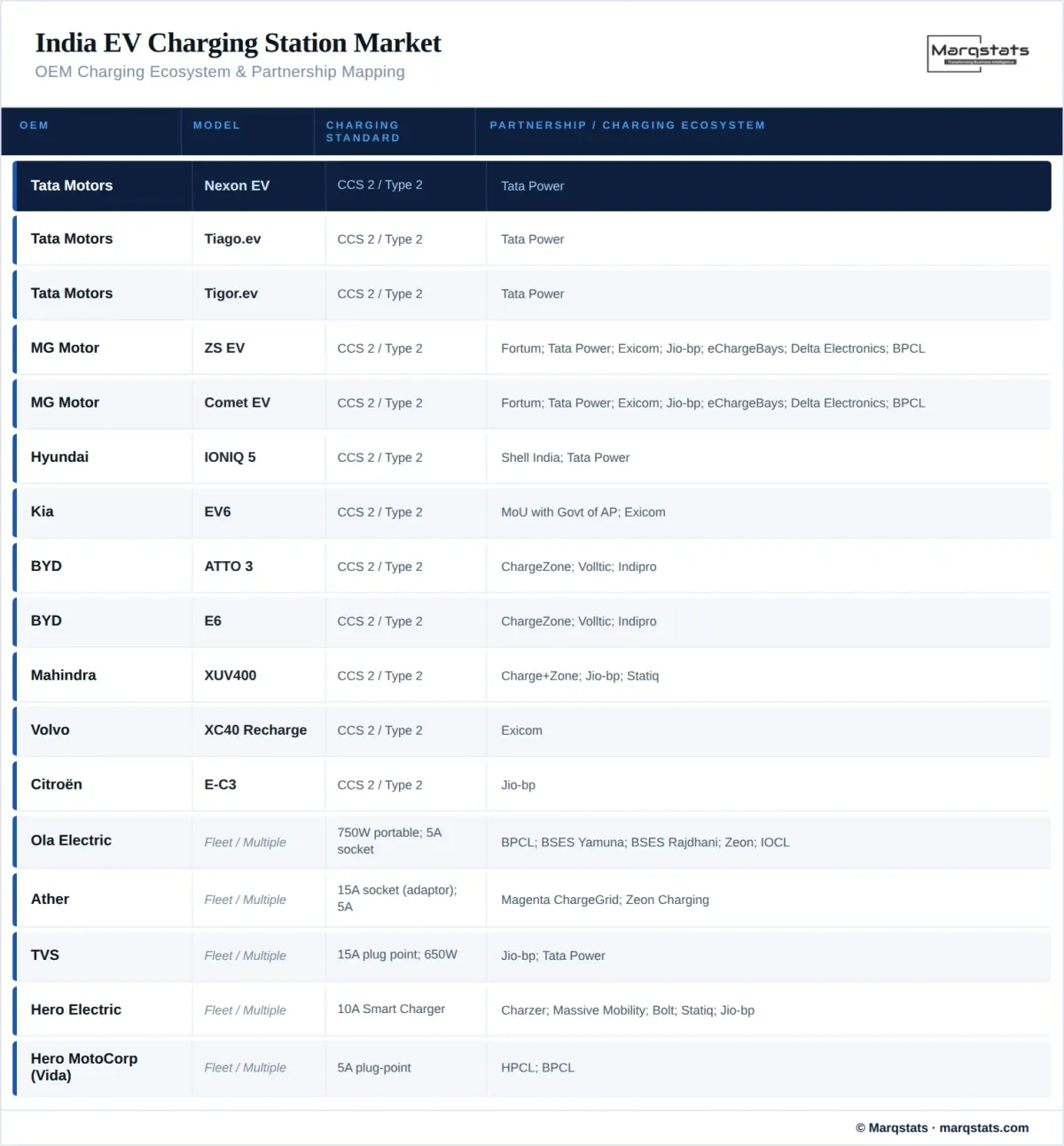
The most important structural shift is that OEMs are now acting as charging orchestrators, not just vehicle sellers. TATA.ev announced a target of 400,000 charge points by 2027 under its Open Collaboration framework, partnering with Tata Power, Statiq, Zeon, and ChargeZone, and launching 21 Mega Charging Hubs with Shell in February 2026. Kia signed with BPCL to onboard 3,000+ charging points to K-Charge. Mahindra's Charge_iN partnered with HPCL to deploy charging at retail outlets nationwide. Interoperability is becoming a competitive weapon: Statiq integrated 5,100+ HPCL chargers into its EVLinq platform, Exicom partnered with IONAGE for a neutral open ecosystem, and multiple OEM-CPO app integrations are reducing the fragmented access problem. For broader electric vehicle market context, see the India Electric Bus Market and India Electric Three-Wheeler Market reports on Marqstats.
Market Dynamics
Key Drivers
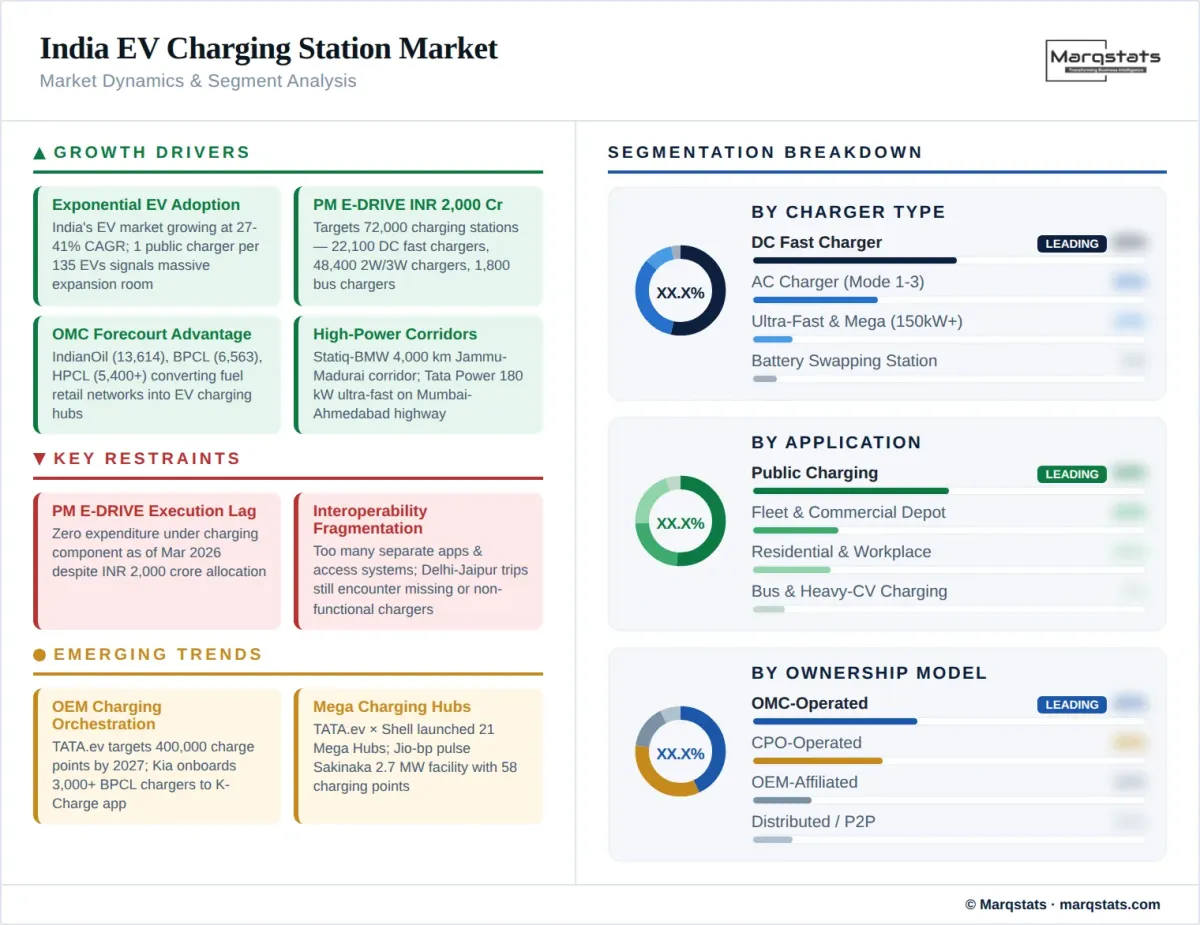
- Exponential EV adoption creating base-load charging demand — India's EV market is projected to grow at 27–41% CAGR through 2030, with two-wheeler and three-wheeler EVs dominating the vehicle parc. Every registered EV requires charging access, creating a structural demand curve. The current ratio of approximately one public charging station per 135 EVs indicates significant room for infrastructure expansion to match vehicle growth.
- PM E-DRIVE's INR 2,000 crore allocation for charging infrastructure — The scheme provides a tiered subsidy structure: 100% subsidy on upstream infrastructure and EVSE for government premises with free public access; 80% on infrastructure and 70% on EVSE for transport hubs (railway stations, airports, bus depots, metro stations); 80% on upstream infrastructure for all other urban and highway locations; and 80% on upstream infrastructure for battery swapping stations at any location. The scheme targets 72,000 charging stations including 22,100 fast chargers for four-wheelers.
- Oil-marketing companies converting fuel retail networks into EV charging hubs — IndianOil (13,614 chargers), BPCL (6,563), and HPCL (5,400+) are leveraging their existing fuel station forecourts, highway touchpoints, grid access relationships, and customer footfall to deploy EV charging at scale. These companies control the most strategic real estate for highway and arterial road charging, creating a powerful land-bank advantage that pure-play CPOs cannot easily replicate.
- High-power corridor charging reducing range anxiety for passenger EVs — Statiq and BMW India built a 4,000 km high-power corridor from Jammu to Madurai with charging every 300–350 km using 120–720 kW chargers. Tata Power launched a 180 kW ultra-fast station on the Mumbai–Ahmedabad highway. Jio-bp pulse's Sakinaka hub in Mumbai is a 2.7 MW facility with 58 charging points. These deployments signal the market's transition from AC destination charging to high-power, multi-bay corridor infrastructure.
- State-level electricity tariff reforms improving charging economics — Maharashtra's latest tariff order lowered residential EV charging rates and set INR 9.50/unit for high-tension and low-tension EV charging stations for multiple years. Haryana instructed discoms to set up charging stations in major cities. Delhi's EV Policy 2.0 supported 4,646 charging points with plans for 13,200–13,700 by 2030. Favourable electricity tariffs directly improve charge point operator (CPO) unit economics and accelerate network expansion.
Key Restraints
- PM E-DRIVE charging execution significantly behind schedule — Despite INR 2,000 crore allocated, parliamentary disclosures confirmed zero expenditure under the PM E-DRIVE charging component as of March 2026, and no specific roadmap for private-sector participation exists. This gap between scheme ambition and on-ground spend is one of the most important realities in the market, delaying the deployment of 72,000 targeted chargers.
- FAME-II operationalisation gap — 71.2% of sanctioned chargers functional — Of 9,332 EV chargers sanctioned under FAME-II, only 6,645 were operational by March 2026. This 29% non-operational rate highlights persistent execution challenges around site acquisition, grid connectivity, equipment procurement, and commissioning timelines that carry forward into PM E-DRIVE deployment.
- Fragmented app ecosystems and interoperability barriers — India still has too many separate apps, access systems, and operational silos across charge point operators. A reported Delhi–Jaipur EV trip that encountered missing or non-functional chargers illustrates that user experience still lags headline numbers. While Statiq-HPCL integration and OEM-CPO partnerships are improving, full plug-and-charge interoperability across all networks remains elusive.
- Grid infrastructure inadequacy in Tier-2/Tier-3 deployment zones — While non-metro areas have overtaken Tier-1 cities in charger count, the quality and reliability of power supply in smaller cities and highway corridors creates operational challenges. Transformer upgrades, dedicated EV feeders, and consistent power availability are prerequisites for reliable fast-charging networks that many locations still lack.
Key Trends
- OEMs becoming charging orchestrators through Open Collaboration models — TATA.ev's target of 400,000 charge points by 2027 with 30,000+ new public fast chargers, Kia's onboarding of 3,000+ BPCL chargers to K-Charge, and Mahindra's Charge_iN partnership with HPCL for retail outlet deployment demonstrate that vehicle manufacturers are directly shaping charging infrastructure deployment and user access patterns.
- Mega Charging Hubs and high-throughput fleet charging emerging — TATA.ev and Shell launched 21 Mega Charging Hubs in February 2026. Jio-bp pulse's Sakinaka hub in Mumbai (2.7 MW, 58 points) represents the fleet and ride-hailing hub model. These large-format, multi-bay charging facilities optimise real estate utilisation and serve high-frequency commercial users, moving beyond single-charger installations.
- Domestic EV charger manufacturing and IP development accelerating — ThunderPlus and Delta Electronics launched India's first locally manufactured fast charger for two-wheelers and three-wheelers in December 2024. Servotech pursued CCS2-to-GB/T and low-voltage charging patents. Exicom launched an integrated CPO rollout solution. The hardware and software stack is becoming strategically important as India pushes domestic content requirements under PM E-DRIVE.
- Software and interoperability layer becoming the key competitive differentiator — Statiq's integration of 5,100+ HPCL chargers (including 2,900 DC fast chargers) into its EVLinq platform, Exicom-IONAGE's neutral open ecosystem partnership, and multiple OEM app integrations signal that the market's next competitive frontier is not just installing chargers but making them discoverable, trustworthy, and easy to pay for across networks.
Market Segmentation
DC fast charging held approximately 63.7% market share by revenue in 2024 and is the fastest-growing segment, driven by highway corridor deployment, fleet and commercial charging demand, and consumer expectations for rapid refuelling. DC chargers range from 30 kW urban fast chargers to 180 kW ultra-fast highway chargers (Tata Power) and 720 kW corridor chargers (Statiq-BMW). PM E-DRIVE specifically targets 22,100 DC fast chargers for four-wheelers and 1,800 bus chargers. The segment is dominated by CCS2 connector standard for passenger vehicles with GB/T emerging for commercial applications.
AC charging serves the largest installed base by unit count, spanning home chargers, workplace chargers, and public destination chargers. AC chargers are the primary charging solution for electric two-wheelers and three-wheelers, which constitute approximately 80% of India's EV sales. Tata Power alone has deployed 200,000+ home chargers. PM E-DRIVE targets 48,400 chargers for two-wheelers and three-wheelers, predominantly AC. The segment benefits from lower installation cost and simpler grid requirements but faces lower per-unit revenue and utilisation challenges.
Ultra-fast charging (150–350 kW) and mega charging (350 kW+) represent the premium segment targeted at highway corridors, fleet hubs, and commercial truck/bus charging. Statiq's 720 kW chargers on the Jammu–Madurai corridor, Jio-bp pulse's 2.7 MW Sakinaka hub, and TATA.ev x Shell Mega Charging Hubs represent this emerging tier. As India's EV fleet shifts toward larger-battery passenger vehicles and commercial EVs, ultra-fast charging demand will grow proportionally.
Battery swapping stations complement plug-in charging, particularly for two-wheelers, three-wheelers, and emerging heavy-duty applications. PM E-DRIVE provides 80% subsidy on upstream infrastructure for BSS at any location. IndianOil operates 37 battery-swapping facilities; HPCL has 150+ under HP e-Charge. For comprehensive analysis of the swapping segment, see the India EV Battery Swapping Market report on Marqstats.
Public charging is the largest segment, accounting for approximately 65% of market share. India's ~29,000+ public stations serve both urban commuters and intercity travellers. Highway fast charging has become a priority with PM E-DRIVE targeting 50 national highway corridors. Karnataka leads with 6,097 public stations. The segment's economics depend on utilisation rates, with public charging consuming approximately 847.8 MU of electricity in FY2024-25 — more than 4x the earlier reported level.
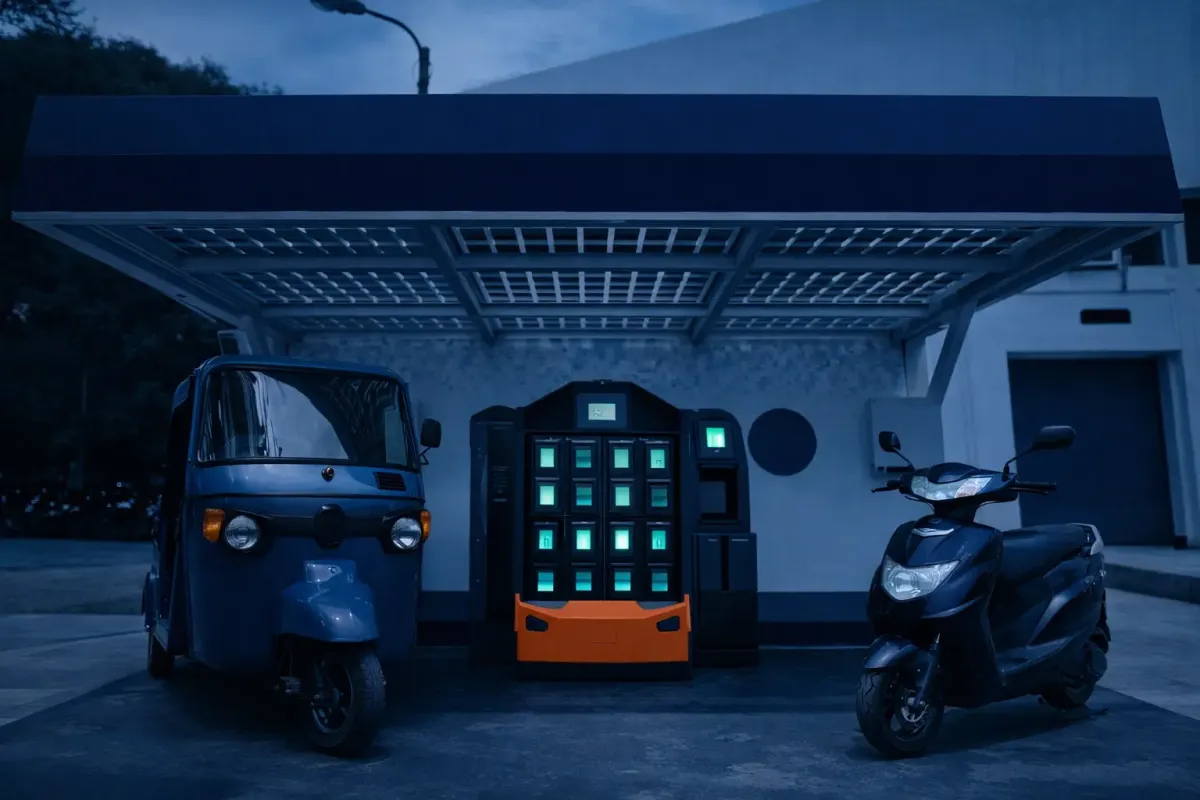
Fleet charging is the fastest-growing application segment, driven by e-commerce logistics electrification, electric bus depot requirements, and ride-hailing fleet operators. Jio-bp pulse's Sakinaka fleet hub model, Tata Power's 1,200+ e-bus charging points, and commercial depot installations for delivery fleets represent this category. Fleet operators require guaranteed uptime, predictable energy costs, and dedicated infrastructure that public charging cannot always provide.
Residential charging represents the largest absolute point count but is predominantly private/semi-public rather than open public infrastructure. Tata Power's 200,000+ home chargers and Bolt.Earth's 100,000+ distributed network (spanning home, semi-public, and peer-to-peer) dominate this segment. Workplace charging is emerging as employers install chargers at office complexes, particularly in technology parks and corporate campuses.
Bus and heavy-CV charging is an emerging high-value segment requiring high-power depot chargers (60–350 kW) and megawatt-class charging for heavy trucks. PM E-DRIVE allocates support for 1,800 bus chargers. Exicom's Harmony Gen 1.5 DC charger (60–400 kW) is designed to serve the spectrum from two-wheelers to e-buses. The India Electric Truck Market report on Marqstats provides complementary analysis of heavy-vehicle charging requirements.
By Geography
Karnataka
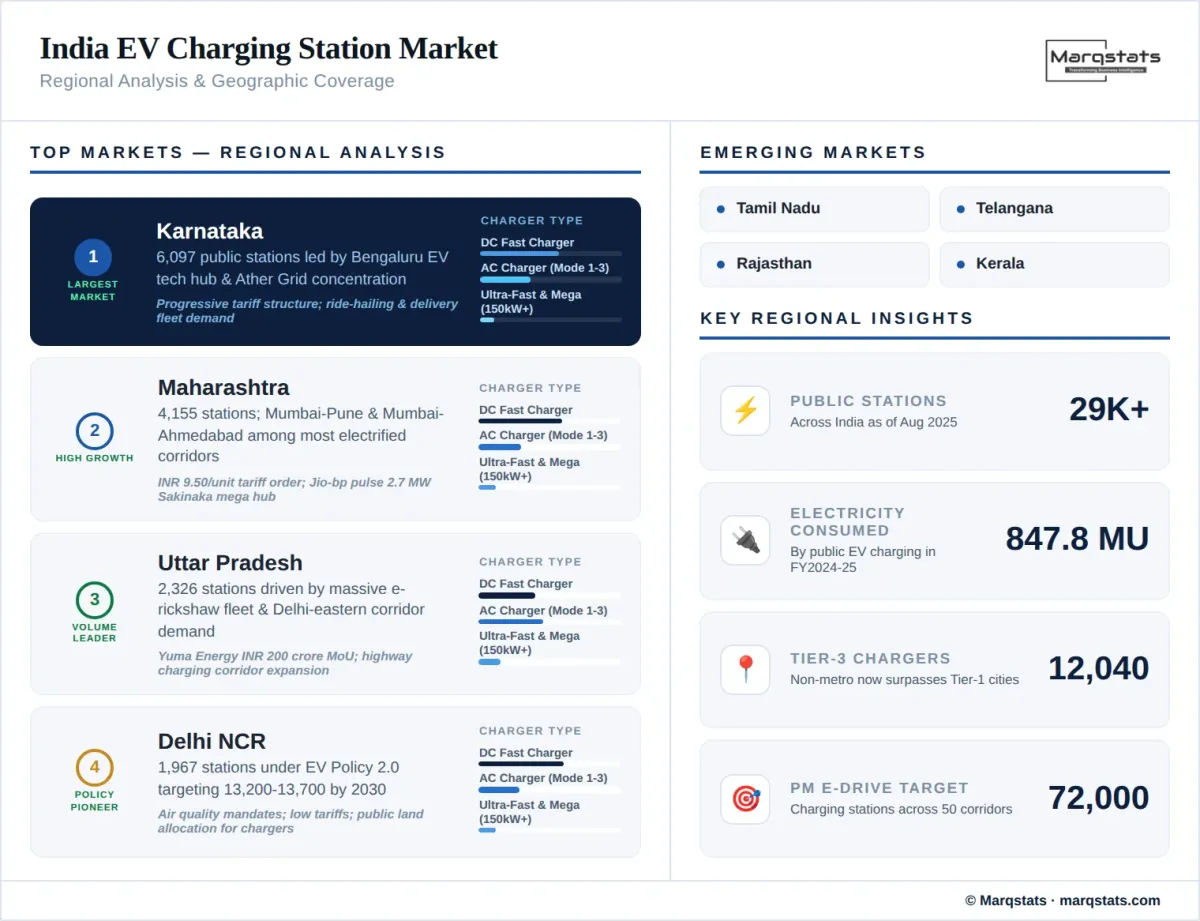
Karnataka leads the India EV charging station market with 6,097 public stations as of August 2025, driven by Bengaluru's status as India's EV technology hub, the presence of Ather Energy's Grid network (5,000+ fast chargers across 395+ cities, with Bengaluru concentration), state EV policy incentives, and strong demand from ride-hailing and delivery fleets. The state's progressive electricity tariff structure and supportive regulatory environment for CPO deployment further reinforce its leadership position.
Maharashtra
Maharashtra ranks second with 4,155 public stations, anchored by Mumbai and Pune's dense urban charging networks. Key deployments include Jio-bp pulse's 2.7 MW Sakinaka fleet hub, Tata Power's 180 kW ultra-fast station on the Mumbai–Ahmedabad highway, and TATA.ev x Shell Mega Charging Hubs. Maharashtra's latest tariff order setting INR 9.50/unit for EV charging stations for multiple years has significantly improved CPO unit economics. The Mumbai–Pune and Mumbai–Ahmedabad highway corridors are among India's most actively electrified freight and passenger routes.
Uttar Pradesh
Uttar Pradesh ranks third with 2,326 public stations, driven by the state's massive e-rickshaw fleet (India's largest) and growing passenger EV adoption in Noida, Lucknow, and Agra. The state's highway network connecting Delhi NCR to eastern India creates corridor charging demand. UP's EV policy provides subsidies for charging infrastructure deployment, and Yuma Energy's INR 200 crore MoU with Invest UP signals both swapping and charging infrastructure expansion.
Delhi NCR
Delhi has 1,967 public stations supported by the Delhi EV Policy 2.0, which facilitated 4,646 charging points and targets 13,200–13,700 by 2030. Delhi's severe air quality challenges, vehicular emission restrictions, and high EV adoption rate (particularly two-wheelers and ride-hailing) create concentrated charging demand. The region serves as a testbed for policy innovation including low tariffs, public land allocation for chargers, and interoperability mandates.
Tamil Nadu
Tamil Nadu has 1,781 public stations, supported by its auto manufacturing cluster in Chennai, Hyundai's 600 fast charging station commitment over seven years, and the state's MoU-driven approach to attracting EV charging investment. The state's port connectivity and industrial corridor demand create both passenger and commercial charging requirements. ThunderPlus and Delta Electronics' locally manufactured 2W/3W fast charger was launched in Tamil Nadu.
How Competition Is Evolving
The India EV charging station market features a multi-layered competitive structure: integrated energy-utility CPOs (Tata Power), oil-marketing companies leveraging forecourt networks (IndianOil, BPCL, HPCL), private fast-charging specialists (ChargeZone, Statiq), OEM-affiliated charging networks (Ather Grid, Jio-bp pulse), distributed/peer-to-peer platforms (Bolt.Earth), and hardware/technology enablers (Exicom, Servotech, ABB India, Delta Electronics). Market concentration is moderate but evolving rapidly as OMC networks scale and private CPOs consolidate through fundraising and interoperability partnerships.
Tata Power EZ Charge is the strongest all-round charging incumbent, with 6,700+ public, semi-public, and fleet charging points, 1,200+ e-bus charging points, 200,000+ home chargers, presence across 630+ cities, and 500,000+ registered customers. Its competitive strength lies in combining public charging, fleet charging, bus depots, and home charging with utility-side credibility. Among OMCs, IndianOil claims India's largest EV mobility infrastructure with 13,614 chargers and 37 swapping facilities; BPCL commissioned 3,428 new stations in FY2024-25 to reach 6,563 total; and HPCL operates 5,400+ EV charging stations and 150+ swapping stations under HP e-Charge. These OMCs may not always have the best software layer, but they control forecourts, highway touchpoints, grid access, and customer habit loops that matter at scale.
Among private CPOs, ChargeZone markets itself as India's largest network with 13,500+ charging points plus solar-BESS integration and OEM partnerships. Statiq has grown to 8,000+ chargers across 70 cities, raised USD 18 million for DC fast charging expansion, and differentiated on software through its EVLinq platform integrating 5,100+ HPCL chargers. Jio-bp pulse operates 6,000+ points across 75+ cities with 95%+ claimed uptime, focusing on high-throughput fleet and hub-style charging. Bolt.Earth operates the largest distributed network at 100,000+ chargers across 1,900+ cities with 411,000+ active users, though this spans home, semi-public, and peer-to-peer infrastructure rather than classic public fast charging. Ather Grid is the segment leader in two-wheeler fast charging with 5,000+ fast chargers across 395+ cities.
Companies Covered
Companies covered in the report include:
Recent Market Activity
Table of Contents
Coverage & Segmentation
This report provides a comprehensive analysis of the India EV charging station market covering the historical period 2021–2025 and forecast period 2026–2030, with 2025 as the base year. The study encompasses market size and revenue projections, charger type segmentation (DC fast, AC slow, ultra-fast, battery swapping), application analysis (public urban/highway, fleet/commercial, residential/workplace, bus/heavy-CV), ownership model evaluation (CPO-operated, OMC-operated, OEM-affiliated, distributed/P2P), regional deployment analysis across India's leading states, competitive landscape across CPOs, OMCs, OEMs, and hardware providers, and policy impact assessment including PM E-DRIVE, FAME-II legacy, and state-level EV charging incentives.
Primary research includes assessment of CPO network disclosures, OMC infrastructure announcements, OEM-CPO partnership formations, government subsidy disbursement data, and charger utilisation patterns. Secondary research draws from parliamentary replies (Lok Sabha, Rajya Sabha), BEE energy scenario reports, PM E-DRIVE operational guidelines, FAME-II scheme reviews, company press releases and annual reports, state EV policy documents, and trade media coverage. Market sizing employs bottom-up estimation based on charger deployment volumes, per-station revenue by charger type and utilisation tier, and subsidy impact modelling, validated against top-down industry benchmarks and government-reported installed base figures.