Market Snapshot
Middle bar: base-year value × (1 + CAGR), rounded to two decimals. This is a calculated illustration, not a separately researched annual estimate.
The Philippines EV charging station market was valued at USD 92 million in 2025 and is projected to reach USD 398 million by 2030, expanding at a 34.04% CAGR across the 2026–2030 forecast period. Growth is attributed to the Electric Vehicle Industry Development Act, mandatory charging provisioning in malls and fuel stations, and a national roadmap targeting a large rise in the electric-vehicle fleet by 2030. The Philippines EV charging station market is scaling from an early base, driven by policy mandates and private-sector build-out concentrated in Metro Manila, and is among the earlier-stage charging markets in Southeast Asia relative to its vehicle base.
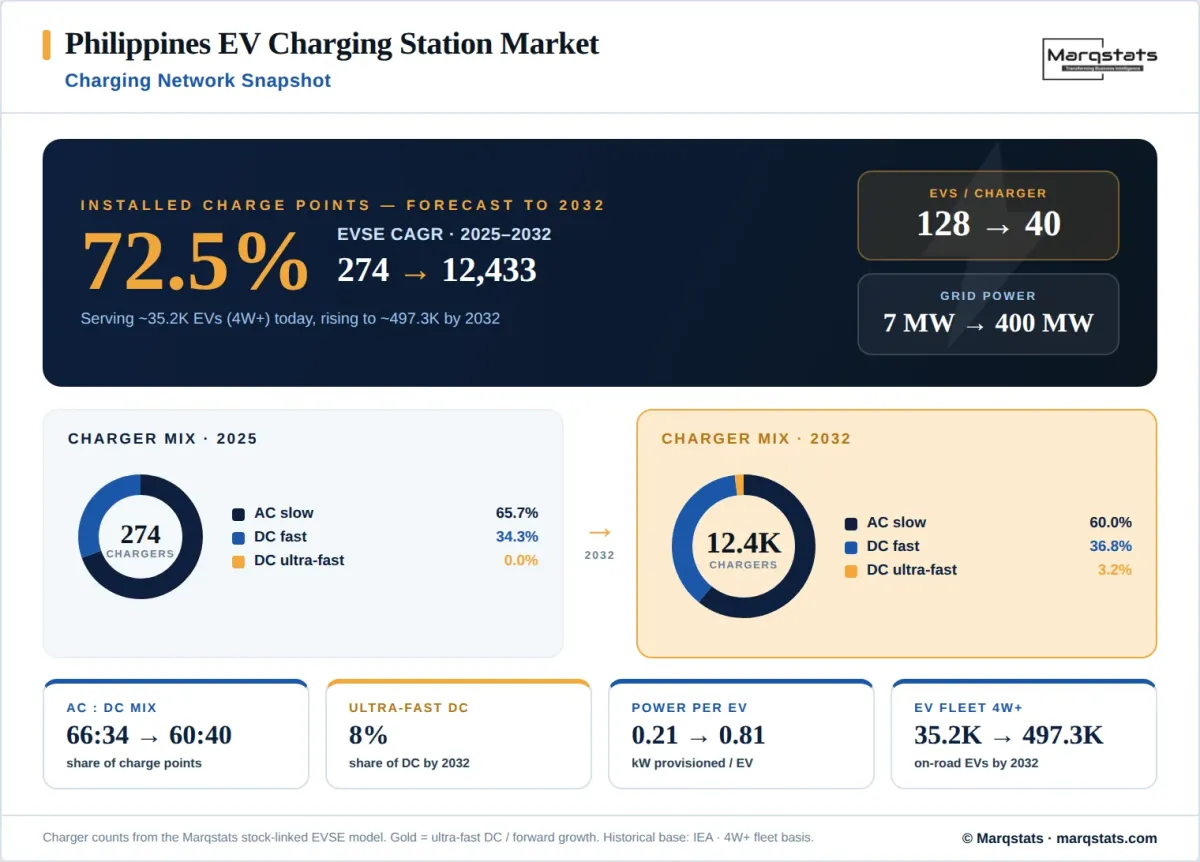
The market spans alternating-current and direct-current charging hardware, installation, networking software, and charging services across public, commercial, residential, and fleet applications. Registered public charging points reached roughly 1,600 nationwide by early 2026, well short of the target set under the roadmap of the Department of Energy, of which alternating-current units form the majority. Direct-current fast chargers concentrate in Metro Manila and along expressway corridors.
The operator structure is concentrated among a few well-capitalized groups. Meralco, through Movem Electric, powers much of the charging infrastructure, ACMobility of the Ayala group runs the most extensive public network through its Evro platform, and Pilipinas Shell operates Shell Recharge, alongside mall developers such as SM Supermalls, Robinsons Land, and Megaworld. Type 2 alternating-current and CCS2 direct-current connectors anchor the standard, alongside legacy CHAdeMO and imported GB/T units. Deployment concentrates in Metro Manila and along Luzon expressways, with Cebu and Davao emerging as secondary demand centres.
Key Takeaways
Market Overview & Analysis
Report Summary
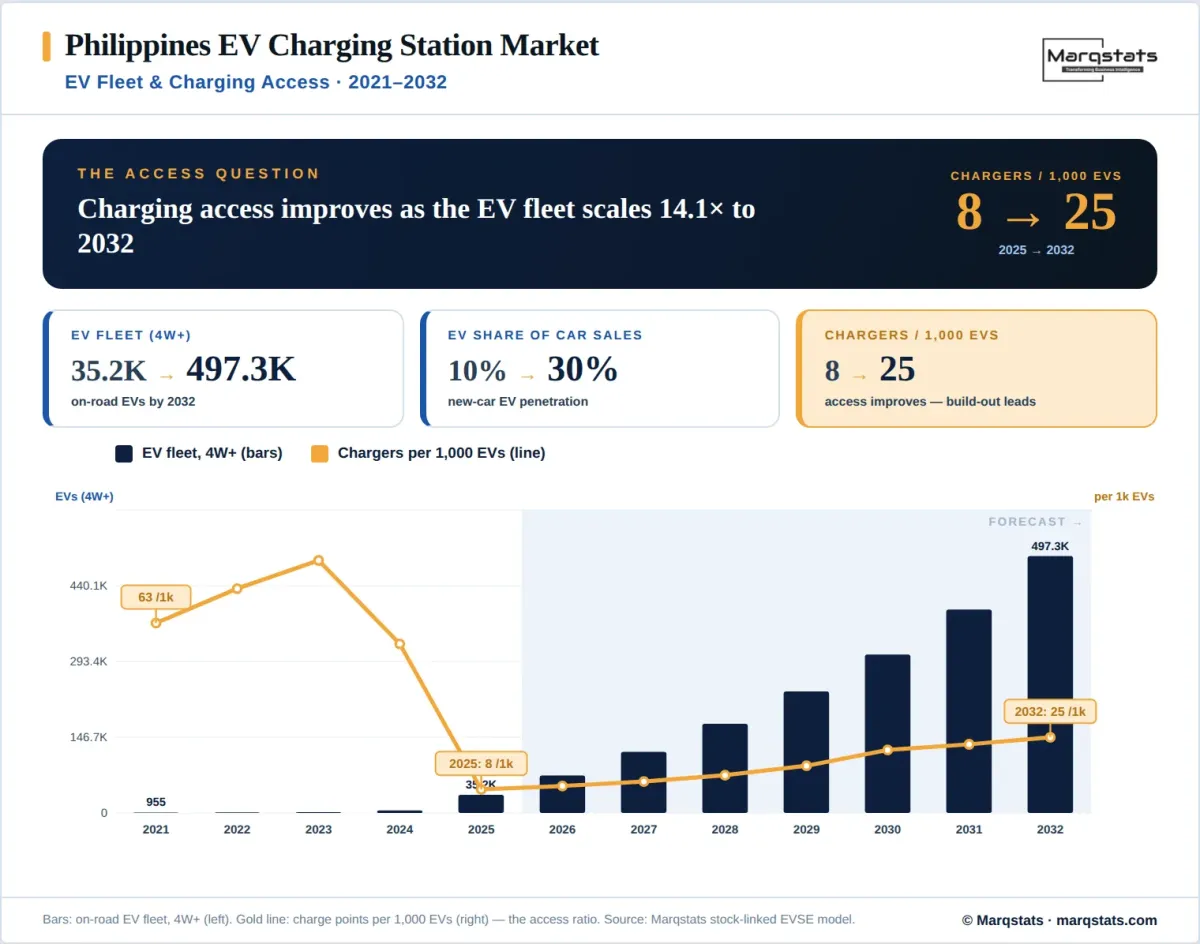
The Philippines EV charging station market sits at the intersection of transport, energy, and industrial policy, and is scaling from an early base across an archipelago of more than seven thousand islands. Electric-vehicle adoption is accelerating from a small share, with the Department of Energy reporting 29,715 electric vehicles registered in the first seven months of 2025 and cumulative registrations passing 60,000 units by early 2026. Rising adoption is expanding the parc that depends on accessible public and home charging. Adoption sits in the middle tier of Southeast Asia, leaving substantial headroom as affordable imported models and zero-tariff policy widen the market.
The vehicle mix is distinctive. Alongside passenger cars, the Philippines carries a large fleet of tricycles and jeepneys tied to public transport, so electrification pairs private-car charging with fleet and depot charging for modernized public-utility vehicles, giving the ecosystem a structure shaped by mass transit.
Charging infrastructure is anchored by legislation. The Electric Vehicle Industry Development Act, Republic Act 11697 of 2022, and the Comprehensive Roadmap for the Electric Vehicle Industry require distribution utilities and private operators to build charging in public areas, mandate that establishments reserve at least five percent of parking for electric vehicles, and require fuel stations to provide commercial charging. Incentives administered through the Board of Investments include income-tax holidays and zero tariffs on imported charging equipment through 2030.
Policy support is broad and increasingly fiscal in character. Executive orders removed import tariffs on completely-built-up electric vehicles and, subsequently, electric motorcycles and buses, while a PHP 60 billion electric-vehicle incentive strategy pivots public support toward electrification. Charging installations connect through distribution utilities, which assess load and connection, and the Department of Energy accredits commercial operators and maintains a public charging-station registry that is updated as the network expands. The charging-infrastructure development plan is being integrated with utility distribution planning to align capacity with demand. Charging businesses qualify for Board of Investments incentives under the strategic investment priority plan, including income-tax holidays of four to seven years, sharply lowering entry cost for new operators.
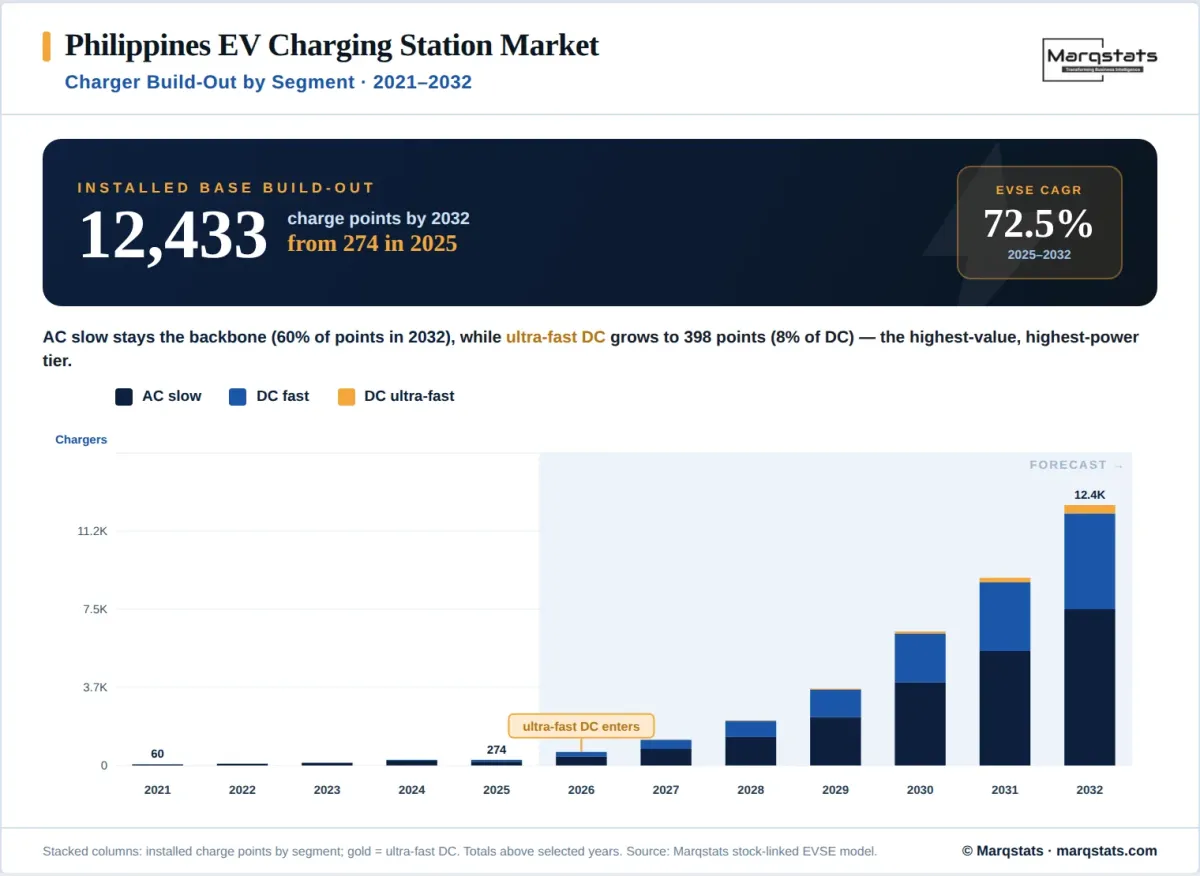
Market value is built from hardware, installation, networking software, and charging-service revenue. The network is alternating-current-led, giving alternating-current charging the larger installed base, while direct-current fast chargers carry higher unit prices and anchor expressway and destination sites. Growth is driven by legislative mandates, private-sector participation, and rising vehicle registrations, even as coverage concentrated in Metro Manila, grid connection for high-power sites, and slower deployment against targets remain points of attention.
Market Dynamics
Key Drivers
Market is driven by the Electric Vehicle Industry Development Act, which mandates charging provisioning in malls, fuel stations, and buildings.
A national roadmap targeting over 7,000 public charging stations by 2028 and a larger electric-vehicle fleet by 2030 sustains demand.
Fiscal incentives, including income-tax holidays and zero tariffs on charging equipment through 2030, lower deployment cost.
A PHP 60 billion electric-vehicle incentive strategy pivots public support toward vehicle and infrastructure electrification.
Private-sector participation from utilities, oil retailers, and mall developers accelerates build-out at high-traffic sites.
Key Restraints
Charging coverage is concentrated in Metro Manila, leaving the Visayas, Mindanao, and provincial areas under-served.
Deployment has run behind roadmap targets, reflecting permitting, grid connection, and site-economics constraints.
Grid connection lead times and load capacity limit high-power direct-current deployment outside major hubs.
Early-stage utilization and the shift to paid charging pressure operator returns at newer sites.
Key Trends
Fuel retailers and mall developers are adding direct-current fast charging at high-traffic sites, mirroring the upgrade cycle across the global EV DC charging station market.
Operators are moving from free to paid charging, funding maintenance and network expansion as the market matures.
Public-transport electrification, including electric jeepneys and tricycles, is creating fleet-charging and depot demand.
Smart charging and load management are being adopted to ease grid stress, alongside early vehicle-to-grid interest.
Market Segmentation
Alternating-current charging holds the largest installed base, accounting for the majority of public charging points and most home installations. Level 2 units drawing 7 kW to 22 kW dominate on cost and suitability for long-dwell locations such as malls, offices, and residences, and the legislated minimum of 22 kW for public alternating-current points sets a common baseline that shapes procurement across establishments. Lower hardware and installation cost favours dense alternating-current deployment across establishments meeting parking-provisioning rules. The mandate reserving at least five percent of parking for electric vehicles channels much of this demand into malls, offices, and residential developments, giving alternating-current charging a policy-backed deployment path.
Direct-current charging commands higher per-unit value and is the fastest-growing segment, owing to premium hardware and faster turnaround at expressway and destination sites. The installed base is migrating toward 60 kW to 180 kW classes, with the legislated minimum of 60 kW for public direct-current points, and higher-power hubs deployed at fuel stations and logistics depots, and depot-scale megawatt-class readiness emerging for electric buses. Faster turnaround makes direct-current charging central to serving drivers without reliable home charging and to enabling inter-city travel. Fuel retailers partnering with charge-point operators are adding fast chargers across dozens of sites nationwide. Section 19 of the governing law requires fuel-station owners to install commercial charging, converting the retail fuel network into a channel for direct-current deployment.
Type 2 serves alternating-current charging across homes, workplaces, and public sites, while CCS2, the Combined Charging System, is the emerging standard for direct-current fast charging. The market retains a mix of standards from varied vehicle imports reflecting the country's diverse sourcing of used and new models, and interoperability is advancing through common apps and open charge-point protocols that let drivers locate and pay across operator networks. A single mobility application has become the de facto tool for locating and paying at the largest public networks.
CHAdeMO and imported GB/T units hold a small share tied to early Japanese and Chinese models, while newer deployments standardize on CCS2 for direct-current charging. The gradual consolidation around Type 2 and CCS2 simplifies hardware procurement and reduces stranded-asset risk for operators building out new sites, and aligns the Philippines with the direct-current standard used across much of the region.
Passenger cars represent the largest vehicle segment by charging-station value, owing to rising imports of battery-electric models supported by zero-tariff policy. Growing volumes broaden charging utilization across public and home settings and anchor the four-wheeler charging network in urban centres. Passenger cars contribute the largest share of charging-station revenue given the higher energy and hardware intensity of four-wheelers, and this share is set to widen as affordable models reach the market.
Electric two-wheelers and three-wheelers, including electric tricycles, form a large vehicle segment by volume, tied to public-transport modernization. These vehicles rely mainly on home and depot charging, and their electrification supports last-mile mobility across dense urban districts. Public-transport modernization is a key channel, converting tricycle and jeepney fleets into anchor demand for depot charging, and swap-and-charge models are being explored for high-frequency operators.
Commercial vehicles and buses, including electric jeepneys and logistics fleets, form a growing segment anchored by public-utility-vehicle modernization and last-mile delivery. Fleet operators concentrate demand at depots, including large multi-port charging hubs serving delivery vehicles. Logistics electrification is an early anchor of high-utilization charging, supporting the economics of larger commercial sites and encouraging depot investment by fleet operators.
Public and commercial charging is the defining application, anchored by the legislated requirement for malls, establishments, and fuel stations to provide charging. Mall developers and fuel retailers host the densest public networks, while expressway sites add en-route capacity that supports inter-city travel across Luzon. A large multi-port charging hub for delivery vehicles illustrates the scale that commercial sites are beginning to reach.
Home charging anchors everyday replenishment for private owners, supported by building provisioning rules for new residential developments, while fleet and depot charging serves logistics operators and public-transport fleets. These applications convert legislative mandates and fleet targets into steady, predictable demand. Building provisioning rules ensure that new developments arrive charging-ready, narrowing the gap between vehicle sales and available charging.
By Geography
Metro Manila (NCR)
Metro Manila, the National Capital Region, holds the largest installed base and market value, owing to the highest vehicle density and the concentration of malls, offices, and corporate fleets across Makati, Taguig, and Quezon City. The region anchors both alternating-current destination charging and the densest cluster of direct-current hubs, with operators reporting dozens of sites across the capital. The concentration of premium and mass-market electric vehicles sustains utilization across both charger classes.
North and Central Luzon
North and Central Luzon expand on expressway corridors and industrial estates, where direct-current fast charging along major toll roads supports inter-city travel. Charging investment tracks logistics corridors and provincial capitals north of the capital region, where industrial estates and long-distance trucking anchor early fast-charging demand.
CALABARZON and Southern Luzon
CALABARZON and southern Luzon grow on industrial and residential expansion adjacent to Metro Manila, owing to manufacturing estates, expressway build-out, and spillover of vehicle ownership from the capital. The region adds destination and fleet charging along the southern expressway network, and benefits from rising residential vehicle ownership as households relocate from the capital.
Visayas
The Visayas, anchored by Cebu, records the fastest regional growth, owing to a rising demand centre in Cebu, municipal support for charger installation at transport terminals and public parking, and expanding operator coverage. Provincial hubs and tourism corridors reinforce charger rollout across the central islands, where rooftop and solar-hybrid installations at terminals and public parking extend access. Local-government support for charger approvals has helped Cebu advance ahead of other provincial markets.
Mindanao
Mindanao, anchored by Davao, remains an earlier-stage region, owing to lower vehicle density and dispersed demand. Targeted deployment around Davao and provincial capitals, supported by distribution utilities and solar-hybrid pilots, is opening early charging access across the south. Closing the coverage gap outside Luzon is central to extending adoption nationwide, where dispersed island geography makes phased, hub-based deployment the practical near-term approach.
How Competition Is Evolving
The Philippines EV charging station market is concentrated among a few well-capitalized groups, several backed by conglomerates and utilities. Meralco, through Movem Electric, powers much of the charging infrastructure and is moving toward operating public charging directly as a charge-point operator. ACMobility, the mobility arm of the Ayala group, runs the most extensive public network through its Evro platform and has set an ambitious target of thousands of charging points through its charging spine, while Pilipinas Shell operates Shell Recharge across fuel stations. Meralco has electrified a share of its own fleet and plans to offer its charging network to the public.
Partnerships are shaping expansion. ACMobility and Pilipinas Shell are installing direct-current fast chargers across dozens of fuel stations spanning Luzon, the Visayas, and Mindanao, while mall developers such as SM Supermalls, Robinsons Land, and Megaworld host charging at high-traffic destinations. Fuel retailers including Petron, Unioil, and Phoenix have entered charging, the latter through a partnership with a regional network operator. Global hardware suppliers, including ABB, Schneider Electric, Delta Electronics, and Siemens, provide the underlying equipment, assembled and installed by local integrators connected to distribution-utility grids.
Competition centres on network coverage, charging speed, location economics, and platform experience. Operators differentiate through mall and fuel-station partnerships, app-based access and payment, and the shift from free to paid charging that funds maintenance and expansion. Standardization on CCS2 and interoperable platforms are shifting the basis of competition toward uptime, coverage, and customer experience across a concentrated field. Scale, grid access, and partnership breadth increasingly determine competitive position as the network expands beyond the capital.
Companies Covered
Companies covered in the report include:
Recent Market Activity
Table of Contents
Coverage & Segmentation
This report provides a comprehensive analysis of the Philippines EV charging station market across the 2021–2025 historical period and the 2026–2030 forecast period, with 2025 as the base year. The study covers alternating-current and direct-current charging hardware, installation, networking software, and charging services across public, commercial, residential, and fleet applications, segmented by charging type, connector type, vehicle type, and application, with coverage of Metro Manila, North and Central Luzon, CALABARZON and southern Luzon, the Visayas, and Mindanao. Market sizing is benchmarked against Department of Energy charging-station data and International Energy Agency charging datasets.
The study examines market size, growth, segment-level value, competitive structure, and the policy and regulatory framework, including the Electric Vehicle Industry Development Act and the Comprehensive Roadmap for the Electric Vehicle Industry administered with the Department of Trade and Industry. Primary research includes 40+ interviews with charge-point operators, hardware manufacturers, fleet operators, utilities, and policy makers.